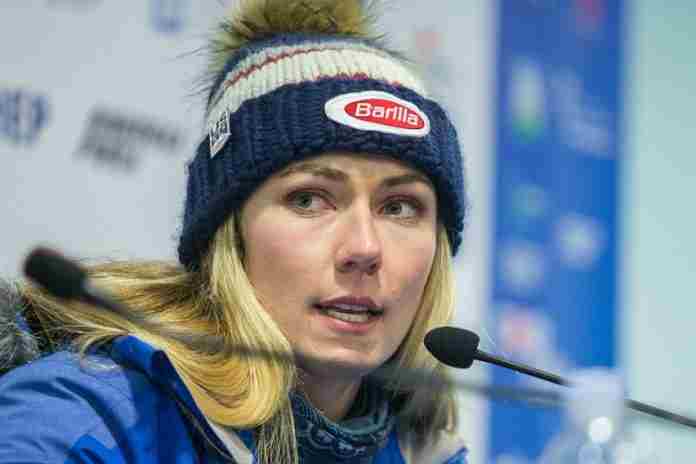
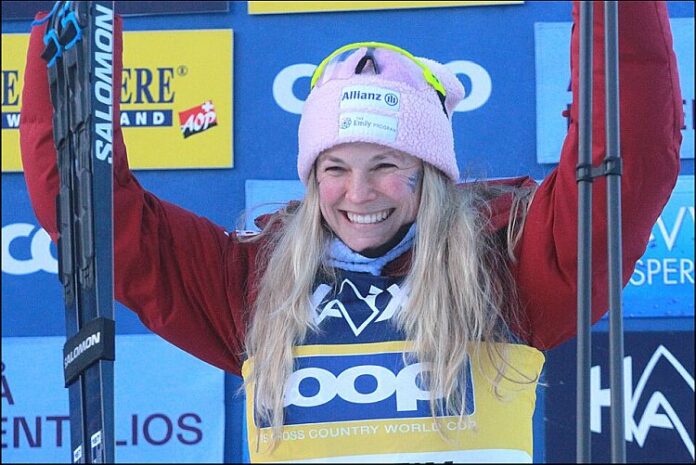
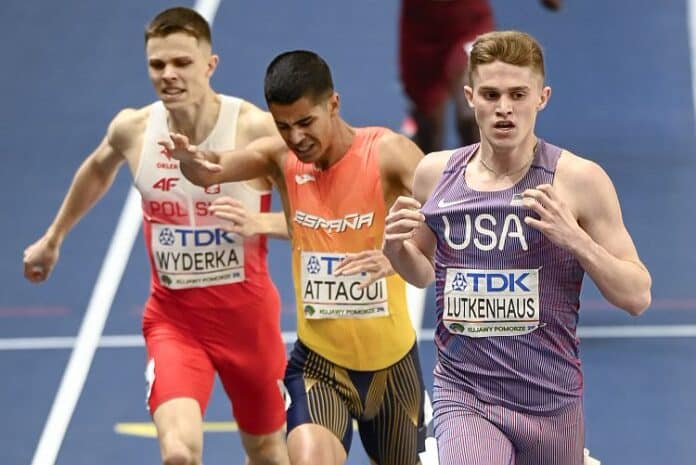
Another big splash for world-record holder Gretchen Walsh of the U.S.! (Photo: University of Virginia).
★ The Sports Examiner: Chronicling the key competitive, economic and political forces shaping elite sport and the Olympic Movement.★
★ To get the daily Sports Examiner Recap by e-mail: sign up here! ★
≡ TYR PRO SWIM WESTMONT ≡
It’s early in the season, but there were world-leading performances for 2026 in 22 events at the Tyr Pro Swim Series that finished Saturday evening in Westmont, Illinois, especially from Americans Gretchen Walsh, Katie Ledeckyand Chris Guiliano, and Canadian teen star Summer McIntosh and Australian distance star Sam Short.
Walsh swam five races and recorded five world-leading marks, including in the women’s 50 m Free, in the heats at 24.51 and then the final at 24.39. She swept her three rounds in the 50 m Butterfly, winning in 55.39 (heats), 55.31 (semis) and then 55.20 in the final, the sixth-fastest time in history.
Ledecky was just as brilliant, defeating McIntosh in the women’s 800 m Free on the first night in 8:08.37 (world lead) to 8:10.45, then winning the 1,500 m Free by more than 41 seconds in 15:40.86, and finally the 400 m Free in 4:00.54, equaling her own world lead from the Tyr Pro Swim Series in Austin in January.
McIntosh lost in the 800 Free, but she won the 200 Free in a world-leading 1:53.80, the 200 m Fly in 2:04.72 (world lead) and the 200 m Medley in a world-leading 2:08.21. Five-time Olympic medalist Kate Douglass won three events, in the 100 m Free (53.45), the 100 Breast (1:06.42 world lead) and 200 Breast (2:22.01 world lead).
Australia’s Short, the 2023 World 400 m champion, also dominated the distances, taking the 400 m Free in 3:43.49 (world leader), the 800 m Free over Tokyo 2020 Olympic champ Bobby Finke of the U.S., 7:40.98 (world lead) to 7:58.35, and the 1,500 m Free in a world-leading 14:52.33 to two-time Olympic champion Finke’s 15:08.27.
In the short men’s races, American Guiliano was supreme, winning the 50 m Free in a world-leading 21.43, as well as getting a world-leading 47.38 in the 100 m heats, then winning the final in 47.84. Guiliano won the 200 m Free in 1:45.53, just ahead of fellow American Gabriel Jett(1:43.54), after swimming a world lead of 1:45.38 in the prelims.
Paris Olympic 400 m Medley medalist Carson Fosterwon the two men’s medleys, both in world-leading times, in 1:57.39 (200 m) and 4:09.49 (400 m). U.S. Sprint star Michael Andrew won the 50 m Breaststroke in 27.00 and the 50 m fly in 23.10. French Olympic hero Leon Marchand was a two-event winner in the 200 m Backstroke in 1:57.56 and the 200 m Breast in 2:10.06.
Jett came back to get his own world lead in the men’s 200 m Butterfly in 1:55.07. Russian Ivan Tarasov won the 50 m Back in a world-leading 24.90, with Andrew second in 25.23. Canada’s Blake Tierney swam a world-leading 53.60 in the 100 m Back.
American star Regan Smith scored two wins as well, taking the women’s 200 m Back in 2:04.90 (world lead) and the 400 m Medley in 4:35.74. Katharine Berkoff, the 2025 World Champion, won the 50 m Back in 27.24, also a world-leading time, ahead of Isabelle Stadden (27.29). Stadden won the 100 m Back in 58.24, and was also second to Smith in the 200 m Back (2:05.91).
Quite a meet for March! The third Tyr Pro Swim is in 20-23 May in Sacramento.

★ Receive our exclusive, weekday TSX Recap by e-mail by clicking here.
★ Sign up a friend to receive the TSX Recap by clicking here.
★ Please consider a donation here to keep this site going.
For our updated, 45-sport, 910-event International Sports Calendar for 2026 and beyond, by date and by sport, click here!

From the opening ceremony of the 2026 Paralympic Winter Games at the Arena di Verona (Photo: OIS-Thien-An Truong).
★ The Sports Examiner: Chronicling the key competitive, economic and political forces shaping elite sport and the Olympic Movement.★
★ To get the daily Sports Examiner Recap by e-mail: sign up here! ★
≡ OPENING CEREMONIES ≡
“When the first Paralympic Games took place in Rome in 1960 thanks to the work of Sir [Ludwig] Guttmann and Dr Antonio Maglio, athletes competed not for applause or headlines, but to prove a simple, powerful truth: that human potential is infinite.”
That introduction by International Paralympic Committee President Andrew Parsons (BRA) was the theme of the colorful opening of the 2026 Winter Paralympic Games at the ancient Arena di Verona, upgraded for much greater accessibility specifically with this moment in mind.
Parsons, noted, however, the reflection of the opening of the 2022 Winter Paralympics, just after Russia had started its invasion of Ukraine:
“Four years ago, I said I was horrified at what was happening in the world. Unfortunately, the situation has not improved.
“In a world where some countries are better known by the names of their leaders, I prefer to know countries by the names of their athletes.
“Sport offers the world, another way forward, another perspective.
“Here at Milano Cortina 2026, these Paralympic Games offer something truly different.
“Here, differences are not reasons for separation, but sources of strength.
“Here, nations gather as neighbors, and athletes compete with ferocity and fairness, united in respect for one another and of the rules of sport.
“The Paralympic Village is a living model of what society can and should be: free from politics, it is a place where everyone is welcome, everyone belongs, and everyone is valued. A barrier-free community where potential is realized and opportunity is open to all.
“And, tonight in this ancient arena – where gladiators once stood – we welcome a new generation of heroes.”
Organizing committee chief Giovanni Malago (ITA) underscored the Italian role in helping to create what is now the Paralympic Movement:
“Italy’s bond with the Paralympic Movement runs deep and is rooted in a defining chapter of our history. Together with Ludwig Guttmann, the father of the Paralympic Movement, it was the Italian physician Antonio Maglio who championed the first Paralympic Games. They were held in Rome alongside the 1960 Olympic Games, marking our nation’s rebirth in the eyes of the world after the devastation of the Second World War.
“All of this reminds us of a fundamental truth about the Paralympic Games: they represent an extraordinary opportunity to transform society – to make a country truly inclusive, and above all to inspire collective reflection on disability and inclusion within the public conscience.
“Yes, the Games are a powerful game changer. And we stand wholeheartedly for that change.”
As he did for the Olympic Winter Games, Italian President Sergio Mattarellaopened the Games.
The parade of the nations was one of the most compact in history. A total of 55 nations were represented, with the flags carried – as approved by the International Paralympic Committee delegations last year – by volunteers and not by athletes. Owing to the spread-out nature of the Games and the competition schedule which got going in earnest on Saturday morning, only 45 athletes from 29 delegations actually marched; the U.S. was represented by alpine skier Laurie Stephens and sled hockey’s Josh Pauls.
The IPC said Czechia, Estonia, Finland, Latvia, Lithuania, Poland and Ukraine did not attend the opening as a political statement.
Russia had its flag in the opening for the first time since the Sochi 2014 Games in view of doping issues and its invasion of Ukraine. It was re-admitted by a vote of the IPC General Assembly last September. More cheers were heard for the Ukrainian entry.
The Paralympic Flame entered the Arena di Verona via six-time Paralympic fencing medal winner Bebe Vio (ITA) and the cauldrons were lit in Milan by 15-time Paralympic medalist Francesca Porcellato (athletics, cycling, cross-country skiing), and by Turin 2006 Paralympic skiing winner Gianmaria Dal Maistroin Cortina.
The show closed with Domenico Modugno’s immortal “Volare” from 1958, perhaps the most celebrated Italian song of all, and as such, an invitation for everyone to enjoy the Winter Games.

★ Receive our exclusive, weekday TSX Recap by e-mail by clicking here.
★ Sign up a friend to receive the TSX Recap by clicking here.
★ Please consider a donation here to keep this site going.
For our updated, 45-sport, 910-event International Sports Calendar for 2026 and beyond, by date and by sport, click here!

★ The Sports Examiner: Chronicling the key competitive, economic and political forces shaping elite sport and the Olympic Movement.★
★ To get the daily Sports Examiner Recap by e-mail: sign up here! ★
≡ “BLATANTLY DISCRIMINATORY” ≡
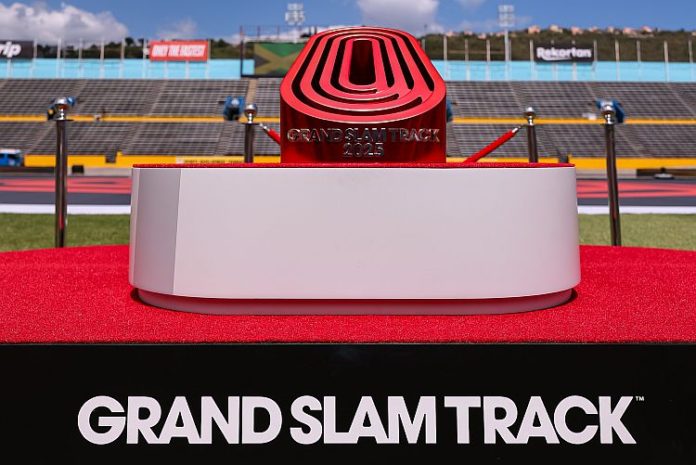
A no-holds-barred reply and objection from the more than 100 unsecured creditors of Grand Slam Track on Friday asked the U.S. Bankruptcy Court in Delaware to throw out a proposed plan to pay athletes about 85% of what they are owed and less than 1.5% to almost everyone else. It started with:
“The Plan (as defined below), as proposed, is not confirmable on its face because it violates the fundamental bedrock tenet of the Bankruptcy Code of treating similarly situated creditors equally and contains a coercive death trap provision if either class of creditors does not approve the Plan.
“In fact, through the Plan, Winners [Alliance], in partnership with Debtor’s senior management, are attempting to preserve their reputations among athletes at the expense of all other creditors. Winners does this by proposing to fund an blatantly discriminatory Plan with no business purpose. For Winners, this is a continuation of its bad faith conduct, commenced long before this case was filed.
“Winners apparent distain [sic] for ordinary trade creditors, who supported this company since its inception, is only rivaled by their contempt for the Bankruptcy Code’s requirement of treating similarly situated creditors equally.
“Rather than articulate a business purpose, outline a coherent vision or demonstrate how the reorganized Debtor would operate, the Plan only serves one purpose: to communicate to the world that Winners wants to take care of athletes, at the expense of everyone else. However, reality reveals a much different story.”
The filing goes on to cast Winners itself as a central actor in the financial failure of the Grand Slam Track project:
● “Winners, while cloaking itself as a white knight savior of the Debtor, is actually one of, if not the, primary reason the Debtor has failed. As will be detailed in a forthcoming draft complaint that the Committee [of Unsecured Creditors] will be seeking standing to pursue, Winners is not an innocent bystander or simple investor in the Debtor.
“Rather, Winners orchestrated the Debtor’s every step from before the Debtor was even incorporated. The Committee’s investigation to date into the Debtor has identified shocking levels of incompetence, bad faith, self-dealing and failures to fulfill its fiduciary duty by the Debtor’s management and Winners as well as a failure to provide the committed financing promised to the Debtor and communicated to the broader trade community.”
● “The proposed Plan is the final step for Winners to make the athletes close to whole while trying to bury all of the bad conduct under the rug. To add insult to injury, the Debtor attempts to blame its failures at the feet of the innocent trade creditors who supported the business throughout and have not been paid.
“For their troubles, Winners and the Debtor offered trade creditors with an estimate $13 million in claims a projected 1.50% distribution from a pool of $200,000, a small fraction of what the Debtor has allocated to the Debtor’s professionals in this case, and an even smaller fraction of what has been paid to the athletes prior to the case or the approximately $6 million offered to the athletes in the Plan.”
● “At the end of the day, the Plan is nothing more than a disguised Bankruptcy Rule 9019 settlement among insiders where the settlement proceeds are earmarked for a select group of favored creditors.”
The filing notes its future action against Winners, asking the Court to dismiss any plan to settle the Grand Slam Track debts in the meantime:
“[I]t is important to understand that the Debtor has been under the control of Winners from before the Debtor was even formed. As will be detailed in the Committee’s forthcoming motion seeking standing to prosecute estate causes of action, Winners has unabashedly repeatedly directed the Debtor to ignore the valid claims of its trade vendors and prefer the athletes while at the same time failing to live up to its financing commitments.
“The Committee anticipates actively litigating significant and valuable claims against Winners, the Debtor’s Board, including its former directors, and Mr. [Michael] Johnson. Meanwhile, the Plan contemplates burying these valuable claims and causes of action by simply re-vesting the claims in the Reorganized Debtor, which will remain under Winners thumb after its debts have been discharged.”
The filing runs through a series of legal objections to the plan as offered, primarily on its unequal treatment of creditors and states:
“In the absence of a viable business plan, the Plan is simply a mechanism for Winners to ensure that their preferred athletes and vendors receive a near total recovery while shielding any estate claims from being prosecuted against them. This is the epitome of bad faith.”
The next scheduled hearing is on 12 March, for the court to consider the proposed reorganization plan, with the unsecured creditors asking for the plan to be thrown out now and a new, fairer plan to be created.

★ Receive our exclusive, weekday TSX Recap by e-mail by clicking here.
★ Sign up a friend to receive the TSX Recap by clicking here.
★ Please consider a donation here to keep this site going.
For our updated, 45-sport, 910-event International Sports Calendar for 2026 and beyond, by date and by sport, click here!
Former L.A. City Council member Zev Yaroslavsky at the 6 March 2026 hearing of the State Assembly committee on the 2028 Games (California State Assembly video screen shot).
★ The Sports Examiner: Chronicling the key competitive, economic and political forces shaping elite sport and the Olympic Movement.★
★ To get the daily Sports Examiner Recap by e-mail: sign up here! ★
≡ ROLE OF THE BANKER ≡
A scheduled two-hour inaugural hearing of the California State Assembly Select Committee on the 2028 Olympic and Paralympic Games held Friday (6th) at the LA84 Foundation campus in Los Angeles ran long, thanks to many questions from 10 Assembly members and State Senators present.
Chaired by Assembly member Tina McKinnor (D-61st District), the focus was on the “Lessons and Legacy Impacts of the 1984 Los Angeles Olympic Games,” and a summary of the history of the bid, planning and staging of that Games, which changed the Olympic Movement was offered, along with a detailed explanation of the legacy of the Games.
In specific, the LA84 Foundation, created with $93 million of the financial surplus left by the Los Angeles Olympic Organizing Committee, continues work throughout the Southern California area, with more than $230 million distributed to more than $2,500 grantees over more than 40 years, with assets at the end of 2024 at $186.01 million.
LA84 Foundation President Renata Simrilexplained:
“Legacy for us is ultimately measured by how we positively impact the lives of young people. … So, yes, 1984 was a moment, but LA84 was what happened when a city decided that movement should be a mission. We were proof that you can celebrate a global moment and also build something that lasts after the world goes home.
“And that brings me to a simple idea: the Olympic Games weren’t just a successful event. It was a civic decision, a decision that proved Los Angeles could do something big and then to make sure that something good lasted after the Games went home. … The LA84 Foundation is just one expression of the many legacies that were left in the City of Los Angeles.”
Former Los Angeles City Council member Zev Yaroslavsky, later a longtime Los Angeles County Supervisor, spoke about the development of the Los Angles bid for the Games and the difficult in-city politics that ended with a City Charter amendment winning overwhelming voter approval to prohibit any City financing of the Games.
Yaroslavsky also spoke passionately about the impact the Games had on him, as he began running regularly after seeing American Joan Benoit’s spectacular victory in the first Olympic women’s marathon, and how the Olympic Arts Festival led to the founding of the Los Angeles Opera.
Known throughout his career as a budget hawk, Yaroslavsky also turned his attention to the Committee’s primary focus, the 2028 Olympic and Paralympic Games and the government guarantees against any deficits of the LA28 organizers. The City of Los Angeles is responsible for the first $270 million, then the State of California for the next $270 million and then back to the City for any more. Yaroslavsky’s warning was about vigilance:
“You’re the banker. The City of Los Angeles is the main banker, and – I’m not in the City [government]; I’m certainly not in the State – I don’t know what the City knows about the revenues are.
“We can sit here and say, ‘well, they [LA28] got a billion-two from Delta Airlines and this and that and that,’ but nobody knows for sure and … I don’t believe that anybody in the City knows exactly what the books are.
“Now, we didn’t know what the books were in 1984, but we didn’t need to know because we were protected, and that [LAOOC President Peter] Ueberroth would have to make it work, because he knew he couldn’t go to the City and say, ‘I’m broke.’ We can’t do anything for you, Peter, because we are precluded by the City Charter from doing that. And so he used that leverage with all of his sponsors …
“You guys, the State of California, whoever is responsible for this, whether it’s the Legislature of the Governor’s Office, or both, and the Mayor and the City Council need to know – and you should not jeopardize the confidentiality of bids and stuff like that – but somebody in the City has got to know where they stand.
“Otherwise, come July of 2028, there’s going to be a big bill put on the City’s desk, and probably on yours.”
The Assembly committee will have its second hearing in Sacramento on 6 April, combined with the Arts, Entertainment, Sports and Tourism committee, with the LA28 organizers expected to be in attendance.

★ Receive our exclusive, weekday TSX Recap by e-mail by clicking here.
★ Sign up a friend to receive the TSX Recap by clicking here.
★ Please consider a donation here to keep this site going.
For our updated, 45-sport, 910-event International Sports Calendar for 2026 and beyond, by date and by sport, click here!

★ The Sports Examiner: Chronicling the key competitive, economic and political forces shaping elite sport and the Olympic Movement.★
★ To get the daily Sports Examiner Recap by e-mail: sign up here! ★
≡ ASSEMBLY HEARING ≡
On Friday (6th), I testified at the first hearing of the California State Assembly’s Select Committee on the 2028 Olympic and Paralympic Games, titled “Lessons and Legacy Impacts of the 1984 Los Angeles Olympic Games.”
Here is my prepared statement, giving a (very) short overview of the history and innovations of the Los Angeles Olympic Organizing Committee, which created and staged the Games of the XXIIIrd Olympiad:
I am Rich Perelman and in 1984 I was the Vice President in charge of Press Operations for the 1984 Olympic Games and then Editor-in-Chief of the Official Report of the Games. It’s a pleasure to offer a very, very short summary of the Games that changed the future of the Olympic Movement.
After the murder of 11 Israeli athletes and officials at the 1972 Munich Games and a C$1 billion deficit at the 1976 Montreal Games, there was just one bid for the 1984 Games, in 1977. That was from Los Angeles, trying for the 10th time to bring the Games back after the success of the 1932 Olympic Games.
This unprecedented leverage allowed the volunteer Southern California Committee for the Olympic Games, in close cooperation with Mayor Tom Bradley, to force the International Olympic Committee to agree that the City of Los Angeles would have no financial liability for the Games, which would be organized strictly with private financing.
From the start, the Los Angeles idea for the 1984 Games was different, not only financially, but using existing or temporary sites for 18 of the 21 sports. Olympic Villages would use student housing at UCLA and USC.
With no other option, the IOC agreed in May 1978 to award the 1984 Games to Los Angeles. On March 26, 1979, travel industry entrepreneur Peter Ueberroth, was elected by a single vote as the President of the Los Angeles Olympic Organizing Committee. The LAOOC started out about $300,000 in debt from the bid.
Less than three weeks later, the LAOOC had $2.5 million in the bank thanks to a new television rights sales approach from bid committee member and noted television producer David Wolper. Within six months, Ueberroth signed the largest television deal in Olympic history: $225 million with ABC for U.S. rights and host broadcast services.
These were only the start of many more innovations:
● Ueberroth and marketing chief Joel Rubenstein revamped corporate opportunities around category exclusivity for the first time. Where Moscow 1980 received $5 million from 325 sponsors and suppliers, the LAOOC received $126.7 million from just 99. The “less is more” concept revolutionized the sports and event marketing world and continues to this day.
● Sports venues were almost all existing: the 23 sports at the 1984 Games — including two demonstration sports – took place at 27 sites, 24 of which were extant or temporary. The LAOOC built three venues: a cycling velodrome at Cal State Dominguez Hills, now the site of the Dignity Health Sports Park; a swimming and diving site at USC, still in use today, and a shooting range in Chino, also still in use today.
● The visual “Look of the Games” was reimagined in 1982, to incorporate bright, vibrant colors and use inexpensive materials such as construction scaffolding. Developed under the direction of Executive Vice President and General Manager Harry Usher, “Festive Federalism” unforgettably used three million square feet of colored nylon, 21,046 street banners and 35 miles of fence fabric to decorate the Games and the area.
● The organizing committee staff grew from 11 at the end of 1979 to 1,750 by June 1, 1984. But the revolution was using volunteers as the primary workforce, a concept met with disbelief by the IOC.
Some 33,500 volunteers helped the 1984 Games run superbly, and the use of volunteers has now become the norm for sporting events of all sizes and types.
● The LAOOC also ignored old ideas for arts and youth. The usual Games-time art program was expanded into a 10-week “Olympic Arts Festival” of 432 performances and 31 exhibitions attended by 1.26 million people. The usual, two-week “youth camp” for 300 was replaced by a four-year sports and educational program that touched 1.25 million youngsters from 1981-84.
● A never-before-tried national Olympic Torch Relay, beginning on May 8, 1984 and running 9,375 miles across the U.S. for 82 days, raised more than $10.95 million for three youth-sport organizations.
The LAOOC championed the addition of 11 new women’s events, including the marathon, sold a record 5.72 million tickets and staged a safe, secure and wildly-popular Games that revitalized the Olympic Movement.
It also made money. The original budget forecast $368 million in revenue and a $21 million surplus. In the end, there was $768.6 million in revenue and a surplus of $232.5 million, of which 40% went to the U.S. Olympic Committee, 20% to the National Governing Bodies and 40% to found the LA84 Foundation, where we are today.
I will be happy to answer any questions you may have.
The actual delivery was slightly spiced up with some asides, but the facts and statistics are here for the record. It was a pleasure to offer up a summary of what actually happened in an event which changed the trajectory of the Olympic Movement, sports marketing and a lot more.
Rich Perelman Editor
★ Receive our exclusive, weekday TSX Recap by e-mail by clicking here.
★ Sign up a friend to receive the TSX Recap by clicking here.
★ Please consider a donation here to keep this site going.
For our updated, 45-sport, 910-event International Sports Calendar for 2026 and beyond, by date and by sport, click here!

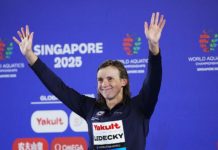
The greatest women’s swimmer ever: American Freestyle superstar Katie Ledecky (Photo: World Aquatics/Aniko Kovacs).
★ The Sports Examiner: Chronicling the key competitive, economic and political forces shaping elite sport and the Olympic Movement.★
★ To get the daily Sports Examiner Recap by e-mail: sign up here! ★
≡ THE 5-RING CIRCUS ≡
● Winter Paralympic Games 2026: Milan Cortina ● Two curling stones were stolen from the Cortina arena, but were being replaced. World Curling stated to The Associated Press:
“The spare stones from the set are now being used and have been brought to the same specifications as the rest of the set so there has been no impact on the competition.”
Police are investigating the thefts.
● Athletics ● The New York Road Runners said that the 2026 NYC Marathon received a record “240,000+ applicants from more than 160 countries – a near-20 percent increase from 2025.”
Only about 1% of the applicants will be selected to run; other options to join the race are through charity partners or through a series of other, small entry programs. The 2025 race once again set a record as the largest marathon ever with 59,226 finishers.
● Baseball ●The World Baseball Classic opened in Tokyo (JPN), with wins for South Korea, by 11-4 over the Czech Republic, and Australia, a 3-0 winner over Taiwan.
The Aussies got home runs from Robbie Perkins in the fifth and Travis Bazzana in the seventh to generate all three runs, while the Koreans got two home runs from Shay Whitcomb and homers from Bo-gyeong Moon – a grand slam in the first – and Jahmai Jones.
Defending champion Japan opens on Friday in Tokyo against Taiwan.
● Basketball ●FIBA announced a deal through 2029 for U.S. cable-caster TNT Sports to show the FIBA women’s World Cup in Germany in September 2026 and the FIBA men’s World Cup in 2027, being held in Qatar.
Games will be shown on TNT, TBS and truTV, with added events on the HBO Max streaming service. The first event to be shown is the FIBA women’s World Cup qualifying tournament in San Juan (PUR) from 11-17 March.
● Cricket ● Defending champion India faced off with prior winner England in a tight semifinal of the ICC men’s T-20 World Cup in Mumbai and the hosts came out on top, 253/7 (20) to 246/7 (20) and will play for a second straight title against New Zealand on Sunday (8th).
India won in 2007 and in 2024; New Zealand has been on one final, in 2021, and lost to Australia.
● Football ●FIFA was reported to release 800 of its 2,000 hotel rooms reserved in Mexico City (40%), citing no need for so many people for operations.
Alberto Albarran Leyva, the Executive Director of the Mexico City Hotel Association said that the current occupancy target for the opening of the tournament in Mexico City on 11 June is 85%.
● Swimming ●American Olympic relay gold medalist Chris Guiliano started off the Wednesday prelims of the Tyr Pro Swim Series in Westmont, Illinois with a sensational, world-leading 47.38 in the men’s 100 m Freestyle. And that signaled a meet with significant swims ahead on day one:
● Katie Ledecky won the women’s 800 m Freestyle in another duel with Canadian superstar Summer McIntosh, 8:08.57 to 8:10.45. Ledecky pulled away in the second half of the race and produced the no. 13 time in history; she has 14 of the top 17. It’s McIntosh’s fourth-fastest time ever.
● Six-time Worlds gold medalist Regan Smithwon the women’s 200 m Back in a speedy 2:04.90, fastest in the world in 2026, chased by Isabelle Stadden in 2:05.91, a lifetime best and no. 13 all-time (no. 7 all-time U.S.).
● Olympic champ Kate Douglass of the U.S. won the 200 m Breaststroke in a world-leading 2:22.01, winning by more than six seconds.
● French Olympic hero Leon Marchand won the men’s 200 m Back in 1:57.56, well ahead of Blake Tierney (CAN: 1:58.61), and took the 200 m Breast in 2:10.06 later in the same session!
● American Michael Andrew won the men’s 50 m Fly in 23.10, no. 3 in the world for 2026 and his fastest since 2024.

There were technical issues on the first night as well, with SwimSwam.com editor-in-chief Braden Keith scolding USA Swimming:
“[I]n spite of being a really good session by Pro Swim standards, anybody who wasn’t able to attend the meet wasn’t able to follow the meet in anything resembling real time. That means last night’s live recap conversation was almost entirely around the technical failures.
“The live stream didn’t work. It never does when it’s in the USA Swimming app.
“The live results didn’t work. The current systems seem to become somehow less reliable by the year.
“Even USA Swimming’s data hub didn’t work, which probably only we noticed, but was just the cherry on top of a mess of a night for America’s ‘professional’ swimming series. …
“So we’re left with a meet in an out-of-the-way place that makes it hard to attend in person, with an out-of-the-way app that makes it hard to stream, that didn’t work, and no results, for a professional swim meet where prize money is being awarded. China for darn sure isn’t going to have these issues when they pay the world’s best swimmers more money to go race there in a few months.
“I guess it could be worse. USA Track & Field recently didn’t even attempt to live stream a national championship event (the combined events championship), missed streaming women’s shotput, and they charge $100 per year for access to their streaming platform (albeit with a lot more events).”
● Volleyball ● The International Volleyball Federation (FIVB), following the path of the International Basketball Federation (FIBA) has renamed its men’s and women’s “World Championship” as the “World Cup,” to fall in line with the ultra-popular FIFA World Cup for men and women.
This will first apply to the FIVB men’s 2027 “World Cup” in Poland and the women’s “World Cup” in the U.S. and Canada.
FIBA changed the name of its championship in advance of the 2014 men’s tournament after the “FIBA World Championship” was held from 1950 to 2010. The 2014 women’s tournament was still called the “FIBA World Championship,” but this was changed to “World Cup” for the 2018 tournament.

★ Receive our exclusive, weekday TSX Recap by e-mail by clicking here.
★ Sign up a friend to receive the TSX Recap by clicking here.
★ Please consider a donation here to keep this site going.
For our updated, 45-sport, 910-event International Sports Calendar for 2026 and beyond, by date and by sport, click here!

The “Fair Play” moment of the Milan Cortina Winter Games, as American Ilia Malinin congratulates Mikhail Shaidorov (KAZ) on winning the men’s Olympic figure skating gold (TSX photo by Karen Rosen).
★ The Sports Examiner: Chronicling the key competitive, economic and political forces shaping elite sport and the Olympic Movement.★
★ To get the daily Sports Examiner Recap by e-mail: sign up here! ★
≡ MILAN CORTINA WINTER GAMES ≡
American figure skater Ilia Malinin lost what looked like a sure gold medal in the Olympic men’s Singles Free Skate due to an error-filled program that dropped him all the way to eighth place overall.
But his warm embrace of a shocked Olympic champion – Georgia’s Mikhail Shaidorov– following the announcement of the scores won him the International Fair Play Award for the Milan Cortina Games.
Malinin, 21, won over five other candidates, with the fan voting total surpassing that for the Paris 2024 Olympic Games.
The 2026 award is especially important as it comes 62 years after the very first Fair Play Award, given to Italian bobsled legend Eugenio Monti. During the 1964 Innsbruck Winter Games, he aided his direct rivals, the British Two-Man team with a replacement bolt that ultimately helped them win the Olympic gold, while Monti’s team ended up with the bronze.
Said Malinin:
“I am deeply humbled to receive this honour, especially given the incredible legacy of Eugenio Monti here in Italy. Congratulating Mikhail wasn’t about the results; it was about the shared journey we take as athletes. Knowing that fans worldwide connected with that moment means more to me than any medal.”
The men’s Free Skate was one of the great shockers of the Games. Shaidorov stood fifth after the Short Program at 92.94, more than 15 points behind Milanin, the leader at 108.16. In fact, Shaidorov was more than nine points out of the bronze-medal position.
Starting fifth from last, Shaidorov energized the crowd and claimed a lifetime best of 198.64 and shot into the lead with his all-time best score of 291.58. And then each of the remaining skaters had trouble. Finally, Malinin fell twice during his scaled-down routine and ranked only 15th in the Free Skate at 156.33 and missed the podium entirely at 264.49, in eighth place.
But rather than mope, he embraced the stunned Shaidorov, who was suddenly the Olympic champion.
International Committee for Fair Play President Sunil Sabharwal (USA) observed:
“The Milano Cortina 2026 Games have proved that the spirit of Eugenio Monti is more alive today than ever before. To see our global ‘fair play community’ engage in such record-breaking numbers – surpassing even the heights of Paris – shows that sportsmanship is a positive force to reckon with. Ilia’s gesture was the embodiment of ‘victory beyond the medal’, and we are honored to recognize him in the very mountains where this movement began over 60 years ago.”

★ Receive our exclusive, weekday TSX Recap by e-mail by clicking here.
★ Sign up a friend to receive the TSX Recap by clicking here.
★ Please consider a donation here to keep this site going.
For our updated, 45-sport, 910-event International Sports Calendar for 2026 and beyond, by date and by sport, click here!
★ The Sports Examiner: Chronicling the key competitive, economic and political forces shaping elite sport and the Olympic Movement.★
★ To get the daily Sports Examiner Recap by e-mail: sign up here! ★
≡ IPC NEWS CONFERENCE ≡
International Paralympic Committee President Andrew Parsons(BRA) thought that the vote at the IPC General Assembly last September had ended questions about the re-admission of Russia and Belarus.
But it didn’t and he told reporters at a Thursday news conference in Milan, “yes, we were surprised to see that it has exploded again.”
IPC Chief Brand and Communications Officer Craig Spence (GBR) explained that for the Friday opening in Verona:
“Let me be very clear on the NPCs [National Paralympic Committees] who are not coming for political reasons. We have Czechia, Estonia, Finland, Latvia, Lithuania, Poland, and Ukraine.
“At the moment, the IPC is aware of seven National Paralympic Committees that are not coming for political reasons. We respect that decision.”
He also noted:
“Canada, Great Britain, Germany, France: they’re not boycotting the ceremony. They told us that they are not coming for performance reasons.”
Spence said that some of the selected flagbearers could not attend the ceremony since they had competitions beginning at 9:30 the following morning. So, during the opening, all of the actual flagbearers will be volunteers.
As for the Ukrainian “map” uniforms that were rejected:
“We have uniform guidelines for each Paralympic Games.
“Those uniform guidelines say that things like lyrics, slogans, mottos from your country are prohibited, and that includes maps.
“This piece of uniform in particular from Ukraine was presented to us in the middle of January.
“We went back and said, ‘I’m sorry, but this is in breach of the rules’. If any of the National Paralympic Committees had come to us with a piece of kit that featured within it a map of their borders, their country, we had the same answer. It was ‘No, can you change it?’.
“We had some great dialogue with NPC Ukraine. They said ‘Thank you for the feedback’. Within 24 hours, they provided us with an alternative design, and we approved it within 30 minutes. So, for us, that was cleared up three months ago.”
Parsons emphasized that even with the Russia-Ukraine war ongoing and the new conflicts in the Middle East, the purpose of the Paralympic Games means it need to go on:
“These Games are about sport, but not only sport. These Games are about inclusion, about 1.3 billion persons with disability out there.
“Sport is what we’re trying to protect here in these Games. Sport is our main focus here. It’s about the more than 600 athletes in six sports of a record number of nations. This will remain our focus. This and the message of it.”
Parsons said that the 612 qualifers for the 2026 Winter Games, from 56 national committees is a record, and that National Paralympic Committee athletes from El Salvador, Haiti, Montenegro, North Macedonia, and Portugal will make their Winter Paralympic debut.
The Winter Paralympic opening will be shown on USA Network and NBC’s Peacock streaming service beginning at 1:30 p.m. Eastern time on Friday.

★ Receive our exclusive, weekday TSX Recap by e-mail by clicking here.
★ Sign up a friend to receive the TSX Recap by clicking here.
★ Please consider a donation here to keep this site going.
For our updated, 45-sport, 910-event International Sports Calendar for 2026 and beyond, by date and by sport, click here!
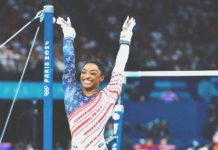
U.S. Paralympic and World Championships Alpine medalist Andrew Kurka (Photo: Joe Kusumoto).
★ The Sports Examiner is delighted to present this important contribution from our patron, the United States Olympic & Paralympic Committee, with a focus on American Paralympic stars. Opinions expressed are those of the USOPC. ★
Stephens and Kurka have combined to win nine medals in seven Paralympic appearances.
By Bob Reinert Red Line Editorial
After bringing home one medal four years ago from Beijing, the U.S. Paralympic Alpine Ski Team will look to the experience and leadership of sit skiers Laurie Stephens and Andrew Kurka at the Paralympic Winter Games Milano Cortina 2026, which take place 6-15 March.
Stephens, who turns 42 a day before the Paralympics gets underway, returns for her sixth Games. The Wenham, Massachusetts, native, is a seven-time Paralympic medalist who has regularly won world championships and world cups over the years. She made her Paralympic debut at Torino in 2006, skiing to gold medals in the women’s Downhill and Super-G and a silver medal in the Giant Slalom.
Now in his 17th year on the national team, Kurka will be competing in his fourth Paralympics. The 34-year-old from Plamer, Alaska, owns two Paralympic medals and six world championships medals.
Kurka may have more Paralympic medals if it weren’t for some untimely injuries. In 2014, he qualified for the Sochi Games but didn’t compete after he broke his back in a training crash. Eight year later in Beijing, Kurka broke his arm, thumb and nose in a practice run but still finished in fourth in the men’s downhill. After that event, he pulled out of the Games.
With 23 athletes and one guide, the alpine ski team is the largest U.S. sport delegation for these Games. Those skiers hail from 13 different states, with five of them coming from Colorado, the only state with more than two athletes represented on the U.S. team.
While Kurka and Stephens are the only members of the team who have won a Paralympic medal, they are two of 10 athletes who have prior experience at the Games.
The only athlete that comes close to Stephens in terms of Paralympic experience is Jasmin Bambur. Now 46, Bambur made his Paralympic debut in 2010 for Serbia, becoming the country’s first Paralympian. After gaining U.S. citizenship in 2010, he eventually began competing for Team USA. The Granby, Colorado, resident is set to compete in his fourth Games for the U.S. and fifth overall.
Among the 13 Paralympic debutants on the U.S. alpine team, Audrey Crowley comes in with possibly the best chance to come home with a medal. The Eagle, Colorado, native – who just turned 19 on 1 March – won a bronze medal in the women’s Standing Giant Slalom at the 2025 World Championships, earning the only medal for the U.S. at the competition.
Like Crowley, Kelsey O’Driscollcompetes as a standing skier and is another promising newcomer for Team USA. The 32-year-old from Caldwell, New Jersey, made her debut on the World Cup circuit in December 2025 in Steinach am Brenner, Austria. In only her third event, O’Driscoll won the women’s standing Super-G.
The U.S. will have plenty of competition for medals from the rest of the world at the Paralympics. Austria, China and Norway should be right in the middle of the podium chase. China led the way with 19 alpine ski medals on home soil four years ago, followed by Austria with 12, and France, Japan, Slovakia, Italy, Germany and Canada with six apiece.
The Tofane Alpine Skiing Centre will serve as the site for alpine events, which is where the Olympic women’s alpine races took place. The world-renowned venue hosted events during the 1956 Winter Olympics and is a regular stop on the World Cup circuit.
Para alpine skiing includes events for sitting, standing and visually impaired athletes. The skiers will compete in Downhill, Giant Slalom, Slalom, Super-G and super combined for a total of 30 medal events at the Games.
The first alpine medals will be handed out in Downhill on 7 March. The Super-G finals will take place on 9 March, followed by women’s Giant Slalom on 12 March, men’s Giant Slalom on 13 March, women’s Slalom on 14 March and men’s Slalom on 15 March.
NBC’s Peacock will stream every event live, while CNBC and USA will provide live coverage throughout the Games as well.
Bob Reinert spent 17 years writing sports for The Boston Globe. He also served as a sports information director at Saint Anselm College and Phillips Exeter Academy. He is a contributor to TeamUSA.com on behalf of Red Line Editorial, Inc.
★ The Sports Examiner: Chronicling the key competitive, economic and political forces shaping elite sport and the Olympic Movement.★
You can receive our exclusive TSX Report by e-mail by clicking here. You can also refer a friend by clicking here, and can donate here to keep this site going.
For our updated, 45-sport, 910-event International Sports Calendar for 2026 and beyond, by date and by sport, click here!

★ The Sports Examiner: Chronicling the key competitive, economic and political forces shaping elite sport and the Olympic Movement.★
★ To get the daily Sports Examiner Recap by e-mail: sign up here! ★
≡ THE 5-RING CIRCUS ≡
● Olympic Games 2028: Los Angeles ● The Los Angeles City Council has calendered Friday consideration of a resolution by member Monica Rodriguez from 11 February which includes:
“NOW, THEREFORE, BE IT RESOLVED, that the Los Angeles City Council reaffirms its commitment to the core values of the Olympic movement, including excellence, respect, integrity, accountability and transparency in leadership as the 2028 Olympic and Paralympic Games belong to the people of Los Angeles; and
“BE IT FURTHER RESOLVED, that the City Council expresses concern regarding the potential conflict between the Olympic movement’s values and Casey Wasserman‘s association with the Epstein files, and calls for a thorough and transparent review of his involvement in the ongoing investigations into these matters; and
“BE IT FURTHER RESOLVED, that the City Council urges the LA 28 Organizing Committee, and the International Olympic Committee, to ensure that all leadership roles are held by individuals who consistently reflect the Olympic movement’s commitment to integrity, accountability, and respect for all people; and
“BE IT FURTHER RESOLVED, that the City Council pledges to work collaboratively with community leaders, sports organizations, and stakeholders to ensure that the 2028 Games in Los Angeles serve as a global model of fairness, justice, and honor;
“BE IT FURTHER RESOLVED, that this Resolution be distributed to the LA28 Organizing Committee, the International Olympic Committee, and all relevant parties involved in the 2028 Olympic and Paralympic Games.”
The resolution is non-binding and two Council committees passed on discussing it and sent it to the City Council for direct review.
● Paralympic Winter Games 2026: Milan Cortina ●The U.S. Olympic & Paralympic Committee announced the selection of four-time Paralympic gold medalist Josh Pauls(sled hockey) and seven-time Paralympic medalist Laurie Stephens (alpine skiing) as flag bearers for Friday’s opening of the Milan Cortina 2026 Paralympic Winter Games in Verona.
They were selected through a process led by the Team USA Athletes’ Commission. The opening of the Paralympic Games will be shown live on Friday on USA Network beginning at 1:30 p.m. Eastern time.
The Paralympics actually started on Wednesday; the U.S. won its Mixed Doubles opening in curling with an 11-6 win over Latvia.
● Baseball ● The best baseball you will see until October starts on Thursday in Japan as the 2026 – sixth – edition of the World Baseball Classic begins.
First held in 2006, this is the premiere national-teams tournament in the world and features 20 teams for the second time in a row, playing in four groups:
Group A: San Juan, Puerto Rico ● Canada ● Colombia ● Cuba ● Panama ● Puerto Rico
Group B: Houston, Texas ● Brazil ● Great Britain ● Italy ● Mexico ● United States
Group C: Tokyo, Japan ● Australia ● Chinese Taipei ● Czech Republic ● Japan ~ defending champion ● South Korea
Group D: Miami, Florida ● Dominican Republic ● Israel ● Netherlands ● Nicaragua ● Venezuela
Pool play continues through the 11th, with the quarterfinals on 13-14 March, the semis and finals in Miami on 15-16-17 March.
FOX has coverage of the tournament in the U.S., with most of the games to be shown on FOX, FS1 or FS2.
Japan won the 2023 WBC final with a dramatic final showdown between then-Angels teammates Shohei Ohtanifor Japan and Mike Troutfor the U.S., with Ohtani striking Trout out on a 3-2 slider for the 3-2 and the WBC title. Ohtani was named Most Valuable Player and will be back again for the Japanese team.
● Cricket ● At the ICC men’s T20 World Cup, New Zealand won the first semifinal, defeating South Africa, 173/1 (20 overs) to 169/8 (12.5), in Kolkata (IND).
Defending champion India faces 2023 winner England on Thursday in the second semi in Mumbai. Cricket T20 will be featured as a medal sport at the 2028 Olympic Games in Los Angeles.
● Football ●The town of Foxborough, Massachusetts has demanded $7.8 million in security funding from the Boston 2026 World Cup host committee, or it will not approve the use of Gillette Stadium for the matches.
The deadline for the issuance of the license is 17 March and at a Tuesday evening meeting, host committee officials said invoices for reimbursement of all security amounts would be made within two days on presentation of an invoice. Town officials want payment guarantees and do not want to spend any of their own funds.
The host committee committed to the funding required and said that it has backing from the Kraft Group, owner of the stadium, as a guarantor.
Gillette Stadium is slated to host seven matches, starting on 13 June.

An undated post by the Los Angeles host committee for the 2026 FIFA World Cup, apparently from late January, predicts the event will bring $515 million in “direct visitor spending on lodging, dining, retail, transportation, and entertainment” and a total economic impact of $892 million counting indirect and induced spending over time.
No details, methodology or calculations were provided. SoFi Stadium will host five group-stage matches and three playoff matches, including a quarterfinal, between 12 June and 10 July.

/Updated/The U.S. women’s National Team had its second SheBelieves Cup match on Wednesday, in Columbus, Ohio against Canada. The first half was a defensive battle, with the U.S. controlling possession at 69% and a 9-3 edge on shots, but no goals. Striker Ally Sentnorhad a couple of good looks, but both stayed outside the net.
Finally, a corner from midfield star Rose Lavellesent a ball just outside the penalty area and Sentnor brought it down and sent a left-footed rocket into the net in the 55th minute for the 1-0 lead. Both sides had chances after that, but neither could score and the U.S. ended up with the 1-0 win, 65% possession, an 18-6 shots edge and a shutout streak of 715 minutes.
It’s the eighth straight win for the U.S. women, who have beaten Canada six straight after the loss at the Tokyo Olympic Games in 2021.
Colombia (1-1) beat Argentina (0-2), 1-0, in the afternoon match; the final matches come on Saturday (7th), as the American women will face Colombia in Harrison, New Jersey.
● Speedskating ● US Speedskating announced that Executive Director Ted Morris will step down from his role on 31 August 2026. He has been with the organization since 2013.
The federation has grown during his tenure, with assets of just $401,375 in May 2014 and $2.669 million at the end of May 2024. Revenues are steadier now than in the past. In the year ended 31 May 2014, USS revenue was $5.142 million in a Winter Olympic year, but down to $3.939 million in May 2015.
For the fiscal year ending May 2022, revenues were $5.539 million and were $5.399 million in the non-Olympic fiscal year ended May 2024.
● Wrestling ● Mongolian wrestler and 2024 Worlds Freestyle 61 kg bronze medalist Tsogbadrakh Tseveensuren was banned for doping (testosterone) for four years by the Anti-Doping Division of the Court of Arbitration for Sport. His ban is from 19 June 2025 to 18 June 2029, but can be appealed.
Georgia’s 2024 Worlds Freestyle 79 kg gold medalist Avtandil Kentchadze accepted a 20-month ban for the anti-estrogenic Clomifene, and suspended from 25 May 2025 until 24 January 2027. His failed tests came in October 2024 during the World Championships and in January 2025. His victory at the 2024 Worlds is annulled.

★ Receive our exclusive, weekday TSX Recap by e-mail by clicking here.
★ Sign up a friend to receive the TSX Recap by clicking here.
★ Please consider a donation here to keep this site going.
For our updated, 45-sport, 910-event International Sports Calendar for 2026 and beyond, by date and by sport, click here!
★ The Sports Examiner: Chronicling the key competitive, economic and political forces shaping elite sport and the Olympic Movement.★
★ To get the daily Sports Examiner Recap by e-mail: sign up here! ★
≡ THE FOLLOW-UP ≡
Sunday’s USA Track & Field women’s Half Marathon Championships race went wrong about 11 miles in, when the lead car went off the course and the top four women in the race at the time followed it, to the detriment of all four.
At the 15 km split (9.3 miles), Emma Grace Hurley, Edna Kurgat and Jess McClain were running together at 49:11, with Carrie Ellwood fourth in 49:16 and then eventual “winner” Molly Born fifth in 49:32.
McClain – who was leading – Hurley and Kurgat had to turn around and rejoin the actual course around the 12-mile mark, with only a little more than a mile to go. At the 20 km split (12.4 miles), McClain was 11th and 1:46 behind Born, now the leader.
In the end, Born won in 1:09:43, with McClain ninth in 1:11:27, Hurley 12th (1:11:38) and Kurgat 13th (1:11:50). McClain said afterwards that her wrist GPS indicated she actually ran 21.9 km (13.6 miles), costing her more than two minutes.
The Atlanta Track Club, the race organizer, posted a statement on Sunday, taking responsibility for the error and promising to find out what happened and make the impacted runners – notably McClain, Hurley and Kurgat – “whole.”
On Tuesday (3rd), the ATC did exactly that. In a long post, the explanation and the remedy were provided:
● “Thirteen minutes before the lead women reached that intersection, a report of an officer down was broadcast across the assigned Atlanta Police Department frequency. The officer was reported to be down one block from the race course.”
● “As per their training, the police personnel assigned to the race responded to aid the officer down and to support the arrival of additional first responders around and through the race course.
“This action left a number of key race intersections, including the one where the wrong turn occurred, unattended for a brief period.”
● “In a well-orchestrated response, Atlanta Police Department backfilled this intersection with personnel who would help keep runners safe while helping first responders through the intersection to reach the officer down.
“The lead vehicle driver for the women’s race knew the course was to continue over the footbridge. But because the intersection and the traffic cones had not been reset for the race due to the arrival of emergency vehicles, the driver followed a police motorcycle off course – believing the race was being rerouted.
“The backfilled officer at that intersection, who was not assigned to the race, did not know that the race’s lead vehicles were going to use a footbridge that does not normally allow cars on it, so was not equipped to prevent the wrong turn.”
The resolution of the damage to the runners involved was also noted:
“We are responsible for the integrity of these championships. We regret that Jess McClain, Emma Grace Hurley and Ednah Kurgat were impacted by this incident and were unable to be recognized as the top three finishers reflective of their performance on the course.
“Atlanta Track Club has offered to match the prize money as follows: McClain to receive the equivalent of first-place prize money. Hurley and Kurgat will split the combined total of second- and- third-place prize money because they were shoulder-to-shoulder when they left the race course.”
That means McClain is to received $20,000 and Hurley and Kurgat will receive $9,750 each, half of the combined second and third-place prize money of $12,000 and $7,500. Ellwood, who veered off course for about 150 m, was passed by a surging Born and was second by 4.47 seconds, did not receive any added compensation.
The next step is up to USA Track & Field, which was using this race to select its team for the World Road Running Championships in Copenhagen (DEN) in September, and said Sunday:
“USATF will review the events from Atlanta carefully. While we understand athletes are eager to resolve this issue expeditiously, our process will ensure an ultimate decision is in the best interest of all the athletes involved.”
Born has already said she should not be selected.
Observed: This is a masterclass by the Atlanta Track Club and chief executive Rich Kenah – a former 800 m star himself – on how to handle a problem correctly.
It took immediate responsibility, promised to make it right and obtained and released (1) the facts and (2) the remedy in following two days.
Good for them. Now, it is up to USATF to do two things: (1) make a proper selection of McClain, Hurley and Kurgat for the World Road Running Championships and (2) set up a seminar at its December Annual Meeting for Kenah to explain how he dealt with this situation, so that others will know the right way to handle it in the future. This applies to not only road events, but track & field as well.
The other good news in the ATC post is that the Fulton County Sheriff’s deputy involved in the incident was transported to Grady Hospital and released later that day.

★ Receive our exclusive, weekday TSX Recap by e-mail by clicking here.
★ Sign up a friend to receive the TSX Recap by clicking here.
★ Please consider a donation here to keep this site going.
For our updated, 45-sport, 910-event International Sports Calendar for 2026 and beyond, by date and by sport, click here!

An official champagne for USA Fencing? Yes: Champagne Billecart-Salmon!
★ The Sports Examiner: Chronicling the key competitive, economic and political forces shaping elite sport and the Olympic Movement.★
★ To get the daily Sports Examiner Recap by e-mail: sign up here! ★
≡ THE 5-RING CIRCUS ≡
● International Olympic Committee ● In view of the Middle East conflict especially, the IOC posted a statement on Tuesday, emphasizing its political neutrality, including:
“As a global organisation, the IOC has to navigate a complex reality. At every edition of the Olympic Games, the IOC has to deal with the consequences of the current political context and the latest developments in the world. At the same time, it must live up to its mission to preserve a values-based, truly global sporting platform that can give hope to the world. This objective depends on the ability of the IOC to bring athletes together to take part in peaceful competition, no matter where they come from.”
and
“The Olympic Truce Resolution is an aspirational and non-binding resolution which the UN Member States agree on for each edition of the Olympic and Paralympic Games. It is tabled by the host nation of the Games and is adopted by the UN Member States themselves. The IOC, with its Permanent Observer Status at the UN, has no means of enforcing the implementation of the resolution. We recognise that this is entirely in the remit of the UN system and outside the remit of the IOC.”
It closed with an appeal “to all UN Member States to support athletes who have qualified for the Milano Cortina 2026 Winter Paralympics, and who may be affected by the most recent conflicts, in their journey to these Games.”
There was no mention of sanctions, or other actions related to the Iran conflict or that between Pakistan and Afghanistan or Russia and Ukraine.
● Athletics ●It costs money to be bankrupt. That’s the message from the monthly statement filed with the U.S. Bankruptcy Court in Delaware for the ongoing Grand Slam Track proceedings, showing $617,935 spent in the month of January 2026.
Most of the money – $440,000 – went to lawyers Levene, Neale, Bender, Yoo & Golubchik, L.L.P. in escrow, with another $25,000 to Freeman Advisors and almost $90,000 for payroll and medical insurance.
Grand Slam Track received $1 million of the $2.305 million loan available from Winners Alliance for bankruptcy support to pay for all of this, and now has a total indebtedness of $41.68 million.
The next step is consideration of a proposed reorganization plan that would pay athletes about 85% of what they are owed and almost nothing to the unsecured vendors and suppliers at a hearing on 12 March 2026.
● Fencing ●Another first for USA Fencing: the first-ever, formal sports sponsorship in the United States for the 208-year-old Champagne Billecart-Salmon of Mareuil-sur-Ay, France.
It’s now the “Official Champagne of USA Fencing,” and will be featured at the U.S. Fencing Foundation Gala on May 28 in New York and the Hall of Fame Dinner on June 30 in Portland, Oregon.
This is a cash-and-product deal, with Champagne Billecart-Salmon to have visibility at all U.S. Fencing Foundation events and receptions, with other federation sponsor-led events, and some branding presence at events with adult (21+) tournaments, starting with the April North American Cup in Richmond, Virginia.
Family-owned for seven generations, Champagne Billecart-Salmon is widely respected as a medium-sized Champagne house, producing about two million bottles annually. USA Fencing chief executive Phil Andrews (GBR) explained:
“Billecart-Salmon represents exactly the kind of partner we want associated with our sport. They’re a family-built institution defined by precision, heritage and an unwavering commitment to craft.
“And, just as importantly, I can personally attest that they make some of the finest Champagne on the planet.”
● Football ● FIFA unveiled the Official Tournament Poster for the 2026 FIFA World Cup, created by artists from the three host countries: Carson Ting (CAN), Minerva GM (MEX) and Hank Willis Thomas of the U.S.
It’s 24 by 36 inches in size and retails for $20 each, with poster to begin shipping by 23 March. No dynamic pricing is involved. The tournament poster adds to the gallery of 16 host city posters already announced.

U.S. Soccer announced a series of World Cup-related events, including a U.S. Soccer House at Venice Beach in Los Angeles that will open with the start of the tournament on 11 June. The programming is to feature “watch parties, appearances by U.S Soccer legends, exclusive fan moments, a dedicated stage for speaker sessions and celebrity appearances, and live podcast recordings. The Bank of America Vault will offer premium match viewing, hospitality amenities, and curated programing.”
Access to the facility “will be open to registered members of the U.S. Soccer Insiders program (complimentary registration available), with ADA accessible floors.”
A World Cup roster announcement event will be held in New York on 26 May, followed by four warm-up matches, against Belgium on 28 March and Portugal on 31 March, both in Atlanta, then on 31 May against Senegal in Charlotte, North Carolina and finally vs. Germany on 6 June in Chicago.
● Table Tennis ● World Table Tennis announced the postponement of two future youth events in light of the continuing actions against and by Iran, including a WTT Youth Contender tournament in Riyadh (KSA) from 31 March to 3 April and another in Sulaymaniyah (IRQ) from 22-25 April.

★ Receive our exclusive, weekday TSX Recap by e-mail by clicking here.
★ Sign up a friend to receive the TSX Recap by clicking here.
★ Please consider a donation here to keep this site going.
For our updated, 45-sport, 910-event International Sports Calendar for 2026 and beyond, by date and by sport, click here!
Hunter Armstrong after the U.S. Swimming Trials for the Tokyo 2020 Olympic Games (Photo: Wikipedia via Invmanmom).
★ The Sports Examiner: Chronicling the key competitive, economic and political forces shaping elite sport and the Olympic Movement.★
★ To get the daily Sports Examiner Recap by e-mail: sign up here! ★
≡ ARMSTRONG ROLLS THE DICE ≡
Two-time World Champion backstroker Hunter Armstrong announced Tuesday that he will swim at the Enhanced Games in Las Vegas on 24 May, but without taking any banned substances and expects to keep his eligibility.
In an Instagram post, he noted,
“I want to be very clear … I am joining the Enhanced Games as a clean athlete. I will NOT be taking any banned substances and I WILL be continuing my path to win gold on home soil in L.A.”
Armstrong, 25, won the 2023 Worlds 50 m Back and 2024 Worlds 100 m Back golds and has five more relay wins with the U.S. team. He has three Olympic medals, all in relays, with golds in the Tokyo 2020 4×100 m Medley and Paris 2024 4×100 m Freestyle.
He expects to contest the 50 m Back and 100 m Free at the Enhanced Games and told ESPN that his financial situation – he lost his primary sponsor last year – requires he take a chance:
“If I don’t join Enhanced, I lose everything. If I do join Enhanced, I have a chance at not losing everything.
“My back was against the wall, so I had to reopen that conversation to see if it was a plausible option.”
Enhanced Games is offering $500,000 in prize money for each event and a $1 million bonus for swimming faster than the World Aquatics-recognized world record.
Armstrong said that he spoke with World Aquatics officials about competing at the Enhanced Games without doping, but in June 2025, the federation adopted a by-law that makes ineligible anyone who participates in
“a sporting event or competition that embraces scientific enhancements that include the use of Prohibited Substances or Prohibited Methods (as those terms are defined in the Doping Control Rules) and/or the use of any illegal drug.”
However, the by-law applies to “a time when they were not subject to the Rules and Regulations,” and Armstrong is saying he is subject to the doping rules even during the Enhanced Games. Further, the by-law says any affected swimmer’s situation will judged on a case-by-case basis.
So, it is not completely clear that Armstrong will be sanctioned. The Enhanced Games lost a court case against World Aquatics and USA Swimming, charging a monopoly and signing Armstrong could give them an opening to sue again.
There are opposite effects which can also be true, for example, World Aquatics can say that with Armstrong competing in a pro-doping event and maintaining his non-doping position, that the International Testing Agency must be allowed into the event and provided with adequate testing facilities in order to monitor Armstrong’s doping-free status.
Armstrong added:
“Nobody really knows what’s going to happen, and nobody will give me an answer on what’s going to happen.
“So all I can work off of is what the rules say and take a chance because I won’t get an answer by waiting.”
SwimSwam.com reported on a message sent by USA Swimming National Team Director Greg Meehan:
“We are aware that Hunter Armstrong has announced his plans to participate in the Enhanced Games as a clean athlete. I wanted to be sure you heard from USA Swimming immediately and directly. We are disappointed in this news, as Hunter has been a valuable member of our National Team for over five years, and we are not sure how the relevant regulatory bodies will respond to this unprecedented situation. If we learn more to address this uncertainty, we will share with you.”
The Enhanced Games suit against World Aquatics and USA Swimming claimed that their stance prevented them from recruiting swimmers; Armstrong is the 18th swimmer to agree to compete.

★ Receive our exclusive, weekday TSX Recap by e-mail by clicking here.
★ Sign up a friend to receive the TSX Recap by clicking here.
★ Please consider a donation here to keep this site going.
For our updated, 45-sport, 910-event International Sports Calendar for 2026 and beyond, by date and by sport, click here!

The now-banned Ukrainian ceremonial “map” uniform for the 2026 Winter Paralympic Games (Photo: Ukrainian National Paralympic Committee).
★ The Sports Examiner: Chronicling the key competitive, economic and political forces shaping elite sport and the Olympic Movement.★
★ To get the daily Sports Examiner Recap by e-mail: sign up here! ★
≡ UKRAINE PROTESTS ≡
The International Paralympic Committee will not allow the Ukrainian Paralympic team to wear a ceremonial uniform which depicts a map of the country, showing its internationally-recognized borders from 1991, before the Russian invasion of the Crimea as well as the 2022 invasion.
Ukraine National Paralympic Committee President Valerii Sushkevych explained in an interview:
“The International Paralympic Committee said: ‘No, no, no – it won’t work like that!’ They said that this uniform was political. And they said that no one would allow us to go out in such a uniform. This uniform was very beautiful, very symbolic and very emphatically ‘shouted’ that there is Ukraine in the world, in Europe, with all its territories without occupation by Russia. …
“We barely had time to make a new uniform, barely had time. We urgently took this new uniform by bus to Italy, where our entire team is already located. And we could have dressed the boys and girls here in the uniform that was already ready, but they banned us from using it.”
Sushkevych said that the map design is a reaction to the increasing acceptance of Russian athletes back into international competitions, and that the continuing aggression against Ukraine must be remembered.

The Ukrainian National Paralympic Committee also posted a long message to Italian Prime Minister Giorgia Meloni, thanking her for her support of Ukraine and noting with regard to the Winter Paralympic Games beginning Friday:
● “As of today, the Paralympic Committees of Ukraine, Latvia, Lithuania, Estonia, Finland, Poland, the Czech Republic, Canada and the Netherlands have declared a boycott of the Opening Ceremony. The Government of Croatia declared a boycott of the official events of the Paralympics.”
● “The National Paralympic Team of Ukraine and the National Paralympic Committee of Ukraine with gratitude and respect received the information that the Government of Italy, which you head, expressed resolute objection to the IPC decision on the admission of russian and belarusian sports entities to the Paralympic Games 2026 with permission to use their national symbolism, including anthems.”
The message makes an argument that the admission of Russian athletes is against the International Paralympic Committee rules because Ukrainian territory is being occupied and states:
“According to Article 12.3.1 of the IPC Constitution a National Paralympic Committee has the right to enter its athletes only under condition of compliance with the Constitution and regulations of the IPC.
“IN CASE OF SYSTEMATIC VIOLATION OF THE PRINCIPLE OF TERRITORIAL EXCLUSIVITY THE RIGHT OF THE NPC TO ENTER ATHLETES IS LEGALLY UNLAWFUL!”
In the end, the message asks, “NOT TO ALLOW THE STATE AND POLITICAL IDENTIFICATION OF RUSSIA, WHICH, CONTRARY TO THE AFOREMENTIONED LEGAL NORMS, REPRESENTS THE OCCUPIED TERRITORIES OF UKRAINE AT THE WORLD SPORTING EVENT.”
The International Paralympic Committee’s General Assembly re-admitted Russia and Belarus as full members last September, so the request by the Ukrainian NPC is unlikely to go anywhere.
But the Ukrainians are making their presence felt and their cause known however they can, first with Skeleton racer Vladyslav Heraskevych’s “memory helmet” at the Olympic Winter Games and now with their uniform attempt and appeal to the Italian Prime Minister for the Winter Paralympic Games.

★ Receive our exclusive, weekday TSX Recap by e-mail by clicking here.
★ Sign up a friend to receive the TSX Recap by clicking here.
★ Please consider a donation here to keep this site going.
For our updated, 45-sport, 910-event International Sports Calendar for 2026 and beyond, by date and by sport, click here!
An 1896 Athens Olympic champion’s medal, in excellent condition, sold by Danish auctioneers Bruun Rasmussen on 1 March 2026 (Photo: Bruun Rasmussen).
★ The Sports Examiner: Chronicling the key competitive, economic and political forces shaping elite sport and the Olympic Movement.★
★ To get the daily Sports Examiner Recap by e-mail: sign up here! ★
≡ THE 5-RING CIRCUS ≡
● Olympic Winter Games 2026: Milan Cortina ● Olympic super-statistician Dr. Bill Mallon is back from his month in Milan and shared some of the critical numbers from the XXV OWG:
● “There were 2,807 competitors at MiCo26 – those who actually started in any event. Of these there were 1,446 men and 1,361 women.”
● “Only Italy and the United States competed in all 16 disciplines. China and Germany competed in 15 of them.”
● “92 nations competed + AIN (Individual Neutral Athletes by the French acronym). 89 nations had men competitors – only Malaysia, Malta, and Puerto Rico had only women compete. 70 nations + AIN had female competitors.”
● “There were 17 nations with only 1 competitor as follows: Benin, Bolivia, Colombia, Ecuador, Eritrea, Guinea-Bissau, Kenya, Malaysia, Malta, Monaco, Nigeria, Pakistan, Puerto Rico, Singapore, San Marino, Uruguay, and Venezuela.”
● “Benin, Giunea-Bissau, and the United Arab Emirates made their Olympic Winter débuts (along with AIN, for what that’s worth).”
Mallon notes that results from the 2026 Games are now fully integrated into the comprehensive Olympedia.org database.
Looking to the future, his prediction is that Nordic Combined will be cut from the Olympic Winter Games program!
● Pan American Games ● Panam Sports announced an agreement for the German SPORTFIVE agency as “the exclusive global media rights partner of Panam Sports for the Pan American Games in Lima [2027] and Asunción [2031].”
As the international sports calendar has become more and more globalized, the Pan American Games have struggled to maintain their once-high profile and relevance. The move for rights to a European-based agency is hoped to expand interest in the Games beyond the Western Hemisphere.
● Memorabilia ● An Athens 1896 first-place winner’s medal – made of silver for the first modern Games – was sold at auction by the Danish house Bruun Rasmussen sold for DKK 900,000 (~$140,945 U.S.) as a single item on Sunday (1st).
The medal, picturing Zeus on the front and the Acropolis on the back, was in what appeared to be excellent condition and in an original presentation box. There were 42 bids.
This was a strong price for this medal, which is often seen in auctions. Recent sales of 1896 Athens first-place medals have included $103,713 by RR Auction in February 2026 and $111,960 by RR Auction in January 2024.
● Alpine Skiing ●Italian hero Federica Brignone, 35, who returned from a bad crash in just 10 months to win Olympic golds in the women’s Super-G and Giant Slalom, said Monday she is finished for the season.
“I asked a lot of my body over these months. I tried to continue the season but now my body is paying the price. So I’m taking advantage of the season being nearly over to give myself a break and then continue with my rehab.”
● Athletics ● Kenyan Rita Jeptoo, now 45 and who served a four-year doping ban from 2014-18, was provisionally suspended by the Anti-Doping Agency of Kenya, for whereabouts failures.
The Daily Nationreported Monday that 27 athletes were suspended, mostly for whereabouts failures, dating back to August 2025. Jeptoo won the Boston Marathon in 2006 and 2013 and in Chicago in 2013, was banned from 2014-18 and then began running again in 2022.
● Badminton ●At the BWF World Tour German Open in Mulheim, the all-French men’s final saw Christo Popov sail past older brother Toma Junior Popov, 21-16, 21-15, while the women’s final was all-China as Zhi Yi Wang defeated Qian Xi Han, 21019, 22-20.
China swept the men’s, women’s and Mixed Doubles.
● Basketball ● The U.S. moved to 3-1 in the Americas World Cup qualifying in Group A with a 123-88 win over Mexico in Oceanside, California on Sunday evening (1st).
The Americans were up, 40-14 at the quarter and 71-32 at the half and cruised for the win, and a second-place standing; the top three in the group will advance to the second round of qualifying play. Forward David Roddyscored 20 for the U.S., with forward Malcolm Hillscoring 18.
The third window for qualifying comes on 3 and 6 July, with the U.S. playing on the road at the Dominican Republic and Mexico, respectively.
● Cricket ● The Super-8 stage has been completed at the ICC men’s T20 World Cup in India and Sri Lanka, with the semifinalists now set.
Defending champion India (4-0), Zimbabwe (3-0), West Indies (4-0) and South Africa (4-0) won the groups and in the Super-8, South Africa went 3-0 in Group 1, ahead of India (2-1).
Group 2 had 2022 winner England at 3-0 and advancing, along with New Zealand at 1-1, with one match rained out.
The remaining matches are all in India. The semis will be played on 4-5 March with South Africa and New Zealand meeting in Kolkata (formerly Calcutta) and India vs. England in Mumbai. The final will be on 8 March in Ahmedabad.
Cricket T20 is on the Olympic program for the first time ever for Los Angeles in 2028.
● Equestrian ● The International Equestrian Federation said that any withdrawals from competitions due to the current Middle East conflict, will not be penalized. Two events for this week, in Qatar and the UAE, have been canceled.
● Fencing ● In a message to its national federations, the International Fencing Federation said Monday that it is postponing the 5-8 March men’s and women’s Foil World Cup in Cairo (EGY), and the 6-8 March men’s Sabre World Cup in Padua (ITA), women’s Sabre World Cup in Athens (GRE), as a consequence of the continuing conflict with Iran.
The decision “was taken to ensure, as a top priority, the safety of the entire fencing family and to ensure that delegations are not denied participation for reasons beyond their control.
“Furthermore, the FIE Executive Committee will continue to monitor the situation daily and collaborate with the organizers regarding possible new dates.”
● Football ● FIFA Secretary General Mattias Grafstrom (SWE) said Saturday of the U.S. and Israeli intervention in Iran:
“I read the news [about Iran] this morning the same way you did. We had a meeting today and it is premature to comment in detail, but we will monitor developments around all issues around the world.
“We had the Finals draw in Washington in which all teams participated, and our focus is on a safe World Cup with all the teams participating. We will continue to communicate as we always do with three [host] governments as we always do in any case. Everybody will be safe.”
● Judo ●The joint Israel and U.S. attacks on Iran caused the Israeli judo squad to leave the Tashkent Grand Slam in Uzbekistan and fly immediately to a central European location. Instructions from the Shin Bet security agency were to leave Uzbekistan as soon as possible, and 11 Israeli athletes who had already competed on Friday and Saturday left before the final weight classes on Sunday.

★ Receive our exclusive, weekday TSX Recap by e-mail by clicking here.
★ Sign up a friend to receive the TSX Recap by clicking here.
★ Please consider a donation here to keep this site going.
For our updated, 45-sport, 910-event International Sports Calendar for 2026 and beyond, by date and by sport, click here!

Henri Vidal's Caïn venant de tuer son frère Abel (Cain, after having murdered his brother Abel), in the Tuileries Garden, Paris (Photo: Wikipedia)
★ The Sports Examiner: Chronicling the key competitive, economic and political forces shaping elite sport and the Olympic Movement.★
★ To get the daily Sports Examiner Recap by e-mail: sign up here! ★
≡ CHAOS OR CONTAINMENT? ≡
An already troubled world is deeper in conflict now, with the American and Israeli strikes on Iran and Iran’s scattered response with missiles launched against neighboring countries such as Bahrain, Iraq, Jordan, Kuwait, Qatar, Saudi Arabia, the United Arab Emirates and, of course, Israel. An Iranian drone also hit a target in Cyprus. Israel has also acted against the Iranian proxy Hezbollah in Lebanon.
With the Milan Cortina 2026 Winter Paralympic Games opening on Friday (6th), the International Paralympic Committee issued a statement on Monday that included:
“[W]e are assessing the impact on Games operations, in particular on travel, while maintaining a clear focus on delivering the best Paralympic Winter Games and ensuring the event continues to serve as a platform to drive social inclusion for the world’s 1.3 billion persons with disabilities.
“We are in close contact with all delegations competing at the Games as well as other stakeholders. Many of the teams are already in Europe attending training or holding camps, but the closure of airspace in the Middle East is impacting the arrival of some stakeholders. We would prefer not to comment on the status of individual delegations or stakeholders at this stage but can provide assurance that we are working diligently with Milano Cortina 2026 to find solutions for those affected.”
In terms of the impact on teams, the U.S. announced a major squad of 72 to compete at the Winter Paralympics, probably the second-biggest at the Games behind China (77). For the 2022 Beijing Winter Paralympics, Iran sent four athletes and Israel sent one.
On Friday, the biggest issue for the Winter Paralympics was the diplomatic boycott of the opening ceremony in Verona over the inclusion – as the result of the Court of Arbitration for Sport ruling – of six Russian and four Belarusian “neutral” athletes. A half-dozen European nations said their officials would not attend the opening and Ukraine expects not to participate at all in protest of the inclusion of the aggressors in a four-year war against them.
Which leads to new issues now created for not only the International Paralympic Committee – trying to get through another difficult Games – but also the International Olympic Committee.
It has not escaped the attention of Russian officials that:
● Russia launched its invasion of Ukraine on 24 February 2022, two days after the close of the Olympic Winter Games in Beijing (CHN).
● The U.S. and Israel launched strikes against Iran on 28 February 2026, six days following the close of the Milan Cortina Winter Games.
Both came during the “Olympic Truce” period declared by the United Nations. So:
● Dmitry Svishchev, First Deputy Chairman of the State Duma Committee on Physical Culture and Sports, told the Russian news agency TASS:
“The IOC needs a response here. If it doesn’t, then our athletes must be reinstated without any reservations. They quickly began suspending and condemning us four years ago, but there’s been no response yet. That’s how we’ll be able to assess their commitment to our country. And if there’s no response, then our athletes and organizations must be reinstated.”
● Deputy Chairman of the Russian Security Council Dmitry Medvedev, the Deputy Chairman of the Russian Security Council, went further, telling TASS, “The IOC and the Olympic movement must be disbanded and reassembled, remembering the legacy of Pierre de Coubertin.”
So much for Russian hopes in getting support from new IOC chief Kirsty Coventry (ZIM).
● The IOC did not respond Monday to a TASS inquiry about potential sanctions against Israel and the U.S.
The attacks aren’t anything that Coventry and the IOC are involved in, but they’re involved in a different now, somehow as moral judges of right and wrong.
The suspension of the Russian Olympic Committee is based on the Russian takeover of Ukrainian territory and control of formerly Ukrainian sports organizations, which the Russians state is – legally – not the case any more. But the Russians are still there.
The U.S. and Israel are taking out Iranian war-making capabilities and the people behind them, but don’t try and sell the differences to Russia or other Iranian allies (whoever they still are).
Complicating the situation is, of course, that the 2028 Olympic Games will be in Los Angeles. And they will be in Los Angeles, because there is nowhere else to go.
Not only does L.A. have all existing venues – some to be temporary – but its key difference with other sites are the essentially “permanent” Olympic Villages in the student housing at UCLA as well as the University of Southern California.
Prior Olympic Villages, such as in Tokyo and Paris are being used as housing in their communities and not subject to being instantly repurposed.
Nothing is easy.
The IOC has not scheduled an Executive Board meeting in the coming weeks, but has an extraordinary Session on 24-25 June, ostensibly to consider Coventry’s “Fit for the Future” proposals on a series of topics which seem somehow less important right now.
In truth, what happens in Iran and to the murderous regime which came to power in 1979 is far more important that any Olympic Games. But the IOC has a voice and especially under prior President Thomas Bach (GER) has insisted it can play a role for peace.
Russia’s clear objective in 2022 was to overrun all of Ukraine and take control of the country, as it had already done with the Crimea region of Ukraine in 2014. That’s clearly not the objective of the current U.S. and Israeli action against Iran, but no one can say for sure what the outcome(s) will be.
But the IOC needs to get ready to create a position, because it will be asked – as it always is – where it stands on the actions of governments over which it has absolutely no control.
Perhaps Coventry, who suffered some very public criticism during her tenure as Minister of Youth, Sport, Arts and Recreation in Zimbabwe, might be better prepared than her critics think. She will have to be.
Rich Perelman Editor
★ Receive our exclusive, weekday TSX Recap by e-mail by clicking here.
★ Sign up a friend to receive the TSX Recap by clicking here.
★ Please consider a donation here to keep this site going.
For our updated, 45-sport, 910-event International Sports Calendar for 2026 and beyond, by date and by sport, click here!

★ The Sports Examiner: Chronicling the key competitive, economic and political forces shaping elite sport and the Olympic Movement.★
★ To get the daily Sports Examiner Recap by e-mail: sign up here! ★
≡ TEAM USA: 2026 WINTER PARAS ≡
The U.S. Olympic & Paralympic Committee announced a 72-member team for the Milan Cortina Winter Paralympic Games that will start on Friday.
Per the USOPC announcement, it’s an impressive squad:
“The 2026 roster features 48 men and 20 women (not including [four] guides) and an impressive group of 44 returning Paralympians, including two seven-time Paralympians, one five-time Paralympian, three four-time Paralympians, eight three-time Paralympians, 12 two-time Paralympians, 18 one-time Paralympians and 24 athletes making their Paralympic debut.
“The resume of veterans includes 25 medalists who have earned a combined 54 gold medals from 89 Paralympic podium appearances. Twenty athletes have won multiple Paralympic medals with 14 winning multiple Paralympic gold medals.”
The most-veteran athletes include:
● Oksana Masters (Nordic Skiing): winner of 19 Paralympic medals, including nine in Cross Country skiing (3-4-2), five in biathlon (2-3-0) and five in Paralympic Games sports, including cycling (3-0-0) and rowing (0-0-1), between 2012-24. This is her fourth Winter Paralympic Games and she has won the most medals of any American Winter Paralympic athlete.
● Dan Cnossen owns seven Winter Paralympic medals, in Cross Country skiing (0-2-1) and biathlon (2-2-0).
● Kendall Gretsch has seven Paralympic medals, in Cross Country skiing (1-0-0), four in biathlon (2-1-1) and two (1-1-0) in Para triathlon.
● Laurie Stephenshas also won seven career Winter Paralympic medals, all in Alpine skiing (2-2-3), in 2006-10-14-18.
The U.S. sled hockey team has won four Paralympic Winter Games golds in a row and five of the last six and will try for a fifth in a row, by far the most ever (more on the drive-for-five here).
Masters and Aaron Pike, primarily a wheelchair marathon racer, but who also competes in Cross Country skiing and biathlon, will both be seven-time Paralympians.
This is a pretty big team for the USOPC, only slightly smaller than the 2024 Sochi team; U.S. participation in this century includes (medal performance in parentheses):
● 65 in 2022 Beijing (20: 6-11-3) ● 68 in 2018 PyeongChang (36: 13-15-8) ● 74 in 2014 Sochi (18: 2-7-9) ● 50 in 2010 Vancouver (13: 4-5-4) ● 56 in 2006 Turin (12: 7-2-3) ● 57 in 2002 Salt Lake City (43: 10-22-11)
About 665 athletes are slated to compete in the Milan Cortina Paralympics, in 79 events across six sports.
NBC will have 270 hours of coverage, including on USA Network and CNBC, as well as its streaming service Peacock.

★ Receive our exclusive, weekday TSX Recap by e-mail by clicking here.
★ Sign up a friend to receive the TSX Recap by clicking here.
★ Please consider a donation here to keep this site going.
For our updated, 45-sport, 910-event International Sports Calendar for 2026 and beyond, by date and by sport, click here!
★ The Sports Examiner: Chronicling the key competitive, economic and political forces shaping elite sport and the Olympic Movement.★
★ To get the daily Sports Examiner Recap by e-mail: sign up here! ★
≡ USATF HALF MARATHON CHAMPS ≡
“In the women’s race, a pace vehicle left the official course during Mile 11. As Race Director, I take full responsibility for what occurred. Athletes should never have to make a split-second decision between following a pace vehicle or trusting the official course.
“We are conducting a full review to determine exactly how and why the vehicle left the course to strengthen safeguards moving forward. Atlanta Track Club will make best efforts to ensure the affected athletes – Jess McClain, Emma Grace Hurley, and Edna Kurgat – are made whole.”
That’s from Rich Kenah, the Atlanta Track Club chief executive, explaining the incident in which the three women leading the USATF National Half Marathon Championships race in Atlanta on Sunday (1st) were led off course by the lead vehicle.
At the 15 km split (9.3 miles), Hurley, Kurgat and McClain were running together at 49:11, with Carrie Ellwoodfourth in 49:16 and then eventual “winner” Molly Born fifth in 49:32.
McClain, Hurley and Kurgat had to turn around and rejoin the actual course around the 12-mile mark, with only a little more than a mile to go. At the 20 km split (12.4 miles), McClain was 11th and 1:46 behind Born, now the leader.
In the end, Born won in 1:09:43, with McClain ninth in 1:11:27, Hurley 12th (1:11:38) and Kurgat 13th (1:11:50).
There were quite a lot at stake in the race, including selection for the World Road Running Championships in Copenhagen (DEN) in September, plus prize money for the top 10 finishers, of $20,000-12,000-7,500-5,000-3,000-2,500-2,000-1,500-1,000-500.
● “This race was a selection event for the 2026 World Road Running Championships. That team is not officially selected until May. USATF will review the events from Atlanta carefully. While we understand athletes are eager to resolve this issue expeditiously, our process will ensure an ultimate decision is in the best interest of all the athletes involved.”
● “[A] protest was filed by athletes in the women’s field who followed a lead vehicle off course. That protest was denied and an appeal was submitted. The jury of appeals found that ‘the event did not meet USATF Rule 243 and that the course was not adequately marked at the point of misdirection.
“‘This violation contributed to the misdirection taken by the athletes within the top four at the time of misdirection. However, the jury of appeals finds no recourse within the USATF rulebook to alter the results order of finish. The results order of finish as posted is considered final.’”
Winner Born told Race Results Weekly, “I shouldn’t go to Copenhagen. I shouldn’t. I’m fine. I’m not going to fight for my spot.”
Ellwood also went slightly off course, but was re-directed by an official on a motorcycle onto the correct course. That official went and got the leader to turn around. McClain said afterwards that her wrist GPS indicated she actually ran 21.9 km (13.6 miles), costing her more than two minutes.
The men’s race had no such problems, won by Wesley Kiptoo in 1:01:15.
Observed: This stuff happens, unfortunately and the issues are magnified in championship races.
There is no solution other than preparation, but it points the way to more use of loop courses wherever possible to lessen confusion. The Atlanta course was a single, large loop for the Half, but two loops for the Atlanta Marathon. Signage also helps, but there are never enough signs to ensure everyone stays on course.
Painting lines on the streets is also a help, but cities dislike them as they confuse drivers and riders once the race is over.

★ Receive our exclusive, weekday TSX Recap by e-mail by clicking here.
★ Sign up a friend to receive the TSX Recap by clicking here.
★ Please consider a donation here to keep this site going.
For our updated, 45-sport, 910-event International Sports Calendar for 2026 and beyond, by date and by sport, click here!

Dutch speed skating star Jutta Leerdam finishing her winning 2026 Olympic 1,000 m effort in Milan (TSX photo by Karen Rosen).
★ The Sports Examiner: Chronicling the key competitive, economic and political forces shaping elite sport and the Olympic Movement.★
★ To get the daily Sports Examiner Recap by e-mail: sign up here! ★
≡ THE 5-RING CIRCUS ≡
● Olympic Winter Games 2026: Milan Cortina ●Dutch speed skating star Jutta Leerdam won the women’s 1,000 m speed skating gold and a silver in the 500 m and became one of the most popular athletes at the Games.
That is translating into money. She put up two items that did especially well at matchwornshirts.com:
● $230,441: Skating competition suit (signed) ● $5,692: Medal ceremony jacket (signed) ● $1,797: Team NL hairband (signed)
It was reported that Leerdam intends to donate to De IJsvereniging, the skating club in Pijnacker, where she learned to skate.
Items from other stars also sold, but not for those prices. The skating suit from 500 m gold medalist Femke Kok brought $5,675, and Xandra Velzeboer’s competition suit for her 500 m gold on Short Track was sold for $3,309.
● Olympic Games ● Friday’s announcement that Paramount Skydance will acquire Warner Bros. Discovery for $31 a share for all outstanding shares, giving Paramount control, among many other things, of the Olympic streaming rights for 49 territories in Europe for the 2026-28-30-32 Games.
Over-the-air broadcast rights in Europe for these Games are held by the European Broadcasting Union group of national broadcasters.
As a result, NBC continues to hold the U.S. domestic Olympic television rights while the parent of CBS now has the European Olympic streaming rights.
● World Sports Rankings ● The 2025 edition of the World Sports Rankings have been published, compiled by the International Center for Sport Policy & Governance at Notre Dame University–Louaize in Zouk Mosbeh, Lebanon, beginning in 2014.
The leading index, the World Rankings of Countries in Elite Sport was led by the U.S., with 2,129,375 points, over Great Britain (1,303,155) and France (1,293,343). The rest of the top 10 included Italy, Japan, Australia, China, Spain, Germany and Brazil. Points were accumulated across 115 sports at the international level.
The U.S. has led this ranking in all 11 editions.
The World Fittest Countries Index has Japan on top at 94.19 points, over Italy, Germany, France and Switzerland. The U.S. was ninth (88.69).
● Football ●With the U.S. and Israeli offensive against Iran continuing, the hysterical headlines are already appearing about whether Iran will play in the 2026 FIFA World Cup, starting in June.
Bulletin: absolutely no one knows yet. Stay tuned. Calm down.

Player discipline was on the agenda at the meeting of the International Football Association Board in Hensol, Wales, with new rules to be implemented ahead of the 2026 FIFA World Cup. FIFA President Gianni Infantino (SUI) explained:
“[T]he behaviour of players and coaches is absolutely fundamental. They are examples for children, for society in the world, and they should definitely behave in a respectful way. And for this reason, when it comes to incidents, such as incidents of racism and discrimination, we will not allow players to cover their mouths when they speak to an opponent any more.
“We will also not allow players or coaches to walk off the field of play because they disagree with a decision of the referee. This cannot happen. The referee has to be respected. The decisions of the referee have to be respected all the time, by the players and by the coaches, and for this a proposal will be presented by 30 April, so that we can take decisions before the FIFA World Cup.”

It was reported that FIFA is charging an average of $175 for parking passes for 2026 World Cup matches in the U.S., including as much as $600 for the England vs. Ghana match in Foxborough, Massachusetts.
● Weightlifting ●Ecuadorian women’s star Neisi Dajomes, the 76 kg gold medalist at Tokyo 2020 and 81 kg bronzer in Paris in 2024, was suspended by the International Testing Agency for 14 months, from 2 June 2025 until 1 August 2026.
She had a positive test for the banned, anti-estrogenic substance Clomifene in an out-of-competition test on 7 April 2025. Dajomes did not contest the positive and accepted a reduced penalty.
≡ RESULTS ≡
● Alpine Skiing ● Swiss star Marco Odermatt earned a couple of Olympic medals, but no wins on Cortina. But he resumed his winning ways on the FIS World Cup circuit, taking Saturday’s Downhill at Garmisch-Partenkirchen (GER) in 1:47.57 leading a Swiss sweep.
He was followed by Alexis Monney(1:47.61) and Stefan Rogentin (1:48.55); it was Odermatt’s ninth win of this season. The top Americans were Ryan Cochran-Siegle in seventh (1:49.07) and Erik Arviddsson in 11th (1:49.35). The sunday Super-G had to be canceled due to fog.

The FIS women’s World Cup resumed in Soldeu (AND) and Swiss star Corinne Suter grabbed her first win of the season in Friday’s Downhill in 1:31.62, slightly ahead of Nina Ortlieb (AUT: 1:31.73) and Italian star Sofia Goggia, the Olympic bronzer, in 1:31.86. Olympic champ Breezy Johnson of the U.S. finished fifth (1:32.23) and Jackie Wiles was eighth (1:32.65).
Super-Gs were held on the weekend, with Emma Aicher (GER), the Olympic Downhill runner-up, winning her third race of the season in 1:26.72, ahead of New Zealand’s Alice Robinson (1:27.60) and Suter (1:27.70). Keely Cashman was the top American, in 12th (1:28.66).
Sunday’s Super-G was a second win this season for Goggia in 1:25.95, beating Aicher (1:26.19) and Norway’s Kajsa Lie (1:26.26). Americans Mary Bocock and Cashman went 11-12 in 1:27.77 and 1:27.80.
● Athletics ● Kenya’s Brigid Kosgeiran the seventh-fastest women’s marathon in history and won by more than two minutes in Sunday’s Tokyo Marathon, the first of the World Marathon Majors for 2026.
The 2021 winner, Kosgei broke away at 30 km and cruised in at 2:14:29 for her 12th marathon win in 21 career races. Ethiopia’s Bertukan Welde finished second in 2:16:36, now no. 16 all-time. Hawi Feysa(ETH) and Sutume Asefa Kebede finished 3-4, both in 2:17:39.
The men’s race was a dash to the line for three men, with Ethiopia’s Tadese Takele – the defending champion – winning in 2:03:37, 14 seconds slower than in 2025. Geofry Toroitich Kipchumba(KEN) was second in the same time and countryman Alexander Mutiso Munyaowas third in 2:03:38. Kenya’s Daniel Mateiko ran 2:03:44 and was fourth.

Wesley Kiptoo and Molly Born won the USATF Half Marathon Championships races in Atlanta, Georgia, each winning their first national title.
Ex-Kenyan Kiptoo, who ran at Iowa State and was on the U.S. World Cross Country team in January, had the lead from the start, running with two-time Olympic steepler Hillary Bor and finally breaking away only in the final kilometers to win by 1:01:15 to 1:01:20. Ahmed Muhamad was well back in third (1:01:51) and Charles Hickswas fourth in 1:02:10.
The women’s race was led by Emma Grace Hurley, Ednah Kurgat and Jess McClain at 10 km and 15 km, but Born charged from 21 seconds back in fifth place at the 15 km mark to get to the lead by 20 km and stayed there.
Carrie Ellwood was the only one in contact with a kilometer remaining and finished second, 1:09:43 to 1:09:47. Born, the former Oklahoma State All-American, was only in her second career Half, and got a lifetime best and qualified for the World Road Running Championships. Ellwood, the 2025 U.S. Cross Country champ, moved up from eighth in 2025 and was alone in second, with Annie Rodenfels in third in 1:10:12. Kasandra Parker was well back in fourth in 1:10:47.

Greek vault star Emmanouil Karaliszoomed to no. 2 on the all-time list with his victory at his national indoor championships in Paiania – outside Athens – winning at 6.17 m (20-3). Only Mondo Duplantis (SWE) has gone higher, indoors or out, and Karalis took a couple of shots at a world record of 6.31 m (20-8 1/2).
● Basketball ●The first stage of the FIBA World Cup 2027 Americas qualifying has reached the halfway mark with the U.S. losing to the Dominican Republic, 87-79, on Thursday, in Oceanside, California.
The Dominicans led, 39-33, at half and a 21-10 third quarter put them up, 60-43 going in the fourth. The U.S. made it closer – Brandon Knight led with 20 points – but it was not enough.
The U.S. is now 2-1 and tied for the lead in Group A, in which three of the four in the group advance.
● Cross Country Skiing ●As the FIS World Cup resumed in Falun (SWE), who else but six-time gold medalist Johannes Hoesflot Klaebo (NOR) could be expected to win the Freestyle Sprint?
He won, of course, in 2:42.71, ahead of teammate Lars Heggen (+0.36) and Austria’s Ben Moser(+1.63). Klaebo then completed a weekend sweep by winning Sunday’s 20 km Skiathlon in 48:41.8, just ahead of teammates Harald Amundsen (48:42.5) and Olympic 50 km silver winner Martin Nyenget(48:42.6). Gus Schumacherof the U.S. was in seventh place (49:38.6).
Olympic women’s Sprint champion Linn Svahn (SWE) also won in front of the home crowed in the Sprint, in 2:56.75, just outdueling Norway’s Kristine Skistad(+0.29) at the line.
The women’s 20 km Skiathlon was a wild charge to the finish line, with Olympic bronze winner Heidi Weng getting the win in 54:42.8, barely ahead of American Jessie Diggins (54:42.9) and then Olympic winner Frida Karlsson(54:43.7). Fellow American Kendall Kramer was ninth in 55:51.2.
Diggins now has a 262-point lead for the overall seasonal title, after 21 of 28 events.
● Curling ●At the USA Curling National Championships in Charlotte, North Carolina, the top men’s teams were John Shuster’s rink at 7-0, with Andrew Stopera at 6-1. Those two met in a tight championship final, tied at 2-2 after five. Stopera scored two in the sixth, Shuster scored two in the seventh, for a 4-4 tie. Stopera’s 5-4 lead after eight evaporated as Shuster for two in the ninth for a 6-5 edge.
But Stopera got one back for a 6-6 tie after 10. Into the extra end, Shuster finally scored a championship point for the 7-6 win. It’s Shuster’s eighth title as skip– his first was way back in 2009 – and fifth in the last seven years.
The top women’s teams in round-robin play was Elizabeth Cousins’ rink at 6-1 and then Delaney Strouse was 4-3, with two other teams with the same record. Those two advanced to the title match, with Strouse up 5-2 after four ends, but Cousins closed to 5-4 after six. But two for Strouse in the seventh and ninth offset a deuce for Cousins in the eighth, on the way to a 9-6 win. It’s the first national title for Strouse.
● Cycling ●The UCI World Tour arrived in Europe for the start of the spring Classics series, with the 81st edition of the Omloop Nieuwsblad (BEL), and a 15.6 solo breakaway to win for Dutch star Mathieu van der Poel. He finished the 207.2 km ride from Ghent to Ninove in 4:53:55 and won by 22 seconds over countryman Tim van Dijke.
It’s van der Poel’s first win – and first medal – in this famous race.
The women’s race was also taken by a Dutch star, Demi Vollering, who won a sprint to the line over Poland’s Kasia Niewiadomaat the end of the 137.2 km course, in 3:35:51. They broke away with about 15 km left and the final sprint was over the last 200 m. Vollering was second in this race in 2022 and third last year, but now has the trophy.
● Diving ● China confirmed its worldwide dominance in the World Aquatics World Cup opener in Montreal (CAN), sweeping all nine events.
In the men’s program, Paris 2024 runner-up Zongyuan Wangwon the 3 m Springboard over teammate Jiuyuan Zheng, 540.35 to 495.15. Yuming Baiwon the 10 m Platform at 543.55, over three-time Worlds synchro gold medalist Junjie Lian (532.75). The 3 m Synchro went to 2024 Olympic champ Wang and Zheng, and the 10 m Synchro was won by Zhihao Yang and Renjie Zhao.
The women’s 3 m was another 1-2, for Paris Olympic champ Yiwen Chen (375.90) and Jie Chen (362.55), and the 10 m went to Linjing Jiang (428.10) over Jiaxi Cui (370.40).
The synchronized events were won by Chen and Chen for the 3 m, and the 10 m went to Wei Luand Minjie Zhang. The Mixed Team went to China at 469.40 in a close contest with Mexico (460.85), with the U.S. sixth (404.85).
● Football ●The U.S. opened play in the 2026 SheBelieves Cup against Argentina in Nashville, Tennessee, and had control of play immediately. But after a scare in front of the U.S. goal in the 16th, midfield star Lindsey Heapstook a backwards pass from midfielder Emma Sears on the right side and from the top of the box, sent a left-footed liner into the top of the Argentine net for the 1-0 lead in the 19th.
Another U.S. goal was called back for offsides and Argentina’s defense came alive as the half continued. The half ended 1-0, with the U.S. holding 60% of possession, but Argentina had four shots to three.
U.S. keeper Claudia Dickey had to make a save on midfielder Florencia Bonsegundo in the 52nd, then a careful U.S. build-up kept the ball in the Argentina end and a knock-on from Heaps went to striker Jaedyn Shaw, who curled a right-footed shot from near the top of the box in the 56th that went off the hands of keeper Solana Pereyra, and into the net for the 2-0 lead.
That’s how it ended, with the Americans with 68% possession and a modest 6-5 shots edge. It’s the seventh win in a row for the U.S. women since last October and the sixth straight shutout.
● Freestyle Skiing ●At the FIS Ski Cross World Cup in Kopaonik (SRB), German Tim Hronek got his first win of the season, beating Kevin Drury (CAN) and Florian Wilmsmann (GER) in the first men’s race. On Saturday, Canada’s Reece Howden won for the fifth time this season, ahead of Wilmsmann and France’s Youri Duplessis-Kergomard.
The Friday women’s race went to Sweden’s Sandra Naeslund, the 2022 Olympic champion and 2026 bronze winner, winning her sixth race of the season. She crossed ahead of France’s Jade Grillet-Aubertand Marielle Berger Sabbatel. Saturday’s second race was another win for Naeslund, this time over Olympic winner Daniela Maier (GER) and Swiss Saskja Lack.

The FIS Moguls World Cup continued in Nanto-Toyoma (JPN), with two-time Olympic medalist Matt Grahamtaking Saturday’s men’s Moguls final at 78.42, barely ahead of American Landon Wendler, who won his second career World Cup medal, scoring 78.39. Japan’s Ikuma Horishima, the 2026 Olympic bronze winner, was third (75.63).
Horishima, the Olympic silver winner in Dual Moguls, won that event on Sunday, as Rasmus Stegfeldt (GER) did not finish in the final.
American Olivia Giaccio won the women’s Moguls on Saturday for her first gold of the season and is the only one to win medals in all five World Cup stops this season. She scored 75.64 to 75.31 for Japan’s Hinako Tomitaka and 75.01 for France’s Perrine Laffont, the 2018 Olympic winner and 2026 bronze medalist.
For the second time in two events this season, the U.S. swept the Dual Moguls, with Olympic silver winner Jaelin Kauf edging Giaccio, 20-15, and Tess Johnsonwinning the bronze-medal match against Laffont, 19-16.
● Judo ●Azerbaijan and Japan dominated the IJF World Tour Tashkent Grand Slam (UZB), each winning four golds. Two-time Olympic champ Hifumi Abe led Japan’s champions with a win in the men’s 66 kg class, plus Kokomo Fujishiro in the women’s 52 kg, Narumi Tanioka (63 kg) and Tokyo Olympic champ Akira Sone (+78 kg).
Azerbaijan cheered winners Ahmad Yusifov (men/60 kg), Omar Rajabli (men/81 kg), Murad Fatiyev(men/90 kg) and Kanan Nasibov (+100 kg).
The U.S. also won a medal, with Maria Celia Laborde taking a bronze in the women’s 48 kg class.
● Luge ●The penultimate FIL World Cup was in St. Moritz (SUI), with Olympic champions still shining.
Men’s gold medalist Max Langenhan (GER) won the men’s Singles title in 2:12.402 over two-time winner Felix Loch (GER: 2:12.749 and silver medalist Jonas Mueller (AUT: 2:13.160). Women’s Olympic champ Julia Taubitzwon the women’s Singles in 1:48.144 ahead of teammate Merle Fraebel (GER: 1:48.265) and Verena Hofer(ITA: 1:48.369). Summer Britcher was the top American, in seventh, at 1:48.853.
The Italian women’s Doubles team of Andrea Votterand Marion Oberhoferrepeated their Olympic win, this time in 1:48.506, ahead of Elisa-Marie Storch and Pauline Patz (GER: 1:49.101).
Olympic men’s silver winners Thomas Steu and Wolfgang Kindl(AUT: 1:46.693) won the men’s Doubles, just 0.04 ahead of Ivan Nagler and Fabian Malleier(ITA: 1:46.697).
● Nordic Combined ●The FIS World Cup resumed in Kulm (AUT) with a Compact event off the giant 235 m ski-flying hill and a 7.5 km race, won by Finland’s Olympic Large Hill bronze medalist Ilkka Herola at the line in 15:32.5 over seasonal leader Johannes Lamparter (AUT: 15:32.6).
It was Herola’s second career win, both in Compact races!
● Ski Jumping ● The resumption of the FIS men’s World Cup was in Kulm (AUT), jumping off the 235 m ski-flying hill and a resumption of the Domen Prevc win streak.
The Slovenian star won two Olympic Winter golds and won his fifth straight World Cup stage with a 433.0 point total, winning the second round and overtaking first-round leader Stephen Embacher(AUT: 431.9) on Saturday. American Kevin Bickner finished 10th (378.1).
On Sunday, Prevc dominated, winning both rounds and scoring 463.2 to 438.4 for Embacher, with Norway’s Johann Forfang third (405.0). Bickner was 27th.

The FIS women’s World Cup started up again in Hinzenbach (AUT) on the 90 m hill and once again, it was Nika Prevc with the win, scoring 258.6 to edge home favorite Lisa Eder (AUT: 255.6) and Norway’s Anna Stroem (238.3). It’s Prevc’s 14th win of the season, in 24 events.
Prevc had a tough time on Sunday, standing only 10th after the first jump and even winning the second round only brought her to third (230.3). Instead, it was Eder winning for home fans, at 247.1 points, ahead of Stroem (235.8). It’s Eder’s second win of the season.
● Snowboard ●The Parallel Giant Slalom season resumed at the FIS World Cup in Krynica (POL), with Italy’s Maurizio Bormoliniwinning the final over Korea’s 2018 Olympic silver winner Sang-ho Leeby 0.71 seconds. It’s Bormolini’s third World Cup gold of the season.
Bormolini then got his fourth win in Sunday’s final, beating Stefan Baumeister (GER) by 0.09 seconds. Swiss Dario Caviezel,the 2023 Worlds runner-up, won the bronze over Olympic champ Benjamin Karl(AUT), by 0.08.
Japan’s Tsubaki Miki,the 2023 World Champion, took the women’s final for her third win of the season, this time over Czech Zuzana Maderova, who did not finish.
Olympic silver winner Sabine Payer (AUT) was the winner on Sunday, just edging Olympic bronzer Lucia Dalmasso(ITA) by 0.03 seconds for her third win this season.
● Table Tennis ●The World Table Tennis Singapore Smash, with $1.55 million in prize money, concluded Sunday with China sweeping the Singles titles. Chuqin Wang, the 2025 World Champion, swept aside Yun-Ju Lin (TPE) in straight sets, 11-3, 11-8, 11-8, 11-9. Two-time Olympic silver winner Yingsha Sun won the all-China women’s final from Manyu Wang, the 2021 World Champion, by 4-2 (11-8, 11-9, 7-11. 6-11, 12-10, 11-9).
France’s Felix Lebrun and Alexis Lebrunwon the men’s Doubles; Japan’s Miwa Harimoto and Hina Hayata took the women’s Doubles and Brazilians Hugo Calderano and Bruna Takahashi triumphed in the Mixed Doubles.
● Wrestling ● At the United World Wrestling Ranking Series Muhamat Malo tournament in Tirana (ALB), American entries scored two victories, with Spencer Lee winning the men’s 57 kg Freestyle class, and Macey Kilty dominated the women’s 62 kg Freestyle division, winning her four matches by a combined score of 41-2.
Mason Parris(125 kg Freestyle) and Dean Hamiti(79 kg Freestyle) both won silvers.

★ Receive our exclusive, weekday TSX Recap by e-mail by clicking here.
★ Sign up a friend to receive the TSX Recap by clicking here.
★ Please consider a donation here to keep this site going.
For our updated, 45-sport, 910-event International Sports Calendar for 2026 and beyond, by date and by sport, click here!

★ The Sports Examiner: Chronicling the key competitive, economic and political forces shaping elite sport and the Olympic Movement.★
★ To get the daily Sports Examiner Recap by e-mail: sign up here! ★
≡ USATF INDOOR NATIONALS ≡
The USA Track & Field Indoor National Championships – first held in New York in 1906 – got going on Saturday in Staten Island, New York, also selecting the American team for the World Athletics Indoor Championships in Poland.
Paris 2024 Olympic 100 m champ Noah Lyleswas running the 60 m for the first time this season in the Nationals, but had to deal with world leader Jordan Anthony. In the heats, Anthony won race one in 6.51, ahead of Lawrence Johnson(6.57). Lyles had to come from well behind in heat two, winning in 6.56, with Max Thomas in the same time. Trayvon Bromell, who won the 2016 World Indoors 60 m, dominated heat three, winning in 6.49, equal-5th in the world this season.
In the final, Bromell was in lane three, Lyles was in four and Anthony in five. Bromell was out strongly, but Anthony came on in the middle of the race and caught Bromell at the line. Anthony ran 6.45 with Bromell at 6.47, and Lyles at 6.51 in third.
Lyles gifted Anthony with a Pure Athletics championship belt for winning the title. Anthony and Bromell will head to Poland for the World Indoors; Lyles had said that even if he won, he would not be competing there.
The women’s 60 m heats saw hurdles winner Alia Armstrong win the first race in 7.18, then world no. 4 Jacious Sears,last year’s runner-up, won heat two easily in 7.05. Right behind her was Mia Maxwellof Atascocoita High School in Humble, Texas in 7.16!
In the final, Maxwell was out well, but Sears took over and won cleanly at 7.04 for her first national title. Behind her were the Maxwell twins, Mia and Mariah, in 7.13 and 7.14, both lifetime bests. Mia equaled the high school indoor mark of 7.13 by Lisa Raye (West Warwick in Rhode Island) from 2025.
Sears is coming on. She ran 10.77 at Tennessee in 2024 and got hurt, then returned to run 10.85 in 2025, but was only sixth at the USATF Nationals outdoors, but still ran on the U.S. relay prelims team at the Worlds. This could be a big year for her.
Lots of other action on a heavy final day:
● Men/400 m:In the first of the two sections, Elija Godwin got to the lead at the bell, but Jevon O’Bryantzoomed past on the second lap and won going away in 46.41 over Steven McElroy (46.65) with Godwin third (47.47).
Section two had new world-record man Khaleb McRae and he took the pole and led at the bell in 21.28. McRae kept pushing and won clearly over Chris Robinson, 45.01 to 45.36 and they finished 1-2 overall. T.J. Tomlyanovich (45.77) and Demarius Smith (45.89) went 3-4 and look to be on the relay in Poland.
● Men/800 m: Prep star Cooper Lutkenhauscame in as no. 3 in the world this season at 1:44.03 and he had the lead by 400 m in 53.18. Sean Dolan came up to challenge at the bell, but Lutkenhaus – 17 – pulled away around the final bend and won easily in 1:46.68. He was clearly in charge and ran masterfully. Dolan got second in 1:47.16, with Isaiah Harris third in 1:47.22.
It’s Lutkenhaus’ first U.S. title, but it won’t be his last. He said that his high school spring break period coincides with the World Indoors, so he expects to be in Poland.
● Men/1,500 m: Paris Olympic 1,500 m champ Cole Hocker was looking for a 1,500-3,000 m double, and he had the lead at 400 m at 58.43. Paris Olympic bronze winner Yared Nugusetook over at 800 m in 1:59.57, with Hocker close.
Luke Houser, the 2025 World Indoor bronzer, took the lead at 1,000 m and Hocker was sixth at the bell, with a lot of traffic. Houser pulled the field apart and was followed by Vince Ciatteiand Nathan Green, the two-time NCAA champion from Washington.
Green got close and surged at the finish and won with a final lunge, 3:37.65 to 3:37.67 over Houser, with Ciattei third in 3:37.73. Nuguse was fourth (3:38.06) and Hocker was fifth (3:38.08).
● Men/High Jump: Last year’s runner-up, Eli Kosiba was the only one to clear 2.24 m (7-4 1/4) and wound up the winner for his first U.S. indoor title. Caleb Snowden and Kason O’Reilly finished 2-3, both clearing 2.21 m (7-3).
● Men/Long Jump:Jeremiah Davis had the early lead at 7.89 m (25-10 3/4), but Steffin McCarter took over in round four at 8.10 m (26-7), with Davis improving to 8.03 m (26-4 1/4) in round two and then 8.08 m (26-6 1/4).
McCarter, fifth at the 2022 World Championships but hampered by injuries since, got his first U.S. title. Cordell Tinch, the World 110 m hurdles champ, did some long jumping this season and finished sixth at 7.81 m (25-7 1/2).
● Men/Shot:Jordan Geist had the early lead at 21.72 m (71-3 1/4) from round one, but Roger Steen took over in round four, reaching 21.81 m (71-6 3/4). Steen did not imrpove and Geist had the final chance, but Geist fouled and Steen won his first U.S. Indoor gold. He will be out to move up from his Worlds silver in 2025.
Geist won the World Indoor Tour title and has a direct entry into the World Indoors, so Josh Awotunde, the 2025 USATF outdoor champ, can go to Poland as the third-placer at 21.06 m (69-1 3/4).
● Women/400 m:This was a two-section final, with Bailey Lear – fourth last year – holding off Shamier Little to win the first race, 51.60 to 51.78. Rosey Effionghad a slight lead at the bell in section two over qualifying leader Paris Peoples. Those two raced to the finish and Effiong got her first USATF title at the line, 51.53 to 51.65.
Effiong, sixth in the World Indoors last year, won the combined sections title at 51.53, with Lear second at 51.60. Little and Peoples will also be on the way to the World Indoors for relays.
● Women/800 m:Olivia Baker led at 400 m in 58.19 and then Addy Wiley took the lead at the bell and then had another gear into the final straight and won decisively in 1:59.43 for her first U.S. indoor title. A former NAIA champ at Huntington University, she’s on the way to her second World Indoors, also in 2024.
The fight for second was won by Valery Tobiasin 1:59.77, ahead of Meghan Hunter (2:00.03). Tobias was second for the second straight year.
● Women/1,500 m:The race started slowly, and by 800 m, Gracie Morris – sixth last year – was in front at 2:23.12, with everyone bunched up. Sinclaire Johnson had the lead by 1,000 m, with defending champ Nikki Hiltzclose. Lindsay Butler, the 2022 NCAA Indoor champ, took over and pulled the field apart, with Hiltz close at the bell, and Johnson closing.
Butler was rolling with 100 m to go, then Hiltz came through on the outside to win in 4:11.34. Morris came inside of Butler to get second in 4:11.39 to 4:11.52 and Johnson fourth at 4:11.59. It was Hiltz’s fourth straight U.S. Indoor title, the most consecutive wins ever.
● Women/Vault: Three got over 4.50 m (14-9), as Jessica Merciercleared on her first trial, 2024 NCAA champ Chloe Timberg on her second and Emily Grove on her third. Gabriela Leon passed and all four cleared at 4.55 m (14-11), so the bar went up to 4.60 m (15-1).
Timberg got over right away, , but no one else could and she was the winner. But she needed 4.70 m (15-5) to get the World Indoor qualifying standard and made it on her second try!
● Women/Triple Jump:Olympic bronzer Jasmine Moore reached 13.89 m (45-7) in the second round, with Kayla Woods second with 13.50 m (44-3 1/2) in round four. The places didn’t change and neither improved, although Ryann Porter also jumped 13.50 m on her final try, but ended up third on her second-best jump.
● Women/Weight:A clear win for Jalani Davis, no. 2 on the world list for 2026, reaching 24.84 m (81-6) on her second throw. She moved up from third in 2025. Elisia Lancaster finished second at 22.78 m (74-9).
The top two finishers will be selected for the U.S. World Indoor Championships team if they wish to go and have met the entry standard.

★ Receive our exclusive, weekday TSX Recap by e-mail by clicking here.
★ Sign up a friend to receive the TSX Recap by clicking here.
★ Please consider a donation here to keep this site going.
For our updated, 45-sport, 910-event International Sports Calendar for 2026 and beyond, by date and by sport, click here!
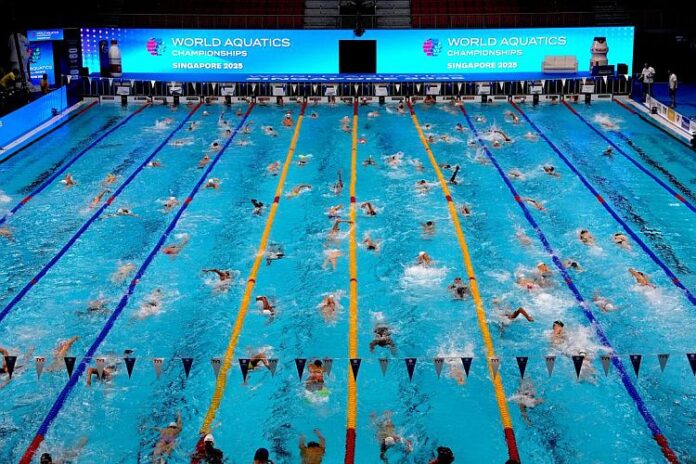
U.S. skater Ilia Malinin embracing a stunned Olympic men's figure skating gold medalist Mikhail Shaidorov of Kazakhstan (TSX photo by Karen Rosen).
★ The Sports Examiner: Chronicling the key competitive, economic and political forces shaping elite sport and the Olympic Movement.★
★ To get the daily Sports Examiner Recap by e-mail: sign up here! ★
≡ FAIR PLAY AWARD ≡
The thrills of the 2026 Olympic Winter Games were also accompanied by some remarkable demonstrations of sportsmanship and fair play. Fan voting is now open – through 3 March (Tuesday) – to select the Fair Play Award winner from the Games, presented by the International Olympic Committee and the International Committee for Fair Play.
From the nominations submitted during the Games, a jury selected six finalists, from three different sports:
● Curling/Mixed Doubles: Julie Zelingrova (CZE) “Zelingrova exemplified ‘playing by the rules’ when no one was watching. By self-reporting a nearly invisible rule violation (touching a running stone), she chose personal honesty over an easy advantage.”
● Curling/Women: Italy and the U.S. “When a disputed stone-touch threatened to cloud the match, the two teams chose honesty over advantage.”
● Figure Skating/Men: Ilia Malinin (USA) “After a heartbreaking drop from first to eighth place, Malinin didn’t retreat and genuinely celebrated gold medallist Mikhail Shaidorov (KAZ).”
● Figure Skating/Men: Yuma Kagiyama (JPN) “Kagiyama’s exuberant, heartfelt celebration of [countryman] Shun Sato’s medal showed that friendship and genuine joy for a peer can bridge the gap of any rivalry.”
● Figure Skating/Women: Amber Glenn (USA) “Despite her own disappointment, Glenn stepped in to shield Kaori Sakamoto (JPN) from intrusive cameras, prioritising mental health and human dignity over the spotlight.”
● Ice Hockey/Women: Canada “When a norovirus outbreak struck the Finnish team, Team Canada didn’t look for a forfeit; they looked for fairness by backing the postponement of their Olympic opener.”
The 2026 award is especially poignant as it comes 62 years after the very first Fair Play Award, given to Italian bobsled legend Eugenio Monti. During the 1964 Innsbruck Winter Games, he aided his direct rivals, the British Two-Man team with a replacement bolt that ultimately helped them win the Olympic gold, while Monti’s team ended up with the bronze.
Monti, who passed in 2003, won silver medals at Cortina d’Ampezzo in 1956 in the Two-Man and Four-Man and went on to win both Olympic golds at the 1968 Winter Games in Grenoble (FRA).

★ Receive our exclusive, weekday TSX Recap by e-mail by clicking here.
★ Sign up a friend to receive the TSX Recap by clicking here.
★ Please consider a donation here to keep this site going.
For our updated, 45-sport, 910-event International Sports Calendar for 2026 and beyond, by date and by sport, click here!
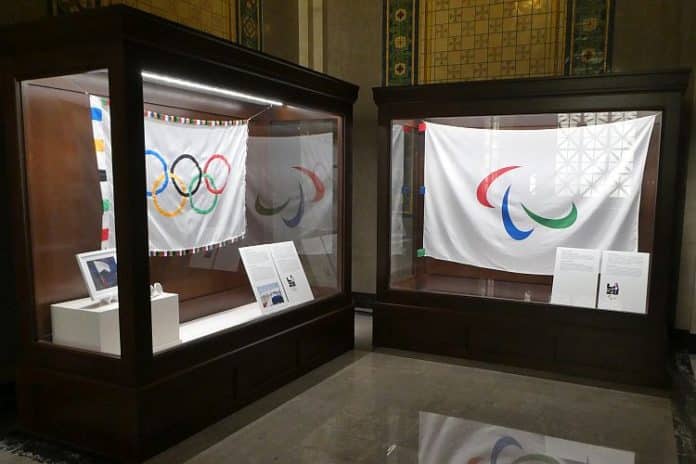
Two-time World Champion Chase Jackson of the U.S. (Photo: Sona Maleterova for World Athletics).
★ The Sports Examiner: Chronicling the key competitive, economic and political forces shaping elite sport and the Olympic Movement.★
★ To get the daily Sports Examiner Recap by e-mail: sign up here! ★
≡ USATF INDOOR NATIONALS ≡
The 2026 USA Track & Field Indoor National Championships – first held in New York in 1906 – got going on Saturday in Staten Island, New York, also selecting the American team for the World Athletics Indoor Championships in Poland.
One of the most anticipated events Saturday was the men’s 3,000 m, with World 5,000 m champion Cole Hocker in excellent form and he went to the front right away with Cooper Teareand 2024 World Indoor runner-up Yared Nuguse.
Hocker passed 1,500 m in 3:58.57, ahead of Teare (3:58.77). Olympic steepler Matthew Wilkinson took over at 1,800 m and then Nuguse went to the front at 2,400 m, with Paris Olympian Nico Young close, and then Young went to the front at the bell.
Young, Hocker and Nuguse were fighting for the win and it was Hocker, with his patented late rush, who got to the line for the win in a tactically-satisfying 7:39.25, just ahead of Nuguse (7:39.28) and Young at 7:39.29. Morgan Beadlescomb was fourth at 7:40.83 with a hard last lap, moving up from seventh.
It’s Hocker’s second 3,000 m national indoor title, also in 2022; he doubled that year in the 1,500 m and he will try for another double on Sunday.
There were also fireworks in the women’s Shot. Two-time World Champion Chase Jackson had been quiet indoors, competing in just one meet. But she was ready Saturday, unleashing a huge throw of 20.44 m (67-0 3/4) in round five to win and extend her own American Record of 20.24 m (66-5) from 2025. It moves Jackson to no. 2 on the 2026 world list.
Behind her was Abria Smith with a lifetime best of 19.23 m (63-1 3/4) for second, over Jaida Ross’s 18.43 m (60-5 3/4).
Lots more on Saturday:
● Men/60 m hurdles: World leader Trey Cunningham led the qualifiers at 7.38, ahead of Dylan Beard(7.47), now equal-8th on the world list for 2026.
Beard – sixth in 2025 – didn’t miss the opportunity in the final, edging Cunningham, 7.37 to 7.40, to tie for the world lead and now equal-7th all-time. Jamal Britt was third in 7.46.
● Men/5,000 m Walk: Nick Christie was an easy winner in an American Record time of 19:13.37, ahead of Jordan Crawford (21:15.02). For Christie, it’s his seventh indoor national title sine 2015; all of the others were at 3,000 m. He’s now no. 5 on the world list for 2026.
(Meanwhile, at the Italian indoor championships, Francesco Fortunatocrushed the world 5,000 m walk record in 17:54.48, obliterating Russian Mikhail Shchennikov‘s 1995 mark of 18:07.08.)
● Men/Vault: Zach Bradford, a two-time World Champs team member, equaled his seasonal best of 5.90 m (19-4 1/4) and was the only one to clear to win his first national title. American record holder KC Lightfoot cleared 5.85 m (19-2 1/4) for second and defending champion Chris Nilsen cleared 5.80 m (19-0 1/4).
Bradford wasn’t done and moved the bar to 6.01 m (19-8 1/2) and cleared on his second try for a lifetime best! He’s the 19th man to clear 6 m indoors and the fifth American. He’s now equal-8th all-time, and equal-second all-time U.S. with Sam Kendricks.
● Men/Triple Jump: Russell Robinson, second last year, got to the lead early at 16.15 m (53-0) in the first round and improved to 16.59 m (54-5 1/4) in round three. Defending champ James Carter was the only other jumper to reach 16 m – in round five – and was second at 16.24 m (53-3 1/2) in the sixth round.
● Men/Weight: Isaiah Rogers won his first national Weight title with his fifth-round throw of 23.29 m (76-5), then improved to 23.41 m (76-9 3/4) on his final toss. Konner Wood was second, with a final-round throw of 22.92 m (75-2 1/2).
● Women/3,000 m: A spirited battle between Emily Mackay and two-time champion Elle St. Pierre came down to the final lap and Mackay – third in this race in 2023 – got her first national title in a meet record of 8:30.01 to 8:31.07 for St. Pierre. Margot Appleton was a distant third in 8:41.41. Mackay moves to sixth on the 2026 world indoor list with her time; St. Pierre has already run faster.
● Women/60 m hurdles: Alia Armstrong, fourth last year, led the qualifiers at 7.90, with heptathlon World Champion Anna Hallalso making it to the final (which she skipped).
Armstrong was in lane four for the final, with 2023 winner Alaysha Johnson and two-time winner Gabbi Cunningham to her right. Johnson was disqualified for a false start and on the second try, Armstrong came through with the win in 7.82, cleaning ahead of Danae Dyer (7.92) and Amber Hughes (7.98). Cunningham finished fourth (8.01).
Armstrong moved to equal-5th on the 2026 world list.
● Women/5,000 m Walk: Lauren Harris, the defending champion from 2025 (3,000 m) won by more than a minute in 22:14.69, a lifetime best and an American Record, ahead of eight-time national indoor winner Maria Michta-Coffey (23:30.42).
● Women/High Jump: Last year’s runner-up, Charity Hufnagelequaled her lifetime best at 1.96 m (6-5) on her third attempt won over Vashti Cunningham (1.93 m/6-4), who had won the prior nine U.S. indoor titles! World Hep Champion Hall took third at 1.90 m (6-2 3/4).
● Women/Long Jump: Olympic bronzer Jasmine Moore took the lead at 6.69 m (21-11 1/2), then extended at 6.86 m (22-6 1/4) in round two, with 2025 World Indoor Champion Claire Bryant into second at 6.68 m (21-11).
Defending champ Monae Nichols, the 2024 World Indoor silver medalist, moved into second place in round four at 6.72 m (22-0 3/4) and equaled that mark in the sixth round. Bryant stayed third and improved to 6.69 m (21-11 1/2) in round six. But no one could touch Moore, who won her first national indoor title.
In the qualifying rounds:
● Men/400 m:Khaleb McRae, who set the “world record” in the event at 44.52 earlier in February, led all qualifiers at 45.63, with Chris Robinson at 45.73, the only ones under 46 seconds.
● Men/800 m: Cooper Lutkenhaus led the qualifiers at 1:47.00 to win heat three, ahead of Sean Dolan (1:47.17).
● Women/400 m: Paris Peoples won heat four with the fastest qualifying mark of 52.18 and Rosey Effiong took heat one in 52.20.
● Women/800 m: Meghan Hunter was the fastest qualifier at 2:00.56 from heat one and the top five were bunched from 2:00.56 to 2:01.24.
The meet concludes on Sunday and will be televised by NBC from 1-3 p.m. Eastern time.

★ Receive our exclusive, weekday TSX Recap by e-mail by clicking here.
★ Sign up a friend to receive the TSX Recap by clicking here.
★ Please consider a donation here to keep this site going.
For our updated, 45-sport, 910-event International Sports Calendar for 2026 and beyond, by date and by sport, click here!
LA28 chief executive Reynold Hoover testifying before a Senate Subcommittee hearing on 10 June 2025 (Senate video screen shot).
★ The Sports Examiner: Chronicling the key competitive, economic and political forces shaping elite sport and the Olympic Movement.★
★ To get the daily Sports Examiner Recap by e-mail: sign up here! ★
≡ THE 5-RING CIRCUS ≡
● Olympic Games 2028: Los Angeles ●LA28 organizing committee chief executive Reynold Hoover told the Los Angeles Times that, as the LA28 Board Executive Committee has stated, Casey Wasserman should continue as Chair:
“Casey was here at the beginning of this whole project, and there’s nobody with the kind of business sense of the Olympics and how to put the partnerships together that you [need] to deliver on the Olympics. … Between him and I, we make a great team.”
He added that, “No sponsor has come to us and said that they don’t want to be associated with us or are concerned about the current controversy.”
Hoover also noted that more than 215,000 have registered to possibly volunteer for the Olympic and/or Paralympic Games and that he continues to work with Federal authorities for funding to cover the security elements of the Games.

The International Olympic Committee is expanding its “Olympic Qualifier Series” for 2028, creating showcase events for final qualifying for Los Angeles for smaller federations, in order to provide more support and a higher profile.
For the Paris 2024 Games, two events were held, focused in BMX Freestyle, breaking, climbing and skateboard. For 2028, three events will be staged between April and June, with BMX Freestyle, climbing and skateboard joined by 3×3 basketball, beach volleyball, and flag football, for a total of six sports or disciplines.
The Greater Orlando Sports Commission (GO Sports) said Wednesday that it is bidding for the third and final stop in the series. Orlando successfully hosted the 2024 U.S. Olympic Marathon Trials and the concept for is to use Camping World Stadium, home of the annual Florida Cirtus Bowl.
Orange County (Fla.) plans to assist with support of the proposed program via its Tourist Development Tax fund.
● Olympic Winter Games 2030: French Alps ●Edgar Grospiron, the 1992 Olympic Moguls champion and head of the French Alps organizing committee, told the French Senate Committee on Culture, Education, Communications and Sport that “All issues are moving forward, despite the governance challenges we’ve faced.”
The recent spate of senior executive departures – including chief executive Cyril Linette – had worried some observers, but Grospiron said the sponsorship sales effort is moving forward and “the decisions have been made and the processes to restructure our organization are underway.”
As for the sports and venues plan, he explained, “We’re roughly four months behind, but that’s four months of delay on only 15% of our venue map. We know 85% of our map and we’re working on it. The remaining 15% concerns the allocation of alpine skiing between Courchevel and Val d’Isère, the speed oval, the Paralympic events which we’re trying to consolidate at a single venue in Savoie, and finally, the additional sports.”
● Alpine Skiing ● Italy’s Federica Brignone was one of the best stories of the 2026 Winter Games, coming back from an April 2025 crash to win two golds. But her future is anything but assured. She explained from the World Cup in Soldeu (AND):
“Believing in something that seems impossible is a huge motivation. It’s difficult, but we are the architects of our own destiny. It was a personal challenge – I didn’t do it to receive gratitude. But if it can be a message for someone, then I’m happy. …
“Honestly, I hoped I would feel better. I’m still in quite a lot of pain and I struggle to put weight on it. That’s why you didn’t see me in training today.
“I’ll evaluate things day-by-day. We agreed that just being at the Olympics was already a ‘bonus’ and now even more so it must not become torture. It has to be something healthy and safe.
If I can’t truly stand on my leg, I have no intention of throwing myself down the mountain at 130 km [81 miles] an hour.”
And the future?
“It depends on my health. If it becomes torture, it will be difficult. If I feel good, why not? I haven’t made a decision. I don’t feel like I want to quit. I’m tired of the pain – not of racing.”
● Athletics ●The USATF National Indoors in on this weekend at the Ocean Breeze Athletic Complex in Staten Island, New York, with the meet selecting the U.S. team for the World Athletics Indoor Championships in Poland in March.
Sunday’s meet will be shown on NBC from 1-3 p.m. Eastern time.

The race to replace Sebastian Coe (GBR) as the head of World Athletics is starting.
Elections will be held prior to the 2027 World Athletics Championships in Beijing (CHN), with filings for office opening on 1 March 2026 and due at the latest by 1 June 2027. Selections will be made for World Athletics President, four Vice Presidents and 13 Council members.
An independent Vetting Panel is to ensure “only candidates who meet World Athletics’ high integrity standards are eligible to stand for election.”
The current World Athletics First Vice President is former Colombian 400 m star Ximena Restrepo, the 1992 Olympic women’s 400 m bronze winner, with a best of 49.64. She married Chilean shot star Gert Weil and lives in Chile and is expected to be a leading candidate.

“The Court of Arbitration for Sport (CAS) has partially upheld an appeal by World Athletics against the Ethiopian National Anti-Doping Office (ETH-NADO) and middle-distance runner Diribe Welteji Kejelcha (Ethiopia).
“Ms Welteji is found to have committed an Anti-Doping Rule Violation (ADRV) and is sanctioned with a period of ineligibility of two years from 8 July 2025, with credit for provisional suspension served.”
Thursday’s announcement follows a 21 May 2025 charge by the Athletics Integrity Unit against Welteji, the 2023 World women’s Road Mile champion, for not providing a testing sample at an out-of-competition doping control on 23 February 2025. She was cleared by the Ethiopian anti-doping authority and was appealed with a request for a four-year ban.
Welteji was not allowed to compete at the 2025 World Athletics Championships, and the arbitrator found that she was negligent only and imposed a two-year ban with credit for time serviced. She will be eligible again on 1 July 2027.

Jeff Galloway, an American 10,000 m Olympian in 1972 and a running evangelist for his “run-walk-run approach” to training, passed away in Pensacola, Florida on 25 February, at age 80.
He was involved in the growth of the famed Peachtree Road Race in Atlanta, the Avon International Women’s Marathon and the Phidippides running shore chain, and for decades as a speaker, urging people to find joy and fitness in running and exercise.

Manteo Mitchell, 38, now a bobsledder, but formerly an Olympic 4×400 m relay silver medalist in athletics, was publicly warned by the U.S. Anti-Doping Agency for attending an online USA Track & Field committee meeting last September.
This was in violation of his two-year doping ban from 2 February 2025, but Mitchell had been invited to the meeting and did not know that the ban extended to non-bobsled activities. It does, but no sanction was added.
● Boxing ● The International Boxing Association, the former governing body for Olympic boxing, said that if the International Olympic Committee does not pay prize money for the 2028 Olympic tournament, it will. The IBA claimed that it paid $100,000 to Paris 2024 gold medalists with $50,000 to the boxer, $25,000 to the coach and $25,000 to the national federation (which is now not affiliated with the IBA). Runner-ups were to have received $50,000, bronze winners $25,000 and fifth-placers $10,000.
● Diving ●Amid violence in the Mexican state of Jalisco, World Aquatics said Thursday that the Diving World Cup stage planned for 5-8 March in Zapopan has been cancelled:
“This decision follows travel restrictions issued by some international embassies and an overall evaluation of travel cautions, which have limited or advised against travel to Mexico at this time and, as a result, did not authorize their national teams to participate in the competition. The safety and participation of all athletes remains a fundamental priority for World Aquatics.”
● Football ● FIFA President Gianni Infantino (SUI) said on Wednesday concerning the violence in the Mexican state of Jalisco:
“We are analysing and monitoring the situation in Mexico these days, at this moment.
“But I want to say from the outset that we have complete confidence in Mexico, in its president [Claudia] Sheinbaum, in the authorities, and we are convinced that everything will turn out for the best.
“From my side, and from FIFA’s side, I have absolute confidence in President Sheinbaum. We are in regular contact with the Presidency and the authorities, and we are, in any case, monitoring the situation. The World Cup is going to be an incredible celebration.”
He noted confidence in the football situation in Mexico:
“We have some matches in Mexico in a month, the World Cup playoffs, and the new Azteca Stadium will also be inaugurated.
“Mexico is a great football country. Like in every country in the world, things happen; we don’t live on the moon or another planet. That’s why we have governments, police, and authorities who will ensure order and security.”
● Shooting ● The International Shooting Sport Federation (ISSF) “is seriously concerned about the recent dissemination by the European Shooting Confederation (ESC), of an article published on the outlet Inside The Games regarding Article 6.12.5.2 of the ISSF General Technical Rules and the ISSF Academy licensing system, which initially included various factual inaccuracies.”
The post criticizes the news site and the European confederation:
“ISSF believes that institutional positions and the discussions among the stakeholders should be made through official institutional channels and not via content produced by a media outlet which appears not to be in good standing with the IOC.” The ISSF is now asking for an “urgent institutional meeting with the full ESC Presidium” and closer monitoring of ESC meetings.
Back story: The ESC President is Russian Alexander Ratner, whose election is being challenged by runner-up finisher Karoliina Nissinen (FIN), for voting interference by former ISSF President Vladimir Lisin (RUS). The ISSF inquiry into the election is ongoing.
● Wrestling ●Sad news that two-time Olympian and National Wrestling Hall of Fame member Bobby Douglas passed away at age 83 on 23 February in Ames, Iowa.
He was a 1964 and 1968 U.S. Olympian and competed at the world championships six times, and won a 1966 silver at 63 kg and 1970 bronze and 68 kg. He had a stellar coaching career, winning the 1988 NCAA title at Arizona State, where he headed the program for 18 season, then moved to Iowa State for 14 years before retiring. He was an assistant or head coach for 10 U.S. Olympic or World Championships teams and the men’s Freestyle coach for the 1992 Olympic Games in Barcelona.

★ Receive our exclusive, weekday TSX Recap by e-mail by clicking here.
★ Sign up a friend to receive the TSX Recap by clicking here.
★ Please consider a donation here to keep this site going.
For our updated, 45-sport, 910-event International Sports Calendar for 2026 and beyond, by date and by sport, click here!

The magnificently-decorated peristyle end of the Los Angeles Memorial Coliseum for the Opening Ceremonies of the 1984 Olympic Games (Photo: Wikipedia)
★ The Sports Examiner: Chronicling the key competitive, economic and political forces shaping elite sport and the Olympic Movement.★
★ To get the daily Sports Examiner Recap by e-mail: sign up here! ★
≡ MARCH 6 ASSEMBLY HEARING ≡
A unique hearing of the California State Assembly Select Committee on the 2028 Olympic and Paralympic Games will take place on Friday, 6 March at the LA84 Foundation in Los Angeles, on the topic of “Lessons and Legacy Impacts of the 1984 Los Angeles Olympic Games.”
The LA84 Foundation, of course, is the living legacy of the Los Angeles Olympic Organizing Committee, which staged the ‘84 Games and turned an Olympic Movement saddled with terrorism, financial failures and boycotts into a worldwide power in sports marketing and presentation.
The two-hour session is slated from 11 a.m. to 1 p.m. and is free and open to the public in the LA84 Foundation pavilion. Chaired by Assembly member Tina McKinnor (D-61st District), short presentations are scheduled from people who were part of the effort that made the Games – and its legacy – a success:
● Renata Simril, President of the LA84 Foundation and of the Play Equity Fund.
● Renato Pavia, an LA84 Foundation grant recipient and member of the Access Youth Academy in San Diego, California.
● Derek Fisher, former Lakers star and an Advisory Board member of the Play Equity Fund.
● Bob Graziano, LAOOC ticket department manager and past LA84 Foundation Board Chair.
● Rich Perelman, LAOOC Vice President/Press Operations and Editor, The Sports Examiner.
● Zev Yaroslavsky, former Los Angeles City Council member (during the Games period), later Los Angeles County Supervisor; Director of the Los Angeles Initiative at the UCLA Luskin School of Public Affairs.
Not yet confirmed is Anita DeFrantz, the senior International Olympic Committee member in the U.S., and the long-time head of the LA84 Foundation, who served as a Vice President/Olympic Villages for the LAOOC, responsible for the USC Olympic Village.
Simril and Pavia will speak to the legacy efforts of the Foundation, chartered with $93 million (40%) of the LAOOC’s $232.5 million surplus from the 1984 Games. Fisher will focus on the continuation of legacy efforts into 2028 and beyond for all area youth. Graziano and Perelman will give brief talks on the delivery of the Games, especially in the planning, innovation, and execution phases.
Yaroslavsky, and if available, DeFrantz, will talk on the lasting impact of the 1984 Games on Los Angeles and beyond.
This is the first meeting of the Assembly Committee on the 2028 Games; the California State Senate’s Special Committee on International Sporting Events met in Sacramento in July 2025.
It is also believed to be the first hearing of any governmental body involved in oversight of the 2028 Games on the development, outcome and legacy of the Games of the XXIIIrd Olympiad in 1984.
The LA84 Foundation is located at 2141 West Adams Boulevard in Los Angeles (90018); parking availability is primarily on the surrounding streets; if you wish to attend, please give yourself time to park and walk.

★ Receive our exclusive, weekday TSX Recap by e-mail by clicking here.
★ Sign up a friend to receive the TSX Recap by clicking here.
★ Please consider a donation here to keep this site going.
For our updated, 45-sport, 910-event International Sports Calendar for 2026 and beyond, by date and by sport, click here!

★ The Sports Examiner: Chronicling the key competitive, economic and political forces shaping elite sport and the Olympic Movement.★
★ To get the daily Sports Examiner Recap by e-mail: sign up here! ★
≡ ANALYSIS & OBSERVATIONS ≡
NBC breathlessly announced a considerable ratings success for its coverage of the 2026 Olympic Winter Games on Monday, posting in part:
“From the most-watched Opening Ceremony in 12 years through last night’s Closing Ceremony, the Milan Cortina Winter Olympics averaged 23.5 million viewers on NBC, Peacock, NBCUniversal Digital Platforms and Versant’s CNBC and USA Network across the combined live afternoon Milan Prime window (2-5 p.m. ET) and U.S. primetime (8-11 p.m. ET/PT) time periods. Milan Cortina viewership is the highest for a Winter Games since Sochi 2014 and up 96% from the 2022 Beijing Olympics (12.0 million).
“Viewership is based on official Nielsen Big Data + Panel viewership (through Thursday 2/19) and preliminary data from Nielsen (2/20-22), and digital data from Adobe Analytics. Final data will be available later this week.”
The release also noted that the “Milan Prime (live U.S. daytime) and Primetime in Milan (U.S. primetime) coverage posted a daily streaming TAD [Total Audience Delivery] of 3.3 million viewers across Peacock and NBCU Digital platforms.”
Thus, using the preliminary 23.5 million daily average, 20.2 million (86.0%)was on NBC broadcast and the USA and CNBC cable networks.
Some additional data is now available from TheTVRatingsGuide.com, which posts Nielsen broadcast and cable data on prime-time programming only:
● 06 Feb.: 13.26 million NBC only ~ opening ● 07 Feb.: 11.15 million NBC + 1.45 million USA Network
● 08 Feb.: 20.02 million NBC only ~ Super Bowl Sunday lead-in ● 09 Feb.: 10.85 million NBC + 2.39 million USA ● 10 Feb.: 10.20 million NBC + 2.04 million USA ● 11 Feb.: 10.75 million NBC + 1.60 million USA ● 12 Feb.: 9.78 million NBC + 1.66 million USA ● 13 Feb.: 8.87 million NBC + 2.49 million USA ● 14 Feb.: 8.01 million NBC + 3.02 million USA
● 15 Feb.: 9.45 million NBC + 2.92 million USA ● 16 Feb.: 9.03 million NBC + 2.69 million USA ● 17 Feb.: 9.75 million NBC + 2.12 million USA ● 18 Feb.: 9.63 million NBC + 2.00 million USA ● 19 Feb.: 11.66 million NBC + 2.31 million USA ● 20 Feb.: 9.48 million NBC + 1.73 million USA ● 21 Feb.: 7.86 million NBC + 1.91 million USA
● 22 Feb.: 4.76 million NBC only ~ closing
Your first question is, what happened to cause the increase on 19 February? Easy: the women’s Free Skate in figure skating and the U.S. women won the ice hockey gold-medal match against Canada, two of the highlights of the Games for Team USA.
By adding up the published numbers and doing some arithmetic, we can see:
● NBC averaged 10.26 million a day for its primetime shows; ● USA Network primetime shows averaged 2.17 million; ● NBC said its streaming platforms averaged 3.3 million; ● So, the daytime (live) shows averaged about 7.8 million daily on NBC, USA and CNBC.
(Sports Media Watchreported that when broadcast and streaming viewers were combined, the evening prime-time shows on NBC, USA and CNBC and digital averaged 13.8 million viewers, and the afternoon shows, with digital, averaged 9.7 million.)
This says:
(1) The power of live sports is demonstrated once again as a dominant “audience aggregator” and one of the last ways to bring people together around a television or a computer (or phone).
(2) The terrible ratings for the Tokyo 2020 Olympic Games and the Beijing 2022 Winter Games were due in part to the pandemic and due in part to being in Asia, a terrible time zone for U.S. viewers. The much-friendlier Central European Time Zone – six hours ahead of U.S. Eastern – creates far more interest in the U.S.
(3) NBC said this was its largest Olympic Winter Games audience since Sochi 2014. Comparing to the other Winter Games this century for the NBC primetime show only:
● 31.9 million 2002: Salt Lake City ● 20.2 million 2006: Turin ● 24.4 million 2010: Vancouver ● 21.3 million 2014: Sochi ● 19.8 million 2018: PyeongChang ● 11.4 million 2022: Beijing ● 10.3 million 2026: Milan Cortina
For 2026, the comparison showing a weak primetime audience in a bit unfair, as it does not include streaming – obviously a big factor now – and that many people watched events live during the day. The Nielsen ratings calculus also more inclusive now than it was in earlier years. But the shared Olympic evening experience on network television is down, substantially, reflecting the general decline in broadcast and cable vs. streaming. Nielsen reported that in January 2026, broadcast and cable accounted for only 42.7% of U.S. television viewing and streaming was 47.0%.
On that basis, the comparison with Sochi is pretty accurate.
One more thing: look at the split of ratings between the first week of the games – nine days from 6-14 February – and the remaining 8 days.
● Week 1 (9 days): 11.41 million NBC; 2.11 million USA ● Week 2 (8 days): 8.95 million NBC; 2.24 million USA
Acknowledging a boost from the NFL Super Bowl being on NBC, the first week still drew more attention – about 27.4% more – than the second week.
That metric will be well received in Monaco, at the headquarters of World Athletics, with track & field held during the first week in Los Angeles in 2028, with swimming now in the second week.

★ Receive our exclusive, weekday TSX Recap by e-mail by clicking here.
★ Sign up a friend to receive the TSX Recap by clicking here.
★ Please consider a donation here to keep this site going.
For our updated, 45-sport, 910-event International Sports Calendar for 2026 and beyond, by date and by sport, click here!

★ The Sports Examiner: Chronicling the key competitive, economic and political forces shaping elite sport and the Olympic Movement.★
★ To get the daily Sports Examiner Recap by e-mail: sign up here! ★
≡ THE 5-RING CIRCUS ≡
● Olympic Games ●Speaking with the Hungarian Nemzeti Sport, International Olympic Committee Vice President Juan Antonio Samaranch (ESP) noted the gravitational pull of the Games that makes it impossible for politics to stay away:
“The success and visibility of the Games attract those who seek to articulate their own causes as loudly as possible here.
“But the Olympics are about unity, friendship, and the message that ‘another world is possible.’”
● Olympic Games 2028: Los Angeles ●U.S. superstar Kevin Durantwon a fourth Olympic gold on the American team at the 2024 Paris Games and said he wants to be considered – at age 39 – for the 2028 L.A. Games as well:
“I didn’t want to just take my name out of consideration just because of the simple fact that I’m older and I did it before.
“[USA Basketball Managing Director] Grant [Hill] understands my love for Team USA. That’s my family. The level of love I have for Team USA and the whole organization over there is unmatched, so I’d love to be part of it until I’m done playing.
“I understand how tough that decision is for Grant, and how many great players are going to emerge the next year and a half, and I’m also very old compared to a lot of these players. I know I’ve got my work cut out for me to make that team.”
● Olympic Games 2026: Milan Cortina ●Members of the victorious U.S. men’s hockey team arrived in Miami from Italy on Monday night, and then flew to Washington, D.C., where they were received at The White House, in advance of attending the State of the Union address on Tuesday night.
Five members of the men’s team could not attend; the NHL schedule resumes on Wednesday. The gold-medal-winning American women’s team was invited, but declined, citing scheduling conflicts.

The International Ice Hockey Federation announced its awards for the Olympic men’s tournament, with Canadian star Connor McDavid named as Most Valuable. The Tournament Directorate choices for best position players selected McDavid as the Best Forward, American Quinn Hughes as Best Defender and American Connor Hellebuyckas Best Goalie.
The media-selected All-Star Team included those three, plus defender Cale Makar (CAN) and forwards Macklin Celebrini(CAN) and Juraj Slafkovsky (SVK).
● Winter Paralympic Games 2026 ●The Paralympic Flame was lit Tuesday in Stoke Mandeville (GBR), the site of the original event – the 16-athlete Stoke Mandeville Games of 1948 – that became the Paralympic Games.
The flame was kindled by three-time Paralypic alpine skier Millie Knight (GBR) and four-time ice hockey Paralympian Andrea Macrì(ITA). The Paralympic Torch Relay will comprise 11 days before arriving for the Paralympic opening in Verona (ITA) on 6 March.
Approximately 665 athletes from 50 nations will contest 79 medal events in six sports.
● AAU Sullivan Award ●Public voting has opened for the 96th AAU Sullivan Award – first awarded in 1930 – with a deadline of 5 March 2026. The 17 finalists comprise both collegiate (8) and Olympic (8) and Paralympic-sport (1) athletes in eight different sports:
Chock & Bates (silver), Liu (two golds), Malinin (gold) and Shiffrin (gold) all won medals at the recent Olympic Winter Games in Italy, although the award is for achievements during 2025.
The winner will be announced in a ceremony in New York on 7 April 2026.
● Fencing ● USA Fencing was happy to announce positive results from a safety study on Tuesday:
“The study, conducted by USA Fencing’s Data Resource Team using Fencing Time Live data collected between August 2019 and July 2025, found that medical withdrawals from direct elimination bouts occurred at a rate of just 0.338% – roughly one withdrawal for every 296 bouts. Of the 44,527 unique competitive fencers analyzed, only 3.9% experienced even a single medical withdrawal over the entire six-season period, and 83% of those fencers withdrew just once.”
This was across 637,283 bouts from 26,930 events. Foil bouts had the highest withdrawal rate, Sabre was in the middle and Epee was the lowest. Age was a factor: the lowest withdrawal rate was among 10-and-under fencers and the highest was for those at 30+ years and in the age 13-14 categories.
● Football ● For some time, the chatter around the 2026 FIFA World Cup was about possible “relocation” of matches due to safety concerns by U.S. President Donald Trump, then about moving matches out of the U.S. to protest the Trump Administration.
Now, after a firefight that killed a cartel leader in state of Jalisco – where the Estadio Guadalajara will host four matches – the talk is suddenly about moving matches out of Mexico.
A media statement which was reported by The Athleticincluded:
“At FIFA Mexico, we are closely monitoring the situation in Jalisco and remain in constant communication with the authorities.
“We will continue to follow the actions and directions from the different government agencies, aimed at maintaining public safety and restoring normalcy, and we reiterate our close collaboration with federal, state, and local authorities.”
Mexican President Claudia Sheinbaumsaid Tuesday that there is “no risk” for the World Cup matches in the country and that in Jalisco, “little by little the situation is returning to normal.”
Further reporting indicates that FIFA would only consider moving matches as a “last resort,” and depending on the safety and security situation. The tournament begins on 11 June, in Mexico City.

At a hearing of the House Committee on Homeland Security, dealing with preparations for the 2026 FIFA World Cup, Miami Host Committee Chief Operating Officer Ray Martinezpointed to the stall in funding from the Federal government due to the continuing shutdown of the Department of Homeland Security as its funding has been held up in Congress. Said Martinez:
“We are 107 days out from the tournament, but more importantly we are about 70-something days out from starting to build the [Miami 23-day] fan fest. These decisions have to be made, generously, within in the next 30 days. Our local agencies are very anxious. Without receiving this money, it would be catastrophic for our planning and coordination.”
Asked if events surrounding the tournament will be subject to cancellation, Martinez explained:
“That is correct. We have to start making some really tough decisions, and that starts with our fan festival. Obviously the matches up at the stadium will take place, but preparing for the other impromptu events and all the watch parties we’re expecting to see, that will be in jeopardy.”
The Miami Host Committee has asked for $70 million in funding, out of a $625 million allocation in last summer’s One Big Beautiful Bill Act. But the agency distributing the funds – the Federal Emergency Management Agency – is part of the Department of Homeland Security and is on hiatus amid the funding showdown in Congress.
Host cities are under heavy financial pressures due to FIFA’s requirements, and a major fan festival program planned for Liberty State Park in New Jersey, for which tickets had been sold, has been cancelled in favor of some smaller, free events. The town of Foxborough, Massachusetts, site of Gillette Stadium, has said it will not issue permits for the matches until its security costs of $7.8 million are covered.
● Sport Climbing ● The World Climbing Executive Board reinstated the Russian and Belarusian federations during its 10-11 February meeting, maintaining neutral status for all of their competitors and continuing the ban on the hosting of any events in those countries.
The ban against Russia and Belarus had been in place since 2022.

★ Receive our exclusive, weekday TSX Recap by e-mail by clicking here.
★ Sign up a friend to receive the TSX Recap by clicking here.
★ Please consider a donation here to keep this site going.
For our updated, 45-sport, 910-event International Sports Calendar for 2026 and beyond, by date and by sport, click here!

★ The Sports Examiner: Chronicling the key competitive, economic and political forces shaping elite sport and the Olympic Movement.★
★ To get the daily Sports Examiner Recap by e-mail: sign up here! ★
≡ 2026 GAMES TEAM SCORING ≡
The Olympic Games draw competitors from across the globe, but only a very few win medals. A few more finish in the top eight in their events and earn a diploma from the International Olympic Committee.
While the medal table is the most-often used metric of “team” success, it’s wholly inefficient to measure achievement at any Games. So, The Sports Examiner uses the familiar 10-8-6-5-4-3-2-1 scoring system used in NCAA track & field scoring and by some International Federations, such as World Aquatics.
For the Milan Cortina Winter Games, The Sports Examiner tracked the top-eight placers. While there were 92 National Olympic Committees, there were 38 that scored points from places 1-8 (scores shown with the number of place winners in parenthesis after):
● 19: Bulgaria (4) ~ 2 medals ● 15: Estonia (4) ~ 1 medal ● 13: Georgia (2) ~ 1 medal ● 10: Brazil (1) ~ 1 medal ● 10: Denmark (2) ~ 1 medal /30/ ● 9: Ukraine (4) ● 8: Hungary (3) ● 5: Slovakia (1) ● 4: Belarus “neutrals” (2) ● 4: Romania (1)
● 2: Hong Kong (1) ● 2: Lithuania (1) ● 1: Ireland (1) /38/
It’s worth noting that 29 National Olympic Committees and a Russian “neutral” won medals at the Games, compared to 38 who scored points, a very close match.
Still, the International Olympic Committee will be pleased with a small expansion of the number of teams that scored points: 38, up from 35 for Beijing in 2022, and 35 in PyeongChang in 2018.
The U.S. improvement was shown quite clearly when comparing these three Games:
This is real improvement, with the caveat that the absence of the Russians in Milan Cortina certainly influenced some of the scoring totals in 2026.
The IOC is currently considering what to do about the Winter Games program and whether to include historically winter sports – such as cross country running and cyclo-cross – in addition to the current rule which limits Winter Games sports to those on snow and ice.
Given the very slow growth in NOC scoring – 35 in 2018 and 2022 and 38 in 2026 – it might be time to give other sports a try.

★ Receive our exclusive, weekday TSX Recap by e-mail by clicking here.
★ Sign up a friend to receive the TSX Recap by clicking here.
★ Please consider a donation here to keep this site going.
For our updated, 45-sport, 910-event International Sports Calendar for 2026 and beyond, by date and by sport, click here!
A young fan is all set to cheer on the Azzurri during the Milan Cortina Winter Games (TSX photo by Karen Rosen).
★ The Sports Examiner: Chronicling the key competitive, economic and political forces shaping elite sport and the Olympic Movement.★
★ To get the daily Sports Examiner Recap by e-mail: sign up here! ★
≡ MILAN CORTINA IN REVIEW II ≡
The memorable XXV Olympic Winter Games provided a lot of thrills, chills and disappointments among the many brilliant moments of sport. Some of the world’s best athletes found out that the Games are a lot different than their own world championships, as explained in the first part of our recap and review yesterday.
On now to the five most prominent lessons from the Games:
● No. 5: Home cooking really does help One of the best things that can help an organizing committee sell tickets is for the host country to win a lot of medals right from the start of a Games.
Cue the Italian team for Milan Cortina, which shattered all records for medals at a Winter Games, in front of thrilled crowds in every venue. The Azzurri won nine medals in the first two days of the Games and kept piling it on to a record of 30 total (10-6-14), 50% more than it had ever won at any prior Winter Games!
Updating our 8 February look at the impact of “home cooking” since the 1998 Nagano Games (the 1992-94 cycle change skews the results too much to be used):
● 1998 Nagano: Japan went from 5 medals in 1994 to 10 (+100%) ● 2002 Salt Lake City: U.S. from 13 to 34 (+162%) ● 2006 Turin: Italy from 13 to 11 (–15%) ● 2010 Vancouver: Canada from 24 to 26 (+8%) ● 2014 Sochi: Russia from 13 to 29 (+123%, after 4 doping disqualifications) ● 2018 PyeongChang: Korea from 8 to 17 (+113%) ● 2022 Beijing: China from 9 to 15 (+67%) ● 2026 Milan Cortina: Italy from 17 to 30 (+76%)
(Yes, the increase in events from 61 in 1998 to 116 now must be noted, but do not explain all of these increases. Note that Italian medal production actually went down for Turin in 2006!)
It’s not a record increase, but by far the best Italy has done at a Winter Games and the story of Short Track ace Arianna Fontana moving up to no. 2 all-time among Winter Games medal winners (she has 14 now) and the amazing comeback story of skier Federica Brignone, returning from injury to win two golds, drove attendance and interest. Broadcast reports indicated that two-thirds of the Italian public watched at least some part of the Games.
That helped to sell about 88% of the tickets available for the Games, after loud concerns over sales were voiced just prior to the Games.
● No. 4: The best are still the best Thanks in part to the continuing expansion in events and to its continuing domination on skis, Norway shattered records again by winning the most-ever medals at a Winter Games with 41 and for gold medals, with 18.
The Norwegians held the prior record with 39 meals at PyeongChang 2018 and the most golds with 16 at Beijing in 2022. Here, they rode dominance in two sports: cross country skiing and biathlon, to 61% of their record totals. Their medals came in seven sports and disciplines:
Norway brought 80 athletes to the Games and won 41 medals. The U.S. brought 232 and won 33 medals, its best-ever showing outside of North America and no. 3 ever, behind Vancouver 2010 (37) and Salt Lake City 2002 (34).
The U.S. won medals in 11 sports and disciplines with the most – 8 – in Freestyle Skiing. And the Americans won 12 golds, its most ever in a Winter Games, despite disappointments in several events.
When Lindsey Vonn crashed in the women’s Downhill, Breezy Johnson won gold. When Mikaela Shiffrin failed in the Team Combined, she won the Slalom. Where Ilia Malininfell in the men’s Free Slate, he won the Team Event. And figure skating winner Alysa Liuand Monobob champ Elana Meyers Taylor were not favored going into their events. And there were more like them in other events.
The U.S. Olympic & Paralympic Committee expected to improve on 23 medals in 2018 and 25 at Beijing 2022. A rise to 33 was both satisfying and points to even greater possibilities with Utah 2034 on the horizon.
The International Olympic Committee will be disappointed that the number of nations winning medals remained at 29, down from the high of 30 from 2018.
● No. 3: Politics are part of the Games Over time, the most consequential athlete of the 2026 Winter Games may be one who never competed: Ukrainian Skeleton racer Vladyslav Heraskevych.
His insistence on wearing his “memory helmet” which pictured 21 Ukrainian athletes – one just nine years old – killed in the Russian invasion that started on 24 February 2022, caused him to be disqualified for violations of the IOC’s Guidelines on Athlete Expression. The guidelines state:
“[E]xpressions are not permitted in the following instances … During competition on the field of play.”
And Heraskevych was making a statement. The artist, Iryna Prots, explained in a story in The Art Newspaper:
“Prots explains she is a family friend of Heraskevych, and has known him since he was a boy. He had come to her, she says, ‘not as an athlete to an artist’ but ‘as a person to a person’, with a wish to commemorate Ukrainian athletes who had fallen in the war. ‘He said, ‘I want them to be with me. Those who did not reach this start’. And I understood: this will not be a drawing; it will be a presence.’”
But what he did was to raise once again – and loudly – the issue of Russian and Belarusian participation. The IOC signaled growing acceptance of Russian and Belarusian re-integration into international sport last December with agreement to allow “youth” athletes to participate openly, with national colors and anthems.
It was left up to the International Federations to decide how to implement this. United World Wrestling is allowing “youth” wrestlers up to 22 years old; have they not checked to see that the age of conscription into the Russian Army is 18? And World Rowing announced that despite the IOC’s continuing ban on teams, Russian and Belarusian SENIOR athletes – as “neutrals” – can compete in Fours and Eights.
Perhaps these formulations will be revisited. But the impetus will have to come from the IOC and President Kirsty Coventry (ZIM), who met with Heraskevych and was unable to dissuade him from wearing his helmet in competition.
● No. 2: In the biggest market, the Games are still big business NBC announced Monday that its Milan Cortina coverage “averaged 23.5 million viewers on NBC, Peacock, NBCUniversal Digital Platforms and Versant’s CNBC and USA Network across the combined live afternoon Milan Prime window (2-5 p.m. ET) and U.S. primetime (8-11 p.m. ET/PT) time periods.”
While the measurement metrics differ from prior Games – NBC says this was the biggest audience since Sochi 2014 – what the viewership numbers make clear is that the Olympic Games remain highly relevant to the American market, by far the most consequential for the IOC and the Olympic Movement.
About half of all of the International Federations depend on the IOC’s television rights sales dividend every four years – mostly powered by NBC’s billion-dollar fees – to keep afloat. So it is critically important that the Games stay popular in the U.S.
And they are. NBC sold out of its ad spots and is looking for an even bigger bonanza coming in 2028 in Los Angeles … for which the promotion has already started.
● No. 1: Doubted all along, the MiCo organizers won Despite sometimes hysterical predictions of failure, the Fondazione Milan Cortina 2026 organizing committee made the Games work, and work well. A Winter Games that was spread out from the city of Milan throughout the northern Italian mountains was tied together by television.
The genesis of this concept came from the IOC in 2014 with the adoption of prior President Thomas Bach(GER) and his “Agenda 2020″ and “Agenda 2020+5,” which insisted on using existing venues and temporary facilities wherever possible and keeping new construction to a minimum. The prior insistence on new buildings (and the attendant spending) had crippled interest in the Games.
The new initiative has created boundless enthusiasm to host the Games among cities, regions and countries that had never seriously considered it before. And the Milan Cortina plan stretched the concept to its limits, using famous winter sports venues that were well known to the competitors already, and had in-place organizations to help run the events.
It worked. The issues ended up being with those venues being built with the Games in mind – the sliding track in Cortina, built by the government at the last moment – and the new Milan arena, privately built, but suffering from delays. Both got done late, but they worked, and worked well.
The Olympic Village in Milan was reportedly excellent and will be used for student housing, which is much needed in the city.
There was some backlash on how widely the Games were spread out and this will be an issue for the IOC going forward. But the Milan Cortina team, led by chief executive Andrea Varnier, showed that it can work.
The cooperation between the organizers and the multiple levels of government in Italy appeared to be very strong and beyond some early demonstrations that received a lot of publicity, there were no threats to the Games (even as some other demonstrations took place).
That coordination is a key to success, and will be a focal point for Los Angeles across the fractious American political scene over the next two years.
Perhaps that is the point to be stressed most, and is the biggest lesson from the 2026 Winter Games. Working together is better.
Rich Perelman Editor
★ Receive our exclusive, weekday TSX Recap by e-mail by clicking here.
★ Sign up a friend to receive the TSX Recap by clicking here.
★ Please consider a donation here to keep this site going.
For our updated, 45-sport, 910-event International Sports Calendar for 2026 and beyond, by date and by sport, click here!
★ The Sports Examiner: Chronicling the key competitive, economic and political forces shaping elite sport and the Olympic Movement.★
★ To get the daily Sports Examiner Recap by e-mail: sign up here! ★
≡ THE 5-RING CIRCUS ≡
● Olympic Winter Games 2026: Milan Cortina ● NBC announced that preliminary data shows “the Milan Cortina Winter Olympics averaged 23.5 million viewers on NBC, Peacock, NBCUniversal Digital Platforms and Versant’s CNBC and USA Network across the combined live afternoon Milan Prime window (2-5 p.m. ET) and U.S. primetime (8-11 p.m. ET/PT) time periods.
“Milan Cortina viewership is the highest for a Winter Games since Sochi 2014 and up 96% from the 2022 Beijing Olympics (12.0 million).”
More data is expected by the end of the week, but there was an important sidenote:
“Over the full Games, Milan Prime (live U.S. daytime) and Primetime in Milan (U.S. primetime) coverage posted a daily streaming TAD [Total Audience Delivery] of 3.3 million viewers across Peacock and NBCU Digital platforms.”
So, on average, 21.2 million watched on television and 3.3 million watched online, daily.

A report from the Olympic Villages at the Games noted that across the Games period, 785 pounds of pasta, 10,000 eggs, 8,000 cups of coffee, and 12,000 slices of pizza were served every day.
● International Olympic Committee ● The IOC said Saturday that FIFA President – and IOC member – the appearance by Gianni Infantino (SUI) at the Board of Peace meeting in Washington, D.C. last Thursday is not in violation of any rules on political neutrality.
Infantino announced an agreement for FIFA to invest as much as $75 million in Gaza for “50 FIFA Arena mini-pitches located near schools and residential areas, five full-size pitches across multiple districts, a state-of-the-art FIFA Academy and a new 20,000-seat national stadium” in the next 36 months.
The IOC noted that this development effort is “entirely in keeping with the role of an international sport federation.”
● World Anti-Doping Agency ● WADA announced that Cote d’Ivoire’s national anti-doping agency is now in compliance as the required changes to its procedures to line up with the World Anti-Doping Code have been adopted.
● Alpine Skiing ● American star Lindsey Vonn said her left leg was saved because of her crash in Switzerland right before the Games, causing Dr. Tom Hackett to be at the Winter Games able to perform surgery that saved her left leg from amputation. Per The Associated Press:
“Vonn, who said she is ‘very much immobile,’ is confined to a wheelchair at the moment, but has turned her attention to her rehab and is working her way toward being able to use crutches. She estimated it will take about a year for the bones in her left leg to heal. Only after that will doctors be able to go in and repair the torn ACL, which played no role in the crash.
“‘It’s going to be a long road,’ she said. ‘I always fight and we keep going.’”
● Athletics ●The 2026 world pole vault season really began on Sunday with the All-Star Vault meet in Clermont-Ferrand (FRA) with the top stars in attendance, led by Olympic and World Champion Mondo Duplantis (SWE).
He did not disappoint, taking the world lead at 6.06 m (19-10 1/2), which he made on his first try. He did take three shots at a world record of 6.31 m (20-8 1/2), but failed on each.
Australia’s Kurtis Marschall, the 2025 Worlds bronzer, got a lifetime best of 6.00 m (19-8 1/4) for second, the 18th man to clear the 6 m mark indoors. Third was Greek Emmanouil Karalis, the 2025 World Champs runner-up, at 5.90 m (19-4 1/4) and then American Sam Kendricks(5.80 m/19-0 1/4).
American record holder KC Lightfootwas sixth, also at 5.80 m.
Pari Olympic fifth-placer Amalie Svabikova (CZE) won the women’s vault with a lifetime best of 4.76 m (15-7 1/4) over Slovenian Worlds bronze winner Tina Sutej, Imogen Ayris (NZL) and Marie-Julie Bonnin (FRA), all at the same height.

The Athletics Integrity Unit is back on the prowl, stating Monday:
“The AIU has banned Mathew Samperu (Kenya) for 3 years from 23 January 2026 for Presence/Use of Prohibited Substance (Testosterone). DQ results from 23 November 2025.”
Samperu is a 2:07:25 marathoner from February 2025, a mark which will stand.
● Gymnastics ●U.S. national All-Around champion Hezly Riveratriumphed in the women’s competition at the USA Gymnastics Winter Cup in Louisville, Kentucky on Sunday, winning on Beam (14.200) and Floor (14.100) on the way to a 56.750 total.
That was ahead of Charleigh Bullock (55.200), who won on the Uneven Bars (14.400) and Claire Pease (54.350). Reese Esponda was the winner on Vault (14.300).

At the FIG Trampoline World Cup in Baku (AZE), Russian “neutral” Iana Lebedeva won the women’s Trampoline final, 57.310 to 56.440 over Seljan Mahsudova (AZE), with American Kennedi Roberts in fifth (52.400).
The men’s Trampoline winner was won by Russian “neutral” Andrei Builou over Olympic champ – and Belarus “neutral” – Ivan Litvinovich, 63.550 to 59.520. Isaac Rowley of the U.S. was fourth at 59.110.
● Volleyball ● The International Volleyball Federation (FIVB) slapped Brazilian beach star Carol Solberg Salgado – the 2025 Worlds bronze winner – with a
“one-tournament suspension on Carolina Solberg Salgado for a demonstration of a non-sporting nature based on the political statements that she made during her post-match interview on the field of play after the third place match at the Beach Volleyball World Championships Adelaide 2025.”
Salgado, 38, said she was “celebrating” the arrest of former Brazilian President Jair Bolsonaro in late November 2025, a political position she has held for years.

★ Receive our exclusive, weekday TSX Recap by e-mail by clicking here.
★ Sign up a friend to receive the TSX Recap by clicking here.
★ Please consider a donation here to keep this site going.
For our updated, 45-sport, 910-event International Sports Calendar for 2026 and beyond, by date and by sport, click here!

★ The Sports Examiner: Chronicling the key competitive, economic and political forces shaping elite sport and the Olympic Movement.★
★ To get the daily Sports Examiner Recap by e-mail: sign up here! ★
≡ MILAN CORTINA PARALYMPICS ≡
At the Beijing 2022 Winter Paralympic Games, opened less than 10 days after Russia’s invasion of Ukraine had started, the International Paralympic Committee was forced to turn away Russian and Belarusian athletes entered in the event. At the time, IPC President Andrew Parsons (BRA) explained:
“In the last 12 hours an overwhelming number of members have been in touch with us and been very open, for which I am grateful. They have told us that if we do not reconsider our decision, it is now likely to have grave consequences for the Beijing 2022 Paralympic Winter Games. Multiple NPCs, some of which have been contacted by their governments, teams and athletes, are threatening not to compete.
“Ensuring the safety and security of athletes is of paramount importance to us and the situation in the athlete villages is escalating and has now become untenable. First and foremost, we have a duty as part of the Paralympic mission, enshrined in the constitution, to guarantee and supervise the organisation of successful Paralympic Games, to ensure that in sport practiced within the Paralympic Movement the spirit of fair play prevails, violence is banned, the health risk of the athletes is managed and fundamental ethical principles are upheld.
“With this in mind, and in order to preserve the integrity of these Games and the safety of all participants, we have decided to refuse the athlete entries from [Russian Paralympic Committee] and NPC Belarus.
“To the Para athletes from the impacted countries, we are very sorry that you are affected by the decisions your governments took last week in breaching the Olympic Truce. You are victims of your governments’ actions.”
Russia, of course, is still in Ukraine, four years later and boycott talk – at least on the ceremonial level – has started again.
Parsons spoke Monday at a news conference in Milan and voiced his concern:
“We have not received any official communication about any boycott. What we’ve heard, we heard from the media.
“What I am afraid of is that sometimes this situation can be used to politicise sports. I’ll give you an example. We have National Paralympic Committees who are saying to the media, and I can quote one, Czechia. They mentioned a couple of days ago that they are boycotting the Opening Ceremony. In December, during their Pre-Delegation Registration Meeting, they had already informed us that they did not want to attend the Opening Ceremony because they were focusing on the athletic performances of the athletes who have to participate in competitions the following day. So that kind of attitude is a concern.
“We were also informed about people who told the media that they were not participating in the Games, when the same person refused the invitation to come to the Paralympic Games, saying that they would be on private holidays. And then they say that it is because they are boycotting. That is why I am afraid.”
Unlike the Olympic situation, where the Russian Olympic Committee is still on suspension, the IPC General Assembly last September voted against the suspension of the Russian Paralympic Committee by 111-55 (11 abstentions) and then against a partial suspension by 91-77 (eight abstentions). Belarus was also fully re-admitted.
Then, the Russian Paralympic Committee won Court of Arbitration for Sport cases to force several International Federations to accept entries, despite the qualifying deadline having passed. Russia will have six athletes and Belarus, four.
Ukraine, of course, was outraged and announced it would not participate in the ceremonial opening of the Winter Paralympics. Parsons commented:
“Every National Paralympic Committee whose athletes qualified is invited to take part in the Opening Ceremony Parade.
“Again, the decision was to treat both National Paralympic Committees [Russia and Belarus] as any other National Paralympic Committee. So we don’t have a legal way to not have Russia and Belarus, if they want to attend the Opening Ceremony Parade. We don’t have it.
“Ukraine, as any other NPC participating, they are invited to attend and to be there with their flags. For different reasons, NPCs can decide not to attend. We strongly encourage them to attend. The Opening Ceremony should not be politicised, in our view. We respect and we understand different views. If they don’t want to participate, we regret, but we respect. We will not punish, we will not do anything negative, we will just accept the fact.”
Meanwhile, governments of 33 countries have opposed the Court of Arbitration for Sport decision, and Ukraine, the Czech Republic and Poland and a European Union Commissioner will not attend the opening ceremony on 6 March.
Importantly, there is no indication, thus far, of athletes or teams not competing in the Paralympic Games.

★ Receive our exclusive, weekday TSX Recap by e-mail by clicking here.
★ Sign up a friend to receive the TSX Recap by clicking here.
★ Please consider a donation here to keep this site going.
For our updated, 45-sport, 910-event International Sports Calendar for 2026 and beyond, by date and by sport, click here!
The LA28 emblem designed by Olympic gold medalist swimmer Simone Manuel (USA)
★ The Sports Examiner: Chronicling the key competitive, economic and political forces shaping elite sport and the Olympic Movement.★
★ To get the daily Sports Examiner Recap by e-mail: sign up here! ★
≡ LA28 NOW IN FOCUS ≡
The LA28 organizing committee announced Monday that registrations for its opening ticket purchase program “draw” have surpassed five million entrants, with registration still open until 18 March.
LA28 had previously only said that it received 1.5 million registrants on the first day of sign-ups on 14 January. Entries have come from all 50 states and 194 countries and territories. According to the statement:
“Fans must register at tickets.la28.org by March 18 for an opportunity to secure a time slot for Drop 1, (April 9–19), and if applicable with a relevant postal code, the LA & OKC [Oklahoma City] Locals Presale (April 2–6).
“Fans registered for the first draw will be notified via email about time slots between March 31 and April 7.”
A limit of 12 tickets will be available for the first purchase window.

A Los Angeles City Council resolution introduced by member Monica Rodriguez on 11 February made a statement concerning the leadership of the LA28 organizing committee, including:
“BE IT FURTHER RESOLVED, that the City Council expresses concern regarding the potential conflict between the Olympic movement’s values and Casey Wasserman’s association with the Epstein files, and calls for a thorough and transparent review of his involvement in the ongoing investigations into these matters; and
“BE IT FURTHER RESOLVED, that the City Council urges the LA 28 Organizing Committee, and the International Olympic Committee, to ensure that all leadership roles are held by individuals who consistently reflect the Olympic movement’s commitment to integrity, accountability, and respect for all people.”
The matter was referred to the Ad Hoc Committee on the 2028 Olympic & Paralympic Games and the Rules, Elections and Intergovernmental Relations Committee, both chaired by Council President Marqueece Harris-Dawson.
Last Thursday (19th), both committees waived consideration of the motion, sending it back to the City Council. It has not yet been scheduled for consideration.
The resolution is significant in that it did not call for the removal of Wasserman as the LA28 Chair, indicating there may not be enough support for this on the Council. In any case, the City cannot force any decision by the LA28 organizing committee, which is a private, not-for-profit California corporation.
The LA28 Board Executive Committee made its own inquiry, including assistance from an outside law firm, and announced that Wasserman would continue as Board Chair.

A City Council motion “establishing Brisbane, Australia as an Olympic Friendship City” was passed on 20 February by a 14-0 vote.
The motion is the first action to tie Los Angeles with the host city of the 2032 Olympic Games and to “develop extensive exchange programs, particularly those linked to the upcoming Olympic and Paralympic Games and future initiatives.”

At last week’s Los Angeles Metropolitan Transportation Authority Executive Management Committee meeting (19th), it was noted that Metro – in addition to its continuing lobbying for billions of dollars in Federal support for the 2028 Olympic and Paralympic Games, is also asking for money from the State of California.
A 21 January request was made to the heads of the State’s Assembly and Senate committees on the Olympic and Paralympic Games, with a “total ask of just shy of $380 million” for money for improvements related to Metro’s Games transit plan, which will also have legacy impacts beyond 2028.
Advocacy is continuing at the Federal level, with the hope for funding requests in the Fiscal Year 2027 Federal budget, which is generally released in March.

★ Receive our exclusive, weekday TSX Recap by e-mail by clicking here.
★ Sign up a friend to receive the TSX Recap by clicking here.
★ Please consider a donation here to keep this site going.
For our updated, 45-sport, 910-event International Sports Calendar for 2026 and beyond, by date and by sport, click here!

A golden finish for U.S. star Mikaela Shiffrin in the Olympic women's Slalom in Cortina! (Photo: Emily Tidwell/U.S. Ski Team)
★ The Sports Examiner: Chronicling the key competitive, economic and political forces shaping elite sport and the Olympic Movement.★
★ To get the daily Sports Examiner Recap by e-mail: sign up here! ★
≡ MILAN CORTINA IN REVIEW I ≡
The Olympic Winter Games in Milan, Cortina and elsewhere have closed, with a considerable level of success, despite many challenges. There will be a lot of post-Games discussions about what was good and what was not, but as for a quick look back, here are 10 impressions, starting with today’s no. 10 to no. 6:
● No. 10: The weight of the Olympic Games is real No one was a heavier favorite going into the Games than American figure skating star Ilia Malinin, who had won two World Championships golds in a row and looked utterly unbeatable.
But he had a rough time in the Short Program of the Team Event, then rebounded somewhat to win the Free Skate and earn a gold for the U.S. He then led the men’s Singles Short Program by almost five points and said afterwards that the Games is a different experience:
“I did not think it would be that heavy. I thought that I could come into this like any other competition, but honestly I definitely underestimated it.
“Now that I’ve gotten three performances under Olympic ice, I think that I’ve really tamed the Olympic ice.”
He hadn’t and he fell apart in the Free Skate, finishing 15th with a modest – for him – four quadruple jumps, but with two falls. He ended up eighth. He said prior to the Free Skate:
“It felt different than any other competition. Sometimes it still overwhelms you, and I definitely felt that in the Team Short Program.”
He was not the only one who felt the weight of expectations. U.S. audiences didn’t see some of these, but consider China’s Eileen Gu, who came in as the reigning Olympic champion in two events, but won only the Freestyle Skiing Halfpipe and settled for silvers in Big Air and Slopestyle. She was looking for three golds.
She’s still just 22 and Malinin is just 21. They have long careers ahead of them. Swiss ski star Marco Odermattcame in leading the FIS World Cup standings in the Downhill, Super-G and Giant Slalom; he won a Super-G bronze and Giant Slalom silver and was fourth in the Downhill.
The Games is different.
● No. 9: King Klaebo supreme, thanks to Putin? For all the difficulties many stars had, Norway’s Johannes Hoesflot Klaebo had none. He won six gold medals at the 2025 FIS World Nordic Championships, sweeping the cross country skiing events. He did the same in the Games, setting a new record for the most golds by a single athlete in a single Games, breaking the mark of five by American speed skater Eric Heiden from way back in 1980.
But he had help, specifically from Russia. The Russian invasion of Ukraine, which started two days following the close of the 2022 Beijing Winter Games, removed his chief foreign rival, Alexander Bolshunov, who won the 2022 Olympic golds n the 30 km Skiathlon and 50 km Classical and also on the Russian team in the 4×10 km relay.
Bolshunov, like Klaebo, is 29, and was not going to be allowed in as a “neutral” for sure, and he can thank Russian President Vladimir Putin for keeping him from trying to stand in Klaebo’s way.
Sometimes even winning medals isn’t enough. Norwegian biathlete Sturla Holm Laegreid won five medals (0-3-2), but said he was sad because he lost his girlfriend … because he cheated on her.
● No. 8: Don’t give up, don’t ever give up The ups and down of champion athletes was no better demonstrated than on the U.S. Ski Team.
Downhill favorite Lindsey Vonn, 41, suffered a bad crash 13 seconds into her race, had to be lifted off the mountain and is now recovering from multiple surgeries on her left leg. Instead, teammate Breezy Johnson – the shock 2025 World Champion – won again!
A few days later, Johnson won the Downhill portion of the women’s Team Combined and turned the lead over to the best Slalom skier in history, teammate Mikaela Shiffrin. Shiffrin had trouble, ranked 15th in the Slalom and she and Johnson finished fourth overall and out of the medals.
Eight days later, Shiffrin was back on the Slalom course in Cortina … and crushed the competition, winning by a huge – in skiing – 1.50 seconds and earned her first Olympic gold since 2018. She wrote in a cathartic post on Instagram, in part:
“I questioned all that I’ve learned in life, multiple times this week. I questioned what kind of grit I have in my heart and I wondered if I should be doing this at all. I questioned my toughness and tenacity. I questioned it all. And then I left those questions behind, and stepped into the arena anyway.
“I won.”
The late basketball coach Jim Valvano’s lesson of “Don’t give up, don’t ever give up” was on display again and again. American Short Track skater Corinne Stoddard apologized in an Instagram post, also noting the weight of the Games:
“I’m not sure what’s been going on. Part of me thinks I haven’t been able to handle the pressure and expectations I put on myself. The other part of me feels so physically drained every time I try to race.
“This whole experience has been incredibly unfortunate, and I feel embarrassed by how many times I’ve crashed, especially since I’m not an athlete who’s known for falling often. I also feel embarrassed by how much I’ve choked on the Olympic stage over and over again. This isn’t what I planned to show the world I was capable of.”
She came back and won a bronze medal in the 1,500 m after two earlier crashes.
● No.7: The Olympics and AI can’t come fast enough The ugly head of favoritism and questionable judging popped up again in 2026, and not just in figure skating.
There were multiple questions raised about scoring in the Ice Dance final, where France’s Laurence Fournier Beaudryand Guillaume Cizeron won by 1.43 points over Americans Madison Chock and Evan Bates. A French judge scored the U.S. pair far less than everyone else on the panel, and an Italian judge scored that country’s pair, Marco Fabbri and Charlene Guignard, in the top three; they finished fourth.
In the women’s Singles Free Skate, it was noted that Kazakh judge Nadezhda Paretskaia gave her highest score to Russian “neutral” Adeliia Petrosian, even though she fell and had issues with two other jumping sequences.
This was a substantial problem for the International Skating Union in 2002 in Salt Lake City and forced a change in the scoring program to try and eliminate outlier scores. But they are obviously still around.
Then there was the “double touching” scandal in curling, where a high-decibel argument between teams was heard worldwide and Canadian and British teams had stones removed from competitions. World Curling added judges, then removed them.
This is where the warp-speed advances in artificial intelligence can help. World Gymnastics, another federation in deep need of judging and meet management help, is already working on an automated-scoring project. The ISU made a big announcement of a “strategic partnership” with IOC professional services sponsor Deloitte during the Games.
Deloitte did an impressive job overseeing the results reporting and integration systems during the Milan Cortina Games. Now it needs to talk with the gymnastics folks and help the ISU and World Curling to take the prejudice out of judges in all three sports.
The sooner, the better.
● No. 6: Opportunity dawns for USA Hockey USA Hockey is considered one of the best-run of the National Governing Bodies, servicing 577,864 player-members and 67,253 coaches during its 2024-25 fiscal year. It also now has the Olympic champion men’s and women’s hockey teams.
The thrilling overtime wins for both of the U.S. creates a sensational, rare opportunity for further growth in this sport, especially on the women’s side.
It is not lost on longtime observers that the rise of the WNBA has been the support of the NBA, which has also extended to the National Governing Body level at USA Basketball, for both men and women.
The National Hockey League has had its eyes toward European expansion, to the concern of the International Ice Hockey Federation, whose finances largely depend on its World Championships, mostly played in Europe.
Is there an opportunity for USA Hockey and well-respected chief executive Pat Kelleher to bring the NHL owners’ attention to the possibilities for a women’s league on the same model as the WNBA was founded?
The existing Professional Women’s Hockey League is a Mark Walter Group project, which has interests in the Los Angeles Dodgers, controlling ownership of the Los Angeles Lakers and a partial ownership of the WNBA Los Angeles Sparks. The structure is there to do much more in hockey.
Next up: the key lessons of Milan Cortina 2026, from no. 5 to no. 1.
Rich Perelman Editor
★ Receive our exclusive, weekday TSX Recap by e-mail by clicking here.
★ Sign up a friend to receive the TSX Recap by clicking here.
★ Please consider a donation here to keep this site going.
For our updated, 45-sport, 910-event International Sports Calendar for 2026 and beyond, by date and by sport, click here!
The record-setting and emotional XXV Olympic Winter Games closed on Sunday evening at the Arena di Verona, a spectacular setting in a venue built in the year 30, at a time when the original Olympic Games were still being held.
The show opened with a panorama of Italian performers through the centuries – especially from opera – with Giuseppe Verdi’s Rigoletto as the guide.
The Olympic Flame, in a glass vase, entered, ahead of the massed flags of the 92 competing National Olympic Committees, who entered from outside the venue, followed by the athletes, entering as a single group rather than behind their national colors.
The operatic salute gave way to a modern, hip-hop dance routine and a performance by the blue-and-gold-clad dancer Ramon Agnelli, a graduate of the Ukrainian Academy of Ballet in Milan, spotlighting a country that made a deep impact on the Games via a Skeleton racer who never competed.
Following the victory ceremonies for the 50 km cross country races, a disco salute to the 18,000 volunteers and a remembrance of those who have passed, a salute to water and the environment led to the handover ceremony to the organizers of French Alps 2030.
A brilliant light show was the centerpiece of the program, “A New Dawn,” followed by the obligatory video presentation and bathing of the stage in light.
Organizing committee chief Giovanni Malago(ITA) spoke of what was achieved and looked to the future:
“What we have witnessed over the past two weeks demonstrates just how much the Winter Games matter to the Olympic Movement.
“An extraordinary kaleidoscope of sporting achievements and personal journeys, where passions and emotions come together, alongside some of the contradictions of our deeply divided world.
“My thoughts turn to the many young people who embraced these Games. To them, we affirmed that another world is possible through sport. I believe that this message has resonated powerfully and will endure.
“In just two weeks’ time, we will do it all again together, when Milano Cortina 2026 hosts the Paralympic Games. …
“Our Olympic mission has been accomplished.”
International Olympic Committee President Kirsty Coventry (ZIM) celebrated the assembled athletes, but also those who helped bring the Games to life, the Italian people, government and the organizers:
“From alpine villages to elegant cities and snow-covered mountains: your warmth, your hospitality, your passion made every single one of us feel at home.
“To the organising committee, my dear friend Giovanni Malago – and your incredible team, everyone behind the scenes across every single venue: You did it! Whenever there was a challenge, you found a way. You delivered a new kind of Winter Games and you set a new, very high standard for the future. You can be so proud. …
“And to the volunteers: where do I even begin? You are amazing. Your smiles, your kindness, your energy – you gave these Games your passionate vibe. Grazie ai volontari!
“The flame may soon go out, but its light will stay with us: in every child inspired to dream big. In every person reminded that courage and kindness still matter.
“The Olympic Games will continue to be a space where the athletes can inspire the world through sport: freely, safely and proudly.”
The Olympic flame in the vase and the giant outdoor cauldrons went out and the lights went down. But Rigoletto came back, and the dance party and light show revved up for a final 10 minutes. And a final performance from Achille Lauro led to Rigoletto closing the door on the Games.
The ceremony ran for two and a half hours, but even so, it was too short. That’s always the way a great Olympic Games ends. ~ Rich Perelman
● The Rosen Report ●American speed skating star Jordan Stolz finished his Milan adventure with two golds and a silver – at age 21 – and is looking ahead for more. He talks about his Olympic experience here.
● Scoreboard ●Norway set records for the most medals in a Winter Games and the most golds, but the big winner was Italy. Coming in with a high of 20 medals in a Winter Games, the home team scored 30! Amazing; the top 10 (actually 11):
● 41: Norway (18-12-11) ● 33: United States (12-12-9) ● 30: Italy (10-6-14) ● 26: Germany (8-10-8) ● 24: Japan (5-7-12)
● 23: France ● 23: Switzerland ● 21: Canada ● 20: Netherlands ● 18: Sweden ● 18: Austria
The U.S. team had a historic Games. The 12 golds is the most ever in a Winter Games, bettering the 10 in 2002 at Salt Lake City. The 33 total medals was the third-most ever, just short of 2002 (34) and 2010 in Vancouver (37). It’s by far the most outside of North America, which had been 28 in Sochi in 2014. And, as noted below, the American depth was outstanding.
A better indication of team performance has to go beyond three places, so The Sports Examiner returns our eight-place scoring, using the NCAA track & field format of 10-8-6-5-4-3-2-1 to score each event. The top 12:
● 493.5: Norway ● 449: United States ● 385.5: Italy ● 338: Germany ● 314.5: France
● 284: Switzerland ● 282: Canada ● 249.5: Austria ● 248.5: Japan ● 237: Netherlands
● 211: China ● 199: Sweden
In terms of total scorers from places 1-8, the U.S. ended with 92, over Norway’s 87, followed by Italy at 78, then Germany (68) and France (64). A full list and analysis is coming in the following days.
● Television ●Another embarrassment for Italian national broadcaster RAI, this time at the Cortina Four-Man bobsled competition, just prior to the start of the racing. In a possibly “open mic” moment, a RAI announcer said: “Let’s avoid crew 21, which is Israeli,” then a “no, because …” and then the actual coverage started.
The announcers were quite aware of what had just happened. RAI commentator Dario Di Gennaro said on-air, “Our sincere apologies for what was broadcast a moment ago. The comment made during the off-air segment before the four-man bobsleigh race was completely inappropriate and in no way reflects the values of sport, respect, and inclusion that should guide public service and our work. We renew our apologies to the athletes involved, the Israeli delegation, and all those who felt offended.”
RAI Sport Interim Director Marco Lollobrigidaapologized in a statement:
“The off-air remark that was broadcast before the four-man bobsleigh race at the Milano Cortina 2026 Winter Olympics on RAI 2 contained an unacceptable expression that in no way represents the values of public service broadcasting or of RAI Sport.
“On behalf of the directorate, I extend sincere apologies to the Israeli athletes, the delegation, and all viewers. Immediate internal reviews have been launched to determine responsibility. Sport must unite, not divide.”
RAI Managing Director Giampaolo Rossi, also issued a statement:
“The incident that occurred during the live broadcast on Rai 2 represents a serious matter, contrary to the principles of impartiality, respect, and inclusion that must characterize the public service. Rai has therefore initiated an internal investigation aimed at opening disciplinary proceedings to ascertain any responsibility as quickly as possible.”
This came after Radio Television Suisse commentator Stefan Renna’s berated Israeli bob pilot Adam Edelmanin a lengthy comment, for his support of Israel’s response to the 7 October 2023 invasion by Hamas. RTS removed the video that included Renna’s diatribe.
● International Olympic Committee ● The 145th IOC Session concluded on Sunday, with two athlete members elected, Yunjong Won (KOR: bobled) and Johanna Taliharm (EST: biathlon). Including retirements, this brings the IOC membership to 106, with 42 of these being Olympic athletes at some point in their careers.
IOC chief Coventry opened the 83-minute meeting with a thanks to those who put on the show:
“We want to thank the Milano Cortina team and the organizers and our dear friends – [President] Giovanni [Malago] – I have no words, really.
“At the start of the Games, we were talking and you spoke about the goals for the Italian team, which you so surpassed, it’s been amazing. But also, the Italian fans, the spectators, the way they have taken in all countries and they’ve cheered for everybody. …
“Thank you for bringing that alive. We’re eternally grateful for the hard work that you and your team have done in the last few months and especially during these Games and we’re very appreciative of that.”
MiCo President Malago added in brief remarks:
“Thank you for never ceasing to believe in us. For showing us the way. For supporting us in the most difficult moments, and there were not a few. For so generously walking this path with us every step of the way, and, above all, for the climate of harmony and genuine cooperation that you fostered in our daily work and for the mutual respect that guided every discussion. …
“Together, we were truly stronger.”
A survey done for the IOC in eight countries led to a projection that “local awareness” of the Games was almost 90% and “about 1 in 2 internationally.” Television audiences in Italy were about two-thirds of the country.
At the end of the meeting, it was announced that an extraordinary IOC Session will be held in Lausanne on 24-25 June 2026. There was no indication of the agenda, but look for a series of decisions on new policies coming out of Coventry’s “Fit for the Future” working groups project. A shake-up could be coming.
● Milan Cortina 2026 ● The organizing committee gave a final briefing on Sunday morning, with chief executive Andrea Varnier summarizing the effort:
“We pioneered an organisational model, that of the widespread Games, which has proven to be successful. We covered an area of about 22,000 square kilometres, where 224 sports sessions were held with 740 medals awarded in about 900 hours of competition.
“As for the athletes, there were 93 delegations, with three ?countries – Benin, Guinea Bissau and the United Arab Emirates – participating in the Winter Games for the first time. There were 2,880 athletes, with a record 47% of women: we welcomed them in three Olympic Villages, those of Milano, Cortina and Predazzo, to which are added eleven hotels, for a total of 5,560 beds prepared for athletes, staff and companions.”
He added that 1.3 million tickets were sold, about 88% of the total available. A later statement noted that 63% of spectators were foreign: 37% were Italian, with the largest contingents from Germany (15%), the U.S. (14%), Switzerland (6%), Great Britain (6%), the Netherlands and France (4.5%), and Canada (3.5%).
Malago also saluted two special contributors to the success:
“There are two parties that deserve to be remembered for their importance in the success of these Games. The first is the Ministry of the Interior and the Ministry of Defence with the JTF [Joint Task Force], which ensured an extraordinary level of security. We received compliments and thanks from everyone for the extraordinary support we received from the police.
“The second person is [IOC Olympic Games Executive Director] Christophe Dubi (SUI). I would like to thank him publicly because without him the Games would not have been such a success, because he dedicated himself to our project with professionalism, skill and great passion.”
Malago and Varnier and their team are not done, of course. The Winter Paralympic Games are now on tap, from 6-15 March.
= RESULTS: SUNDAY, 22 FEBRUARY = (5 finals across 5 sports)
● Bobsled: Four-Man German sleds were 1-2-3 after the first two runs on Saturday, but Michael Vogt’s Swiss sled was close, just 0.12 off the medals. But in front were German stars Johannes Lochner – the Two-Man winner – and two-time defending champion Francesco Friedrich.
Lochner simply shut the door with the fastest third and fourth runs in the field, finishing at 3:37.57, ahead of Friedrich (3:38.14). It’s the third straight Olympic win for the Germans and Lochner moves up from silver in Beijing in 2022.
Behind them was a fight for third, with Vogt trying to catch German Adam Ammour’s sled. He gained 0.03 on the third run, but still down 0.09 going into the fourth. But the Swiss was faster by 0.13 and grabbed the bronze in 3:38.64 to 3:38.68 for Ammour. It’s the first Swiss medal in this event since a bronze in 2006 in Turin.
Kris Horn had the fastest U.S. sled, finishing 11th in 3:39.94, then Frank Del Duca in 12th in 3:40.06.

Israel’s sled was 24th out of 27 after the first two runs and then was disqualified by the Israeli National Olympic Committee for faking illness. According to a statement from the NOC:
“The bobsleigh team asked to include Ward [Fawarseh], the substitute, in the competition.
“According to the rules, this is only permitted if one of the athletes is injured or ill. In order to make this possible, one of the team members – encouraged by his teammates – declared that he was unwell. He even went for a medical examination and signed an affidavit so that the Olympic Committee could request approval for a substitution.”
Brakeman Uri Zisman “admitted to the head of the delegation that he had acted improperly. This forced the Olympic Committee of Israel to withdraw the request and disqualify the move.”
● Cross Country Skiing: Women’s 50 km Classical With Sweden’s Frida Karlsson, the 10 km and 20 km Skiathlon winner out with illness, teammate and silver winner Ebba Andersson was the logical choice for the 50 km gold.
Logic held.
Andersson was in front of the start and ran away from the field to win in a dominating 2:16:28.2, some 2:15.3 ahead of Norway’s Heidi Weng (2:18:43.5), the favorite for silver. It’s the first win for Sweden in this event and only its second medal, ever, and ended a three-Games Norwegian win streak.
A half-dozen skiers fought for the bronze, including Jessie Digginsof the U.S., silver winner in 2022. Over the final 5 km, Swiss Nadja Kaelinmoved into third and stayed there to take the bronze medal in 2:23:09.7. Norway’s Kristin Fosnaes was close behind in 2:23:12.1 and Diggins, in her final Olympic race – at 34 – was fifth in 2:23:14.6.
It was the first medal in this event ever for the Swiss. The Swedes dominated the women’s cross-country skiing, winning five of six events and placing second in the other. They won 10 of the 18 medal available. By contrast, Norway won 11 of the 18 men’s medals.
Fellow Americans Rosie Brennan (2:29:30.8) and Hailey Swirbul(2:32:09.7) and Kendall Kramer(2:35:00.4) finished in 15th, 19th and 26th, respectively.
● Curling: Women’s final A clash of the titans produced a brilliant final as 2018 Olympic winner Anna Hasselborg’s rink from Sweden tangled with four-time World Champions Silvana Tirinzoni from Switzerland.
The Swedes broke on top immediately with two points in the first end, but neither side could score in the second or third. The Swiss got a point back in the fourth and two in the sixth saw them tied, 3-3.
Sweden put up points in the seven and eighth, but the Swiss scored twice in the ninth to tie at five. In the 10th end, the Swedes managed a point and took the gold at 6-5.
The victory continued Sweden’s streak of Olympic medals to six straight Games, including two for Hasselborg. The Swiss got their first Olympic medal since a 2006 Turin silver and third silver all-time.
● Freestyle Skiing: Women’s Halfpipe Postponed a day due to heavy snowfall on Saturday, defending champion Eileen Gu (CHN) shook off a bad first run to take the lead from Britain’s Zoe Atkin in the second round and then crush the field with a brilliant final run to repeat as Olympic champion.
Atkin, the leading qualifier, took the lead as the last skier in the first round, scoring 90.50. That held up for eight more skiers until Gu came up in the second round and nailed a 94.00 routine that looked like it might be the winner. Three skiers later, China’s Fanghui Li– the 2025 World’s runner-up – put up a 91.50 and moved into second place.
No one challenged the top three; Canada’s Amy Fraserscored 88.00 in the final round to move into fourth, then Gu stormed to a 94.75 which looked very much like the winning ride.
It was. Li improved to 93.00 as the next-to-last rider and solidified her silver position and Atkin also improved to 92.50, but stayed third. Impressively, all three medalists got their best scores in the final round!
American Svea Irvingfinished 11th, at 22.50.
Gu repeated her 2022 gold in this event, the first repeat winner in the four times it has been held. Britain got its first medal in the event.
Gu finished with a gold and two silvers, in Big Air and Slopestyle. There was an enormous political fuss about Gu competing for China as she was born in San Francisco, but it was barely mentioned that Atkin, 23, was born in Newton, Massachusetts, of an English father and Malaysian mother who both worked at the World Bank in Washington, D.C.
● Ice Hockey: Men’s final The titanic Canada vs. U.S. final was a struggle as anticipated, with the Americans taking a 1-0 lead in the first period on a Matt Boldy goal at 6:00, but the Canadians tied it in the second on a Cale Makar score at 18:16 after the U.S. fought off a 5-on-3 situation earlier in the period.
The Canadians were the attackers in the second, with 19 shots to eight, after 8-8 on shots in the first period. And they continued in the third, starting with a 9-1 shots edge before the U.S. got in gear. But the U.S. was the aggressor in the late stages, ending 10 shots to 14 for Canada (41-27 for the first three periods). It was keeper Connor Hellebuyck’s acrobatics who kept the Canadians off the board.
There was no scoring, so the game – like the women’s final – moved on to a 3×3 overtime period. Canada had control in the first minute, but with the puck in the Canadian zone, the U.S.’s Zach Werenski got control of the puck, backed up to get clear and passed across the ice to Jack Hughes.
Hughes had a clear shot at keeper Jordan Binnington and wound up for a low blast that skipped under his left pad and into the net for the gold-medal goal and a 2-1 win at 1:41 of the overtime period.
This has been a long time coming for the U.S.; its only two Olympic ice hockey golds were on home ice in 1960 and the “Miracle on Ice” team in 1980. Now a gold in Europe … and on the same date as astonishing U.S. win over the USSR 46 years ago!
This was the third Olympic final meeting between the teams with NHL players, with Canada winning in 2002 and 2010 (overtime). Canada has not won the Olympic gold now in three straight Games, last in 2014.
= INTEL REPORT =
● Athletics ● At the World Athletics Indoor World Gold Copernicus Cup in Torun (POL), Italy’s 2025 World Indoor women’s bronze winner Zaynab Dosso equaled the world lead, winning the 60 m final in 6.99, becoming the 15th woman to break seven seconds. Luxembourg’s Patrizia van der Wekenwas a close second at 7.01.
In the women’s 60 m hurdles, world-record holder Devynne Charlton (BAH) took the 2026 world lead at 7.77 in the final, just ahead of the 100 m hurdles World Champion Dita Kambundji(SUI: 7.78) and Dutch star Nadine Visser(7.80). American Alaysha Johnson was fifth (7.85).
The speedy men’s 1,500 m was won by Botswana’s Olympic 800 m finalist Tshepiso Masalelain 3:32.55, but he was disqualified for unsportsmanlike conduct at the finish line, giving the win to France’s Azeddine Habz, the 2024 European Indoor runner-up, just behind in 3:32.56! Habz now stands no. 3 in the world for 2026; Samuel Chapple(NED) was close in second in 3:32.68.
Poland’s Jakub Szymanskiwon the men’s 60 m hurdles in 7.48, over Jamal Brittof the U.S. (7.52) and Devion Wilson in fifth 7.62). Two-time American World Champion Joe Kovacswon the men’s shot at 21.92 m (71-11), beating Roger Steen at 21.62 m (70-11 1/4).

The USATF Indoor Combined Championships were in Indianapolis, Indiana, with Health Baldwin, sixth at the 2025 Worlds Decathlon, leading after six events, but in the concluding 1,000 m, it was 2025 runner-up Hakim McMorriswinning by 2:35.72 to 2:39.94. That was enough to give McMorris his first USATF title with 6,255 points to 6,245. They now stand nos. 3-4 on the 2026 world list.
World Hep Champion Anna Hallwon the women’s Pentathlon for her second national title in the event, scoring a world-leading 4,831, ahead of defending champion Timara Chapman (4,603) and Erin Marsh(4,432).
● Badminton ● USA Badminton was de-certified by the U.S. Olympic & Paralympic Committee as the National Governing Body for the sport, but on Wednesday (18th), the badminton organization issued a status update that included:
“[Badminton World Federation’ has expressed that it does not view a long-term divergence where one organization is recognized domestically by the USOPC (which might happen in the near to medium term future) while another is recognized internationally by BWF as a desirable outcome for the sport. …
“To that end, BWF and the USOPC have been working collaboratively, with input from USAB, on a proposed “RESET” plan intended to outline a pathway for USAB to regain NGB recognition.”
So far, the BWF and USA Badminton have met and the BWF is to discuss a plan with the USOPC in the coming weeks. However, the USOPC will not be satisfied until the USA Badminton “administrative compliance concerns” are resolved.
● Cycling ●Mexico’s Isaac del Toro had the lead in the UCI World Tour UAE Tour after the first stage, then lost it, then regained it by winning the sixth stage and finished with a 20-second win after the seventh and final stage in 21:10:30.
Del Toro finished second in the 2025 Giro d’Italia and this was his first UCI World Tour full-race victory. Italy’s Antonio Tiberi was second (+0:20) and Luke Plapp(AUS: +1:14) was third.
Del Toro erased Tiberi’s 12-second lead after the fifth stage with a 12-second win in the sixth over Plapp, with Tiberi fourth at +0:31.
● Gymnastics ●Familiar faces on the podium at the first FIG Artistic World Cup of 2026, in Cottbus (GER), with Israel’s Tokyo 2020 Olympic Floor champion Artem Dolgopyattaking his specialty at 14.500, and two-time Worlds Vault bronze medalist Nazar Chepurnyi of Ukraine winning his event at 14.176.
Italy’s Gabriele Targhetta, the 2025 European bronzer, won the Pommel Horse (15.000) and Armenian star Artur Avetsiyan, also a 2025 European bronze winner, winning Rings at 14.366. American Kam Nelson was third, scoring 13.866.
Japan’s Shohei Kawakami, the 2025 Universiade All-Around runner-up, won the Parallel Bars at 14.866 and then the Horizontal Bar at 14.966.
The women’s Vault went to Russian Anna Kalmykova (13.816) and Italian Elisa Iorio, the 2024 European runner-up won on the Uneven Bars (14.266). On Sunday, Japan’s 2025 Worlds bronze medalist, Agio Sugihara took the Beam title at 14.066, ahead of 2025 Worlds silver winner Kaylia Nemour (ALG: 13.833). Kalmykova won on Floor at 13.333, over Sugihara (13.133).

At the USA Gymnastics Winter Cup in Louisville, Kentucky, Olympic and Worlds medal winner Fred Richardtook the men’s All-Around title at 84.359 over Tokyo 2020 Olympian Yul Moldauer(79.710), returning from a 16-month suspension for “whereabouts” failures. Stanford’s David Shamah was third at 79.608.
Richard won on Floor at 14.355 and Moldauer took the Parallel Bars title at 14.955. The other apparatus winners were Parker Thackston on Pommel Horse (15.325); Danila Leykinon the Horizontal Bar at 14.658; Garrett Schooleyon Vault (14.135) and Christopher Hiser on Rings, scoring (14.352).
The women’s Winter Cup competition was held Sunday evening.
● Rowing ● World Rowing announced that it is allowing all Russian and Belarusian athletes, regardless of age and in both individual and team events, to compete in its competitions “subject to strict neutrality and independence conditions.”
The federation states that “World Rowing’s approach is aligned with the principles reaffirmed by the Olympic Summit,” but in fact goes well beyond it, as the Summit proposed admitting only “youth” athletes and maintaining the ban on teams.
Rowing is now among a small, but growing number of International Federations which are allowing the re-entry of full Russian teams. No mention is made of any “neutrality” verification or checks for senior-level athletes, a condition continued by the International Olympic Committee for the Milan Cortina Olympic Winter Games.

★ Receive our exclusive, weekday TSX Recap by e-mail by clicking here.
★ Sign up a friend to receive the TSX Recap by clicking here.
★ Please consider a donation here to keep this site going.
For our updated, 45-sport, 910-event International Sports Calendar for 2026 and beyond, by date and by sport, click here!

U.S. speed skating star Jordan Stolz meets his family in Milan after his 2026 Olympic 1,500 m bronze; coach Bob Corby is behind him (TSX photo by Karen Rosen).
★ The Sports Examiner: Chronicling the key competitive, economic and political forces shaping elite sport and the Olympic Movement.★
★ To get the daily Sports Examiner Recap by e-mail: sign up here! ★
≡ THE ROSEN REPORT ≡
MILAN, Italy – “What’s Jordan Stolz going to do?”
That’s sure to be the question in speed skating for a long time, but on Saturday it referred only to the men’s Mass Start.
After two skaters broke away from the field in the 16-lap race, Stolz knew his competitors were depending on him to lead the chase. Nope. He’s too smart for that.
“We could have probably made that all back if we would have all attacked, but they were more so expecting me to do it,” Stolz said. “If I would have done that for the amount that they wanted me to, I would have had no legs at the end of the race.”
No one wanted to share the load, and five laps to go “they were all sitting on me,” Stolz said. “It was kind of depressing actually when it got to the point where it’s like everybody’s settling for third place.“
Only Andrea Giovanniniof Italy, however, was third. Stolz, who eventually did take over and lead the sprint, finished fourth. Forty-year-old Jorrit Bergsma of the Netherlands and Viktor Hald Thorupof Denmark secured the gold and silver.
Stolz still leaves the 2026 Milan Cortina Winter Games as the most decorated U.S. athlete with two golds and a silver. He set Olympic records in the 1,000 and 500 m and it took an Olympic record to beat him in the 1,500 m.
Not bad for a couple of weeks in Milan. “I would say it’s pretty successful,” Stolz said. “There’s things that could have gone better, but two golds and a silver, I’m pretty happy with that.”
Stolz is only 21 and yet he is a veteran with two Winter Olympic Games under his belt. From here, he will go to the ISU World Championships in the Netherlands from 5-8 March, where he will attempt an unprecedented schedule in the sprints and Allround over four days.
“He’s a phenom,” Dan Jansen– the 1994 Olympic 1,000 m gold medalist – told The Sports Examiner. “Two golds and a silver, anybody would be happy with that. He should be, because he skated awesome.”
Jansen said that the other skaters didn’t want to lead the Mass Start because they knew Stolz would outsprint them in the end. Skaters who sit back save 40 percent of their energy.
“He knew it was him against the field,” Jansen said. “If he would have gone with the two guys at the start, it might have been different, but it’s easy to say after the event.”
Jansen said Stolz, a fellow Wisconsin native, is still getting better and will be a force in the sport for a long time.
“He might even go up in distance (to 5,000 m),” Jansen said. “He can do it all. Technically he’s better than anybody, his turns are much better than anybody’s and his endurance – not only can he sprint, but he’s got endurance for the last lap in the 1,500. That’s pretty rare.”
Yet Stolz’s 1,500 m in Milan was an anomaly. After Zhongyan Ning of China posted an eye-popping, Olympic record time of 1:41.98, Stolz, skating in the final pair, saw only red next to his time. That signifies a skater is behind the winning pace, not green for ahead.
Stolz said the early stages of the race weren’t good. “I didn’t have it today, not sure why,” he said. “I knew Ning’s time was 1:41. I thought that was a super fast time for him, probably the best race of his life. And I didn’t have my best race, so it was kind of hard to compete with his.”
Coach Bob Corbysaid it had been a long time since the usually consistent Stolz had a race like that. “Just not performing well, that hasn’t happened in a couple of years,” he said. “He didn’t have it in his legs from the start.”
On the podium, Stolz was disappointed, but gracious. “I was thinking it would have been nice to have gold,” he said, “but if anybody was going to win, I thought Ning would be the one to do it and I was happy for him.”
Going into the next Olympic cycle, Stolz plans to stick with these four events – the 500 m, 1,000 m, 1,500 m and Mass Start – but said, “in four years you don’t know what could happen.”
Upon his arrival in Milan, Stolz was the favorite to win four gold medals, possibly five if he skated in a heat of the relay (he did not skate in an early round and the relay eventually won the silver medal).
His quest brought comparisons to American Olympic icon Eric Heiden, who won five individual skating golds in Lake Placid from the 500 m to the 10,000 m.
“Oh yeah, nobody’s able to do what Heiden’s done,” Stolz said. “And probably will never happen again. Five gold medals is insane.”
He also marveled at the 1,500 m bronze medal won by 36-year-old Kjeld Nuis of Norway.
“That’s pretty impressive for his age,” Stolz said.
Could he see himself still going strong at age 36?
“I don’t know about that,” Stolz said. “That’s a little bit too long.”
And it’s a question for another day.

★ Receive our exclusive, weekday TSX Recap by e-mail by clicking here.
★ Sign up a friend to receive the TSX Recap by clicking here.
★ Please consider a donation here to keep this site going.
For our updated, 45-sport, 910-event International Sports Calendar for 2026 and beyond, by date and by sport, click here!

Last July, The Sports Examiner picked up on the quadrennial effort by Turin 2006 Winter Games chief operating officer Luciano Barra (ITA) and compiled the results of the winter-sport world championships in Olympic events to project what the outcome of the 2026 Winter Games might be.
● 22: Japan ● 21: Netherlands ● 18: France ● 17: Italy ● 16: Sweden
With five events left on Sunday, here’s where we are today, after 111 of 116 events:
● 40: Norway (18-11-11) ● 32: United States (11-12-9) ● 30: Italy (10-6-14) ● 24: Germany (7-9-8) ● 24: Japan (5-7-12)
● 23: France ● 20: Netherlands ● 20: Switzerland ● 20: Canada ● 18: Austria
Norway has set Olympic record for medals and golds with 40 and 18, just about where the 2025 Worlds results placed them. For all of the well-deserved attention to the record six gold medals for star Johannes Hoesflot Klaebo in cross country skiing … that simply duplicated what he did at the 2025 Worlds! The Norse will have a chance to add another medal in the women’s 50 km Classical on Sunday.
Where Germany has performed well in some sports, its production is down from the 2025 Worlds, while the U.S. is right where it was projected, albeit with fewer golds than hoped for, but still a record for most golds in a single Winter Games.
And there could be more American gold in the men’s hockey final and even perhaps Jessie Diggins in the 50 km Classical. It’s the best Winter Games ever for the U.S. outside of North America and could equal the 2022 Salt Lake City total of 34, the second-best ever. That would be special.
The shocker is Italy, with 30 total medals, vs. 17 during the 2025 Worlds. The country’s old high at a Winter Games was 20, so this has been a sweet Games for the home team.
A better indication of team performance has to go beyond three places, so The Sports Examiner returns our eight-place scoring, using the NCAA track & field format of 10-8-6-5-4-3-2-1 to score each event. After 16 of 17 days, the top 12:
● 480.5: Norway ● 430.0: United States ● 381.5: Italy ● 314.5: France ● 312: Germany
● 261: Canada ● 257: Switzerland ● 247.5: Japan ● 246.5: Austria ● 237: Netherlands
● 190: China ● 177: Sweden
The U.S. took the lead in top-8 placers with 89, to 85 for Norway, then 77 for Italy in its dream Games. Fourth are France and Germany at 64 each and then Austria (57).
How does this compare with 2022? Here are the top five (remember that the number of events increased from 109 to 116):
● 415: Norway ● 394: Russia ● 369: United States ● 340: Germany ● 312: Canada
In 2018 in Korea:
● 441 1/2: Norway ● 377 1/2: Germany ● 357 1/2: United States ● 352: Canada ● 208: France
The absence of Russia has made a significant impact in multiple events, but should not dim the brilliance of the Norwegian athletes in 2026. But the U.S. is also on the move and the overall improvement anticipated by the U.S. Olympic & Paralympic Committee has indeed shown up.
With Utah 2034 coming sooner than everyone thinks, the U.S. push for winter stardom is continuing as planned, even with the well-publicized disappointments early in the Games. That’s impressive. ~ Rich Perelman
● Il Tempo Olimpici ●The final day of the Winter Games in Milan is expected to be cloudy, as usual, with a high of 55 F and a low of 39 F, with just a mild breeze of two miles an hour. All calm for the closing.
In Cortina, more clouds with a 40 F high and 25 F low; also very little wind at 3 miles per hour.
● Milan Cortina 2026 ● The U.S. Olympic & Paralympic Committee announced that figure skater Evan Bates and hockey star Hilary Knight will be the flag bearers for the American team at the closing ceremony at the Arena di Verona on Sunday.
● Alpine Skiing ● American star Lindsey Vonnposted on X after her latest procedure on Friday (20th) following her crash in Cortina:
“Just a quick update… my last surgery went well. It took a little over 6 hours. I have been recovering from the surgery but pain has been hard to manage. Making slow progress but I hope I can be out of the hospital soon. Thank you all for the support.”
She posted ax x-ray of her repaired left leg with the new hardware inside, and the caption, “I’m bionic for real now.”
● Short Track ● Polish skater Kamila Selliersuffered an accidental facial injury in the sixth quarterfinal of the women’s 1,500 m on Friday, when she and American Kristin Santos-Griswold slid out.
Santos-Griswold’s skate caught Seiller in the face and she was removed to a hospital for treatment. The Polish team said she was cut on the cheek and left eyelid and had to have stitches. She had considerable swelling on her cheekbone, with further examinations needed to determine if there was a deeper injury.
● Memorabilia ●A strong sale of Olympic memorabilia by RR auction ended Friday, bringing $1.08 million in total sales, including $128,066 for a Moscow 1980 “Stadium Torch,” designed to be fail-safe even in bad weather. The first-known sale of a 2026 Milan Cortina Olympic Torch also concluded, bringing $34,879. Full details here.
= RESULTS: SATURDAY, 21 FEBRUARY = (9 finals across 7 sports & disciplines)
● Biathlon: Women’s 12.5 km Mass Start France finished off a superb Olympic performance with Sprint silver medalist Oceane Michelon winning her third medal of the Games with a tight victory over teammate Julia Simon, 37:18.1 (2) to 37:24.7 (1). The French took three of the five women’s golds and seven of the 15 medals available!
Czech Tereza Vorbornikova was a surprise bronze winner, just behind Simon in 37:25.5 (1) and well ahead of fourth-place Anna Magnusson (SWE: 37:44.7/0). The U.S. had no qualifiers.
All together, France won 13 medals in biathlon, Norway had 11 and everyone else had nine. Amazing.
● Bobsled: Two-Woman After two rounds on Friday, it was Germany’s Laura Nolte and Deborah Levi leading at 1:53.93, then teammates Lisa Buckwitz and Neele Schuten at 1:54.11. Americans Kaillie Armbruster Humphries– a two-time Olympic champ for Canada – and Jasmine Jones were third at 1:54.16, with Kaysha Love and Azaria Hillfifth at 1:54.55. Monobob winner Elana Meyers Taylorand Jadin O’Brienwere 12th at 1:55.13.
The third round belonged to the Germans, with defending champion Nolte, 2024 World Champion Buckwitz and 2023 World Champion Kim Kalicki the top three and Armbruster Humphries, Love and Meyers Taylor 4-5-6.
That left Nolte at 2:51.19, then Buckwitz at 2:51.54 and Armbruster Humphries in third at 2:51.74, with Kalicki (2:51.82), Love (2:52.12) and Meyers Taylor (2:52.73) trailing. On the fourth runs, Love took the overall lead (3:49.71) from Swiss Melanie Hasler, who had passed Meyers Taylor (3:50.49).
Kalicki went next and despite some bumps, took the lead at 3:49.36, but Armbruster Humphries gathered speed throughout and guaranteed at least a bronze at 3:49.21. Buckwitz was next to last and despite some bumps, built up great speed and took over the lead in 3:48.99.
Nolte was last and rolled through the course, taking the gold in 3:48.46 and matching Armbruster Humphries’ back-to-back Olympic wins in 2010 and 2014. Armbruster Humphries won her fourth Olympic medal in this event – two golds, two bronzes – and sixth overall.
Love – who at 28 has a brilliant future ahead of her – ended up fifth and Meyers Taylor seventh.
● Cross Country Skiing: 50 km Classical He did it! It wasn’t easy, but he did it.
Norway’s Johannes Hoesflot Klaebo repeated his six-event sweep of the 2025 World Championships and set the record for the most gold medals ever won at a single Olympic Winter Games with his sixth win, in the 50 km Classical on Saturday.
He and teammates Martin Nyenget and Emil Iversen broke away from the pack by the halfway point and then Iversen dropped back with about 4 km left. Nyenget and Klaebo were side by side into the final kilometer, but Klaebo made a push on the final climb and broke away to win clearly in 2:06:44.8, then collapsed past the finish line.
Nyenget was an easy second in 2:06:53.7 and Iversen took the bronze in 2:07:15.5. Fourth was France’s Theo Schelyin 2:09:44.5. American Gus Schumacherwas 13th in 2:14:11.6, then Hunter Wonders in 35th (2:22:34.3).
Klaebo now owns the record book: most golds in a single with six, and most golds in Winter Olympic history with 11. At, 29, he’s good for at least one more Games, in 2030 and perhaps even to Utah in 2034. He has 13 total Olympic medals, with the record in sight at 15 by Norway’s Marit Bjorgenfrom 2006-18, also in cross country. But he has to wait to 2030.
Six Olympic golds for Norway’s Johannes Hoesflot Klaebo, shown in 2019 (Photo: Wikipedia via Granada)
● Curling: Men’s final The final between 2014 Olympic champ Brad Jacobs‘ Canadian rink and two-time World Champion Bruce Mouat’s British rink – the Beijing 2022 silver winners – was as tight as expected.
The Canadians went up 1-0 after the first end, but the Brits got two in the second, one in the fourth and two more in the sixth for a 5-4 lead. Canada got one to tie in the seventh, but Britain won a point in the eighth for a 6-5 lead.
The ninth was chaotic, but a couple of missed placements for Britain allowed Jacobs to clear their stone and take three points for an 8-6 lead heading to the 10th end. The Canadians got one more in the 10th and finished with the gold and a 9-6 victory.
It’s Jacobs’ second gold and a second-straight bronze for Mouat. It’s the fourth gold for Canada in men’s curling, the most ever and first since Jacobs won in 2014.
● Freestyle Skiing: Men’s Ski Cross; Mixed Team Aerials Upsets started quickly in the men’s Ski Cross, as World Cup star Reece Howden (CAN) was eliminated in the quarterfinals. Defending champion Ryan Regez (SUI) was last in his semifinal and would not race for medals.
Instead, Italy had 2023 World Champion Simone Deromedis in the final, along with 2022 Olympic silver medalist Alex Fiva (SUI). Deromedis got off quickly and was never headed, winning the gold cleanly. Meanwhile, Fiva was edged by Italy’s unheralded Federico Tomasonifor the silver and had to settle for bronze.
While Fiva won a medal for the second Games in a row, Deromedis and Tomasoni won italy’s first-ever medals in this event.

This was the second appearance for the Mixed Team Aerials, with the U.S. the defending champion and Chris Lillis returning from that squad and he and Kalia Kuhnwere back from the 2025 World Champion team.
And they showed, with Connor Curranas the third member, that they were the favorites, scoring 351.23 to lead the first final by more than 36 points and head to the medal round.
Once there, Switzerland managed 296.91 points, China scored 279.68 and Australia had 256.04. Kuhn scored 94.44, Connor added 113.72 and in the third round, Lillis came up for the final jump of the event and stuck the landing on a back double full-full-full for 117.19 points, and a gold-medal-winning 325.35 total.
Lillis was eighth in the men’s final and Connor was 12th; Kuhn – the 2025 World Champion – finished sixth. So this was their shot at redemption, as Kuhn noted afterwards:
“All of us came in so motivated after the individual events because it didn’t really go any of our ways. And so we came in today motivated, strong as ever, we adjusted our jumps. We did some of the best jumps we’ve ever done, and we put it down when it counted, so we are so ecstatic right now.”
● Ski Mountaineering: Mixed Relay No surprise as French medal winners Emily Harrop(silver) and Thibault Anselmet (bronze) led throughout and won in 26:57.44. Sprint winner Marianne Fatton and Jon Kistlerhad the Swiss in second by halfway and they won the silver in 27:09.30, about 12 seconds back.
Third was clearly the Spanish, with men’s Sprint winner Oriol Cardona Coll and Ana Alonso, in 27:23.94, ahead of the U.S. pair of Ana Gibson and Cameron Smith, in 27:40.43 in fourth.
This was the first appearance of ski mountaineering in the Games; the question now is whether it will stay in for 2030, or disappear.
● Speed Skating: Men’s Mass Start; Women’s Mass Start Chaos is always promised in the Mass Start races, but in the men’s race, a wily veteran broke away and gained control. Dutch star Jorrit Bergsma, the 2014 10,000 m gold medalist and the 2026 bronzer, put the pedal down early in the race with Denmark’s Viktor Hald Thorup and were 1-2 after three laps and continued to break away.
Bergsma won going away in 7:55.50, with Thorup taking silver in 8:00.52. Their tactics took the race away from the kickers, like American star Jordan Stolz. He was left to battle for the bronze and was third with a lap to go, but Italy’s 2025 World Champion Andrea Giovanninihad a faster last lap – 23.16 to 23.68 – and won the bronze, 8:04.42 to 8:04.51, with Korean Jae-won Chung in fifth in 8:04.60.
At 40, Bergsma is the oldest speed-skating gold medalist in Olympic history!

The women’s Mass Start has been dominated by Dutch ace Marijke Groenewoud, the 2021, 2023 and 2025 World Champion, and a two-time winner and two-time runner-up on the World Cup circuit.
She was near the front of the final early, then moved back in the middle laps. But she knew when to move and was fourth after 14 laps and first at the bell. She finished with a brilliant 24.66 lap (for 400 m) and crossed with the gold in 8:34.70.
American Mia Manganello, the World Cup seasonal winner, had her eyes on Groenewoud and was second at the bell, but was passed on the final lap by Canadian star Ivanie Blondin. Who put up a 24.72 final lap and got the silver in 8:35.09.
But Manganello, 36, who won a Team Pursuit bronze in 2018, finally got her individual Olympic medal in third in 8:35.39. She held off a late charge from double Olympic winner Francesca Lollobrigida (ITA), who finished in fourth in 8:35.95.
It was the fourth win in the women’s skating for the Dutch, across seven events, to go with one win – Bergsma – in the men’s events.
Elsewhere:
● Curling:In the women’s bronze-medal match, three-time World Champion Rachel Homan’s Canadian rink was down 3-2 in the fifth to Tabitha Peterson and the U.S., but scored three in the sixth, three in the eighth and two in the 10th to offset American deuces in the seventh and ninth for a 10-7 win.
The medal for Canada is its first in women’s curling since 2014; the U.S. has never won a women’s Olympic curling medal.
● Ice Hockey: Defending champion Finland faced 2022 Olympic bronzers Slovakia for the bronze in Milan, and had a 2-1 lead after two periods, thanks to scores from Erik Haula and Thomas Tatar at 8:05 and 19:30 of the second stanza.
The Finns pulled away in the third, scoring a power-play goal at 8:27 by Roope Hintz and then a fourth 42 seconds later by Kaapo Kakko. It was 5-1 after Joel Armia scored at 15:32 and the final was 6-1 after an empty-netter by Haula at 18:42. The Finns had 35 shots to 31 for Slovakia.
It’s the fourth medal in the last five Games for the Finns, with bronzes in 2010 and 2014 and then the 2022 gold.
= PREVIEWS: SUNDAY, 22 FEBRUARY = (5 finals across 5 sports)
● Bobsled: Four-Man German star Francesco Friedrich has won the last two Olympic titles, and the last seven World Championship golds in a row. But it was countryman Johannes Lochner who won the Two-Man, tied Friedrich for the 2017 Worlds gold and has been the Worlds runner-up three times since.
In the 2025-26 World Cup season, it was a three-way fight between Friedrich (two wins), Lochner (two) and Adam Ammourwith two. German sleds swept the medals in four of the seven races and must be favored to do so again.
The three World Cup medals not won by German sleds in the World Cup were bronzes for Jin-su Kim (KOR), Patrick Baumgartner (ITA) and Swiss Michael Vogt. Candidates for a surprise bronze start with British driver Brad Hall, with a 2023 Worlds silver and 2025 bronze. American Frank Del Duca drove to an impressive fourth-place finish in the Two-Man.
In the first two races on Saturday, German sleds were, yes, 1-2-3. Lochner won the first run and was 0.01 behind Ammour on the second run, to stand first at 1:48.61, followed by Friedrich at 1:49.04, then Ammour at 1:49.20. Vogt’s Swiss sled was fourth, but in striking distance at 1:49.32.
Kris Hornwas the fastest U.S. sled in ninth at 1:49.61, then Frank Del Ducawas 12th in 1:50.02.
There were some unfortunate crashes, including Austrian pilot Jakob Mandlbauer, who had to be removed on a stretcher and was treated at a Cortina hospital, happily without serious injury. His brakemen were uninjured. Sleds from France and Trinidad & Tobago also crashed and did not finish, but no injuries were reported.
● Cross Country Skiing: Women’s 50 km Classical Sweden has dominated the women’s skiing, with Frida Karlsson winning the 10 km, and the 20 km Skiathlon, both times over teammate Ebba Andersson.
But now Karlsson has withdrawn from the 50 km Classical due to illness; she was the 2025 World Champion, with Norway’s Heidi Weng second.
That helps American Jessie Diggins, the 10 km bronze winner, but who also shocked everyone in 2022 with her Olympic silver in the 30 km. If she is feeling good enough – after a first-day crash in the Skiathlon and multiple races since – she will be a factor, in her final Games.
During the World Cup season, two 20 km Mass Starts were held, with Swede Jonna Sundling – better known as a sprinter! – won over Diggins and Weng in November and then Finland’s Johanna Matintalo was victorious in the last pre-Games race, ahead of Diggins and Astrid Slind(NOR).
Not to be counted out is Austria’s Teresa Stadlober, a 20 km Pursuit bronze winner during the World Cup season.
● Curling: Women’s final Two titans of the sport collide in the gold-medal match as Swede Anna Hasselborg’s rink faces the four-time World Champions from Switzerland and skip Silvana Tirinzoni.
These are no strangers to each other; Hassleborg won the 2018 Olympic title, 2022 Olympic bronze and Worlds silvers in 2018 and 2019. Tirinzoni’s rink won the 2019 Worlds gold against Hasselborg and also won in 2021, 2022 and 2023 and finished second in 2024 and 2025.
In the round-robin, it was the Swedes with a 6-4 win back on 16 February. The Swedes have already kept their Olympic medal streak going, winning a women’s medal in six Games in a row. The Swiss are looking for their first Olympic medal since 2006, and first win.
● Freestyle Skiing: Women’s Halfpipe This was postponed to Sunday due to heavy snowfall. China’s Eileen Guwas a spectacular winner of this event in 2022, over 2018 gold medalist Cassie Sharpe (CAN) and teammate Rachel Karker. Since then, Karker (2023) and Sharpe (2025) both won Worlds bronzes.
At the 2023 Worlds, it was Britain’s Zoe Atkin second, and Atkin moved up to Worlds gold in 2025. China’s Fanghui Li took the 2025 Worlds silver, and Gu, Atkin and Li all won World Cup events this season.
In the qualifying round, Atkin put up 91.50 right away and qualified first, with Li at 85.00 and 90.00. Sharpe (88.25), Gu (86.60) and World Cup medalist Svea Irving of the U.S. made it in at 80.75.
Qualifying fourth was the wild card, Australia’s Indra Brown (87.50). At age 16, she won a World Cup gold, silver and bronze in four events this season. She is dangerous.
● Ice Hockey: Men’s final The Canada vs. U.S. match-up has been keenly anticipated since the 2025 Four Nations Face-Off final in Toronto, where the Canadians won by 3-2 in overtime, on 20 February 2025 on a Connor McDavidscore at 8:18. In the round-robin portion, the U.S. won by 3-1, using an aggressive style.
Most of the players on both sides were on those Four Nations teams.
In terms of Olympic play where NHL players have been involved, this is the third gold-medal match between the two:
● 2002: Canada 5, U.S. 2 ● 2010: Canada 3, U.S. 2, in overtime
Canada owns nine Olympic titles, with the last in 2014. The U.S. has two golds, in 1960 in Squaw Valley and in 1980 in Lake Placid. Another classic could be in store.

★ Receive our exclusive, weekday TSX Recap by e-mail by clicking here.
★ Sign up a friend to receive the TSX Recap by clicking here.
★ Please consider a donation here to keep this site going.
For our updated, 45-sport, 910-event International Sports Calendar for 2026 and beyond, by date and by sport, click here!

The 1980 U.S. Olympic Team commemorative ring (Photo: RR Auction).
★ The Sports Examiner: Chronicling the key competitive, economic and political forces shaping elite sport and the Olympic Movement.★
★ To get the daily Sports Examiner Recap by e-mail: sign up here! ★
≡ MILAN CORTINA TORCH SOLD ≡
A very successful RR Auction winter sale of Olympic memorabilia finished on Thursday evening and close with total sales of $1.08 million across 191 items, including a very unique “Stadium Torch” from the 1980 Moscow Olympic Games.
Designed to be used for actual lightings of Olympic Flame cauldrons Leningrad, Minsk, Kiev and in the opening ceremony in Moscow, it was engineered to be fail-safe, even in difficult weather, and only 20 were made. Ultra-rare, it brought the highest price in the sale, with 25 items reaching $10,000 or more, including the buyer’s premium:
● $128,066: 1980 Moscow Olympic “Stadium” Torch ● $103,713: 1896 Athens winner’s medal and case ● $50,001: 1952 Oslo Winter gold medal, framed, with pins ● $45,384: 1932 Lake Placid Winter bronze medal and badges ● $34,879: 2026 Milan Cortina Winter Torch
● $33,752: 2024 Paris bronze medal ● $27,468: 2024 Paris Olympic Torch ● $26,173: 1956 Cortina Winter Torch ● $25,469: 1988 Calgary Winter Torch and safety lamp ● $25,005: 1972 Sapporo Winter gold medal
● $22,651: 1896 Athens Olympic invitation letters (3) ● $21,889: 1972 Sapporo Winter Torch ● $20,725: 1904 St. Louis Olympic participation medal ● $19,134: 1994 Lillehammer Winter Torch ● $18,809: 1956 Melbourne Olympic Torch
● $18,301: 1932 Los Angeles gold medal and case ● $16,643: 1948 St. Moritz Winter IOC President’s badge ● $16,250: 2006 Turin Winter silver medal ● $15,313: 2006 Turin Winter silver medal (unawarded) ● $13,753: 1964 Innsbruck Winter gold medal
● $12,501: 1976 Innsbruck Winter silver medal ● $12,501: 1896 to 2010 participation medal collection (41) ● $12,104: 2008 Beijing silver medal and case ● $10,358: 1936 Berlin bronze medal and case ● $10,005: 1988 Calgary Winter medal display
How much value was placed on the 1980 “Stadium Torch” vs. a standard Moscow Games torch? One was available in the auction and went for $2,500.
The first known sale of a Milan Cortina Olympic Winter Torch, offered during the Milan Cortina Games, brought an excellent price of $26,173 and a Paris 2024 Torch, produced in limited numbers, sold for $27,468!
The 1904 St. Louis participation medal is generally considered the most rare and valuable and the winning price of $20,725 reflects its scarcity.
There were also some really unique items, including unissued, duplicate accreditation badges from the 2004 Athens Games, of U.S. swim star Michael Phelps (where he won six golds), a then-19-year-old LeBron James and diplomatic guest, ex-U.S. President George H.W. Bush! This was an Olympic collector’s auction and Phelps’ badge brought $9,000, to $4,654 for James and $2,275 for Bush.
It really is all about the athletes.
One of the best-performing items at the sale was a stainless-steel 1980 U.S. Olympic Team ring, produced for the winter and summer teams. Expected to sell for about $400, the size-12 ring brought $7,500!
A 2002 Sports Emmy, won by NBC feature producer Nicholas Worthfor Outstanding Live Sports Special sold for $4,038 and a Paris 2024 Olympic Flame Lighting Priestess dress and sandals for the ceremony at Olympia went for $2,505.
The auction had a well-timed pin from the never-held 1944 Winter Games originally assigned to Cortina d’Ampezzo (ITA), but cancelled due to World War II. It sold for $833; Cortina later held the 1956 Winter Games and, of course, is a major site in 2026.
A plethora of items from the estate of the late Canadian International Olympic Committee member James Worrall were sold, including his collection of 39 Olympic-related ties. They went for $165, a little less than the projected $200.
Whoever got those has an Olympic tie for every occasion!

★ Receive our exclusive, weekday TSX Recap by e-mail by clicking here.
★ Sign up a friend to receive the TSX Recap by clicking here.
★ Please consider a donation here to keep this site going.
For our updated, 45-sport, 910-event International Sports Calendar for 2026 and beyond, by date and by sport, click here!
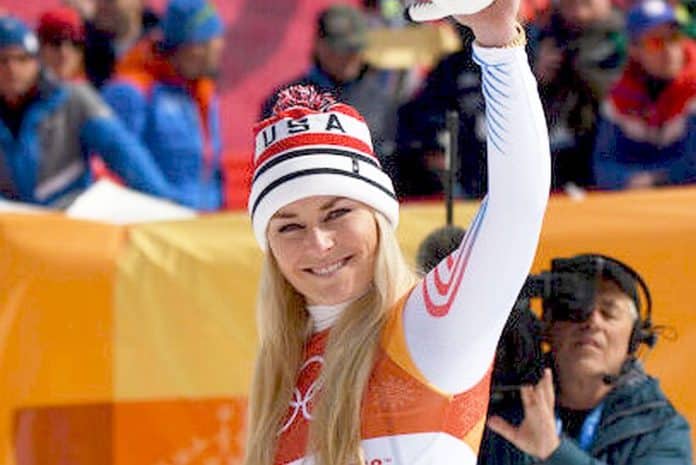
The Winter Games are winding to the close, but an important off-the-field development is worth noting. It was the election of former basketball great Pau Gasol (ESP) as the Chair of the International Olympic Committee Athletes’ Commission.
Gasol, of course, won two NBA titles while with the Los Angeles Lakers and at 45, will be the face of the Athletes’ Commission through the 2028 Los Angeles Games. The 7-0 scoring star was a five-time Olympian and three-time medal winner.
If the IOC’s political history informs us, he is also now someone to watch as a possible future head of the IOC.
Most IOC Presidents have not been Olympic athletes. But in 2001, Belgian sailor Jacques Rogge took over, then German fencer Thomas Bach and in 2025, swimmer Kirsty Coventry (ZIM). Coventry’s maximum term of 12 years will end in 2037, when Gasol will be 57.
Bach served on the first IOC Athletes Commission, formed in 1981. Coventry was the head of the Athletes Commission from 2018-21. Gasol was elected to the Athletes Commission in 2021 and is also a member of the IOC Coordination Commission for the LA28 Games. And he will see how it all works now, from a position on the IOC Executive Board.
There is a natural progression here. Don’t anoint him yet. But recognize that Gasol is an emerging leader in the Olympic Movement and standing 7-0, he literally towers over many others who see themselves as possible future heads of the IOC.
He also won’t have to be concerned with questions about salary or subsidies, as he earned a reported $224.45 million during his NBA career.
Gasol’s election is important and look for him to raise his profile the same way he played: with consistent effort, considerable skill and a keen understanding of what it takes to win and how he can contribute. ~ Rich Perelman
● The Rosen Report ● American Olympic figure skating champion Alysa Liu was “calm, happy and confident” on the way in her historic Free Skate performance in Milan. More on Liu and her life-changing night on the ice.
● Il Tempo Olimpici ● Saturday’s Milan weather is for partly sunny skies with a high of 56 F and a low of 38 F, with modest winds of 4 miles per hour and only a 10% chance of rain.
In Cortina, more snow is predicted, possibly complicating the schedule, with a high of just 33 F and a low of 22 F. Winds are to be 6 miles per hour, which will add to the cold. Cloudy skies and a high of 40 F is projected for Sunday, if needed.
● Scoreboard ●Norway continues its impressive march to the top of the medal table for the third Winter Games in a row. The Norse won 39 medals at PyeongChang 2018 and 37 at Beijing 2022 and are certainly not done for 2026:
● 37: Norway (17-10-10) ● 29: United States (10-12-7) ● 27: Italy (9-5-13) ● 24: Japan (5-7-12) ● 22: Germany (6-8-8)
● 20: France ● 18: Netherlands ● 18: Austria ● 17: Switzerland ● 17: Canada
This is the most golds ever for Norway at a Winter Games and the most golds ever won by one country at a Winter Games. The U.S. now has its third-highest Winter medal total ever and highest ever outside of North America. The 10 gold equals the most ever for the U.S. at a Winter Games, also in 2002 in Salt Lake City. And there are two days to go.
A better indication of team performance has to go beyond three places, so The Sports Examiner returns our eight-place scoring, using the NCAA track & field format of 10-8-6-5-4-3-2-1 to score each event. After 15 days, the top 12:
● 450.5: Norway ● 388.5: United States ● 341.5: Italy ● 278: Germany ● 274.5: France
● 242.5: Austria ● 242.5: Japan ● 232: Canada ● 220.5: Switzerland ● 217: Netherlands
● 181: China ● 169: Sweden
The top 1-8 place winners are now the U.S. with 81, Norway with 80, then Italy with 70, France with 57 and Germany with 56.
● Television ●NBC said that Thursday’s combination of the women’s figure skating Free Skate and women’s hockey final produced an average of 26.7 million viewers for its afternoon and evening prime-time programming blocks, according to preliminary data for NBC, Peacock, NBCU Digital Platforms and Versant’s USA Network. As for the Games as a whole:
“Through Thursday, the Milan Cortina Winter Olympics is averaging 24.1 million viewers on NBC, Peacock, NBCUniversal Digital Platforms and Versant’s CNBC and USA Network – marking the most-watched Winter Games presentation at this point since the 2014 Sochi Olympics.”
● International Olympic Committee ● IOC President Coventry told reporters on Friday the Milan Cortina Games “successful in a new way of doing things, in a sustainable way of doing things, in a way that I think many people thought that maybe couldn’t be done well, and it’s been done extremely well, and it surpassed everyone’s expectations, and that’s what we need to take away the Games.”
Asked about the impact of the Games in view of political issues that have come up around them, Coventry noted:
“I think that when we look at just the pure viewership numbers that we’re getting across the globe, it shows that the Games can unify people, and they can bring people together. And I wholeheartedly still believe that we have a huge role to play in this world to allow for that to still happen, to remind of people of just what kindness looks like and what courage looks like, and respect looks like.”

Coventry was asked about a possible return of Russia to the Olympic Movement, so far limited to “neutral” status for a limited number of athletes. She explained during her Friday news conference that no discussions concerning Russia’s status have been held and none are scheduled.
● Fair Play ●A special ceremony was held on Monday (16th) at the “German House” in Cortina during the Games to honor the memory of Italian bobsled star Eugenio Monti, the 1956 double silver medalist, 1964 double bronze medalist and 1968 double Olympic champion, for whom the old sliding track in Cortina was named and for whom the new track has also been named.
Among those participating was Prince Albert IIof Monaco, member of the International Olympic Committee, who told attendees:
“It is a profound honor to be in Cortina today to celebrate the enduring legacy of Eugenio Monti. For those of us who have lived the speed and intensity of bobsleigh, Monti is more than a champion; he is the soul of the sport. His legendary act during the 1964 Innsbruck Games – handing a crucial bolt from his own sled to his [British] rivals so they could compete – remains the ultimate gold standard for sportsmanship. To be here in Cortina, the very ground where his journey began and where his spirits still resides, accentuated by the fact that the sliding center is named after him, is a powerful reminder that while medals may tarnish, the integrity of a fair competitor is immortal.
“As an Honorary Member of the International Fair Play Committee (CIFP) and a five-time Olympian in bobsleigh, I have always believed that the ‘finish line’ is secondary to how we run the race. The sport of bobsleigh requires a unique blend of courage, technical precision, and, above all, mutual respect. We are not just competing against the clock or each other; we are stewards of a tradition that demands we lift one another up. The CIFP exists to protect this heartbeat of the Olympic movement, ensuring that the values of fairness and solidarity are never sacrificed at the altar of victory.”
CIFP President Sunil Sabharwal (USA) added:
“Eugenio Monti’s moment in 1964 was more than a gesture; it was a defining pivot for international sport. As President of the CIFP, my mission is to ensure this legacy is not just remembered, but transformed. We want the next generation of athletes to see that true meaning in sport comes from respect. By embedding these values today, we ensure that the youth of the Milano Cortina 2026 Games and beyond understand that winning with honor is the only way to truly win.”
● Olympic Games 2032: Brisbane ●The Australian Financial Reviewreported that Commonwealth Bank Australia is set to be announced as the first major sponsor of the Brisbane 2032 organizing committee, sometime in the second quarter.
The deal was noted to cost in the range of A$200 million for the six-year term to 2032, about $141.74 U.S. at current rates.
● Olympic Games: Future ● German President Frank-Walter Steinmeier indicated Thursday that he was in favor of a German bid for the 2040 or 2044 Olympic Games, but not for 2036, the centennial of the infamous “Nazi Games” of 1936. A spokesman said a 2036 bid and possible hosting would be “historically problematic.”
His concerns are not universally felt in Germany, as others are in favor of a 2036 Games. The German Sports Confederation (DOSB) has interest from four regions, with a decision on a bidder due in September 2026.
● Russia ●The New York Times published a story on Friday stating that Russian Anti-Doping Agency head Veronika Loginova was involved in covering up doping test results in 2014, during the 2011-15 state-sponsored Russia doping program, and that the World Anti-Doping Agency had received information on this from a whistle-blower.
“These fantasies, based on a desire to promote ‘hot facts,’ apparently to boost sales, are not true. I know that the N.Y. Times is downsizing, and journalists are chasing such fake news. During the 2014 Olympic Games, I was responsible for the educational program and a member of the WADA team. I had no potential exposure to the anti-doping lab’s operations, much less influence the collection of doping samples and their subsequent analysis.
“All the facts of my activities during the preparation and conduct of the 2014 Olympic Games in Sochi are known to WADA representatives and other employees from other countries’ anti-doping agencies involved in the Olympics. These facts have never, under any circumstances, aroused any suspicion. I am considering taking a strong response to any offensive or defamatory publications.”
= RESULTS: FRIDAY, 20 FEBRUARY = (7 finals across 5 sports & disciplines)
● Biathlon: Men’s 15 km Mass Start The men’s program finished with a second gold for Norway, as Johannes Dale-Skjevdal, the 2021 Worlds Mass Start runner-up, took advantage of perfect shooting to earn the victory in 39:17.1 over teammate Sturla Holm Laegreid, who won a medal in all five men’s and mixed events, taking silver in 39:27.6 (1).
France’s Quentin Maillet Fillon(FRA) won a third medal, the bronze in 39:42.7 (4), by almost 10 seconds. Campbell Wrightwas the lone American, in 27th (45:14.0/7).
The men’s biathlon competition turned out to be the exclusive property of three countries: Norway (2-4-2), France (2-1-2) and Sweden (1-0-1). No one else won medals. Five countries have won medals so far in the women’s events, with the Mass Start on tomorrow.
● Freestyle Skiing: Men’s Aerials; Men’s Halfpipe; Women’s Ski Cross The men’s Aerials final came down to a China vs. Switzerland duel as four Chinese jumper and two Swiss made the final … and no one else!
Both countries got on the podium, as Xindi Wang, 30, won his first major championship medal by scoring 132.60 points in the medal final, edging two-time Swiss World Champion Noe Roth, at 131.58.
Third was China’s Tianma Li, like Wang, a World Cup event winner this season. Li scored 123.93 for the bronze, barely ahead of teammate Jiaxu Sun, at 123.42.
It’s China’s second Olympic win in a row and Chinese jumpers have now won a medal in this event in six straight Games. Roth got the first Swiss medal in Aerials since the first Games in which it was held, back in 1994!

In the men’s Halfpipe, only Americans and New Zealanders have won this event in its three Olympic appearances.
American Alex Ferreira, the 2018 silver medalist and 2022 bronzer, had a strong run going in the first round, but had some errors that caused a score of 49.50. In fact, only Andrew Longino of Canada scored more than 70 points and was the leader at 76.50. No way that was going to be good enough for gold.
In round two, American Birk Irving grabbed the lead at 87.50, but Estonia’s 19-year-old Henry Sildaru exploded onto the lead at 92.75 and looked like a possible winner. He took over from Ferreira, who had popped a 90.50 and ended the round in second place.
The final round saw Irving improve to 88.00, but he was still fifth. The top four in the standings were the last four to go, with Ferreira up at no. 9 and soaring into the lead with a splendid 93.75 and three men left to challenge.
Sildaru at no. 10 was up for it and scored 93.00, but still in second. American Nick Goepper, the 2025 Worlds silver winner, scored 89.00 in round two and did not improve, but he was standing third with only Canada’s Brendan Mackay left.
Mackay, the 2023 World Champion, had scored only 37.75 and 53.00 on his first two runs, but was in full form and was rewarded with a 91.00 score and the bronze medal, over Goepper.
This makes three U.S. wins out of four times this event has been held at the Games and the first medal for Estonia!
Goepper was fourth, Irving was fifth and Hunter Hess finished 10th at 58.75 as the other Americans finalists behind Ferreira, who now has a full set of medals, finally adding a gold.

The expected stars of the women’s Ski Cross advanced right to the final, with defending champion Sandra Naeslund (SWE) and 2025 Worlds bronze medalist Daniela Maier, who also won the 2022 Olympic bronze.
They were accompanied by 2022 co-bronze winner – and two-time World Champion – Fanny Smith (SUI), and French star Marielle Berger Sabbatel. Off the start, Naeslund skied well, but was overtaken by Maier and Smith and Maier had the edge to the finish over Smith by 0.14, and the gold medal. Naeslund settled for bronze.
So, the co-bronze winners from 2022 were 1-2 in 2026, with champion Naeslund in third. It’s the first gold for Germany in this event and the third straight for Smith: bronze-bronze-silver.
● Short Track: Men’s 5,000 m relay; Women’s 1,500 m The Netherlands won one medal in Short Track at the 2014 Winter Games, then four each in 2018 and 2022. In Milan, they went wild, with five golds, a silver and a bronze to lead all nations. One of those wins was in the men’s relay.
Defending champion Canada fought with South Korea for most of this race, but it was the Dutch took control in the late stages and with three laps to go and skated away with the gold medal in an impressive show of pacing, tactics and speed in 6:51.847, with Jens van’T Woutwinning his third gold to go along with one bronze, dominating the meet.
South Korea edged Italy for the silver on the final lap, 6:52.239 to 6:52.335, with defending champion Canada in fourth (6:52.425).

In the women’s 1,500 m, the semifinals produced multiple crashes, but the fastest times belonged to two-time Olympic champion Min-Jeong Choi (KOR) at 2:20.984 and American Corinne Stoddardat 2:21.042, both from semifinal three. But Italian Arianna Fontana was also qualified, looking for a historic 15th medal to tie for the most in Winter Games history.
Stoddard took the lead in a slow-starting event, with Fontana second, but the pace quickened on the second lap. Choi moved up to second with six laps left, then 2024 World Champion Gil-li Kim moved onto the inside into third. Choi and Kim rolled into the lead with two laps to go, them Kim accelerated into the lead at the bell and held on to lead the Korean 1-2 at 2:32.076 and 2:32.450.
Stoddard was third at the bell and she held off China’s Jingru Yang for the bronze, 2:32.578 to 2:32.713. Fontana was fifth in 2:32.783.
It was the first U.S. Short Track Olympic medal since 2018 and only the fifth women’s individual medal ever, the last in 2010 from Katharine Reutter in the 1,000 m. Stoddard’s bronze – especially sweet after her earlier crashes – is the first American medal ever in this event (Stoddard pictured below; TSX photo by Karen Rosen):
The Koreans extended their win streak in the 1,500 to three straight Games and five out of seven all-time.
● Speed Skating: Women’s 1,500 m The first skater, 500 m champion Femke Kok (NED) – skating alone – set the pace with a fast 1:54.79 time that stood up through the 10th pair! It took that long for Canadian Valerie Maltais – the 3,000 m bronzer – to take the lead with an impressive 1:54.40 time.
Two more pairs passed until Norwegian Ragne Wiklund, the 2021 World Champion in this event and the 3,000 m runner-up, got on the track and she pushed hard in the middle of her race and crossed in 1:54.15 to take the lead, with two pairs to go.
Antoinette Rijpma-de Jong (NED), the 2025 Worlds silver winner, was matched against American star Brittany Bowe, 37, the 2015 World Champion at this distance. Bowe was out hot, but Rijpma-de Jong finished better and timed 1:54.09, a track record to 1:54.70 for Bowe, in fourth.
The final pair had 2024 World Champion Miho Takagi, who started very fast and looked like a possible winner, but faded on the final lap and her 1:54.87 time placed her sixth overall. Greta Myers of the U.S. finished 29th in 1:59.81.
Rijpma-de Jong was a contender coming in, but won with a superior final lap, helped by Bowe’s challenge. She’s the fifth straight Dutch winner in this event and she moved up from bronze at Beijing 2022. Wiklund won the first Norwegian medal in this event ever, and Maltais won Canada’s first medal in this event since 2010.
Bowe, in her last Games, finished fourth, as she did in the 1,000 m and Team Pursuit. She has been one of the best-ever American skaters, with two Olympic bronzes and 13 World Single Distance Championships medals, including four golds, from 2013-24.
Elsewhere:
● Curling:Switzerland and Yannick Schwaller(9-1) faced off with Magnus Ramsfjelland Norway (5-5) in the bronze-medal game for the men. Schwaller’s squad got off to a 4-0 lead with three in the second and one in the third. It was 4-1 after the fifth, but the Swiss added two in the eighth and one in the ninth for a 9-1 victory and third place overall.

The women’s semifinals had dominant performances from the Swedes and the Swiss.
Sweden’s Anna Hasselborg, the 2018 gold medalist and 2022 bronzer, had her rink in top form, scoring two in the sixth end for a 4-2 lead on three-time World Champion Rachel Homan and Canada and the Swedes followed through to a 6-3 win and into the gold-medal final.
The U.S. beat the Swiss in 11 ends to reach the semis and then play Silvana Tirinzoni’s four-time World Champions once again. Tabitha Peterson’s U.S. rink took a 1-0 lead, but it was 4-2 for Switzerland after four. The U.S. closed to 5-4 after nine, but two in the 10th gave the Swiss a 7-4 win and advanced to the gold-medal match on Sunday.
Canada and the U.S. will play for bronze tomorrow.
● Ice Hockey:The first men’s semifinal was a doozy, with Finland ahead of favored Canada by 1-0 after the first period, then getting a short-handed goal from Erik Haula to lead 2-0 just 3:26 into the second period.
But the Canadians fought back and closed to 2-1 by the end of the second and then tied it at 10:34 of the third on a Shea Theodore score. The Finns suffered a penalty at 17:25 of the third for high sticking and a determined Canadian attack paid off as Nathan MacKinnon got a go-ahead score at 19:24 and that turned out to be the 3-2 winner. Canada’s 39-17 shots edge was barely enough to get by and into the final.
The U.S. played Slovakia in the second semi, and Dylan Larkin have the Americans a 1-0 lead at 4:19 of the first period and then Tage Thompson scored on a power play at 19:19. The Americans blew it open in the second period with scores from Jack Hughes at 12:14, then Jack Eicheljust 19 seconds later (12:33) and Hughes again at 18:24 for a 5-0 scoreline after two (and a 26:13 shots advantage).
In the third, Slovakia got a goal from Juraj Slafkovsky at 4:55 of the period, but the U.S. responded with a Brady Tkachuk score at 10:52 for a 6-1 edge. Pavol Regenda (SVK) scored the final goal of the game at 13:17 and, after some physical play in the final few minutes, ended at 6-2. The Americans ended with a 39-24 shots advantage.
Slovakia will play Finland for the bronze and the U.S. and Canada will face off for the gold on Sunday. It had to be.
= PREVIEWS: SATURDAY, 21 FEBRUARY = (10 finals across 7 sports & disciplines)
● Biathlon: Women’s 12.5 km Mass Start The two Mass Start races in the IBU World Cup this season were won by Norway’s Maren Kirkeedie – the Olympic Sprint winner – and France’s Julia Simon, the 15 km Individual gold medalist. In those races, Olympic Pursuit champ Lisa Vittozzi(ITA) won a bronze and 2026 medal winners Oceane Michelon(FRA: Sprint silver) and Lou Jeanmonnot (FRA: Individual silver) also won medals.
So did defending Olympic champion Justine Braisaz-Bouchet, making this final event a sort of “all-star” showdown.
You can add in Sweden’s relay silver winner Elvira Oeberg as well; she won the 2025 World Championships gold, over Michelon and Kirkeedie. Braisaz-Bouchet won the 2024 Worlds, over Vittozzi and Jeanmonnot. And Hanna’s sister Elvira, won the 2023 Worlds gold.
So it has to be one of these stars who will win, right? Maybe; do not count out Finland’s Pursuit winner Suvi Minkkinen!
● Bobsled: Two-Woman One of the great showdowns in Olympic history is in this event, with two-time Olympic champion – when with Canada – Kaillie Armbruster Humphriesof the U.S., four-time Olympic medalist Elana Meyers Taylor of the U.S. and German star Laura Nolte, the defending champion.
Nolte and fellow pilots Kim Kalickiand Lisa Buckwitzwent 1-2-3 at the 2025 Worlds; Buckwitz won in 2024 and Kalicki won in 2023. During the 2025-26 IBSF World Cup season, Nolte was dominant, winning five of the seven races (with Deborah Levi), with Armbruster Humphries winning the other two with Emily Renna.
German sleds won 14 of the 21 World Cup medals this past season, the U.S. took six and Melanie Hasler’s Swiss sled took one. While Meyers Taylor did not medal, that also did not stop her from winning the Monobob. And Kaysha Love of the U.S. won two silvers and is fully capable of a surprise.
It didn’t all go to plan on the first two runs on Friday. Armbruster Humphries and Jasmine Jones had the lead after the first round, then were fourth after round two and it was Nolte and Levi at 1:53.93, then Buckwitz and Neele Schuten at 1:54.11. as the top two Armbruster and Jones are third at 1:54.16, with Love and Azaria Hill fifth at 1:54.55. Meyers Taylor and Jadin O’Brien stand 12th at 1:55.13.
● Cross Country Skiing: 50 km Classical Can Norway’s superstar, Johannes Hoesflot Klaebo, complete his sweep of the men’s events?
He has five golds in five events, echoing the six golds he won at the 2025 World Championships, where he won the 50 m (31.1 miles) race in 1:57.47.1, just a couple of seconds up on Swede William Poromaa(1:57:49.2) and eight seconds ahead of teammate Simen Krueger (1:57:55.6).
A 50 km race is usually held only once during the FIS World Cup season, coming up in Oslo (NOR) on 14 March. Klaebo won the 2025 season 50 km, held in Lahti (FIN), leading a Norwegian sweep with Martin Nyengetand Krueger 2-3. This could happen again.
Klaebo also won the Oslo 50 km World Cup in 2024, again over Nyenget, with Erik Valnes third for another Norwegian sweep.
Beyond the Norwegians, Swede Edwin Anger won 20 km Mass Start and Pursuit World Cup bronzes this season, but in four World Cup races of all styles at 20 km, Norway won 10 or the 12 medals available.
Klaebo has 10 career Olympic golds, more than anyone else in Olympic Winter Games history. If he wins his 11th, and sweeps his six events, it will be the most ever in a single Games, passing American Eric Heiden’s five speed skating golds in 1980 in Lake Placid, New York.
● Curling: Men’s final Canadian skip Brad Jacobs was the 2014 Olympic champion and is back to the final with a new rink, after going 7-2 in the round-robin and then edging Norway, 5-4, in the semis.
Against them is Bruce Mouatand Great Britain, normally representing Scotland, but part of the British team at the Olympic Games. His rink was the Beijing 2022 runners-up and has the same line-up. Mouat’s Scots won the World Championships in 2023 and 2025, but were just 5-4 in the round-robin.
In the one match between them so far, Jacobs scored a 9-5 win on the 17th, scoring in six of the nine ends. Jacobs’ rink has been consistent in Cortina, and that makes them a slight favorite over the reigning World Champions.
● Freestyle Skiing: Men’s Ski Cross; Women’s Halfpipe, Mixed Team Aerials Switzerland’s Ryan Regez won the Beijing 2022 Olympic title and the 2025 World Championships gold. He’s in, but didn’t win a medal on the World Cup circuit this season.
Instead, the big winner has been Canada’s Reece Howden, with four wins and 2023 World Champion Simone Deromedis, with two wins. German Florian Williamson, a 2023 Worlds silver winner, scored a win and two silvers. They have been the stars of this season.
That doesn’t mean they will win, or even medal. Beijing 2022 silver medalist Alex Fiva(SUI) won a World Cup silver this season and German Tim Hronekwon two. Under the radar are Sweden’s Erik Mobaerg, a two-time Worlds bronzer in 2021 and 2023, and brother David, a World Cup medalist this season.

China’s Eileen Gu was a spectacular winner of this event in 2022, over 2018 gold medalist Cassie Sharpe (CAN) and teammate Rachel Karker. Since then, Karker (2023) and Sharpe (2025) both won Worlds bronzes.
At the 2023 Worlds, it was Britain’s Zoe Atkin second, and Atkin moved up to Worlds gold in 2025. China’s Fanghui Litook the 2025 Worlds silver, and Gu, Atkin and Li all won World Cup events this season.
In the qualifying round, Atkin put up 91.50 right away and qualified first, with Li at 85.00 and 90.00. Sharpe (88.25), Gu (86.60) and World Cup medalist Svea Irving of the U.S. made it in at 80.75.
Qualifying fourth was the wild card, Australia’s Indra Brown (87.50). At age 16, she won a World Cup gold, silver and bronze in four events this season. She is dangerous.

This is the second time in the Games for the Mixed Team Aerials, with the U.S. back to defend its 2022 title with a strong team. Chris Lillis returns from the 2022 Olympic winners and has been part of the 2023 World Champions (also with Quinn Dehlinger) and the 2025 World Champions (with Dehlinger and Kalia Kuhn).
The U.S. certainly rates as a medal favorite, but China has Olympic Aerials women’s winner Mengtao Xuand veteran Guangpu Qi, on their 2022 Beijing silver winners. Ukraine has medaled in the last two Worlds and has proven veterans in Oleksandr Okipniukand Dmytro Kotovskyi and the Swiss have medals at the 2021 and 2025 Worlds, with Noe Roth and Pirmin Werner on the team, then and now.
● Ski Mountaineering: Mixed Relay Lots of familiar names from the Sprint medal stand at the 2025 World Championships, as France’s Emily Harrop(Olympic silver) and Thibault Anselmet (Olympic bronze) won, ahead of Spain with Sprint winner Oriol Cardona Coll and Ana Alonso Rodriguez (Olympic bronze).
Third was Switzerland, with Sprint winner Marianne Fatton and Robin Bussard, and those three teams looked poised to share the podium again.
Looking for upset are the 1-2 finishers from the early December ISMF World Cup in Solitude, Utah: Anna Gibson and Cameron Smith of the U.S. and Italy (of course) with Michelle Boscacci and Alba De Silvestro.
● Speed Skating: Men’s Mass Start; Women’s Mass Start The Mass Start races are always the most fun, since the racers are together for a change. In the men’s race, the one constant in this event has been Belgian Bart Swings.
He’s the 2018 Olympic silver medalist, 2022 gold medalist and a two-time World Champion in 2023 and 2024. He’s a favorite.
Also in the mix is Italian Andrea Giovaninni,who had a first and two thirds on the World Cup circuit this season and is the reigning World Champion. Dutch star Jorrit Bergsma, the 2014 Olympic 10,000 m champ and 2026 bronze medalist, was best on the World Cup tour, winning twice.
Two others won World Cup races this past season and are both dangerous. Czech teen Metodej Jilek, the Olympic 10,000 m winner and 5,000 m silver man, won the last World Cup prior to the Games.
American Jordan Stolz, the 500 and 1,000 m and 1,500 m silver medalist, competed four times on the World Cup tour and won once and was third once. He likely has the best flat speed in the field and in a race of positioning and acceleration, he is certainly equipped to win.
This should be great.

The women’s Mass Start has been dominated by Dutch ace Marijke Groenewoud, the 2021, 2023 and 2025 World Champion, and a two-time winner and two-time runner-up on the World Cup circuit.
But Beijing Olympic runner-up and 2025 Worlds runner-up Ivanie Blondin (CAN) is ready to challenge, as is Italian star Francesca Lollobrigida. She’s already won the 3,000 and 5,000 m golds and earned the Beijing 2022 Olympic bronze. She had only modest success on the 2026 World Cup tour, however.
Canada’s 1,500 and 3,000 m bronzer, Valerie Maltaisshould be a factor; she had two seconds in World Cup races and was very competitive.
But that still leaves out the World Cup winner this season: American Mia Manganello. In five races, she won once, was second once and third twice. She was fifth at the 2025 Worlds and this has been her best season. At Beijing in 2022, she missed the podium by 1.17 seconds, finishing fourth. Is this her year?

★ Receive our exclusive, weekday TSX Recap by e-mail by clicking here.
★ Sign up a friend to receive the TSX Recap by clicking here.
★ Please consider a donation here to keep this site going.
For our updated, 45-sport, 910-event International Sports Calendar for 2026 and beyond, by date and by sport, click here!
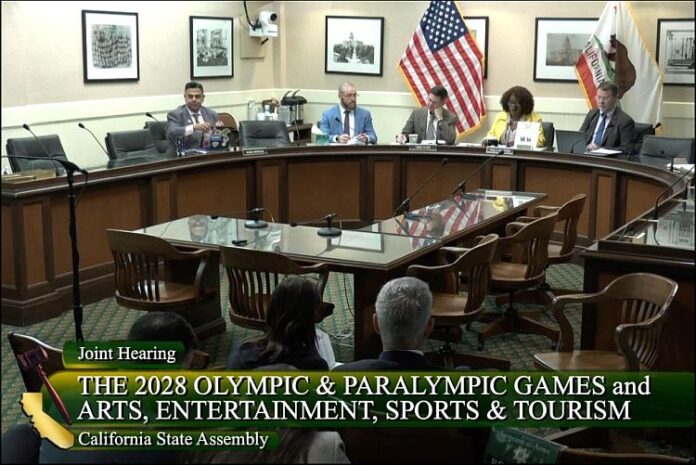
Olympic women's figure skating champion Alysa Liu of the U.S. (Photo: Wikipedia via YantsImages)
★ The Sports Examiner: Chronicling the key competitive, economic and political forces shaping elite sport and the Olympic Movement.★
★ To get the daily Sports Examiner Recap by e-mail: sign up here! ★
≡ THE ROSEN REPORT ≡
MILAN, Italy – Alysa Liu brought the fun back to U.S. figure skating, punctuating a dynamic Olympic performance by pointing toward the sky and flipping her ponytail at center ice.
Pressure? What’s that?
“The feelings I felt out there were calm, happy and confident,” she said. “Of course I had fun. But I’ve been having fun all the time. This experience is really cool, and the past two nights, I got to see my siblings and my friends, had dinner with them. It was super fun.”
Wearing a gold dress that matched the gold stripes in her two-toned hair, Liu further accessorized with the first gold medal by an American woman since Sarah Hughes in 2002 and the first medal of any kind since Sasha Cohen‘s silver in 2006. That drought had been felt keenly in light of 17 U.S. medals – seven gold – from 1956-2006.
“I don’t need this,” Liu said, “but what I needed was the stage. And I got that. So, I was all good no matter what happened. If I fell on every jump, I would still be wearing this dress. So it’s all good.”
The 20-year-old Californian didn’t fall on any jump, the dress twirling exquisitely. And Liu posted the highest score in the Free Skate (a season-best of 150.20) to move from third place following the Short Program to first. She leapfrogged over Japan’s three-time World Champion Kaori Sakamoto, who remained in second place and 17-year-old Ami Nakai, who led the Short Program, but fell to third following a flawed Free Skate.
Liu made sure the crowd at the Milano Ice Skating Arena was enjoying her routine as much as she was. Liu smiled as she landed difficult jumps to the beat of Donna Summer‘s rendition of “MacArthur Park.” She also showed off the mouth piercing – which she did herself – and calls her “smiley.”
Fellow skaters watching the competition from their seats near the rafters clapped along loudly. When Liu was finished, she had to wait in a white armchair while the two Japanese skaters took the ice. She couldn’t keep a poker face, still smiling, and then jumped out of her chair to chat with teammate Amber Glennuntil an official made her sit down again. When the final scores were announced and Liu realized she won, Glenn said, “She was in disbelief.”
Liu even skated out for the victory ceremony and made a hand gesture like, “Who would have thought?”
While IOC president Kirsty Coventry (ZIM) awarded her the gold medal, fellow U.S. Olympic champions Dorothy Hamill (1976), Brian Boitano (1988) and Kristi Yamaguchi (1992) stood together at the railing and held up their phones to record the moment like two proud aunts and an uncle.
And to think Liu retired after her first Olympic experience in 2022, where she finished sixth. About 18 months ago, she was ready to return on her terms, culminating with an Olympic gold medal (actually two counting the team competition).
Liu also won the first medal by a U.S. woman in singles since Sasha Cohen took silver 20 years ago. She had already broken a world championships drought in 2025 when she won the first gold at the event since Kimmie Meissnerin 2006.
Nathan Chen, the 2022 Olympic men’s champion, told The Sports Examiner on the eve of the competition, “The thing that’s so cool about her is that she has no pressure. She doesn’t think about or conceptualize pressure in the way that I do. She’s just out there to have fun and really enjoy the experience. And as a result, the best performances come out of that.
“I think that she has a really golden opportunity to look back at this experience and say, ‘I just had the best time of my life.'”
Liu would probably agree that’s the case. As she held court with the media following the Free Skate, she bounced up and down while answering questions.
“No matter what happens in my life, I think I have a beautiful life story,” she said, “and I feel really lucky and I’m glad that a lot of people are now watching me so I can show them everything that I’ve come up with in my brain, share my stories. I want to be a storyteller of sorts.”
Liu’s father, Arthur, fled China for a better life in the U.S. Alysa started skating at age 5 and was a national champion as a cute-as-a-button 13-year-old.
While Chen was finding redemption in Beijing following a below-expectations showing at his first Games in 2018, Liu was losing her love of the sport.
“I am grateful for both Olympic experiences,” Liu said, “but I feel like I am more gracious now because I have stuff that I want to share and I want to be here. And I think that’s the difference from last time.”
She likes being here so much she’d like to stay longer. “I wish there was another event we could do,” Liu said. “I want to be out there more.”
Well, there is the “gala” on Saturday. “I have a program that I really am excited to show,” Liu said. “It’s a really cool dress, unlike any dress I have, so I’m super stoked for that.”
She knows that all eyes will be on her as the new Olympic women’s champion. The message she would share, Liu said, “I guess it’s doing stuff that people tell you that you shouldn’t do. I’ve been doing a lot of that.”
She also advises people to find a really good team, like her two coaches,Phillip DiGuglielmo and Massimo Scali, and her family and friends, who she said, “bring me joy.”
Liu joins an exclusive club of U.S. female figure skating championships that started 70 years ago with Tenley Albright(1956) and includes Carol Heiss (1960), Peggy Fleming (1968), Hamill, Yamaguchi, Tara Lipinski– an NBC commentator for the Milan competition – and Hughes.
“I’m really honored and they are incredible athletes,” Liu said. “Incredible athletes get these medals …. So, I’m just so grateful to be an athlete. I really love this life.”

★ Receive our exclusive, weekday TSX Recap by e-mail by clicking here.
★ Sign up a friend to receive the TSX Recap by clicking here.
★ Please consider a donation here to keep this site going.
For our updated, 45-sport, 910-event International Sports Calendar for 2026 and beyond, by date and by sport, click here!
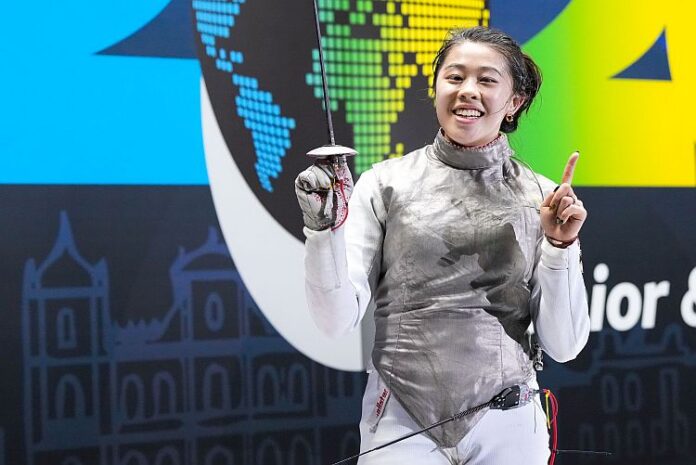
International Olympic Committee President Kirsty Coventry (ZIM) at her 20 February 2026 news conference in Milan (IOC video screen shot).
★ The Sports Examiner: Chronicling the key competitive, economic and political forces shaping elite sport and the Olympic Movement.★
★ To get the daily Sports Examiner Recap by e-mail: sign up here! ★
≡ COVENTRY ON THE GAMES ≡
Always near the end of an Olympic Games, a news conference gives the International Olympic Committee President an opportunity to pronounce their feelings on what has transpired. IOC chief Kirsty Coventry (ZIM) opened her Friday session this way:
“I hope that you’re having a good couple of weeks and have managed to get out into these incredible venues and watch and experience the amazing atmosphere that Milano Cortina team have created for every single one of us.
“I have had the honor and privilege of traveling around in a beautiful Italian country and got to spend some time with athletes in all of the Villages and get to watch some magnificent performances around.
“I don’t think you can leave these Games without being inspired by what we’re seeing on the field of play.
“So, I really want to thank the Milano Cortina team, across all the venues, and all the Villages; really, it’s been amazing.”
She was asked about her evaluation of this wide-spread Games, in Milan and the mountains; she brought it back to the athletes:
“I’ve had the opportunity to go to all of the venues, across these Games and Villages, and the athletes are extremely happy. And they’re happy because the experience that the MiCo team and my team delivered to them have been the same.
“So we really tried very hard, and I have to thank the MiCo organizing committee for hearing from our Athletes’ Commission that the one thing that would be really important to the athletes of a widespread Games was to ensure that the experiences in each of the Villages would be exactly the same.
“And I’ve gone to every single Village and just about all the venues, and they are exactly the same. And I spent some time with some athletes in Cortina, who said they think that their experience in the opening ceremony was actually better than walking into the stadium, because they got to be so close with everyone in a small city, and they got to engage.
“And they were sharing some of the highlights with me, of seeing little kids from the windows, and they were waving and smiling, and they got to like run down and high-five them. You know, when you’re walking into a big stadium, you don’t get that close to the spectators, so they loved the fact that the team worked really hard on ensuring the experiences were not just going to be the same, but even better.”
She called the Milan Cortina Games “successful in a new way of doing things, in a sustainable way of doing things, in a way that I think many people thought that maybe couldn’t be done well, and it’s been done extremely well, and it surpassed everyone’s expectations, and that’s what we need to take away the Games.”
Asked about the impact of political issues drowning out the message of the Games, Coventry noted the audience the Games has generated:
“I think that when we look at just the pure viewership numbers that we’re getting across the globe, it shows that the Games can unify people, and they can bring people together. And I wholeheartedly still believe that we have a huge role to play in this world to allow for that to still happen, to remind of people of just what kindness looks like and what courage looks like, and respect looks like.”
She also pointed to the lessons everyone can learn from the athletes and what they demonstrate on and off the field of play:
“Last night, it was just the sweetest thing to watch the last figure skater – the Japanese figure skater [Ami Nakai, 17] – and she’s waiting for her scores, and I think we all realized she came third before she realized it, and then she realized it and she looked over to Alysa [Liu, 20], who had won gold, and she was like ‘oohhh’ and they ran up and hugged, and that is the best thing, right?
“They have so much respect for each other. They are inspired by each other, each other’s performances. And that, for me, is the greatest sign of everything: of peace, of unity, of respect. They choose to respect each other; it doesn’t matter where they come from.
“You have seen that on every single field of play across these Games, and I think that is truly just incredible. It’s why we’re sitting here. It’s why we have thousands of people, thousands of volunteers, thousands of staff on the MiCo, on the IOC team, thousands of broadcasters sharing these stories, these images. It’s what reminds us, hopefully, to be better humans, right?
“If you don’t want to walk away from watching that, and be like, ‘I’m going to be a better person,’ then maybe, yeah, we need to think about what choices we’re making. Because I don’t think you can not watch that and not want to walk away inspired by what they’re showcasing for us.”
So what how is she feeling about her first Games as IOC President?
“My first impression is that it goes very quickly and I can’t believe we’re already at the end!”
Coventry was asked a series of questions about events, people and statements from outside the Games and either wasn’t familiar, or said they would be dealt with later.
Right now, she’s still enjoying the Games, which end on Sunday.

★ Receive our exclusive, weekday TSX Recap by e-mail by clicking here.
★ Sign up a friend to receive the TSX Recap by clicking here.
★ Please consider a donation here to keep this site going.
For our updated, 45-sport, 910-event International Sports Calendar for 2026 and beyond, by date and by sport, click here!
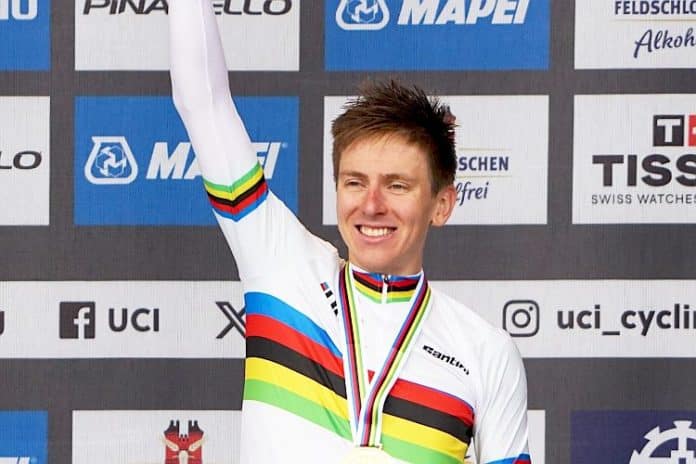
The Milano Cortina Olympic Winter Games are rushing to the close and will finish on Sunday. The worries about no snow have been unfounded; multiple competitions have been re-scheduled due to heavy snow in the Alps.
The venues that could not be finished were, at least enough to hold the competitions. And the hand wringing about a lack of interest turned out to be for nothing. The Games have not been a sell-out, but the organizing committee has met and surpassed its goal of 1.3 million tickets sold days before the close.
Italy, of course, has the most ticket buyers, but reports have consistently shown the U.S. as the top foreign ticket buyers, as much as 35% of the foreign sales, according to the early reports.
This is fairly amazing, considering the constant harping by media at the Games on U.S. political divisions. Yet, for the women’s hockey final on Thursday, attendance was reported at 11,171 at the new Santagiulia Arena – a full house – with the camera pans showed American and Canadian fans all over the place.
That kind of support says a lot about the Olympic Games, and about sport. And it has helped the American team – the largest at the Games at 232 athletes – which has won 27 medals despite some stunning disappointments, and nine golds.
The 27 medals is one short of the record for the most U.S. medals at a Games outside of North America: the U.S. won 34 in Salt Lake City in 2002 and 37 in Vancouver (CAN) in 2010. The golds record is 10 from 2002 and that could be eclipsed.
The U.S. Olympic & Paralympic Committee believed that its team performance would be improved from 2022 and it has been, despite the upsets. And to reach 30 medals would be an outstanding achievement. One thing they can count on is support in the stands from fellow Americans. ~ Rich Perelman
● Rosen Report ● Correspondent Karen Rosen made the trek from Milan to the mountains, and back again. Her report on this spread-out Games, part of the challenge and the charm of the 2026 Winter Games is here.
● Il Tempo Olimpici ● The Milan forecast for Friday calls for sunny skies for a change and a balmy 63 F for the high, with a low of 39 F. Winds are projected at 8 miles per hour. Saturday is also supposed to be sunny.
In Cortina, mostly cloudy skies are expected, with a high of 31 F and a low of 21 F. Winds are moderate at 7 miles per hour and the chance of rain is only 20%. A touch of snow is possible on Saturday.
● Scoreboard ●The U.S. had a good day and surged into second place for total medals at the Games, with three days to go:
● 34: Norway (16-8-10) ● 27: United States (9-12-6) ● 26: Italy (9-5-12) ● 24: Japan (5-7-12) ● 21: Germany (5-8-8)
● 19: France ● 18: Austria ● 16: Netherlands ● 15: Sweden ● 15: Canada
Italy already has a record for the most medals ever (and most wins) at a Winter Games and the U.S. has surpassed its medal totals from Beijing 2022 (25) and PyeongChang 2018 (23). The Americans won 28 medals at Sochi 2014 (after the Russian doping disqualifications), the most ever for a Games outside of North America.
A better indication of team performance has to go beyond three places, so The Sports Examiner returns our eight-place scoring, using the NCAA track & field format of 10-8-6-5-4-3-2-1 to score each event. After 14 days, the top 12:
● 419.5: Norway ● 357.5: United States ● 327.5: Italy ● 261: Germany ● 260.5: France
● 242.5: Austria ● 237.5: Japan ● 210: Canada ● 194.5: Switzerland ● 192: Netherlands
● 163: Sweden ● 148: China
In terms of place winners from 1-8, Norway and the U.S. each have 75, followed by Italy (66), Austria (55), France (54) and Germany (53).
“Through Tuesday, NBC’s ‘primetime’ coverage of the Milan-Cortina Winter Olympics is averaging a combined 23.8 million viewers across a live afternoon window and primetime replay – a figure that combines a mix of preliminary and final Nielsen data with streaming viewership measured by Adobe Analytics — up 86% from the same point of the Beijing Winter Olympics four years ago (12.8M).”
● Milan Cortina 2026 update ● The organizing committee said 89,000 tickets were sold on Wednesday, meaning the total is well past 1.3 million so far.
● International Olympic Committee ●The evolving nature of the IOC’s Olympic sponsorship program was discussed on Wednesday morning, by Anne-Sophie Voumard (SUI), Managing Director of the IOC Television & Marketing Services group.
Asked about the expanding presence of TOP sponsors in product-placement situations – such as Proctor & Gamble’s Puffs facial tissues placed in the post-competition area in figure skating – she explained:
“We continue to look with every one of our partners: what are the opportunities for those partners to be organically be present and supporting us in the Games.
“It has been a very dynamic program. I would say it has been the most successful sports marketing program in the world and it needs to continue to evolve. You know, we have partners who have been here for almost 100 years, and we have partners – by the last time we were here in Italy [2006] – were companies that were not even created. So, it shows the agility of the program.”
She also noted that while there were 15 partners for the Paris 2024 Games and 11 now:
“We don’t have a [required] fixed number of partners. We want to make sure we bring the companies that actually help, that are aligned with our values, also that help us deliver great Games, and we will be looking always for those kinds of partnerships around the globe that complement, actually, that program.
“It’s also a balance that we have to be found, with also the number of partners that the organizing committees, or the categories that the organizing committees can then have in their program, and also the National Olympic Committees. So, it’s really balance to be found and we feel, really, I would say, in a good place with respect to the conversations we are having at the moment.”
● Alpine Skiing ●Following her dominating Slalom gold, American star Mikaela Shiffrin took to Instagram to share her thoughts, including:
“I won!
“I got there, in the face of fear and adrenaline and the potential for criticism and backlash from people who know nothing and don’t even try to understand.
“I won.
“I stood in the start gate, and looked out at the mountain and the course ahead and my heartbeat nearly fell out of my butt. Still, when the countdown started, I pushed. I pushed to chase, I pushed to earn. I pushed to dare and to dream. I pushed to believe.
“I won.
“I questioned all that I’ve learned in life, multiple times this week. I questioned what kind of grit I have in my heart and I wondered if I should be doing this at all. I questioned my toughness and tenacity. I questioned it all. And then I left those questions behind, and stepped into the arena anyway.
“I won.”
Shiffrin won Olympic golds in 2014 and 2018, but missed in 2022 and had finished out of the medals in the women’s Team Combined and the Giant Slalom, before her dominant Slalom triumph.
= RESULTS: THURSDAY, 19 FEBRUARY = (6 finals across 5 sports & disciplines)
● Figure Skating: Women’s Singles The Short Program left Japanese skaters in first, second and fourth, all to skate in the fourth group.
At the end of the second group of four, American Amber Glenn– in 13th – got to skate and landed an impressive, clean triple Axel to start. She moved elegantly on the ice, executed a three-element sequence perfectly in the middle of the routine, then had to put a hand down on her last jumping pass, a triple Loop. She was happy and the crowd roared; she said “so close” on the ice as she took in the cheers. She was rewarded at 147.52, a seasonal best that thrilled her and … put her into first place at 214.91, with 12 skaters remaining.
Fellow American Isabeau Levito, eighth after the Short Program, suffered a fall on a triple Flip on her first jumping pass, but was otherwise solid and athletic and received a big cheer in the hall. But the error hurt and she scored 131.96 and 202.80 in total, standing sixth.
And at the end of three groups, with six skaters to go, Glenn was still in front.
Russian “neutral” Adeliia Petrosian, 18, was fifth in the Short but fell on her first jumping pass on a quad Toe attempt, and toned her program down a little and gained momentum as she went. The performance was impressive and demonstrates that Russian skaters are still to be reckoned with. She scored 141.64 and a 214.53 total, and with four skaters left, Glenn was still on top.
Japan’s Mone Chiba, 20, came next and skated with technical grace and elegance, smiling with joy as she left the ice. She scored 143.88 and took the lead at 217.88.
World Champion Alysa Liuof the U.S. was next, and wowed the crowd to Donna Summer’s “MacArthur Park” and “One of a Kind,” with an expressive and brilliant program. She was thrilled with it, jumping into the arms of her coaches and scored a seasonal best 150.20 and took the lead at 226.79, a lifetime best at just the right time.
A hard act to follow, but Japan had three-time World Champion Kaori Sakamoto on the ice next. She glided powerfully on the ice, executed her jumping sequences slightly out of order, and performed with great artistry. The cheers were loud, but she was not satisfied as she came off, in what she says will be her final season. She scored 147.67 and 224.90 overall, good for second.
That brought 17-year-old Short Program lead Ami Nakaion, fourth at the Japanese nationals and now skating for the Olympic gold. She hit her opening triple Axel and executed a difficult technical program with athleticism and some flair. There were some technical errors and her score of 140.45 gave her a total of 219.16 and the bronze medal.
That means Liu won the gold at 226.79 over Sakamoto (224.90) and Nakai (219.16) with Glenn an amazing fifth. It was the first U.S. medal since Sasha Cohen’s silver in 2006 and the first win since Sara Hughes in 2002. She is the eighth American women’s gold medalist, at 20, after “retiring” in 2022 and then coming back in 2024. Amazing.
● Ice Hockey: Women’s final Canada came in as the defending champions, but the U.S. had won the last five matches against them by a combined 29-7 score.
The first period was defensive, with only eight Canadian shots and six for the U.S. and no goals. Canada did end the period with a penalty and the U.S. started with 1:45 on the power play.
But it backfired as a Canadian clearance led to a 2-on-2 break and Kristen O’Neill scored off a cross-ice pass from Laura Stacey for the 1-0 lead just 54 seconds into the period. The rest of the period was tightly played, with no penalties and no more scoring. Canada had some good chances on the U.S.’s Aerin Frankel, but the Canadian defense was excellent in front of Anne-Renee Desbiensand rush after rush for the Americans came to naught.
The third period continued with a packed-in Canadian defense and the U.S. desperately looking for the equalizer. The Canadians stayed strong and the U.S. had to pull Frankel with 2:23 to go.
That led to a U.S. set-up with a smash from Laila Edwards from straightaway near the blue line, that was on-line and tipped in front of goal by Hilary Knight for the score at 2:04 to go for the 1-1 tie. With that goal, Edwards became the all-time leading scorer in U.S. Olympic women’s history.
Canada had only one penalty in the game and a 29-28 shots edge, but it was not to be decided in regulation. A 3×3, sudden-death overtime followed, with back-and-forth action, but a long lead pass from Taylor Heise to Megan Keller put her in position on the left side of the ice. She rolled to the center, went through defender Claire Thompson and sent a low shot that got past Frankel’s right leg pad and into the goal for the gold-medal, 2-1, winner at 4:07.
It’s the third U.S. gold in women’s hockey, after 1998 and 2018. Canada and the U.S. have now met seven times in the Olympic final, with Canada holding a 4-3 edge. Canada played its best game of the tournament, but it was not quite enough; the U.S. ended with a 33-31 shots edge for the game.
The bronze-medal match with Switzerland and Sweden was a low-scoring affair, tied 1-1 and also needing overtime. Finally, Swiss forward Alina Muller scored at 9:09 for the 2-1 win and the second-ever medal for Switzerland.
● Nordic Combined: Team Sprint Large Hill (141 m) + 2 x 7.5 km It was snowy in Tesoro for the first running of this event in the Winter Games, but the competition was hot. Germany’s Johannes Rydzek and Vinzenz Geiger led the jumping and started skiing first, with a 13-second margin over Norway’s Andreas Skoglund and two-time gold winner Jens Oftebro.
Eventually, in difficult conditions that saw Geiger crash and fall back, it came down to Oftebro and Finland’s Eero Hirvonen fighting it out to the line, with Oftebro winning his third Olympic gold and sweeping the events at 41:18.0, with Ilkka Herola and Hirvonen second by just 0.5.
Austria, with Steffen Retteneggerand Johannes Lamparter, finished a clear third in 41:40.3, with Italy well back in fourth (42:21.5). The U.S. pair of Ben Loomis and Niclas Malacinski finished seventh in 43:42.8.
● Ski Mountaineering: Men’s Sprint; Women’s Sprint Spain’s 2025 World Champion Oriol Cardona Coll was the favorite in the men’s Sprint, as Ski Mountaineering made its Olympic debut in Bormio. He was a close second in his heat, but in the final, he led wire to wire and was a clear winner in 2:34.03, with Russian “neutral” Nikita Filippov scoring the silver ahead of France’s co-favorite Thibault Anselmet, 2:35.55 to 2:36.34. Swiss Arno Lietha was in medal position for most of the race, but fell to fourth at 2:39.07.
The women’s final started as expected, with French favorite Emily Harropin the lead. But she was passed in mid-race by 2025 World Champion Marianne Fatton (SUI), who was unchallenged to the finish in 2:59.77. Harrop was the only one close and won silver in 3:02.15.
Behind the leaders, Ana Alonso (ESP) charged past Tatjana Paller(GER) to win the bronze, 3:10.22 to 3:13.26.
● Speed Skating: Men’s 1,500 m American Jordan Stolz, the 500 and 1,000 m winner, was favored again, having won all five races during the ISU World Cup season.
The racing really got started in the 11th of 15 pairs, as the 2025 World 1,000 m champ, Joep Wennemars(NED) crushed the Olympic Record of 1:43.21 by two-time winner Kjeld Nuis (NED) from 2022 and won the pair in 1:43.05.
Nuis was on the track himself in the 13th pair, against China’s Zhongyan Ning, a four-time World Cup medal winner this season and the 1,000 m bronze medalist. Nuis started well, but Ning was sensational in the middle laps and finished in a sensational 1:41.98 for another Olympic Record. Nuis was well back at 1:42.82, but into second place.
Stolz came up in the final pair, against 2025 World Champion Peder Kongshaug (NOR). Stolz was off well, but his lap times were 0.4, 0.6 and 0.4 behind Ning. Stolz was all out on the final lap and made up 0.5, but finished in 1:42.75 to get the silver. Kongshaug was a distant second in 1:43.93 and finished sixth.
Ning had the race of his life and won China’s first medal at this distance. Stolz won a U.S. 1,500 m medal for the first time since 2010 and Nuis extended the Dutch medal streak in the event to five Games. Stolz still has the Mass Start ahead of him.
The other Americans, Emery Lehman (1:47.23) and Casey Dawson (1:47.88) finished 25th and 29th.
Elsewhere:
● Curling: The men’s tournament round-robin concluded with Yannick Schwaller and Switzerland – the 2025 Worlds silver winners – at 9-0, ahead of 2014 Olympic champ Brad Jacobs and Canada at 7-2. Norway and Britain made the playoffs at 5-4, with Daniel Casper’s U.S. rink at 4-5 and missing out by one place in fifth. The Americans were 1-3 in the matches against the semifinalists.
The Swiss played Bruce Mouat’s British team in the semis, with Canada facing Norway. Mouat, the 2018 silver medalist, was down 4-2 in the fourth, and and 5-4 in the seventh, then scored twice in the eighth and 10th and advanced to the final, 8-5. Schwaller’s first loss moved the Swiss to the bronze match.
The Canada-Norway semi went to an extra end as the Norwegians scored two in the 10th to tie. But Jacobs’ rink for the point in the 10th and won, 5-4, to try for a second Olympic gold.

The women’s tournament round-robin ended with Swede Anna Hasselborg – the 2018 Olympic champ – and her rink at 7-2 in first place. A battle for second ended with three teams at 6-3: Tabitha Peterson’s U.S. team, the four-time World Champion Swiss team skipped by Silvana Tirinzoniand Rachel Homan’s Canadian squad.
The U.S. was able to get into the semis with thrilling, extra-end, final-shot win over the Swiss, 7-6. The Americans were cruising into the 10th end, leading 6-3, but the Swiss scored a triple to tie it and head to the 11th. But a final shot by Peterson found the back of the circle and got the victory.
The U.S. reward is to face the Swiss again in the semis, with Sweden and Canada facing off first. Those matches will be on Friday.
= PREVIEWS: FRIDAY, 20 FEBRUARY = (7 finals across 5 sports & disciplines)
● Biathlon: Men’s 15 km Mass Start There will be familiar faces from the Beijing 2022 podium in the race with silver winner Martin Ponsiluoma (SWE) and Norway’s Vetle Christiansen, the bronze medalist. Both have 2026 medals, with Ponsiluoma winning the Pursuit and Christiansen with silvers in the Sprint and Relay.
Neither won either of the two Mass Start races on the World Cup circuit, with Tommaso Giacomel(ITA) winning over France’s Eric Perrot– already with two medals at the Games – in December and then Perrot winning in January, right before the Games. In that race, Campbell Wrightof the U.S. got the silver, and the U.S. is still looking for its first-ever Olympic biathlon medal.
With all of Italy’s success at the Games, it has no men’s biathlon medals and Giacomel won four World Cup golds this season.
There are more contenders, of course. Norway’s Sturla Holm Laegreid, sad for losing his best girlfriend by cheating on her later, has had a great Games: bronzes in the Individual and Sprint, silver in the Pursuit and silver on the Relay. Maybe a gold to get his girl back? He’s also the 2021 World Champion in this event.
Swede Sebastian Samuelsson has a relay bronze at the Games and was the 2023 World Champion. France’s Quentin Fillon Maillet has had great success in the Mass Start, with a 2020 Worlds silver and bronzes in 2021 and 2023; he already has golds in the Sprint and Relay.
One more reason for Giacomel to do well: Italy has never won an Olympic medal in this event.
● Freestyle Skiing: Men’s Aerials; Men’s Halfpipe; Women’s Ski Cross Bad weather postponed the aerials until Friday. Defending champion Quangpu Gi (CHN) won a couple of World Cup medals this season. Two-time World Champion Noe Roth (SUI) won one.
But there were lots of others who shined, including China’s Jiaxu Sun, Xindi Wangand Tianma Li,who all won World Cup golds. Ukraine’s Dmytro Kotovskyi and Oleksandr Okipniuk also won.
The U.S. has two contenders, with Chris Lillis, the 2021 Worlds silver winner and Quinn Dehlinger, the 2023 and 2025 Worlds runner-up. A darkhorse pick would be Swiss Pirmin Werner, the 2025 Worlds bronze medalist, who won one World Cup medal this season.
No one has dominated; someone else could completely surprise.

Only Americans and New Zealanders have won this event in its three Olympic appearances. Americans and New Zealanders have won six of the 10 Worlds golds and six of the last seven. Americans and New Zealanders won all four World Cups this season.
The U.S.’s Alex Ferreira won silver in 2018 and bronze in 2022, won the Worlds bronze in 2023 and 2025 and won one of the World Cup events this season. Teammate Nick Goepperwon Olympic medals in Slopestyle in 2014-18-22 (0-2-1) then switched to Halfpipe and took a Worlds silver in 2025! He also won a World Cup gold this season, plus a bronze.
The most consistent of the Americans was Hunter Hess, who won two silvers and a bronze in the four World Cups, the one of two to take three medals.
All of them will be contending with the actual favorite, Kiwi Finley Melville Ives, the 2025 World Champion and who won two events and a silver at a third this season. He’s the most consistent.
There are other stars in the field, such as 2023 World Champion Brendan MacKay (CAN) and teammate Andrew Longino, a World Cup medalist this season. New Zealand’s Luke Harrold also won a Worlds silver this season, as did American Birk Irving. And a longshot? How about 19-year-old Estonian Henry Sildaru, sixth at the Worlds last year?

The women’s Ski Cross also has multiple stars back from past Games, but the story of this event continues to be Swede Sandra Naeslund. She is a three-time World Champion, the defending Olympic champion and has won five of the nine World Cup held this season and is the seasonal leader.
No doubt, she is the favorite. Canada’s Marielle Thompson was the Olympic winner in 2014 and runner-up in 2022 and the 2019 World Champion. She won two bronzes just before the Games and should be ready.
Perhaps the best challengers for Naeslund are the co-bronze winners from 2022. Swiss Fanny Smith was the World Champion in 2013 and in 2025 and has four World Cup medals, and German Daniela Maier has two World Cup wins and a silver this season and won the Worlds bronze last season.
Upset choices would be Canadian Courtney Hoffos, last year’s World silver winner and veteran Italian star Joie Galli, who was first and third in the two World Cups right before the Games. She’s obviously ready.
● Short Track: Men’s 5,000 m relay; Women’s 1,500 m Canada has four Olympic golds in the men’s relay, more than anyone else and is the defending champion, with 500 m winner Steve Dubois returning. The Canadians also won the 2025 Worlds gold in this event, ahead of China and South Korea. They are the logical favorites.
During the World Cup season, however, Canada won once and it was the Dutch with a win and a second, the Koreans with a two wins, China with three seconds and Italy with bronzes in all four races. Those five appear to be the real contenders and at Beijing 2022, it was Canada, South Korea and Italy.

The Koreans field a formidable team in the women’s 1,500 m, with two-time Olympic champion Min-jeong Choi, who also happens to be the 2025 World Champion! Her teammate, Gil-li Kim, won the 2024 Worlds gold, was third in 2025, and took two World Cup wins and a silver in the four races at this distance this past season.
They will be attacked by Canadian star Courtney Sauralt, the 500 m bronzer and 1,000 m runner-up, who was the 2025 Worlds runner-up.
But looking for a record-tying 15th Olympic Winter Games medal is Italian star Arianna Fontana, the 2022 Olympic silver medalist and a 2014 bronze winner. Fontana has 14 medals and will have the crowd screaming for her to get level with Norwegian cross-country star Marit Bjorgen (2002-18).
This was a strong event for the U.S. during the World Cup season, with Corinne Stoddard winning a silver and a bronze and Kirsten Santos-Griswold taking a bronze. Both have the talent to medal; Stoddard has already apologized online for crashing in her other races. She can put a different spin on her 2026 Games with a big performance in the 1,500 m.
● Speed Skating: Women’s 1,500 m A Dutch skater has won this event at four straight Olympic Games, but three-time winner Ireen Wust is retired. World Champion Joy Beune is next in line and is the clear favorite, having won this event all four times she contested it on the ISU World Cup circuit.
Right behind her is teammate Antoinette Rijpma-de Jong, the 2025 Worlds silver winner.
Standing in their way will be Japanese star Miho Takagi, the 2024 World Champion and the Olympic runner-up in both 2018 and 2022. She went 5-2-5-1-2 on the World Cup tour.
China’s Han Meihas to be accounted for, with a 2024 Worlds silver and 2025 bronze, but was not strong in the World Cup races. Norway’s Ragne Wiklund, the 3,000 m silver medalist and 5,000 m bronzer, was third three times during the season, but will she have enough speed?
The best American is Brittany Bowe, 37, who was the 2015 World Champion at this distance, and second in 2021. She had a third and a fourth in the World Cup, and if she catches fire, she could be on the medal stand again, following two Olympic bronzes in 2018 and 2022.
= INTEL REPORT =
● Athletics ●The annual World Athletics World Indoor Tour Gold Hauts de France meet in Lieven was focused on a world women’s 800 m indoor record shot by British Olympic champ Keely Hodgkinson. And she delivered.
Taking over after a 55.56 paced first 400 m, she sprinted alone to the finish and timed a world record 1:54.97, destroying the 1:55.82 standard of Jolanda Ceplak (SLO) from the European Indoor Champs on 3 March 2002, the same day Hodgkinson was born.
Swiss Audrey Werro was a distant second in 1:58.38
This was a strong meet, with four world-leading marks beyond the women’s 800:
Hull’s mark in the rarely-run 2,000 is no. 2 all-time. The women’s 1,500 m was also a strong 4:00.21 win for Britain’s Georgia Hunter Bell.
The World Indoor Gold circuit moves on to Poland on Sunday for the Copernicus Cup in Torun.

★ Receive our exclusive, weekday TSX Recap by e-mail by clicking here.
★ Sign up a friend to receive the TSX Recap by clicking here.
★ Please consider a donation here to keep this site going.
For our updated, 45-sport, 910-event International Sports Calendar for 2026 and beyond, by date and by sport, click here!
The Olympic Freestyle Skiing venue in Livigno (TSX photo by Karen Rosen).
★ The Sports Examiner: Chronicling the key competitive, economic and political forces shaping elite sport and the Olympic Movement.★
★ To get the daily Sports Examiner Recap by e-mail: sign up here! ★
≡ THE ROSEN REPORT ≡
“IT’s Your Vibe.”
That’s the motto for the 2026 Milano Cortina Winter Olympics. “IT” is capitalized on purpose to symbolize communication and connection, but your vibe is completely different depending on where you experience the Games.
It’s more than just the traditional city vs. mountains or pavement vs. snow that has characterized past editions.
Giovanni Malago, the head of the organizing committee, said this would be “a pioneering edition of the Winter Games, spread across a vast territory,” as if it were a good thing.
Instead, it’s a challenge. One Olympic veteran said the Games are more like five distinct World Championships.
Most Olympic media and fans have been encouraged to choose a “cluster” and stay there because traveling between them is too onerous. It is five to six hours from Milan to Cortina by car. Without a car, it can take even longer based on train and bus schedules.
Milan hosts the figure skating, hockey and speed skating while Cortina has women’s alpine, the sliding events and curling.
Livigno, part of the Valtellina cluster, has Freestyle skiing (including moguls) and snowboard events. It is about four hours by car or bus between Livigno and Milan, and includes passage through some very long tunnels. Bormio, about an hour from Livigno, has men’s alpine and the new sport of ski mountaineering.
The Val di Fiemme cluster, comprising Predazzo and Tesero, hosts cross country, ski jumping and nordic combined, while Bolzano (Anterselva di Sopra) has biathlon.
People who have been to many summer and winter Olympics have commented that Milan, which has a population of 1.4 million, “doesn’t feel like an Olympic city.”
The Games are more like a few blips on the urban landscape. There are some large billboards and signage in some parts of the city. That huge Samsung ad on the Duomo, a revered religious site, is a bit jarring. Near the La Scala opera house and a statue of Leonardo da Vinci, people stand in line to pose in front of the Olympic rings, which unobtrusively stand in front of a building.
Most banners are only near the venues. There are pictograms on wires stretched across the street courtesy of Milano Cortina 2026 sponsor Eli Lilly, which explains that it is a “medicine” company.
People wearing accreditation or volunteer uniforms were more noticeable at previous Games. In Milan, metro riders stare at accreditations like they have never seen one before. However, you do see fans, particularly the Dutch in their orange, around the Duomo or on public transportation.
There are long walks from the metro stations to the Milan venues, particularly the Fiera Milano Rho (speed skating and some hockey), which is about a mile. While there are some moving sidewalks along the way, it is still an incredibly long corridor. If you get off at the wrong stop for figure skating/short track (the official transport app has the wrong number of stops), you actually have to cross a highway on foot.
City life does have its charms. The Milanese dining scene is superb and diverse, and must-see sightseeing trips include the Duomo, “The Last Supper” by da Vinci at the Convent of Santa Maria delle Grazie and other museums and cultural attractions.
But if you came to the Games for the Olympic spirit, it’s much more visible in Livigno and Cortina. Each has a population of about 6,000, and expands during the ski season. Their main streets are covered in banners and flags. Shop windows, which cater to winter enthusiasts, are full of Olympic imagery. It seems every other person is wearing a team jacket or volunteer uniform or is a fan. And yet life goes on, with some folks carrying ski equipment for their own trips to the slopes, oblivious to the competitions around them.
In Livigno, many of the accommodations are just a few minutes’ walk to the venues and a shuttle bus connects them. The Australians – who have their best medal hopes here – have a big presence here and have scoped out the best cafes. However, if you order a cappuccino at the cafe they say has the best selection, the proprietors prefer you drink it without sugar, handing it over reluctantly. You can pop out of the venue after a morning session, eat a good lunch in town, and then see a night event. Amazingly, portions of the competitions, like Snowboard Cross and Big Air, are visible from the street without a ticket.
The town center of Cortina is the 18th century church of Santi Filippo e Giacomo with its iconic bell tower. Only the peaks are higher. The Corso Italia has a vibrant night life, and in the distance lights illuminate the Tofane skiing course.
The Olympic-decorated Corso Italia in Cortina (TSX photo by Karen Rosen).
The new sliding center and curling arena are adjacent to each other. Curling is held at the site that hosted the 1956 Winter Olympic figure skating competitions and some of the wooden seats are original and extremely uncomfortable. “Sometimes we have to suffer. It proves we are alive,” said one volunteer.
The weather, of course, also varies tremendously between city and mountains. Milano is warm – sometimes in the 50s – and rainy. There are usually puddles because of fog and drainage issues.
Livigno is currently blanketed by heavy snow, causing disruptions to the competition schedule, and it can be bitterly cold. That’s not an issue with the indoor venues of Milan, so in this case comfort wins out over spirit.
The experiences on the Olympic “sidelines” vary, too. The Casa Italia and other hospitality houses are en route to the curling and sliding venues in Cortina. There are more hospitality houses and sponsor activations in Milan, but they are spread out.
Of course, there are some similarities. Expect lines to get into the Olympic stores anywhere you go. Time to head for the metro.

★ Receive our exclusive, weekday TSX Recap by e-mail by clicking here.
★ Sign up a friend to receive the TSX Recap by clicking here.
★ Please consider a donation here to keep this site going.
For our updated, 45-sport, 910-event International Sports Calendar for 2026 and beyond, by date and by sport, click here!
A popular event at the Milan Cortina Winter Olympics occurs seven times a night, lasts roughly as long as a figure skating free skate and holds its viewers spellbound.
The best part is it’s free.
Since the Opening Ceremony on Feb. 6, the Olympic flame has been suspended within the Arco della Pace – Arch of Peace – at the Piazza Sempione in Milan (pictured above; TSX photo by Karen Rosen). A smaller cauldron sits off the Corso Italia in Cortina.
While the two flames dance 24 hours a day, as night falls the sound and light shows begin. They start at 5 p.m. and run on the hour until 11 p.m.
Eighteen months ago, the 2024 Paris Olympics set the bar high for a “cauldron experience” with its 30-meter flying balloon at the Tuileries Garden.
Milan Cortina made its flames even more accessible, with the one in the Arco della Pace easy to see from afar.
On a typical night thousands of people stream into the park – sharing paths with the usual runners and cyclists who are indifferent to the spectacle – and then wait expectantly in the open area in front of the triumphal arch. A significant police presence protects both flames.
The cauldrons were Inspired by Leonardo da Vinci’s geometric studies, with the brazier supposed to resemble a sun that opens and closes.
The crowd hushes when lasers begin to flash, producing designs on the cauldron, and the music begins. Soothing and inspirational, the music was composed by Roberto Cacciapagglia, who also wrote the soundtrack for the opening ceremony.
The colors on the cauldron range from red to orange – reminiscent of the Dutch team and fans – to purple, green and deep blue.
Just when you wonder if the cauldron really does expand, it starts to flex its muscles. Now a golden hue, the diameter increases from 3.1 to 4.5 meters (10-15 feet) as the music crescendos.
About four minutes after it began, the show is over.
The flame will be extinguished on 22 February during the closing ceremony and then return for the Paralympic Winter Games – and more shows – from 6-15 March. ~ Karen Rosen
● The Rosen Report ● The U.S. federations for figure skating, ice hockey and speed skating created a Milan hideaway – the “Winter House” – for its athletes and supporters. The U.S. Olympic & Paralympic Museum is there with a unique “medal care kit” for the stars of 2026, and before!
● Il Tempo Olimpici ● More rain is forecast for Milan on Thursday, with highs of 45 F and a low of 40 F. Winds will be up a little to an average of 7 miles per hours.
In Cortina, the last snow of the Games is projected with a high of 27 F and a low of 19 F. Winds, however, are expected to be modest, at 5 miles per hour. Partly-cloudy skies are predicted for Friday and Saturday.
● Scoreboard ●We’re up to 89 of the 116 events decided, and Norway continues to extend its lead on the medal table:
● 33: Norway (15-8-10) ● 26: Italy (9-5-12) ● 24: United States (7-11-6) ● 22: Japan (5-6-11)
● 21: Germany ● 17: France ● 17: Austria ● 15: Netherlands ● 15: Sweden
A better indication of team performance has to go beyond three places, so The Sports Examiner returns our eight-place scoring, using the NCAA track & field format of 10-8-6-5-4-3-2-1 to score each event. After 13 days, the top 12:
● 404.5: Norway 72 ● 323.5: United States 70 ● 314.5: Italy 62 ● 250: Germany 50 ● 241.5: France 50
● 235.5: Austria 53 ● 215.5: Japan ● 202: Canada ● 181: Netherlands ● 168.5: Switzerland
● 158: Sweden ● 137: China
Norway has 72 placers from 1-8, with the U.S. at 70, then Italy with 62, Austria at 53 and France and Germany with 50 each.
● Television ● From the International Olympic Committee’s news briefing on Wednesday:
“In the United States, Milano Cortina 2026 has been averaging 24.3 million viewers on NBCUniversal platforms up to [Monday] 16 February – up 88 per cent compared to Beijing 2022 at the same point. Coverage has topped 20 million viewers for each of the first 11 days of competition.”
● Cross Country Skiing ● A Czech wolfhound wandered into the finish-line area with some of the later finishers in the women’s Team Sprint qualifications, looking for its owner.
It was shown on the race broadcast; Greek racer Konstantina Charalampidou, who finished 26th, said later, “He followed the camera on the finishing straight, was cute, and thankfully didn’t disrupt the race.
“It was funny. He made me forget about the race, because it wasn’t good. Thanks to him, I’m famous now, so I have to thank him.”
The dog was reunited with its owner.
● Freestyle Skiing ● The athlete quota for the men’s Freestyle Ski Cross event is 32 total athletes, but there are 31 entries indicated, with the event taking place on Saturday (21st). The U.S. has no entries, but American Tyler Wallaschpublished an open letter through Global Athlete, asking for the final spot:
“I have qualified for that vacant quota place through international competition rankings and have had the backing of the USOPC and FIS to be granted the spot. However, the IOC has denied my request to compete and denied the USA representation in the men’s Skicross event.”
He cites “an administrative rule and administrative procedures that fail to uphold the athlete-centered Olympic ideals of participation and fair competition.”
The letter was signed by 32 other Skicross competitors. According to Global Athlete Director General Rob Koehler (CAN) on X:
“1. @FIS_news and @TeamUSA supported @TJWallasch entry to the @milanocortina26 . Both indicated @Olympics has the power to make the decision.
“2. Tyler requested @iocmedia to attend the Games – the IOC said it was the FIS’s decision. FIS then denied entry.”
● Short Track ● American star Corrine Stoddard, who won three medals at the 2024 World Championships, has had a nightmare in Milan so far, crashing out of her races. But she’s not done; she posted on Instagram:
“I came into the 2026 Olympics with a lot of hopes and dreams of bringing home multiple medals, considering how well I performed throughout the World Cup season. Ultimately, that hasn’t happened. I’m not sure what’s been going on. Part of me thinks I haven’t been able to handle the pressure and expectations I put on myself. The other part of me feels so physically drained every time I try to race.
“This whole experience has been incredibly unfortunate, and I feel embarrassed by how many times I’ve crashed, especially since I’m not an athlete who’s known for falling often. I also feel embarrassed by how much I’ve choked on the Olympic stage over and over again. This isn’t what I planned to show the world I was capable of.
“I’m sorry to my friends and family who’ve had to watch me suffer so many times over the last week. I have one last chance on the 20th (1500m), and then my 2026 Olympics will be over. Thank you to everyone who has continued to be there for me. I’m sorry I haven’t been myself.”
Optimistically, it’s worth noting that she won the 1,500 m bronze at the 2024 Worlds.
● Skeleton ● Ukrainian racer Vladyslav Heraskevych became a household name in Cortina, even though he was not allowed to race in his “memory helmet” that included images of Ukrainian athletes killed during the Russian invasion.
Only 27, he’ll be able to continue racing, as he was given a donation of $200,000 by Ukrainian businessman Rinat Akhmetov, who owns the Azovstal steel company and the Shakhtar Donetsk football club. He said in a statement:
“At the same time, I want him to have enough energy and resources to continue his sporting career, as well as to fight for truth, freedom and the remembrance of those who gave their lives for Ukraine.”
The Associated Press noted the money will be paid to Heraskevych’s foundation, “to ensure the athlete and his coaching staff have the necessary resources to continue their sporting career and their advocacy for Ukraine on the international stage.”
● Winter Paralympic Games ● After the International Paralympic Committee’s General Assembly narrowly voted to return Russia and Belarus to full status last September, and a series of appeals by Russian winter-sport federations against several International Federations, Russia will have six athletes and Belarus will have four at the Winter Paralympics from 6-15 March.
The IPC confirmed on Tuesday that the Russians will have “two in Para alpine skiing (one male, one female), two in Para cross-country skiing (one male, one female), and two in Para snowboard (both male).” All will compete with national colors and anthems, given their restored status.
This has enraged Ukraine, with sports minister Matvii Bidnyi saying Wednesday that Ukrainian officials will not attend the Paralympic Games opening and is asking others to stay away. He explained:
“The flags of Russia and -Belarus have no place at international -sporting events that stand for fairness, integrity, and respect. These are the flags of regimes that have turned sport into a tool of war, lies and contempt.
“In Russia, Paralympic sport has been made a pillar for those whom Putin sent to Ukraine to kill – and who returned from Ukraine with injuries and disabilities.”
Ukrainian foreign minister Andrii Sybiha wrote on X that “I have instructed Ukraine’s ambassadors to engage with officials in their host countries and urge them not to attend the Opening Ceremony if this disgraceful decision is not reversed.”
= RESULTS: WEDNESDAY, 18 FEBRUARY = (9 finals across 6 sports & disciplines)
● Alpine Skiing: Women’s Slalom “I came here for the skiing. I wanted to feel these two runs that I felt today. That it was on the limit, that it wasn’t easy but I took the risk even when it felt that there was something to lose. But in the end there was everything to earn.”
That’s American star Mikaela Shiffrin, who dominated the Slalom – as she has so many times before – and ran up a huge, 0.82-second lead on the first run and then was second only to teammate Paula Moltzan on the second to win in 1:39.10, by a sensational 1.50 seconds.
After winning the Slalom in 2014 and the Giant Slalom in 2018, Shiffrin’s difficulties in 2022 were well documented. And a bad crash in a Giant Slalom in November 2024 took a significant toll on her. In Cortina, she missed a clear chance for gold in the Team Combined and did not contend in the Giant Slalom, but destroyed the field in her specialty. The best ever saluted her competition:
“I think there’s many people who can take that [greatest] title and many were skiing today. This is a sport where we get to share the beautiful feelings. Even if one can be on the top of the podium, we share it together.”
A golden finish for U.S. star Mikaela Shiffrin in the Olympic women’s Slalom in Cortina! (Photo: Emily Tidwell/U.S. Ski Team)
Lena Duerr(GER) stood second after the first run, but skied out on the second, and 2025 World Champion Camille Rast(SUI) moved from fourth to the silver in 1:40.60. Swede Anna Swenn Larsson moved up from fifth to bronze in 1:40.81.
Many of the first-round leaders had trouble on the second run, while Moltzan, 29th in the first run, had the fastest second round and zoomed up to eighth overall at 1:41.29. American A.J. Hurt was 18th at 1:42.43.
Shiffrin is the second to win this event twice, after Vreni Schneider(SUI) in 1988 and 1994. It’s her fourth Olympic medal (3-1-0) and at 30, she’s not close to being done. Could she make it all the way to Utah 2034 … or will she be in the broadcast booth?
Shiffrin is also the leader of the FIS World Cup circuit, looking for a sixth seasonal title. She can rest a little; the next Giant Slalom-Slalom weekend isn’t until 14-15 March in Are (SWE).
● Biathlon: Women’s 4×6 km Relay France’s lead-off skier, Camille Bened had three penalties and her leg and handed off 55.8 seconds behind defending champion Sweden. No need to worry.
The next three French legs – Olympic medalists Lou Jeanmonnot, Oceane Michelon and Julia Simon – buried the field and brought France a relay sweep – men’s women’s and mixed – in 1:10:22.7 (6 penalties).
Jeanmonnot had the lead by 1.6 seconds over the Swedes after the second leg and then it was over. But the Swedes hung in for silver with Elvira and Hanna Oeberg handling the final two legs to finish in 1:11:14.0 (7). Norway was an expected third, but well back at 1:11:30.3 (7) and then Germany at 1:11:51.8 (9).
The U.S. was 18th at 1:16:49.4 (13) with Deedra Irwin, Luci Anderson, Margie Freed and Joanne Reid.
● Cross Country Skiing: Men’s Team Sprint; Women’s Team Sprint Coming into the 2026 Winter Games, the U.S. had won a total of four medals in cross country skiing, ever. Bill Koch won the 1976 men’s 30 km silver and Jessie Diggins had won a gold (with Kikkan Randall) and an individual silver and bronze.
As of Wednesday, Americans have won three medals in 2026.
As expected, the heavily-favored Norwegian team, with Einar Hedegart and star Johannes Hoesflot Klaebo, got to the line first in 18:28.98, barely ahead of American Gus Schumacher, charging on the final leg for second in 18:30.35, as he and Sprint silver medalist Ben Ogden both had the fastest final legs.
Said Ogden, the first-ever U.S. men’s double Olympic medalist in cross country:
“It’s insane. Man, we proved today and all week we are here to stay and the USA guys are in good form, so it was awesome.”
Italy figured in the medal hunt and with Elia Barpand veteran Federico Pellegrino, they were third in 18:32.29, just ahead of the Swiss (18:33.20).
Klaebo won his record 10th Olympic gold, and continues alone behind swim icon Michael Phelpsof the U.S., who won 23 Olympic golds for the all-time lead. Klaebo won six golds at the 2025 World Championships and had a chance at a sixth in the 50 km Classical to come.

Diggins was looking for another medal in the women’s Team Sprint, with Julia Kern, but the favored Swedes – silver winner Jonna Sundlingand bronzer Maja Dahlqvist – had the lead for most of the race and finally won a tight battle with 2025 Worlds bronze winners Switzerland, 20:29.99 to 20:31.39.
The U.S. was second or third for the first half of the race, but Diggins and Kern slowed on the final legs and Germans Laura Gimmlerand Coletta Rydzek took the bronze in 20:35.86, followed by Norway (20:36.00) and the U.S. in 20:41.53.
● Freestyle Skiing: Women’s Aerials Defending champion Mengtao Xu recorded a 107.75 jump in the first final and skipped the second, confident of advancing to the medal final. She did, as the no. 3 qualifier. Australia’s Danielle Scott, the 2025 Worlds bronze winner, uncorked a 117.19 score and was the top qualifier into the medal round.
Once there, it was Xu who scored big as the third starter out of six and took the lead at 112.90 and invited anyone to pass her. No one could, with Scott the last to try and her 102.17 earned her the silver medal, Australia’s first since 2014 in this event.
China’s unheralded Qi Shaq, whose first-up jump scored 101.90, ended up with the bronze, ahead of teammate Fanyu Kong (101.31), the 2023 World Champion.
The U.S. also had two finalists, with Kalia Kuhn scoring 99.16 and Winter Viniecki finished sixth with 90.58 in the medal round.
Xu made history as the first to win this event twice!
● Short Track: Men’s 500 m; Women’s 3,000 m Relay Dutch star Jens van’T Wout was in lane one and ready for a third gold in the men’s 500 m A final, but he was beaten to the first corner by Canada’s Steven Dubois, the 2025 World Champion. A lap later, his teammate and seasonal leader William Dandjinoupassed aggressively on the inside and got into second, but it caused a ripple effect that sent Teun Boer (NED) flying into the pads.
That left Dubois with a serious lead over Melle van’t Wout – the older brother – and they rolled to the line 1-2, with Dubois advancing from bronze in Beijing to gold in Milan. Melle van’T Wout won a completely unexpected silver and Jens recovered enough to finish third, so both were on the podium. Dandjinou was disqualified for his inside pass.
It’s the first win in this event for Canada since 2010 and the first medals ever in the 500 for the Dutch.

The women’s 3,000 m relay had defending champion Netherlands and star sprinter Xandra Velzeboer, but with 15 laps to go, the Dutch crashed out and it was Canada and Italy at the front, with South Korea third.
Canada maintained the lead with the crowd ready to explode for Italy and the Azzurri were in front with four laps to go. Then 1,000 m bronze winner Gil-li Kim flew to the front with two laps to go, with Italian star Arianna Fontanachasing. But it was Kim who got to the line first in 4:04.02, just ahead of Italy in 4:04.15.
Canada ended up with the bronze (4:04.33) with the Dutch finishing in 4:09.10.
The Koreans have won a medal in this event in four straight Games and took the win in the relay for seventh time in the 10 times it has been held.
For Fontana, it was her 14th career Winter Games medal (3-6-5), tying her for the second-most in history with Norse biathlete Ole Einar Bjorndalen and one behind Marit Bjorgen (NOR: cross country).
● Snowboarding: Men’s Slopestyle; Women’s Slopestyle A loaded field, but the returning silver medalist, China’s Yuming Su, got off an 82.41 jump in the first round and had the lead. Japan’s Taiga Hasegawa, a Worlds medalist in Big Air but not in Slopestyle, scored 82.13 in round one to sit second.
But the big scores never came. France’s Romain Allemandwas third heading into the third round at 76.95. American Jake Carter, no. 3 in the order, jumped into bronze-medal position with a 79.36 finale and Su popped an 82.18 back-up score two jumpers later.
But there were no late fireworks and Su moved up from second in 2022 to the top of the podium. Winning on his 22nd birthday, he will have more chances for medals. Hasegawa won his first major international medal in Slopestyle, and Canter – also 22 – won his first major medal as well.
The U.S.’s Red Gerard, the 2018 winner, was fifth (76.60) and Oliver Martin(75.36) was ninth.

The women’s Slopestyle had Big Air medal stars – gold winner Japan’s Kokomo Murase and runner-up Zoi Sadowski Synnott (NZL) – as the final two jumpers in the order, and Murase delivered in the first round, scoring 79.30 for the lead.
That stood until the middle of the second round, when Mari Fukada (JPN), the 2025 Worlds Big Air bronze winner, took over at 85.70, which turned out to be one of just four jumps over 80.00 during the competition.
The action finally got hot in the final round, but Fukada added pressure with an 87.83 closer.
Murase got untracked and improved to 85.80 and the Sadowski Synnott reached 87.48, but it was not enough and Fukada had the gold, and Sadowski Synnott a second silver at the 2026 Games. The 1-3 for Japan were their first medals in this event.
The U.S. finished 6th and 11th with 16-year-olds Jessica Perlmutter (68.18) and Lily Dwawornvej (41.81).
Elsewhere:
● Curling: Swiss Yannick Schwaller’s men’s rink continued undefeated at 8-0, with a 10-4 win over Norway, with 2014 Olympic champ Brad Jacobsand Canada at 7-1 after an 8-3 defeat of Italy.
Daniel Casper’s U.S. squad fell to 4-5 and finished group play, losing to Bruce Mouat and Britain (5-4), 9-2. Casper’s rink is currently sixth and has only a slight chance of getting into fourth place and the playoffs, depending on the results of the remaining matches tomorrow.
In the women’s tournament, Anna Hasselborg’s Swedish rink finished at 7-2, with the four-time World Champion Swiss – skip Silvana Tirinzoni – at 6-2, then the U.S., Canada and South Korea at 5-3, with a day to play.
American Tabitha Peterson’s rink lost to Britain, 8-7, and Hasselborg – the 2018 Olympic champ – lost to South Korea, 8-3. The U.S. will finish tomorrow with the Swiss, and the Canadians and Koreans face off in what could be a play-in game.
● Ice Hockey: In the men’s quarterfinals, Canada got all it could handle from the Czech Republic, but a Mitch Marner goal just 1:22 into overtime got a 4-3 win and advanced the favorites to the semis.
No. 3 Slovakia handled Germany by 5-1 and no. 4 Finland also had to go to overtime to get past Switzerland, 3-2.
The U.S. was matched with no. 7 Sweden, which was 2-1 in Group B, in a tight match that was scoreless after a period. In the second, the Americans broke on top with a Dylan Larkingoal at 11:03 of the period, tipping in a Jack Hughes shot from the top of the zone.
The U.S. stayed in front until 1:31 to go, as Mika Zibanejad took a cross-ice pass from Lucas Raymondand sent a laser past American keeper Conor Hellebuyck, who had turned aside 28 Swedish shots. The U.S. ended regulation with a 34-29 edge on shots.
So the third of four quarterfinals to go to a 3×3 overtime saw the U.S. take the first five shots and dominate the period. Finally, Quinn Hughes reversed from right to left inside the blue line and fired a liner that zipped past the left shoulder of Swedish keeper Jacob Markstromfor the 2-1 win.
So Canada will face Finland and the U.S. will play Slovakia in the semifinals on Friday.
= PREVIEWS: THURSDAY, 19 FEBRUARY = (7 finals across 6 sports & disciplines)
● Figure Skating: Women’s Singles Japan dominated the Short Program, with Ami Nakai, 17, and fourth at the national championships, landing a triple Axel and scoring 78.71 points to stand just ahead of three-time World Champion Kaori Sakamoto (77.23).
American Alysa Liu, the 2025 World Champion, is in the mix at 76.59 for third, and Japan’s Mone Chiba, 20, is fourth at 74.00. Russian “neutral” Adeliia Petrosian is fifth at 72.89.
The other Americans are Isabeau Levito in eighth (70.84) and Amber Glenn missed an element and was 13th (67.39).
If the Free Skate scores during the season mean anything, this is going to be close. Sakamoto has the best score so far at 150.13, trailed closely by Nakai at 149.08 and Liu at 146.70. Chiba has scored 144.94.
Sakamoto has scored as high as 155.77 (2022) and figures as the favorite; Liu has scored 150.97and Nakai, 149.08. Close. Very close.
Chiba’s 144.94 Free Skate best and Petrosian has scored 140.91, so they figure to be looking at bronze, not gold, if any of the top three fall back.
● Freestyle Skiing: Men’s Aerials Defending champion Quangpu Gi (CHN) won a couple of World Cup medals this season. Two-time World Champion Noe Roth(SUI) won one.
But there were lots of others who shined, including China’s Jiaxu Sun, Xindi Wangand Tianma Li, who all won World Cup golds. Ukraine’s Dmytro Kotovskyi and Oleksandr Okipniuk also won.
The U.S. has two contenders, with Chris Lillis,the 2021 Worlds silver winner and Quinn Dehlinger, the 2023 and 2025 Worlds runner-up. A darkhorse pick would be Swiss Pirmin Werner, the 2025 Worlds bronze medalist, who won one World Cup medal this season.
No one has dominated; someone else could completely surprise.
● Ice Hockey: Women’s final Canada has been in all seven Olympic Winter Games finals and has won five of them. The U.S. has been in six, winning in 1998 and 2018.
So far, this season has been one-sided. The U.S. won the four games in the Rivalry Series by a combined score of 24-7. And the Americans were 5-0 winners in the group-stage game between the two.
On paper, no contest. But it’s one game for the gold.
Canada won, 3-2, at Beijing in 2022, and the Canadians have won three of six IIHF World titles from the U.S. since the 2018 Games. In 2025, the Americans won, 4-3, in overtime.
● Nordic Combined: Team Sprint Large Hill (141 m) + 2 x 7.5 km This is a new Olympic event, with two athletes per team. The simple math from the Large Hill competition was that Norway’s Jens Oftebroand Andreas Skoglundwent 1-4, Finland’s Ilkka Herola and Eero Hirvonen went 3-5 and Austria’s Johannes Lamparter and Stefan Rettenegger went 2-8, so those are the medal favorites.
Germany should challenge, with veterans Vinzenz Geigerand Julian Schmid or Johannes Rydzek, who placed 9-12-11 in the Large Hill competition.
● Ski Mountaineering: Men’s Sprint; Women’s Sprint This will be the debut for this sport in the Olympic Winter Games, combining uphill climbing and downhill skiing, to be held in Bormio. The 750 m course starts and finished at 1,215 m (3,986 feet), has a climb of 70 m (230 feet) and returns to the original altitude.
Spain’s Oriol Cardona Coll is the unquestioned men’s favorite, having won the ISMF World Championships in 2023 and 2025 and a World Cup Sprint this season. But he has a real challenger in France’s Thibault Anselmet, second and first against Cardona this season and twice runner-up to him in the 2023-25 Worlds. Russian “neutral” Nikita Filippov won two World Cup bronzes this season and could challenge, along with Swiss Jon Kistler – the 2025 Worlds bronzer – and Arno Lietha, who went 1-2 in the World Cup in Utah in early December.
Based on the World Cup season so far, France and Italy are expected to battle for the women’s race, with Emily Harrop(FRA) a two-time World Cup winner this season and the bronze and silver medalist in the last two Worlds. Teammate Margot Ravinel finished 1-2-3 in the three Sprint World Cups this season.
However, Swiss Marianne Fatton, won the 2021 and 2025 Worlds golds, and there is a home favorite. Italy’s Giulia Mirada won two silvers and a bronze in the three World Cup races and took silver at the 2017 World Championships. She will surely be in the mix.
● Speed Skating: Men’s 1,500 m Two races and two wins for American Jordan Stolz, in the 500 m and 1,000 m and now he goes for the 1,500 m, in which he won the World Championships golds in 2023 and 2024. He was second in the 2025 1,500 m Worlds but then won all five races during the 2025-26 World Cup season.
If he’s healthy, he should win. If not, the three logical challengers are two-time defending Olympic champion Kjeld Nuis (NED), who was second twice and third twice in the World Cup season. China’s Zhongyan Ningwas also second twice and third twice in the World Cups and won the 1,000 m bronze.
German Finn Sonnekalbhad a second, third and two fourth during the World Cup. Just 18, he won the Youth Olympic Games gold in the 1,500 m in 2024 and the World Junior gold in 2025. A breakthrough?
It must be noted that it was Norway’s Peder Kongshaug who won the 2025 Worlds gold over Stolz and Connor Howe (CAN) was third. Kongshaug was quiet on the World Cup circuit in four races; Howe is injured and is not in Milan.
A U.S. skater hasn’t won this race since Derek Parra in 2002, and no medals since 2010. Stolz is trying to change all that.
= INTEL REPORT =
● Olympic Games 2028: Los Angeles ●The Los Angeles City Council approved on Tuesday, by 10-2, a second reading of an ordinance to be submitted to voters on the 2 June 2026 municipal ballot, an increase in the Transient Occupancy Tax (“hotel tax”) through 2028, raising revenue from visitors through the 2028 Olympic and Paralympic Games.
The current rate would, if approved by voters, to go 16% through 2028 and then revert down to 15% thereafter.
● Athletics ● The U.S. Justice Department announced an indictment in Florida against Paul Askew, 46, of Jacksonville, Florida under the Rodchenkov Anti-Doping Act of 2019, which seeks to punish those who supply doping materials to athletes. Per the announcement:
“[F]rom on or about July 10, 2023, and continuing through on or about January 31, 2024, Askew conspired with others to influence major international sports competitions by providing performance enhancing drugs to an athlete. The major international sports competitions the conspiracy sought to influence included the 2023 Ed Murphey Classic, the 2023 Xiamen Diamond League, the 2023 Prefontaine Classic, the 2024 American Outdoor Track and Field Championship, the 2024 World Athletics Indoor Championships, the 2024 United States Olympics Trials, and the 2024 Olympics in Paris.”
No further details were offered in the indictment; The Associated Press reported that information from 2022 Worlds 100 m silver medalist Marvin Bracy-Williams – banned for 45 months in November 2025, with credit back to February 2024 for time already suspended – was used in charging Askew.
● Cycling ● “Although cycling is now hugely popular across five continents, its media coverage and the revenues generated for its stakeholders do not yet fully reflect its potential. There is considerable room for improvement, provided that a concerted, balanced approach is developed that is adapted to future challenges, while preserving the historical strengths of the discipline.
“Several reforms implemented in recent years have helped to promote the development of road cycling (internationalisation, new events, the growth of women’s cycling, etc.). The aim now is to continue this positive momentum collectively, in a spirit of dialogue and shared responsibility, under the auspices of the UCI.”
That is the driver behind a discussion project of the Union Cycliste Internationale with the road cycling community, to be completed by 30 April 2026. At that point, “in-depth” discussions with the stakeholders in the sport are to develop a better model for the sport.
● Wrestling ● Paris 2024 Olympic 86 kg bronze medalist Aaron Brooksof the U.S., a four-time NCAA champion at Penn State, was suspended for two years by an independent arbitrator.
Brooks tested positive for anabolic agent dehydroepiandrosterone (DHEA) on 21 April 2025, which was ruled as unintentional. Therefore, his sanction was chopped from four years to two; it began on 13 June 2025, the date of his provisional suspension.

★ Receive our exclusive, weekday TSX Recap by e-mail by clicking here.
★ Sign up a friend to receive the TSX Recap by clicking here.
★ Please consider a donation here to keep this site going.
For our updated, 45-sport, 910-event International Sports Calendar for 2026 and beyond, by date and by sport, click here!
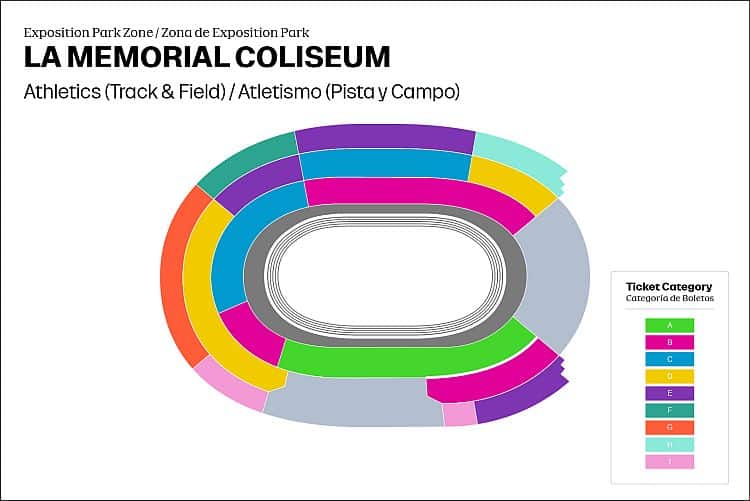
The lounge area at the “Winter House” in Milan, organized by the U.S. federations for ice hockey, figure skating and speed skating (TSX photo by Karen Rosen).
★ The Sports Examiner: Chronicling the key competitive, economic and political forces shaping elite sport and the Olympic Movement.★
★ To get the daily Sports Examiner Recap by e-mail: sign up here! ★
≡ THE ROSEN REPORT ≡
U.S. Olympic medal winners who visit the Winter House, the American hospitality center in Milan for figure skating, hockey and speed skating, receive a “Medal Care Kit,” courtesy of the U.S. Olympic & Paralympic Museum.
While this kit can’t fix a broken medal like Breezy Johnson‘s – “I was jumping in excitement and it broke” – said the Downhill champ, it can prevent wear and tear.
“At the Museum, we often see athletes bring their medal with them,” said Lindsay Flanagan Huban, the Museum’s chief content & integration officer. “They pull it out of a pocket, and say, ‘Oh, I keep it in a shoebox, I keep it in a sock drawer.’ Bonnie Blair will pull hers out of a pocket and put it around peoples’ necks. They get sort of worn after a while.”
Museum archival specialist Oriana Va’I had the idea to put together the proactive kits which have, Huban said, “everything an athlete needs to take care of and preserve their piece of history.”
There’s an acid-free archival box so the medal won’t tarnish, foam to wrap the ribbon so it doesn’t crease, acid-free tissue paper, and “because we are a museum, of course we’re going to give you a pair of white gloves,” Huban said.
A lint-free wipe, also included, is the only thing an athlete should use to clean a medal because solvents or soap and water will damage it.
The U.S. Olympic & Paralympic Museum’s “medal care” kit, at the U.S. Winter House in Milan (TSX photo by Karen Rosen).
“We have not done anything like this before and there has been a lot of interest, not just from current members of Team USA, but athletes who competed, 15, 20, 50 years ago,” Huban said, noting the Museum has gotten emails from athletes who aren’t in Milan. “We’re really pleased to be able to offer this.”
The museum brought 50 kits and could run out if both U.S. hockey teams reach the podium.
For now, each medal-winning athlete has received one kit and the museum is happy to ship more. Blair, who won five speed skating golds and a bronze in her Olympic career, has already requested five more boxes.
The kit also includes a loan and donation card if the athlete is inclined down the road to remember the Museum.
The Winter House, set unobtrusively in a Milan hotel with heavy security outside, is sponsored by Starbucks and is one of the most exclusive tickets in the Olympic city. Olympic athletes, their families, sponsors, donors and guests, including entertainers Marisa Tomeiand Jeff Goldblum, have enjoyed the warm atmosphere reminiscent of a lounge from the last century during nightly watch parties.
Sponsored by Starbucks, the original plan was to call it the Ice House because the three sports are all played on ice. However, the name was changed because of its similarity to the Immigration and Customs Enforcement acronym.
The capacity is about 300 a night. “Some people who have come in have enjoyed it so much that they want to come back,” Huban said.
Besides the Starbucks cafe, drinks are served from “Boitano’s Lounge,” created by 1988 Olympic figure skating champion Brian Boitano. For entertainment, he has conversed with a large stuffed ostrich in the Winter House.
Athletes who visit sign a panel like the ones that cover the U.S. Olympic & Paralympic Museum. Besides Winter Olympians, gymnastics icon Simone Biles, Olympic swim star Mary T. Meagher and rugby player Ilona Maher have swung by to hobnob.
There are photos of current American athletes on the wall and they sign them when they visit.
The Winter House has celebrated the 50th anniversary of the 1976 Innsbruck Winter Olympics with gold medalists Dorothy Hamilland Sheila Youngand the 20th anniversary of the 2006 Turin Games with U.S. stars Sasha Cohen, Apolo Ohno, Ben Agosto and Rusty Smith.
As part of its display, the Museum brought three torches that rest in a case: 1984 Los Angeles, because L.A. is hosting the next Olympics; 2022 Beijing, the previous Winter Games, and 2024 Paris, the previous Summer Games.
“We pull out either L.A. or Beijing every evening,” Huban said. “We let people put on some gloves – and it’s two hands on the torch at all times. They take a photo, make a memory. It’s been super popular.”
A Milan Cortina torch and set of medals have been promised and they will be installed soon at the Museum.
“The Museum is just so pleased to have the opportunity to connect with the athletes and introduce ourselves if they don’t know us yet,” Huban said.

★ Receive our exclusive, weekday TSX Recap by e-mail by clicking here.
★ Sign up a friend to receive the TSX Recap by clicking here.
★ Please consider a donation here to keep this site going.
For our updated, 45-sport, 910-event International Sports Calendar for 2026 and beyond, by date and by sport, click here!
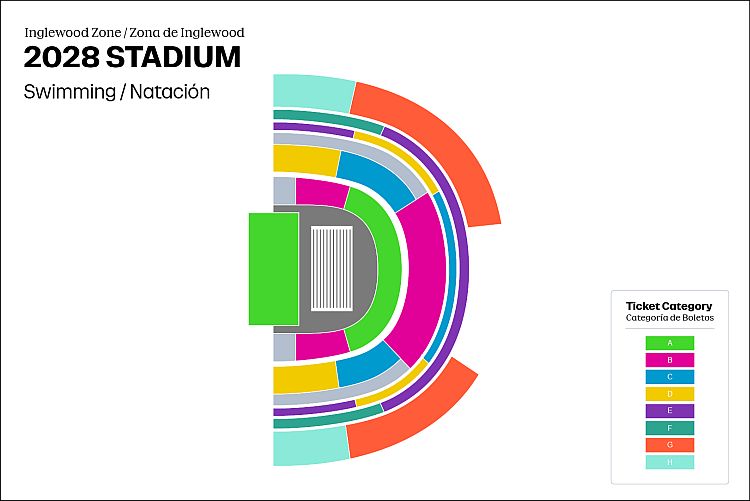
There is a certain rhythm to the modern Olympic Games, especially as reported in the run-up. There are always crises, calls to move the Games elsewhere, or cancel them. Costs are an issue and for the Milan Cortina organizers, real questions about the bobsled, luge and skeleton track that finally did get built on time, and the privately-finance Santagiulia ice hockey arena, which also was finished enough to hold the men’s and women’s tournaments in substantial style (see the between-period imagery on the ice above).
But on Tuesday, the Milan Cortina 2026 organizers announced that they sold 55,000 tickets Monday and had met their goal – branded unattainable by some – of 1.3 million tickets sold, with close-to-capacity attendance at many sports and huge crowds in the mountain venues.
That’s a success, powered in part by the enormous success of the Italian team, which is shattering all records for medals. Their prior best was 20 from 1994 in Lillehammer (NOR), with seven golds. Already, the Azzurri have 24 medals and nine golds (9-4-11) and still have five days remaining. It’s worth noting that at their last home Winter Games – Turin 2006 – the Italians won just 11 medals (5-0-6). They did something right this time.
Our correspondent in Italy, Karen Rosen, noted, ”Even the people on the metro who are not attending the Games know that their country is doing well.”
So is the organizing committee, which still has a third of the Games to go, and then the Winter Paralympic Games in March. But there are a lot of happy people at the venues and one of the big “problems” has been that souvenirs of the mascots Tina and Milo and the Flos have repeatedly sold out.
There are also some angry people, for whom nothing is ever right and nothing ever will be right. They will have their day soon, after the Games have passed, as seen in France only months following the close of the Paris Games. But that did not detract from the greatness of that Olympic edition.
As for the U.S. team, at 232 members the largest at this Games, it crossed the 20-medal level (21 so far) for the seventh straight time after having never won more than 13 in any Winter Games through 1998. There are more opportunities coming, such as Mikaela Shiffrin in the women’s Slalom, both the men’s and women’s hockey teams, Alysa Liuin women’s Figure Skating and more from phenom Jordan Stolz in speed skating (he has two events left).
The best-ever U.S. gold-medal performance is 10, at the 2002 Salt Lake City Games, and the American team is at six now and could get a new record in the remaining five days. Interestingly, Team USA has won nine gold in the succeeding five Winter Games.
But there is a sense that the U.S. has under-performed with gold-medal misses from Lindsey Vonn (a crash), from Shiffrin in the Team Combined, Chloe Kim (silver), Ilia Malinin(falls) and Madison Chock and Evan Bates (silver) in figure skating and so on.
If, however, it’s true that it is how you finish that counts, U.S. fans will be feeling better by the end of the Games on Sunday. ~ Rich Perelman
● Il Tempo Olimpici ● Cloudy weather in Milan on Wednesday, with a high of 53 F n a low of 37 F; rain is expected on Thursday.
Cortina is forecast for cold temperatures at 26 F, but with clouds and no snow, which impacted Monday’s events. The low is expected to be at 11 F and with light winds of 3 miles per hour. More snow is expected Thursday.
● Scoreboard ●Norway has passed the 30-medal mark and is pulling away – as expected – through 12 days on the medal table:
● 31: Norway (14-8-9) ● 24: Italy (9-4-11) ● 21: United States (6-10-5) ● 20: Germany (5-8-7) ● 19: Japan (4-5-10)
● 17: Austria ● 16: France ● 13: Netherlands ● 12: Sweden ● 12: Canada
A better indication of team performance has to go beyond three places, so The Sports Examiner returns our eight-place scoring, using the NCAA track & field format of 10-8-6-5-4-3-2-1 to score each event. After 12 days, the top 12:
● 378.5: Norway ● 299.5: Italy ● 280.5: United States ● 234: Germany ● 226.5: Austria
● 223.5: France ● 187.5: Japan ● 169: Canada ● 157: Netherlands ● 139.5: Switzerland
● 134: Sweden ● 99: China
In terms of place winners from 1-8, Norway continues to lead with 68, then 60 for the U.S., 59 for Italy and 50 for Austria. To say this has been a great Winter Games for Italy is an enormous understatement; it’s their best ever.
● Television ●French-language Radio Television Suisse bobsled announcer Stefan Renna launched into a lengthy criticism of the Israeli two-man bobsled team and driver Adam Edelman during his run on Monday, citing his support of the Israel Defense Forces in its response to the Hamas invasion on 7 October 2023 that killed more than 1,200.
Renna further questioned why Edelman is competing while Russians supporting their war against Ukraine are not, and more.
RTS has deleted the segment from its web site and told Reuters:
“Our journalist wished to question the IOC’s policy regarding the statements made by the athlete concerned. However, although factual, such information may have appeared inappropriate due to its length within the context of a sports commentary. For this reason, we removed the segment from our website last night.”
Edelman replied on X:
“I am aware of the diatribe the commentator directed towards the Israeli Bobsled Team on the Swiss Olympics broadcast today.
“I can’t help but notice the contrast: Shul Runnings is a team of 6 proud Israelis who’ve made it to the Olympic stage. No coach with us. No big program. Just a dream, grit, and unyielding pride in who we represent. Working together towards an incredible goal and crushing it. Because that’s what Israelis do.
“I don’t think it’s possible to witness that and give any credence to the commentary.”
U.S. Ambassador to Israel Mike Huckabee also commented on X:
“Beyond disgusting that the Jew-hating Swiss ‘sportscaster’ spewed bigotry & bile at @Israel Olympic Bobsled team & its captain @realajedelman as they competed.”
So much for Swiss neutrality.
● Olympic Winter Games 2028: Los Angeles ●In a CNN interview, Los Angeles Mayor Karen Basschanged her position and said that LA28 Chair Casey Wassermanshould resign. She had previously said the matter was up to the LA28 Board, which has determined he should continue. But now:
“I cannot fire him, but I have an opinion. And my opinion is that he should step down. That’s not the opinion of the [LA28] Board.
“The Board made a decision. I think that decision was unfortunate. I don’t support the decision. I do think that we need to look at the leadership.”
Wasserman said in a statement when his name surfaced in a U.S. Justice Department dump of three million pages of documents related to the Jeffrey Epstein case, including some personal e-mails with convicted child-sex trafficker Ghislaine Maxwell (GBR), “I never had a personal or business relationship with Jeffrey Epstein. As is well documented, I went on a humanitarian trip as part of a delegation with the Clinton Foundation in 2002 on the Epstein plane. I am terribly sorry for having any association with either of them.”
Asked about this on Tuesday, International Olympic Committee spokesman Mark Adams (GBR) stated, “This is a matter for their board, LA28, at this stage,” but noted that “there are many conversations happening at this moment, but I will not make any further comment.”
● Figure Skating ●A happy story from Milan, where ice dancers Olivia Smart (ESP) and American Jean-Luc Baker– a four-time U.S. nationals bronze medalist – got engaged on the streets of the city on Saturday (14th).
Smart and Tim Dieck finished ninth at the 2026 Ice Dance on the 11th and Baker proposed three days later. Baker said they had been close friends for more than 10 years.
● Memorabilia ●Just a couple of days left in the RR Auction winter Olympic sale, with first bids closing on Thursday (19th) at 7 p.m. Eastern time. Thus far, the unique Moscow 1980 “Stadium Torch” – one of just 20 “no-fail” torches made, is up to $69,975, indicating it will go much higher when the hammer finally drops.
It was specially made to continue burning no matter what the weather conditions were and was used for torch-lighting ceremonies in multiple Soviet cities, including for the opening of the Moscow Games.
A rare 1896 Athens Olympic winner’s medal – silver in those days – in good condition with a rare original presentation case – is already at $33,000 and expected to go for more than $100,000.
The auction includes what is believed to be the first public sale of a Milan Cortina 2026 torch – while the Games are going on – and is already at $15,749 with 33 bids, ahead of the estimate of $12,500-plus beforehand.
The highly-sought-after Lillehammer 1994 Winter Torch is also doing well, at $10.454 so far and 30 bids. It is estimated to bring $30,000 or more.
A unique item on sale is a pin for the cancelled 1944 Winter Games slates to be in Cortina d’Ampezzo! Estimated to bring $300, it’s already up to $666!
= RESULTS: TUESDAY, 17 FEBRUARY = (6 finals across 5 sports & disciplines)
● Biathlon: Men’s 4×7.5 km Relay Norway came in as the defending Olympic and World Champion and Uldal Martin handed his team a 50.3-second lead after the first leg over France, in snowy conditions in Anterselva.
But France’s Pursuit bronze winner Emilien Jacquelin stormed the second leg while Norway’s Johan-Olav Botn had shooting problems and took the lead by 16.1 seconds and the French never looked back and won by 1:19:55.2 (9 penalties) to 1:20:05.0 (6). It was their first win ever in this event, after a silver in 2022 and three prior bronzes.
Norway was an easy second, then came Sweden in 1:20:52.7 (6), another 47.7 seconds back, followed by Germany (1:21:43.5/12) and the U.S. in fifth.
That’s the best finish ever by a U.S. team or individual in Olympic biathlon, with Sean Doherty, Maxime Germain, Paul Schommer and Campbell Wright skiing. Wright, who won two Worlds silvers in 2025, started 11th but moved up to fifth by the last shooting stage, with a total time of 1:22:22.6 (8). Wright is just 23.
● Bobsleigh: Two-Man German stars Johannes Lochner and George Fleischauer, the 2022 silver medalists, came into Tuesday with a 1:49.90 to 1:50.70 margin over teammates Francesco Friedrich and Alexander Schueller, the defending Olympic champions.
That lead grew in the third heat, as Lochner drove the fastest time in 54.68, with third-place Adam Ammour (and Alexander Schaller) second-fastest at 55.12 and then Friedrich’s sled at 55.16. Ammour’s fast time also extended his lead to 0.55 over Frank Del Duca and Joshua Williamson of the U.S., fourth-fastest at 55.40.
Lochner led Friedrich, 2:44.79 to 2:45.71 into their final runs, with Ammour third at 2:46.17.
Del Duca has his best run of the Games and took the lead with a 55.34 time and a 3:41.96 total. Ammour was next, and his 55.35 was good enough for bronze at 3:41.52. Friedrich was up, trying for a third Olympic title in a row and a strong run finished in 55.33 and 3:41.04, good enough for at least silver.
Last up was Lochner, trying for a first Olympic gold and they blitzed the field, racing to a 54.91 time and destroying a brilliant field with a 3:39.70 total. Lochner was the best all season and there were no surprises in Cortina.
The Germans were favored to sweep and did for the second straight Games.
● Freestyle Skiing: Men’s Big Air Strange things happen in the Olympic Games. Norway’s Tormod Frostad, 23, had won a career total of two World Cup medals coming into the Big Air final, with his only win coming in December of 2024. He was 12th at the 2022 Beijing Games.
But on Tuesday, he was brilliant. In a hot first round, he took the lead at 95.25, barely ahead of teammate and defending champion Birk Ruud (95.00). Frostad was even better in round two, scoring 97.00, but American Mac Forehand, the 2025 Worlds silver winner, was at 95.00 and 95.00 for his first two rounds for a 190.00 total and just behind Frostad’s 192.25.
Austria’s Matej Svancer was also a threat at 187.00.
In round three, American Konnor Ralphscored 91.50 to raise his total to 178.00, then teammate Troy Podmilsak, the 2023 World Champion, scored 94.00 to finish at 184.50 and move into fourth, with Ralph set for fifth.
Svancer improved again to 96.00 to up his score to 191.25, putting the pressure on Forehand for the silver. But the American scored a sensational 98.00 and totaled 193.25, taking the lead with Frostad still to go.
The Norwegian was up to the challenge, scoring an amazing 98.50 on his third attempt and winning the gold with 195.50 points. Superb.
This is the second time Big Air has been in the Games and Norway has won both (Ruud and Frostad) and the U.S. has been second both times (Colby Stevenson and Forehand).
● Nordic Combined: Large Hill (141 m) + 10.0 km Highly competitive, the Large Hill event ended up just about the same way the Normal Hill did: Norway’s Jens Oftebro coming from behind after the jumping to win.
Oftebro was fifth after the jumping, won by Roya Yamamoto (JPN), and started 22 seconds behind the lead. Austria’s Johannes Lamparter, the 2021 World Champion, was second after the jumping, but Oftebro put down the fastest time on the cross-country course and won in 23:45.0.
Lamparter was game and won silver for the second straight event, in 24:50.9. The bronze went to Finland again, but this time to Ilkka Herola, who moved up from seventh to third in 24:59.8. Teammate Eero Hirvonen, who won the Normal Hill bronze, finished fifth in 25:31.5.
Niklas Malacinskiwas the top American, in 13th at 27:07.4 after being 12th in the jumping. Ben Loomis was 27th (28:44.9)
Norway has won this event in three of the last four Games, but Lamparter’s silver was the first Austrian medal since 2010 and Herola won Finland’s first medal in the event since 2002.
● Snowboard: Women’s Slopestyle Heavy overnight snowfall postponed the event until Wednesday!
● Speed Skating: Men’s Team Pursuit, Women’s Team Pursuit As noted in our preview, the U.S. team of Casey Dawson, Emery Lehman and Ethan Cepuran won the 2025 Worlds gold in this event, were the 2022 Olympic bronze winners, own the world record of 3:32.49 from last November, and won all three World Cup races this season.
They had no shot in the final, facing Italy’s Davide Ghiotto, Andrea Giovanniniand Michele Malfatti, who took the lead with 2 1/2 laps to go in the eight-lap race and rolled to a convincing 3:39.20 to 3:43.71 victory.
Italy won its first medal in this event since its first appearance in the Games, at Turin in 2006. The U.S. trio was the same that won bronze in Beijing in 2022, so they moved up one notch. It’s the third American medal in this event (0-2-1).
China won the B Final and took the bronze medal over the Netherlands, 3:41.38 to 3:41.47.

The women’s relay came down to Canada and the Netherlands as expected and the defending Olympic champions from Canada – Ivanie Blondin, Valerie Maltais and Isabelle Weidemann– had the lead with two laps to go in the six-lap race and won by 2:55.81 to 2:56.77, over Joy Beune, Antoinette Rijpma-De Jong and Marijke Groenewoud.
The Dutch won a medal in this race for the fourth straight Games – 1-2-3-2 – and Rijpma-De Jong won her third medal in this event (0-2-1).
Japan had the lead early in the B Final over the U.S. trio of Giorgia Birkeland, Brittany Bowe and Mia Manganello, and won by 2:58.50 to 3:02.00 for the bronze medal. This was the third straight medal for Japan in this event, with 2022 Olympic 1,000 m champ Miho Takagi on all of them (1-1-1).
Elsewhere:
● Curling: Swiss skip Yannick Schwaller’s rink continued undefeated, at 7-0 in the men’s tournament, defeating defending champions Sweden and Niklas Edin, 9-4. Canada, with 2014 Olympic winner Brad Jacobs as skip, is 6-1.
Danny Casper’s U.S. team fell to 4-4 and sixth place after losing, 8-5 to China and 8-5 to Italy (4-3). Round-robin play continues to the 19th.
PyeongChang Olympic champ Anna Hasselborg’s Swedish team lost their first match, 8-6, to Canada and three-time World Champion Rachel Homan, and is still first at 6-1. Tabitha Peterson’s U.S. squad routed Denmark, 10-3, to move to 5-2 and in second place with four-time World Champions Switzerland.
● Figure Skating:The women’s Short Program was held Tuesday, with Japan’s Ami Nakai– with a high-profile, high-scoring triple Axel in her program – leading into the final group at 78.71.
First up in the final six was American Alysa Liu, the 2025 World Champion, who was elegant and precise on the ice and scored 76.59 to stand second. Isabeau Levito, the 2023 U.S. champion, came next in an all fire-engine-red costume and skated with grace and style that scored 70.84 and fifth place. Beautiful, but not spectacular.
After Anastasiia Gubanova (GEO) scored a lifetime best of 71.77 for fourth, Japan’s three-time World Champion Kaori Sakamoto took the ice and offered a technically special and beautiful program that wowed the crowd. She scored 77.23 to stand second.
American Amber Glenn, the triple U.S. champ, was next-to-last and opened with a successful triple Axel, but missed a double Loop. The crowd loved the routine, but Glenn clearly felt the error as she finished and sobbed as she left the rink. “I had it,” she said through tears. The crowd cheered, but her score was 67.39 and 12th place.
The last skater was Japan’s Mone Chiba, the 2025 Worlds bronze winner. Skating to Donna Summer’s “Last Dance.” she had the crowd in her hands and got the loudest cheers of the final group. Her 74.00 earned her fourth place overall, behind Nakai, then Sakamoto, Liu and Chiba. Levito is eighth, heading into the Free Skate on Thursday. Glenn was 13th; nine scored 70 or higher.
● Ice Hockey:In the men’s play-in games, the Czech Republic beat Denmark, 3-2 and will face no. 1 seed Canada. Germany routed France, 5-1 and will play no. 3 Slovakia and the Swiss blanked Italy, 3-0 and will play no. 4 Finland.
Sweden played Latvia with the winner to take on the second-ranked American team on Wednesday. The Swedes got off to a 2-0 lead after a period, and 3-1 after two. The final was 5-1. The Slovakia-Germany and USA-Sweden games are in the lower bracket, and the Canada-Czech and Finland-Swiss games in the top bracket.
= PREVIEWS: WEDNESDAY, 18 FEBRUARY = (9 finals across 6 sports & disciplines)
● Alpine Skiing: Women’s Slalom Last event on the alpine calendar and the last chance for a medal in Cortina for American star Mikaela Shiffrin, the greatest Slalom skier in history.
She won this event at Sochi 2014 and an Olympic Giant Slalom gold at PyeongChang in 2018, along with a silver in the Combined. But in the Slalom, she was fourth in 2018 and did not finish in 2022. She owns four Worlds title in the Slalom, but none since 2019, finishing 3-2-5 in the three Worlds since.
In Cortina, she was poised to win a Team Combined gold after Breezy Johnson had the lead following the Downhill, but Shiffrin was 11th in Slalom and fourth as a team. Now she has one more chance to strike gold, before returning to the FIS World Cup tour.
She’s the favorite, but there is doubt. Also, 2025 World Champion Camille Rast has been strong, winning a World Cup this season, and Albania’s Laura Colturi has taken four Slalom medals this season.
Emma Aicher (GER), the Downhill silver winner, is one of the most versatile skiers on tour and won World Cup medals in three Slalom races this season. Those are the logical challengers.
U.S. teammate Paula Moltzan won the Team Combined bronze with Jackie Wiles and is a definite threat in Slalom. Swiss Wendy Holdener, the silver winner in 2018 and bronzer in 2024, also won a World Cup bronze this season. So did Katharina Truppe, who won the Team Combined gold, and her teammate, Katharina Liensberger, was the 2025 Worlds bronze winner.
But this is about Shiffrin. If she is right, she should win. If not?
● Biathlon: Women’s 4×6 km Relay Sweden is the defending champion and has the Oeberg sisters – Elvira and Hanna – back. France has won this at the last two World Championships and has its 2025 team – Lou Jeanmonnot, Oceane Michelon, Justice Braisaz-Bouchet, Julia Simon – all back and ready to go. They figure as the favorites.
Norway, with Sprint winner Maren Kirkeedie, won the Worlds silver in 2025, and those three teams are odds-on for medals. But Italy, which won two silvers in this event during the World Cup season, has Pursuit winner Lisa Vittozzito anchor and the home crowd.
During the World Cup season, France won twice, Norway and Sweden once, and Germany and the Czech Republic both won bronzes.
● Cross Country Skiing: Men’s Team Sprint; Women’s Team Sprint The Team Sprint, with two athletes, has Norway as the two-time defending Olympic champions, both times with record-setter Johannes Hoesflot Klaebo on the team. Klaebo has been part of Norway’s World Championships winners in 2019-21-23-25. Who’s going to stop him from a record 10th Olympic gold? Especially with teammate Oscar Viketaking the Sprint bronze as a partner?
The two World Cup Team Sprint events had Norway winning, then Italy (Elia Barp and Federico Pellegrino) second and Sweden and the U.S. winning bronzes. Pellegrino, Simone Drapa and Simone Mocellini all made the Sprint semis and look ready.
Ben Ogden won the surprise Sprint silver for the U.S. And JC Schoonmaker also made the Sprint semis in Tesoro, so a U.S. medal is a real possibility. But the Czechs, Swedes and perhaps Finland are just as likely to get there as well.
In the women’s event, Norway won four of the six medals during World Cup competition, but they were silvers and bronzes. Sweden has to be the favorite after sweeping the Sprint medals, with Linn Svahn taking gold over Jonna Sundling and Maja Dahlqvist.
Germany also won a World Cup race with Laura Gimmler and Coletta Rydzek, both semifinalists in Tesoro. Norway had Julie Drivenes fourth and Kristine Skistadfifth in the Olympic Sprint and they figure to compete for silver.
The U.S. had Julia Kern in the Sprint final and three others – including Jessie Diggins – in the quarters. Will Diggins compete here with the 50 km still to go? If not, Sammy Smithor Lauren Jortberg could get the call. Diggins and Kern won the Worlds silver in 2025, over the Swiss.
● Freestyle Skiing: Women’s Aerials Because of heavy snowfall on Tuesday, both the qualifying and finals will be on Wednesday. Beijing 2022 champion Mengtao Xu(CHN) is back, was the silver winner at the 2025 Worlds and scored medals in five of the six World Cup events, including one win.
But American Kalia Kuhn, the 2025 World Champion was third and first in the final two World Cups and teammate Winter Vinecki – maybe the best name in the Games – had a World Cup gold and silver.
Australian Danielle Scottis also a medal favorite, after her 2025 Worlds bronze and a first and third in the final two World Cups, both held in Lake Placid, New York. Canadian Marion Thenaultscored a World Cup silver this season and has been in the top six in the last three Worlds and should be a contender. Same for China’s Fanyu Kong, the 2023 World Champion, but who won the second World Cup in December, then didn’t score another medal.
● Short Track: Men’s 500 m; Women’s 3,000 m Relay In the four ISU World Cups in the men’s 500 m, Canadian star William Dandjinou won three and American Andrew Heo won one. Dutch star Jens van’T Woutwon nothing.
He’s won the 1,000 and 1,500 m already.
Canadian Steve Dubois is the 2025 World Champion, beating Denis Nikisha(KAZ: second straight silver) and van’T Wout, and he won two World Cup medals.
Not to be overlooked are Beijing 2022 gold medalist Shaoang Liu (HUN) now affiliated to China, and ex-Korean Xiaojun Lin – the 2024 World 500 m champ – also competing for China.
Pietro Sighel is the best Italian entry and won the 2023 Worlds gold, and a 500 m World Cup silver this season.
The women’s 3,000 m relay should be a fight between the Dutch – with so-far-unbeatable star Xandra Velzeboer– Canada and South Korea. All won World Cup races and the Dutch and Koreans went 1-2 at Beijing 2022 and the Dutch won the 2023 Worlds. In the semis, the Koreans and Canadians had the fastest times.
Italy is also in the A final and that means another shot for star Arianna Fontana to contend for a 14th career Olympic medal.
● Snowboarding: Men’s Slopestyle; Women’s Slopestyle The winner no matter what the results are will be Canadian Mark McMorris. The 2014-18-22 Olympic bronze medalist suffered a bad crash on 4 February with a concussion and other injuries. But he qualified third on Sunday and is into the final.
Lots of experience in this event. American Red Gerard,the 2018 Olympic winner, is back and qualified 11th. China’s Yuming Su, the 2022 Beijing silver winner, qualified eighth and won medals in both World Cup events this season.
The two World Cup winners, Jake Canter of the U.S. and Romain Allemand (FRA) are in, qualifying 10th and seventh.
But the qualifying leaders were New Zealand’s Dane Menzies – a World Cup bronzer this season – at 86.06 and Norwegian veteran Marcus Kleveland (81.86), the 2021 and 2023 World Champion, who has never won an Olympic medal, placing sixth and eighth in 2018 and 2022. Still just 26, this might be his time.
The U.S. has a third qualifier as well, Oliver Martin, a World Cup bronze winner in Big Air; he scored 78.30 to stand in sixth. And not to be overlooked is Japan’s Ryoma Kimata, the 2023 Worlds runner-up who was the fourth to score 80 or more (80.83) in the preliminaries.
The women’s Slopestyle had to be postponed a day due to heavy snowfall, but is now to be held on Wednesday.
Japan’s Kokomo Muraseand New Zealand’s Zoi Sadowski Synnottwent 1-2 in the Big Air final, but the Kiwi is the favorite in Slopestyle, where she is the defending Olympic champion, the 2019-21-25 World Champion and beat Murase last year.
Murase was third and first in the two World Cups held so far, which Sadowski Synnott skipped. But in qualifying on Sunday, Sadowski Synnott led at 88.08, trailed by Murase, at 84.93.
Those two appear ready to fight for the top spot on the podium. But Korean Big Air bronzer Seung-eun Kim appears ready to contest as well, third in the qualifying at 76.80.
Japan has two more contenders in Reira Iwabuchi, last year’s World bronzer and Mari Fukada, the 2025 Worlds Big Air third.
Canada’s Laurie Blouin, the 2017 World Champion and 2018 Olympic runner-up is in the final, and won a World Cup this season, and Austria’s Anna Gasser, the two-time Olympic Big Air winner, must be acknowledged, as the no. 5 qualifier.
The U.S. has 16-year-old Lily Dhawornvej, who took a World Cup silver this season and qualified along with fellow 16er Jessica Perlmutter.

★ Receive our exclusive, weekday TSX Recap by e-mail by clicking here.
★ Sign up a friend to receive the TSX Recap by clicking here.
★ Please consider a donation here to keep this site going.
For our updated, 45-sport, 910-event International Sports Calendar for 2026 and beyond, by date and by sport, click here!

American bobsled star Elana Meyers Taylor is 41 and in her fifth Olympic Winter Games. She’s married, with two young sons – both deaf – and has won medals in each of her four prior appearances: bronze in 2010, silver in 2014 and 2018 and bronze again in 2022 for the Two-Woman, and a Monobob silver in 2022.
“I really want a gold medal. I haven’t gotten it yet, so I feel like that is the one thing that I am missing from my resume, but besides that it is doing it for myself and doing it for my kids.
“To show them that I can chase my dreams and I can overcome obstacles and just continue to persevere through any obstacles that come my way and actually achieve my dreams.”
Dreams do come true and if the Olympic Games show us anything, it is about drive and will and belief. Meyers Taylor put together two brilliant second-day runs, the equal-fastest third run and the no. 2 fourth run to overtake German star Laura Nolte and win the Monobob, 3:57.93 to 3:57.97: by 0.04. She explained afterwards about her second-day approach:
“I just focused on what I needed to do, the points I needed to hit. I had gone over the track again with my coach this morning, and he told me what I needed to do. We discussed it and we just went to work.
“I was super grateful to be able to put the pieces together and finally have a run that I could walk away very proud with.”
And now?
“I’m feeling great. I’m a little tired, the adrenaline’s wearing off a little bit, but I’m super excited to finally have a gold medal and to have worked so hard all these years.
“It means so much to the support staff around me, to my friends, my family, everyone behind me who’s worked so hard to even get me to the starting line, let alone to win a gold medal. It’s been incredible.
“Lots of ups and downs, and you have to be able to ride the storm. At the end of the day, I have great support behind me, starting with my husband [Nic].
“My husband’s been there every step of the way telling me I could do this, whether he’s taken late nights with the kids or anything like that.”
And there was more family on hand in Cortina, as she hugged her sons at the finish line:
“It was so incredible. They’re tired, a little cranky – especially Nico. He’s like, ‘I’m ready to go to bed mom.’ It is a little late.
“But to be able to have them and be able to share this moment with them; like, my mom she was so excited and to be able to have her here – she’s Italian too – but she’s never been to Italy before, so now she’s been to Italy and seen her daughter win a gold medal, it’s just incredible.”
There are lots of people who will tell you what is all wrong about the Olympic Games and the Olympic Movement. Meyers Taylor demonstrates what makes it all right. ~ Rich Perelman
● Milan Cortina 2026 update ●The organizing committee said it sold 108,000 tickets on Sunday, sending the total over 1.3 million for the Games, out of about 1.5 million available.
Spokesman Luca Casassa explained, “The number of tickets sold keeps increasing, day by day. It’s a linear increase and we believe this linear increase will continue from now on, to the end of the Games.”
● Rosen Report ●The U.S. men’s hockey team routed Germany, 5-1, and won Group C with a 3-0 record, but there is “more to accomplish” as the playoffs start. The U.S. has never won an Olympic gold outside in a foreign Games.
● Il Tempo Olimpici ●A rare sunny day is forecast for Milan on the 17th (Tuesday), with highs of 57 F and a low of 36 F. But winds are to pick up slightly to 8 miles per hour.
In Cortina, a cold but partly sunny day is anticipated, with wintry temps of 26 F for the high and 12 F for the low. Wind is expected to be modest at 5 miles an hour. Snow is expected again on Thursday.
● Scoreboard ● Norway continues to lead the medal table, as 26 countries have won one or more at the Winter Games:
● 28: Norway (12-7-9) ● 23: Italy (8-4-11) ● 19: United States (6-8-5) ● 18: Japan (4-5-9) ● 17: Germany (4-7-6)
● 15: Austria ● 15: France ● 12: Netherlands ● 11: Sweden ● 11: Canada
A better indication of team performance has to go beyond three places, so The Sports Examiner returns our eight-place scoring, using the NCAA track & field format of 10-8-6-5-4-3-2-1 to score each event. After 11 days, the top 12:
● 338.5: Norway ● 287.5: Italy ● 241.5: United States ● 211.5: Austria ● 209.5: France
In terms of place winners from 1-8, Norway continues to lead with 61, followed by 57 for Italy, 53 for the U.S., 47 for Austria and 44 for France.
● Television ●No ratings data from NBC for a couple of days, but the top viewing markets for the Games in the U.S. so far were shared. The top markets by rating:
The second five are St. Louis, Missouri (13.1), West Palm Beach, Florida (12.4), Richmond, Virginia (11.6), then a tie between Cleveland, Ohio, Kansas City, Missouri and Buffalo, New York, at 11.4. Salt Lake City, Utah, site of the 2034 Winter Games, was next at 11.3 in 12th.
● French Alps 2030 ●International Olympic Committee Olympic Games Executive Director Christophe Dubi(SUI) was asked about the turmoil among the top echelon of the French Alps 2030 organizing committee, with several executives moving on. But he is not concerned at present:
“Yes, there are problems, that’s life. The Games are so important, they involve so many people. In a position like mine, if you’re not prepared to face problems and challenges, you should change jobs. The project is so important that there are always problems. Right now, we have a people problem. We need to distinguish between problems that could impact the project and people problems. There are always people problems. It’s unpleasant, we don’t like seeing it in the media, it’s uncomfortable for all of us, but somehow it will be resolved.”
He also noted calls to switch the organizing dates with Utah 2034 are irrelevant, since that would only give the Utahans two years to market and organize the Games, following Los Angeles in 2028.
And what about Milan Cortina 2026? He’s happy, as the two most important groups are enjoying the events, despite the spread-out nature of the Games:
“They [athletes] tell us it’s working, and the fans love being in the mountains in this warm atmosphere. As long as these two major groups tell us it’s working, we don’t change a thing.”
● National Olympic Committees ●CNBC posted a list of the medal payouts for the Winter Games, which are made by the National Olympic Committees which send teams to the Games (in reality, their governments, which fund almost all of them).
The biggest prizes are from Singapore, with the equivalent of $792,000 for gold, and Hong Kong at $768,000 for winning. Among those countries active at the Winter Games, Italy is paying $214,000-107,000-71,000 for gold-silver-bronze. The U.S. Olympic & Paralympic Committee pays $37,500-22,500-15,000.
What about Norway, the Winter Games medal leader? The story notes:
“Norway … does not award cash bonuses for podium finishes. Instead, athletes who continue competing may qualify for financial support from the Norwegian Olympic and Paralympic Committee. The stipend is worth roughly 160,000 Norwegian kroner per year ($16,831) and includes access to professional training and medical services.”
● Figure Skating ● American star Ilia Malinin failed in his Free Skate at the Games and finished eighth after leading following the Short Program. But while he has drawn applause for his sportsmanship and grace in defeat, there has been a darker side. He posted on Instagram:
“On the world’s biggest stage, those who appear the strongest may still be fighting invisible battles on the inside. Even your happiest memories can end up tainted by the noise. Vile online hatred attacks the mind and fear lures it into the darkness, no matter how hard you try to stay sane through the endless insurmountable pressure. It all builds up as these moments flash before your eyes, resulting in an inevitable crash. This is that version of the story.”
He closed with “Coming February 21, 2026,” indicating he will skate in the closing gala, reserved for the medal winners at the Games (he won the Team Event gold for the U.S.). His agent also confirmed that he plans to defend his Worlds gold at the 26-29 March ISU Worlds in Prague (CZE).
● Ski Jumping ●American Annika Belshaw was disqualified in the women’s Large Hill competition, after qualifying for the final and taking one jump. The results noted the sanction was for “Ski length / Too long ski (by +1 cm).” That’s about 13/32nds of an inch. Now you know.
= RESULTS: MONDAY, 16 FEBRUARY = (6 finals across 6 sports & disciplines)
● Alpine Skiing: Men’s Slalom Despite fresh snow which created difficult conditions, Switzerland completed a near-sweep of the men’s Alpine program as 2025 World Champion Loic Meillard came from second on the first run to win the men’s Slalom with the equal-fastest time on the second run.
Meillard timed 56.88 on his second run to take the lead from surprise Austrian skier Fabio Gstrein, 1:53.61 to 1:53.96 as both had the same second-run time, fastest in the field. That left first-run leader Atle Lie McGrath (NOR), who forged a big lead with his 56.14 performance.
But about a quarter of the way down the run, McGrath straddled a gate and was disqualified. He threw his poles over the netting and then walked away, into the trees nearby. He was checked on by medical personnel and finally came back, not stopping to talk to anyone.
That left Meillard with a bronze in the Giant Slalom, silver in the Team Combined and now a gold in the Slalom in Cortina. Gstrein, 28, came in with a total of two World Cup medals in his career – both bronzes – and is now Olympic silver medalist.
Norway’s Henrik Kristoffersen, who won a 2014 Olympic bronze in this event, won the same medal 12 years later, in 1:54.74, moving from sixth to third in the second run.
The soft snow proved to be a problem for a lot of the skiers; out of the 95 starters, 49 did not finish the first run (!), including Giant Slalom winner Lucas Pinheiro Braathen (BRA) and River Radamus of the U.S., and two more were disqualified. There were only 39 final placers.
● Bobsled: Women’s Monobob Americans Elana Meyers Taylor and defending Olympic champ Kaillie Armbruster Humphries were hunting German Laura Nolte in the final two runs on Monday, starting 0.22 and 0.31 behind the 2023-24 World Champion.
The third heat saw the two Americans get close, as they co-led the heat at 59.08, with Nolte at 59.15. So, entering heat four, Nolte held a 2:58.27 to 2:58.42 lead on Meyers Taylor with Armbruster Humphries at 2:58.51. German Lisa Buckwitz, a two-time Worlds bronze winner, was chasing the Americans at 2:59.15 in fourth.
Buckwitz timed 59.67, not as smooth as her prior runs and ended up seventh in the run and fell back. Armbruster Humphries charged from the start, had only a small bump and rolled to a 59.54 time and into the lead with only two left.
Meyers Taylor was immediately aggressive, got to the top of the track to increase her speed early and flew through the middle of the course, touching the sides twice just for a moment and finished in 59.51 and took the lead at 3:57.93, ahead of Armbruster Humphries at 3:58.05 and Buckwitz at 3:58.82.
It was up to Nolte, fourth in heat three and she did not get the line she was looking for, suffered a small bump and finished in 59.70 – ninth-best in the final heat – for a 3:57.97 total and the silver medal.
Meyers Taylor is no stranger to the Olympic Games at 41, and won the Olympic Monobob silver in 2022 behind Armbruster Humphries and four Two-Woman medals – bronze, silver, silver, bronze – from 2010-22. This season was arguably her worst on the World Cup circuit, where she didn’t win a Monobob medal. Now she is Olympic champ and owns six Olympic medals, and had husband Nic and boys Nico and Noah with her in Cortina.
With six total Winter medals, she tied speedskater Bonnie Blairfor the most Winter Olympic medals ever by an American woman.
Armbruster Humphries,40, won her fifth Olympic medal: two golds and a bronze in Two-Woman for Canada and as an American, a Beijing 2022 gold and now a Cortina bronze in the Monobob.
Kaysha Love, the third American, wasn’t far behind at 3:59.27 and was seventh overall. At 28, she’s the future.
● Figure Skating: Pairs After the first two Free Skate groups, the U.S. duo of Emily Chan and Spencer Akira Howe got a seasonal best of 130.25 and were first with a total score of 200.31.
After a tough Short Program and standing fifth at 73.11, two-time World Champions Riku Miuraand Ryuichi Kihara dropped a lyrical, elegant and perfect Free Skate on the judges and were rewarded with the highest score in history: 158.13!
That gave them a total of 231.24, no. 5 all-time, with four pairs yet to come.
Hungary’s Maria Pavlova and Alexei Sviatchenko were up to the challenge and scored a lifetime best of 141.39 with a lifetime best of 215.36 to move into second. Canada’s Lia Pereiraand Trennt Michaud had some errors and ended at 199.66; Georgia’s Anastasiia Metelkina and Luka Berulovascored 146.29 and a total of 221.75 to move into second.
That brought Short Program leaders, Germans Minerva Fabienne Hase and Nikita Volodin, who scored 80.31 to lead, and needed 151.24 to win, with a prior best of 149.57 from December 2025. Their program was athletic and fluid, but not perfect, with Hase’s two errors on jumps. They scored 139.08 to total 219.09 and earn the bronze.
Miura and Kihara were overwhelmed with their come-from-behind win, after finishing seventh in Beijing in 2022. Under pressure, they were supreme.
This was Japan’s first Pairs medal ever, and Georgia got its first Winter Olympic medal ever! This was the fourth Games in the last five that Germany has won a Pairs medal, three of them bronzes.
Americans Chans and Howe finished seventh overall, and Ellie Kam and Danny O’Shea scored 194.58 to finish ninth.
● Freestyle Skiing: Women’s Big Air Despite an hour’s delay due to a snowstorm, and amid continuing snow, six different skiers scored 90.00 or more points, starting right away with Austria’s Lara Wolf at 93.50, followed by Megan Oldham(CAN), the Slopestyle bronze winner, at 91.75. Defending champion Eileen Gu(CHN) was at 90.00 in third.
In round two, it was Kirsty Muir(GBR) who hit 93.00 to lead the round, with Mengting Liu(CHN) at 90.00 and Oldham at 89.00, so she was the leader into the final round at 180.75.
Wolf, fifth in the order, finished with a 76.25 for a 169.75 total and would finish fifth. Gu, jumping sixth, earned an 89.00 for a brilliant jump and a 179.00 total and was the leader. Starting tenth was Italy’s 2025 World Champion, Flora Tabanelli, who exploded to a 94.25, best score of the day, but performing the same trick as she did in the first round, when she scored a 90.00. So only the 94.25 counted and she had to add in the 84.00 from the second round for a 178.25 total that left her in third place.
Muir, starting 11th, did not improve and finished at 174.75 and was fourth, meaning Oldham was the winner. She crashed out, but took the gold for Canada to get her first championship victory after the Slopestyle bronze and a Worlds silver and three bronzes.
Gu’s silver is fairly amazing, considering she didn’t contest the event in FIS competitions since the 2022 Beijing Winter Games!
● Short Track: Women’s 1,000 m: Italian fans were screaming for another medal for home favorite Arianna Fontana, but Dutch star Xandra Velzeboer – the 2023 World champ in this event – took the lead with a lap to go and would not relinquish it and completed a 500-1,000 m double in 1:28.437.
She was just ahead of Canada’s Courtney Sauralt (1:28.523) and Korean Gil-li Kim (1:28.614), both of whom made mad dashes for the line, but could not catch Velzeboer. Fontana had to settle for fourth (1:28.745), just missing her 14th career Olympic medal.
It’s the third straight win for the Dutch in this event and the first 500-1,000 double since China’s Meng Wangin Vancouver in 2010.
Sauralt, an 11-time Worlds medal winner, now has three Olympic medals in Milan and her own 500-1,000 double, with a bronze and now, silver.
● Ski Jumping: Men’s Team (141 m) Bad weather in Predazzo shortened the this reformatted competition – with two jumpers – to two rounds, but there was no doubt about the best team.
Austria’s defending Olympic champions prevailed again, with Jan Hoerl and Stephan Embacher winning both rounds and totaling 568.7 points, well ahead of Poland’s Pawel Wasik and the surprise of the competition, teen medalist Kacper Tomasiak, who totaled 547.3.
Norway’s Johann Forfangand Kristoffer Sundal were third (538.0), moving up from sixth after the first round. Slovenia’s Anze Lanisek and Domen Prevc stood second after the first round, but dropped to seventh in round two and ended up fifth at 536.1.
The U.S. had Kevin Bickner and Tate Frantz, 10th in the first round, but fourth in the second; they finished eighth at 520.2.
It’s the second straight gold for Austria and fourth win in the last six Games.
Elsewhere:
● Curling:The men’s tournament continued with Swiss Yannick Schwaller’s rink on top of the round-robin standings at 5-0 after a 9-7 win over China. Canada’s Brad Jacobs,the 2014 Olympic winner, moved his team to 5-1 after defeating defending champ Sweden and Niklas Edin by 8-6. At 1-5, the Swedes are in real danger of not making the playoffs.
David Casper’s U.S. team continues at 4-2, in third place and play China on Tuesday.
PyeongChang 2018 gold medalist Anna Hasselborghas her Swedish women’s team at 6-0 and leading Tabitha Petersonand the U.S. at 4-2. Sweden defeated four-time World Champions Switzerland (now 4-2), 6-4 on Monday, but Italy swamped the U.S., 7-2.
● Ice Hockey:The U.S. women were challenged by a physical Swedish side, but maintained excellent discipline and got a strong performance from keeper Aerin Frankel in a 5-0 shutout, to advance to the Olympic final once again.
Cayla Barnesopened the scoring at 5:09 of the first period as the U.S. piled up a 13-2 shots lead. But the Swedes attacked in the second, sending 13 shots at Frankel, while the Americans managed 11, but scored four times to break the game open.
Taylor Heisescored on a Hannah Bilkacross-ice pass at 9:09 of the second, then Abbey Murphysent a seeing-eye shot over the shoulder of Swedish keeper Ebba Svensson Trafffor a 3-0 edge at 15:12. That was followed quickly by Kendall Coyne Schofield at 16:10 and then Hayley Scarmurraat 17:59 for a 5-0 lead that ended up as the final. The U.S. ended with a 34-23 shots advantage.
This will be the seventh gold-medal final for the U.S. in eight women’s Olympic tournaments, with wins in 1998 and 2018, but losses in the other four to Canada, which had been in the seven prior finals, winning five.
Canada faced Switzerland in its semifinal, and despite a 46-8 shots edge, won by 2-1, on two second-period goals by star Marie-Philip Poulin.So, Canada and the U.S. will face off for gold, as expected, on Thursday. The Americans are 5-0 this season vs. Canada … so far.
= PREVIEWS: TUESDAY, 17 FEBRUARY = (7 finals across 6 sports)
● Biathlon: Men’s 4×7.5 km Relay The protagonists are well known. Norway, France and Sweden won 11 of the 12 medals in this event during the World Cup season. Those three have won eight of the nine medals in the last three World Championships.
And the favorite is Norway, which won this event three of four times during the World Cup season and was second in the fourth race. Vetle Christiansenwas the anchor all four times, with the other positions shifting slightly between the races. The Norwegians are also the defending Olympic champs from 2022 and won the World Championship gold in 2025.
The French will not be intimidated, however, and have fielded a star-filled line-up with Sprint gold medalist Quentin Fillon Mailletand Pursuit bronzer Emelien Jacquelin, along with Individual runner-up Eric Perrot,. It may come down to penalties.
Sweden was third in this event on the World Cup circuit the first three times it was held and the Germans got the bronze in the fourth. They figure to battle for bronze this time as well.
● Bobsleigh: Two-Man A German sweep seems inevitable, judging by the IBSF World Cup results. Johannes Lochner and George Fleischauer won six of seven races, usually by very slim margins over teammates Francesco Friedrichand Alexander Schueller.
But Germany’s Adam Ammour, with different brakemen, also claimed two silvers and four bronzes. So, yes, German sleds won 20 out of 21 medals during the World Cup season. Only Britain’s Brad Hall and Taylor Lawrence managed one bronze.
Friedrich is the two-time Olympic champion in this event; Lochner was second in 2022. At the Worlds, Friedrich has won nine golds, Lochner has one, from 2023.
In the first two heats, Lochner and Fleischauer were on it, leading by 1:49.90 to 1:50.70 – an 0.80-second margin – over Friedrich and Schueller. And as expected, Ammour was third, with Alexander Schaller, at 1:51.14. The surprise was in fourth, as Americans Frank Del Ducaand Joshua Williamson were fourth at 1:51.24.
Lochner won both heats; Ammour was a solid third in the first run, but was 11th in the second.
● Freestyle Skiing: Men’s Big Air American Troy Podmilsak won two of the three World Cups so far this season, and was the 2023 World Champion. New Zealand’s Luca Harrington medaled in all three World Cup, is the reigning (2025) World Champion and took a Slopestyle bronze already. Norway’s Birk Ruud won the 2026 gold in Slopestyle, is the defending champion , and won bronzes at the last two World Championships.
On paper, those are the favorites. But the qualifying was led by Mac Forehand of the U.S., scoring 93.25 and 89.75 for a 183.00 total and was last year’s Worlds runner-up. Austria’s Matej Svancer won a World Cup medal this season and had 92.50 and 90.00 scores for a qualifying total of 182.25. Ruud was third at 181.00.
The U.S. also has a third finalist in Konnor Ralph – the last man in – who scored 171.75; he also won a World Cup silver this season. Under the radar is Norway’s Ulrik Samnoy, who won the World Cup stop in China in December.
● Nordic Combined: Large Hill This is a Gundersen-style race off a 141 m hill with a 10.0 km race to follow. History says that the logical favorites are Austria’s 2021 World Champion Johannes Lamparter, a five-time winner on the World Cup circuit, and Norway’s Jens Oftebro, the 2022 silver medalist in this event.
Oftebro won three of the last five races in the World Cup season and beat Lamparter by 1.0 seconds in the Normal Hill race. The re-match should be epic.
Ready to spoil the fun are Germany’s Vinzenz Geiger, the 2025 Worlds bronzer and a two-time World Cup winner this season and teammate Julian Schmid, who won once but collected six total medals. Austria also has upset-minded brothers in Thomas and Steffen Rettenegger, both World Cup medalists.
The International Olympic Committee is concerned that the Nordic Combined is too predictable and involves too few athletes and nations at the podium level. The World Cup shows this concern: all the medals went to Norway, Austria, Germany and one for Finland. That’s it.
● Snowboard: Women’s Slopestyle Japan’s Kokomo Muraseand New Zealand’s Zoi Sadowski Synnott went 1-2 in the Big Air final, but the Kiwi is the favorite in Slopestyle, where she is the defending Olympic champion, the 2019-21-25 World Champion and beat Murase last year.
Murase was third and first in the two World Cups held so far, which Sadowski Synnott skipped. But in qualifying on Sunday, Sadowski Synnott led at 88.08, trailed by Murase, at 84.93.
Those two appear ready to fight for the top spot on the podium. But Korean Big Air bronzer Seung-eun Kim appears ready to contest as well, third in the qualifying at 76.80.
Japan has two more contenders in Reira Iwabuchi, last year’s World bronzer and Mari Fukada, the 2025 Worlds Big Air third.
Canada’s Laurie Blouin, the 2017 World Champion and 2018 Olympic runner-up is in the final, and won a World Cup this season, and Austria’s Anna Gasser, the two-time Olympic Big Air winner, must be acknowledged, as the no. 5 qualifier.
The U.S. has Lily Dhawornvej, who took a World Cup silver this season and qualified along with Jessica Perlmutter.
● Speed Skating: Men’s Team Pursuit, Women’s Team Pursuit The U.S. team of Casey Dawson, Emery Lehmanand Ethan Cepuran won the 2025 Worlds gold in this event, were the 2022 Olympic bronze winners, own the world record of 3:32.49 from last November, and won all three World Cup races this season.
They believe this race belongs to them, an event in which the U.S. has a silver and a bronze, but no wins. It will not be handed to them.
Italy and the Dutch were 2-3 at the 2025 Worlds, with the U.S. winning comfortably and both, along with Norway and France, should contend for medals.
Competing head-to-head in the quarterfinals, the Italians – distance star Davide Ghiotto, Andrea Giovannini, Michele Malfatti– won over the U.S. in the same pair, 3:38.40 to 3:39.27, with China third-fastest at 3:41.66.
Can the U.S. overcome Italy’s home-ice advantage?

The women’s relay has Canada as the small favorite, as defending Olympic champions – with Ivanie Blondin, Valerie Maltaisand Isabelle Weidemannall back – and with a win and two seconds on the World Cup tour this season.
And they had the fastest time in qualifying at 2:55.03, but just ahead of Japan (2:55.52) and the Dutch (2:55.65), who each won a World Cup race. The U.S. was fourth, but slower at 2:58.32, with Giorgia Birkeland, Brittany Bowe and Mia Manganello.
At the 2025 Worlds, the Dutch got to the line first, with Japan second and Canada third. Those three seem ready to stand on the podium again, with the U.S. trying to find more speed to get into the medals.
= INTEL REPORT =
● Archery ● At the World Archery Indoor World Series in Merida (MEX), the men’s Recurve final was an all-North American affairs, with Matias Grande (MEX) edging Nicholas D’Amour of the U.S., 6-5 in a shoot-off. The women’s Recurve final was all-Mexico, with Angela Ruiz winning by 6-0 over Alejandra Valencia.
Dane Matthias Fullerton took the men’s Compound title over Mexico’s Miguel Becerra, 148-147 and Mexico’s Andrea Becerra took the women’s Compound gold, 148-147 over American Alexis Ruiz.
● Badminton ● In the Pan Am Team Cup finals in Guatemala City (GUA), the U.S. and Canada faced off in both the men’s and women’s final. Canada won both, by 3-1 in the men’s division and by 3-2 for the women.
● Sport Climbing ●The Boulder winners at the USA Climbing nationals in Orlando, Florida were Hugo Hoyer for the men (44.9) over Cozmo Rothfork (39.1), and 2021 World Champion Natalia Grossman (84.9) for the women. U.S. Paris silver medalist Brooke Raboutou was second at 69.2.

★ Receive our exclusive, weekday TSX Recap by e-mail by clicking here.
★ Sign up a friend to receive the TSX Recap by clicking here.
★ Please consider a donation here to keep this site going.
For our updated, 45-sport, 910-event International Sports Calendar for 2026 and beyond, by date and by sport, click here!

The barely-ready, but impressive Santagiulia Arena in Milan (TSX photo by Karen Rosen).
★ The Sports Examiner: Chronicling the key competitive, economic and political forces shaping elite sport and the Olympic Movement.★
★ To get the daily Sports Examiner Recap by e-mail: sign up here! ★
≡ THE ROSEN REPORT ≡
MILAN, Italy – The “Miracle on Ice” is still fresh in the minds of U.S. hockey fans even though it has been 46 years since Mike Eruzionescored the game-winning goal against the Soviet Union in Lake Placid. Just ask the fan striding down the concourse Sunday at Milano Santagiulia Ice Hockey Arena in his Eruzione “No. 21” USA jersey.
Could he be inspired to add to his wardrobe after the 2026 Winter Olympics? The Americans are legitimate contenders for another gold medal after defeating Germany 5-1 Sunday in a game that started close but turned into a rout.
The U.S. clinched first place in Group C with a 3-0 record to advance to the quarterfinals against the winner of the qualification round game Tuesday between Sweden and Latvia. Group winners receive a bye, so that means one more day of rest for the U.S.
The Americans, who also defeated Latvia and Denmark in Group C, are seeded no. 2 behind Canada, which defeated France 10-2, based on goal differential. If the perennial rivals advance through the knockout rounds, they would meet for the gold medal.
“This group is special and it’s fun to be out there with them,” said Dylan Larkin, who now wears Eruzione’s No. 21 for the U.S. “We’ve got to keep going, keep playing for each other to keep up the fun.”
Chants of “U-S-A, U-S-A” rang out as a large contingent of American fans were scattered throughout the new arena. Peter Gabriel‘s “Sledgehammer” played over the public address system, an apt choice as the U.S. team outshot Germany 37-24.
If the U.S. advances to the championship game, it would be Sunday before the Closing Ceremony. No U.S. men’s team has won an Olympic title on foreign soil, with the previous golds in Squaw Valley in 1960 and, of course, Lake Placid in 1980.
Team USA has not won any medal in men’s hockey since 2010, when Canada prevailed in Vancouver, 3-2, in overtime. There was never a more apt example of the saying, “You don’t win silver, you lose gold,” than the American players glumly standing on the medal podium.
The U.S. also took silver behind Canada at the Salt Lake City Games, with four-time Olympian Keith Tkachuk playing on that team.
His sons Matthew and Bradyare integral players for this American squad. Brady said in the lead-up to Milan that their father played a very influential role in their careers. “Growing up, him winning a silver medal in 2002 in Salt Lake City – of course, it was not the medal he wanted – but to still bring home a medal to show his hard work,” he said.
In second grade, Brady brought the Olympic silver medal into show-and-tell. “I had no idea what the significance of it was,” he said, “but all my classmates loved it and thought it was the coolest thing ever.”
A gold would be even cooler. Older brother Matthew said he thought the U.S. team played better as the Germany game went along.
“Our goal coming in was to go 3-0 in group play, check that box and move on,” he said. “We accomplished that, and still have more to accomplish now. I’m super-excited to get to the knock-out stage.”
Matthew Tkachuk said although they have only been in Milan for a short time, “It feels like this group’s been together for way longer. The sacrifice we talk about all the time, the commitment, kind of the life-changing experience this is for all of us, we don’t want to stop now.”
While the Miracle on Ice team was made up of a ragtag group of college and amateur players led by the legendary Herb Brooks, the NHL now provides the players for the Olympic tournament. The New York Rangers’ Mike Sullivan is the U.S. head coach.
“I think everyone on this team has their own unique skill-set and they bring it,” said goaltender Connor Hellebuyck, who had 23 saves vs. Germany. “It’s a complete team. Everyone is needed.”
Zach Werenski said the U.S. played its best 60 minutes of hockey so far in the tournament. “We were stingiest defensively,” he said, “and we created a lot of offense.”
Auston Matthews, who like Eruzione in 1980 is the team captain, had two goals and one assist.
“It seemed like everything he touched turned into a Grade-A chance or a great play or a strong defensive breakup,” said Matthew Tkachuk. “He was awesome. He’s our captain and we’re following his lead.”
For the record, Matthews wears jersey no. 34.

★ Receive our exclusive, weekday TSX Recap by e-mail by clicking here.
★ Sign up a friend to receive the TSX Recap by clicking here.
★ Please consider a donation here to keep this site going.
For our updated, 45-sport, 910-event International Sports Calendar for 2026 and beyond, by date and by sport, click here!
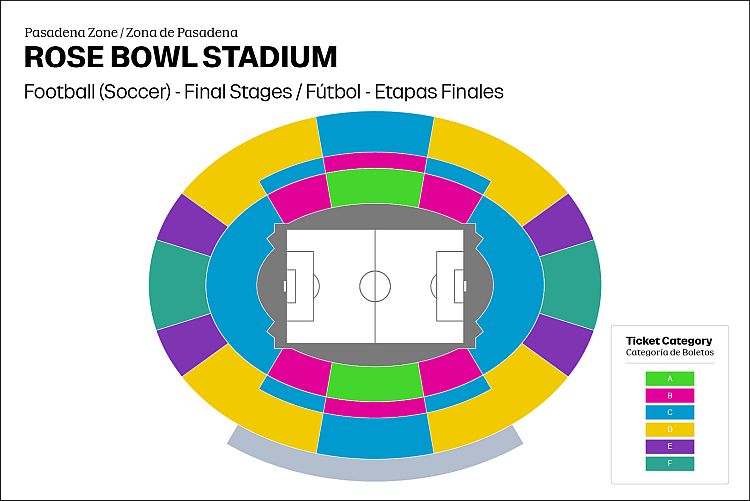
There is a new standard-bearer for the most Olympic Winter Games gold medals. Americans have almost surely never heard of him, but he’s special: Norway’s Johannes Hoesflot Klaebo.
He won his fourth gold of the Milan Cortina 2026 Winter Games to go with five he previously won and became the first Winter Olympian to win nine gold medals. And he’s not done. But he sits above all others in Winter Games history:
● 9: Johannes Hoesflot Klaebo (NOR: Cross Country 2018-26) ● 8: Marit Bjoergen (NOR: Cross Country 2010-18) ● 8: Ole Einar Bjorndalen (NOR: Biathlon 1998-2014) ● 8: Bjorn Daehlie (NOR: Cross Country 1992-98)
What is impressive about Klaebo is his ability to win at all distances. In three Winter Games – he’s still just 29 – he has won nine golds, one silver and one bronze:
● 1998: Sprint, Team Sprint, Team Relay golds ● 2022: Sprint, Team Sprint golds; Team relay silver;15 km bronze ● 2026: Sprint, 10 km, 20 km Skiathlon, Team Relay golds
He still has the Team Sprint and the 50 km Classical to go, both of which he won at the 2025 World Championships in Trondheim (NOR) and where he will be favored again.
If he does win, Klaebo will have 11 career Olympic golds and 13 Winter Games medals: the most golds ever and equal-third all-time for total Winter medals, behind Bjorgen (15) and Bjorndalen (14) and tied with Ireen Wust (NED: Speed Skating) and Italian star Arianna Fontana– both with 13 – with Fontana still competing!
At nine career golds, Klaebo is now tied for the second-most ever in Olympic history – winter or summer – with Soviet gymnast Larisa Latynina, Finland distance legend Paavo Nurmiand American swimmers Caeleb Dressel, Katie Ledecky and Mark Spitz and sprint and jumps star Carl Lewis. If he’s wins any more, he’ll stand only behind Michael Phelps, who won 23 from 2004-16.
And Klaebo is only 29, so could he go on to French Alps 2030 and Utah 2034? With today’s training, nutritional and medical advances, why not? And by 2034, he might be closing in on Phelps.
Following his ninth career gold in the Team Relay on Sunday, Klaebo preferred to focus on the team:
“It was a fantastic race and great to be able to give this gold medal to Norway. The other guys made it so possible and easy for me, it’s a team result. There are so many people involved and I want to share the victory with all of them.” ~ Rich Perelman
● Milan Cortina 2026 ●The International Olympic Committee said Saturday that 1.27 million tickets for the 2026 Games had been sold through the first week. Moreover, more than 250,000 had visited the Fan Villages.
In terms of tickets vs. capacities, 94% of tickets were sold for speed skating, 90% for ski jumping, and 87% for luge. About 85% of the tickets available have been sold for the events held so far.

The volunteer corps is 18,000 strong in Milan Cortina, with individuals from 98 countries and territories; 2,000 came from outside Italy to volunteer. They were selected from more than 135,000 applications, with 35,000 interviews made over 11 months, in Italy and abroad.
In terms of age, 46% are less than 35 years old, and 15% are over 60!
Some 14,000 are working during the Olympic Games; the remainder will be assisting during the Paralympic Games.

Italian railway lines were hit again by sabotage attempts on Friday, possibly burnt-out cables, on high-speed line between Rome and Naples, Florence and Milan. The U.S. State Department’s Consular Affairs office posted Saturday:
“On February 13, Italian authorities announced enhanced security measures to prevent disruptions to railway networks during the Winter Olympics. These efforts include increased patrols along the tracks and rigorous technical monitoring of railway services.”
Italian authorities are treating the incidents as criminal acts.
● Il Tempo Olimpici ●Mostly cloudy weather will continue in Milan on the 16th, with highs of 52 F and a low of 39 F, but no rain in the forecast.
Cortina will be cold, with a 29 F high and a low of 16 F, with light snow forecast and winds averaging a light 3 miles per hour.
● Scoreboard ● Italy has done it. Led by Federica Brignone’s amazing Giant Slalom win, the Azzurri have won more medal at Milan Cortina then in any Winter Games in history.
The high was 20 in 1994 at Lillehammer, but they are now at 22 (8-4-10), also getting the most-ever gold medals; seven was the prior high, also in 1994. So far, after 68 of 116 events:
● 27: Norway (12-7-7) ● 22: Italy (8-4-10) ● 17: United States (5-8-4) ● 17: Japan (3-5-9) ● 15: France (4-7-4)
● 15: Germany (4-6-5) ● 13: Austria ● 11: Netherlands ● 11: Sweden ● 9: Switzerland ● 9: Canada
A total of 25 countries have won medals so far.
A better indication of team performance has to go beyond three places, so The Sports Examiner returns our eight-place scoring, using the NCAA track & field format of 10-8-6-5-4-3-2-1 to score each event. With a week to go, the top 12:
● 319.5: Norway ● 270.5: Italy ● 220.5: United States ● 209.5: France ● 188.5: Austria
● 175: Germany ● 167.5: Japan ● 134: Netherlands ● 130: Canada ● 128: Sweden
● 116.5: Switzerland ● 73: China
In terms of top-8 place winners, Norway is ahead of Italy by 57-53, with the U.S. next at 48, then France (44) and Austria (43).
● Television ● NBC said that Friday’s viewing averaged 21.0 million across Milan Prime and the primetime show, so seven of eight days have averaged 20 million or more. The overall average has not been updated for a few days.
● China ● The Wall Street Journal noted that a Beijing Municipal Sports Bureau report for 2025 listed payments to snowboard star Eileen Gu and figure skater Zhu Yi– American-born athletes now competing for China – $6.6 million for the year and more than $14 million for the past three years combined.
The report has been revised to remove their names.
Observed: This is a surprise? No. Countries, especially those with a political view of sports such as Russia, China and others, routinely pay athletes to switch nationalities where it makes sense for them. Yi has been a minor performer at the international level, but Gu has been a sensation, winning two golds and a silver at the 2022 Winter Games in Beijing and has a silver so far in Cortina, with her best events coming up.
● Figure Skating ● U.S. Figure Skating did not file an appeal the scoring of the Ice Dance final, where Madison Chockand Evan Bates won the silver medal. In a statement to USA Today, USFS chief executive Matt Farrellexplained:
“There has been a lot of thoughtful, and at times emotional, discussion about the ice dance competition in Milan.
“Working together with Madi and Evan after the Games, we will have thoughtful and intentional discussions about the best way to support them and the future of the sport.”
= RESULTS: SUNDAY, 15 FEBRUARY = (9 finals across 8 sports & disciplines)
● Alpine Skiing: Women’s Giant Slalom Here’s a timeline of a skiing miracle, the story of Italian star Federica Brignone:
● 13 Feb. 2025: Won the FIS World Championships Giant Slalom, following a silver in the Super-G seven days earlier.
● 03 Apr. 2025: Crashed at the Italian Championships in Val di Fassa, with multiple fractures of her left leg and tearing her anterior cruciate ligament.
● 17 Apr. 2025: First rehab session, in Turin.
● 26 Nov. 2025: First training session on snow.
● 20 Jan. 2026: FIS World Cup return, sixth in the Giant Slalom at Kronplatz (ITA).
● 31 Jan. 2026: Finished 18th in the Super-G at Crans-Montana (SUI).
● 08 Feb. 2026: Olympic Downhill: 10th.
● 12 Feb. 2026: Olympic Super-G: Gold.
● 15 Feb. 2026: Olympic Giant Slalom: Gold.
Nothing short of stunning, as Brignone, 35, stormed to a first-run lead by 0.34 over Lena Duerr (GER), then held on to win in 2:13.50, a remarkable 0.62 ahead of defending champion Sara Hector (SWE) and Thea Louise St Jernesund (NOR), who shared the silver.
Brignone won the bronze in this event in 2018, then the silver in 2022. Now her second gold in these Olympic Games, nothing short of dreamland.
Hector and St. Jernesund skied the exact same time in their first run (1:03.97) and were 11th-fastest in their second run (1:10.15) to end up sharing silver. What are the odds on that?
The other favorites all had trouble. Austria’s Julia Scheib was 11th after the first run, then fifth in the second, to finish fifth. New Zealand’s Alice Robinson was 10th and ninth to finish eighth. American Mikaela Shiffrin, who won this event in 2018, was seventh after the first run and then 13th in the second and placed 11th overall (2:14.42).
Fellow Americans Paula Moltzan (2:14.77) and Nina O’Brien (2:15.31) were 15th and 20th. A.J. Hurtdid not finish the first run.
● Biathlon: Men’s 12.5 km Pursuit; Women’s 10 km Pursuit Italy had never won a medal in the women’s Olympic Pursuit, but that changed with Lisa Vittozzi’s dominant win, shooting clean and finishing in 3:11.8 to earn her first individual Olympic medal and first Olympic gold.
She took the lead after the final shooting stand and was, in the end, an easy winner, finishing almost 29 seconds ahead of Norway’s Maren Kirkeedie (30:40.6/3), who endured two penalties in the final shooting segment. Finland’s Suvi Minkkinen shot clean to earn the bronze in 30:46.1, more than 15 seconds up on France’s Lou Jeanmonnot (31:01.2/3).
This is Vittozzi’s third Games; she finished 11th and 32nd in the Pursuit in 2018 and 2022 and had never been higher than fourth in an individual event. Not any more.
Deedra Irwin was the only U.S. entry, in 35th (33:51.5/4).

France had won the men’s Pursuit at the last three Winter Games and Emilien Jacquelin was leading the event into the last shooting stanza, but suffered two penalties and the race got away.
Sweden’s Martin Ponsiluomashot clean and took over, finishing in 31:11.9 (1) for his first Olympic gold and second medal, after a 2022 silver in the Mass Start. He was cleanly ahead of Norway’s Sturla Holm Laegreid (31:32.5/2), who emotionally confessed to infidelity after winning a bronze in the 20 km Individual race, then won another bronze in the 10 km Sprint and now a silver in the Pursuit! He still has the Mass Start to go!
Jacquelin ended up with the bronze in 31:41.6 with three penalties that hurt badly. France has now won a medal in this race in five straight Games.
Campbell Wright of the U.S. finished a very creditable eighth in 32:25.4, but with three penalties. Paul Schommerwas 47th (36:41.4/4).
● Cross Country Skiing: Men’s 4×7.5 km relay there wasn’t a lot of doubt about the outcome and Norway got strong early legs from Emil Iversen and Martin Nyenget and cruised to a 1:04:24.5 victory, anchored by Johannes Hoesflot Klaebo, who won his record ninth Winter Olympic gold medal.
Klaebo won six golds at the 2025 Nordic World Championships – four individual and two relays – and he is on track for the same in 2026. He’s won three individual events, including the Sprint, and one relay, and has the Team Sprint and the 50 km Classical still on the program. No one has ever won six golds at a single Winter Games; American speed skater Eric Heidenwon five in 1980. But that’s still to come.
Klaebo was on the Norwegian gold-medal team in this event in 2018, then was second to Russia in 2022. This time, he had the lead after Einar Hedegart’s leg and won by 22.2 seconds over France (1:04:46.7) and 47.9 seconds over Italy (1:06:12.4).
The U.S. finished sixth – Sprint silver man Ben Ogden, Gus Schumacher, John Steel Hagenbuch, Zak Ketterson – in 1:06:11.8.
● Freestyle Skiing: Men’s Dual Moguls The greatest Moguls skier in history, Canada’s Mikael Kingsbury, was an appropriate favorite to win the first-ever Olympic appearance of the Dual Moguls. And he did not disappoint.
A five-time winner of the Worlds gold in this event, Kingsbury won his first two matches by 25-10 and 23-12, , then rolled past Dae-yoon Jung (KOR), who did not finish, to reach the semis. There, he sailed past Takuya Shimakawa, 33-2 to reach the final against familiar foe Ikuma Horishima.
This time, it was no contest, as Kingsbury completed a romp through the event with a 30-5 victory. It’s his second Olympic gold after a 2018 Moguls win and his fifth Olympic medal.
It’s also the first gold in the 2026 Winter Games for Canada, which has been disappointing through the first half of the program.
Horishima had previously won two Moguls bronzes (2022-26) and now has an Olympic silver.
The third-place match saw 2021 World silver medalist Matt Graham(AUS) defeat Shimakawa, 20-15, for the bronze.
The U.S. duo of Charlie Mickeland Dylan Walczykfinished sixth and seventh.
● Skeleton: Mixed Team Britain’s men’s gold winner Matt Weston teamed with Tabitha Stoecker and the pair were unbeatable in this first-time event at the Winter Games, with Weston’s best-of-the-day time lifting them to the win in a combined 1:59.36. They moved up from silver at the 2025 World Championships.
That was 0.17 better than the German pairing of Susanne Kreher(third-fastest woman) and Axel Jungk (second-fastest man) of 1:59.53 for silver and the bronze – just 0.01 back – for Germans Jacqueline Pfeiferand Christopher Grotheer (1:59.54). The second British team of Marcus Wyattand Freya Tarbit was fourth at 1:59.65.
The U.S. pair of Austin Florian and Mystique Ro – the 2025 World Champions – was seventh overall (2:00.39). Kelly Curtis and Daniel Barefoot finished 10th (2:01.43).
● Ski Jumping: Women’s Large Hill (141 m) Norway seized the first round and had the top four jumpers heading into round two: Worlds bronzer Eirin Kvandal(140.6 points), Normal Hill gold medalist Anna Stroem (136.7), Silje Opseth (131.8) and Heidi Traaserud (129.6). Favored Nika Prevc (SLO: 128.3) was fifth.
Prevc, jumping fifth to last in the final, put the pressure on with a 127.5 m jump and 143.2 points to move into the lead with 271.5 points, with the four Norwegians to follow. Traaserud and Opset both fell back to third and fourth, then Stroem, jumping next to last, uncorked a 132.0 m jump that scored 148.1 points and took the lead at 284.8.
Last up was Kvandal, whose effort was out to 133.5 m – best of the day – but scored 142.1 points, behind Prevc, but still good enough for silver, at 282.7. Sweden’s Freda Westman moved up to fourth with a big second jump and a 265.4 total.
So, Stroem swept the women’s events, including the first appearance of the Large Hill, and Prevc ended with a silver and a bronze.
The U.S. had three jumpers in, but Paige Jones scored 182.7 and was 28th. Annika Belshaw was disqualified and Josie Johnsondid not start.
● Snowboard: Mixed SnowCross Britain’s Huw Nightingale and Charlotte Bankes won the only World Cup race in this event this season, beating Italy’s Michela Moioli and Lorenzo Sommariva.
Ditto!
The British barely won their quarterfinal over Austria (+0.02), but easily won over France in their semi. The Italians won their quarter by 0.13 and their semi over Australia by just 0.04 to make it to the final. Once there, the Brits were decisive winners, taking the gold by 0.43 over Italy, with Loan Bozzolo and Lea Casta getting the bronze for the French. Australia finished fourth.
This was only the second time for this event on the Olympic program, but Nightingale and Bankes were able to repeat their 2023 Worlds win in this event!
The U.S. team of 2022 winner Nick Baumgartner and Faye Thelen were eliminated in their quarterfinal; Nathan Pare and Stacy Gaskilldid not finish in their quarterfinal race.
● Speed Skating: Women’s 500 m Everyone sensed this was going to come down to the final pair, between defending champ Erin Jackson of the U.S. and three-time World Champion Femke Kok (NED). It did.
Beforehand, Japan’s Miho Takagi, the Beijing 2022 silver winner, put down an impressive time of 37.27 in the fourth of the 15 pairs. It took until the 12th pair for 1,000 m winner Jutta Leerdam (NED) to move ahead, winning in 37.15.
A surprise win (and time) for Italy’s Serena Pergher in the 10th pair had her third going into the last pair with Jackson and Kok. While Jackson was off well at the start, Kok had much better speed and won easily and took her expected gold in an Olympic Record of 36.49, close to her world mark of 36.09 from last November.
The Dutch 1-2 was historic: they had never won an Olympic gold or silver in this event.
Jackson’s 37.32 was good for fifth; Sarah Warren of the U.S. finished 28th in 39.19.
Elsewhere:
● Curling: Questions continue to be raised about “double touching” of the stone by some teams, but on the ice, Danny Casper’s U.S. team beat defending champ Sweden and Niklas Edin by 8-5 early on Sunday and then edged Norway, 10-8, to move to 4-2. Yannick Schwaller’s Swiss side is 5-0, with Canada (Brad Jacobs) standing second at 4-1. The round-robin continues through the 19th.
The women’s standings have Sweden’s 2018 winner Anna Hasselborg at 5-0, with the U.S.’s Tabitha Peterson’s rink at 4-1 and four-time World Champion Switzerland (Silvana Tirinzoni) at 3-1. The U.S. edged China, 6-5, on Sunday.
● Ice Hockey: In the men’s round-robin, Canada crushed France, 10-2, to finish 3-0 in Group A with a 20-3 total score. Slovakia and Finland were both 2-1 in Group B and advanced to the quarters.
In Group C, the U.S. got a first-period goal from Zach Werenskiand two in the second, from Auston Matthewsand Brock Faber to lead 3-0, with a 28:15 shots advantage. The win was sealed with third-period scores from Tage Thompsonand a second from Matthews, at 6:46 of the period. The Germans got a score at 11:22 from Tim Stutzle, that made the final 5-1. The U.S. finished with a 37-24 shots total and a 16-5 scoring total for their three games.
The playoffs will start on the 17th with play-in matches to the quarterfinals (18th).
The women’s semifinals (USA-Sweden, Canada-Swiss) come tomorrow.
= PREVIEWS: MONDAY, 16 FEBRUARY = (6 finals across 6 sports & disciplines)
● Alpine Skiing: Men’s Slalom Lucas Pinheiro Braathen secured the first-ever Brazilian medal in the Olympic Winter Games in the men’s Giant Slalom on Saturday. He’s just as much a threat in the Slalom.
He won the first Slalom World Cup race in Finland in November, beating defending Olympic champ Clement Noel(FRA), and took a silver in January behind Norwegian seasonal leader Atle Lie McGrath.
McGrath has five Slalom medals this season, and teammate Henrik Kristoffersen has four, so it will be no surprise if they show up on the podium. Kristoffersen already has an Olympic Slalom bronze from 2014 and he’s the 2023 World Champion.
But there are lots of contenders. Swiss Loic Meillard won the 2025 Worlds gold and was part of the Swiss gold in the Team Combined. But teammate Tanguy Nef, who has never won a World Cup medal in his career, had the fastest Slalom in the Team Combined!
Austria has two threats: Manuel Fellerand Michael Matt, who were second and third-fastest in the Team Combined Slalom, won the Worlds silver in this event in 2017, and Olympic bronzse in 2018, respectively. And while Noel won the Olympic title in Beijing, teammate Paco Rassat won twice on the World Cup circuit and is a definite medal threat.
● Bobsled: Women’s Monobob This is the second appearance of this race on the Olympic program. The IBSF World Cup circuit in this event was dominated by 2023-24 World Champion Laura Nolte (GER) and Australia’s Breeana Walker, who led all riders with three wins. Just behind were Lisa Buckwitz (GER), a two-time Worlds bronzer and American Kaillie Armbruster Humphries, the defending Olympic champion.
Armbruster Humphries and Elana Meyers Taylorof the U.S. went 1-2 at Beijing in 2022, and Armbruster Humphries won once on the World Cup circuit, as did fellow American Kaysha Love. Austria’s Katrin Beierl won three medals and was in the top five in the seasonal standings.
The favorites were in front after the first two runs, with Nolte at 1:59.12, then Meyers Taylor – on her best day of the season – at 1:59.34, followed by Armbruster Humphries at 1:59.43. Swiss Melanie Haslerstood fourth at 1:59.90 and Love was fifth at 2:00.01.
Nolte, Meyers Taylor and Love were 1-2-3 on the first run, then Armbruster Humphries won the second heat, ahead of Nolte, with Meyers Taylor fourth and Love falling back in 15th. Consistency wins and Nolte was good on both runs. The Americans will need a mistake from her to jump to gold.
● Figure Skating: Pairs The three World Championships from 2023-25 were won by Japan’s Riku Miura and Ryuichi Kihara (twice) and Canada’s Deanna Stellato-Dudek and Maxime Deschamps (once). They’re the favorites, with the 42-year-old Stellato-Dudek cleared to compete after hitting her head on the ice during training on 30 January. But they did not appear in the Team Event.
China’s defending champs, Wenjing Sunand Cong Han, returned to competition for the 2025-26 season and placed third in two Grand Prix events. Italy’s Sara Conti and Niccolo Macii were second at the ISU Grand Prix Final, ahead of Germans Minerva Fabienne Hase and Nikita Volodin. Along with Georgia’s Anastasiia Metelkina and Luka Berulava, they’re in the next tier.
So what happened in the Short Program? Hase and Volodin were elegant and precise and scored 80.01 to lead by a considerable margin over Metelkina and Berulava (75.46) and Canada’s Lia Pereira and Trennt Michaud(74.60). Miura and Kihara had problems and stand fifth at 73.11, with Conti and Macii also disappointed in eighth (71.70). Stellato-Dudek and Deschamps were 14th at 66.04.
Americans Ellie Kam and Danny O’Shea scored 71.87 for seventh, just ahead of teammates Emily Chan and Spencer Akira Howe (9th: 70.06). Both qualified for the Free Skate.
● Freestyle Skiing: Women’s Big Air Defending champion Eileen Gu (CHN) is back, but did not contest the event at any of the three FIS World Cup events this season. Same for Swiss Mathilde Gremaud, the 2022 bronzer, who already has a 2026 Olympic gold in Slopestyle.
This is the second appearance for this event, after its Beijing debut. During the 2025-26 World Cup, Britain’s Kirsty Muir (21) won and is back for a second Games, Finland’s Anni Karava won and was the 2025 Worlds bronze winner and Canada’s Naomi Urness won once, in her second season in World Cup competition.
Urness and China’s Mengting Liu, the 2025 Asian Winter Games winner, were the only ones to medal twice during the World Cup season. Italy’s Flora Tabanelliwon the 2025 Worlds gold, but has been quiet this season; same for Swiss Sarah Hoefflin, the 2025 Worlds silver winner, who won Olympic gold in 2018 in Slopestyle.
In qualifying, Canadian Megan Oldham – the Olympic Slopestyle bronzer and the 2023 Worlds Big Air bronzer – led the field at 171.75, followed by Gu at 170.75 and Gremaud at 169.00.
No Americans advanced to the final (top 12) as Grace Henderson was 14th (139.25), Avery Krummewas 19th (125.00), Marin Hamillfinished 22nd (115.50) and Reli Harwood was 23rd (101.25).
● Short Track: Women’s 1,000 m The home crowd wants to know what 35-year-old Arianna Fontanawill do. Now the owner of 13 Olympic medals (3-5-5), tied for the third-most all-time. A 14th would tie her for second, with Ole Einar Bjorndalen (NOR: Cross Country 1998-2014).
She has stiff opposition, starting with 500 m Olympic champ Xandra Velzeboer, who won this event at the 2023 Worlds, over Korea’s 2022 Olympic silver winner Min-jeong Choiand Canadian Courtney Sauralt. All three could be on the podium again.
American Kristin Santos-Griswold won this event at the 2024 ISU Worlds, over Korea’s Gil-li Kim with Fontana third. Then at the 2025 Worlds, Belgian Hanne Desmet got her first Worlds gold, beating Sauralt with Velzeboer in third.
Sauralt won three of four times on the World Cup circuit and Desmet won the other. American Corinne Stoddard won three medals in four events this season, but has crashed out twice in the Games. This is her chance for redemption.
● Ski Jumping: Men’s Team (141 m) Austria, Slovenia and Germany won the medals in 2022, and Slovenia, Austria and Norway won the medals at the last two World Championships. Add in Japan and those are the medal favorites.
The Slovenians won last year with Domen Prevc, Anze Lanisek, Timi Zajc and Lovro Kos, with Lanisek, Zajc and Kos all holdovers from the 2023 Worlds winners. They should be favored, but Austria has three consistent stars with Daniel Tschofenig, Jan Hoerl and three-time World Champion Stefan Kraft.
Domen Prevc will be trying to add to the family trophy case again; older brothers Peterand Cene were on the Olympic silver-medal team (as were Zajc and Kos) in 2022.
= INTEL REPORT =
● Artistic Swimming ● At the World Aquatics World Cup 1 in Medellin (COL), Canada’s 20-year-old Audrey Lamothe scored two wins, winning the women’s Solo Technical at 237.9382 over Zofia Strapekova (SVK: 237.0800), and the Solo Free at 247.0625, ahead of Germany’s Klara Bleyer (236.7025).
Bleyer teamed with Amelie Blumenthal to win the Duet Technical with 275.2792 points; Russian “neutrals” Mayya Doroshko and Aleksandra Shmidt won the Duet Free at 257.2693.
The men’s Solo Technical was won by Ranjuo Tomblin(GBR: 223.8033), with the Solo Free taken by Eduard Kim (KAZ: 195.2476). The Mixed Technical final saw Isabelle Thorpe and Tomblin (GBR) win, scoring 202.9517 and they doubled back in the Mixed Free at 241.0792.
Mexico won the Team Technical, 263.2375 over the U.S. (249.8833); Kazakhstan took the Team Free at 189.8591.
● Athletics ● A first world record in the men’s Half Marathon Walk, as Japanese star Toshikazu Yamanishi– a two-time World Champion at 20 km – won in 1:20:34 at the national walk championships in Kobe.
This is a new event and Yamanishi’s mark is the first under the minimum standard of 1:21:30. Yamanishi was the 20 km world-record holder at 1:16:10 from 2025.

A plethora of hot indoor times on Friday and Saturday, with World 5,000 m champ Cole Hockerof the U.S. blazing the second-fastest mile in history – and an American Record – of 3:45.94 at the ASICS Sound Invite in Winston-Salem, North Carolina, ahead of Cooper Teare(3:50.94). Hocker took Yared Nuguse’s U.S. mile mark from 2025 (3:46.63).
Hocker passed 1,500 m en route in 3:30.80, another American Record, bettering Nuguse’s 3:31.74 and the no. 3 performance in history (no. 2 performer).
Cooper Lutkenhaus, the 17-year-old phenom, won the 800 m in 1:44.03 for a world indoor U-20 record and no. 6 on the all-time list and no. 2 all-time U.S.
Hurdles star Trey Cunningham won the 60 m hurdles at the Tiger Paw Invitational in Clemson, South Carolina in 7.37, another world leader and tying him for seventh-fastest in history.
At the Boston University Hemery Valentine Invitational, Elle St. Pierrewon the women’s invitational mile in 4:17.83, best in the world this year and the no. 9 performance ever. She passed 1,500 m in a world-leading 3:59.33.
Britain’s Olympic 800 m champ, Keely Hodgkinson blasted the women’s 800 m in 1:56.33 at her national championships in Birmingham in a heat, then skipped the final. It’s the no. 3 performance in history (no. 3 performer) and the fastest in the event indoors since 2002!

An impressive 10 km road debut for triple Olympic women’s 1,500 m champ Faith Kipyegon (KEN), winning the Monaco Run in 29:46 on Sunday. It moves her to third on the 2026 world list and equal-15th all-time.
● Sport Climbing ● At the USA Climbing National Championships in Orlando, Florida, 2023 Worlds silver medalist Colin Duffy was an easy winner in Lead at 47+, ahead of Dillon Countryman(33+).
Ben Jennings won the Speed title (5.10), defeating Noah Bratschi, who fell. The Boulder final was held after this post went live.
Paris 2024 Olympic silver medalist Brooke Raboutou won the women’s Lead at 46, well ahead of Analise van Noang (34+) and Sophia Curcio won the Speed final over Piper Kelly,6.95 to 8.30. The Boulder final was held after this post went live.

★ Receive our exclusive, weekday TSX Recap by e-mail by clicking here.
★ Sign up a friend to receive the TSX Recap by clicking here.
★ Please consider a donation here to keep this site going.
For our updated, 45-sport, 910-event International Sports Calendar for 2026 and beyond, by date and by sport, click here!
CORTINA D’AMPEZZO, Italy – American skeleton racer Katie Uhlaender made it to the start for her sixth Winter Olympic Games, but this time she was not a competitor.
Uhlaender was sitting in the front row of the spectator section as a guest of the Danish Bobsleigh and Skeleton Federation (pictured below).
Denmark was one of the 12 countries supporting Uhlaender in her appeal to be granted an entry to the Games based on competition manipulation. A Canadian coach withdrew four athletes from the final North American Cup race of the season at the last minute, costing Uhlaender the points she needed to earn a spot on the U.S. Olympic Team.
Uhlaender said she found out on 6 February, the day of the Winter Games’ opening ceremony, that she had come to the end of the appeals track.
“I honestly was at home and felt so heartbroken and disconnected from the community,” Uhlaender said during the break between heats. “No one had called from my federation to ask if I was OK or anything. So I felt really distant. And then Denmark called and they said, ‘We want to fly you to the Olympics to be a part of our hospitality team because you stood up for the right thing and it meant a lot to us and we want you to be able to cheer for the athletes you helped support.'”
At age 41, Uhlaender said she wants to prove that anyone can chase their dreams.
“My heart has been filled with inspiration, with the Olympic spirit and I’m just so happy to be here cheering on Team USA,” she said. “Because it was never about me trying to get a spot as much as it was about upholding the integrity of sport.”
For the U.S., Kelly Curtisplaced 12th and Mystique Rowas 15th. In her five straight Olympics starting in 2006, Uhlaender placed sixth, 11th, fourth, 13th and sixth again.
Uhlaender said officials from the U.S. bobsled and skeleton federation called her and insinuated that she would hurt the U.S. athletes if she showed up at the start. “They said, ‘What are you doing here, and why did you bring your helmet? Are you planning to slide?'”
Uhlaender said her helmet was at the hotel. She said Curtis has “been awesome,” and Uhlaender has been giving Ro space so as not to distract her.
And yet Uhlaender admitted that watching the athletes, led by 36-year-old Olympic champion Janine Flock of Austria, take off down the new Cortina track gave her a slight feeling of “That could have been me.”
She grinned. “I think I would have done well here.”
So, is Uhlaender finally retired after a career spanning nearly a quarter century?
“We’re going,” she said, “to hold off on that for a minute.” ~ Karen Rosen
● International Olympic Committee ● The theme of the daily news briefing was the IOC’s Olympic Solidarity program, which provides support to athletes and teams to train. For the Winter Games in the current cycle (2023-26), the IOC provided scholarships – direct payments to athletes – to 449 athletes from 90 countries across six sports, at a cost of $12.2 million.
Team support was also provided to 13 teams from 12 National Olympic Committees, in curling and ice hockey; nine of those made it to the Milan Cortina Winter Games. That was another $1.2 million in support,
● Il Tempo Olimpici ● Sunday’s Milan weather forecast is for cloudy skies, but comfortable temperatures of 58 F for the high and 40 F for the low. Rain is unlikely.
In Cortina, partly sunny conditions are projected, but still cold with a 26 F high and 19 F low. Winds continue to be modest at 6 miles per hour, but no rain or snow. That comes Monday.
● Scoreboard ●Norway continues at the top of the medal table, but Italy is getting close to history.
The Italian high for medals at a Winter Games is 20, from 1994 in Lillehammer (NOR), where it won seven golds. Now, after 59 out of 116 events:
● 20: Norway (10-3-7) ● 18: Italy (6-3-9) ● 17: United States (5-8-4) ● 15: Japan (3-4-8) ● 13: Austria (4-6-3)
● 13: Germany (4-5-4) ● 12: France ● 9: Netherlands ● 9: Sweden ● 9: Switzerland
The U.S. won 25 medals at Beijing 2022 and 23 at PyeongChang in 2018 and is on pace to do better than that in Milan Cortina.
A better indication of team performance has to go beyond three places, so The Sports Examiner returns our eight-place scoring, using the NCAA track & field format of 10-8-6-5-4-3-2-1 to score each event. After three days, the top 12:
● 251.5: Norway ● 223.5: Italy ● 205.5: United States ● 182.5: Austria ● 169.5: France
Italy and Norway both have 46 top-8 placers so far; the U.S. has 42.
● Alpine Skiing ●Lindsey Vonnposted on Instagram that she has another surgery scheduled on her left leg for Saturday in Treviso, after crashing in the women’s Downhill on 8 February:
“It has been quite a hard few days in the hospital here. I’m finally feeling more like myself. I have a long, long way to go. Tomorrow I’ll have another surgery and hopefully that goes well and then I can potentially leave and go back home, at which point I will need another surgery. Still don’t know exactly what that entails yet until I get some better imaging, but it’s kind of where I am right now.”
● Ice Hockey ● A Slovakian fugitive for 16 years was apprehended in Milan on Wednesday (11th) by Italian authorities after being wanted for thefts back in 2010.
He was in Milan to attend the Slovakian men’s team’s opening game against Finland, which it won by 4-1. He was detected when he checked in at a campsite outside the city. He was returned to a Milan prison to serve the remaining 11 years on his sentence. He was not named by authorities.
= RESULTS: SATURDAY, 14 FEBRUARY = (8 finals across 8 sports & disciplines)
● Alpine Skiing: Men’s Giant Slalom Motivation is a powerful driver in life and Norwegian skier Lucas Braathen, born in Oslo to a Norwegian father and Brazilian mother, lived in both countries growing up. He skied for Norway from 2019 to 2023, with 12 World Cup medals, then retired, then changed allegiance to Brazil, hen re-joined the World Cup tour for the 2024-25 season.
He just won Brazil’s first-ever Olympic medal in alpine skiing. In fact, it’s Brazil’s first medal in the Winter Games! At 25, he’ll have more chances, too.
Now going by Lucas Pinheiro Braathen, he led off the first run and finished in 1:13.92, a time no one could touch and he had a big, 0.95-second lead on Swiss star Marco Odermatt going into the second run.
This time, he skied last in the order, and even with the 11th-fastest run, he managed a total time of 2:25.00 and that was enough to hold off Odermatt (2:25.58) and fellow Swiss Loic Meillard (2:26.17). Swiss Thomas Tumler(2:26.45) was fourth; the top four in the first run ended up being the first four overall.
Odermatt, on his way to a fifth straight seasonal World Cup victory, has had a pretty good Winter Games: fourth in the Downhill, bronze in the Super-G, silver in the Team Combined and now silver in the Giant Slalom. But he would have preferred another gold to go with his 2022 Giant Slalom victory.
Meillard’s bronze was his second Olympic medal, to go with his Team Combined silver.
The top U.S. finisher was River Radamus in 17th (2:27.96), also Ryder Sarchett in 25th (2:30.11); Kyle Negomir skied out on the first run.
● Biathlon: Women’s 7.5 km Sprint You was served on Saturday as Norway’s Maren Kirkeeide, 22, had the best skiing time in the field, shot clean and got to the line first in 20:40.8 to beat France’s Oceane Michelon (20:44.6/0) and Lou Jeanmonnot (21:04.5/1).
It was the second Olympic win in a row for the Norwegians, but Kirkeeide was hardly the favorite coming in, although she had won a World Cup sprint silver behind Jeanmonnot in December. She took control on the final lap and managed to avoid a penalty for only the second time in her World Cup and major-event career! It won her an Olympic gold, after finishing 16th at the 2025 Worlds.
Michelon, 23, had two World Cup medals this season, but also shot clean and challenged for the gold, but fell just short. She was 12th in the Worlds Sprint last year. Jeanmonnot won her third Olympic medal at this Games and now has a gold (relay), silver (Individual) and bronze (Sprint).
Deedra Irwin was the top American, in 47th (22:59.5/0), with Margie Freed in 66th (23:43.2/3) and Joanne Reid in 72nd (24:01.9/1). Luci Anderson placed 79th (24:28.7/3).
● Cross Country Skiing: Women’s 4×7.5 km Relay Sweden was the clear favorite coming in, but star Ebba Andersson fell shortly after her start on the second leg, then fell again and lost a ski and more than a minute of time until her team could get a new one on her. She passed to Frida Karlsson in eighth place, down 1:18.4.
However, Karlsson, the 10 km and Skiathlon winner had the fastest leg in the race and made up time to get the Swedes into fourth at the final pass, down 1:06.8 from the lead. Jonna Sundling “won” the final leg and moved up to second, making up 16 seconds on Norway, but falling short in silver position in 1:16:35.7.
The Norwegians were steady, with strong 3-4 legs from Karoline Simpson-Larsen and Heidi Weng to finish in 1:15:44.8 with an easy, 50.9-second margin. It was the fifth win for Norway in this race all-time and first since 2018.
Finland was a clear third in 1:16:59.6, more than 21 seconds up on fourth-place Germany.
The U.S. was fifth, with Julia Kern, Rosie Brennan, Novie McCabe and Jessie Diggins, in 1:17:37.0, with Diggins moving up from sixth on her anchor leg.
● Freestyle Skiing: Women’s Dual Moguls Australia’s Jakara Anthony was the Beijing 2022 Olympic Moguls winner and looked like a possible repeat winner, but finished eighth this time. With the addition of Dual Moguls in 2026, she got another shot and made the best of it.
She won her round-of-32 match easily, then took her round-of-16 test by 27-8, then edged American Olivia Giaccio by 20-15 in the quarterfinals. She then beat Moguls winner Elizabeth Lemley of the U.S. in the semis when Lemley did not finish.
That put Anthony into the final against American star Jaelin Kauf, the 2025 World Champion. Kauf had sailed through her bracket with wins by 29-6, and two wins where her opponent did not finish.
The final was close. Kauf won on the first three jumps, but Anthony won the last four and took a 20-15 win and a second career Olympic gold.
Kauf continued her excellent performance in major events, with a third Olympic silver, to go along with her 2022 Moguls and 2026 Moguls silvers.
Lemley faced off in the bronze medal final against 2018 Moguls winner Perrine Laffont (FRA) and had two excellent jumps in the bottom half of the course to win the bronze, 18-17.
Americans Tess Johnson and Giaccio ended up ranking fifth and sixth.
● Short Track: Men’s 1,500 m The final looked to be a showdown between 1,000 m winner Jens van’T Wout (NED) and Canada’s World Champion William Dandjinou, one of the semifinal winners. But the Dutchman left nothing to chance, taking the lead at the 1,000 mark and maintaining to the finish, in 2:12.219.
Dandjinou was in the hunt until about the 1,000 mark, then fell back and it was Korea’s defending Olympic champion Dae-hwon Hwang who moved up to challenge and got the silver (2:12.304) just ahead of Latvia’s Roberts Kruzbergs (2:12.376). Dandjinou fell back to fifth in 2:12.639.
This was the first 1,000-1,500 m double at the Games since 2010, when Korean Jung-su Lee did it. Van’T Wout still has the 500 m to go and no one has won all three at an Olympic Games. Hwang won his fourth career Olympic medal (1-3-0)
● Skeleton: Women Austria’s Janine Flock, the favorite off her six World Cup wins this season, came into the second day of racing leading by just 0.04. But she made sure she took home the Olympic gold by winning the third run by 0.17 over second-place Susanne Kreher (GER: 2023 World Champion) and by just 0.01 over German Jacqueline Pfeifer and 0.09 over Kreher.
So, the totals showed 3:49.02 for Flock to 3:49.32 for Kreher and 3:49.46 for Pfeifer. In fact, German Hannah Niese – the defending champion – was fourth at 3:50.17.
It’s the first-ever medal in this event for Austria for the 36-year-old Flock, who won a Worlds silver way back in 2016 and 10 years later, is Olympic champion.
The American entries, Kelly Curtis (3:52.13) and Mystique Ro(3:52.48) finished in 12th and 15th place, respectively.
● Ski Jumping: Men’s Large Hill (141 m) Slovenia’s Domen Prevc has dominated the World Cup this season, with 11 wins and was part of Slovenia’s winning Mixed Team gold, but was just sixth in the Normal Hill event. He made up for it on Saturday.
Japan’s Ren Nikaido, the find of the season on the FIS World Cup circuit, led the first round with 154.0 points to 147.0 for Prevc. But in round two, Prevc rang up a 141.5 m jump and 154.8 total points and that was enough to win.
Prevc’s total of 301.8 won over Nikaido (295.0), with Poland’s 19-year-old Kacper Tomasiaktaking a surprise bronze at 291.2, following his surprise silver in the Normal Hill event. His best in this World Cup season has been fifth. But strange things happen in the Olympic Games.
Prevc joins his older brother Peteras an Olympic medalist in this event; Peter won the silver in 2014, the only prior medal for Slovenia in this event.
Americans Tate Frantz (254.1) and Kevin Bickner (249.1) finished 19th and 20th.
● Speed Skating: Men’s 500 m All eyes were on the 13th pair, with two-time World Champion Jordan Stolz of the U.S. facing 2025 World Champion Jenning De Boo (NED).
This is where the Olympic gold was expected to be won, and it was. Stolz had a small lead for much of the race, but De Boo got to the front coming out of the final turn and looking like a possible winner. Then, Stolz pushed hard to the line to cross first, with an Olympic record of 33.77, with the Dutchman at 33.88. De Boo fell to the ice and held his head in his hands in disbelief; they finished 1-2.
Canada’s Laurent Dubreuil, the 2021 World Champion, had been the leader, from the 10th pair, in 34.26, with American Cooper Mcleod well back at 34.90. That was going to be challenged in the 14th pair, with Poland’s Damian Zurek a medal favorite. But Zurek finished in 34.35, finishing in fourth.
American Zach Stoppelmoorwas 27th, in 35.42.
Stolz’s win is the first in this event for the U.S. since Joey Cheekin 2006. He’s the first American to take the 500-1,000 double since Eric Heiden won five golds in 1980. And Stolz still has the 1,500 m – where he is the favorite – and the Mass Start still to come.
Elsewhere:
● Curling:In the men’s tournament, American Daniel Casper’s rink defeated Germany, 8-6, to move to 2-2. Switzerland is now 4-0, as Yannick Schwaller’s rink defeated 2014 champ Brad Jacobs(CAN: 3-1) by 9-5, and defending champ Niklas Edin’s Swedish team (1-3) finally won, 6-4, over China.
The normally-respectful tone of curling blew up in the match between Canada and Sweden on Friday, when Swede Oskar Eriksson accused second Marc Kennedy of a second touch of the stone after it left his hand. The match, eventually won by Canada, 8-6, came to a halt with fingers pointed and some harsh language exchanged.
“Game Umpires are situated at the end of each sheet and physically cannot see every delivery infraction. However, when they are made aware of delivery issues, game umpires are positioned to observe the delivery for three ends. During this period of observation in the Friday evening game, there were no violations recorded.”
A warning on “language” was issued to the Canadian team.
Sweden’s Anna Hasselborg(4-0) leads the women’s tournament, but four-time World Champion Switzerland (3-1), skipped by Silvana Tirinzoni, lost to Sakaya Yoshimura’s Japan (1-3) by 7-5. American Tabitha Peterson’s squad is 3-1, defeating Yoshimura’s Japan in the late draw, 7-4.
● Ice Hockey: In the men’s Group B, Sweden (2-0) beat Slovakia, 5-3, and Finland (2-0) crushed Italy, 11-0. In Group C, Latvia (1-1) edged Germany (1-1) by 4-3.
The U.S. men faced Denmark in the evening match, with a 1-1 tie after the first period and then 2-2 in the second. The Americans took control with a goal from Jack Eichel at 10:23 of the period for a 3-2 lead and then 4-2 when Noah Hanifin scored at 17:23. But the Danes took advantage of a partial screen against U.S. keeper Jeremy Swayman and Phillip Bruggisser scored with just three seconds left to close to 4-3, despite a 28-11 shots edge for the USA through two periods.
In the third, the U.S. extended to 5-3 on a Jake Guentzel score at 7:24 and then Jack Hughes put the game away with a goal at 14:27 for the 6-3 final. The Americans out-shot the Danes, 47-21.
The U.S. plays Germany tomorrow; group play will finish on the 15th.
In the women’s tournament, the seeding for the quarterfinals shows the U.S. meeting Sweden on the 16th, with Canada vs. Switzerland in the lower bracket.
= PREVIEWS: SUNDAY, 15 FEBRUARY = (9 finals across 8 sports & disciplines)
● Alpine Skiing: Women’s Giant Slalom Italian star Federica Brignone has already written one of the miracle tales of this Winter Games, winning the 2025 World Championships gold in the Giant Slalom, then suffering a brutal crash in April at the Italian championships and somehow recovering enough to ski here 10 months later. She didn’t just ski, but was 10th in the Downhill and won a stunning victory in the Super-G.
So now, can she pull off another shocker, with another Giant Slalom win? Now 35, she won a Worlds Giant Slalom silver way back in 2011 and again in 2023, and has 17 career World Cup wins in this event, more than in any other. She won the Olympic bronze in this race in 2018 and silver in 2022 and needs a gold to complete her set!
While Brignone was recovering, the FIS World Cup saw two skiers dominate the event: Austria’s Julia Scheib (four wins) and New Zealand’s Alice Robinson (two wins). But defending Olympic champ Sara Hector (SWE) won the last G-S before the Games and had three other medals; she could repeat.
The U.S. has two solid entries, with 2018 Olympic champ Mikaela Shiffrin, and Paula Moltzan, a Worlds bronzer last year and a two-time Worlds medal winner this season. Shiffrin has 22 World Cup wins in this discipline, but none since her November 2024 crash in a Giant Slalom that ended her season.
● Biathlon: Men’s 12.5 km Pursuit; Women’s 10 km Pursuit The men’s Pursuit was held five times during the IBU World Cup season, with five different winners, each of whom could win at the Games: France’s defending Olympic champ Quentin Fillon Maillet(already the Sprint gold medalist), teammate Eric Perrot(already the 20 km silver winner), 20 km Individual gold winner Johan-Olav Botn (NOR), teammate Johannes Dale-Skjevdal and Italian star Tommaso Giocomel.
Swedes Sebastian Samuelsson (2) and Martin Ponsiluomaalso won World Cup Pursuit medals this season and should contend. The French will be going for a fourth straight Olympic title, with legendary Martin Fourcadewinning in 2014 and 2018, before Fillon Maillet’s victory in 2022.
Norway’s lovelorn Sturla Holm Laegreid has won two bronzes so far and was the 2024 Worlds silver winner, with teammate Vetle Christiansenin third (he was the Sprint runner-up); either could figure in the medals again.
American Campbell Wright shocked with a Worlds silver in this event in 2025, and finished a creditable 12th in the Sprint.
The women’s Pursuit is more straightforward: Lou Jeanmonnot is the favorite. The French star won this event twice during the World Cup season.
But she will have company, as teammate Julia Simonwon the 15 km Individual race already and won this event at the 2024 Worlds. Teammate Justine Braisaz-Bouchet won the 2024 Worlds bronze and then again in 2025.
Italy has two contenders in 2024 Worlds runner-up Lisa Vittozziand Dorothea Wierer,the 2020 World Pursuit champ who also got a 2025 World Cup bronze. Maybe the most dangerous of all is Finn Suvi Minkkinen, who took three World Cup bronzes in this race.
Sweden has Beijing 2022 silver winner Elvira Oeberg back and Anna Magnusson as an under-the-radar contender.
● Cross Country Skiing: Men’s 4×7.5 km relay Sure things have been a problem at this Olympic Winter Games. For example, American gold-medal favorites Chloe Kim, Ilia Malinin, Lindsey Vonn and Mikaela Shiffrin have all stumbled, and those are just a few of the disappointments so far.
Not for Norwegian star Johannes Hoesflot Klaebo. He won six golds at the 2025 World Championships. So far, he has won the Skiathlon, the Sprint and the 10 km Freestyle. He has this relay, the Team Sprint and the 50 km Classical left … and won all those last year.
He is now in a tie for the most gold medals in Olympic history – 8 – with three fellow Norwegians and will be favored to win a ninth career Olympic Winter gold here. Consider that in the 10 km here, Norway finished 1-3-4-5. It appears Klaebo will make history; if not, it will be a huge upset.
Switzerland and Sweden were 2-3 at the 2025 Worlds, both more than 21 seconds behind the Norwegians. Based on the 10 km results, look for France as a silver-medal favorite and teams from Italy (of course), Great Britain, Sweden, Canada and the Swiss to be in contention.
● Freestyle Skiing: Men’s Dual Moguls Another debut event at the Games, with Canadian superstar Mikael Kingsbury the reigning World Champion – his fifth Worlds win – ahead of Japanese star Ikuma Horishima, who won the 2017 Worlds, and Australian Matt Graham, the 2021 Worlds runner-up in Duals.
They figure as favorites, but then there is Swede Walter Wallberg, who won the Worlds silver in 2023. And at the lone FIS World Cup stop so far this season, it was Canadian Julien Vielwho got the win, over Horishima and Filip Gravenfors (SWE).
Kingsbury and Horishima were upset in the Moguls final by Australia’s unheralded Cooper Woods. Lightning can’t strike twice, can it?
● Skeleton: Mixed Team This is a first-time event at the Winter Games, with one man and one woman competing and ranked by the combined time. It was held four times during the IBSF World Cup season, with Britain winning twice with Marcus Wyatt and Tabitha Stoecker.Men’s champ Matt Weston teamed with Amelia Coltman and was second once, in a race won by Germans Susanne Kreher and Axel Jungk.
Look for Britain and Germany as the favorites, with multiple challengers for the bronze, including China (Zhan Dan and Yin Zhengwon a World Cup race) and 2025 World Champion Americans Mystique Ro and Austin Florian.
At the 2025 Worlds, Stoecker and Weston won the silver and Dan and Qinwei Lin took the bronze for China. Germans Hannah Niese and Christopher Grotheerwon the 2024 Worlds and Kreher and Grotheer won in 2023.
At this Games, Italy cannot be counted out and Alessandra Fumagalli and Amedeo Bagnis did win a World Cup bronze this season.
● Ski Jumping: Women’s Large Hill (141 m) Another first-time Winter Games event and on a hill size more of this year’s World Cups have been held on. Slovenia’s Nika Prevcwon 11 Worlds Cup golds this season and Japan’s Nozomi Maruyamawon six, so they rank as the favorites, even over Normal Hill winner Anna Stroem of Norway.
Prevc won this event at the 2025 World Championships, ahead of Selina Freitag (GER) and Eirin Kvandal(NOR) and both medalists will be fighting again for the podium. Also strong in the World Cup this season were Austrian Lisa Eder and Canada’s Abigail Strate. Both are capable of medals of any color.
But can Prevc really be beaten twice?
● Snowboard: Mixed SnowCross This is the second time for this event on the Olympic program, famously won in 2022 by Americans Lindsey Jacobellis and Nick Baumgartner, over Omar Visintin and Michela Moioliof Italy.
Jacobellis is doing commentary for NBC, but Baumgartner – at 44 – is still in there, as are the Italians. Canada’s Eliot Grondin won the bronze with Meryeta O’Dine in 2022 and is clearly still dangerous.
The event was held only once during this season’s World Cup, with Britain’s Huw Nightengale and Charlotte Brooks winning over Moioli and Lorenzo Sommariva and France’s Aidan Chollet and Chloe Trespeuch.
With Josie Baff winning the women’s SnowCross, look for an Australian team with Adam Lambert as challengers as well.
● Speed Skating: Women’s 500 m American Erin Jackson won a rousing Olympic gold in Beijing in 2022 and is back to defend. Also returning is Japan’s runner-up, Miho Takagi, who won the 1,000 m in Beijing.
But the favorite is clearly Dutch star Femke Kok. She has won the 500 m in three straight Worlds – 2023-24-25 – and won all seven World Cup races she entered this season. She proved she is in great form with her silver in the 1,000 m, her first Olympic medal.
Teammate Jutta Leerdam, the 1,000 m gold medalist, was second three times to Kok in the World Cup series, out of six races she entered. Jackson was second twice as was Poland’s Kaja Ziomek-Nogal.
Less heralded, but talented contenders will also include 2024 Worlds runner-up and 2025 Worlds bronzer Min-sun Kim (KOR) and 2025 fourth-placer Kristina Silaeva (KAZ).
= INTEL REPORT =
● Olympic Games 2028: Los Angeles ● LA28 Chair Casey Wassermanannounced Friday that he will sell his talent, sponsorship and media agency, named for him, in light of the release of 2003 e-mail messages between him and convicted child sex-trafficker Ghislaine Maxwell (GBR) in a U.S. Justice Department document dump of materials related to the Jeffrey Epstein case.
In a message to the company’s 4,000 staff, Wasserman said he was “heartbroken that my brief contact with them 23 years ago has caused you, this company, and its clients so much hardship over the past days and weeks. …
“At this moment, I believe that I have become a distraction to those efforts. That is why I have begun the process of selling the company, an effort that is already underway.”
Wasserman is continuing as the Board Chair of LA28 after the Executive Committee of its Board determined, after an inquiry, that he should remain as the head of the organizing committee.
● Athletics ●A world indoor record at the Tyson Invitational in Fayetteville, Arkansas as Khaleb McRae, third at the USATF Nationals in 2025, won the 400 m first race in 44.52, breaking the World Athletics-recognized mark of 44.57 by American Kerron Clement from 2005.
The mark is inferior to the 44.49 by Canadian Christopher Morales Williams from 2024, but that time was never ratified; neither was the 44.52 by American Michael Normanin 2018.
NCAA 60 and 100 m champion Jordan Anthony, back on his college track, took the world lead in the men’s 60 at 6.43, moving him to equal-ninth all–time and equal-sixth all-time U.S. He won ahead of Tennessee junior Traunard Folson,at 6.49.
Johnny Brackins, the NCAA fourth-placer in 2025, won the 60 m hurdles in 7.47, now no. 4 in the world for 2026. And there was a surprise in the long jump, where Brackins also excels, with 110 m hurdles World Champion Cordell Tinch coming back to the event and winning at 8.29 m (27-2 1/2), a lifetime best and equal-third in the world for 2026!
Paris 2024 women’s 100 m winner Julien Alfred(LCA) shaved 0.01 off her world lead in the women’s 60, winning in 6.99 over American Jacious Sears (7.03) and Brianna Lyston(JAM: 7.07). Alfred won her heat in 7.01, a time no one else has reached this season.
American Britton Wilson, the 2022 NCAA 400 m hurdles champ, won the women’s 400 m in 50.66, now no. 3 in the world, and Olympic long jump bronzer Jasmine Moorewon at 6.86 m (22-6 1/4), also moving to world no. 3 this season.
● Modern Pentathlon ●The Union Internationale de Pentathlon Moderne (UIPM) named its 2025 athletes of the year and it was no surprise: Egypt’s sensational World Champions Moutaz Mohamed (21) and Farida Khalil(now 15) won both the Senior and Junior athlete-of-the-year awards.
The coach of the year was Egypt’s Yasser Hefny.
● Rowing ●The Russian Rowing Federation said Friday that World Rowing had agreed to allow Russian teams – Double Sculls and Eights – to compete as “neutrals”:
“The extended list of disciplines and tournaments that Russian rowers will be able to compete at proves that we are moving in the right direction and even the most stubborn federations can return Russian athletes back to international tournaments without any restrictions whatsoever.”
Not exactly true, given the “neutral” status.

★ Receive our exclusive, weekday TSX Recap by e-mail by clicking here.
★ Sign up a friend to receive the TSX Recap by clicking here.
★ Please consider a donation here to keep this site going.
For our updated, 45-sport, 910-event International Sports Calendar for 2026 and beyond, by date and by sport, click here!
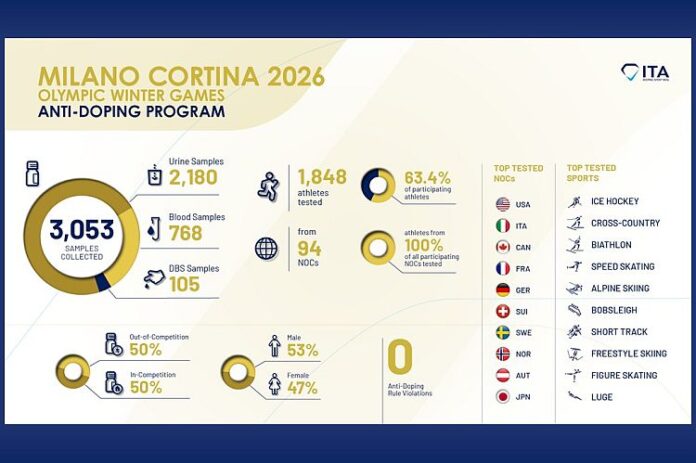
That’s International Olympic Committee President Kirsty Coventry (ZIM) on Friday, reflecting her view of the 2026 Olympic Winter Games so far.
She was instantly asked, of course, about the rules over athlete expression and the disqualification of Ukrainian Skeleton rider Vladyslav Heraskevych. Coventry explained:
“I was chairing the Athletes’ Commission in 2020 and 2021 when we heard from athletes that it was really important for us to identify safe spaces for them to express themselves, and to be able to share messages with the world, of all kinds. …
“At the same time, athletes wanted to ensure that we could still provide safe spaces for them and said that if we just opened things up completely, they would potentially by parties outside of the sporting family to carry messages that they do not agree with. And how would we be able to protect them from doing that.”
Coventry said she explained to Heraskevych and his father how the regulations were developed and what they were designed to do, in a “very respectful conversation.” She said “he was very committed to his beliefs, which I can respect, right? But sadly, it doesn’t change the rules.”
She added, “I believe that the rules allow for there to be the safest and fairest way, right now, that we have, to allow for athletes to express themselves but keep athletes safe” and not to be used for messages they don’t believe in.
Coventry was asked about the spread-out nature of the Games and she said the athletes have been enjoying the Olympic experience, especially be able to compete in famous venues that they know from their World Cup seasons. She also enjoyed the enthusiasm of the spectators, which was widespread. In short, “really no complaints.”
For her, so far so good. It has not hurt, either, that the Italian team is on the way to a historic Winter Games performance, which the crowds have loved. ~ Rich Perelman
(Pictured above: U.S. skating star Ilia Malinin embracing a stunned Olympic men’s figure skating gold medalist Mikhail Shaidorov of Kazakhstan; TSX photo by Karen Rosen.)
● Il Tempo Olimpici ● Light rain is projected for Milan for Saturday, with a high of 51 F and a low of 43 F. Very little sunshine until Monday.
In Cortina, snow showers are forecast with a high of 30 F and a low of 21 F. Winds are expected to average a mild 4 miles per hour.
● Scoreboard ●Norway and Italy are at the top of the medal table after 51 of 116 events:
● 18: Norway (8-3-7) ● 18: Italy (6-3-9) ● 14: United States (4-7-3) ● 14: Japan (3-3-8) ● 12: Austria (3-6-3)
● 11: Germany ● 10: France ● 8: Sweden ● 7: Switzerland ● 7: Netherlands ● 7: Canada
Seven days in and Italy has 18 medals, against an all-time high of 20.
A better indication of team performance has to go beyond three places, so The Sports Examiner returns our eight-place scoring, using the NCAA track & field format of 10-8-6-5-4-3-2-1 to score each event. After seven days, the top 15:
● 220.5: Norway ● 216.5: Italy ● 170.5: United States ● 165.5: Austria ● 147.5: France
● 131.5: Japan ● 128: Germany ● 100: Canada ● 94: Netherlands ● 93: Sweden
● 92.5: Switzerland ● 62: China ● 47: Czech Republic ● 46: South Korea ● 43: Australia
In terms of top-eight place winners, Italy leads with 44, then Norway at 41, Austria at 37 and the U.S. with 36.
“Through Wednesday, the Milan Cortina Winter Olympics is averaging 25.7 million viewers on NBC, Peacock, NBCUniversal Digital Platforms and Versant’s CNBC and USA Network – marking the most-watched Winter Games presentation at this point since 2014 Sochi Olympics, according to official Nielsen Big Data + Panel viewership and preliminary data from Nielsen, and digital data from Adobe Analytics.”
All days have been over 20 million, with Wednesday’s coverage at 21.5 million.
Although not truly comparable – the 2026 audience measurement uses a wider Nielsen system and includes the 2-5 p.m. and 8-11 p.m. shows – the indications are that viewership is up over PyeongChang 2018 (19.8 primetime-only average) and Beijing 2022 (11.4 million). The Sochi 2014 Games drew a primetime–only average of 21.3 million.
● Figure Skating ●Questions about the judging of the Ice Dance final that saw France’s Laurence Fournier Beaudry and Guillaume Cizeron win a tight gold-medal battle with the U.S.’s Madison Chockand Evan Bates continued to linger, with the International Skating Union’s statement on Friday explaining:
“It is normal for there to be a range of scores given by different judges in any panel and a number of mechanisms are used to mitigate these variations. The ISU has full confidence in the scores given and remains completely committed to fairness.”
In the aftermath of the 2002 Salt Lake City Games judging scandal, the scoring system in figure skating was revamped and in order to exclude clearly unrealistic scores, the highest and lowest scores for each element and program component are discarded, and then the remaining marks from the other seven (of nine) judges are averaged.
If a challenge were to be filed with the Court of Arbitration for Sport, it is likely to fail absent some evidence of collusion or intentional mis-scoring. The Court of Arbitration generally considers “field of play” decisions as up to the International Federation (in this case, the ISU) to deal with exclusively.
● Skeleton ● As expected, the Court of Arbitration for Sport dismissed the appeal of Ukrainian Skeleton rider Vladyslav Heraskevych, to overturn the International Bobsleigh & Skeleton Federation’s disqualification for the use of the “Memory Helmet” in competition. The decision summary noted:
“The Sole Arbitrator, whilst fully sympathetic to Mr Heraskevych’s commemoration, is bound by rules in the IOC Athlete Expression Guidelines. The Sole Arbitrator considers these Guidelines provide a reasonable balance between athletes’ interests to express their views, and athletes’ interests to receive undivided attention for their sporting performance on the field of play. …
“The Sole Arbitrator is bound by such proportionate rules and has no means to override them.”
● Ukraine ● Heraskevych isn’t the only Ukrainian athlete using their heads – or helmets – to make a statement. Freestyle Slopestyle and Big Air skier Kateryna Kotsar and Short Track skater Oleh Handeiwere both told not to wear helmets with “political slogans” on them.
Both have apparently cooperated; neither has been disqualified.
● Also on TSX ●A guest column by Olympic historian and Pierre de Coubertin expert George Hirthler (USA), “The Power of a Caring Voice: Kirsty Coventry’s Stunning Global Debut,” reviewing her opening ceremony remarks in Milan.
= RESULTS: FRIDAY, 13 FEBRUARY = (7 finals across 6 sports & disciplines)
● Biathlon: Men’s 10 km Sprint France’s Quentin Fillon Maillet won silver in the men’s Sprint at the 2022 Beijing Games, but he took the lead early on Friday and was almost unchallenged on his way to the Sprint gold in 22:53.1 with no penalties.
He was comfortably in front of Norway’s Vetle Christiansen and lovelornSturla Holm Lagreid, in 23:06.8 (0) and 23:09.0 (0). The French also finished fourth with Emilien Jacquelin(23:09.0/0).
At 33, Fillon Maillet now has seven Olympic medals and golds from Beijing 2022 (Individual and relay) and Milan Cortina 2026 (Sprint and relay).
Campbell Wrightof the U.S., who won the Worlds silver in 2025, finished 12th in 24:03.1 (1); Paul Schommer was 47th (25:31.3/1); Sean Doherty was 65th (26:12.6/3) and Maxime Germain was 66th (26:13.4/3).
● Cross Country Skiing: Men’s 10 km Freestyle The question coming in was: can anyone stop Norway’s amazing Johannes Hoesflot Klaebo?
No, and history is being made.
Klaebo was second for much of the race behind teammate Einar Hedegart and trailed by 0.7 seconds with 1,000 m to go. But, as usual, he had the most left in the tank and rolled to a win in 20:36.2. He had the fastest final km in the race at 2:02.5.
Hedegart also lost his lead over France’s fast-closing Mathis Desloges and had to settle for the bronze. Desloges took the silver in 20:41.1 and Hedegart finished in 20:50.2, with teammares Harald Amundsen(21:00.2) and Martin Nyenget (21:03.5) following in 4-5.
What Klaebo has done is amazing and historic. At 29, he now has 10 total medals and eight golds, equaling the most ever in Olympic Winter Games history:
Klaebo’s 10 total medals ranks equal-sixth all-time. And he’s not done. He won six golds at the 2025 Worlds in Trondheim (NOR) and the 50 km Classical, Team Freestyle Sprint and 4 x 7.5 km relay are all ahead and he has excellent chances in all three. Wow.
After being held from 1992-1998, the Sprint was eliminated from the Winter Games program until 2026; in the four times it has been run, Norwegians have won all four.
The top American in the Sprint was John Hagenbuch in 14th (21:41.1), with Zanden McMullenin 32nd (22:17.7), Zak Ketterson in 38th (22:28.4) and Gus Schumacher in 39th (22:30.8).
● Figure Skating: Men’s Singles The men’s Free Skate started with three men who scored more than 100 points during the Short program: World Champion Ilia Malininof the U.S. (108.16), Beijing 2022 runner-up Yuma Kagiyama(JPN: 103.07) and France’s 2024 Worlds bronzer Adam Siao Him Fa (102.55). There was a wide drop-off to fourth place Daniel Grassl (ITA: 93.46).
The final group was energized by Kazakhstan’s Mikhail Shaidorov, who got a lifetime best of 198.64 and a total of 291.58 to take the lead. Grassl was next, with the home crowd cheering heartily, but he touched a hand to the ice once; he scored 170.25 and his total of 263.71 left him a disappointed sixth following his routine.
France’s Siao Him Fa also had an early full fall and had other errors that quieted the crowd; he added a backflip that the crowd loved. But he scored 166.72 and a total of 269.27, in sixth with two to go. That meant Shaidorov was a medalist, a first for Kazakhstan since Denis Ten’s 2014 bronze.
That brought up Kagiyama, trying to pressure Malinin, but he fell on a quad Flip early on. His score of 176.99 and total of 280.06 was deeply disappointing, but it earned the bronze, and assured Shaidorov of at least silver.
Malinin had the crowd absolutely silent at the start and until his quad Flip, and he did not attempt his patented quad Axel. He did throw in a quad Lutz, but the routine was toned down. And then he fell on a quad Lutz, and then fell again on his last jumping pass. He threw in his famed backflip, but this was a flawed routine that left him devastated, skating off the ice.
He said while waiting for the score, “it’s not easy.” The score was 156.33 for a total of 264.49 that left him in eighth. It also made Shaidorov an unlikely Olympic champion, as the only one to skate a flawless routine in the six-man final grouping.
Malinin told NBC’s Andrea Joyce afterwards, “I was not expecting that,” and said he might have been too confident coming in. He added, “I can’t process what happened,” said it was “definitely mental.”
He confessed that the Olympic Games “is not like any other competition” and “that was not the skate I wanted.” His bottom line: “I blew it. There’s no way that just happened.” He’s 21; he’ll be back.
Malinin hadn’t lost since 2023. The other U.S. skaters included Andrew Torgashev (259.06) for 12th and Maxim Naumovscored 223.36 for 20th.
Kagiyama (280.06 for silver) and Shun Sato (274.90 for bronze) and extended the Japanese men’s medal streak to five straight Olympics.
● Skeleton: Men In the first two races on Thursday, favored Matt Weston (GBR) won both and leads at 1:52.09, 0.30 up on Germany’s 2022 silver winner Axel Jungk (1:52.39) and 0.46 on defending Olympic champ Christopher Grotheer(1:52.55). China’s Wenhao Chen was a close fourth at 1:52.68.
The third run saw Weston win by 55.63 to 55.72 over Jungk to extend his lead, with Grotheer fourth at 55.92, and Weston took the fourth heat in 55.61 to seal a clean win and the gold medal by almost a second in 3:43.33.
Grotheer and Chen went 2-3 in heat four and Jungk was fifth. Added up, it left Jungk second at 3:44.21 and Grotheer with the bronze at 3:44.40. Chen remained fourth (3:44.59).
Austin Florianwas the top American, in 12th (3:46.59) and Daniel Barefoot was 20th (3:49.86).
Britain won its first-ever gold in men’s Skeleton, to go with three for the women. Germany won two medals for the second straight Games.
● Snowboard: Men’s Halfpipe; Women’s SnowCross Japan’s 2021 World Champion Yuko Totsukawas on it from the start in the men’s Halfpipe final, ripping off a 91.00 first run and then improving to 95.00 in the second round.
The only one close, not surprisingly, was four-time World Champion Scotty James (AUS), already an Olympic bronzer in 2018 and silver winner in 2022. He scored 95.00 in qualifying, and 93.50 in the second round, but had to wait until the last jump of the day to see if he could catch Totsuka.
Japan’s Ryusei Yamada was also hot, scoring 92.00 as the leader in the first round, and teammate Ruka Hirano, the 2025 Worlds runner-up, at 90.00 in both rounds. They stood 3-4 going into the final round of jumps.
Jumping eighth in the final-round, Hirano improved to 91.00, but stayed in fourth. Yamada started 10th and flew to a 92.00 score, but remained in third and was assured the bronze. That brought up Totsuka, who did not improve. James had the last chance, but had no heroics and had to settle for a second straight silver (plus his 2018 bronze).
The Americans: Jake Pates (77.50) was eighth, Alessandro Barbieri (75.00) was 10th, and Chase Josey (70.25) was 11th.
Japan now dominates this event, with back-to-back Olympic golds and six medals across the last four Games.

Italian Michela Moioli, the 2018 Olympic winner, looked good as the women’s SnowCross races progressed. She won her round-of-16 race, then her quarterfinal and her semi and was into the final as another possible Italian star in 2026.
On the other side of the bracket, however, the 2023 Worlds runner-up, Josie Baff, was looking strong with a heats win, second in her quarter and then winning her semi over Czech Eva Adamczykova, the 2014 Olympic champ and a two-time World Champion.
Those three looked like the medal winners and in the medal final, Baff got to the lead past the halfway mark and kept it, edging Adamczykova and Moioli for the medals and winning Australia’s first medal in the event.
For Adamczykova, it completes an Olympic medal set, with a silver to go with her 2014 gold and 2018 bronze.
American Faye Thielen made the small final and finished seventh overall.
● Speed Skating: Men’s 10,000 m This painful race had the world-record holder, the reigning World Champion and two former Olympic champions. And the winner was a 19-year-old, first-time Olympian from the Czech Republic.
After Poland’s Vladimir Semirunniy – the 2025 Worlds silver medalist – set a hard pace in the third pair, finishing at 12:39.08, the final three pairs had a hard time catching him.
World-record man and 2025 World Champion Davide Ghiotto(ITA) couldn’t keep pace with 2014 Olympic champ Jorrit Bergsma – 40 – in the fourth pair and Bergsma moved into second place at 12:40.48. Ghiotto ended up finishing sixth in 12:46.72.
That brought up 2018 Olympic champ Ted-Jan Bloemen (CAN: 39) and Czech teen Metrodej Jilek, the 5,000 m silver winner but also the winner of the lone 10,000 m on the World Cup circuit this season. And Jilek was methodical, unwinding nine straight sub-30-second laps in the middle of the race and then holding on to take the lead at 12:33.43. Bloemen was well back at 13:00.01.
The final pair had Norway’s 5,000 m winner, Sander Eitrem and France’s Tim Loubineaud, the former world-record man in the 5,000 m. Eintrem was out hard early, but Loubineaud won the pair easily in 12:44.20, but could not squeeze past Bergsma for the bronze.
So, Jilek won a race that first debuted in the original Winter Games back in 1924 and he and Semirunniy are the first from their countries ever to win a medal in this distance. Bergsma completed his medal color-set, adding a bronze to his 2014 gold and 2018. Dutch skaters have won a medal in this race in 11 straight Winter Games.
Elsewhere:
● Curling:The U.S. men’s team, skipped by Daniel Casper, fell to 1-2 in round-robin play, losing to 2014 Olympic gold winner Brad Jacobs’ Canadian rink, 6-3. Round-robin play continues through the 19th.
The women’s tournament saw 2018 Olympic champ Anna Hasselborg’s Swedish rink beat the Tabitha Peterson-led U.S. team on Thursday by 9-4, but the Americans rallied on Friday to go to 2-1 with a 9-8, extra-end win over three-time World Champion Rachel Homan and Canada! Round-robin play also continues through the 19th.
● Ice hockey: Quarterfinals in the women’s playoffs started Friday, with sixth-ranked Sweden upsetting third-ranked Czech Republic by 2-0. The no. 1 U.S. faced Italy, and had only a 1-0 lead after the first, on a goal by Megan Keller at the 13:31 mark, despite a 20-2 shots edge.
The game broke open in the second, with Kendall Coynescoring at 1:41 and 4:51 of the period for a 3-0 advantage. Laila Edwards scored 26 seconds later for a 4-0 lead and Britta Curlgot a short-handed goal for the U.S. at 11:29. Hannah Bilka’s goal at 18:27 ended the period at 6-0 (with 19-2 on shots in the period).
In the third, there was no scoring and the play got physical at times. The U.S. ended with a 51-6 shots advantage and four straight shutouts. Gwyneth Phillips got the shutout in goal.
The playoffs continue on Saturday with Canada vs. Germany and Finland vs. Switzerland. The semis will be re-seeded.
= PREVIEWS: SATURDAY, 14 FEBRUARY = (8 finals across 8 sports & disciplines)
● Alpine Skiing: Men’s Giant Slalom Swiss superstar Marco Odermatt lost the Downhill to teammate Franjo von Allmen, finishing fourth and then won a bronze behind von Allmen in the Super-G.
So how about an Odermatt win in the Giant Slalom? More than reasonable; he’s the defending Olympic champion! And the 2023 World Champion, and won three Giant Slaloms this season at the FIS World Cup.
But there were other winners, like Austrians Raphael Haaser– the 2025 World Champion – and Stefan Brennsteiner and Marco Schwarz. Swiss Loic Meillard won twice this season on the World Cup circuit and has been silver-bronze in the last two Worlds.
Perhaps the most motivated skier in this event will be ex-Norwegian and now Brazilian Lucas Pinheiro Braathen, who won four World Cup silvers this season, two each in the Giant Slalom and Slalom. He’s hungry to win a medal for his “new” country.
Given Italy’s amazing Games so far, their best hope for a medal is likely Alex Vinatzer, who won a Worlds bronze in Slalom in 2023.
● Biathlon: Women’s 7.5 km Sprint Like most of the women’s events, the Sprint has been mostly about France, with the last two World Championships going to Julia Simon in 2024 (she already won the Individual race in 2026) and Justine Braisasz-Bouchet, in 2025.
In fact, Simon was at the head of a French sweep in 2024, with Lou Jeanmonnot – the 2026 Individual silver winner – and Braisasz-Bouchet taking the other medals.
But another sweep seems unlikely. There are two returning medalists from 2022: Sweden’s Hanna Oeberg (silver) and Italy’s Dorothea Wierer. German Franziska Preuss and Finland’s Suvi Minkkinenwent silver-bronze at the 2025 Worlds.
In the four times the Sprint was contested during the IBU World Cup season, Minkkinen, Jeanmonnot, Oeberg (twice) and sister Elvira Oeberg all won. Jeanmonnot was the most consistent, with three medals, but Minkkinin won two and both Wierer and teammate Lisa Vittozziboth won one medal. Perhaps the sleeper is Sweden’s Anna Magnusson, who took two Sprint medals early in the season, but has been quiet since.
● Cross Country Skiing: Women’s 4×7.5 km Relay Sweden went 1-2 in the Skiathlon, 1-2 in the 10 km and swept the Sprint. No doubt, they are prohibitive favorites. They are the reigning World Champions from 2025, winning a tight race with Norway with a team of Emma Ribom, Frida Karlsson, Ebba Andersson and Jonna Sundling.
Andersson had won medals in this event in the last two Games: silver in 2018, bronze in 2022.
Norway’s depth makes them the attractive second choice, led by Skiathlon bronze winner Heidi Weng, Astrid Slind and two more top-10 finishers in the 10 km Interval Start. Germany and Finland were 3-4 at the 2025 Worlds and close, followed a couple of minutes later by the Swiss and the U.S.
Will Jessie Diggins be healthy enough to go in this race? If so, will she be close enough to have a shot at a medal?
● Freestyle Skiing: Women’s Dual Moguls The U.S. went 1-2 in Moguls with Elizabeth Lemley and Jaelin Kauf, and Kauf is even better in the Dual Moguls than she is at Moguls. This is the first time the Dual Moguls has been held at the Winter Games.
How good? She’s the 2025 World Champion, edging teammate Tess Johnson in the gold-medal final, won silvers in 2019 and 2023 and a Worlds bronze in 2017. At the only FIS World Cup held this season, she led a U.S. sweep ahead of Lemley and Johnson!
Best bets to break up an American sweep start with French star Perrine Laffont, the 2018 Moguls gold winner and who just won the 2026 Moguls bronze. She also won the 2023 Worlds Dual Moguls over Kauf, with Austria’s Avital Carroll taking bronze. Japan’s Rino Yanagimotoand Anastassiya Gorodko(KAZ) figure as possible spoilers as World Cup medal winners last season; Gorodko won the Worlds bronze in 2025.
● Short Track: Men’s 1,500 m Canada’s William Dandjinou won nothing in the 1,000 m, but is the reigning World Champion at this distance. In the World Tour season, Dandjinou won four races and one silver in six meets. He is the favorite.
But there are challengers. Teammate Steven Dubois is the Beijing 2022 runner-up, Korea’s Ji-won Parkwon the 2023 Worlds gold and Dutch star Jens van’T Wout – who won the 1,000 m – won the 2024 Worlds silver at this distance. China’s Long Sun won the 2024 Worlds and won one World Cup medal this season.
What about Italy? With a dreamy Games so far, surely Pietro Sighelhas to be a contender. He won two World Cup bronzes this season and appears ready for more.
But all eyes will be on Dandjinou.
● Skeleton: Women Dutch racer Kimberley Bos won the Olympic bronze in 2022 and moved up to Worlds silver in 2023 and then to World Champion in 2025. Beijing Olympic champ Hannah Niese(GER) won the 2024 Worlds bronze and four medals in this World Cup season, but teammate Susanne Kreher was the 2023 Worlds gold medalist. Canada’s Hallie Clarke won a surprise Worlds gold in 2024.
But none of these rate as favorites. Austria’s Janine Flock, 36, won the Worlds silver back in 2016, but won six medals in eight World Cup races this season, including the last three before the Games! She has to be the one to beat.
Belgium’s Kim Meylemans won once and had three medals and British sliders Amelia Coltman and Freya Tarbit each won once. All are contenders.
On the first two runs, the top five were within 0.53. Flock led run one and was second on run two with a fast close and timed 1:54.58 for a 0.04 lead on Kreher and 0.13 on second-run winner Jacqueline Pfeifer (GER).
There was a small gap back to Niese in fourth (1:54.85) and Britain’s Tabitha Stoecker in fifth (1:55.01). Tarbit was sixth and Meylemans was eighth. The American leader was Kelly Curtis in 10th (1:55.69) and Mystique Rowas 17th (1:56.36).
● Ski Jumping: Men’s Large Hill (141 m) Slovenian star Domen Prevcwas off his game in the Normal Hill final, placing only sixth, as Germany’s Philipp Raimund sprung the upset. In the Team Normal Hill final, Prevc’s teammate, Anze Lanisekwas the best of the day and Prevc was close, both sailing over 100 m as Slovenia won the gold decisively.
Prevc was the 2025 Large Hill World Champion has 11 wins on the World Cup circuit this season, every one on a Large Hill. He has to be the favorite, right?
Lanisek has three wins this season and looks ready to be in the medal mix along with Japan’s Ryoyu Kobayashi, the 2022 Olympic Large Hill runner-up, teammate Ren Nikaido, a six-time World Cup medalist this season and Austrians Jan Hoerl – the 2025 Worlds runner-up – Daniel Tschofenig and three-time World Champion Stefan Kraft.
Raimund, of course, cannot be counted out. But this should be Prevc’s opportunity to fix his failure on the Normal Hill event.
● Speed Skating: Men’s 500 m American star Jordan Stolzwon the 1,000 m and two 500 m Worlds golds in 2023 and 2024. But this will be his stiffest test, facing 2025 World Champion Jenning De Boo and Poland’s Damian Zurek, who won the last two World Cup races prior to the Games and was second three times.
Stolz won the season title, with five wins and two seconds and a third, but will have to get a fast start and avoid mistakes to get this gold. Teammate Cooper Mcleod was a surprise Worlds bronze winner last year and will be looking for a repeat.
Japan has a contender in 2022 bronze winner Wataru Morishige, who was fourth in the seasonal World Cup, and defending champ Tingyu Gao (CHN) is back, but was only 18th in the seasonal World Cup standings. An American hasn’t medaled in this event since 2006; Stolz is trying to end that streak.
= INTEL REPORT =
● Olympic Games 2028: Los Angeles ● The Los Angeles City Council approved without debate on Friday a request for the LA28 organizers to “tie the allocated contingency as a percentage to the budget, and therefore increase the allocated contingency as the budget increases.”
This reflects the City Council’s continued worry about a deficit by the LA28 organizers that the City would ultimately be liable for, and requires a change in the Games Agreement between the City and the organizing committee.

★ Receive our exclusive, weekday TSX Recap by e-mail by clicking here.
★ Sign up a friend to receive the TSX Recap by clicking here.
★ Please consider a donation here to keep this site going.
For our updated, 45-sport, 910-event International Sports Calendar for 2026 and beyond, by date and by sport, click here!

/A guest column by George Hirthler, who has been working in the Olympic world since 1989. Since then he has served as a writer/producer on ten international Olympic bid campaigns, including the winning bids of Beijing 2008, Vancouver 2010 and LA 2028. In 2016, Hirthler published The Idealist, a fictionalized biography of Baron Pierre de Coubertin, the founder of the modern Olympic Games, and he is writer and producer of documentaries on Atlanta 1996 and de Coubertin. His opinions are, of course, his own alone./
Much has been made – and rightly so – about the advancement of women in Olympic sport over the last few decades. Eighteen months ago at the Paris 2024 Olympic Games, the world celebrated the 50/50 gender equality milestone between male and female competitors-and the Milan Cortina Winter Games almost matched that mark at 47%.
It took 130 years of Olympic history and a painstakingly gradual evolution to reach that point. But just last week, with far less fanfare, another gender-driven sea change took place when Kirsty Coventry, the first female president of the International Olympic Committee, stepped to the podium to deliver her remarks during the opening ceremony in Milan.
While it was striking to see a woman in the most powerful role in global sport, it wasn’t her gender that ultimately distinguished Coventry as a game-changer. It was her message and the humility and compassion with which she delivered it.
Coventry’s voice – not her tone, which was warm and welcoming, not her cadence, which reflected her Zimbabwe upbringing and her African roots – but her theme, which reached deeply and profoundly into the core mission of the Olympic Movement and strummed the heartstrings of the world’s yearning for harmony and unity during a time of bloody conflicts and angry divides.
The content of Coventry’s message gave the world new insights into the power, purpose and promise of the global movement she now guides. Her immediate focus was on the athletes – “This is your moment” – reminding us that the Games are only a stage and the athletes are the stars.
And then she personified the athletic feats yet to come as something far greater than sport alone:
“You’ll show us what it means to be human. To dream. To overcome. To respect one another. To care for each other. You’ll show us that strength isn’t just about winning – it’s about courage, empathy and heart … You will show the world how to live.”
Staying away from the diplomatic appeals and moral push for peace that had often marked the IOC’s ceremonial messages in the past, Coventry doubled down on the personal as universal.
She rooted the Olympic spirit-the spirit embodied in each of the athletes at Games-in the communities that nurtured their talents and lifted them toward this global opportunity.
And she used her own community as a universal proof point: “In Africa, where I’m from, we have a word: ubuntu. It means: I am because we are. That we can only rise by lifting others. That our strength comes from caring for each other. No matter where you come from, we all know this spirit – it lives and breathes in every community.”
Coventry is only 42 – the youngest IOC president since Frenchman Pierre de Coubertin, the founder of the modern Games, entered the office in 1896 at 33 – but she stepped into her role with the assurance and savoir faire of a seasoned leader.
She did not have to pound the podium; she did not use any facial gestures or theatrics or modulate her voice like an actor, she simply spoke with a quiet certitude rooted in her own conviction of what is true: that the Olympic Movement and the Games it produces offer the world something rare and unique – an opportunity for everyone to join in a shared experience to celebrate the astonishingly beautiful advancement of human excellence against the backdrop of our shared history and the Olympic record books.
As a double-gold Olympic swimmer and seven-time medalist, Coventry speaks from a place of authenticity. Her identification with the athletes and the unique circumstances they each face grew deeper and deeper as she served on the IOC’s Athletes’ Commission for eight years from 2013 to 2021, emerging as a champion of their rights and needs, a qualification that put her in a strong position to run for the presidency when German Thomas Bach‘s term ended in 2025.
As she spoke of empathy and caring – of lifting each other up and showing the world how to live – Coventry called on the Olympic athletes and the broader Olympic family to embody the solidarity the world needs now: to become the reality of the hopes that the rituals and symbols of the Games have long stood for.
As the first woman to preside over any edition of the Olympic Games, winter or summer, Coventry was bound to symbolize the change so many women have been fighting for. But she brought far more to the podium last Friday night than a change of gender. In the words of her stunning opening ceremony speech, she made it clear the Olympic Movement and global sport have found a new voice – and that voice has a powerful new message of hope for our world.
[≡The Sports Examiner encourages expressions of opinion – we really do – but preferably based on facts. Send comments to [email protected]. We do not guarantee publication of any comment, but all comments submitted will be considered and your submission implies your agreement to publication (and light editing if needed to meet our grammatical and punctuation standards) at our sole discretion. Please include your name and hometown on any comment submitted for publication.≡]

You can receive our exclusive TSX Report by e-mail by clicking here. You can also refer a friend by clicking here, and can donate here to keep this site going.
For our updated, 45-sport, 910-event International Sports Calendar for 2026 and beyond, by date and by sport, click here!