

















★ The Sports Examiner: Chronicling the key competitive, economic and political forces shaping elite sport and the Olympic Movement.★
★ To get the daily Sports Examiner Recap by e-mail: sign up here! ★
≡ REINSTATEMENT REACTION ≡
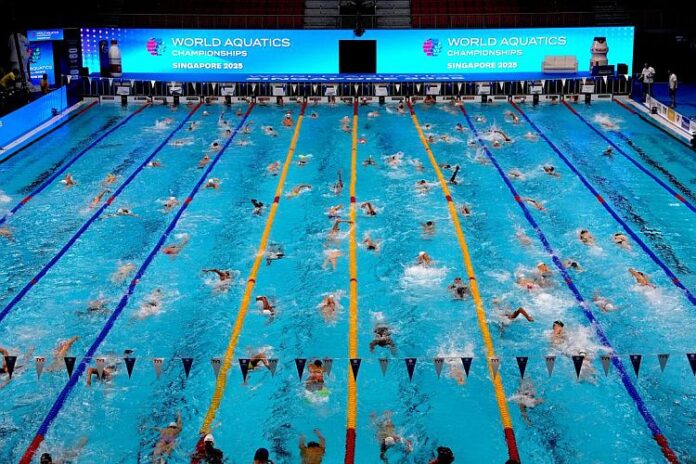
The reinstatement of Russia and Belarus by World Aquatics on Monday reverberated within the Olympic Movement, with the International Olympic Committee telling the Russian news agency TASS:
“It is up to each International Federation (IF) as the sole authority for its international competitions, outside of the Olympic Games, to decide on this question.”
Participation in the Olympic Games is up to the IOC, of course.
As to why the aquatics federation decided to make the change now, in a quiet year without an all-discipline World Aquatics Championship, one long-time observer suggested that there was no specific reason for the timing, but a general belief within the federation that the International Olympic Committee – which last December recommended allowing Russian and Belarusian youth and junior athletes to compete without restrictions – will do so with all Russian and Belarusian athletes “soon.” The federations for judo and taekwondo had already reinstated Russia and Belarus.
However, the IOC’s recommendations from December also included, “IFs should continue to refrain from organising or supporting international sports events in Russia.” World Aquatics has ignored this also.
For other national aquatics federations – including those for artistic swimming, diving, swimming and water polo – the issue now presented is not simply competing against Russian and Belarusian athletes and teams, but also having them at competitions in their countries.
On Tuesday, Erkki Susi, the President of the Estonian Swimming Federation, released this statement:
“The Estonian Swimming Federation (EUL), which currently chairs the Nordic Swimming Federation, has discussed this issue with other federations on numerous occasions. The common position of the Nordic swimming federations is clear: this decision is not supported, and objections to this matter are also known at the level of the European Swimming Federation.
“At the same time, World Aquatics’ decisions are binding under the European Swimming Federation’s statutes, so they automatically bind the European and Estonian federations. The Nordic federations emphasized that athletes should not be harmed or suspended from participation; the common position of the Nordic countries is to allow their athletes to continue competing at the international level.
“However, the Nordic swimming federations confirm that they do not intend to organize international swimming competitions in the coming years until the current situation and the decisions made change.”
The Nordic federation includes Denmark, Estonia, Faroe Islands, Iceland, Finland, Latvia, Lithuania, Norway and Sweden.
The angriest of all federations, of course, is Ukraine, still trying to repel the Russian invasion that started in February 2022. Ukraine’s two-time Skeleton Olympian Vladyslav Heraskevych, who was famously disqualified from the Milan Cortina Winter Games for insisting on wearing his “memory helmet” with images of fallen Ukrainian athletes during the 2026 Games, protested the World Aquatics decision on X, calling out specific Russian swimming stars by name:
“This is unacceptable and disgraceful.
“In its statement, World Aquatics (@WorldAquatics) claims it can keep the conflict away from pools and competition venues. But of course, this does not apply to Ukrainian sports facilities and pools, which are constantly being struck by Russian missiles. It does not apply to Ukrainian athletes, who are also dying in the war unleashed by Russia.
“At the same time, this does not apply to Russian athletes either – those who actively support the war and the occupation of Ukraine.
“Take, for example, Evgeny Rylov, who as far back as 2022 participated in a rally at Luzhniki alongside Putin, wearing a propagandistic ‘Z’ on his chest.
“In October 2024, Russian swimmers Kolesnikov and Zhilkin took part in propaganda video created by organisation ‘Zdorovoye Otechestvo’ to congratulate Putin on his birthday.
“World Aquatics is trying to act as though none of this exists. With this decision to restore Russian flags and anthem, they are providing their competition platforms for the spread of Russian propaganda – propaganda that is killing us, Ukrainians.”
(Rylov was the Tokyo 2020 Olympic 100-200 m men’s Backstroke champion; Kliment Kolesnikov won two Tokyo 2020 men’s medals; Andrey Zhilkin won two European Championships relay golds in 2018 and 2020.)

World Aquatics may also be impacted by the results of the national elections in Hungary on Sunday, in which the 16-year reign of Prime Minister Viktor Orban was ended as the Tisza party – led by Peter Magyar – won 52.1% of the vote and 137 seats in the 199-seat National Assembly, Orban and his Fidesz party, received 39.5% and won 56 seats.
The Orban government had supported the move of World Aquatics to a new headquarters being built for the federation in Budapest, as part of a larger, privately-financed development project. Groundbreaking was on 7 October 2025, based on an agreement “between the Hungarian State and World Aquatics [and] was signed in 2023.”
The 20,000 sq m (215,200 sq. ft.) headquarters and training center is expected to open in 2028, but the question must be asked if it will continue if the new Hungarian government is not as enthusiastic as the Orban regime was.
Time will tell. The new parliament must convene within 30 days of the election date, that is by 12 May.

★ Receive our exclusive, weekday TSX Recap by e-mail by clicking here.
★ Sign up a friend to receive the TSX Recap by clicking here.
★ Please consider a donation here to keep this site going.
For our updated, 681-event International Sports Calendar for 2026 and beyond, by date and by sport, click here!