




















★ The Sports Examiner: Chronicling the key competitive, economic and political forces shaping elite sport and the Olympic Movement.★
★ To get the daily Sports Examiner Recap by e-mail: sign up here! ★
≡ L.A. BUDGET HEARINGS ≡
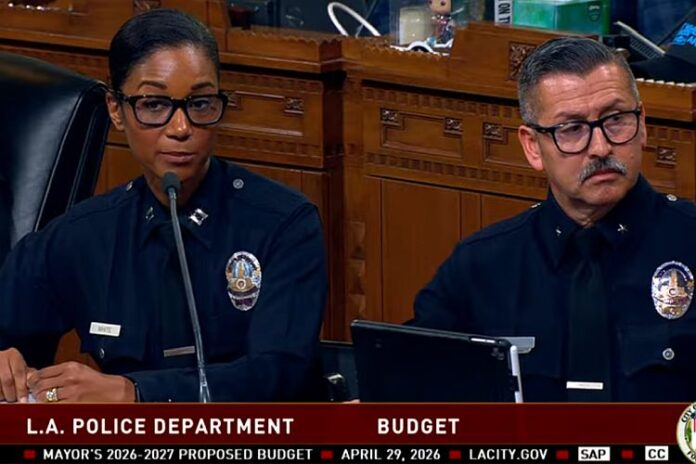
The friction over City of Los Angeles costs for the 2028 Olympic and Paralympic Games got hotter after Wednesday’s budget hearings with Captain Shannon White from the Los Angeles Police Department’s Major Events Group explaining that the $1 billion Federal security allocation in the One Big Beautiful Bill Act of 2025 (known as “OB3″) won’t be anywhere near enough to cover costs.
She and Commander Mario Mota explained in detail:
● Average daily deployment of police officers at the eight competition venues in the City of Los Angeles is currently estimated at 6,700, going down to 5,400 on low-demand days.
● A total of 66 days of operations are planned for the Olympic and Paralympic Games, including the changeover period between, with 700-800 patrol cars needing to be committed to Games security operations, including to secure the Games Route Network.
● The current estimate is that the total security force required will be on the order of 30,000 officers to be brought into the area to fulfill all of the expected law enforcement roles.
White was asked by Council Budget & Finance Committee Chair Katy Yaroslavsky if the Federal government – led by the Secret Service – was supposed to provide security for the Games, and replied:
“The Secret Service is the lead for that but the Federal government performs very specific operations. They will not perform patrol on our streets, and that’s probably more of what you’re looking for.
“It is an inaccurate statement, if that’s what’s been conveyed to Council to say that the Federal government will secure the entirety of those venues. The Federal government’s apparatus has been very specific with us about that they have clear roles that relate to security for our international delegations that come, some of the places where there are high-security assets within the venues, but when you talk about, as Commander Mota said, ‘cops on dots’ – with high visibility on the corners – when we talk about who is going to do enforcement, who is going to respond to radio calls, they don’t actually have the ability to enforce state laws for us.”
White further detailed the scope of the security operation for the Games as the LAPD sees it:
● “The most the Department is able to dedicate to the Games on a daily basis hovers around 2,400.” (The LAPD currently has approximately 8,677 sworn officers.)
● “As it’s been framed to us, we will have to use contract services in which we will need to pay any outside agencies coming into town, and that includes if they’re from outside of the region, we would have to cover their hotel costs, per diem and transportation.”
● “We’ve run the estimates for the rest of the region, which will bring it up to closer to 30,000 personnel needed for each 24-hour period needed. And that’s not including our specialized resources, so we’re looking at canines, bomb squad, haz-mat, etc.
“That also does not account for the Games Route Network, which covers significant mileage on our freeways and streets. The street part of the Network will be the responsibility of the Los Angeles Police Department or any entities that we bring in order to have oversight and direction.”
● Referring to the $1 billion Federal appropriation in the One Big Beautiful Bill Act (“OB3″), White noted firmly:
“Salaries alone will greatly exceed what there is, what is available … that’s knowing what we will deploy as the City of L.A. from our own resources, can move beyond what OB3 can properly fund and knowing that other municipalities will be looking to attach to that [funding], as well as the City beyond just Fire, Police and DOT [transportation].
“When we ran those calculations, we exceeded the billion dollars on our own salaries that are deployed towards those Games, and so I would like to offer some clarity on that to make sure that as we’re moving forward, ‘maybe OB3 can take care of this,’ we certainly as the City of L.A. will greatly exceed what is available.”
Said Yaroslavsky, with understatement, “I think we need a better plan.”
LAPD Chief Jim McDonnell in his opening remarks, also referred to the department’s needs:
“We requested funding to purchase vehicles, technology and specialized equipment to be able to do the Olympics. We appreciate the funding is provided for vehicles and some funding for technology but we need additional funding for technology and specialized equipment to prepare for the Olympics.
“For example, while funding is provided to purchase vehicles, funding was not provided for the technology equipment in the vehicles. While we anticipate funding will be available in the [One Big Beautiful Bill Act of 2025], it will not be released until the fall.
“In addition, the $1 billion [Federal] budget is for all agencies involved in the Olympics, not just the LAPD and will be restricted primarily to police officer overtime.
“LA28 confirms that they have zero police or public safety budget, and while they do have a security budget, it doesn’t cover law enforcement.”
The LAPD has asked for $42 million to acquire 407 vehicles for use during the Olympic period, about 300 of which would be “black-and-white” patrol cars.
Observed: Wednesday’s testimony offered the first public information provided about police deployment during the Games and Yaroslavsky was visibly irritated over the lack of clarity up to this point on who was responsible for what concerning security for the 2028 Games.
She was clearly under the impression that the Federal government was going to cover most of the needs, but the LAPD explained that (1) the $1 billion Federal grant in 2025 won’t come close to covering the needs of even the LAPD alone and that (2) the LA28 organizers have no money in its $7.145 billion budget for security funding of law enforcement.
Said Yaroslavsky, “It’s confusing and it’s starting to get frustrating.”
This issue is going to get hotter because the City of Los Angeles is on the hook for the first $270 million of any LA28 deficit, expected to be covered by an LA28 internal fund of $270 million. The State of California would pay the next $270 million of any deficit and then the City of Los Angeles has unlimited liability beyond that.
And the City cannot afford to pay it.

★ Receive our exclusive, weekday TSX Recap by e-mail by clicking here.
★ Sign up a friend to receive the TSX Recap by clicking here.
★ Please consider a donation here to keep this site going.
For our updated, 681-event International Sports Calendar for 2026 and beyond, by date and by sport, click here!