


















★ The Sports Examiner: Chronicling the key competitive, economic and political forces shaping elite sport and the Olympic Movement.★
★ To get the daily Sports Examiner Recap by e-mail: sign up here! ★
≡ MEXICAN ECONOMIC IMPACT ≡
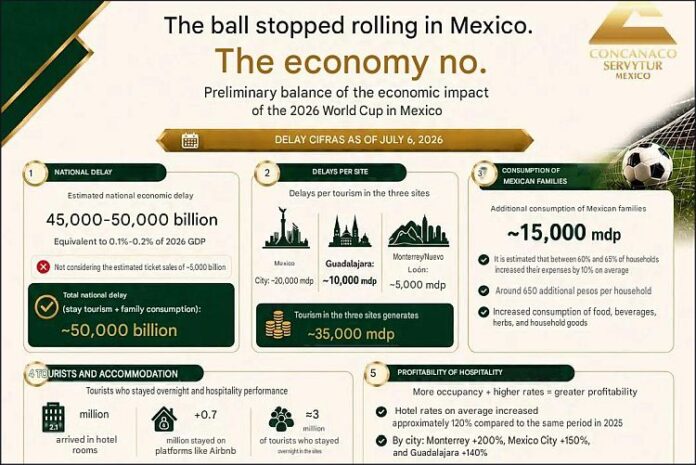
The Mexican Confederation of Chambers of Commerce, Services and Tourism (CONCANACO Servytur) announced last week that the economic impact of the 13 matches held in Mexico totaled between 45-50 billion pesos, or about $2.57 to $2.86 billion U.S. (MXN 1 = $0.057 U.S.):
“[A]n estimated national economic impact of between 45 and 50 billion pesos, driven by tourism and consumption by Mexican families during the tournament that showcased Mexico to the world and demonstrated the country’s capacity to organize global-scale events.
“Of the total, approximately 35 billion pesos corresponded to tourist spending generated in Mexico City, Guadalajara, and Nuevo León; 15 billion pesos to additional household consumption of food, beverages, entertainment, and convenience products; and nearly 5 billion pesos more to ticket sales. Fan Fest in Mexico City solidified its position as one of the main drivers of economic activity: 39 dates, 18 venues, and an estimated economic impact of 2 billion pesos, of which 1.8 billion pesos had already been generated by July 6.
“In the lodging sector, the average hotel occupancy rate across the three venues reached 66%, with peaks between 80% and 90% on match days, and rates increased by an average of 120%. An estimated 2.1 million tourists stayed overnight in hotels, and 700,000 used short-stay platforms. Latin American travelers stayed for up to 16 days and visited other cities outside the host cities. CANIRAC reported sales increases of 15% to 30% on Mexico’s match days and the creation of 15,000 temporary jobs.”
This is part of the story. The Spanish sports daily, Diario AS, noted the actual outcome was far less than predicted:
● “Before the tournament began, estimates of the World Cup’s economic impact varied widely. The Mexican Confederation of Chambers of Commerce, Services and Tourism (CONCANACO Servytur) projected between 65 billion and 200 billion pesos (US$3.7 billion to US$11.4 billion) in economic activity, while organizations such as IMEF and Moody’s Analytics were far more conservative, arguing that the tournament’s overall contribution would be relatively modest.”
● “Before kickoff, analysts estimated the tournament would add between 0.14% and 0.5% to Mexico’s GDP. Current economic indicators place the impact at approximately 0.14% to 0.15%, in line with Moody’s Analytics’ forecasts.”
The CONCANACO graphic that accompanied the statement noted further:
● Average hotel occupancy in the three host cities was 66% during the match period, up just 8% over the comparable period in 2025.
● Occupancy was 80-90% on match days, with about 70% of visitors staying in hotels and 23% in Airbnb-style accommodations.
● Pricing rose dramatically for accommodations: up 20% from 2025 during the period and with increases of 100% in Monterrey, 50% in Mexico City and 40% in Guadalajara.
● While tourism accounted for about 35 billion pesos in spending, 15 billion (30%) came from increased spending by Mexican families across the country.
This describes a success, but hardly of epic proportions.

A long article on TravelandTourWorld.com reviewed the accommodations and economic impact in the Los Angeles, noting a last-minute surge:
“[T]he city witnessed a significant late surge in accommodations bookings as FIFA World Cup supporters finalised their travel plans just days before key matches. … the booking trend has highlighted changing traveller behaviour, with shorter reservation windows increasingly replacing long-term planning for major global sporting events.”
The story points to changing travel patterns thanks to changing technologies for travel and housing:
● “Digital booking platforms provide continuous access to accommodations availability, allowing customers to compare prices almost instantly.”
● “Flexible cancellation policies introduced during the pandemic have encouraged travellers to postpone final decisions.”
● “Mobile booking technology has simplified last-minute reservations.”
As far as the matches at SoFi Stadium in Inglewood were concerned, the hotel winners were spots close to the venue, in Santa Monica – also fairly close by to the north – and downtown Los Angeles.
In short, the lack of booking activity in the run-up to the World Cup was changed late: when the matches arrived, so did the traveling fans.
No statistics were cited; these will eventually come out in the post-match analysis. But it is instructive as technology continues to change the way people attend faraway events.

★ Receive our exclusive, weekday TSX Recap by e-mail by clicking here.
★ Sign up a friend to receive the TSX Recap by clicking here.
★ Please consider a donation here to keep this site going.
For our updated, 681-event International Sports Calendar for 2026 and beyond, by date and by sport, click here!