










★ The Sports Examiner: Chronicling the key competitive, economic and political forces shaping elite sport and the Olympic Movement.★
★ To get the daily Sports Examiner Recap by e-mail: sign up here! ★
≡ THE 2032 SPORTS PROGRAM ≡
At last week’s International Olympic Committee Executive Board news conference, President Kirsty Coventry (ZIM) was clear about the need for changes to the sports program of the Olympic Games:
● “We feel we need to regain the control of the program and we’re the leaders, this is our product, so we should regain that control and we should look after it and we should figure out how we want, potentially, new sports, innovative sports and disciplines to come onto the program.
“But we’re also under the very big realization that we can’t continue to get bigger, bigger, bigger, bigger, bigger, that’s not the answer either.”
● “When we add additional sports, additional disciplines that need new venues, that’s when really where we see additional costs and complexities coming into play. That’s where we potentially more widespread Games, which adds complexity to National Olympic Committees, broadcasters, to athletes, to ourselves.
“It changes the experience for all the stakeholder groups, so we’re looking at everything holistically: how does it all play into each other, and yes, how can we help contain and reduce the cost and the complexity and the economics of the Games.”
● “L.A., you know, is 36 sports; in London [2012], we were 26 sports. I’ve said this again, numerous times, I don’t think in Brisbane we’re going to see 36 sports, so this is the right time to have these kinds of conversations in a really transparent manner.”
So what gets cut? The Sports Examiner looked at this question last week, before the IOC news conference; with the benefit of the new instructions and direction … so what gets cut?
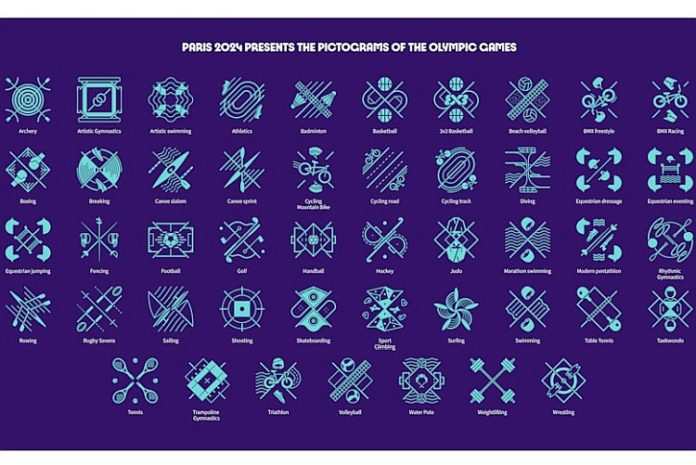
Coventry’s Olympic program working group has identified sports and disciplines that need their own venues as a key determinant. The Brisbane 2032 Host City Contract told the organizers to use the Paris 2024 Olympic program as their planning blueprint; that included 28 sports. The Paris organizers added four more – breaking, sport climbing, skateboard and surfing – with small athlete quotas, but these were not part of the IOC’s program.
So looking at the 47 disciplines in the 28 sports shown by the IOC at last week’s news conference, let’s see where the questions might arise.
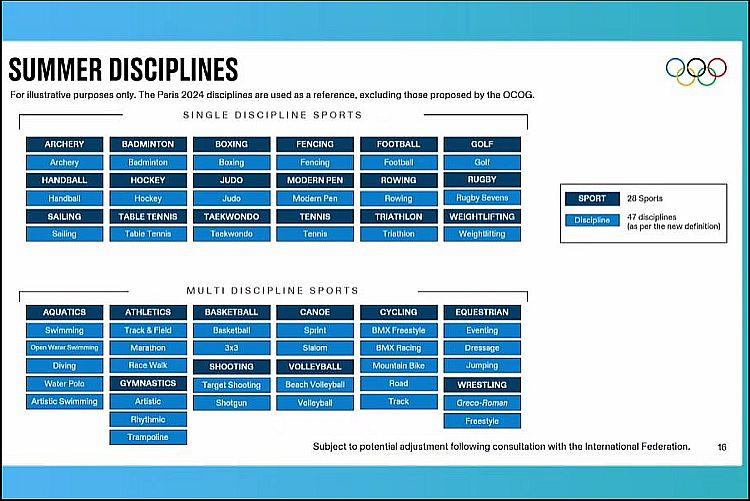
The IOC showed 18 single-discipline sports, based on the Paris 2024 program:
● Archery: 128 athletes ~ 1 venue
● Badminton: 172 athletes ~ 1 venue
● Boxing: 248 athletes ~ 1 venue
● Fencing: 212 athletes ~ 1 venue
● Football: 504 athletes ~ 6-7 venues
● Golf: 120 athletes ~ 1 venue
● Handball: 336 athletes ~ 1 venue
● Hockey: 384 athletes ~ 1 venue
● Judo: 372 athletes ~ 1 venue
● Modern Pentathlon: 64 athletes ~ 1 venue
● Rowing: 502 athletes ~ 1 venue
● Rugby Sevens: 288 athletes ~ 1 venue
● Sailing: 330 athletes ~ 1 venue
● Table Tennis: 172 athletes ~ 1 venue
● Taekwondo: 128 athletes ~ 1 venue
● Tennis: 172 athletes ~ 1 venue
● Triathlon: 110 athletes ~ 1 venue
● Weightlifting: 120 athletes ~ 1 venue
All of these sports are over 100 athletes except for modern pentathlon, which has changed its program – at the IOC’s request – to remain in the Games. It was able to combine with equestrian in Paris, but that element has been removed and pentathlon promotes itself as a single-venue sport now, with obstacle racing instead. It could be on the endangered list again.
The IOC list showed rowing as a single-discipline sport from Paris, but is adding the coastal beach sprint for LA28 with 64 athletes. This is likely to be cut unless ganged with another sport that can share the same venue.
Triathlon at 110 athletes needs to be paired with open-water swimming, and questions can be raised about golf if a quality course is not available in the host city. The rest appear fairly safe, but the number of teams or sizes of squads in some of the team sports could be reduced.
The list of multi-discipline sports included 10 federations:
● Aquatics/Artistic: 96 athletes ~ 1 venue
● Aquatics/Diving: 136 athletes ~ 1 venue
● Aquatics/Open Water: 44 athletes ~ 1 venue
● Aquatics/Swimming: 830 athletes ~ 1 venue
● Aquatics/Water Polo: 264 athletes ~ 1 venue
Having a separate venue for 44 athletes in open water looks like a place to cut, but could possibly be co-located with triathlon. Artistic and water polo need to be in the same venue; two separate sites might mean one has to go.
● Athletics: 1,810 athletes ~ 2 venues
There is one site for the stadium events and then at least a separate start for the marathons and walks if they finish in the stadium. World Athletics has already removed the marathons from its World Championships; if the IOC follows suit, the walks could also go. There were 172 marathoners in Paris and 97 walkers in the individual events, with many of the walkers also among the 50 who raced in the mixed relay. If the marathon goes, the walks – now contested at the half-marathon and marathon distances – will too.
● Basketball/3×3: 96 athletes ~ 1 venue
● Basketball/5×5: 288 athletes ~ 1 venue
The 3×3 game is growing in popularity, but it requires another venue. It could be cut.
● Canoe/Slalom: 82 athletes ~ 1 venue
● Canoe/Sprint: 236 athletes ~ 1 venue
As far as Brisbane 2032 is concerned, Slalom is a must-have as Jess Fox is an Australian national hero and the best Slalom canoeist in history. Normally, it would be a candidate for exclusion because it needs a special venue, but with Fox possibly still competing, it has to be in.
● Cycling/BMX Freestyle: 24 athletes ~ 1 venue
● Cycling/BMX Racing: 48 athletes ~ 1 venue
● Cycling/Mountain Bike: 72 athletes ~ 1 venue
● Cycling/Road: 180 athletes ~ 1-2 venues
● Cycling/Track: 190 athletes ~ 1 venue
Road and track are the traditional cycling disciplines at the Games and the BMX events and Mountain Bike are fairly new, in 1996 (Mountain Bike), 2008 (BMX Racing) and 2020 (Freestyle). Each requires its own venue and all three could be cut and save 144 quota places … and three venues. These will be hard to keep.
● Equestrian/Dressage: 60 athletes ~ 1 venue
● Equestrian/Eventing: 65 athletes ~ 1-2 venues
● Equestrian/Jumping: 75 athletes ~ 1 venue
Dressage and Jumping are quite popular, but Eventing requires a cross-country component which has often required a separate site, especially to deal with equine health and heat. It could be cut.
● Gymnastics/Artistic: 192 athletes ~ 1 venue
● Gymnastics/Rhythmic: 94 athletes ~ 1 venue
● Gymnastics/Trampoline: 32 athletes ~ 1 venue
Women’s artistic is one of the highlights of the Games, but rhythmic and trampoline are not nearly as popular and if not held at the same site as artistic, could be cut.
● Shooting: 340 athletes ~ 1 venue
Although the IOC recognizes rifle-pistol and shotgun as separate disciplines, they have generally been held at one site. However, this will not be true in Los Angeles for 2028, so questions can be raised about part or all of the sport if an existing facility is not available.
● Volleyball/Beach: 96 athletes ~ 1 venue
● Volleyball/Indoor: 288 athletes ~ 1 venue
Although the beach program is small, it has attracted far more interest than other disciplines of the same size, and, if needed, could be held indoors in an existing site, or in a small football stadium, saving cost.
● Wrestling: 288 athletes ~ 1 venue
Although Freestyle and Greco-Roman are shown separately, they are contested in the same venue at the same time. It’s essentially a single-venue sport.
Complicated? Of course. And even more so with the three sports held in Tokyo, Paris and Los Angeles – sport climbing, surfing and skateboard – which believe they should now be a permanent part of the program. All three required separate venues and that’s a problem.
This does not address the five added sports for LA28 – baseball and softball, cricket, flag football, lacrosse and squash. Look for Brisbane 2032 to want cricket, which is a big deal in Australia, but not the others.
There will be some hard discussions, one of which could be about trimming the teams in some sports, such as water polo (13 per team), basketball (5×5: 12), football (18), handball (14), hockey (16) and rugby sevens (12). If all of these went to 10 entries instead of 12 for both men and women, 340 quota places would be saved.
Removing open-water swimming (44), cycling BMX Racing-BMX Freestyle-Mountain Bike (144), equestrian Eventing (65), gymnastics trampoline (32), and modern pentathlon (64) saves another 349 places.
If climbing (76), surfing (48) and skateboard (88) are not included for 2032 – all sexy to be sure, but requiring added venues – then the Olympic Charter target of 10,500 athletes comes down by 901 to 9,599 and eliminates from 10-12 venues from the Games, while still retaining a total of 27 sports (and frees up Olympic Village space).
The IOC’s program working group will be moving the numbers around just like this to try and figure out what to propose for Brisbane 2032. Think these ideas are dumb? They might be, but the choices will not be any easier.
Rich Perelman
Editor

★ Receive our exclusive, weekday TSX Recap by e-mail by clicking here.
★ Sign up a friend to receive the TSX Recap by clicking here.
★ Please consider a donation here to keep this site going.
For our updated, 681-event International Sports Calendar for 2026 and beyond, by date and by sport, click here!