


















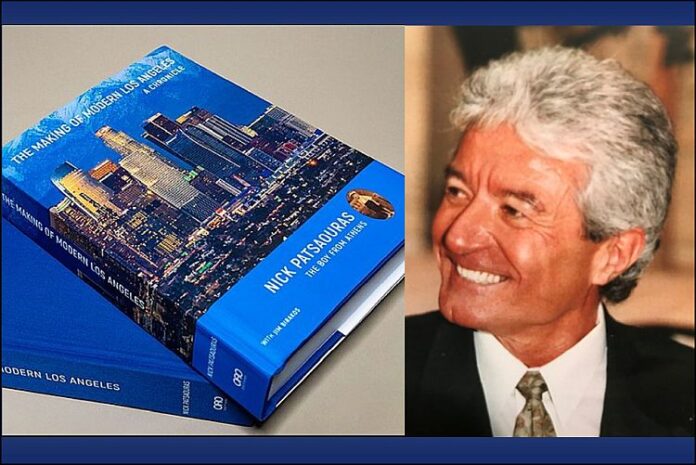
[Nick Patsaouras, originally an electrical engineer, was president of the Southern California Rapid Transit District during the 1984 Olympic Games, and has served as a Board member with the Los Angeles Department of Water and Power, the Board of Zoning Appeals and others. His 2024 book, The Making of Modern Los Angeles (ORO Editions) chronicled an insider’s view of the growth of the city. His opinions, are, of course, solely his own.]
The 100-meter sprint is the most thrilling athletic event in the Olympics, crowning the fastest human on Earth with unmatched publicity, explosive drama, and extraordinary global attention.
It has always been like that.
In the earliest Games in ancient Greece, Olympiads were referred to after the short-sprint champion, reflecting the belief that speed signaled divine favor and human excellence. In 776 B.C., for instance, Coroebus, a cook or baker from the city of Elis, won the sprint, and that Olympiad became known by his name, the Coroebus Olympiad.
Unfortunately, current trends regarding LA28 suggest Los Angeles may be remembered not as a champion, but as a loser. The city’s Olympic reputation could shift from the “miracle of 1984” to the “fiscal disaster of 2028” – a harsh but lasting judgment earned through overexposure, political incompetence and miscalculation, and a failing organizing committee facing serious operational and managerial risks.
Budget concerns have been raised, often referring to academic papers which propose that recent Olympic host city budgets show an average overrun of 172%. Applied to LA28, that benchmark would put the cost at about $12.3 billion. The Los Angeles 1984 Games produced a surplus of $232.5 million, which has locally funded youth sports programs for decades.
The concern is warranted: if LA28 runs into financial trouble, Los Angeles will be responsible for the costs because it voluntarily accepted unlimited liability for the Games.
In short, a fiscal disaster would begin with Olympic cost overruns. City taxpayers would cover the first $270 million, the state would cover the next $270 million, and Los Angeles would be responsible for anything beyond that. If the Games exceed their revenue by more than $540 million – a historically common outcome – the City alone would pay the remaining costs, facing possible bankruptcy if the City is unable to pay its bills according to the requirements of the California Government Code.
The risks do not end there. The City may also have to cover billions in unbudgeted services, including security, sanitation, and transit. And if the Games cannot be delivered, Los Angeles could face breach-of-contract liability.
So how did this happen? City officials accepted a high-risk contract, relied on optimistic projections and the legacy of 1984, failed to secure key reimbursement agreements, and underestimated the cost realities of the modern Olympic Games.
The draft Enhanced City Resources Master Agreement (ECRMA) sets out how Los Angeles will recover its Olympic-related costs. Originally due in October 2025, it has been delayed nearly nine months by complex negotiations over taxpayer protections and still requires formal approval from the City Council and Mayor Karen Bass.
But the ECRMA is only a baseline. Los Angeles and LA28 still must negotiate separate venue-by-venue contracts for more than fifteen sites within City limits, including the Crypto.com Arena, L.A. Memorial Coliseum, the Convention Center, Dodger Stadium, Peacock Theater and others. Those agreements, defining the services that will be provided at each venue, must be finalized by July 1, 2027, and they must agree on the cost of those services by October 1, 2027.
Los Angeles World Airports, the Port of Los Angeles and the Department of Water and Power would need to enter into their own service agreements with LA28.
Other venue cities still have to reach their own agreements with LA28, though only Los Angeles is a guarantor.
Is this a vital safeguard for the city’s fiscal health? Some Los Angeles City Council members, such as Monica Rodriguez, remain vigilant and concerned, noting that the true, final financial impact on the city’s budget cannot be fully determined until the Federal security allocations and venue-specific contracts are finalized.
Transportation is one of the major cost drivers and operational foundations of the 2028 Games. Yet urgent issues remain, as I noted here in April, and they could create a traffic Armageddon in addition to financial risks.
The Los Angeles Metropolitan Transportation Authority and the City have committed to adding 100 miles of priority bus lanes before the 2028 Summer Olympics. However, some businesses and residents along the proposed routes have not been consulted. LA28’s transportation leadership may be unfamiliar with the resistance that bus-only lanes on Pico and Olympic boulevards faced in the 1990s.
In the 1990s, proposals to convert parts of Pico and Olympic boulevards into bus-only lanes faced strong opposition from local businesses and residents. Backed by the Los Angeles Department of Transportation and former County Supervisor Zev Yaroslavsky, the plans drew objections from business owners who argued that parking restrictions would hurt their operations by reducing rush-hour customers and limiting access for religious and community activities.
LA28 has not provided Metro with enough data to plan effectively, including information on executive lanes and spectator activity around venues. It also has venue traffic plans that have not yet been shared with cities or transit agencies.
Another concern is whether the 1,700 additional buses needed to move spectators will be available and fully funded. Metro is likely to receive only a fraction of the $2 billion in Federal funding it has requested. The House version of the fiscal-year 2027 Transportation, Housing and Urban Development (THUD) Appropriations bill has proposed $875 million in support of the Games.
That is definitely not enough, assuming it gets through Congress, and even then, funding will likely not arrive until February 2027. Under the Memorandum of Understanding between Metro and LA28, Metro is not required to provide service beyond its standard operations unless it receives full funding. Specifically, the MOU states “Metro shall not be obligated for any Metro Enhanced [Olympic] Services, in full or in part, unless and until sufficient New Consideration [funds] is designated, dedicated or committed to Metro.” If that funding falls short, LA28 could have to rely on private charter buses, but the funding, planning, and execution of such a backup plan remain unclear.
With less than two years before the 2028 Olympic torch is lit, City leaders must ensure that Los Angeles and California are not left with the bill, and that L.A. avoids embarrassment on the world stage.
Although the Mayor is focused on reelection, she should use her bully pulpit to press LA28 Chair Casey Wasserman and his handpicked board to open LA28’s books and share information with its partners. The City cannot know whether LA28’s private revenue from sponsorships, ticket sales, and other sources will be enough to cover costs.
Because LA28 is a private nonprofit rather than a City agency, it is not subject to the California Public Records Act and is not required to disclose internal financial records. It can keep its books private. But given that Los Angeles is the financial backstop of the LA28 Games, the city can strongly argue that transparency is necessary to assess its risk.
Every elected official should be focused on the potential fiscal disaster facing Los Angeles. Aside from Council member Rodriguez, however, most have remained silent. The public deserves clear, ongoing answers – especially from Mayor Bass and mayoral candidate Council member Nithya Raman – about whether the LA28 agreement fully protects the city.
The successful 1984 Los Angeles Games remain instructive. Mayor Tom Bradley refused to put taxpayers at risk. He secured a deal that protected the city from cost overruns, limited the International Olympic Committee’s leverage, empowered a private organizing committee, relied on existing venues, negotiated from a position of strength, and kept City obligations tightly controlled. Los Angeles taxpayers faced no financial exposure.
Unfortunately, today, Los Angeles faces the very risk Tom Bradley worked so hard to avoid: becoming the deep pocket for Olympic overruns.

Comments are welcome here.
[≡The Sports Examiner encourages expressions of opinion – we really do – but preferably based on facts. Send comments to [email protected]. We do not guarantee publication of any comment, but all comments submitted will be considered and your submission implies your agreement to publication (and light editing if needed to meet our grammatical and punctuation standards) at our sole discretion. Please include your name and hometown on any comment submitted for publication.≡]

You can receive our exclusive TSX Report by e-mail by clicking here. You can also refer a friend by clicking here, and can donate here to keep this site going.
For our updated, 681-event International Sports Calendar for 2026 and beyond, by date and by sport, click here!