










Home Blog

PANORAMA: Canada, Estonia, others push back on IOC’s Russia plan; L.A. police may close academy to put more officers on streets in 2028

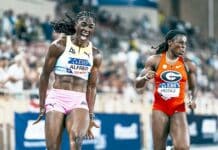
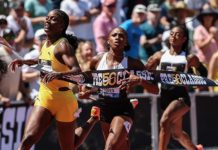
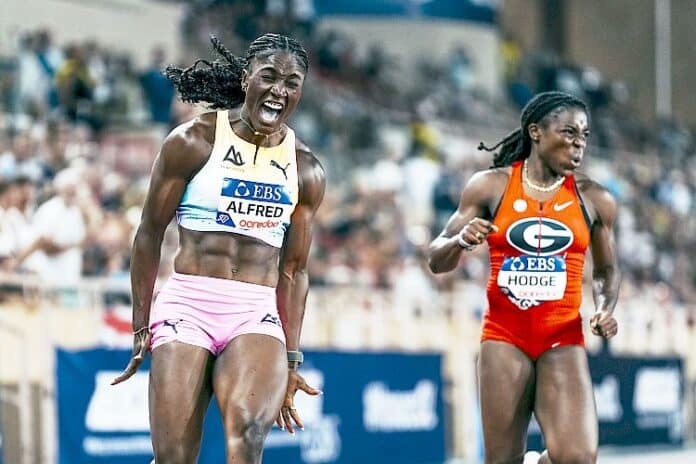
Olympic 100 m champ Julien Alfred (LCA) screams with delight over her 2026 Monaco Diamond League 200 m win (Photo: Chiara Montesano for Diamond League AG).

The Sports Examiner: Chronicling the key competitive, economic and political forces shaping elite sport and the Olympic Movement.★

To get the daily Sports Examiner Recap by e-mail: sign up here!

≡ THE 5-RING CIRCUS ≡

● Olympic Games 2028: Los Angeles ● The Los Angeles Times reported that the Los Angeles Police Department is considering closing the Police Academy during part of 2028 in order to reassign more than 300 training officers to street duty in advance of the 2028 Games.

The LAPD has explained it does not have enough officers to maintain normal policing and cover security needs for the Games, and expects to bring in officers from other jurisdictions during the Games period in 2028. Using training officers will increase the number of actual LAPD officers on duty during the planed 66 days of police operations to secure the Olympic and Paralympic Games.

● Olympic Winter Games 2034: Utah ● The International Olympic Committee continued ski mountaineering for the 2030 Winter Games in the French Alps, added Freeride skiing and snowboarding and cut Nordic Combined. What does this mean for the 2034 Games in Utah, which has already planned for a program based on the 2022 Winter Games?

The Deseret News reported that Utah 2034 organizing committee Chair Fraser Bullock said, “We’re wide open to new experiences and new things that could enhance the Games,” but also noted:

“I think they’ve pretty much added everything that was under consideration. We’ve got a very full program that’s fantastic. So we’ll have a very busy set of venues. Therefore, we don’t see a need to add any additional disciplines at this point in time.”

The IOC has initiated a process to review disciplines rather than sports and the decisions in 2034 are expected probably in 2027. The Utah organizers are unlikely to be enthusiastic on adding anything which would require a new venue to be added or built, since the Games plan is based on existing venues.

● International Olympic Committee ● The IOC’s removal of its recommended restrictions on Russian athletes on 7 July even caught the attention of the editorial board of the Wall Street Journal. Editorial page deputy editor Dan Henninger, a big Olympics fan, opined on the “Hits and Misses” segment of the “Journal Editorial Report:

“I’m giving a big miss to the International Olympic Committee, which has lifted its ban on Russian athletes and is going to allow them to compete in the 2028 Olympic Games in Los Angeles

“Russia was banned after Putin invaded Ukraine in 2022 and the spectacle of the IOC lifting this ban at the very time that Putin is increasing his bombardment and destruction of civilian buildings across Kyiv is a travesty and a disgrace, and just such a violation of the Olympic ideal.”

Canadian Secretary of State for Sport Adam van Koeverden wrote on X on 8 July:

“I am appalled by the IOC’s decision to provisionally lift their sanction on the Russian Olympic Committee” and added in a statement:

“Canada maintains, as it has since 2022, that the countries of Russia and Belarus should not be represented in international sports competitions while Russia’s illegal and unjustifiable full-scale invasion against Ukraine continues.

“Canada will maintain restrictions in condemning on the participation of Russian and Belarusian athletes at events hosted in Canada that receive funding from the Government of Canada.”

The government of Estonia said it will propose that the European Commission end support for IOC programs, such as the Erasmus+ project, with Estonian Culture Minister Heidy Purga stating, “It is impossible to understand decisions that seek to bring aggressor countries back into international sport as if nothing had happened.”

European Commissioner for Sport Glenn Micallef (MLT) told Politico:

“Athletes should not pay the price for the decisions of their governments. But sport cannot become a back door for normalizing aggression. If dialogue cannot guarantee that, the EU and its member states must be ready to consider proportionate steps to defend the values international sport is built on.”

The IOC receives the vast majority of its funding from private-sector sources from the sales of Olympic Games broadcast rights and corporate sponsorships.

● Athletics ● Olympic 100 m champion Julien Alfred (LCA) made a statement at the Monaco Diamond League meet on Friday, winning in 21.51, moving her to no. 3 on the all-time list and shattering her prior best of 21.71. She was thrilled:

“It´s not about the reaction time, it´s about how you finish. I don´t care about my reaction time, I was first, that´s all that matters. I have been preparing for this for such a long time, to finally see it pay off, I am just happy.

“I didn´t realize how fast it was, ‘til I crossed the line. I looked at the clock and saw my time and that´s why I was screaming like at the Olympics. Because I have been looking forward to this for such a long tine. I am just so happy to see that time. There is no limits right now. Today, I was actually hoping to see 21.6, I got 21.5, so I am happy nonetheless.”

Jamaican World men’s 100 m champ Oblique Seville won his 100 m race in 9.88 and explained:

“The start wasn’t that great, but I still have to finish well. What matters is winning. I love competing in Europe because last year I haven´t lost a race here. The aim is to be unbeatable.”

American Jordan Anthony, the World Indoor 60 m champ, was second in 9.92 and is still in transition from college track … and being a wide receiver in football:

“It was a funny race. I came to Europe in May, my first race was June 4, I think. It was Rome. A lot of people do not know my dad passed in June a couple of years ago. So June always hits heavy for me.

“So I had to go through mental health stuff, but that is what makes us professional athletes. You have got to overcome certain situations that you deal with in the outside world. And this was just like a starter. I showed myself like I am still who I say I am.

“It just took a couple of steps back and a few steps forward to understand the dance routine. So now I understand the dance routine and I can perfect it. I do not regret coming to this sport because it is different and it is fun. But I do miss the feeling of scoring a touchdown. You cannot replicate that.”

≡ RESULTS ≡

● Archery ● Tokyo Olympic men’s champion Mete Gazoz (TUR) won the Recurve gold at the World Archery World Cup in Madrid (ESP), defeating Italian Mauro Nespoli in the final by 6-0. It’s his third career World Cup title. Czech Marie Horackova, the 2023 World Champion, won the women’s gold, also winning 6-0, over Turkey’s Elif Gokkir.

South Korea won the men’s Team title (the U.S. was fourth) and the women’s Team final, 5-1, over the U.S. trio of Casey Kaufhold, Jennifer Mucino and Catalina GNoriega. Spain won the Mixed Team final.

In the Compound division, Colombia’s Pablo Gomez edged 2013 World Champion Mike Schloesser (NED), 148-147. Britain’s Ella Gibson won the women’s final, 148-145, over Malaysia’s Fatin Mat Salleh. The team titles went to Denmark (men) and Colombia (women) and Britain (Gibson and Ajay Scott) in the Mixed Team final.

● Athletics ● Lots of fast, but mostly wind-aided times at the Ed Murphey Classic in Memphis, Tennessee, but Jamaica’s Kadrian Goldson won the men’s 100 m in 9.89 with legal +1.9 m/s wind. An earlier 100 with +4.0 m/s wind produced a 9.85 winner for American Ajani Dwyer.

The 200 went to Zimbabwe’s Denzel Simusilela (19.84w +3.9) over countryman Tapiwa Makarawu (19.88w) and Canada’s Aaron Brown (19.88w). World leader Samuel Ogazi (NGR) won the 400 in 44.87 and 2019 World Champion Donavan Brazier won the 800 in 1:44.94. The wind carried rising U.S. star Jamal Britt to a 12.91w (+3.2) win in the 110 m hurdles.

Two field event marks of note, with Russell Robinson getting a (legal-wind) lifetime best in the triple jump at 17.54 m (57-6 1/2), no. 5 in 2026 and no. 12 on the all-time U.S. outdoor list. In the shot, Jordan Geist got a PR 22.44 m (73-7 1/2) to win, no. 3 in 2026 and equal-11th all-time U.S.

The women’s 100 m went to Tamari Davis in 10.89w (+2.1) and the 200 to Nigeria’s Favour Ofili in 21.74w (+2.8). Davis won an earlier 100 in 10.87w (+3.4).

There were spirited 800 m races at the Sunset Tour at Occidental College in Los Angeles, with Abe Alvarado (MEX) edging Yusuf Bizimana (GBR), 1:44.07 to 1:44.08 in the men’s race and Americans Makayla Paige – the NCAA Indoor champ – winning with a lifetime best of 1:58.14 to 1:58.17 for Emily Mackay, the 2024 World Indoor 1,500 m bronzer.

Former Utah All-American Emily Venters won the USATF Women’s 6 km Championship in Canton, Ohio, moving away from the rest of the field in the final 2 km and winning in 18:08. Elise Cranny was second in 18:12 and Annie Rodenfels finished third in 18:16.

It’s the first national title for Venters.

● Canoe-Kayak ● Hungary took five wins to highlight the ICF Sprint World Cup in Montreal (CAN), but Portugal’s Fernando Pimenta, Serbian Marko Dragosavljevic and Ukraine’s Liudmyla Luzan each collected two solo or doubles golds.

Pimenta, a five-time World Champion, won the men’s K-1 1,000 m final (3:35.60) and then the 5,000 m race in 21:57.79. Luzan, who won four 2025 Worlds golds, took the C-1 200 m final in 44.68, with American Tokyo Olympic winner Nevin Harrison in fifth (45.84). Luzan then teamed with Anastasiia Rybachok in the C-2 500 m to win in 2:02.02.

Dragosavljevic tied for the win in the K-1 200 m with Italian Worlds silver winner Andrea Di Liberto at 35/78 and then teamed with Zarko Jakovljevic to win the K-2 500 m in 1:26.67.

Hungary scored golds in the men’s C-1 5,000 m with Balazs Adolf (24:50.90), the C-2 500 m with Kristof Kollar and Istvan Juhasz (1:36.88), the C-4 500 m (1:32.96), the men’s K-4 500 m 91:22.10) and Zsofia Csorba in the women’s 5,000 m (28:43.11).

Olympic C-2 champ Bowen Ji (CHN) won the men’s C-1 500 m in 1:50.61, and Paris C-1 1,000 m winner Martin Fuksa (CZE) took that event in 4:09.49. Paris K-2 and K-4 gold medalist Jacob Schopf (GER) won the K-1 500 m in 1:36.43, with American Jacob Ecker in fifth (1:37.90).

Paris C-2 Olympic winner Mengya Sun (CHN) won the C-1 500 , final in 2:10.67, and New Zealand 2021 K-1 World Champion Aimee Fisher took the K-1 1,000 m in 4:11.69. Reigning World Champion Melina Andersson (SWE) won the K-1 5,000 m in 24:43.29. Poland’s World women’s K-2 500 m champs Martyna Klatt and Anna Pulawska won that event in 1:38.25.

● Cycling ● The 113th Tour de France continued with a sprint stage on Friday of 175.1 km finishing in Bordeaux with Belgium’s Tim Merlier getting to the line first at 3:44:20 with the top 100 riders receiving the same time. Norway’s Soren Waerenskjold was second.

On Saturday, the modestly-hilly 180.4 km route to Bergerac was another mass finish, with the top 89 riders getting the same time and Merlier winning again, in 3:52:50! Biniam Girmay (ERI) was second. It’s Merlier’s fifth career Tour stage win.

Sunday’s 154.6 km, hilly race to Ussel was shortened from the planned 185.5 km due to extremely high temperatures in the Massif Central region, but it was still hot during the route, with a rest day on Monday. A breakaway group of 15 attacked with 95 km to go, but was down to eight by 40 km and four by 10 km left, with 2023 World Champion Mathieu van der Poel (NED) winning in 3:27:51, ahead of Tobias Johannessen (NOR) and British Olympic star Tom Pidcock.

No change among the race leaders, with four-time winner Tadej Pogacar (SLO) leading two-time winner Jonas Vingegaard (DEN) by 2:42.

Rio 2016 Olympic champion Jenny Rissveds enjoyed the UCI Mountain Bike World Series in Pal Arsinal (AND), winning the Cross Country Olympic race in 1:18:48, well ahead of Martina Berta (ITA: 1:19:04), with American Savilla Blunck in fourth (1:19:15).

That gave her a sweep of the weekend, as she won her third women’s Short Track race of the season previously in 21:50, barely ahead of Laura Stigger (AUT) and Ronja Blochlinger (SUI), both in the same time.

American Bjorn Riley won the men’s Short Track race in 20:54, just ahead of Adrien Boichis (FRA: 20:55) and Chris Blevins of the U.S. (20:57), then Boichis took the XCO race cleanly in 1:14:48 ahead of countryman Mathis Azzaro (1:16:00), with Blevins in fourth (1:16:50).

In the Downhill racing, Britain enjoyed a 1-2 in the men’s event, as Jordan Williams won his second straight race, this time over Reece Wilson, 2:41.666 to 2:43.997, with Americans Ryan Pinkerton (2:44.166) and Asa Vermette (2:44.207) finishing 3-4. Four-time World Champion Valentina Hoell (AUT) won her fifth race out of six this season in the women’s final, in 3:06.717, with Gracey Hemstreet (CAN) second (3:07.202).

● Gymnastics ● Two-time World All-Around champ Darya Varfolomeev (GER) was on top again at the World Gymnastics Rhythmic World Cup in Milan (ITA), taking the A-A gold at 119.400, ahead of 2022 World A-A winner Sofia Raffaeli (ITA: 113.050). Americans Rin Keys (108.600) and Megan Chu (108.500) finished 12-13.

Varfolomeev followed up with wins on Ball (28.950) and Clubs (31.000) while Raffaeli won on Hoop (29.650). Bulgarian star Stiliana Nikolova won on Ribbon (28.650), with Keys in sixth (26.650).

● Shooting ● More world records at the Trap finals of the ISSF World Cup in Lonato (ITA), including home favorite Erminio Frasca taking the men’s final with a perfect 30/30 score, ahead of Spain’s Andres Garcia (28). Now 43, Frasca was the 2006 Worlds silver winner, but took down the record of 29 by Turkey’s Tolga Tuncer from May 2026.

India’s Neeru Neeru won the women’s Trap final for her first major international gold, scoring 27/30 over 2022 World Champion Carole Cormenier (FRA: 25). American Rachel Tozier was seventh.

One more record came in the Mixed Team final, as Australia’s James Willett and Catherine Skinner teamed up to score 37/40 for a world mark, bettering the 36 total by Wan-Yu Liu and Kun-Pi Yang (TPE) from May. Britain and Turkey won silver and bronze.

● Sport Climbing ● American Annie Sanders won her fourth individual World Climbing World Cup in Chamonix (FRA) in women’s Lead, totaling 52+ to edge Bulgarian Aleksandra Totkova (48) in the final. Indonesian Putra Tri Ramadani won the men’s final at 38+, ahead of 2025 World Champion Do-hyun Lee (KOR: 35+).

In the Speed finals, the all-Indonesian final saw former world-record holder Veddriq Leonardo win in 4.89, to 5.11 for Antasyafi Robby Al Hilmi. Fellow Indonesian star Desak Made Rita Kusuma Dewi, the 2023 World Champion, won the women’s final in 6.22 over Giulia Randi (ITA: 6.51). American Isis Rothfork was fourth.

● Triathlon ● Reigning World Champion Matt Hauser (AUS) was a close winner in the World Championship Triathlon Series Sprint in Hamburg (GER), crossing the finish in 50:07, with Portugal’s Vasco Vilaca right behind at 50:10 and Henry Graf (GER: 50:15) in third.

Hauser, the defending champion in this race, was second out of the water and started the run three seconds back of leader Alberto Garcia of Spain. But he had the fastest time in the field at 14:18, with Vilaca at 14:19 for the 1-2 finish.

The women’s title went to France’s Leonie Periault, the 2024 European silver medalist, in 55:51, beating Lisa Tertsch (GER: 55:56), Tilda Mansson (SWE: 56:03) and American Taylor Spivey (56:05).

Periault, also the 2025 Hamburg winner, was 35 seconds behind the leader in the swim, but just eight seconds back at the start of the run. She rolled through the field on the way to the fastest 5 km split in 15:56 to win, with Tertsch third-fastest at 16:06 and Mansson moving up thanks to a 15:58 final segment.

In the Mixed Relay World Championship race – an LA28 qualifier – Periault, Tom Richard, Emma Lombardi and Dorian Connix teamed up for France to win in 1:18:37, four second up on Hungary, followed by Britain (1:18:50) and the U.S. quartet of Gina Sereno, Seth Ryder, Spivey and Morgan Pearson (1:19:03). The French were the front throughout, but Connix took the tape thanks to the fastest final leg.

Receive our exclusive, weekday TSX Recap by e-mail by clicking here.
★ Sign up a friend to receive the TSX Recap by clicking here.
★ Please consider a donation here to keep this site going.

For our updated, 681-event International Sports Calendar for 2026 and beyond, by date and by sport, click here!
FOOTBALL: England, Argentina advance at FIFA World Cup; 50.1 million saw USA-Belgium; five deaths of Mexican fans, 25% of hoped-for tourism

The Sports Examiner: Chronicling the key competitive, economic and political forces shaping elite sport and the Olympic Movement.★

To get the daily Sports Examiner Recap by e-mail: sign up here!

≡ FIFA WORLD CUP ≡

The semis are set: France and Spain in Arlington, and England and Argentina (again) in Atlanta. Here’s how it happened:

England 2, Norway 1 (in extra time) ● It was 88 F and 68% humidity at Hard Rock Stadium in Miami Gardens for the start of this quarterfinal, with England in total possession to start the game and Norway sometimes placing its entire team in front of the ball.

At the first hydration break, the English had 73% of possession and the only shot of the game.

But out of the break, the game changed and the Norwegians were thinking offense. A header by scoring star Erling Haaland in the 35th was saved by England keeper Jordan Pickford. Then, in the 36th, forward Andreas Schjelderup was simply standing on the left side of the field with the ball, then slammed a left-footed liner across the English goal and into the top of the net in the 36th for a 1-0 lead!

After another foray into the England zone and a shot by midfielder Martin Odegaard in the 40th, Norway settled back into defense-and-counter mode. But it only worked for so long.

In the 47th, English forward Anthony Gordon crossed from left to right to of the box to midfield star Jude Bellingham, who then rolled toward goal, had space and sent a left-footed shot from the middle of the box into the net to tie the game at 1-1. Norway contended the goal kick that preceded this action hit the overhead camera wire and should have been re-taken; it was not called (FIFA said it didn’t happen).

England star striker Harry Kane scored at 45+4 off a feed from Bellingham, but it was called offsides. The half ended tied, with England at 68% possession and Norway up, 5-4, on shots.

Both sides were looking for the lead, and in the 54th, off a Norway corner, a shot by midfielder Patrick Berg was saved by Pickford, then rebounded in front and was kicked in for a goal by defender Torbjorn Heggen. But the goal was nullified for a Haaland foul – a two-hand shove – on defender Elliot Anderson before the corner was taken.

It was a defensive battle, with the second hydro break showing England at 61% possession but both sides at six shots. So there were a total of three shots in the “third quarter.”

A Norway corner in the 76th caused a lot of chaos in front of the England net and a header by midfielder Sander Berge hit the crossbar, and was barely cleared. A promising cross by England striker Bukayo Saka from the right endline in the 87th looked ready for a score, but it was cleared by midfielder Fredrik Aursnes.

In the 90th, English sub defender Djed Spence pressured Norway keeper Orjan Nyland on a ball played back, and hit Nyland’s kick, which popped out of bounds, but could have been an England goal! But it finished 90 minutes at 1-1, with England at 58% possession and Norway up on shots, 9-7.

In extra time, England was on offense from the start, and in the 93rd, a shot from the top of the box by striker Morgan Rogers was saved by Nyland, but the rebound was volleyed into the goal by Bellingham, his sixth goal in the tournament. 2-1.

In the 99th, a run by Spence into the box resulted in a foul by midfielder Oscar Bobb that was initially called for a penalty, but it was nullified after video review. .

An exhausted Haaland was subbed out by Norway for the second extra period for Jordan Larsen. Norway was looking to equalize, but Nyland had to double-save Spence and Saka on the 108th. Norway would not find a goal and it ended 2-1, with 53% possession at the end for England and 14-13 on shots.

England survived in the heat, and advances to an indoor match in Atlanta for the semi. Norway will be remembered for a long time for this historic run. 

Argentina 3, Switzerland 1 (in extra time) Warm conditions of 83 F and 66% humidity at Arrowhead Stadium in Kansas City for this quarterfinal, with a stunning early strike from Argentina early on.

After being down 2-0 to Egypt in the Round-of-16, the Argentines wanted a better start. They had a corner in the 9th on the right side of the field, and resulted in a shot from midfielder Alexis Mac Allister was deflected by a Swiss defender for another corner. From the other side of the field, star Lionel Messi sent the corner to the middle of the box and Mac Allister got his head on it and sent it to the far side of the Swiss net for the 1-0 lead in the 10th.

At the hydration break, the Swiss had 52% possession and shots were 3-3, but Argentina was in control. The Swiss controlled the ball, and finally got a real chance in the 31st on a run into the box by forward Dan Ndoye, but he was pushed aside by Argentine defender midfielder Rodrigo De Paul and Ndoye then fell over keeper Emiliano Martinez in the middle of the box.

The Swiss continued with the ball and the half ended 1-0, with Switzerland at 57% in possession and the shots still at 3-3, i.e., no shots recorded in the “second period.”

Down a goal, the Swiss looked for the equalizer at the start of the second half, but the Argentine defense was tight. Ndoye was finding some room for crosses and a dangerous header in the 65th, and midfielder Granit Xhaka sent a curling shot from the top of the box in the 66th that Martinez had to save.

Then in the 67th, another play by Ndoye tied it! He came down the left side, forwarded the ball to defender Ricardo Rodriguez, who kicked it back to Ndoye, who sent a screamer to the far side of the net for the tie. 1-1.

The game changed dramatically in the 70th, as striker Breel Embolo went down, with a yellow card given to Argentine midfielder Leandro Paredes. But video review reversed the call, and Embolo got the yellow and because he had one, was disqualified (red card). Now, the Swiss play with 10 men. The hydro break followed, with 53% Swiss possession, a 9-to-5 shots lead and now playing a man down.

In the 84th, Messi tried to catch the Swiss sleeping and broke for the goal as a cross was tried, but Swiss keeper Gregor Kobel was ready and caught the shot, with offsides called on Messi. Messi also missed a shot just wide right at 90+2 and Kobel had to fend off a couple more shots before the 90-minute whistle blew. Now, Argentina had 55% possession in the game and a 10-9 shots edge, but extra time was next.

Argentina held the ball against the packed-in Swiss defense, but no goals in the first extra period. Argentina possession was up to 59% now and shots were 17-11, so 7-2 for the defending champions in the period.

Argentina continued probing and Kobel stopped a Messi blast on goal in the 112th. But a few seconds later, striker Julian Alvarez had the ball on the left side at the top of the box, moved to his right and sent a long, right-footed strike that just cleared Kobel’s hand and ended up in the far right corner of the Swiss goal for the 2-1 lead.

The Swiss looked for another goal and pressing, were subject to a fast break the other way. Thiago Armada’s shot was blocked by Kobel, but sub striker Lautaro Martinez was there to finish on the rebound at 120+1 for the 3-1 final. Argentina finished with 59% possession and a 22-11 shots edge on the way to 12th straight game without a loss in World Cup play.

≡ PANORAMA ≡

On to the last four matches of the tournament:

Semifinal: 14 July in Arlington: France vs. Spain (3 p.m. Eastern)
Semifinal: 15 July in Atlanta: England vs. Argentina (3 p.m. Eastern)

Third: 18 July in Miami Gardens (5 p.m. Eastern)
Final: 19 July in East Rutherford (3 p.m. Eastern)

And then it will be over.

/Updated/TicketData.com reporting showed that the lowest “get-in” price for the quarterfinals went down from the round-of-16:

● $913 for the Group Stage
● $1,015 for the Round-of-32
● $1,453 for the Round-of-16
● $1,188 for the Quarterfinals

And all of the quarterfinal matches dove in price (from their highest point) as the games got closer:

FRA vs. MAR: $3,194 on 23 June to $1,027 on 9 July (–68%)
ESP vs. BEL: $4,395 on 22 June to $1,087 on 10 July (–59%)
ENG vs. NOR: $4,144 on 3 July to $1,805 on 11 July (–56%)
ARG vs. SUI: $4,167 on 22 June to $832 on 11 July (–80%)

Through 100 of 104 matches, the median (not average) of the lowest “get-in” prices was $912.

U.S. television ratings have soared for the country’s two favorite teams: the Americans and Mexico.

The epic England-Mexico round-of-16 match drew 23.5 million for English-language coverage on Fox and 23.20 million in Spanish on Telemundo for a 46.7 million final total, upgraded from the preliminary report.

The U.S.-Belgium match did even better, with a 37.2 million final total on Fox and 12.9 million on Telemundo for a 50.1 million total. This match was seen by more U.S. viewers, outside of the NFL, than any sporting event since game seven of the Cubs-Cleveland World Series in 2016.

The entire round-of-16 averaged 14.5 million on Fox and 11.1 on Telemundo for a 25.6 million average total. For comparison, the Knicks-Spurs five-game NBA Finals series averaged 20.9 million on ABC.

A story by Mexican Sports Journalists Federation President Evencio Flores on the AIPS Web site about the impact of the World Cup in Mexico noted:

“The rosy figures from agencies, financial, tourism, and economic entities tried to convince us that everything would become a land of plenty, with overflowing coffers, cities teeming with visitors, that after the World Cup, we would all be happy, by decree, forever and ever.

“Reality crushed us, took root within us, overwhelmed us.

“The economic impact barely reached 50 billion pesos [~$2.82 billion U.S.], 25% of what was expected, with only 800,000 visitors out of the 5.5 million the Ministry of Tourism had announced.”

Rather amazingly, there was also this:

“Zero serious security incidents at two of the three venues (except for five deaths during a celebration at the Angel of Independence in Mexico City). The Mexican government achieved what many believed impossible: that the World Cup would not be remembered for tragedies. That, for the international narrative, is worth more than the nearly $3 billion earned.”

Really: “except for the five deaths”?! Following the 2-0 Mexican win over Ecuador in the Round-of-32 on 30 June, it was reported that “Three people died from asphyxiation during crowd congestion along Paseo de la Reforma, while a fourth victim died later in a hospital after being transported from the celebration area” and a fifth fatality was disclosed during a 6 July briefing by Mexican officials, related to the World Cup, but not necessarily to the Mexico-Ecuador match and crowd.

During the entire scope of the World Cup in Mexico (at three sites), there were 120 total requiring significant treatment, plus the five deaths. True, these tragedies were not at the stadiums, but any injury to spectators – let alone a death – around a sporting event is a major tragedy.

Receive our exclusive, weekday TSX Recap by e-mail by clicking here.
★ Sign up a friend to receive the TSX Recap by clicking here.
★ Please consider a donation here to keep this site going.

For our updated, 681-event International Sports Calendar for 2026 and beyond, by date and by sport, click here!
FOOTBALL: Spain edges Belgium, 2-1, will face France in FIFA World Cup semis; FIFA offers new finals tickets at up to $32,970

The Sports Examiner: Chronicling the key competitive, economic and political forces shaping elite sport and the Olympic Movement.★

To get the daily Sports Examiner Recap by e-mail: sign up here!

≡ FIFA WORLD CUP ≡

The second quarterfinal of the FIFA World Cup was in Southern California, and drew a full house, with the “lowest” price for tickets seen at $4,396 on 22 June, but down to $1,087 on Friday.

Spain 2, Belgium 1 European champion Spain and perennial power Belgium played a high-quality game at SoFi Stadium in Inglewood, California in the World Cup quarters, with Spain starting out in normal form, with most of the possession.

But the defense was tight and there were only four shots by the time of the first hydration break, with the Spanish at 64% of the ball and 3-1 on shots. Belgium was playing without star midfielder Youri Tielemans due to injury.

But Spain’s pressure finally paid off in the 30th. After a build-up on the right side, a pass by defender Pedro Porro into the box resulted in a shot from star midfielder Dani Olmo, saved by Belgian keeper Thibault Cortois.

But the rebound came straight out and was slammed home by midfielder Fabrian Ruiz for the 1-0 lead.

Spain kept coming – especially teen striker Lamine Yamal – but Belgium increased its offensive effort, and midfield star Kevin De Bruyne got the ball to defender Timothy Castagne on the right side, who sent a perfect cross into the box that was headed in for the 1-1 tie by forward Charles De Ketelaere in the 41st.

It was the first goal allowed by Spain in the tournament. There was no more scoring in the half, with Spanish possession down to 62% and Spain ahead on shots, 9-2. Belgium made the most of its opportunity in the “second quarter.”

In the second half, Cortois was called on for more saves – four by the time of the hydration break – and at the stoppage, Spanish possession was back up to 67% and 13-4 on shots. But no more goals.

On the re-start, Cortois had to come out after an initial save, but was hurt on a Spanish shot and had to be replaced in the 71st by Senne Lammens. The Spanish pressure continued unabated, without success until the 88th. A shot by defender Pau Cubarsi straightaway from the top of the box was saved by Lammens, but rebounded in front of him and was followed up with an easy score by midfielder Mikel Merino for the 2-1 lead.

Belgium as on the attack, of course, for the final minute and seven in stoppage time, but could not score and it ended, 2-1. Spain ended with 68% possession and 17-5 on shots and after winning the trophy in 2010, the Spanish have gone out in the group stage, then twice in the Round-of-16. They are in their third semi, after 1950 and 2010.

≡ PANORAMA ≡

Two more quarterfinals to go on Saturday:

● Norway vs. England: In Miami Gardens. (5 p.m. Eastern)
● Argentina vs. Switzerland: In Kansas City. (9 p.m. Eastern)

The semifinals will be on 14-15 July in Arlington (Spain vs. France) and Atlanta and the final in East Rutherford on the 19th. The third-place game in Miami Gardens will be on the 18th.

FIFA released more tickets for sale for the World Cup Final, with 1,178 seats in Category 2 at a staggering $7,380 each, reportedly in the top deck of MetLife Stadium in East Rutherford, Nee Jersey.

There were 68 tickets offered in “Front Category 1″ priced from $19,995 to $32,970.

Britain’s The Independent reported, “On Fifa’s official marketplace, resale tickets for the final were listed from $7,440.50 to $11,499,998.85.”

Receive our exclusive, weekday TSX Recap by e-mail by clicking here.
★ Sign up a friend to receive the TSX Recap by clicking here.
★ Please consider a donation here to keep this site going.

For our updated, 681-event International Sports Calendar for 2026 and beyond, by date and by sport, click here!
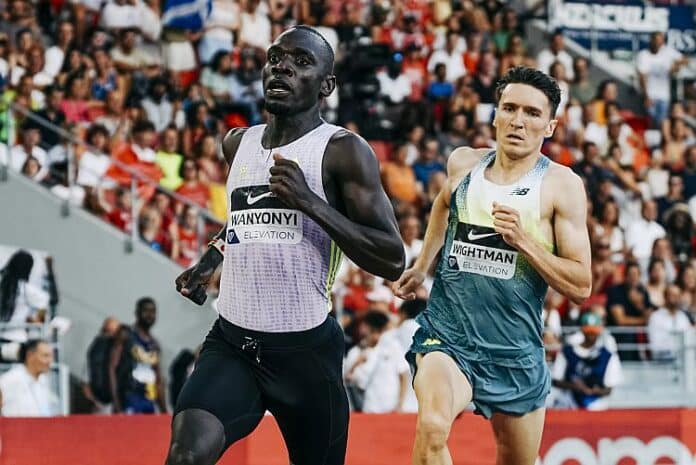
ATHLETICS: Wanyonyi gets 1,000 m world record at Monaco Diamond League; Alfred screams 21.51 in women’s 200 m, Masai Russell wins again!

Kenya’s Emmanuel Wanyonyi on the way to a 1,000 m world record at the 2026 Monaco Diamond League (Photo: Chiara Montesano for Diamond League AG).

The Sports Examiner: Chronicling the key competitive, economic and political forces shaping elite sport and the Olympic Movement.★

To get the daily Sports Examiner Recap by e-mail: sign up here!

≡ MONACO DIAMOND LEAGUE ≡

The 10th stop on the 2026 Diamond League tour was the annual Herculis Monaco at the Stade Louis II, in warm and humid conditions, that produced a world record and world leads in four other events:

Men/1,000 m: 2:11.83, Emmanuel Wanyonyi (KEN) ~ World Record
Men/Long Jump: 8.61 m (28-3), Miltiadis Tentoglou (GRE)
Women/200 m: 21.51, Julien Alfred (LCA)
Women/3,000 m: 8:08.95, Agnes Ngetich (KEN)
Women/Vault: 4.95 m (16-2 3/4), Nina Kennedy (AUS)

The rarely-run men’s 1,000 m was designed as a shot at the 1999 world record of 2:11.96 by Noah Ngeny (KEN) and the second pacer Louey Ouerrat (FRA) came through at 1:45.11 for 800 m, so the chase was on.

Wanyonyi, the Olympic 800 m champ and Britain’s Jake Wightman, the 2022 World 1,500 m champ, were the ones battling for the win and Wanyonyi – barely ahead in the final turn – ran away in the final 50 m and got the world record at 2:11.83 with Wightman at 2:12.77 (no. 5 all-time) and then Algeria’s Djamel Sedjati (2:13.94). American Bryce Hoppel was fifth in 2:15.80, now no. 5 all-time U.S.

Wanyonyi said afterwards that this was his first-ever 1,000 m!

With three laps to go in the Steeple, Kenya’s Paris Olympic finalist Simon Koech had the lead behind the pacer and then he and countrymen Edmund Serem and Leonard Bett were 1-2-3 by 2,000 m. But Koech broke away and took the bell all alone and he won by 50 m in 8:03.35. Japan’s Ryuji Miura moved up on the final lap to get second (8:10.30), then Serem (8:11.15) and American Matt Wilkinson (8:11.76). Carson Williams of the U.S. was seventh (8:17.36).

Olympic champ Tentoglou (GRE) was on it in the men’s long jump from the start, taking the lead at 8.48 m (27-10) in round one and extending to a world-leading 8.52 m (27-11 1/2) in round two. Paris Olympic silver winner Wayne Pinnock (JAM) reached a seasonal best of 8.39 m (27-6 1/2) in round one and stood second.

But Tentoglou wasn’t satisfied and blew up the final round with a sensational 8.61 m (28-3)! Cuba’s Jorge Hodelin got up for third in round five at 8.38 m (27-6).

The women’s 200 m had Olympic 1-2 – Gabby Thomas of the U.S. and Alfred – in lanes 7 and 6 and Alfred was out well on the turn. She had a small lead into the straight, but she moved away from Thomas, with collegiate record-holder Adaejah Hodge (IVB) coming up for second. Alfred crossed in a brilliant 21.51 (+0.9), now no. 3 all-time, with the no. 5 performance in history!

Hodge finished in 21.76, then Thomas in 21.84 and Americans Kayla White fourth in 22.04, Cambria Sturgis in 22.40 and Anavia Battle in 22.42. Alfred was amazing.

Kenya’s Faith Kipyegon was the headliner in the women’s 3,000 m, designed as a shot at the world record. With four laps to go, it was World Cross Country champ Ngetich (KEN) alone behind pacer Jess Hull (AUS: Olympic 1,500 m silver!) and took over at 2,000 m in 5:24.08. Ngetich was all alone – by 80 m – at the bell and finished alone at 8:08.95, the no. 3 performer and performance in history!

Aleshign Baweke (ETH) led the chase pack in 8:23.81, then Senayet Getachew (ETH: 8:24.02) and then Kipyegon (8:24.21).

In the women’s vault, only Kennedy and American Amanda Moll cleared 4.72 m (15-5 3/4), with Emily Grove of the U.S. third at 4.62 m (15-1 3/4). At 4.82 m (15-9 3/4), Kennedy cleared, but Moll missed once and passed to 4.87 m (15-11 3/4) and missed twice and was out. Kennedy missed once, but having secured the win, passed to the world-leading height of 4.95 and made it on her first try. It was a lifetime best and moved Kennedy to equal-fourth on the all-time list!

Tokyo Olympic champ Katie Moon of the U.S. was fifth at 4.62 m and Hana Moll was seventh at 4.52 m (14-10).

There were many more highlights:

World Champion Oblique Seville (JAM) was in lane five, with Olympic 200 m champ Letsile Tebogo (BOT) was in four in the men’s 100 m. Off the gun, the field was close through 30 m, but Seville took control cleanly after mid-way and won clearly in 9.88 (+0.2). American World Indoor 60 m champ Jordan Anthony was strong in the final 20 m and was second in 9.92, ahead of Emmanuel Eseme (CMR: 10.00). Tebogo was fifth in 10.04; Sam Blaskowski of the U.S. was seventh in 10.06.

Botswana’s 400 m World champ Collen Kebinatshipi was in the lead on the backstraight, but American 2025 World Indoor bronzer Jacory Patterson came into the lead off the final turn. No problem for Kebinatshipi, who pushed hard on the straight and won easily in 43.44, a lifetime best and now no. 4 all-time!

Patterson was second in 43.96, a seasonal best and Olympic 400 m hurdles champ Rai Benjamin of the U.S. was third in 44.13, moving up in the final 50 m.

Swiss European champ Dominic Lobalu had the lead in the men’s 5,000 m at the 3,000 m mark at 7:43.48, then Kenyan Cornelius Kemboi in front with two laps to go. Seven were together at the bell, with 2022 Worlds silver winner Jacob Krop in the lead and Krop and American Graham Blanks were 1-2 into the final turn. Lobalu and Blanks were 1-2 into the straight and it looked like Blanks would win with 25 m to go, but Lobalu found speed in the final meters and won in 12:52.54. Blanks finished in 12:52.60, then Birhanu Balew (BRN: 12:52.91) and Krop (12:53.71). American Abdi Nur was ninth in 13:09.49.

Only three cleared 2.26 m (7-5) in the high jump – Oleh Doroshchuk (UKR), Sarvesh Kushare (IND) and Kimani Jack (GBR) – then at 2.28 m (7-5 3/4), Jack cleared on his first, then Doroshchuk cleared on his third. On to 2.30 m (7-6 1/2), Jack was over again on his first, and Doroshchuk on his second. At 2.32 m (7-7 1/4), Doroshchuk upped the ante with a first-try clear, and that was good enough to win.

American JuVaughn Harrison was fourth at 2.23 m (7-3 3/4).

The non-Diamond League men’s Vault had only six jumpers and three cleared 5.85 m (19-2 1/4): Sweden’s Mondo Duplantis, France’s Baptiste Thiery and two-time Worlds bronzer Kurtis Marschall (AUS). Thiery and Marschall failed at 6.00 m (19-8 1/4) and Duplantis moved on to 6.07 m (19-11), then went to 6.15 m (20-2), but missed all three.

Olympic champ Marileidy Paulino (DOM) was only third off the final turn in the women’s 400 m, but made a charge past rising Czech star Lurdes Manuel and then had to fight off American Aaliyah Butler in the final 50 m to win in a meet record 48.67, with Butler getting a lifetime best in second at 48.84! That moves Butler to no. 4 all-time U.S. and improves on her prior best of 49.09 from this meet in 2025.

Manuel was third in 49.44; American Jasmine Jones was eighth in 51.09, a lifetime best for the 400 m hurdles star, in only her second race at the distance!

The women’s 100 m hurdles was all over quickly, as Olympic champ Masai Russell of the U.S. was in charge right away and ran a clean race, rolled cleanly and won easily in 12.20 into a headwind of 0.4 m/s. It’s the equal-sixth performance all-time; she has four of the seven!

American Alaysha Johnson was second in 12.38, with Nadine Visser (NED: 12.49) third; Rayniah Jones of the U.S. was fifth in 12.54.

World Indoor champ Leyanis Perez (CUB) had the lead in the women’s triple jump almost from the start at 14.80 m (48-6 3/4), but then exploded in the final round to a lifetime best of 15.06 m (49-5) to win. She needed to, since Saly Sarr (SEN) had the lead after round four; after the Perez took the lead, Sarr got a personal record right behind her at 14.99 m (49-2 1/4). Olympic champ and world leader Thea LaFond (DMA) was third at 14.79 m (48-6 1/4). Perez is now the 30th woman to jump 15 m or more!

In the women’s javelin, China’s 18-year-old star, Ziyi Yan, won her fourth Diamond League meet this season, taking the lead in the second round, but saving her best for the sixth at 68.75 m (225-6). Two-time European silver winner Adriana Vilagos (SRB) was a distant second at 63.18 m (207-3).

The Diamond League moves to London next Saturday (18th).

Receive our exclusive, weekday TSX Recap by e-mail by clicking here.
★ Sign up a friend to receive the TSX Recap by clicking here.
★ Please consider a donation here to keep this site going.

For our updated, 681-event International Sports Calendar for 2026 and beyond, by date and by sport, click here!
FOOTBALL: France handles Morocco, 2-0, at FIFA World Cup; La Liga chief rips FIFA on Balogun reversal, Egypt coach asks about “external factors”

The Sports Examiner: Chronicling the key competitive, economic and political forces shaping elite sport and the Olympic Movement.★

To get the daily Sports Examiner Recap by e-mail: sign up here!

≡ FIFA WORLD CUP ≡

France 2, Morocco 0 This was a rematch of the 2022 World Cup semi, won by France, 2-0, in 86 F and 60% humidity at Gillette Stadium in Foxborough, Massachusetts.

France was on offense from the start, dominating the chances, but with Morocco taking possession time in between French attacks. The game looked to take a turn in the 25th, as French star striker Kylian Mbappe was brought down in the box by defender Noussair Mazraoui for a penalty.

There was a long review, but Mbappe finally got to take the shot in the 28th, with a stutter-step approach and a clean save by Morocco keeper Yassine Bounou! He guessed correctly. By the hydration break just after, France had 59% of possession and was 7-0 on shots.

More of the same in the rest of the half, with Bounou the hero again in the 35th with striker Desire Doue sending a right-footed shot from the middle of the field that the keeper kicked away, and another save of a ripped shot in the 46th by defender Lucas Digne, that hit the crossbar.

France had 13 shots before Morocco got its first at the end of the half, as a free kick was given for a handball just outside the box. Defender Achraf Hakimi took the kick, but send it wide of the French goal on the final play of the half. Thanks to some time holding the ball inbetween French attacks, Morocco ended with 51% of ball and a 0-0 score.

Morocco started on offense in the second half, but could not score, with the ball turning back to French attacks within 10 minutes. Mbappe finally broke through in the 60th, after a Moroccan turnover at the top of the box at the left side, and once he got possession of the loose ball, he curled a right-footed shot into the far right side of the goal for the 1-0 lead. He now has 20 World Cup goals in 20 World Cup games.

France continued to press and broke the game apart in the 66th as striker Ousmane Dembele moved right at the top of the box and sent a right-footer liner into the right side of the net for the decisive 2-0 lead. It’s his fifth goal of the tournament.

The hydro break showed France now with 52% possession in the game and 17-2 on shots. Mbappe went off with what appeared to be a foot injury in the 76th, but he was walking well.

Morocco worked for a comeback goal, but the French remained on the hunt for more and shots were 20-4 by the end of 90 minutes. It ended 2-0, with Bounou making six saves to one for France’s Mike Maignan. Morocco ended with 52% possession, but the French ended 22-5 on shots. The French continue their hunt for their third straight final.

≡ PANORAMA ≡

Three more quarterfinals to go:

Friday, 10 July:
● Spain vs. Belgium: In Inglewood. (3 p.m. Eastern)

Saturday, 11 July:
● Norway vs. England: In Miami Gardens. (5 p.m. Eastern)
● Argentina vs. Switzerland: In Kansas City. (9 p.m. Eastern)

The semifinals will be on 14-15 July in Arlington and Atlanta and the final in East Rutherford on the 19th. The third-place game in Miami Gardens will be on the 18th.

Norwegian players complained about construction and road noise at their Ft. Lauderdale hotel in advance of Saturday’s match with England, and the team was relocated to another spot, closer to Hard Rock Stadium.

The team has also had issues with illnesses, but FIFA will pay for 50 rooms, security and transportation, while the Norwegian federation will cover any player charges for upgraded facilities.

Egyptian coach Hossam Hassan told reporters after the stunning 3-2 loss to Argentina in the round-of-16 that “external factors” may have been in play:

“We looked better than the reigning champions – better in everything – but the result was influenced by internal factors on the pitch and external factors off it. Perhaps they wanted to keep the world champion in the competition. Perhaps they wanted [Lionel] Messi to stay in the running.

“In football, there are sometimes external factors that go beyond the technical aspects. The world champion received support at every level.

“There seem to be pressures from the Argentina side on this outcome. We were objecting to the selection of the referee because of the French situation [Argentina beat France in the 2022 World Cup final], but everybody has to suffer at some point, and we suffered.

“We haven’t seen respect or fair play. A penalty was ruled out [a foul ruled on Mo Salah]. It was not even checked by the VAR [Video Assistant Referee], and our second goal was remarkably, for whatever reason, disallowed.

“I want to put it in beautiful words and say, ‘hard luck,’ but we have been treated unfairly and it has been an injustice.”

The news for U.S. star midfielder Christian Pulisic was worse than just the 4-1 loss to Belgium in the round-of-16 on Monday. U.S. Soccer said Thursday that he suffered a bone bruise and a microfracture of his right tibia and fibula, apparently in the 52nd minute while attempting a shot and hitting the leg of Belgian Youri Tielemans.

The anger over FIFA’s review and revision of the red card given to U.S. striker Folarin Balogun brought a direct comment from the head of Spain’s La Liga, Javier Tebas. His comment included:

“The lifting of the suspension of American player Balogun is neither a mere anecdote nor an isolated mistake. It is, quite simply, the tip of the iceberg of a governance model that has been undermining the credibility of FIFA and football in general for many years.

When rules can be interpreted or changed at will; when the most far-reaching decisions are made without real dialogue or agreement with the national leagues — even though they are the ones that keep professional football alive 365 days a year (the vast majority of professional clubs and players do not take part in international competitions); when a unilateral agenda is imposed without listening to football’s main stakeholders, the problem stops being a specific decision and becomes the system itself. …

“The Balogun case only reinforces this perception; it is only the tip of the iceberg. Moreover, if rules are systematically applied arbitrarily, trust disappears. And without trust, there is no institutional credibility.

“Worse still, a large part of the football world is aware of this, but far too many people prefer to keep a complicit silence. Because staying silent is more comfortable than defending independence, transparency, and good governance.”

FIFA said that a record total of 6,259,584 people have attended matches through the round-of16, with a per-match average of 65,204. The largest crowds have been at the Azteca in Mexico City (80,824 capacity) for five FIFA World Cup 2026 matches, with a total attendance of 404,120.

As for food: “More than 1.4 million bottles of water and 5 million beers have been sold during the tournament. More than 1 million concession items have been sold across Stadium Fan Experience areas alone, with the top three items being beer, water and pizza.”

A total of 607,350 hospitality packages have been sold so far across all venues:

“Sixty per cent of hospitality guests are regular fans looking for a premium experience, while 40 per cent are B2B clients. The three host nations – the United States, Mexico and Canada, in that order – account for 82% of customers. The UK, Brazil, Argentina, Qatar, India, Colombia and China complete the top 10. Hospitality packages have been sold to guests from 154 countries.”

The volunteer corps for the tournament has totaled 43,328 so far, from 162 countries and territories; the paid workforce is 4,738 people, from 134 different nationalities. FIFA noted a “total of 5,230 accredited media representatives.”

Also, FIFA stated that fan festival attendance has reached 7.7 million across all sites.

The top souvenir item is the team scarf, with 103,000 sold all together.

The quarterfinals and the round-of-16 show that despite all of the improvement in teams around the world, it is still Europe which dominates the field of possible winners:

Quarterfinalists:
2026: 6 Europe, 1 South America, 1 Africa
2022: 5 Europe, 2 South America, 1 Africa
2018: 6 Europe, 2 South America
2014: 4 Europe, 3 South America, 1 CONCACAF
2010: 4 South America, 3 Europe, 1 Africa

Round-of-16:
2026: 7 Europe, 4 South America, 3 CONCACAF, 2 Africa, 0 Asia
2022: 8 Europe, 2 South America, 1 CONCACAF, 2 Africa, 3 Asia
2018: 10 Europe, 4 South America, 1 CONCACAF, 0 Africa, 1 Asia
2014: 6 Europe, 5 South America, 3 CONCACAF, 2 Africa, 0 Asia
2010: 6 Europe, 5 South America, 2 CONCACAF, 1 Africa, 2 Asia

In terms of advancement from the group stage, the big winner of the expansion to 48 teams and 32 in the knock-out round was Africa, and always-strong Europe also did better than in 2022:

● 13: Europe (of 16 entries; vs. 8/13 in 2022)
● 9: Africa (of 10 entries; vs. 2/5 in 2022)
● 5: South America (of 6 entries; vs. 2/4 in 2022)
● 3: North & Central America & the Caribbean (of 6 entries; vs. 1/4 in 2022)
● 2: Asia (of 9 entries; vs. 3/6 in 2022).

The 16 elimination-round teams in 2018 in Russia included 10 from Europe, four from South America and one each from Asia and CONCACAF.

While World Cup ticket prices for the round-of-16 all slid down in the final days and hours before kickoff, the overall average remained high for the lowest “get-in” prices:

● $913 for the Group Stage
● $1,015 for the Round-of-32
● $1,453 for the Round-of-16

The most expensive round-of-16 ticket was England-Mexico at $3,820 and Swiss-Colombia was the least-priced, but still at $434.

The pricing is from TicketData.com reporting; The France-Morocco “get-in” price topped out at $3,194 on 23 June, but settled at $1,027 on Thursday, down 68%.

Receive our exclusive, weekday TSX Recap by e-mail by clicking here.
★ Sign up a friend to receive the TSX Recap by clicking here.
★ Please consider a donation here to keep this site going.

For our updated, 681-event International Sports Calendar for 2026 and beyond, by date and by sport, click here!
PANORAMA: Pogacar re-takes Tour de France lead; IOC skeds four-part 2028 Q-Series; Ukraine’s Heraskevych says IOC at “new low”

The Sports Examiner: Chronicling the key competitive, economic and political forces shaping elite sport and the Olympic Movement.★

To get the daily Sports Examiner Recap by e-mail: sign up here!

≡ THE 5-RING CIRCUS ≡

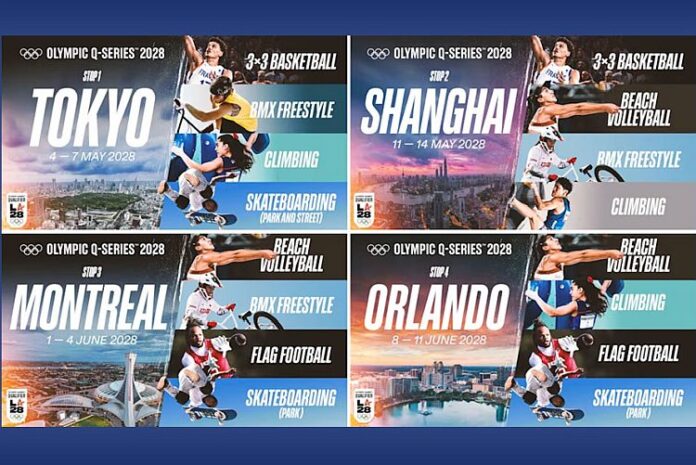
● Olympic Games 2028: Los Angeles ● The International Olympic Committee announced details for its Olympic Q-Series, designed to raise the profile of some of the smaller disciplines. The 2028 program:

04-07 May: Tokyo (JPN): Basketball/3×3, Cycling/BMX Freestyle, Skateboard, Sport Climbing

11-14 May: Shanghai (CHN): Basketball/3×3, Cycling/BMX Freestyle, Sport Climbing, Volleyball/Beach

01-04 June: Montreal (CAN): Cycling/BMX Freestyle, Flag Football, Skateboard/Park only, Volleyball/Beach

08-11 June: Orlando (USA): Flag Football, Volleyball/Beach, Skateboard/Park only Sport Climbing

The series will provide direct qualification to the LA28 Olympic Games.

LA28 announced that the International Broadcast Center is moving from the new Hollywood Park Studios to the Warner Bros. Studios The Ranch Lot in Burbank, California. Per the announcement:

“The Ranch will house the International Broadcast Center (IBC), the global operational headquarters for Media Rights Holders (MRHs) who have secured the exclusive rights to distribute Games coverage. This campus offers the scale, technical infrastructure and production facilities required to support one of the world’s largest temporary broadcast operations and will be fully operational for several months before, during and after the LA28 Games.”

As for the Hollywood Park Studios, “LA28 will utilize Hollywood Park Studios’ state-of-the-art production facilities to support Main Press Center operations, provide space for broadcasters conducting live stand-ups, and accommodate a variety of Games-time operational functions.”

The Main Press Center and Paralympic Press Center are, for now anyway, still at the NFL Los Angeles building in Inglewood.

● Russia ● The All-Russian Athletics Federation has filed a claim with the Court of Arbitration for Sport to try and force World Athletics to allow its athletes to compete. Per the federation statement:

“Experienced international lawyers specializing in sports law, including within the Court of Arbitration for Sport, have been involved in representing RusAF during the arbitration process.

“The lawsuit was filed within the five-day period stipulated by the Constitution of World Athletics and it meets all procedural requirements.

“It should be pointed out that the decision of World Athletics affects the fundamental interests of Russian athletics and restricts the rights of Russian athletes to participate in competitions on a discriminatory basis. The RusAF continues resorting to all available legal tools in order to protect the interests of its national athletes.”

World Athletics told the Russian news agency TASS, “We take note of the All-Russian Athletics Federation’s appeal to the CAS and will vigorously defend our position.”

On Wednesday, the International Volleyball Federation (FIVB) announced the removal of restrictions on Russian athletes and teams and “Russian athletes and technical officials in all disciplines will be allowed to return to FIVB, World and Official competitions.”

This follows the IOC’s Tuesday recommendation to allow Russian athletes and teams to be re-integrated into international competitions.

On Thursday, Russian Olympic Committee President Mikhail Degtyarev said that the Union Internationale de Pentathlon Moderne (UIPM) had also lifted all restrictions.

● Ukraine ● Ukrainian skeleton racer Vladyslav Herasvyevch, famously barred from racing at the Milan Cortina 2026 Winter Games because of his insistence on wearing a “memory helmet” picturing Ukrainians lost to the Russian invasion, wrote on X of the IOC’s recommendations on Russia:

“Absolutely shameful decision.

“The IOC leadership is hitting yet another new low with its actions.

“The current IOC leadership increasingly looks like yet another Russian asset that is simply working for Russian propaganda.

“And all of this is happening against the backdrop of residential buildings being shelled in Ukraine, which literally happens every other day.

“A huge number of Russian sports federations continue to operate in the occupied territories, and the IOC completely ignores this.

“I hope that the NOCs [National Olympic Committees] of other countries will not tolerate this arbitrariness and will finally show a strong stance against these shameful decisions.”

● Athletics ● The Diamond League resumes with the annual Herculis meet in Monaco on Friday, with good fields in many events, and a world record is always a possibility with Swedish vault star Mondo Duplantis lined up to compete.

This is the 10th Diamond League meet of the year, and the stars include the sprints, with World men’s 100 m champ Oblique Seville (JAM) facing Olympic 200 m winner Letsile Tebogo (BOT) and American Jordan Anthony, the 60 m World Indoor winner.

The women’s 200 m has Paris 2024 Olympic champion Gabby Thomas of the U.S. and Paris 2024 Olympic 100 m winner Julien Alfred (LCA), both facing collegiate record-setter Adaejah Hodge (IVB).

The men’s 400 m has the Pre Classic 1-2 of World Champion Collen Kebinatshipi (BOT) and American Rai Benjamin (expected not to be in lane nine again) and Olympic silver winner Matthew Hudson-Smith (GBR). The women’s 100 m hurdles has American Olympic champ Masai Russell continuing her chase of the world record.

Kenyan star Faith Kipyegon headlines the 3,000 m after her third in the Pre Classic mile.

World Junior men’s 200 m record holder Gout Gout (AUS), with a best of 19.67 this season, is out for the season with a torn left hamstring, suffered during a training session in Brisbane.

He will miss the World U-20 Championships in Eugene in August. The injury was reported as a “grade-three tear.” Gout, 18, wrote on Instagram:

“I’m very disappointed but I have no other possibility but to accept the situation. I understand that this is part of athletics.

“My focus now will be on my rehab in the coming weeks and months and ensuring I come back in 2027 better and stronger and faster.”

● Cycling ● Tour de France race favorite Tadej Pogacar (SLO) made a statement Thursday during the first climbing stage of the event, destroying the field with an attack on the second of three major climbs – the Col de Tourmolet – and finished the 186.2 km route in Gavarnie-Gedre in 4:32:07.

That was 2:38 up on two-time Tour de France winner Jonas Vingegaard (DEN) and 2:57 ahead of Mexico’s Isaac Del Toro. Pogacar broke away with about 42 km to go and not only won the stage, but re-took the race lead from Torstein Traeen (NOR), who finished 29:55 back.

Pogacar is now 2:42 up on Vingegaard and 3:27 up on Del Toro through six of 21 stages.

Receive our exclusive, weekday TSX Recap by e-mail by clicking here.
★ Sign up a friend to receive the TSX Recap by clicking here.
★ Please consider a donation here to keep this site going.

For our updated, 681-event International Sports Calendar for 2026 and beyond, by date and by sport, click here!
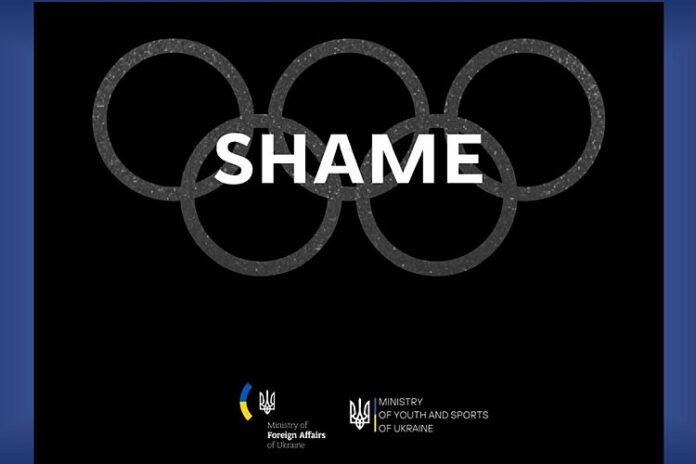
VOX POPULI: LA28: Olympic Glory or Fiscal Disaster?

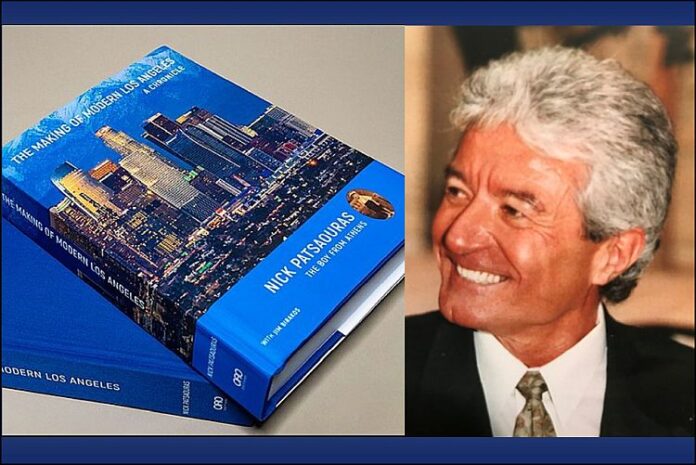
Former Southern California RTD President Nick Patsaouras and his 2024 book, “The Making of Modern Los Angeles.” (Photos courtesy Nick Patsaouras.)

[Nick Patsaouras, originally an electrical engineer, was president of the Southern California Rapid Transit District during the 1984 Olympic Games, and has served as a Board member with the Los Angeles Department of Water and Power, the Board of Zoning Appeals and others. His 2024 book, The Making of Modern Los Angeles (ORO Editions) chronicled an insider’s view of the growth of the city. His opinions, are, of course, solely his own.]

The 100-meter sprint is the most thrilling athletic event in the Olympics, crowning the fastest human on Earth with unmatched publicity, explosive drama, and extraordinary global attention.

It has always been like that.

In the earliest Games in ancient Greece, Olympiads were referred to after the short-sprint champion, reflecting the belief that speed signaled divine favor and human excellence. In 776 B.C., for instance, Coroebus, a cook or baker from the city of Elis, won the sprint, and that Olympiad became known by his name, the Coroebus Olympiad.

Unfortunately, current trends regarding LA28 suggest Los Angeles may be remembered not as a champion, but as a loser. The city’s Olympic reputation could shift from the “miracle of 1984” to the “fiscal disaster of 2028” – a harsh but lasting judgment earned through overexposure, political incompetence and miscalculation, and a failing organizing committee facing serious operational and managerial risks.

Budget concerns have been raised, often referring to academic papers which propose that recent Olympic host city budgets show an average overrun of 172%. Applied to LA28, that benchmark would put the cost at about $12.3 billion. The Los Angeles 1984 Games produced a surplus of $232.5 million, which has locally funded youth sports programs for decades.

The concern is warranted: if LA28 runs into financial trouble, Los Angeles will be responsible for the costs because it voluntarily accepted unlimited liability for the Games.

In short, a fiscal disaster would begin with Olympic cost overruns. City taxpayers would cover the first $270 million, the state would cover the next $270 million, and Los Angeles would be responsible for anything beyond that. If the Games exceed their revenue by more than $540 million – a historically common outcome – the City alone would pay the remaining costs, facing possible bankruptcy if the City is unable to pay its bills according to the requirements of the California Government Code.

The risks do not end there. The City may also have to cover billions in unbudgeted services, including security, sanitation, and transit. And if the Games cannot be delivered, Los Angeles could face breach-of-contract liability.

So how did this happen? City officials accepted a high-risk contract, relied on optimistic projections and the legacy of 1984, failed to secure key reimbursement agreements, and underestimated the cost realities of the modern Olympic Games.

The draft Enhanced City Resources Master Agreement (ECRMA) sets out how Los Angeles will recover its Olympic-related costs. Originally due in October 2025, it has been delayed nearly nine months by complex negotiations over taxpayer protections and still requires formal approval from the City Council and Mayor Karen Bass.

But the ECRMA is only a baseline. Los Angeles and LA28 still must negotiate separate venue-by-venue contracts for more than fifteen sites within City limits, including the Crypto.com Arena, L.A. Memorial Coliseum, the Convention Center, Dodger Stadium, Peacock Theater and others. Those agreements, defining the services that will be provided at each venue, must be finalized by July 1, 2027, and they must agree on the cost of those services by October 1, 2027.

Los Angeles World Airports, the Port of Los Angeles and the Department of Water and Power would need to enter into their own service agreements with LA28.

Other venue cities still have to reach their own agreements with LA28, though only Los Angeles is a guarantor.

Is this a vital safeguard for the city’s fiscal health? Some Los Angeles City Council members, such as Monica Rodriguez, remain vigilant and concerned, noting that the true, final financial impact on the city’s budget cannot be fully determined until the Federal security allocations and venue-specific contracts are finalized.

Transportation is one of the major cost drivers and operational foundations of the 2028 Games. Yet urgent issues remain, as I noted here in April, and they could create a traffic Armageddon in addition to financial risks.

The Los Angeles Metropolitan Transportation Authority and the City have committed to adding 100 miles of priority bus lanes before the 2028 Summer Olympics. However, some businesses and residents along the proposed routes have not been consulted. LA28’s transportation leadership may be unfamiliar with the resistance that bus-only lanes on Pico and Olympic boulevards faced in the 1990s.

In the 1990s, proposals to convert parts of Pico and Olympic boulevards into bus-only lanes faced strong opposition from local businesses and residents. Backed by the Los Angeles Department of Transportation and former County Supervisor Zev Yaroslavsky, the plans drew objections from business owners who argued that parking restrictions would hurt their operations by reducing rush-hour customers and limiting access for religious and community activities.

LA28 has not provided Metro with enough data to plan effectively, including information on executive lanes and spectator activity around venues. It also has venue traffic plans that have not yet been shared with cities or transit agencies.

Another concern is whether the 1,700 additional buses needed to move spectators will be available and fully funded. Metro is likely to receive only a fraction of the $2 billion in Federal funding it has requested. The House version of the fiscal-year 2027 Transportation, Housing and Urban Development (THUD) Appropriations bill has proposed $875 million in support of the Games.

That is definitely not enough, assuming it gets through Congress, and even then, funding will likely not arrive until February 2027. Under the Memorandum of Understanding between Metro and LA28, Metro is not required to provide service beyond its standard operations unless it receives full funding. Specifically, the MOU states “Metro shall not be obligated for any Metro Enhanced [Olympic] Services, in full or in part, unless and until sufficient New Consideration [funds] is designated, dedicated or committed to Metro.” If that funding falls short, LA28 could have to rely on private charter buses, but the funding, planning, and execution of such a backup plan remain unclear.

With less than two years before the 2028 Olympic torch is lit, City leaders must ensure that Los Angeles and California are not left with the bill, and that L.A. avoids embarrassment on the world stage.

Although the Mayor is focused on reelection, she should use her bully pulpit to press LA28 Chair Casey Wasserman and his handpicked board to open LA28’s books and share information with its partners. The City cannot know whether LA28’s private revenue from sponsorships, ticket sales, and other sources will be enough to cover costs.

Because LA28 is a private nonprofit rather than a City agency, it is not subject to the California Public Records Act and is not required to disclose internal financial records. It can keep its books private. But given that Los Angeles is the financial backstop of the LA28 Games, the city can strongly argue that transparency is necessary to assess its risk.

Every elected official should be focused on the potential fiscal disaster facing Los Angeles. Aside from Council member Rodriguez, however, most have remained silent. The public deserves clear, ongoing answers – especially from Mayor Bass and mayoral candidate Council member Nithya Raman – about whether the LA28 agreement fully protects the city.

The successful 1984 Los Angeles Games remain instructive. Mayor Tom Bradley refused to put taxpayers at risk. He secured a deal that protected the city from cost overruns, limited the International Olympic Committee’s leverage, empowered a private organizing committee, relied on existing venues, negotiated from a position of strength, and kept City obligations tightly controlled. Los Angeles taxpayers faced no financial exposure.

Unfortunately, today, Los Angeles faces the very risk Tom Bradley worked so hard to avoid: becoming the deep pocket for Olympic overruns.

Comments are welcome here.

[≡The Sports Examiner encourages expressions of opinion – we really do – but preferably based on facts. Send comments to [email protected]. We do not guarantee publication of any comment, but all comments submitted will be considered and your submission implies your agreement to publication (and light editing if needed to meet our grammatical and punctuation standards) at our sole discretion. Please include your name and hometown on any comment submitted for publication.≡]

You can receive our exclusive TSX Report by e-mail by clicking here. You can also refer a friend by clicking here, and can donate here to keep this site going.

For our updated, 681-event International Sports Calendar for 2026 and beyond, by date and by sport, click here!
PANORAMA: IOC ending support of World Olympians; Ukraine asks for stand against Russian symbols; skeet world record for U.S. star Hancock!

The Sports Examiner: Chronicling the key competitive, economic and political forces shaping elite sport and the Olympic Movement.★

To get the daily Sports Examiner Recap by e-mail: sign up here!

≡ THE 5-RING CIRCUS ≡

● Olympic Winter Games Alpes 2030 ● Our first reaction is, inevitably, one of disappointment.”

That’s International Ski & Snowboard Federation President Alexander Ospelt (LIE), reacting to the removal of Nordic Combined from the Olympic program for the 2030 Winter Games. He added:

“Nordic Combined has been a part of the Olympic Winter Games since the very first edition, in 1924, and is a cornerstone of Nordic skiing across all levels, especially in terms of athlete development. Not only that, but it is also a discipline that has been observing clear and tangible growth and an ever-broader international participation over the last few years thanks to the inclusion of women’s competitions. This is a very hard decision for FIS and for our National Ski Associations.”

Interim FIS Secretary General Urs Lehmann (SUI), explained, “The fact that Nordic Combined will not be in the Games in 2030 changes nothing regarding our support for the discipline as an integral part of the FIS World Cup calendar and of the FIS Nordic World Ski Championships. If anything, it’s a reason for us to back them up even more strongly.”

The federation said it will work to restore the discipline for the Utah 2034 Winter Games. There was good news in the addition of Freeride for both skiing and snowboard. Ospelt observed, “Freeride is a success story on the development level: within a couple of decades, the discipline created a structured pathway for athletes to compete, from the junior level all the way to the elite.”

The International Skating Union scored a considerable win with the International Olympic Committee’s approval of the addition of synchronized skating to the 2030 Winter Games program.

The ISU made strategic decision in December 2025, introducing “Synchro9″ with nine skaters on a team instead of the 16-20 allowed up to that time, with up to 16 on the ice at one time. As the ISU announcement noted, “the ambition behind the Synchro9 model is to drive the growth of Synchronized Skating through a dynamic new event concept, a simplified judging system, and a show-enhanced, television-friendly approach.”

It worked.

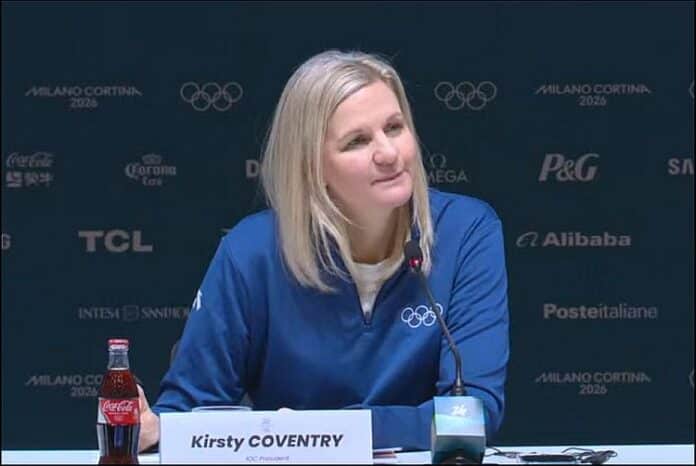
● Int’l Olympic Committee ● The IOC is ending its long ties with the World Olympians Association, an idea it moved toward under prior President Thomas Bach (GER) and will now implement under Kirsty Coventry (ZIM):

“[T]he IOC Executive Board (EB) has decided to phase out its cooperation with the World Olympians Association (WOA). Until the agreement ends one year from now, the IOC will, in line with its contractual obligations, continue to provide support to WOA with the aim of allowing the organisation to adapt its operations.

“WOA’s activities and governance have, over the years, been marked by a number of serious concerns, and the cooperation between the IOC and WOA has been challenging. …

“Despite the IOC’s efforts and goodwill to continue the cooperation, challenges and concerns have persisted. The IOC has therefore concluded that the current model is no longer compatible with the best interests of Olympians, and that a more direct engagement model is necessary.”

The WOA has been responsible for the recognition and registration of the “OLY” identifier; it seems likely that the IOC will try to take this role once its agreement with the WOA ends.

● Russia ● Russian Sports Minister Mikhail Degtyarev welcomed the International Olympic Committee’s decision on Russian athlete eligibility, noting on his Telegram page:

“As of today, over 20 international sports federations have allowed [Russian] youth athletes to compete under the Russian flag and to the tune of the national anthem, while 10 federations cleared all athletes without restrictions. The IOC’s decision will significantly speed up this process.

“There is still a lot of work to be done to implement the IOC’s decisions in international organizations, but the IOC is sending a clear message – the Olympic movement must not be politicized.”

The Ukrainian Ministry of Foreign Affairs was, of course, angry with the IOC’s recommendations, stating in a post on X:

“The IOC’s decision to lift its recommendations restricting the participation of Russian athletes sends a deeply concerning signal to the international community.

“We call on the governments of countries hosting international sporting events not to permit the display of Russian state symbols on their territory. Under this flag, Russia continues its unprovoked and illegal war against Ukraine.

“Every day, civilians are killed, cities are destroyed, and international law is violated. The symbols of an aggressor state have no place at international sporting events. …

“We also call on international sports federations to maintain the existing restrictions on representatives of the aggressor state, in line with their commitment to protecting the integrity and values of international sport.”

Despite the IOC Executive Board announcement on Tuesday, Swede Olle Dahlin, the President of the International Biathlon Union, said his federation’s ban on Russian entries remains in place. He said in a statement:

“The IBU has taken note of the IOC’s decision regarding its recommendations to IFs on Russian athletes’ participation in international competitions. As the IOC reiterated, decisions on participation fall within the autonomy of each IF.

“The IBU’s position is unchanged, and the IBU Congress decision of 2022 remains in place. The IBU Executive Board set up a monitoring group which will continue to regularly evaluate the situation and provide regular reports to the Executive Board.”

● Basketball ● The U.S. defeated Mexico, 94-93, in Monday’s FIBA men’s World Cup qualifying game in Zacatecas (MEX), as guard Mike James hit two free throws with seven seconds left for the winning points. He had 19 and forward Torrey Craig led the U.S. with 23.

The victory gave the Americans a 5-1 record in the first round of qualifying, winning Group A and moving on to the second qualifying round.

● Cycling ● Stage four of the 113th Tour de France was a hilly stage of 181.9 km that ended in Foix, with a final sprint as much of the final quarter of the route was downhill. Danish sprinter Mads Pedersen got to the line first in 4:10:45 at the head of 10 men in the final pack. American Quinn Simmons was second and Sean Quinn was seventh.

The major race contenders were content to finish 12:59 back and Norway’s Torstein Traeen is now the leader by 0:28 over Quinn; Slovenia’s four-time winner Tadej Pogacar is now fourth, 7:53 behind.

● Shooting ● At the ISSF Shotgun World Cup in Lonato (ITA), Olympic star Vincent Hancock of the U.S. shot a world-record, perfect 36/36 in the finals of the men’s Skeet competition to lead a U.S. 1-2.

He managed a one-shot win over countryman Christian Elliott, who missed his 12th shot, but made all the rest to finish at 35/36, which equaled the old world mark by Italian Gabriele Rossetti in May 2026. Hancock, 37, is a four-time Olympic champion and won his 23rd career World Cup gold.

The women’s Skeet title went to Italy’s Sara Bongini, who equaled the world record at 35/36 with Sweden’s two-time Worlds bronzer Victoria Larsson and the final went to a shoot-off with Bongini winning, 3-2. Both equaled the mark set by Adel Sadakbayeva (KAZ) in January 2026. American stars Sam Simonton (22) and Dania Jo Vizzi (21) finished fifth and sixth.

The competitions continue with the Trap events.

● Swimming ● Canadian world-record setter Summer McIntosh withdrew from the remainder of the Canadian Trials in Montreal after winning the women’s 200 m Butterfly and the 400 m Medley, writing on Instagram, in part:

“I’m so sorry, but on the advice of my doctors and coach, I’ve made the difficult decision to scratch from my remaining events at the 2026 Canadian Trials.

“I started feeling ill yesterday morning, and while I hoped I’d be able to keep racing, this is the right decision.

She was the leading qualifier in the 400 m Free morning heats on Tuesday before withdrawing.

Receive our exclusive, weekday TSX Recap by e-mail by clicking here.
★ Sign up a friend to receive the TSX Recap by clicking here.
★ Please consider a donation here to keep this site going.

For our updated, 681-event International Sports Calendar for 2026 and beyond, by date and by sport, click here!
FOOTBALL/Update: A classic as Argentina stuns Egypt late, 3-2; Swiss penalty Colombia at FIFA World Cup; unbelievable stadium food items

The Sports Examiner: Chronicling the key competitive, economic and political forces shaping elite sport and the Olympic Movement.★

To get the daily Sports Examiner Recap by e-mail: sign up here!

≡ FIFA WORLD CUP ≡

Shock as the operative word on Tuesday, as Egypt was up 2-0 on defending champion Argentina with 11 minutes left, but Lionel Messi & Co. found a way to win, again. And after the Swiss won on penalties, six European teams are into the quarters. .

Argentina 3, Egypt 2 This match in Atlanta was turned upside down in the 15th minute, with a long cross from the right side of the field, well beyond the box, from midfielder Marawan Attia, that was headed in by defender Yasser Ibrahim between two defenders, into the right side of the Argentina net for the 1-0 lead!

Argentina got to work on an equalizer and in the 19th, forward Haissem Hassan was called for a penalty for submarining Argentine defender Nicolas Tagliafico in the box. Superstar Messi lined up for the penalty shot, but his drive to the right side was saved quite easily by Egypt keeper Mostafa Shoubir. It was the second penalty missed by Messi at the World Cup, also against Austria.

By the hydration break, Argentina had 55% of possession and shots were one apiece. The Argentines continued their assault, in Shoubir kept they scoreless. He stopped midfielder Alexis Mac Allister’s header in the 28th, and then a Messi free kick from above the box in the 31st hit the left post. In the 39th, striker Julian Alvarez’s run through the box led to a shot that was saved again by Shoubir.

At the half, Argentina had 60% possession and a 7-2 lead on shots, with Argentina starting on offense right way, but unable to find the net.

Egypt looked to strike again on a fast break in the 58th, with scoring star Mo Salah sending the ball to the left to oncoming midfielder Mostafa Zico, who sent a strike into the net for the 2-0 lead. But a foul was called on midfielder Marawan Attia at the start of the attacking play, way back in the Egyptian zone, nullifying the goal!

Another Egyptian fast break in the 67th looked almost the same as the one that was nullified earlier: Salah moved out, forwarded the ball to Hassan, who found Zico coming in from the right side and he finished with authority for the 2-0 lead (confirmed).

With 63% possession and 12-3 on shots, Argentina went into the second hydro break in serious trouble. The pressure continued and on the 79th, it finally worked with a cross by Messi from the right side in front of Egyptian goal that was headed in by defenders Cristian Romero to close to 2-1.

A Messi cross in the box was barely missed by striker Lautaro Martinez on a header in the 82nd, then a loose ball in the box was tipped by Martinez to defender Gonzalo Montiel, who popped it to his right to Messi, whose left-footed shot from the center of the box got through to the left side of the goal for the 2-2 tie in the 83rd!

Off a follow-up Egyptian flurry, Argentina regained possession and the ball moved to the right side of the field for Martinez, who sent a looping pass into the box where it was scored by Enzo Fernandez on a header as he essentially stopped in the box to create space, as the Egyptian defender kept going, at 90+2. Unbelievably, 3-2.

Egypt demanded the goal be nullified for a foul in the Argentina box before the scoring play begin, but this was waved off. After 11 minutes of extra time, it was over; Argentina had 64% possession and was 19-5 on shots, but it was three goals on 13 minutes that made the difference.

Switzerland 0 (4) Colombia 0 (3) on penalties ● This was a tight match in Vancouver, with Colombia looking for offense and the Swiss ready for the counter. The first hydro break saw no score and 58% for Colombia and the only two shots of the match.

Both keepers had to make saves in the “second period,” but still no score at half, with more Swiss possession (down to 51% for Colombia at half), with five shots for the South Americans and two for the Swiss.

The second half saw both teams working harder for a goal,

The Swiss had 51% possession for the game at the second hydro break, with Colombia still leading on shots 7-5 (meaning there were five in the “third period” compared with seven in the whole first half). Both sides had two shots on goal.

The game was more open in the final minutes of regulation, with Swiss forward Dan Ndoye barely missing a shot from near the right endline at 90+1. But regulation time ended 0-0, with the Swiss at 52% of the ball and Colombia up on shots, 7-6. On to extra time.

It was more of the same: tight defending, and physical play. But in the 99th, Colombian Jhon Lucumi almost scored on a header, which was tipped over the crossbar by the right hand of Swiss keeper Gregor Kobel. And Kobel stopped a promising drive from distance by midfielder Jaminton Campaz in the 101st. But it was still 0-0, with Colombia at 12-6 on shots (5-0 in the period).

In the second period, a Swiss turnover in their own end resulted in a chance in the 115th, but Campaz’s shot from the right of goal went over the crossbar. But it finished 0-0, with the Swiss at 53% of the ball through 120 minutes and Colombia with 15 shots to seven.

The shoot-out saw both sides made two of their first three, then Colombia’s Cucho Hernandez had his shot saved by Kobel and Swiss forward Cedric Itten and midfielder Ruben Vargas made theirs for a 4-3 win. The Swiss reward is to face Argentina in Kansas City, in their first quarterfinal since 1954.

≡ PANORAMA ≡

The tournament is down to the final eight, and once again, it is Europe which dominates the field of possible winners:

2026: 6 Europe, 1 South America, 1 Africa
2022: 5 Europe, 2 South America, 1 Africa
2018: 6 Europe, 2 South America
2014: 4 Europe, 3 South America, 1 CONCACAF
2010: 4 South America, 3 Europe, 1 Africa

Looking at the final 16, despite all of the great play by smaller countries and that nine of 10 African teams made it to the round-of-32, Europe and South America were once again – as usual – responsible for most of those still playing:

2026: 7 Europe, 4 South America, 3 CONCACAF, 2 Africa, 0 Asia
2022: 8 Europe, 2 South America, 1 CONCACAF, 2 Africa, 3 Asia
2018: 10 Europe, 4 South America, 1 CONCACAF, 0 Africa, 1 Asia
2014: 6 Europe, 5 South America, 3 CONCACAF, 2 Africa, 0 Asia
2010: 6 Europe, 5 South America, 2 CONCACAF, 1 Africa, 2 Asia

After 27 straight days of matches, 8 July will be a football-free days in preparation for the quarterfinals on 9-10-11 July:

Thursday, 9 July :
● France vs. Morocco: In Foxborough. (4 p.m. Eastern)

Friday, 10 July:
● Spain vs. Belgium: In Inglewood. (3 p.m. Eastern)

Saturday, 11 July:
● Norway vs. England: In Miami Gardens. (5 p.m. Eastern)
● Argentina vs. Switzerland: In Kansas City. (9 p.m. Eastern)

The semifinals will be on 14-15 July in Arlington and Atlanta and the final in East Rutherford on the 19th. The third-place game in Miami Gardens will be on the 18th.

While World Cup ticket prices for the round-of-16 all slid down in the final days and hours before kickoff, the overall average remained high for the lowest “get-in” prices:

● $913 for the Group Stage
● $1,015 for the Round-of-32
● $1,453 for the Round-of-16

The most expensive round-of-16 ticket was England-Mexico at $3,820 and Swiss-Colombia was the least-priced, but still at $434.

The data is from TicketData.com reporting; mid-Tuesday average asking prices for the quarterfinals was $1,470.

In a FIFA “Disciplinary Preview” for the Monday matches, two U.S. Soccer staff members – team manager Sam Zapatka and the U.S. Soccer vice president of security, Frank Pannell, were listed as “suspended.

No more information was listed.

Fox Sports said the overnight report on the average English-language viewing audience from the USA-Belgium match was 30.0 million, the most ever in the U.S. for a soccer game, peaking at 36.895 million from 9:15 to 9:30 p.m. Eastern time, early in the second half.

Delish.com reviewed some of the most outrageous stadium concessions offered for the World Cup, leading off with this:

“The stadium food experience used to follow a pretty straightforward routine: Wait in an egregious line, overpay, and then try not to spill ketchup, mustard, or nacho cheese all over your jersey. Apparently, FIFA World Cup venues did not get the hot dogs-and-chicken-tenders-only concessions memo.

“Instead, host cities across the U.S. have gone full chaos mode — in the best possible way — with some of the most imaginative stadium fare we’ve seen. We’re talking outrageous, extravagant, occasionally confusing foods that make you wonder, ‘Who even approved this?’”

Of course, the lead-off item was the $75 Miami “Fancy AF Tots” with “deep-fried hash brown patties with caviar, crème fraîche, and chives—and a 5-pound (!!) empanada.”

There is also the “Twinkie Cheeseburger” at SoFi Stadium, a hamburger “topped with a Texas Twinkie, which is a bacon-wrapped jalapeño stuffed with brisket and cream cheese. Honestly? It’s even more ridiculous than my first thought.”

Receive our exclusive, weekday TSX Recap by e-mail by clicking here.
★ Sign up a friend to receive the TSX Recap by clicking here.
★ Please consider a donation here to keep this site going.

For our updated, 681-event International Sports Calendar for 2026 and beyond, by date and by sport, click here!
ALPES 2030: IOC Executive Board eliminates Nordic Combined, adds synchro figure skating and Freeride for 2030 Winter Games

The Sports Examiner: Chronicling the key competitive, economic and political forces shaping elite sport and the Olympic Movement.★

To get the daily Sports Examiner Recap by e-mail: sign up here!

≡ 2030 WINTER GAMES ≡

The long-awaited decisions on the sports program for the 2030 Winter Games in the French Alps were announced Tuesday by the International Olympic Committee:

Biathlon: Mixed Singles Team event added

Figure Skating: Synchro9 event added

Speed Skating: Men’s and women’s Team Sprint event added

Ski & Snowboard: Freeride was added as a discipline, with four events
Ski & Snowboard: Freestyle Ski Cross Mixed Team event added
Ski & Snowboard: Snowboard Mixed Team Parallel event added
Ski & Snowboard: Ski Jumping women’s Super Team event added
Ski & Snowboard: Nordic Combined removed

Ski Mountaineering: Continued from 2026, with five events.

In addition, the Snowboard Parallel Giant Slalom event was retained for 2030, after also being on the chopping block with Nordic Combined. As far as the Parallel Giant Slalom:

“The IOC EB noted that PGS – as part of the discipline of snowboard – had demonstrated significant improvement since Beijing 2022 across a number of popularity indicators. It was therefore decided to retain the PGS events on the Alpes 2030 programme, provided that they will not have a standalone field of play.”

The removal of Nordic Combined had been discussed by the IOC for several years, which saw too few countries competing in it and a concentration of medals among just a few countries, year after year. The International Ski & Snowboard Federation (FIS) had made a significant push in adding women’s Nordic Combined to its World Cup program, but now it’s out for 2030. This is a discipline that had been in every Winter Games since the beginning, in 1924. The IOC’s comment included:

“Across most of the popularity indicators, Nordic combined ranked lowest among all Olympic Winter Games disciplines at Sochi 2014, PyeongChang 2018, Beijing 2022 and Milano Cortina 2026. At the most recent Olympic Winter Games, it was the lowest-ranked discipline in 11 of the 14 popularity indicators assessed.

“In addition, the discipline continues to face challenges in terms of universality and participation at the Olympic Games. Only five National Olympic Committees (NOCs) won medals in Nordic combined across the last four editions of the Olympic Winter Games.”

During the follow-up news conference, it was explained that the affected International Federations had been kept clearly informed during the evaluation process, but that the actual decisions were not formally revealed until after the Executive Board meeting with all of the federations. 

The outcome of these changes allowed the IOC to announce its prized goal of equal numbers of men and women athletes at the Winter Games for the first time:

“Some 3,046 athletes (1,525 female and 1,521 male, including athletes in ski mountaineering proposed by the OCOG as an additional sport) are set to compete across 126 events – 56 for women, 55 for men and 15 mixed.”

Under the new IOC discipline evaluation process, all will be reviewed ahead of Utah 2034, based on a 14-point program, which has been provided to the International Federations, so they know what they have work on.

Receive our exclusive, weekday TSX Recap by e-mail by clicking here.
★ Sign up a friend to receive the TSX Recap by clicking here.
★ Please consider a donation here to keep this site going.

For our updated, 681-event International Sports Calendar for 2026 and beyond, by date and by sport, click here!
INT’L OLYMPIC COMMITTEE: IOC Executive Board provisionally reinstates Russian Olympic Committee, drops Russian athlete restrictions

International Olympic Committee President Kirsty Coventry (ZIM) listens at a 1 February 2026 news conference (IOC video screen shot).

The Sports Examiner: Chronicling the key competitive, economic and political forces shaping elite sport and the Olympic Movement.★

To get the daily Sports Examiner Recap by e-mail: sign up here!

≡ RUSSIAN RETURN ≡

The headline was this:

“IOC provisionally lifts suspension of Russian Olympic Committee – Recommendations to IFs with regard to Russian athletes’ participation no longer applicable”

The International Olympic Committee’s Executive Board, meeting online on Tuesday, followed up on the newly-passed Olympic Charter amendments to underscore the importance of the neutrality of sport, and agreed:

● “The International Olympic Committee (IOC) Executive Board (EB) has provisionally lifted the suspension of the Russian Olympic Committee (ROC) that had been in effect since 12 October 2023.”

● “The decision was taken following a thorough analysis by the IOC’s Legal Affairs Commission, considering that the ROC no longer includes as its members any regional sports organisations in territories falling under the jurisdiction of the National Olympic Committee (NOC) of Ukraine.”

● “In addition, the ROC confirmed that it does not, and will not, conduct any activities in these territories. The IOC EB will continue to closely monitor the situation relating to any ROC activities in those territories, and reserves the right to take any further measures if deemed necessary.”

The IOC issued recommendations asking International Federations not to have Russian or Belarusian athletes or officials in international sport quickly after the Russian invasion of Ukraine in February 2022. Now, most of those restrictions are over.

IOC President Kirsty Coventry (ZIM) explained in a follow-up news conference:

“We made it clear that we wanted to ensure all athletes have the possibility to compete at the Olympic Games and not be held responsible for their government’s actions, and I believe that is what this decision speaks to.

“It allows for Russian athletes to take part in sport competitions, but we’ve also been very clear that we do not condone any violence and war around the world, and we will continue with that stance.

“We also made it very clear that we would not be changing any of the recommendations when it pertains to state officials of Russia and we would not be taking a decision at this point to look at any potential events in Russia, so none of that has changed. …

“We will review the protocols around anthem and flag in the future.”

The Russian Olympic Committee was informed of the decision immediately following the Executive Board meeting. The IOC’s head of National Olympic Committee relations, James Macleod (GBR) also noted, “We have also had a conversation with the Ukrainian Olympic Committee and a number of other NOCs that have voiced their concerns around this matter.”

Macleod explained that the IOC Legal Affairs Commission “was set up in 2025 to look at the specific reasons for the suspension and whether those had been corrected. And they have been working for a whole year, gathering evidence, whether it has been submitted by the Russian Olympic Committee, or indeed, the Ukrainian Olympic Committee, to be able to have a very balanced view on that, and to come to a recommendation to the Executive Board, which they did today.”

As for Los Angeles 2028, the IOC’s statement indicated that the new Olympic Charter provisions will apply:

“In accordance with the Olympic Charter, and as applicable to all NOCs in general when selecting the athletes participating in the Olympic Games, the ROC must ensure that Russian athletes’ ‘selection [for the Olympic Games] shall be based not only on their sports performance, but also on their ability to serve as role models who respect, uphold and promote a peaceful society through sport as set forth in the Olympic Charter.’ (Bye-law 2.1 to Rules 27 and 28).”

As for doping, the statement further explained that any returning Russian athletes “must be part of a national (RUSADA/ROC) anti-doping programme (including risk assessment, test distribution plan and results management) that is delegated to the International Testing Agency (ITA).”

Seven International Federations have fully readmitted Russian athletes, but others have either allowed only “neutral” athletes or no Russian athletes at all.

Observed: This outcome was telegraphed by the changes to the Olympic Charter at the 146th IOC Session that was just completed. The IOC and the International Federations will now be faced with a series of problems created by this decision, including – at the least – inevitable protocol clashes when Russian and Belarusian athletes are face-to-face with Ukrainian and other Eastern European athletes whose own countries may be subject to Russian aggression.

The IOC’s next decision is on the Youth Olympic Games in Dakar (SEN) in November, where the Ukrainian Olympic Committee has asked for permission for its athletes not to attend ceremonies where the Russian flag and/or anthem are presented. There was no word on this today.

Receive our exclusive, weekday TSX Recap by e-mail by clicking here.
★ Sign up a friend to receive the TSX Recap by clicking here.
★ Please consider a donation here to keep this site going.

For our updated, 681-event International Sports Calendar for 2026 and beyond, by date and by sport, click here!
PANORAMA: Olympic jump star Davis-Woodhall admits to depression; U.S.’s Hunt sets Speed world record; FEI shows new high of 4,937 events in ‘25

American climbing star Emma Hunt after her 4 July 2026 Speed world record in Krakow, Poland (Photo: World Climbing).

The Sports Examiner: Chronicling the key competitive, economic and political forces shaping elite sport and the Olympic Movement.★

To get the daily Sports Examiner Recap by e-mail: sign up here!

≡ THE 5-RING CIRCUS ≡

● Olympic Games 2024: Paris ● One of the signature legacies of the 2024 Games was the re-opening of the Seine River for swimming and it continues in 2026, with the opening of three areas for public enjoyment.

Designated areas at Bercy (near City Hall), Grenelle (views of the Eiffel Tower) and eastern Paris at Bras Marie opened on Saturday (4th), under the observation of lifeguards and only when water quality tests show adequate conditions.

● Russia ● Another instance of visa refusal keeping a Russian team from competing in Europe, this time in archery, as Spain declined to allow entry of Russians to the World Archery World Cup in Madrid from 7-12 July.

A Russian squad of 13 competitors and six coaches had been lined up to compete.

● Athletics ●It feels, it sounds incredible. I just can’t really believe it.”

That was the reaction from 18-year-old Tate Taylor, the winner of the Pre Classic men’s 200 m in a lifetime best 19.75, no. 5 in the world for 2026, beating Paris Olympic champ Letsile Tebogo (BOT: 19.93). Headed to Texas Tech, he added:

“I really don’t even know what to say. … I was like, man, that’s just crazy ridiculous. I wasn’t going to expect to win this race. I knew it was going to be close. I told my dad, I told my coach, if they’re gonna beat me they’re gonna have to throw something crazy down to beat me, but I definitely wasn’t expecting to win.”

Even for the winners, it’s not all sunshine. Olympic and World champ Tara Davis-Woodhall took the women’s long jump at 7.13 m (23-4 3/4) and had three jumps over 23 feet, but said afterwards:

“Just to get here was a struggle this week. We’re dealing with some mental health problems. Just so you know, I have depression. I have anxiety. This week was really difficult. I couldn’t fathom just being here for some reason.

“I couldn’t get myself to like envision it, so the fact that I showed up today, the fact that I even gave myself a chance every single time. I have to show up for myself every single day because no one else will. My support team, oh my God, they’re the best people in the whole world. They just were here for me throughout the entire way and without them I wouldn’t be here and I’m just like grateful and thankful.”

● Cycling ● Favorite and four-time champion Tadej Pogacar (SLO) won the third stage of the 113th Tour de France as the race crossed over the border from Spain on Monday, and took the yellow jersey as the race leader.

Due to wildfires in the southern Pyrenees areas, the final 40 km of the 195.9 km route that started in Granollers in Spain and finished in Les Angles in France, was closed to spectators. There was an early crash, but the race finally came down to the major contenders with 11 km to go.

A pack of 10 raced to the finish and Pogacar crossed first in 4:45:11, two seconds up on two-time winner Jonas Vingegaard (DEN), Richard Carapaz (ECU) and France’s Paul Seixas. Pogacar and Vingegaard are tied on time, but Pogacar now gets the leader’s position on criteria.

● Equestrian ● The 136-member Federation Equestre Internationale published its annual report for 2025, showing an increase in total events staged last year, reaching an all-time high of 4,937. Of these, jumping continues to be the overwhelming leader:

● 1,790: Jumping ~ Olympic event
● 921: Endurance
● 868: Dressage ~ Olympic event
● 735: Eventing ~ Olympic event
● 315: Driving

There were small totals for Vaulting and for Para events. Jumping reached an all-time high in 2025 and the top countries holding events were the U.S. (613), France (522) and Italy (342).

In all, the FEI has 44,039 registered athletes, with the most in Jumping (24,958: 56.7%), followed by Endurance (6,205), then Eventing (5,498), Dressage (3,998) and Vaulting (2,022). France has the most athlete registrations with 5.494.

In terms of horses, there are 80,297 equine athletes registered, with 53,388 (66.5%) in Jumping, then 9,081 in Endurance and 8,866 in Eventing. France again led, with 11,313.

The federation’s finances showed CHF 87.103 million in assets (CHF 1 = $1.24 U.S.) and reserves of CHF 61.141 million. Revenues, including a portion of the International Olympic Committee television rights fee for 2024, totaled CHF 60.587 million and expenses were CHF 58.409 million for a surplus (after investment gains) of CHF 2.178 million. Essentially, the federation has a year’s worth of expenses in reserve.

Certainly solid, and positive considering the continuing growth in the number of events held, new athletes and horses registered.

● Sport Climbing ● While she finished third, American Emma Hunt became a barrier-breaker at the World Climbing Series Speed races in Krakow, Poland, winning her quarterfinal in 5.99, a world record and the first women to race under six seconds.

She broke the 2025 record of 6.03 by Poland’s Aleksandra Miroslaw, who ended up fourth in what she said was her final competition.

● Swimming ● Canadian teen sensation Summer McIntosh claimed a world record in a fourth event on Sunday with a brilliant 2:01.65 in the women’s 200 m Butterfly at the Canadian Swim Trials in Montreal. It was a mark she had been targeting, in part because it had been considered untouchable, as it was set in the “supersuit” era in 2009 at 2:01.81.

She told the CBC afterwards:

“That was the one world record that I’ve always dreamt of as a kid. To now do it is really incredible.

“As you can see my emotions, this is the absolute world [to me]. Growing up this is the one world record I thought I would never break and to do it tonight is really special in front of a home crowd. It means the absolute world and I’m in shock right now.”

She told the fans from the deck:

“Thank you so much for supporting me, you guys were the reason I broke it tonight. That last 50 was pure adrenaline and I could hear the crowd going crazy and I knew I was probably under or close to world-record pace so that’s really what kept me going.”

She won the women’s 400 m Medley on Monday in 4:27.35, the no. 8 performance in history; she now owns nine of the top 10. She also has her other world-record events on the program this week: the 400 m Free and 200 m Medley.

Receive our exclusive, weekday TSX Recap by e-mail by clicking here.
★ Sign up a friend to receive the TSX Recap by clicking here.
★ Please consider a donation here to keep this site going.

For our updated, 681-event International Sports Calendar for 2026 and beyond, by date and by sport, click here!
FOOTBALL: Fury at FIFA’s Balogun decision, racism aimed at Mbappe; Spain outlasts Portugal, 1-0, and Belgium clubs U.S., 4-1

The Sports Examiner: Chronicling the key competitive, economic and political forces shaping elite sport and the Olympic Movement.★

To get the daily Sports Examiner Recap by e-mail: sign up here!

≡ FIFA WORLD CUP ≡

The 2026 FIFA World Cup round-of-16 will finish tomorrow. Today, the reverberations of FIFA’s reinstatement of American striker Falorin Balogun were being felt across the sport.

U.S. President Donald Trump confirmed during a Monday briefing that he spoke to FIFA President Gianni Infantino (SUI) about the red card given to Balogun during the U.S.-Bosnia & Herzegovina match:

“All I did was ask for a review. I didn’t say, you have to do this. This man is a smart, tough man, Gianni Infantino. He’s a smart, tough man, and his stock has gone through the roof because the job he has done has been great. I feel like we have to have all the best players on the field.”

“I didn’t think it was a foul. I thought it was two great athletes that crashed each other and got entangled.

Further: “A U.S. official told ABC News that Trump and Infantino discussed why a red card was issued, and that the U.S. government provided additional evidence that was used in the appeal process.”

Infantino confirmed that he spoke to Trump, noting “During our conversation, I explained that there was an ongoing legal process involving FIFA’s independent judicial bodies and that the case would be decided in due course by the competent bodies. That is how FIFA’s system works, and it is a principle that I will always uphold.”

The European confederation, UEFA, went ballistic, posting Monday:

“Yesterday’s decision to suspend for a probationary period of a year the implementation of the one-match automatic suspension following the red card issued to the player Folarin Balogun crossed a red line. …

“When the certainty of rules is no longer guaranteed by its guardians, the integrity of the game is at stake and the credibility of a competition is undermined. Equally, such decision creates a precedent in the ongoing tournament, where similar situations will now require an equal treatment, to the detriment of the competition. …

“We express our disbelief at such an unprecedented, incomprehensible and unjustifiable decision.”

Red-card suspensions have been reduced or postponed from qualifying rounds to allow players to compete in the World Cup. The Associated Press reported:

“Balogun’s case seems to be the first since 1962 in which a sending-off during a World Cup match didn’t result in a suspension. On that occasion, the president of host nation Chile argued for Brazilian midfielder Garrincha to be allowed to play the final after he had kicked a Chilean opponent.”

The Belgian federation filed an appeal of the decision, but this was rejected on Monday: “The request was rendered inadmissible on the grounds that the RBFA is not a party to the proceedings and, as such, has no standing to appeal the decision.”

As for the games:

Spain 1, Portugal 0 These two ancient foes met in Arlington, and as usual, Spain was in possession from the start. But star forward Mikel Oyarzabal missed an open shot from the left side of the box in the 8th, just barely wide right. Portugal keeper Diogo Costa had to make back-to-back saves in the 16th off of shots by Lamine Yamal and Rodri to keep it scoreless.

Spain had 58% of possession and a 5-3 shots edge at the hydration break, still without a score. Portugal star strikers Joao Felix and Cristano Ronaldo both challenged Spain keeper Unai Simon in the 36th, but Simon saved both. In the 41st, a left-footed rocket from defender Nuno Mendes from just inside the box was deflected by Spanish defender Pedro Porro and hit the crossbar, bouncing away.

It was still 0-0 at half, with Spain holding 55% of the ball – much less than in its prior games – and leading on shots by 8-5 (and 3-2 for shots actually on goal). The second half was closely played, with both holding the ball, but still no score. At the second hydro break, Spain had 56% of possession and an 11-6 shots edge (but only 4-2 on shots on goal).

The “fourth quarter” was back and forth, but with tight defenses on both sides and a minimum of clear chances. Finally, at 90+1, off a free kick, Spain forward Ferran Torres had the ball above the box and sent a through ball into the middle of the box and midfielder Mikel Merino ran onto it and popped a shot to the left side of the Portugal net for the 1-0 lead very late.

At 90+6 in the final seconds, Portugal midfielder Bernardo Silva got to a header in the box and put it just over the crossbar, and at 90+8, a final header try by midfielder Joao Neves missed and it ended at 1-0.

Spain finished at 56% and 15-10 on shots. They were better, barely, but Spain advances, barely. It ends the great World Cup career of Ronaldo.

Belgium 4, U.S. 1The Belgians were on offense in Seattle right away, with defender Timothy Castagne sending a laser from the top of the box in the first minute that was saved by U.S. keeper Matt Freese.

It was warm at the start, with 80 F temperatures, and the Belgians were hot right away. And in the 9th, off a failed clearance, midfielder Nicholas Raskin sent a cross from left to right in front of the American net and striker Charles De Ketelaere ran onto it and scored on a tap-in for the 1-0 lead. Through the first 12 minutes, Belgium had seven shots to none for the U.S.

The U.S. finally got some possession at the 20-minute mark, but at the hydration break, Belgium had 56% possession and still 7-0 on shots.

Then, Balogun was fouled on top of the box in the 31st, giving the U.S. a free kick by Malik Tillman – who scored against Bosnia & Herzegovina – and his right-footed blast tipped off of Belgian defender Hans Vanaken and into the net for the 1-1 tie! It was the first American shot of the game.

Belgium was unimpressed and in the 33rd, rolled into the U.S. zone and at the left endline, forward Leandro Trossard sent another cross into the middle of the box and De Ketelaere headed it between two defenders for his second goal! 2-1.

The Belgians continued to control, but the U.S. got some late possession with Balogun being active in the box. But the half finished 2-1 and Belgium at 11-3 on shots and 53% possession.

The U.S. was more aggressive to start the second half, and had more possession. But in the 57th, Belgium got possession at midfield and a pass over the top by defender Brandon Mechele saw Freese come out to clear it, but his effort hit De Keteleare and rolled to Vanaken, who kicked the ball toward the American goal with Freese clear and U..S. defender Tim Ream could not stop it. 3-1.

U.S. midfield star Christian Pulisic was injured on a tackle in the 54th and had to come out in the 59th. At the hydration break in the 69th, Belgium had a 13-4 shots lead even as the U.S. now had 55% possession for the match.

The U.S. kept coming and sub midfielder Sebastian Berhalter had a close miss from the top of the box of the 79th and Balogun’s drive in the 82nd was saved by Belgian keeper Thibault Cortois. But at 90+3, a failed U.S. clearance at the left of goal was possessed by sub star striker Romelu Lukaku, who then rolled to the middle of the box and slammed home a right-footed strike for the 4-1 final.

The U.S. finished with 56% possession, but Belgium had 15-7 on shots. The American record against Belgium is now 1-7, with seven straight losses. In this century, the U.S. is now 2-7-6 (W-L-T) against European teams in the World Cup. Belgium moves on to face Spain.

All three host countries went out in the round-of-16.

≡ PANORAMA ≡

The round-of-16 runs from 4 to 7 July:

Tuesday, 7 July:
● Argentina vs. Egypt: In Atlanta (12 p.m. Eastern)
● Switzerland vs. Colombia: In Vancouver (4 p.m. Eastern)

After 27 straight days of matches, 8 July will be a football-free days in preparation for the quarterfinals on 9-10-11 July:

Thursday, 9 July:
● France vs. Morocco: In Foxborough. (4 p.m. Eastern)

Friday, 10 July:
● Spain vs. Belgium: In Inglewood. (3 p.m. Eastern)

Saturday, 11 July:
● Norway vs. England: In Miami Gardens. (5 p.m. Eastern)
● Argentina or Egypt vs. Switzerland or Colombia: In Kansas City. (9 p.m. Eastern)

Paraguayan Senator Celeste Amarilla posted racist messages on X about French star Kylian Mbappe after France’s tense and physical 1-0 win over Paraguay in the round-of-16, and after Mbappe ignored keeper Orlando Gill’s attempted handshake after the match:

“This brute hasn’t even learned to write; instead of mother’s milk, he sucked on coconuts, and the most educated thing he heard were chimpanzees. You should’ve shown him the finger, Orlando Gill; I do it in the senate and nothing happens!!!”

Mbappe responded on X:

“Madame Celeste Amarilla, You are a despicable woman and unworthy of your position. You do not represent Paraguay, that country which has sweated passion and honor throughout the competition.

“Through your recklessness and your brazen racism, the entire world has already forgotten the journey and the historic effort that your players accomplished during this World Cup, making way for an incompetent woman who gives the worst possible image of her country.

“I will never allow people like her the freedom to spread their hatred and racism across the world.”

Spanish reporter Romain Molina posted on X (computer translation of the original French):

“Several people on the UEFA board have been working behind the scenes for some time to put forward a candidate against Infantino [for FIFA President] in 2027

“Since the decision to curry favor with Trump (because that’s all it is), other leaders in world football – and not just European ones – have been discussing the idea of finding an alternative because ‘it’s no longer possible’

“That said, there’s often a difference between talking and acting, and a courage that the vast majority of football leaders sorely lack.”

Receive our exclusive, weekday TSX Recap by e-mail by clicking here.
★ Sign up a friend to receive the TSX Recap by clicking here.
★ Please consider a donation here to keep this site going.

For our updated, 681-event International Sports Calendar for 2026 and beyond, by date and by sport, click here!
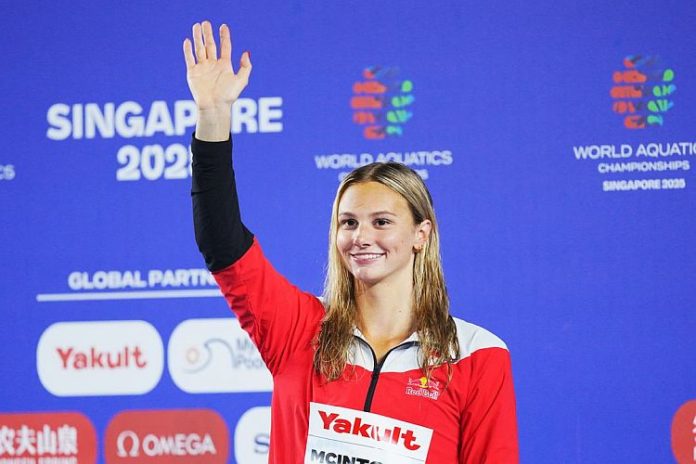
ATHLETICS: AIU ineligibles list expands to 736 total, with India, Kenya and Russia still at the top of the chart

The Sports Examiner: Chronicling the key competitive, economic and political forces shaping elite sport and the Olympic Movement.★

To get the daily Sports Examiner Recap by e-mail: sign up here!

≡ AIU SANCTIONS REPORT ≡

We’re halfway through 2026, so it’s time to revisit the Athletics Integrity Unit’s “Global List of Ineligible Persons” to look for trends in doping in track & field.

Unfortunately, there are more people than ever on this list.

The lengthy list shows 736 people on the roster, up from 683 people at the end of 2025 and 481 at the end of 2024, with 13 countries with 10 or more entries:

● 161 India (21.9% of the entire total)
● 148 Kenya (20.1%)
● 66 Russia (9.0%)
● 35 China (4.8%)
● 24 Ethiopia (3.3%)

● 20 Italy
● 19 South Africa
● 19 Turkey
● 19 Ukraine
● 17 United States

● 15 Morocco
● 13 Nigeria
● 10 Pakistan

So, the top three countries account for 51.0% of the total, and the total has risen 53.0% since the end of 2024! Compared with the top ten on the December 2025 list, and India has surged to the top:

● 140: Kenya
● 137: India
● 75: Russia
● 31: China
● 21: South Africa

● 19: Turkey
● 17: Ethiopia
● 17: Ukraine
● 15: Italy
● 15: United States

At the end of 2024:

● 119: Kenya
● 108: India
● 73: Russia
● 26: China
● 20: Turkey

● 18: Italy
● 18: South Africa
● 17: Ukraine
● 16: United States
● 15: Morocco

India, Kenya and Russia have been at the top of the listings now for multiple years; it’s worth noting that Indian ineligibles were 65 as late as 2022 and Kenyan ineligibles were 54 in 2022. China has also been rising, from 26 in 2024 to 31 at the end of 2025 and 35 now.

U.S. totals have stayed about the same: 16 at the end of 2024, then 15 at the end of 2025 and now 17 in mid-2026.

The AIU has been busy and it appears they are getting busier, and need to be. AIU Chair David Howman (NZL) said last December at the VI World Conference on Doping in Sport that the anti-doping movement cannot declare victory:

“But let’s be honest and pragmatic – the system has stalled. Intentional dopers at elite level are evading detection. We are not effective enough nowadays in catching cheats. We have great education programmes which help but they don’t impact the intentional rule-breakers in elite sport.

“Our ineffectiveness in dealing with those who are beating the rules is hurting the anti-doping movement’s credibility, with the resulting risk that our clean-sport message falls on deaf ears.”

He said that not only do anti-doping agencies need the most modern tools to find dopers, but that incentives to actually find cheaters – and not simply meet compliance standards – are needed. These have yet to be found.

Receive our exclusive, weekday TSX Recap by e-mail by clicking here.
★ Sign up a friend to receive the TSX Recap by clicking here.
★ Please consider a donation here to keep this site going.

For our updated, 681-event International Sports Calendar for 2026 and beyond, by date and by sport, click here!
FOOTBALL: Norway, Haaland dominate Brazil; England outlasts Mexico; Balogun ruled eligible at FIFA World Cup

The Sports Examiner: Chronicling the key competitive, economic and political forces shaping elite sport and the Olympic Movement.★

To get the daily Sports Examiner Recap by e-mail: sign up here!

≡ FIFA WORLD CUP ≡

Halfway through the round-of-16 and two eagerly-anticipated match-ups on Sunday, with the “lowest-price” tickets for the England at Mexico match reaching $4,894 three hours before kickoff, finally settling to $3,820 at the scheduled start.

Oh yes, Brazil is out and Norway’s Erling Haaland still cannot be stopped.

Norway 2, Brazil 1 It was hot at MetLife Stadium in East Rutherford – which will also be the site of the final – with 84 F temps and 64% humidity. But the game began coolly.

Norway controlled possession from the start, with Brazil content to look for counter-attacks – Brazil? – and the Vikings stunned with goal in the third minute from midfielder Patrick Berg with a right-footer in the box, but it was called off for offsides.

It looked like Brazil had a chance to take the lead in the 11th, as striker Matheus Cunha was submarined by Norwegian defender Kristoffer Ajer for a penalty (after a video review). Midfielder Bruno Guimaraes took the penalty in the 14th and it was saved cleanly by Norwegian keeper Orjan Nyland, guessing correctly to his left.

At the hydration break, Norway had 72% of possession, but the only two shots in the game were from Brazil.

There were some chances for both sides before the half, but no scores, with seven shots for Brazil, to four for Norway, which had 65% of possession.

The second half was more of the same: Norway with the ball and Brazil sitting back in defense. But they missed their opportunities; sub striker Endrick missed scoring on a breakaway in the 59th, and forward Rayan’s shot was saved by Nyland in the 62nd.

At the second hydro break, Norway continued at 68% possession with Brazil up on shots, 11-6.

Norway started taking advantage on the re-start, and striker Andreas Schjelderup’s blast was barely stopped by Brazil keeper Alisson in the 75th. Then Schjelderup sent a cross from left to right into the box and in front of goal in the 80th and super-scorer Haaland headed it into the goal for the 1-0 lead.

Nyland made another save in the 86th, deflecting a long try with his fingertips off the post! Then Haaland closed the door in the 90th, with a left-footed rocket from the top of the box flying past Alisson to the far right side of the net for the 2-0 lead. He scored his second goal on his 26th touch in the game and now has seven goals in the tournament, tied for the most.

A penalty was called at 90+9 on Norwegian defender Leo Ostigard for an elbow in the box on Casemiro. Sub striker Neymar took the penalty at 90+10 and scored easily for 2-1. That’s where it ended, with 66% possession for Norway, with Brazil at 14-9 for shots.

It’s Brazil’s sixth straight World Cup without winning it, a record drought that continues. Norway, playing in its first World Cup in 1998, is now in the quarters.

England 3, Mexico 2Rain delayed the start of the match at the Azteca in Mexico City, with 65 F temperatures to 7 p.m. local time. The game was tense from the start, with the first real chance on a header from forward Raul Jimenez in the 15th that was saved at the corner of the net by English keeper Jordan Pickford.

Mexico got off three shots by the hydration break to none for England and had 53% of possession. England was cautious, but Mexico was thinking offense.

Mexico dominated possession, but in the 36th, forward Bukayo Saka ran down the right side of the field, curled in and sent a perfect cross across the goal that was met by a header from star midfielder Jude Bellingham for a 1-0 lead.

Then England got possession again, and the ball was advanced to super-striker Harry Kane on the right side of the box and his cross found a steaming Bellingham coming again on the left side of goal and volleyed the pass into the net with his right foot in the 38th. Officially: 1:38 between the goals! And England had only 40% of the ball up to this point.

But Mexico was back on offense and in the 42nd, it closed to 2-1. A free kick from forward Roberto Alvarado came into the middle of the box, was deflected and then slammed into the net by star forward Julian Quinones. It’s his fourth goal of the tournament.

Mexico kept coming and Pickford stopped a header with his left hand from Jimenez at 45+3. Then defender Cesar Montes’ shot from point-blank range off a free kick was deflected by Bellingham to save a score. The half came at 2-1 and Mexico at 63% of the ball and 7-3 on shots … but down a goal.

And England had a chance to score quickly, as in the 49th, defender Nico O’Reilly got a good shot at the edge of the box, but his blast went off the crossbar. Then the game changed, as a tackle by English defender Jarell Quansah was ruled dangerous and he was removed with a red card, leaving England with 10 men, in the 54th.

But the unthinkable happened in the 58th, as Mexican keeper Raul Rangel tackled – with his hands – forward Anthony Gordon on a run into the box for a penalty! Kane lined up for the penalty and smashed it into the net and a 3-1 lead in the 60th.

In the 66th, a review for a possible penalty on Kane was confirmed on a try for a clearance. Jimenez took the penalty and converted to close to 3-2. The hydro break followed in an increasingly tension-filled game with Mexico at 60% and up to 10-5 on shots.

England stacked in the defense and saw through 90 minutes, but had to deal with 11 minutes ot stoppage time. Unbelievably, they managed it, with blocks, headers, some terrific work from Pickford – including a final punch on a corner – and with 33% of possession and with six shots to 20 for Mexico, it ended 3-2.

Mexico lost for the first time in a competitive match in the Azteca 13 years and only its third loss in the Azteca ever in competitive matches (70-3-17).

≡ PANORAMA ≡

The round of 32 is done. The round-of-16 runs from 4 to 7 July:

Monday, 6 July:
● Portugal vs. Spain: In Arlington (3 p.m. Eastern)
● U.S. vs. Belgium: In Seattle (8 p.m. Eastern)

Tuesday, 7 July:
● Argentina vs. Egypt: In Atlanta (12 p.m. Eastern)
● Switzerland vs. Colombia or Ghana: In Vancouver (4 p.m. Eastern)

After 27 straight days of matches, 8 July will be a football-free days in preparation for the quarterfinals on 9-10-11 July.

U.S. striker Folarin Balogun had his red-card suspension lifted by the FIFA Disciplinary Committee on Sunday:

“By operation of Article 27 [of the FIFA Disciplinary Code], the implementation of the automatic match suspension for USA player Folarin Balogun is suspended for a probationary period of one (1) year.”

He had received a red card for a tackle in the 64th minute of the win over Bosnia & Herzegovina; the relevant parts of article 27 read, “1. The judicial body may decide to fully or partially suspend the implementation of a disciplinary measure. 2. By suspending the implementation of the sanction, the judicial body subjects the person sanctioned to a probationary period of 1 to 4 years.”

The Associated Press reported that U.S. President Donald Trump called FIFA chief Gianni Infantino (SUI) about the red-card incident after the USA-B&H game.

So, Balogun will be available for the round-of-16 match against Belgium on Monday. The Belgian federation’s statement started with:

“The Royal Belgian Football Association (RBFA) is astonished by FIFA’s decision to declare suspended United States player Folarin Balogun eligible to play in the USA–Belgium match on Monday.”

Criticizing the decision as improper and unusual, the RBFA added, “In order to safeguard the legitimate rights of all participating teams and to protect the fundamental principles of fair play in our sport, both at this FIFA World Cup and at future editions of the tournament, the RBFA is investigating all potential options.”

After World Cup tickets for the group stage averaged $913 for the lowest “get-in” price, the 16 matches of the round-of-32 averaged $1,015 according to TicketData.com reporting.

Receive our exclusive, weekday TSX Recap by e-mail by clicking here.
★ Sign up a friend to receive the TSX Recap by clicking here.
★ Please consider a donation here to keep this site going.

For our updated, 681-event International Sports Calendar for 2026 and beyond, by date and by sport, click here!
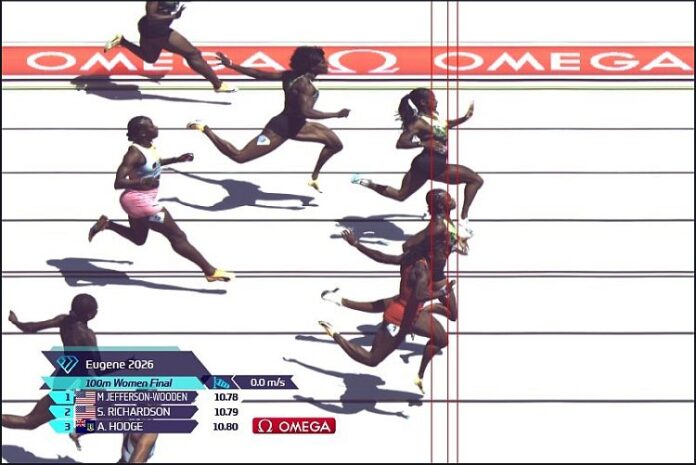
PANORAMA: Privately-built LA28 cricket site open in Pomona; McIntosh gets 200 Fly world record! U.S. dominates FIBA U-17 World Cup

Canadian swim star Summer McIntosh (Photo: Aniko Kovacs for World Aquatics).

The Sports Examiner: Chronicling the key competitive, economic and political forces shaping elite sport and the Olympic Movement.★

To get the daily Sports Examiner Recap by e-mail: sign up here!

≡ SPOTLIGHT ≡

● Swimming ● Canadian superstar Summer McIntosh, 19, claimed another world record on the first night of the Canadian Swimming Trials in Montreal, winning the women’s 200 m Butterfly in 2:01.65.

That shaves 0.16 off the “supersuit” world mark of 2:01.81 from 2009 by China’s Zige Liu, the last of the women’s polyurethane-suit records. McIntosh won by almost nine seconds, as Mary-Sophie Harvey was second in 2:10.58.

McIntosh now has world records in four events: the 400 m Freestyle in 2025; the 200 m Medley in 2025, the 400 m Medley in 2025 – all at the Canadian Trials – and now the 200 m Fly, also at the Trials. She plans to swim her other world-record events later in the week.

≡ THE 5-RING CIRCUS ≡

● Association of National Olympic Committees ● With the support of the Association of National Olympic Committees of Africa (ANOCA), Algerian Mustapha Berraf, the ANOCA President since 2018, is running to be the ANOC President with elections in December.

Berraf has been a member of the International Olympic Committee since 2019 and was close to former President Thomas Bach (GER). Other candidates are expected to join the race.

● Athletics ● Sad news that famed Jamaican coach Stephen Francis passed away on Saturday (4th) at just 64 years of age. As a founder of the Racers MVP club in Kingston in 1999, he coached such stars as Asafa Powell, Kishane Thompson, Shelly-Ann Fraser-Pryce, Elaine Thompson-Herah, Shericka Jackson and Tina and Tia Clayton.

MVP Track & Field Club President Bruce James said: “Stephen Francis changed the trajectory of Jamaican athletics for the better. He proved that Jamaican athletes, guided by Jamaican coaches, supported by Jamaican management, and training in Jamaica, could become the very best in the world.”

A new world lead in the men’s triple jump on Friday evening in Barletta (ITA) as World Indoor champion Andy Diaz reached 17.72 m (58-1 3/4). It’s his third-best jump ever and his only fair jump of the meet!

● Bobsled & Skeleton ● USA Bobsled & Skeleton agreed to extend chief executive Aron McGuire’s contract through the 2030 Olympic Games. McGuire has been in place since 2020 and has expanded the federation’s commercial reach as well as continuing to succeed on the ice, with six Olympic medals combined in 2022 and 2026 and seven World Championship medals in the last four years.

From the 2019-20 season to the 2024-25 season, USABS annual operating revenues grew from $3.10 million to $4.42 million, a 43% increase. Assets grew from $4.30 million to $6.27 million, up 46%.

● Cricket ● The new home field in Pomona, California for the Los Angeles Knight Riders of Major League Cricket opened for play on Thursday, 2 July 2026, losing to the Washington Freedom, 110/4 in 17.1 overs to 108/10 in 17.5.

The Associated Press reported that about 2,000 people attended the opener of the Knight Riders Cricket Ground. The $21 million facility was built and opened in about 70 days, with seating for 5,000 and lit for night matches, that will be expanded to 20,000 next year.

The site will be used for the 2028 Olympic tournament as cricket returns to the Games for the first time since 1900.

● Swimming ● SwimSwam.com reported that the International Swimming League, dormant since 2021, sent a letter to athletes owed money from the third season, for which many have been either unpaid, or only partially paid. It included:

“ISL will pay your outstanding prize money in four equal annual instalments, totalling 100% of the amount owed to you.

“The first instalment of 25% will be paid by December 31st 2026, with subsequent instalments no later than December 31st 2027, December 31st 2028, and December 31st 2029 respectively.”

ISL is targeting a return in late 2026 or 2027; it lost money in each of its three seasons of $20 million ro more.

≡ RESULTS ≡

● Badminton ● At the BWF World Tour Canadian Open in Markham, Japan won four of the five titles, with Riko Gunji (JPN) taking the women’s Singles over Line Christophesen (DEN), 21-15, 15-21, 21-6. The men’s final was all-Japan with Yudai Okimoto sweeping Riki Takei, 21-13, 21-3.

Denmark won the men’s Doubles and Japanese teams won the women’s Doubles and Mixed Doubles.

● Basketball ● The U.S. had won all seven editions of the FIBA Boys U-17 World Cup and rolled into the final of the 2026 edition in Istanbul (TUR). The Americans were 3-0 in group play, winning 115-84, 128-66 and 131-80.

In the playoffs, they beat Cameroon, 141-85; Puerto Rico by 149-82 and Australia by 114-65 in the semifinals. The final was against 5-1 Serbia, with the U.S. piling up a 30-19 lead at the quarter and 57-45 lead at the half. The Americans finished with a convincing 107-81 win, with forwards Clarence Rosser Jr. scoring 27 points and Joaquim Boumtje Boumtje adding 20, as the U.S. shot 53.6% from the field.

Australia won the third-place game over Turkey, 77-69.

In the third window of the FIBA World Cup 2027 Americas Qualifying, the U.S. men’s team of G League players and free agents managed a 82-81 win over the Dominican Republic in Santo Domingo, thanks to a game-winning three-pointer from Torrey Craig.

The next game comes on 8 July against Mexico in Zacatecas City. The U.S. leads Group A at 4-1 so far.

● Beach Volleyball ● At the Beach Pro Tour Elite 16 in Gstaad (SUI), it was an all-American women’s final as 2025 Worlds runner-ups Kristen Cruz and Taryn Brasher won over Megan Kraft and Kelly Cheng, 21-19, 21-15. It was the ninth Elite 16 or Finals win for Cruz and Brasher.

In the third-place match, Katja Stam and Raisa Schoon (NED) swept Americans Julia Donlin and Lexy Denaburg, 21-19, 21-11.

The men’s final was won by Stefan Boermans and Alexander Brouwer (NED) over Americans Trevor Crabb and Chase Budinger in a three-set battle, 26-28, 21-17, 15-11. It was the first Elite 16 win for the Dutch pair.

Third place went to Evandro Oliveira and Arthur Lanci (BRA), 22-20, 21-16, over Philipp Waller and Moritz Pristauz (AUT).

● Cricket ● Australia won the ICC Women’s T-20 World Cup, held in England for its seventh title in the 10 editions of the event.

The Aussies went 5-0 in the group stage, while England won the other group, also at 5-0. Both advanced to the final, with Australia winning by seven wickets: 153/3 (17.1 overs) to 150/4 (20 overs). It was the fourth title in the last five tournaments for Australia.

● Cycling ● The 113th Tour de France got started in Spain with a Team Time Trial in Barcelona, won by Team Visma-Lease A Bike, led by two-time Tour winner Jonas Vingegaard (DEN), in 21:47.

Sunday’s individual stage of 168.5 km from Tarragona to Barcelona, with a modest hill in the middle, ended up with a 13-rider sprint that came down to the four leading contenders in the race, won by Mexico’s Isaac del Toro in 3:40:01, followed by teammate four-time champ Tadej Pogacar (SLO), Belgian Remco Evenepoel and Vingegaard. Vingegaard continues as the race leader, with Pogacar six seconds behind.

France extended its winning streak at the UCI Mountain Bike World Series to three in a row in La Thuile (ITA), with Luca Martin, the 2024 World U-23 Champion, taking his second straight Cross Country Olympic race win, in 1:24:36. Well behind were teammates Mathis Azzaro (1:25:43) and Adrien Boichis (1:25:56). American Bjorn Riley was fourth (1:26:32).

The Short Track race was won by Boichis (19:39) over Martin (19:40).

Rio 2016 Olympic champion Jenny Rissveds (SWE) won the women’s Short Track in 20:27, a second ahead of Swiss Sina Frei and American Savilla Blunck (20:43). Sunday’s Cross Country Olympic race was won by Italian Martina Berta, the 2024 Worlds bronzer, in 1:31:04, ahead of Blunck (1:31:16).

The men’s Downhill was won by Britain’s Jordan Williams in 3:25.767, ahead of American Asa Vermette (3:26.728). World Champion Valentina Hoell (AUT) was the women’s winner in 3:58.469, with Swiss Lisa Baumann a close second (3:58.744).

● Gymnastics ● Belarus women went 1-2 at the World Gymnastics Trampoline World Cup in Coimbra (POR), with Katsiaryna Yarshova winning at 58.57 ahead of Olympic silver winner Viyaleta Bardzilouskaya (57.94). China’s Tokyo 2020 champion, Xueying Zhu, was third (57.84).

The men’s title went to 2025 World Champion Zisai Wang (CHN: 67.01) over Olympic winner Ivan Litvinovich (BLR: 66.03) and Paris bronze medalist Langyu Yan (CHN: 65.91).

Yarshova and Zlata Miniakhmetava won the women’s Synchro; Portugal’s Lucas Santos and Gabriel Albuquerque won the men’s Synchro final. Americans Lourens Willekes and Cody Gesuelli were seventh. The U.S.’s Aliah Raga won the women’s Double Mini (26.20) and Ruben Padilla won the men’s title (32.00).

● Sport Climbing ● The World Climbing Series in Krakow (POL) was focused on Speed, with a strong American performance, starting with Paris 2024 bronze medalist Samuel Watson claiming the men’s gold in 4.60, over China’s Yicheng Zhao (4.69).

The women’s win went to 2023 World Champion Desak Made Rita Kusuma Dewi over Poland’s 2021 Worlds winner, Natalia Kalucka, 6.54 to 6.62. Emma Hunt of the U.S. took the bronze.

The U.S. won the Speed Mixed Relay with Watson and Hunt setting a combined world record of 11.00 in the semifinals and then another WR in the final at 10.89. Indonesia won silver in 11.30.

The men’s Speed Relay was won by China (11.07) over the U.S. (11.72); China also won the women’s relay in 12.89 over Poland (14.00).

● Table Tennis ● At the second U.S. Smash was in Ontario, California, it was an all-China women’s final, with top-seeded World Champion Yingsha Sun outlasting Man Kaui by 4:3 (11-9, 11-6, 9-11, 11-5, 7-11, 10-12, 11-4).

The men’s final saw sixth-seed Sora Matushima (JPN) defeat Russian “neutral” Vladimir Sidorenko by 4:2 (11-5, 11-13, 11-7, 11-4, 5-11, 11-7).

The men’s Doubles was an all-China final, as Rubio Wen and Licen Yuan upset top-seeded Shidong Lin and Youzheng Huang, 3:2 (11-9, 8-11, 6-11, 1-7, 11-9). China’s top-seeded Manyu Wang and Man Kuai won the women’s Doubles over Miwa Harimoto and Hina Hayata, 3:1 (13-11, 4-11, 14-12, 11-8). In the Mixed Doubles final, South Korea’s Jooghoon Lim and Yubin Shin defeated China’s Chuqin Wang and Yingsha Sun, 3:2 (11-9, 6-11, 7-11, 11-7, 11-8).

● Water Polo ● The seventh World Aquatics Boys U-18 World Championship was in Rio Maior (POR), with Croatia winning its second title with a 7-6 penalty shoot-out win over the U.S., which won its first-ever medal in this event.

The Americans were 2-1 in pool play, then edged Hungary, 12-11, in the quarters and beat Montenegro by 17-13 in the semis. The final was 14-14 in regulation time and went to a penalty shoot-out, won by the Croatians, 7-6 (formally, a 21-20 final score).

Tyler Anderson of the U.S. was chosen as Most Valuable.

Receive our exclusive, weekday TSX Recap by e-mail by clicking here.
★ Sign up a friend to receive the TSX Recap by clicking here.
★ Please consider a donation here to keep this site going.

For our updated, 681-event International Sports Calendar for 2026 and beyond, by date and by sport, click here!

FOOTBALL: Moroccan strikes sink Canada; Mbappe’s penalty punishes Paraguay as FIFA World Cup round-of-16 opens

The Sports Examiner: Chronicling the key competitive, economic and political forces shaping elite sport and the Olympic Movement.★

To get the daily Sports Examiner Recap by e-mail: sign up here!

≡ FIFA WORLD CUP ≡

Things are getting serious now, in the round of 16. It’s worthwhile to observe that despite all of the great play by smaller countries and that nine of 10 African teams made it to the round-of-32, Europe and South America are once again – as usual – responsible for most of those still playing:

2026: 7 Europe, 4 South America, 3 CONCACAF, 2 Africa, 0 Asia
2022: 8 Europe, 2 South America, 1 CONCACAF, 2 Africa, 3 Asia (in QAT)
2018: 10 Europe, 4 South America, 1 CONCACAF, 0 Africa, 1 Asia (in RUS)
2014: 6 Europe, 5 South America, 3 CONCACAF, 2 Africa, 0 Asia (in BRA)
2010: 6 Europe, 5 South America, 2 CONCACAF, 1 Africa, 2 Asia (in RSA)

The winners of today’s matches will meet in the quarters on 9 July in Foxborough, Massachusetts.

Morocco 2, Canada 0 Outside temperature were 92 F in Houston, but the round-of-16 opened indoors in NRG Stadium with Canada all over the Moroccan zone from the kick-off. But no goals were scored by the 24th-minute hydration break, despite 61% possession for Canada and four shots to none. For Morocco, they also lost star forward Ismael Saibari to injury in the 22nd, with Soufiane Rahimi replacing him.

The stands were a sea of red – the prime color of both teams – and Morocco was continuously on defense and tempers flared in the 40th with yellow cards booked for both teams. The half ended scoreless with Canada at 67% possession, but just four shots; Morocco had one. More to the point, Canada committed 15 fouls and Morocco 6, Morocco received four yellow cards to Canada’s two.

The second half started the same way, but Morocco got loose in the 50th, off a free kick from the right side by defender Achraf Hakimi, a pass to the left to midfielder Azzedine Ounahi resulted in a right-footed laser that flew through the defense and into the Canadian net for the 1-0 lead on Morocco’s second shot of the game!

Canada continued to push, and the game saw two more yellow cards; at the second hydro break, Canadian possession was down to 62% and shots were still just 5-2 (that’s one shot apiece in the “third period”).

All of the offense was from Canada, then came a fast break for Morocco in the 82nd, with a pass forward to midfielder Brahim Diaz, who dribbled to the right, then stopped and passed left for a one-timer from Ounahi that flashed into the right side of the net for a 2-0 lead.

A third goal almost came in the 85th as a pass this time from Ounahi to the middle of the box for Rahimi resulted in a header that hit the crossbar!

The Moroccans were on the defensive for much of the game, but won handily, making it a 3-0 final with Rahimi scoring almost at the end, on the 98th, on a pass from right to left from Diaz, and then a right-footed finish.

Morocco actually ended with 56% possession, but had just five shots to 11 for Canada. The game had 38 fouls, 24 by Canada. But Morocco is in the quarterfinals once again.

France 1, Paraguay 0 This match started at Lincoln Financial Field in Philadelphia at 5 p.m. Eastern time with 98 F temperatures and 38% humidity. Ugh.

The Paraguay approach was simple: defend. It worked well in the first half, despite 81% possession for France; they had only one shot before the first hydration break, and that came at the 22-minute mark. But the game was also testy, with a face-off between the teams in the 35th minute and some pushing and shoving.

It was scoreless at the half, with France at 80%, and a 5-2 edge on shots. But no goals – and no shots on goal! – and 96 F temps to start the second half. Happily, the field was finally covered in shade by the 60-minute mark.

The French continued to press in the second half, and got closer to a goal, but a major break in the game came in the 67th. Paraguay midfielder Diego Gomez tripped sub forward Desire Doue in the box as he zig-zagged between three defenders, leading to a video review and a penalty.

French superstar scorer Kylian Mbappe stutter-stepped, then sent a liner into the far right side of the goal in the 70th for a 1-0 lead. The second hydro break came with the French at 78% of the ball and 11-3 on shots.

Paraguay kept chasing a goal, but a French fast break in the 89th saw Mbappe smash a liner from distance that was impressively saved by Paraguay keeper Orlando Gill. Then Paraguay got a turnover in the French zone and French keeper Mike Maignan had to make the save on a drive from midfielder Mauricio.

With Paraguay pressing, a fast break at 90+6 ended with Mbappe taking two shots at goal – including a rebound – and Gill saved both to keep his team in the game. It ended 1-0, with France ending at 76% of possession, France up 15-5 on shots and Paraguay with 13 fouls to 11.

Confirmed: France will meet Morocco in the quarters on 9 July in Foxborough; France beat Morocco, 2-0, in the 2022 World Cup semis.

≡ PANORAMA ≡

The round of 32 is done. The round-of-16 runs from 4 to 7 July:

Sunday, 5 July:
● Brazil vs. Norway: In East Rutherford (4 p.m. Eastern)
● Mexico vs. England: In Mexico City (8 p.m. Eastern) ~ subject to change due to possible thunderstorms

Monday, 6 July:
● Portugal vs. Spain: In Arlington (3 p.m. Eastern)
● U.S. vs. Belgium: In Seattle (8 p.m. Eastern)

Tuesday, 7 July:
● Argentina vs. Egypt: In Atlanta (12 p.m. Eastern)
● Switzerland vs. Colombia or Ghana: In Vancouver (4 p.m. Eastern)

After 27 straight days of matches, 8 July will be a football-free days in preparation for the quarterfinals on 9-10-11 July.

Receive our exclusive, weekday TSX Recap by e-mail by clicking here.
★ Sign up a friend to receive the TSX Recap by clicking here.
★ Please consider a donation here to keep this site going.

For our updated, 681-event International Sports Calendar for 2026 and beyond, by date and by sport, click here!
ATHLETICS: Mile world leads for Myers and Hiltz, plus Fabbri, as Taylor shocks Tebogo in 200 at Pre Classic

Photo finish of Melissa Jefferson-Wooden and Sha’Carri Richardson in a 1-2 finish in the 2026 Pre Classic women’s 100 m (Omega finish photo).

The Sports Examiner: Chronicling the key competitive, economic and political forces shaping elite sport and the Olympic Movement.★

To get the daily Sports Examiner Recap by e-mail: sign up here!

≡ PRE CLASSIC ≡

It was another hot meet at the Prefontaine Classic in Eugene, Oregon, with three world leads, but a dozen more stories behind them:

Men/Mile: 3:46.06, Cam Myers (AUS)
Men/Shot Put: 22.74 m (74-7 1/4), Leonardo Fabbri (ITA)
Women/Mile: 4:17.49, Nikki Hiltz (USA)

Australia’s Myers rolled to the front and took the bell ahead of Hobbs Kessler and Yared Nuguse. Myers kept the lead into the final straight and ran away from an excellent field to win in an outdoor world-leading 3:46.06, a week after his world-leading 3:28.00 1,500 m at the Paris Diamond League! Nuguse was second in 3:46.61 and Ethan Strand came on during the final 100 m to get third in 3:46.97, ahead of Kessler (3:47.48). Myers moves to no. 8 on the all-time list, with a national record; he just turned 20. Wow.

Two-time World Champion Joe Kovacs of the U.S. set the pace with the first throw of the men’s shot at 21.02 m (68-11 3/4). That inspired world leader 2023 Worlds runner-up Fabbri, who exploded to 22.74 m (74-7 1/4), the 2026 world leader! Jamaican Olympic bronzer Rajindra Campbell fired up to 22.16 m (72-8 1/2) in the first round to move into second, and then American Jordan Geist passed Kovacs at 21.55 m (70-8 1/2). In fact, Kovacs was sixth after round one.

Geist reached 21.98 m (72-1 1/2) in round two and Tripp Piperi jumped to fourth at 21.70 m (71-2 1/2) in round five. But Fabbri could not be caught and stands atop the world list.

Triple Olympic 1,500 m champ Faith Kipyegon (KEN) was back for another Pre Classic appearance in the women’s mile, and she and Paris 2024 silver medalist were 1-2 with two laps to go. Kipyegon took the bell, with a half-dozen in contention, and U.S. champ Hiltz moved up on her shoulder with 200 m to go.

Kipyegon was in front on the straight, but Hiltz and Dorcus Ewoi (KEN) both got past Kipyegon in the final 25 m and Hiltz won in a world-leading 4:17.49, with Ewoi at 4:17.62 and Kipyegon third in 4:17.80. It’s the no. 6 performance all-time U.S. outdoors for Hiltz.

Those were great, but the sprints and hurdles were even wilder:

Men/100 m: World Champion and world leader Oblique Seville (JAM) was in lane seven, with no. 2 Kayinsola Ajayi (NGR) in four. Ajayi was out well, but so was Seville, but Ajayi – who won the NCAA title for Auburn – ran away in the final 40 m to win in 9.84 (+0.1) to equal his lifetime best. He left no doubt, with Seville a clear second in 9.89, then Americans Christian Coleman in 9.95 and Kenny Bednarek in 9.96.

Men/200 m: Paris Olympic 200 m champ Letsile Tebogo (BOT) was in lane seven, but a scratch allowed high school record man Tate Taylor to enter in lane three. Jamaica’s Bryan Levell was in the lead off the turn, but on the straight, Taylor blew away the field and won in a startling 19.75, into a 0.9 m/s headwind! Tebogo was a well-beaten second in 19.93, then Maka Charamba (ZIM) in 20.11, with Levell fading to fifth in 2020.

Taylor – who is 18 – had a best before today of 19.94, and was a 20.14 guy coming into the season! He’s now no. 3 all-time on the World Junior list.

Men/110 m hurdles: New world-record holder Ja’Kobe Tharp is a pro now and faced an all-star field, including World Champion Cordell Tinch and rising star Jamal Britt. Tharp was out well, but so was Britt and Britt took over in mid-race and won decisively in 12.86 (+1.8 m/s), a lifetime best and now no. 5 all-time (and equal-5th performance)! Tharp was second in 12.91, with DeMario Prince (JAM: 13.01) and Tinch (13.07) following.

Britt started the season with a best of 13.07, equaled that four times and now has four more PRs in 2026. Amazing. Olympic champ Grant Hoilloway was in the NBC booth for the meet and said before the race that he tore his hamstring in January, and is working his way back.

Women/100 m: This was expected to be hot and the heats were won by collegiate record holder Adaejah Hodge (UVB) at 10.82 (-0.2) over 2023 World Champion Sha’Carri Richardson (10.83) and reigning World Champion Melissa Jefferson-Wooden at 10.95 (-0.2).

In the final, Jefferson-Wooden got the best start and she and Richardson were close through the finish, with Jefferson-Wooden getting the nod in 10.78 with Richardson at 10.79. Hodge was third at 10.80 and made up ground over the final 50 m. Jamaican Jonielle Smith was fourth in 10.89.

Women/100 m hurdles: One of the best fields in the history saw World Indoor winner Devynne Charlton (BAH) get out best, but to her right was Olympic champion Masai Russell of the U.S. Russell took over in the middle of the race and was a clear winner of 12.24 (+0.8), with world-record holder Tobi Amusan (NGR) coming on late to get second in 12.34 and Charlton third in 12.41. Russell’s 12.24 is the equal-10th performance all-time.

There was a lot more:

The men’s 400 m had World Champion Collen Kebinatshipi (BOT) in lane five and he took the lead right away, But 400 m hurdles Olympic champ Rai Benjamin started well and was strong on the turn and came into the straight with the lead. Kebinatshipi pushed hard in the final 50 m and got to the line first in 44.00 to 44.11, a lifetime best for Benjamin! Chris Bailey was third in 44.58, ahead of Jacory Patterson in 44.88.

World-record holder Mykolas Alekna (LTU) was in front of the men’s discus after round one at 68.81 m (225-9), but 2022 World Champion Kristjan Ceh (SLO) moved into the lead in round three at 69.94 m (229-5). But Alekna was not done, and exploded into the lead in round five at 71.96 m (235-9). That held up to win, with Ceh second and Paris Olympic champ Roja Stona (JAM) in third at 67.42 m (221-2) in round three.

NCAA champ Sanu Jallow (GAM) took the bell in the women’s 800 m, but Olympic champ Keely Hodgkinson (GBR) had the lead with 200 m to go. She led into the straight, then Kenyan Lilian Odira took over on the straight and won easily in 1:56.19, with Hodgkinson in 1:56.73 and American Addy Wiley coming up for third in 1:57.70. Jallow was fourth in 1:58.12.

The women’s Steeple saw a breakaway by Tokyo Olympic champ Peruth Chemutai (UGA), Paris Olympic champ Winfred Yavi (BRN) and World Champion Faith Cherotich (KEN), followed by Kenyan Doris Lemngole and two-time Olympian Marwa Bouzayani (TUN). The Tunisian took the lead with two laps to go, but Yavi took the bell with Cherotich just behind. But Cherotich took over with 200 m to go and ran away from Yavi to win in 8:51.74 to 8:52.84, with Bouzayani third in 8:54.32.

Ethiopian Asayech Ayichew had the lead in the women’s two-mile with three laps to go, then countrywoman Aleshigh Baweke took over with two laps left. Then Hirut Meshesha took the bell and it was she and Baweke 1-2 into the final turn. Baweke had the speed on the straight to win in 9:20.02, with Meshesha at 9:20.20 and American Shelby Houlihan coming up for third in the straight in 9:21.42.

The women’s long jump was blown open in round one by World Indoor silver winner Larissa Iapichino (ITA) at 7.12 m (23-4 1/2) , but Olympic champ – and world leader – Tara Davis-Woodhall had an answer, taking over at 7.13 m (23-4 3/4) in round two. Alyssa Jones moved up to third at 6.99 m (22-11 1/4) in round three, while Davis-Woodhall jumped 7.06 m (23-2) just to back up her leading mark. American Monae Nichols got out to 7.05 mw (23-1 3/4w) to move into third in round four.

Davis-Woodhall rode the wind – at 4.4 m/s – to a 7.12 mw (23-4 1/2w) in the final round and finished as the winner with three jumps over 7 m!

American Chase Jackson, the two-time World Champion, was looking for a big mark in the women’s shot and took the first-round lead at 20.56 m (67-5 1/2) over world leader Jessica Schilder (NED: 20.11 m/65-11 3/4). That’s how it ended, with Fanny Roos (SWE) in third at 19.70 m (64-7 3/4).

In the women’s hammer, Olympic and World Champion Cam Rogers (CAN) got busy in the first round and powered out to 77.81 m (255-3) and dared anyone to catch her. It took until the sixth round, but China’s Worlds bronzer Jiale Zhang finally did, reaching 77.94 m (255-8) to steal the win! American DeAnna Price, the 2019 World Champion, was third most of the day but got her best in the final round as well, at 76.95 m (252-5).

Next up on the Diamond League schedule is Herculis meet in Monaco on 10 July (Friday).

Receive our exclusive, weekday TSX Recap by e-mail by clicking here.
★ Sign up a friend to receive the TSX Recap by clicking here.
★ Please consider a donation here to keep this site going.

For our updated, 681-event International Sports Calendar for 2026 and beyond, by date and by sport, click here!
ATHLETICS: World Athletics Council maintains full ban on Russia, Belarus in latest review

The Sports Examiner: Chronicling the key competitive, economic and political forces shaping elite sport and the Olympic Movement.★

To get the daily Sports Examiner Recap by e-mail: sign up here!

≡ RUSSIA STILL BANNED ≡

“The Council reaffirmed the decision it made in March 2022, revisited in 2023 and 2025 and discussed again in March 2026 to exclude Russian and Belarusian athletes, officials and supporting personnel from international competition.”

That’s the short summary of the outcome of the latest World Athletics Council’s review of deliberations on the question of Russian and Belarusian participation in athletics, which has been essentially banned since the 2016 explosion of the state-sponsored doping scandal in place from 2011-15.

Doping and the war against Ukraine have been the drivers of the World Athletics ban, even as seven other International Federations have reinstated Russian and Belarusian athletes and more have allowed competition on a “neutral” basis. The last doping-related ban by World Athletics was lifted in March 2025.

The World Athletics Council, meeting online, decided to maintain its outright ban. Per the announcement:

“In its deliberations, the Council was cognisant of the wider impact of the conflict on Ukraine athletics, for example, the ability to hold domestic competitions regularly, impacting on their ability to achieve qualification standards and/or earn ranking points, the numbers of Ukrainian athletes who are able to compete, and the severely compromised athletics infrastructure within Ukraine, coaches and support personnel.

“The dedicated fund that World Athletics established in 2022 to support Ukraine is helping ameliorate some of that impact, but there is no doubt the ability of Ukraine and its athletes to train and compete remains severely compromised.”

World Athletics President Sebastian Coe (GBR) explained further:

“The Council and the Working Group on the status of Russians/Belarusians in International Competitions & Events have been consequential and methodical in reviewing the sanctions imposed on Russia and Belarus and in identifying a conditional pathway back into international competition.

“We presented options for the Council to consider on this matter, however, the original decision remains on the sanctions that protect the integrity and fairness of our competitions, with no tangible movement towards peace negotiations having materialised.”

The Russian Athletics Federation was, of course, unhappy; its statement included:

“Russian Athletics is disappointed by yet another discriminatory decision by the World Athletics Council to bar Russian athletes from participating in competitions held under the auspices of World Athletics.

“It is clear that this decision runs counter to Olympic principles and to current trends in global sport.

“Of particular concern is the fact that an entire generation of young athletes has no opportunity to compete at a high international level. This deprives them of an important stage in their careers and reduces their chances of further progress. This applies, above all, to youth and junior athletes who consistently deliver strong results, feature in the top European and world rankings, and are rightly regarded as medal contenders at the European Championships, World Championships and Youth Olympic Games.

“Our main objective is the return of Russian athletes to the international arena. Russian Athletics is firmly committed to using all available mechanisms to achieve this goal.”

An appeal to the Court of Arbitration for Sport may be the next step for the Russian federation.

Receive our exclusive, weekday TSX Recap by e-mail by clicking here.
★ Sign up a friend to receive the TSX Recap by clicking here.
★ Please consider a donation here to keep this site going.

For our updated, 681-event International Sports Calendar for 2026 and beyond, by date and by sport, click here!
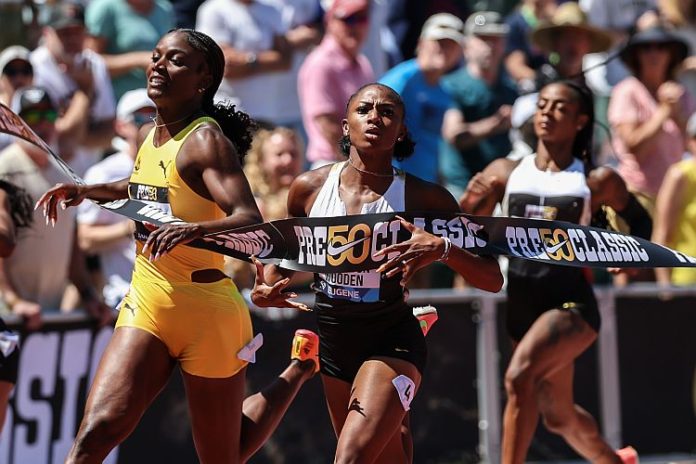
ATHLETICS: World leads from Katzberg and Wolfe at Pre Classic, and a surprise men’s 800 m win for Miller!

Another win for two-time World Indoor Champion Sandi Morris of the U.S. (Photo: Tim Healy for TrackTown USA)

The Sports Examiner: Chronicling the key competitive, economic and political forces shaping elite sport and the Olympic Movement.★

To get the daily Sports Examiner Recap by e-mail: sign up here!

≡ PRE CLASSIC ≡

The Prefontaine Classic is a two-day affair in 2026, with a tantalizing program on Friday evening in Eugene, Oregon that included two world-leading marks:

Men/Two-Mile: 8:10.13, Parker Wolfe (USA)
Men/Hammer: 83.33 m (273-4), Ethan Katzberg (CAN

The men’s two-mile was aimed at the American outdoor record of 8:07.07 by Matt Tegenkamp in 2007, and Mezgebu Sime (ETH) had the lead at 2,000 m, followed by Wolfe. Wolfe took the lead at 2,400 m and had the lead at the bell. And he stayed there, charging down the final straight to win in 8:10.13 and hold off Mohamed Abdilaahi (GER: 8:10.34) and the late-sprinting Grant Fisher in third (8:10.96). 

Olympic and World Champion Katzberg dominated the hammer, with four of his throws over 80 m and his world-leading mark in the second round. American Rudy Winkler was a solid second at 81.12 m (266-2), and Trey Knight was fifth (76.48 m/250-11).

World Indoor champ Cooper Lutkenhaus – still just 17 – was the headliner in the men’s 800 m, and he followed the pacer and had the lead with 300 m to go. But Paris Olympian Brandon Miller unleashed an all-out sprint around the final turn and zoomed past Lutkenhaus and won easily in 1:43.68. Lutkenhaus was second in 1:44.62, with 2019 World Champion Donavan Brazier coming up for third in 1:44.86, followed by American record holder Bryce Hoppel (1:45.05).

In the men’s mile, Australia’s two-time Olympian Olli Hoare took over from the pacer with 600 m to go and he took the bell. American Davis Bove took over with 200 m to go and led Stefan Nillessen (NED) on the straight, but they were passed by Liam Murphy and he and Nillessen ran together to the line. Murphy got there first, in 3:50.49, with Nillessen at 3:50.50 and Abel Teffra third in 3:51.13. Bove was fourth in 3:51.42.

NCAA champion Dejeanea Oakley (JAM) was only third into the final straight of the women’s 400 m, but came on in the final 50 m to win in 49.64. American Aaliyah Butler was strong early, but also surged on the straight to pass Stacey Ann Williams (JAM) for second, 49.97 to 50.12. Alexis Holmes of the U.S. was fourth in 50.36.

Canada’s Lucia Stafford stayed with the pacer through the first 1,000 m of the women’s 1,500 m and was all alone and had 15 m at the bell. She was 20 m up with 200 to go, but the lead vaporized around the turn. Stanford’s Juliette Whittaker took over with 75 m to go and she was passed in the final 25 m by Wilma Nielsen (SWE) in 4:05.60, to 4:05.78. Lindsey Butler of the U.S. was third (4:04.46) and Stafford faded to ninth in 4:07.14. Portland Lincoln High junior Ellery Lincoln was eighth in 4:07.06, moving to no. 4 all-time among U.S. preps.

Five women cleared 4.70 m (15-5) in the vault, and Olympic and World Champion Katie Moon cleared 4.80 m (15-9), But Gabriela Leon, Emily Grove and Hana Moll all missed and finished 3-4-5. Two-time World Indoor champ Sandi Morris passed to 4.85 m (15-11) and zoomed into the lead with a first-time clearance!

Moon missed once and passed to 4.90 m (16-0 3/4), but missed twice. So Morris was the winner, and missed all three at 4.90. Morris moves to no. 2 on the world outdoor list for 2026.

Olympic and World Champion Valarie Sion grabbed hold of the women’s discus from the start, leading off the event at 67.48 m (221-5). She improved to 68.64 m (225-2) in the second round, but 2025 Worlds silver winner Jorinde van Klinken (NED) got close at 68.21 m (223-9). That’s how it ended, with Alida van Daalen (NED: 65.02 m/213-4) in third.

The Saturday portion of the meet starts at noon with field events, and NBC joins from 1-3 p.m. Pacific time.

Receive our exclusive, weekday TSX Recap by e-mail by clicking here.
★ Sign up a friend to receive the TSX Recap by clicking here.
★ Please consider a donation here to keep this site going.

For our updated, 681-event International Sports Calendar for 2026 and beyond, by date and by sport, click here!
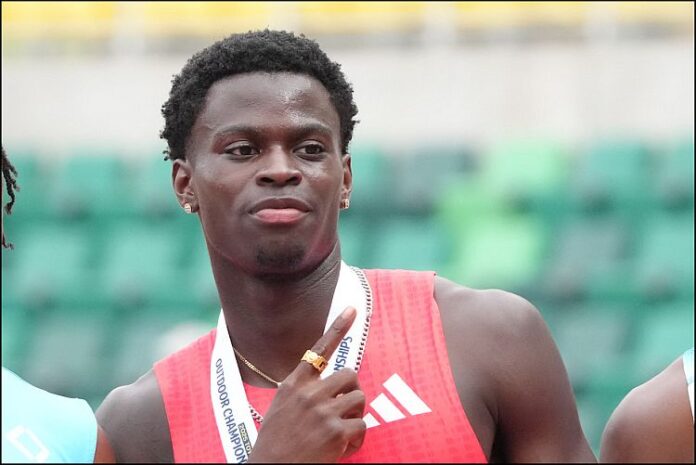
FOOTBALL: Egypt penalties Australia, Argentina survives Cape Verde in an instant classic at the FIFA World Cup

The Sports Examiner: Chronicling the key competitive, economic and political forces shaping elite sport and the Olympic Movement.★

To get the daily Sports Examiner Recap by e-mail: sign up here!

≡ FIFA WORLD CUP ≡

The final day of the round-of-32 continued with drama, with two extra-time games on Friday and an all-time classic between Cape Verde and Argentina that will long be remembered.

Looking at the final 16, despite all of the great play by smaller countries and that nine of 10 African teams made it to the round-of-32, Europe and South America are once again – as usual – responsible for most of those still playing:

2026: 7 Europe, 4 South America, 3 CONCACAF, 2 Africa, 0 Asia
2022: 8 Europe, 2 South America, 1 CONCACAF, 2 Africa, 3 Asia
2018: 10 Europe, 4 South America, 1 CONCACAF, 0 Africa, 1 Asia
2014: 6 Europe, 5 South America, 3 CONCACAF, 2 Africa, 0 Asia
2010: 6 Europe, 5 South America, 2 CONCACAF, 1 Africa, 2 Asia

Asia had Australia, Japan and South Korea in the last 16 in Qatar 2022, but all went out in the round-of-32 this time.

Egypt 1 (4), Australia 1 (2) on penalty kicks Egypt’s “Pharoahs” were on offense from the opening kick at AT&T Stadium in Arlington,

In the 13th, a free kick in the Australian zone by midfielder Emam Ashour’s shot was blocked and the rebound came to striker Omar Marmoush, who pushed it to the right side to defender Karim Hafez. He saw Ashour near the back post and floated a cross from right to left and Ashour came off the picket line to meet it and headed it in for the 1-0 lead.

That score held through the hydration break, with Egypt at 64% of possession, but Australia had four shots to three for the Pharoahs. After the break, the Socceroos were pressing more and created some chances, but there were no more goals in the half. Egypt had 56% of the ball, but the Aussies ended the half with a 5-3 shots advantage.

The second half started with a near-miss for Egypt’s Marmoush, with a drive in the box going just wide. But Australia got even on a free kick in the 55th, also starting with a free kick on the left side, with midfielder Aiden O’Neill sending a looping kick into the box – right in front of goal – and among all the bodies, the ball actually bounced off the head of Egypt defender Mohamed Hany and into the net for the 1-1 tie.

The defenses were tightening and at the second hydro break, Egyptian possession steady at 56% and Australia had a 7-4 shots edge, meaning only three shots were taken in the “third period.” The game continued to be end-to-end, but both defenses were packed in, blocking shots and crosses.

Egypt had the ball for much of the five-minute stoppage time and at 90+4, a header by defender Ramy Rabia was online but was saved by the left hand of Australia keeper Patrick Beach, pushing the ball over the bar. No goals, so on to extra time. Egypt ended regulation at 56% possession and Australia had 12 shots to 10.

The first extra period settled nothing, with two shots for Egypt and none for Australia as the defenses were tight. Egypt was on offense to start the second extra period, with striker Mo Salah especially busy, but Beach and the Aussie defenders were equal. Beach was actually substituted out in the 119th minute for Matthew Ryan, ostensibly thinking of the coming penalty kicks.

Egypt ended play with 58% of the ball and the Socceroos had a 16-14 shots lead in this defensive struggle. On to penalties, with Australian midfielder Harry Soutter missing the first shot over the top and defender Lucas Herrington hitting the crossbar on the fourth and Egypt making four straight for the 4-2 decision. It’s Egypt’s first-ever World Cup elimination round win.

Argentina 3, Cape Verde 2 (extra time) Warm conditions in Miami Gardens at Hard Rock Stadium, with 86 F and 70% humidity at kickoff, but with some cloud cover. Argentina has the most chances early, as expected, but no scoring through the hydration break. The defending champs had 64% of the ball and a 2-1 edge on shots.

But right after the re-start, superstar Lionel Messi snuck behind the defense and took a cross over the top from defender Lisandro Martinez, touched it down in the 29th at the right of goal and scored with his left foot, his record 20th career World Cup goal. 1-0.

Argentina got another good look in the 45th with midfielder Enzo Fernandez sending a blast from the top of the box to the far right corner, but it was saved by Cape Verde keeper Vozinha. But the half ended 1-0 with Argentina at 64% possession and 4-1 on shots.

The Argentines looked completely in control – 63% possession and 3-1 on shots actually on goal – but Cape Verde had the ball on the right side of goal, with striker Ryan Mendes dribbling to the right and sending the bell to midfielder Deroy Duarte close to the right post and he turned and right-footed the ball into the net for the stunning 1-1 tie in the 59th!

In reply, Argentina upped the pressure right away and Messi got free on a pass into the slot by forward Lautaro Martinez, and was one-on-one in front of goal, but his shot was saved in the 63rd by Vozinha. Then Messi quick-took a free kick from just beyond the box in the 72nd and sent a liner that was punched away by the alert Vozinha.

The hydration break came in the 73rd, with a 1-1 tie, and Argentina with 66% possession now and 9-5 on shots. Awake, but tied.

Argentina kept pressing, and Cape Verde defender Pico Lopes made a foot save in the 81st on a shot that got past Vozinha. Messi got a free kick at 90+4 just above the box, and blasted it, but Vozinha saved it, his seventh of the game. At the end of regulation: Argentina had 68% of the ball and 15-6 on shots.

Argentina took over immediately in extra time, with Lisandro Martinez scoring from the right side at the top of the net after a clearance on a corner from the other side, in the 93rd. 2-1.

But not over. Defender Sidny Lopes Cabral was open on the left side and sent a right-footed liner to the far corner of the Argentina goal for the 2-2 tie in the 103rd, and Lopes Cabral ran into the stands to embrace his family! Argentina had 64% possession after the first period, with shots at 21-9.

Argentina took the lead again in the 111th, off a Messi corner that curled in and was headed by defender Cristian Romero at the back post, off the hand of Cape Verde defender Diney Borges (ruled an own goal). But Cape Verde came back again, with Lopes Cabral taking a free kick in the 116th that was barely saved by Argentina keeper Emiliano Martinez.

Argentina survived, 3-2, in an instant classic. The champs had 64% of the ball and ended 22-16 on shots. Vozinha, in a game for the ages, had eight saves. 

Colombia 1, Ghana 0 ● In Kansas City; Colombia was looking to score quickly in warm, sticky conditions with 85 F temps and 67% humidity at the start. And they did, taking the lead in the 14th, with striker Luis Suarez sending a seeing-eye pass from the right endline to midfielder Jhon Arias in front of goal and volleyed it into the far right corner of the net.

Colombia dominated, with 79% possession at the hydro break and 3-1 on shots. Ghana’s offense came alive in the “second period,” but without a goal to show for it. Ghana keeper Lawrence Ati Zigi made a fabulous one-handed save at 45+1 on a header by Colombia defender Johan Mojica to keep it at 1-0. The half came quickly after, with Colombia at 67% possession, but Ghana with six shots to five.

Ghana had a great chance in the 53rd, when forward Antoine Semenyo crossed the ball right across the Colombia goal from nearly the endline, but there was no one to touch it in. Then Colombia appeared to make it 2-0 in the 56th on striker Luis Diaz’s volley into the net from an Arias cross to the front of goal, but it was called offsides.

The game as more end-to-end, and the hydro break was called in the 69th, with Colombia at 63% possession and 9-6 on shots (and 4-1 in the “third quarter”). Ghana just could not get organized around the Colombian goal. But the Colombians kept attacking the goal, but could not find the net, or were stopped by Zigi, who finished with seven saves.

At the end, Colombia controlled possession and it ended 1-0, with Colombia holding 61% of the ball and 20 shots to eight (and a third straight shutout).

≡ PANORAMA ≡

The round of 32 is done. The round-of-16 runs from 4 to 7 July:

Saturday, 4 July:
● Canada vs. Morocco: In Houston (1 p.m. Eastern)
● Paraguay vs. France: In Philadelphia (5 p.m. Eastern)

Sunday, 5 July:
● Brazil vs. Norway: In East Rutherford (4 p.m. Eastern)
● Mexico vs. England: In Mexico City (7 p.m. Eastern)

Monday, 6 July:
● Portugal vs. Spain: In Arlington (3 p.m. Eastern)
● U.S. vs. Belgium: In Seattle (8 p.m. Eastern)

Tuesday, 7 July:
● Argentina vs. Egypt: In Atlanta (12 p.m. Eastern)
● Switzerland vs. Colombia: In Vancouver (4 p.m. Eastern)

After 27 straight days of matches, 8 July will be a football-free days in preparation for the quarterfinals on 9-10-11 July.

A report from Octagon Media Rights Consulting showed that 97-98% of all U.S. English-language viewers on Fox stayed with the World Cup broadcasts during the hydration breaks. Although bitterly criticized by purists, what turned out to be commercial breaks were treated like commercials during other sporting events.

Halftime viewing saw a 14% decrease, noted to be similar to the experience with NFL games.

The FIFA Social Media Protection Service, which uses artificial intelligence to scan social-media channels for abusive messages, checked more than six million posts during the group stage and identified 225,000 referred to platform operators for manual review.

The subsequent inquiries resulted in about 89,000 messages being deleted – about 1.5% – and FIFA’s announcement noted that “1,000 accounts have been identified for further investigation, while 181,000 hateful comments have been hidden as part of moderation effort.”

Analysis of the abusive comments showed the leading category was racial abuse, at about 11%.

The specific platforms reviewed were not specified.

Receive our exclusive, weekday TSX Recap by e-mail by clicking here.
★ Sign up a friend to receive the TSX Recap by clicking here.
★ Please consider a donation here to keep this site going.

For our updated, 681-event International Sports Calendar for 2026 and beyond, by date and by sport, click here!
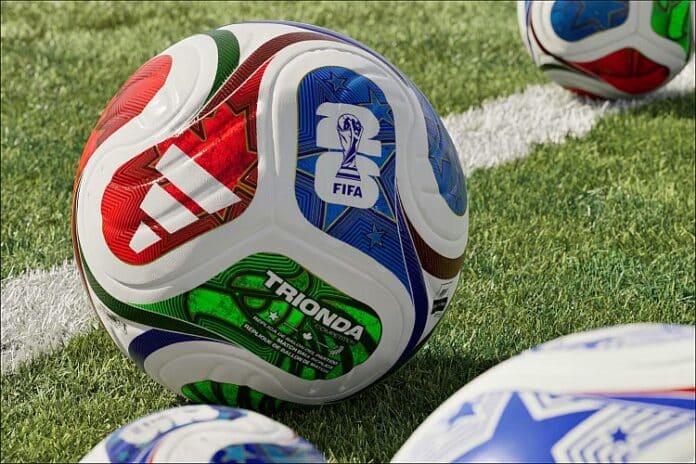
PANORAMA: Russian canoe team exits Junior Worlds due to Canada visa issues; Pre Classic starts Friday; 113th Tour de France starts Saturday

American sprint star Melissa Jefferson-Wooden winning the 2025 Pre Classic women's 100 m (Photo: Diamond League AG).

The Sports Examiner: Chronicling the key competitive, economic and political forces shaping elite sport and the Olympic Movement.★

To get the daily Sports Examiner Recap by e-mail: sign up here!

≡ THE 5-RING CIRCUS ≡

● Olympic Winter Games 2030: French Alps ● The speed skating events will be held at the iconic, 12,500-seat Thialf arena in Heerenveen (NED), but FrancsJeux.com reported that there are costs attendant to the honor:

“The central government will contribute €30 million. The province of Friesland will provide €5 million and the municipality of Heerenveen €2.5 million, for a total public commitment of €37.5 million. This amount will cover, in particular, the Olympic Village (the exact location of which is yet to be determined) , security, transportation, and infrastructure for spectators and the media.” (€1 = $1.14 U.S.)

● Association of National Olympic Committees ● ANOC has opened nominations for President for the term of 2026-30:

“As per the ANOC Constitution, for nominations to be eligible they must be submitted to ANOC by an NOC and endorsed by at least one other NOC by no later than 9 September 2026. ANOC will then send the final names of the nominees for the presidency to the NOCs by no later than 9 October 2026.”

The election for this potentially powerful position will take place at the ANOC General Assembly on 7-8 December 2026 in Hong Kong. Dr. Robin Mitchell (FIJ) has been on charge since 2018, first in an acting capacity for the deposed Kuwait’s Sheikh Al-Fahad Al-Sabah and then elected for a full term from 2022-26.

● Russia ● A Russian team of junior athletes will not compete at the International Canoe Federation World Junior and U23 Championships in Halifax (CAN). The Russian Canoe Federation told the Russian news agency TASS:

“Russian athletes are forced to miss the Junior and Youth World Championships in Canada.

“Canadians have only issued visas to underage athletes, who, given the current difficult situation, cannot be allowed to compete without adult supervision. Coaches and athletes on the youth team are still waiting for visas, even though the World Championships have already begun.”

● Archery ● Doping in archery? Yes, as Mexican Compound archer Mariana Bernal, a member of Mexico’s 2025 World Championships women’s Team Event gold medalists, was banned for three years by the International Testing Agency after testing positive in October 2025 for the steroid nandrolone.

She did not challenge the positive and earned a one-year reduction from the normal four-year sanction.

● Athletics ● The only Diamond League meet in the U.S. this season – and in most seasons – comes to Hayward Field in Eugene on Friday (3rd) and Saturday (4th) for the Prefontaine Classic.

The Friday night program will be shown on NBCSN and Peacock at 11:30 p.m. Eastern (8:30 p.m. local), including the women’s discus with Olympic and World Champion Valarie Sion, women’s vault with Olympic champ Katie Moon, twice World Indoor winner Sandi Morris and NCAA champions Hana and Amanda Moll.

The men’s 800 m has new American star Cooper Lutkenhaus, the World Indoor champ and the women’s 400 m has NCAA winner and world no. 2 Dejanea Oakley (JAM). The men’s two-mile is aiming at Matt Tegenkamp‘s 2007 American Record of 8:07.07, with stars Grant Fisher and Parker Wolfe the likely contenders.

Saturday has many highlights-in the making, starting with World Champions Melissa Jefferson-Wooden, Sha’Carri Richardson and Shericka Jackson (JAM) in the women’s 100 m, World Champions Collen Kebinatshipi (BOT) and Michael Norman, Olympic champ Quincy Hall and Olympic 400 m hurdles champ Rai Benjamin in the men’s 400 m, World Champion Cordell Tinch, new world-record holder Ja’Kobe Tharp and rising star Jamal Britt in the 110 m hurdles, world-record holder Tobi Amusan (NGR) and Olympic champ Masai Russell in the 100 m hurdles and Kenyan superstar Faith Kipyegon in the women’s mile, and a lot more.

The Saturday Diamond League slate will be shown on NBCSN and Peacock from 4-5 p.m. Eastern and then on NBC and Peacock beginning at 5 p.m.

● Cycling ● The annual highlight of the world cycling calendar – the Tour de France – starts on Saturday in Barcelona (ESP) for the first of 21 stages. The first three stages will start in Spain before crossing over to France at the end of Monday’s route. Of the 21 stages:

● 1 Team Time Trial (stage 1)
● 1 Individual Time Trial (stage 16)
● 7 Flat stages
● 4 Hilly stages
● 8 Mountain stages

The overwhelming favorites are the winners of the last six Tours: Slovenia’s Tadej Pogacar (2020-21, 2024-25) and Denmark’s Jonas Vingegaard (2022-23). Belgium’s Olympic winner Remco Evenepoel, rising star Paul Seixas (FRA) and Mexico’s Isaac Del Toro are likely contenders if the favorites fail.

Pogacar can become the fifth to win the Tour five times, last done by Miguel Indurain (ESP) in 1995.

● Tennis ● The Women’s Tennis Association Finals was due to be held in Riyadh (KSA) for a third straight year in 2026, but on Wednesday, a joint statement explained:

“Following two impactful years of the WTA Finals in Riyadh, the WTA requested to move the 2026 WTA Finals to a new host location. The Saudi Tennis Federation accepted WTA’s proposal, and the two organizations mutually agreed on the conclusion of the hosting arrangement and remain proud of the achievements realized through their partnership.”

On Thursday, the WTA said the event will be held at the famed Indian Wells Tennis Garden from 8-15 November.

Receive our exclusive, weekday TSX Recap by e-mail by clicking here.
★ Sign up a friend to receive the TSX Recap by clicking here.
★ Please consider a donation here to keep this site going.

For our updated, 681-event International Sports Calendar for 2026 and beyond, by date and by sport, click here!
FOOTBALL: Spain, Swiss roll, Portugal overcomes Croatia in gripping finish at FIFA World Cup; new poll says about half of U.S. is interested

The Sports Examiner: Chronicling the key competitive, economic and political forces shaping elite sport and the Olympic Movement.★

To get the daily Sports Examiner Recap by e-mail: sign up here!

≡ FIFA WORLD CUP ≡

The penultimate day of round-of-32 matches saw Spain completely outclass Austria, but the Portugal-Croatia match had a non-stop second half for the ages.

Spain 3, Austria 0 Spain is one of the tournament favorites and showed their prowess at SoFi Stadium in Inglewood, taking 10 shots in the first half to just two for offensively-cautious Austria and getting a goal in the 36th minute for a 1-0 lead.

Spain got a shot-on-goal in the first minute from star striker Lamine Yamal in the first minute, that was saved, and by the hydration break, the Spanish had three shots to none for Austria. Spanish defender Marc Cucurella scored in the 29th, but the goal was wiped off for a foul.

But Spain did go up 1-0 in the 36th, as a charge up the middle of the field by midfielder Pedri led to a pass to Cucurella on the left, and his cross to striker Mikel Oyarzabal left-footed the finish in the net. It was almost 2-0 at 45+2 as midfielder Alex Baena’s free kick hit the crossbar from 25 yards out and the half ended 1-0.

The second half was more of the same, but Austria had a look at the game in the 61st, as a header from sub forward Sasa Kalajzdic went over the crossbar. But five minutes later, a pass from the left endline by Baena flew into the box and was scored on a header by the onrushing defender Pedro Porro for the 2-0 edge.

That was going to be enough, but Spain scored one more in the 89th, as Oyarzabal took a left-side cross from Cucurella in the box and finished into the right-side corner of the Austrian net for the 3-0 final.

European champs Spain ended with 64% possession and a 23 shots to five, and even more 10 shots on the Austrian goal vs. none for Austrian on the Spanish goal. Decisive in every way.

Portugal 2, Croatia 1 Both sides had chances in the first five minutes on a hot day (88 F, 58% humidity) in Toronto, especially from midfielder Bruno Fernandes for Portugal in the 4th, but no score.

Portugal had more possession and made some threats, but none found the net, including a header by defender Renato Veiga in the 13th, off a corner that was on line, but ended up over the net. At the hydro break, Portugal had 64% possession and an 8-3 edge on shots, but no score.

The “second period” was more of the same. Portugal had the ball, threatened over and over again and did not score. The Croatian attack was most on the counter and Portugal ended the half at 69% of the ball and 9-3 on shots; each had one shot on goal.

Portugal was still holding most of the possession in the 54th, then a Croatian cross from defender Josip Stanisic from the right side went past a header try in the middle of the box by striker Igor Matanovic and fell to forward Ivan Perisic, who gained possession, settled down and then sent a left-footed laser to the far right side of the Portugal goal for a 1-0 lead.

Croatia scored again in the 56th via midfielder Nikola Vlasic on a rush to the goal to meet a cross from the right, but it was called offside. Portugal almost tied in the 58th on a tremendous strike from forward Rafael Leao, but it slammed off the crossbar!

Portugal star forward Cristiano Ronaldo appeared to tie it in the 60th on a long pass into the box than he brought down, controlled and ripped into the net, but called offsides, barely. Off a corner in the 65th, Veiga was pulled down in the box by Croatia’s Vlasic and a penalty was given. Ronaldo lined up, stutter-stepped and scored on the penalty for the 1-1 tie in the 68th. Of course, the hydro break followed, with Portugal at 65% possession and 11-7 on shots, but now even.

Portugal keeper Diogo Costa had to make saves in the 72nd and 74th and 77th minutes to keep Croatia from scoring, then midfielder Petar Sucic scored in the 80th, but was called offside.

Portugal finally got some possession and at 90+4, a left right-side cross into the box, in front of goal by Leao was somehow found between three Croatian defenders by forward Goncalo Ramos, who headed it into the goal for 2-1 with about eight minutes of play still left.

In desperation time at 90+12, a Croatian cross by Perisic from the left side flew into the goal area for a contested header with Matanovic and Veiga on the ball, which rolled left, was popped forward by Mario Pasalic in front of the goal, and ended up in the net, touched by either Portugal midfielder Ruben Neves or Croatian defender Josko Gvardiol for a 2-2 tie!

But a review showed that because Matanovic touched the ball – there is a chip in it that registers touches – Pasalic was clearly offsides on the play. No goal and Portugal held on to win, 2-1.

Portugal finished with 60% possession and 15 shots to 13 with astounding drama throughout the second half.

Switzerland 2, Algeria 0 ● From the kick-off in Vancouver, Algeria was on the move, dominating play in the first 10 minutes, looking for shots and controlling play in the Swiss zone.

But a break-out in the 10th saw Swiss midfielder Johan Manzambi running with the ball through the left side of the Algerian zone, all the way to the endline! As he got close to goal, Algerian keeper Luca Zidane came out and the ball was crossed to an oncoming striker Breel Embolo, who finished easily for the 1-0 lead!

The hydro break came with 60% Algerian possession, but shots were 3-3. Algeria continued to run at the Swiss defense in the “second period,” but could not score. Shots went wide, especially from crosses into the box, and the half ended 1-0. Algeria had 59% possession and a 5-4 shots edge, but trailed.

The Swiss came out on fire in the second half, taking possession in the Algerian zone off a bad clearance, and a cross was deflected to striker Dan Ndoye at the top of the box. He had space and sent a hard shot to the left side of the Algerian goal for a 2-0 lead in the first minute of the half!

An immediate Algerian answer with a cross and a shot from striker Riyad Mahrez was blocked. But the Swiss fast breaks looked much more promising and the Swiss speed was a real problem. The hydro break came with Algeria at 56% of the ball, with shot at 6-6, but goals at 2-0.

Algeria could not solve the Swiss defense and the game got increasingly physical. A Swiss cross in the 81st from the right endline to the front of goal from midfielder Denis Zakaria set up Embolo for a score, but he and Zidane both missed it, and the ball rolled to midfielder Fabian Rieder and he missed what seemed a sure score, with Zidane making the stop.

It ended 2-0, with 56% possession buying Algeria nothing but frustration; the Swiss had an 11-8 shots edge. In the end, it wasn’t close.

≡ PANORAMA ≡

The round-of-32 matches will continue through Friday:

Friday, 3 July:
● Australia vs. Egypt ● In Arlington (2 p.m. Eastern)
● Argentina vs. Cape Verde ● In Miami Gardens (6 p.m. Eastern)
● Colombia vs. Ghana ● In Kansas City (9:30 p.m. Eastern)

The round-of-16 runs from 4 to 7 July:

Saturday, 4 July:
● Canada vs. Morocco: In Houston (1 p.m. Eastern)
● Paraguay vs. France: In Philadelphia (5 p.m. Eastern)

Sunday, 5 July:
● Brazil vs. Norway: In East Rutherford (4 p.m. Eastern)
● Mexico vs. England: In Mexico City (8 p.m. Eastern)

Monday, 6 July:
● Portugal vs. Spain: In Arlington (3 p.m. Eastern)
● U.S. vs. Belgium: In Seattle (5 p.m. Eastern)

Tuesday, 7 July:
● Argentina or Cape Verde vs. Australia or Egypt: In Atlanta (12 p.m. Eastern)
● Switzerland vs. Colombia or Ghana: In Vancouver (4 p.m. Eastern)

A proposed class-action suit against the ticket resales platform StubHub was filed on Tuesday (30th) in Federal court in New York for $5 million or more in damages related to the non-delivery of tickets purchased there. Per the complaint:

“[Fans] were lied to and purchased World Cup tickets for large sums of money — only to incur tremendous financial losses. This is a new low for a sports ticketing industry that has been rampant with consumer protection issues time and time again to the detriment of the fans who make sports special.”

Even where StubHub has refunded the ticket cost, buyers who made travel plans based on the availability of their purchases were out those costs.

The complaint seeks damages “thousands of people” in the U.S. who did not receive tickets, alleging issues related to consumer protection law and false advertising.

An interesting poll by research firm Ipsos from 26-28 June, following the last U.S. group-stage match, which showed that only 38% of Americans were excited to follow the World Cup going forward. An impressive 83% of Americans had heard of the tournament, but as for the remaining games, 17% were really excited, 21% were somewhat excited; 24% not too excited and 37% not at all excited. Giving credit to those who were not too excited, maybe half the country will pay attention.

As to how people have and will follow the tournament: 42% have or will watch broadcast or streaming television, 18% said they will look at clips afterwards and 55% said they have no plan to watch at all.

Respondents said they keep up with the tournament on social media (40%) and 27% are watching from a bar or restaurant and 19% have or plan to go to a watch party. Ipsos noted:

“The poll, which was conducted before the U.S. match against Bosnia-Herzegovina in the first knockout stage of the World Cup, also found that 46% of Americans and 82% of World Cup viewers are at least somewhat excited about the U.S. men’s national team advancing to the knockout round.

“More broadly, America’s overall excitement about the World Cup has grown compared to before the tournament started, with excitement rising from 25% in May to 38% in July. In addition, half (49%) of World Cup viewers say the tournament has increased their personal interest in soccer (48% no impact, 3% decrease).”

As far as the tournament itself so far, 53% said it was going “somewhat well” so far, with 37% unsure and 9% negative. As for FIFA, only 19% of respondents had a positive view, 25% were unfavorable and 55% did not know.

Receive our exclusive, weekday TSX Recap by e-mail by clicking here.
★ Sign up a friend to receive the TSX Recap by clicking here.
★ Please consider a donation here to keep this site going.

For our updated, 681-event International Sports Calendar for 2026 and beyond, by date and by sport, click here!
PANORAMA: Third €20 mil sponsor for Swiss 2038 Winter Games bid; Russia leaves Trampoline World Cup as no flag allowed; Tharp turns pro

U.S. hurdles star and new world-record holder Ja’Kobe Tharp (Photo: USA Track & Field).

The Sports Examiner: Chronicling the key competitive, economic and political forces shaping elite sport and the Olympic Movement.★

To get the daily Sports Examiner Recap by e-mail: sign up here!

≡ THE 5-RING CIRCUS ≡

● Olympic Winter Games 2030: French Alps ● With the events originally planned for Nice now moved to Lyon, the question of the financial balance between the regions of Auvergne-Rhône-Alpes region (Lyon) vs. Provence-Alpes-Cote d’Azur (Nice) has been raised. But Renaud Muselier, the President of the Regional Council of Provence-Alpes-Côte d’Azur – now with just one venue cluster – told Le Dauphine:

“We were all caught off guard by this affair, but we’ll find a solution. It’s not because of the Auvergne-Rhône-Alpes region that they were able to get the ice rink back; it’s because of a far-right mayor in the south [Lyon’s Eric Ciotti] who didn’t want the Games.

“Right now, I don’t know. … Everything is complicated. We contributed to the budget of the Organizing Committee for the 2024 Olympic and Paralympic Games and to SOLIDEO; they’re not the same thing. The same goes for the financial guarantees.”

The head of the Auvergne-Rhône-Alpes region, Fabrice Pannekoucke, said: “We have defined financial agreements and commitments regarding the financial cost, which, in my opinion, must remain in place . Because if we find ourselves in a changing situation today, it’s not the north that went looking for something.”

● Olympic Winter Games 2038: Switzerland ● Swiss corporations are starting to line up behind the 2038 Winter Games bid, which is in “Privileged Dialogue” with the International Olympic Committee to work out the details of an acceptable bid by the end of 2027.

Sportswear company On was the first to jump in, and within the past week, telecommunications company Sunrise has joined as a “flag bearer” as has automation company ABB. Per the ABB announcement:

“The company has committed to provide CHF 20 million to the delivery guarantee undertaken by private companies. The guarantee would be called upon if a deficit were to arise after the 2038 Olympic and Paralympic Games take place.” (CHF 1 = $1.24 U.S.)

● International Olympic Committee ● The Associated Press reported that the IOC will not consider separate National Olympic Committee status for Greenland and the Faroe Islands, after a request from the Danish Parliament.

The IOC pointed to its requirement since 1996 of “an independent state recognized by the international community.” Greenland and the Faroe Islands are semi-autonomous parts of Denmark.

The IOC statement added, “This position has been explained and communicated very clearly to the concerned parties on numerous occasions over the past years.”

● Russia ● For the second week in a row, a European gymnastics World Cup host has refused to allow the Russian flag to be flown, this time at a Trampoline World Cup in Coimbra (POR). Alexey Ryzhkov, head coach of the Russian trampoline team, told the Russian news agency TASS:

“We were preparing for the World Cup in Portugal. But the competition organizers informed us that, due to the Portuguese authorities’ position, they would not be able to ensure the Russian team’s participation with national symbols.

“We were offered the option of competing only as neutral athletes. Given that the decision of the international gymnastics federation [World Gymnastics] is not being implemented, the team withdrew from the tournament.”

A Russian team withdrew from a World Gymnastics Rhythmic World Challenge Cup event in Cluj-Napoca (ROU) last week when the mayor – a former Romanian Prime Minister – refused to allow the Russian flag to be shown in the arena.

TASS reported that Russian rowers were denied entry visas into Poland to compete at the ICF World Junior and U23 Slalom Championships in Krakow.

● Archery ● American archers dominated the Pan American Championships held in Tlaxcala (MEX) last weekend, taking 16 medals in all (8-4-4).

U.S. individual victories came from Jennifer Mucino-Fernandez in the women’s Recurve class, Gauis Carter in men’s Compound, Alexis Ruiz in women’s Compound, and Ava Jones in women’s Barebow.

American teams won the men’s Recurve, women’s Recurve, men’s Compound and Mixed Compound team titles.

Brazilian three-time Worlds medal winner Marcus D’Almeida won the men’s Recurve title, his second career Pan Am title, also in 2022.

● Athletics ● Fast, wind-aided men’s 100 m at the World Athletics Continental Tour Silver Raiffeisen Austrian Open in Eisenstadt, with Tokyo 2020 gold medalist Lamont Marcell Jacobs (ITA) riding a big 4.1 m/s wind to a 9.67w victory, the third-fastest time under all conditions!

Britain’s Romell Glave was second (9.76w) and 400 m world-record man Wayde van Niekerk (RSA: 9.83) was third.

Auburn’s Ja’Kobe Tharp, who set the 110 m hurdles world record of 12.75 at the NCAA Championships, announced on Instagram that will skip his final year and turn professional. His post included:

“I’ve only ever wanted to show the world who I am. If you know me personally, you know this was only a matter of time. I said I was going to do it. I worked for it. And now we’re here. Imma keep chopping heads ’til my sword breaks.

“Now it’s time for the next chapter.

“I’m beyond grateful to announce that I’m officially taking the next step and pursuing my professional track & field career with adidas.

“Thank you to everyone who believed in me, even when the results didn’t show what was coming. And to anyone chasing a dream: don’t run from adversity. Let it shape you. One day you’ll realize the hardest seasons were preparing you for the life you prayed for.

“This is only the beginning.”

Receive our exclusive, weekday TSX Recap by e-mail by clicking here.
★ Sign up a friend to receive the TSX Recap by clicking here.
★ Please consider a donation here to keep this site going.

For our updated, 681-event International Sports Calendar for 2026 and beyond, by date and by sport, click here!
FOOTBALL: Europe comes back, as Kane saves England and Lukaku, Tielemans save Belgium, U.S. wins at FIFA World Cup

The 2026 FIFA World Cup “Trionda” ball by adidas (Photo: adidas).

The Sports Examiner: Chronicling the key competitive, economic and political forces shaping elite sport and the Olympic Movement.★

To get the daily Sports Examiner Recap by e-mail: sign up here!

≡ FIFA WORLD CUP ≡

The round-of-32 matches continued with intense drama; going into Wednesday, five of the seven elimination matches had been decided by one goal or on penalties. That trend continued:

England 2, Dem. Rep. Congo 1 This match in Atlanta went into shock almost immediately, as D.R. Congo striker Brian Cipenga scored on a seeing-eye shot in the seventh minute. He took a cross from right to left from defender Cancel Mbemba, almost to the back post and he punched it past England keeper Jordan Pickford.

England could not solve the energetic D.R. Congo defense and even with 54% possession at the break, the Leopards had the only shot in the game. But the English pressure continued to build. Midfielder Jude Bellingham’s header in the 30th was saved by DRC keeper Lionel Mpasi. A try from forward Marcus Rashford was deflected away in the 37th.

It was almost 2-0 in the 42nd, as defender Aron Wan-Bissaka sent a looping pass from right to left for DRC striker Yoanne Wissa, who hit the post with his shot. Almost immediately after, England striker Harry Kane went down in the box in a collision with Mpasi, but no foul was called. Finally, another Bellingham blast at 45+2 was saved with an Mpasi body block as the half ended. England had 59% possession and was 8-3 on shot and was down 1-0.

The second half saw even more pressure from the English, but still no goals through the hydro break, despite 60% possession and 10-5 on shots; the Leopards were mostly on the counterattack now.

England brought on three subs by the 70th, and forward Anthony Gordon helped right away, as Kane finally scored for the 1-1 tie in the 75th on a header in the center of the box from Gordon’s left-side cross.

Both sides were looking for the winner now, and off a Leopards attack, England got a fast break going in the 86th. A Bellingham shot was saved and came back out to Gordon, who passed to his right to Kane at the top of the box. Kane did the rest, rolling right and slamming the ball into the top of the net for the 2-1 lead, his fifth goal of the tournament.

England held on and won, with 60% possession and 16-7 on shots. And they had Kane. Their “reward” is to go to the Azteca and face Mexico.

Belgium 3, Senegal 2 (extra time) Which Belgian team would show up in Seattle, after a 1-0-2 group performance? Senegal (1-2) was on the hunt right away and had possession, with a close miss in the 13th as a cross was tipped by Belgian keeper Thibaut Cortois and a follow-up by striker Ismaila Sarr hit the right post!

And Senegal kept the pressure on and took a 1-0 lead in the 25th off a cross from striker Sadio Mane that turned into a header from Sarr that hit the post, but came back to midfielder Habib Diarra, who tapped in it. That led to the hydro break, with Senegal at 65% possession and 5-2 on shots, followed by three fans running onto the field, who had to be removed.

Belgium did better after the break, but could not break down the Senegal defense and the half ended 1-0. Possession was now even with Senegal at 7-5 on shots.

And Senegal kept pressing in the second half and got to 2-0 in the 51st, with a long pass by defender Moussa Niakhate to Sarr running beyond the defense, bringing it down and then smashing the ball into the net. At the hydro break, Belgian possession was up to 55%, but with Senegal still up, 11-9, on shots.

Belgium kept looking for an opening and finally found one in the 86th, as a cross from the right endline by defender Thomas Meunier found striker Romelu Lukaku in front and he sent a right-footed flick over the keeper and into the top of the Senegal net for 2-1.

Belgium kept pressing and stunningly, in the 89th, found the equalizer on a wild scramble in front of the Senegal goal, with a cross by striker Leandro Trossard from the left side – above the box – to the front of goal that was headed by midfielder Youri Tielemans into the goal as keeper Mory Diaw missed a punch. Wow: 2-2.

All that desperation flipped the 90-minute statistics, as Belgium finished regulation with 53% possession and a 16-13 shots edge. Belgium offered the most pressure during the first extra period, but no scoring. Belgium remained at 53% possession and 18-13 on shots.

In the second period, Senegal forward Ibrahim Mbaye missed a shot at the far side of the Belgium net in the 108th. In the 118th, Belgium forward Dodi Lukebacio had a golden opportunity on a deflected cross from the left side from forward Diego Moreira, but he hammered it off the crossbar. On a video review, a foul on Tielemans in front of goal by Senegal defender Lamine Camara in front of the goal was determined to be a penalty.

Tielemans took the penalty at 120+5 and scored, and was immediately dogpiled in the corner of the field, for the 3-2 lead. At 120+11, Senegal took a free kick from just above the box, but midfielder Pape Matar Sarr’s kick was over the bar. Over; Belgium ended with 52% of the ball and shots were 19-19. Incredible.

U.S. 2, Bosnia & Herzegovina 0 The U.S. was playing in front of a home crowd in Santa Clara and controlled possession from the start. But the best early goal chance was a corner from B&H in the 11th that looked like it was curling into the net (!), but was punched away from U.S. keeper Matt Freese.

By the hydro break, the U.S. had 78% possession and was 2-1 on shots. American striker Folarin Balogun was busy, getting tripped by defender Amar Dedic in the box in the 29th, but nothing was called (including after a video review) and Balogun scored in the 31st on a left-footed blast from the middle of the box off a Weston McKennie feed, but it was waived off for offsides.

A loose ball in the 45th turned into a goal, as a loose ball in the midfield ended up at the feet of midfielder Tyler Adams, who passed to midfielder Malik Tillman. He turned and sent a through-ball into the box for Balogun, which he collected after a deflection by a defender, turned and then popped between two defenders and popped the ball into the net for a 1-0 lead.

A flurry of American activity in stoppage time ended with Balogun popping another shot toward the net, but it hit the crossbar and dropped over at 45+7. Close, but the U.S. ended the half at 62% possession and 5-1 on shots.

The U.S. started with energy in the second half, but play was physical and ragged. On a play for the ball in the 63rd in the U.S. zone, Balogun stepped on the right foot of Bosnian defender Tarik Muharemovic and was called for a red card, bringing the U.S. down to 10 men. The hydro break came in the 69th, with 55% of the ball for the U.S., but just 5-4 on shots (0-3 in the half).

B&H took possession, but the U.S. was aggressive with some time in the Bosnian zone, and picking up with a high line instead of sitting back. Pulisic actually scored on a loose ball in the 69th, off a shot from Tillman, but the play was called offsides.

Then after a foul gave the U.S. a free kick just above the box, Tillman sent a spectacular curling shot into the goal in the 82nd for the 2-0 lead as the crowd erupted.

The U.S. was now more packed in in front of its goal on defense, and it was a bit chaotic, and there was 10 minutes of stoppage time declared. But the American attacked actually produced a shot by defender Alex Freeman after 90+4, but two follow-up shots by midfielder Amar Memic from distance went just wide of Freese.

It ended 2-0, with the U.S. at 48% possession thanks to the red card, and B&H had a 10-8 shots edge. Next is Belgium in Seattle on Monday.

All three host country teams won their round-of-32 games!

≡ PANORAMA ≡

The round-of-32 matches will continue through Friday:

Thursday, 2 July:
● Spain vs. Austria ● In Inglewood (3 p.m. Eastern)
● Portugal vs. Croatia ● In Toronto (7 p.m. Eastern)
● Switzerland vs. Algeria ● In Vancouver (11 p.m. Eastern)

Friday, 3 July:
● Australia vs. Egypt ● In Arlington (2 p.m. Eastern)
● Argentina vs. Cape Verde ● In Miami Gardens (6 p.m. Eastern)
● Colombia vs. Ghana ● In Kansas City (9:30 p.m. Eastern)

Fascinating ratings data for U.S. viewership of the World Cup, with Fox’s English-language coverage averaging 5.05 million, including the pre-match coverage, and Telemundo averaging 4.6 million (with Peacock) in Spanish.

That’s way up from the 4.71 million for Fox and Telemundo (+ Peacock) combined for the Qatar 2022 tournament.

The U.S. team drove the Fox ratings, with average audiences of 18.04, 16.22 and 17.02 million viewers (17.09 million average) for their three matches; Telemundo’s U.S. coverage average was 7.1 million per match for a 24.12 million combined average!

Mexico’s matches on Telemundo and Peacock averaged 12.1 million each.

The World Cup English-language average of 5.05 million compares with the 2026 NBA Playoffs which averaged 6.35 million across ESPN-ABC, NBCUniversal and Amazon Prime Video. Close behind was the 2025 MLB post-season, which averaged 6.33 million viewers on U.S. television platforms.

Receive our exclusive, weekday TSX Recap by e-mail by clicking here.
★ Sign up a friend to receive the TSX Recap by clicking here.
★ Please consider a donation here to keep this site going.

For our updated, 681-event International Sports Calendar for 2026 and beyond, by date and by sport, click here!
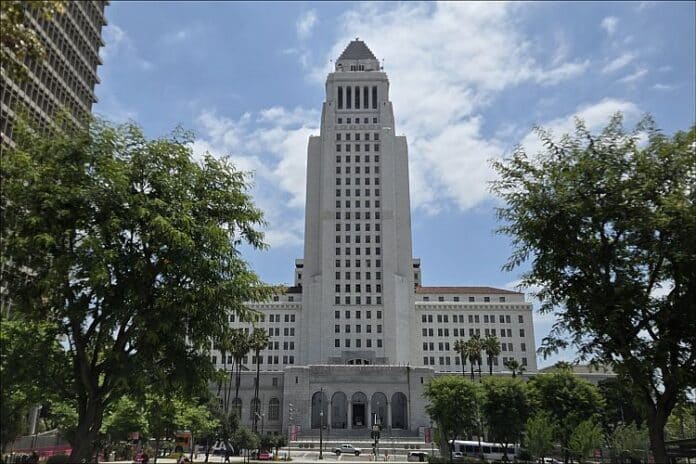
U.S. OLYMPIC & PARALYMPIC COMMITTEE: USOPC salutes new IOC grant program, looking at future (increases) of medal bonuses

The Sports Examiner: Chronicling the key competitive, economic and political forces shaping elite sport and the Olympic Movement.★

To get the daily Sports Examiner Recap by e-mail: sign up here!

≡ USOPC BOARD MEETING ≡

U.S. Olympic & Paralympic Committee Board Chair Gene Sykes said in a Wednesday news briefing that the organization appreciates the new International Olympic Committee grant program of $10,000 per Olympian per Games, starting with Milan Cortina 2026:

“This is a welcome decision and impactful for athletes all around the world. …

“We expect the process to begin at the end of this year and payments to be made to athletes through their respective NOCs in 2027. This is an important to continue in the support of athletes, and we’re grateful that it adds to the steps we are already taking in the United States. And we’ve spent a great deal of time adding to our list of things that help athletes with their financial wellness.”

So, what about upgrades to the USOPC’s existing “Operation Gold” program that pays $37,500-22,500-15,000 for gold, silver and bronze medals at Games? Chief executive Sarah Hirshland explained:

“We actually have a working group that is formed right now consisting of members of our team, members of the Team USA Athletes Commission and representatives from the NGB community, who are looking at and evaluating both the investment in our what we call ‘athlete stipends’ – funding that we provide athletes on an ongoing basis – and the Operation Gold funding that we provide.

“And we’re doing some evaluation on looking at all of that and assessing both, what is the best framework and how do we look at that framework; how do we then identify where there are gaps in funding and fill those gaps.

“So I don’t have an outcome for you today, but I can assure you it’s top-of-mind and we’re giving it lot of attention.”

Hirshland also noted that the USOPC Foundation received more than $150 million in donor commitments in 2025 and had more than 11,000 first-time donors.

As for the 2028 Olympic Games, Sykes noted that “we had a visit with LA28 leadership, which provided us an update as the Games approach the two-years-to-go milestone. Their organizational activity is ramping up significantly, with LA28 continuing to grow in staff and advanced planning across venues, transportation and athlete and fan experience.

“They’ve built upon an excellent [IOC] Coordination Committee meeting in Los Angeles, which I attended in early June, and confidence in the organizing effort remains very high.”

He noted the significant commercial and ticket sales successes so far, and with a second ticket sales period coming in August, he pointed out that “for a private-funded Games, this demand is critically important.”

Hirshland noted that Sykes was re-elected as the USOPC Board Chair for another four-year term, his second, which means he will continue as a member of the International Olympic Committee (his membership is linked to his position with the USOPC).

Sykes explained that the USOPC had certified, as part of its continuing audit function, four governing bodies as compliant: the U.S. Equestrian Team, USA Table Tennis, USA Team Handball and USA Water Polo, and a fifth, USA Judo, “with conditions.” The conditions were not announced.

Hirshland said that the USOPC supports the “Protect College Sports Act” (S. 4668), “recognizing that a strong collegiate system is essential for the long-term health of the Olympic and Paralympic pipeline and the future of Team USA. … It would replace the current patchwork of state NIL (name-image-likeness) laws. And the revised bill provides important protections for Olympic and Paralympic collegiate sports, addressing a gap that existed in the original draft.”

Sykes is already known as a track & field enthusiast, but he was almost glowing when he talked about his visit to the third World Rowing Cup last weekend in Switzerland

“It was wonderful to watch Team USA compete and bring home 12 medals. It was a thrill to be there representing the USOPC, and as a former rower – in fact I started my own athletic career as a rower – to celebrate these athletes and this team. …

“Under high-performance director Josy Verdonkschot [NED], Team USA is showing depth and momentum across events, and with eyes now turning to the World Trials in August and the World Championships in Amsterdam this fall, there are very, very high expectations for this team. And, of course, this team will contribute many of the athletes that will be in Long Beach in LA28.

“I can tell you, I saw rowing in Paris, and I expect we’re going to have a tremendous uptick in performance in rowing, and it’s very exciting to imagine the number of medals that our athletes will bring back to Team USA by virtue of this performance.”

The U.S. won two medals (1-0-1) at Paris 2024 and four medals (2-0-2) at the 2025 World Rowing Championships.

Receive our exclusive, weekday TSX Recap by e-mail by clicking here.
★ Sign up a friend to receive the TSX Recap by clicking here.
★ Please consider a donation here to keep this site going.

For our updated, 681-event International Sports Calendar for 2026 and beyond, by date and by sport, click here!
FOOTBALL: Haaland saves Norway, two more goals for Mbappe as France stomps Sweden, Mexico cruises in FIFA World Cup

The Sports Examiner: Chronicling the key competitive, economic and political forces shaping elite sport and the Olympic Movement.★

To get the daily Sports Examiner Recap by e-mail: sign up here!

≡ FIFA WORLD CUP ≡

Lots of drama in the FIFA World Cup round-of-32, but the stars were out on Tuesday and made the difference for Norway and France.

Norway 2, Ivory Coast 1 This match, at AT&T Stadium in Arlington, saw Ivory Coast the aggressor from the start, but the Norwegian defense was tight. It was scoreless at the hydration break, with the Norwegians at 57% possession, but just three total shots in the game, and only one for Norway.

The Norwegian offense was more focused after the break and in the 39th, and midfielder Martin Odegaard forwarded the ball to Antonio Nusa on the left side, just above the box. He had time and set up for a right-footed, curling shot that found the far side of the Ivory Coast net for the 1-0 lead.

The Vikings were suddenly all over the Ivory Coast net, with close misses for scoring star Erling Haaland in the 43rd, and striker Alexander Sorloth in the 45th. But there as no more scoring and the half ended 1-0, with Norway at 56% of the ball and a 6-5 shots edge.

But the Elephants were vigorous in the second half and Norway keeper Orjan Nyland had to make a strong save on a blast by striker Nicolas Pepe in the 55th. Norway also had chances and defender Torbjorn Heggem almost scored off a corner in the 67th, but it was amazingly saved by Elephants striker Amad Diallo on the goal line. At the second hydro break, it was still 1-0, with possession even now and Ivory Coast with a 10-8 shots edge.

Norway was more defensive now and it cost them, as Diallo came forward took a give and go with Pepe from the right side, rolled into the middle of the box and left-footed the shot and scored in the 74th for the 1-1 tie.

But the Norwegians knew what they had to do: get the ball to Haaland. It finally happened in the 86th, with a perfect cross from the right side of the goal from midfielder Patrick Berg, which drew the defense to him and found Haaland standing in the middle of the box. Haaland just kicked it in and scored his 60th goal for country in just 53 appearances. 2-1.

It got more and more physical in stoppage time, with pushing and shoving during a dead ball at 90+5, leading to an Diallo free kick above the box, which was saved only with a full-stretch, left-handed slap by Nyland! That was the end, with Norway’s first-ever knock-out round win.

Norway had 53% of possession, but Ivory Coast had the most shots, 14-9. Norway is on to face Brazil next.

France 3, Sweden 0 The script was clear for this match in East Rutherford, as tournament co-favorites France were going to be on offense and the Swedes were going hold on as long as possible.

The French had 65% possession at the first hydration break and a 3-1 lead on shots, but no goals. But the pressure continued, with star striker Kylian Mbappe hitting the post in the 34th, then an acrobatic, bicycle-style shot from midfielder Michael Olise in the 34th that hit the far post.

Sweden was playing six men across the back line now, but in the 45th, off a short pass from a corner, striker Ousmane Dembele popped the ball into the box for Mbappe at the left side. He dribbled and created his own shot that sailed into the goal for the 1-0 lead in a moment of individual brilliance.

Swedish midfielder Elliott Stroud shot the ball over the bar on a good chance at 45+2, one of best attempts of the half. The French walked off the field holding 71% of possession and a 15-3 advantage on shots.

France was even more dominant in the second half. Striker Bradley Barcola received a cross into the box from Olise and did the rest, finding the net for a 2-0 lead in the 53rd and creating what looked like an insurmountable advantage for Les Bleus.

At the second hydro break, French possession was a little less at 66% and 20-4 on shots (5-1 in the “third period”).

Olise had shots saved in the 61st and 65th, but Mbappe sealed it with a 3-0 advantage in the 74th, taking a pass from Olise behind the defense and then scoring by sending the ball into the far corner. It’s another multi-goal game for the star and he now has 18 career World Cup goals!

The game ended with the French ay 61% possession and 25-8 on shots and looking very much like a tournament favorite, with an unstoppable scorer.

Mexico 2, Ecuador 0 The start of the match in Mexico City was delayed for an hour due to a rainstorm at the Azteca, but the home team was in full flight from the start. A brilliant exchange in the 6th almost scored, with a glorious cross from the right side of the field by midfielder Luis Romo all the way to the far post for a header by striker Raul Jimenez, but it went wide!

Ecuador’s John Yeboah got through the box for a shot that missed in the 17th, but in the 22nd, a lone run down the left side turned into a 1-0 lead for Mexico, off a right-foot rocket from striker Julian Quinones after he rolled into the box and curled a shot to the left, just inside the post.

Mexico had 60% of the ball by the first break and 7-1 on shots. Ecuador didn’t help itself with a turnover, and Quinones forward the ball to Jimenez for a right-footed shot just inside the box that flew into the far side of the net in the 31st for the 2-0 lead.

Ecuador found some offense in the final 10 minutes, as Yeboah sent a blistering shot in the 40th that Mexican keeper Raul Rangel was able to push away. But the half ended 2-0, with Mexico at 56% of the ball and 10-2 on shots.

The pace slowed in the second half, but Mexico also scored in the 67th, on a Cesar Montes header off a corner was barely saved by Ecuadorian keeper Hernan Galindez. At the second break, Mexico was cruising with 14 shots to three, but Ecuador now had 54% of possession.

In the 74th, Ecuador striker Kevin Rodriguez barely missed a goal off a long pass ahead, and despite several more tries, could not find the net and it ended 2-0. A red card was handed out to Ecuador defender Piero Hincapie at 90+5 for covering his mouth while talking to forward Santiago Gimenez.

Mexico won an elimination game for the first time since 1986, and ended 15-7 on shots, but Ecuador had 57% of possession. The Azteca crowd was elated.

Mexican “fans” did their best to disturb the Ecuadorian team during the early hours of Tuesday morning, as The Associated Press reported:

“From midnight until the early hours of the morning, dozens of fans gathered outside the Westin Hotel in Santa Fe, an upscale area on the outskirts of the capital, using loudspeakers, horns and motorcycles to disturb the visiting team’s rest.”

The Ecuadorian federation filed a protest, stating “Such conduct stands in stark contrast to the principles of fair play, equity, and unity that a World Cup should embody.

“The FEF respectfully calls upon the competent authorities to pay greater attention to these events and to adopt the necessary measures to safeguard the safety of our players, coaching staff, and fans.”

≡ PANORAMA ≡

The round-of-32 matches will continue through Friday:

Wednesday, 1 July:
● England vs. Dem. Rep. Congo ● In Atlanta (12 p.m. Eastern)
● Belgium vs. Senegal ● In Seattle (4 p.m. Eastern)
● U.S. vs. Bosnia & Herzegovina ● In Santa Clara (8 p.m. Eastern)

Thursday, 2 July:
● Spain vs. Austria ● In Inglewood (3 p.m. Eastern)
● Portugal vs. Croatia ● In Toronto (7 p.m. Eastern)
● Switzerland vs. Algeria ● In Vancouver (11 p.m. Eastern)

Friday, 3 July:
● Australia vs. Egypt ● In Arlington (2 p.m. Eastern)
● Argentina vs. Cape Verde ● In Miami Gardens (6 p.m. Eastern)
● Colombia vs. Ghana ● In Kansas City (9:30 p.m. Eastern)

It wasn’t all misery for teams which did not advance out of the group stage. Jordan’s King Abdullah II, posted a message praising the team’s performance in their first World Cup appearance, despite an 0-3 record in Group J:

“Our national team heroes, you have represented a noble face for Jordan and laid the foundation for future successes that we look forward to. The nation awaits you and is proud of you, for you are in the hearts of all Jordanians.

“And to the loyal Jordanian fans: you have reflected the most beautiful image of our nation, embodying true belonging. Jordan is stronger with its unity, more beautiful with its people, and greater with the love that unites its sons.”

Japanese fans came with a plan to the World Cup, bringing with them more than 15,000 blue plastic trash bags to cheer on the Samurai Blue in the stands and then for use in cleaning the stadium later.

The traveling bags idea apparently started at the 1998 World Cup in France, and for 2026, the APA Hotel Company – a sponsor of the Japan federation – produced the bags.

Receive our exclusive, weekday TSX Recap by e-mail by clicking here.
★ Sign up a friend to receive the TSX Recap by clicking here.
★ Please consider a donation here to keep this site going.

For our updated, 681-event International Sports Calendar for 2026 and beyond, by date and by sport, click here!

PANORAMA: IOC asked to grant NOC status to Greenland, Faroe Isles; UCI report shows strong reserves; canoeing to focus on 500 m races

The Sports Examiner: Chronicling the key competitive, economic and political forces shaping elite sport and the Olympic Movement.★

To get the daily Sports Examiner Recap by e-mail: sign up here!

≡ THE 5-RING CIRCUS ≡

● International Olympic Committee ● The Danish Parliament sent a letter to the IOC on 18 June, asking for recognition of the Faroe Islands and Greenland as separate, new National Olympic Committees:

“For many years, both the Faroe Islands and Greenland have sought broader international recognition of their distinct democratic institutions, societies, cultures and sporting identities within the Kingdom of Denmark. The Presidium considers that their aspirations should be assessed on equal terms, including in relation to the possibility of independent representation within the Olympic movement.”

The message noted that this is outside the current procedure, but that there can be exceptions:

“The Presidium fully recognizes that, since 1996, the International Olympic Committee has applied a practice under which admission has generally been limited to territories recognized by the international community, including the United Nations, as independent states.

“At the same time, it remains relevant that exceptions to this practice continue to exist, in that a number of territories – including Aruba, Bermuda and Puerto Rico – participate under their own flags on the basis of recognition granted before the policy was adopted in 1996. The Presidium notices that the Faroe Islands applied for admission in 1983, before the rules were amended in 1996.”

There are currently 206 National Olympic Committees, vs. 193 member states of the United Nations.

● Biathlon ● US Biathlon is asking its donors and friends for more support now that the 2025-26 Olympic season has passed:

“As we reach the final day of our June Fundraising Drive, our athletes, programs, and community need your support now more than ever. We just received a 22% cut in funding from the USOPC, leaving us with a significant gap in our budget going forward.

“Your support is critical to help us continue our momentum at every level, from grassroots to elite. Midway through our 2030 Plan, we are seeing real progress across our organization, from our high performance program to laser biathlon and development to coaching growth and biathlon education, and your support is critical as we head into this next quadrennial.”

● Canoe-Kayak ● The International Canoe Federation Board agreed by 26-1 “in principle, that the future Olympic Canoe Sprint programme should be centered on 500-metre racing, complemented by long-distance racing” for the Brisbane 2032 Games.

The concept was adopted, in part, but the International Olympic Committee’s emphasis on reducing the number of custom venues needed for a specific sport or discipline. Canadian Sprint Olympian John Edwards explained:

“Too often we have found ourselves linked to two-kilometre [rowing] venues that are located well away from where people live.

“There is a real opportunity to bring Canoe Sprint closer to the public by racing on waterways that sit at the heart of our cities. Montreal is a great example of how successful that can be when the venue becomes part of the community and for potential daily users rather than being separated from it.

“I also like the inclusion of long-distance racing because it brings back important characteristics of Canoe Sprint, including wash riding and turning. These are skills that have always been part of our sport and deserve to be showcased.”

The ICF announcement noted that this does not change the current Olympic event program, which includes 200 m and 1,000 m races, which has to be agreed in consultation with the IOC. At its World Cup events, 5,000 m races are routinely included

● Cycling ● The Union Cycliste Internationale posted its annual report on Tuesday (30th), citing some significant cumulative worldwide television audiences for its world championship programs:

● 299 million: World Road Championships
● 123 million: World Track Championships
● 57 million: World Mountain Bike Championships
● 37 million: World Cyclo-Cross Championships
● 30 million: World BMX Freestyle Championships
● 28 million: World Gravel Championships
● 23 million: World BMX Racing Championships

The financial report, which showed an operating loss of CHF 4.2 million (CHF 1 = $1.24 U.S.), was described as good:

“The year 2025 was characterised by very solid financial results for the UCI’s operational activities. In line with the financial model for the current cycle, an operating loss had been anticipated; however, the results achieved were significantly better than expected. Furthermore, the UCI also benefited from the favourable performance of its investment portfolio, which contributed to a significant improvement in the net profit for the year.”

The UCI plans its four-year financial plan around its Olympic television rights dividend, which for Paris 2024 was about $25.7 million. Part goes to reserves and a portion assigned to be spent for development in the following three years. For 2025:

● CHF 42.569 million revenue
● CHF 46.900 million expenses
● CHF –4.241 million operating loss

There was investment income which ended the year with a smaller loss of CHF – 1.506 million.

The overall financial health included CHF 135.875 million in assets and CHF 74.579 million in reserves, about 18 months of expenses in a non-Olympic year.

● Tennis ● Superstar Serena Williams returned to women’s Singles play at Wimbledon for the first time since 2022, but lost in her first-round match against Australian Maya Joint, 6-3, 6-7(6), 6-3, in a match that lasted 2:22.

Receive our exclusive, weekday TSX Recap by e-mail by clicking here.
★ Sign up a friend to receive the TSX Recap by clicking here.
★ Please consider a donation here to keep this site going.

For our updated, 681-event International Sports Calendar for 2026 and beyond, by date and by sport, click here!
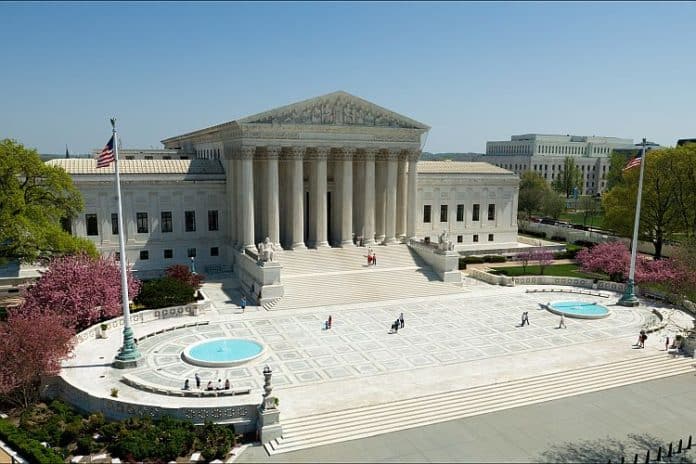
LOS ANGELES 2028: LA28 organizers promise human rights organization grants at City Council Games committee; no agreement on City payments

Los Angeles City Hall (TSX photo).

The Sports Examiner: Chronicling the key competitive, economic and political forces shaping elite sport and the Olympic Movement.★

To get the daily Sports Examiner Recap by e-mail: sign up here!

≡ L.A. CITY 2028 GAMES HEARING ≡

Responding to moans from civil rights and human rights organizations for funding to deal with what they are sure will increases in violations attendant to the 2028 Olympic Games, the LA28 Olympic and Paralympic organizing committee promised to create a grant program to support human-rights prevention in and around the 2028 Games.

Multiple speakers at a snap, two-hour-plus Tuesday meeting of the L.A. City Council’s Ad Hoc Committee on the 2028 Olympic and Paralympic Games reviewed the LA28 human-rights strategy plan submitted in December. Created under the supervision of former U.S. Ambassador to Croatia and career foreign-service officer Juliette Noyes, the document was praised for its breadth, but panned for specific, funded support to deal with labor wage theft, human trafficking and homelessness.

Council President Marqueece Harris-Dawson noted the Council’s expectation that “We want to be sure that all of the resources that are needed are in place, and the people that are needed are in place, the human capital that’s needed, is in place.”

In a later response, LA28 chief executive Reynold Hoover told the committee, “After the last time we were here, we heard loud and clear from both the community as well as all of you, and I would just like to say that I am pleased to announce our next step, which is an upcoming human rights program, in which we will dedicate funding in a grant program for community groups.”

This will be modeled after the LA28 Resilience Champions Fund, which issued its first grants in May to eight organizations for projects of $100,000 each. A total amount for the human rights program has not yet been determined. Hoover added:

“We heard the concern about funding associated with it. We are not the experts on human rights,” and noted a “task force effort among a number of different agencies” is a good approach.

Noyes explained the strategy document at length, pointing out that “major events like this can create unintended consequences for vulnerable communities, That’s why our strategy anticipates those challenges in the context of the ‘28 Games. We plan to address these issues in a framework of community engagement and accountability. …

“We will carry out due diligence, for example, by conducting background checks for key staff members. We will monitor worker protections in our supply chain, and we will train staff and volunteers to help defend human rights. We recognize that protecting human rights requires not just goodwill partnership in LA28-managed programs. It also required resources to bolster existing systems and processes to help fill gaps in human rights protections.”

She also spoke to fears concerning displacement due to the Games: “In terms of addressing the rights of unhoused communities, as required in our Games Agreement, our approach is built on proactive communication and coordination with the City. Based on lessons from previous Games, the largest disruptions to these communities typically stem from the construction of major new facilities. Because LA28 will not be building new permanent venues, we expect to avoid these major disruptions.”

Council member Hugo Soto-Martinez pointedly asked Hoover about what the U.S. Immigration and Customs Enforcement agency (ICE) will be doing during the Games, and in a tense exchange, Hoover explained:

“We work with our Federal partners, with our State partners, City and County, on law enforcement for the Games. I fully expect that the Federal government is going to be supportive of these Games and deliver the Games and respect human rights in the process.”

Soto-Martinez shot back and insisted that Hoover answer the question; the reply: “I don’t know what ICE is going to do, or not do in 2028, on the 14th of July, or before, when the Games come. I can tell you that the relationship that we have with the Federal government and this Administration, and members of Congress, has been incredible. …

“What ICE is going to do or not do, that’s not my answer. I can’t answer that question for you. That’s not my job. My job is to put on a Games in a safe, responsible and fiscally appropriate way, and that’s what I believe I’m going to do.”

Council member Imelda Padilla complained to Hoover about a failure of LA28 to come through for her on promises for an event in her district that had to be canceled.

No action was taken on the report, and the discussion was continued to the next meeting of the committee by Harris-Dawson.

After 85 minutes on human rights, the discussion turned to the draft agreement between the City of Los Angeles and LA28 on the Enhanced City Resources Master Agreement, a blueprint for how LA28 will buy services from the City – related to the Games – specified by follow-on agreements for each of the Olympic and Paralympic venues for which the City will provide services “above and beyond” “normal and customary” services for those sites.

Los Angeles City Administrative Office Matt Szabo explained, “this is the document that says, for the services that are required [by LA28], this is how much and how the City will be paid, based on the services.”

Council member Monica Rodriguez was not comfortable with this form of agreement, especially what happens to the City if LA28 has a shortfall, or even if it has a surplus, if that is insufficient to cover all of the City service costs related to the Games, noting “I have a lot of concerns as to the lack of cost containment, especially with the other venues and the other cities.”

Rodriguez wants a closed session of the Council on this issue, which Harris-Dawson agreed to, subject to the approval of the City Attorney. The committee, at the end of the hearing, moved consideration of the agreement to the full Council, but with no recommendation for approval.

That’s the next step.

Receive our exclusive, weekday TSX Recap by e-mail by clicking here.
★ Sign up a friend to receive the TSX Recap by clicking here.
★ Please consider a donation here to keep this site going.

For our updated, 681-event International Sports Calendar for 2026 and beyond, by date and by sport, click here!

U.S. OLYMPIC & PARALYMPIC COMMITTEE: 2025 audit shows USOPC at $1.11 billion in assets, $654 million reserves, $282 million revenue

The Sports Examiner: Chronicling the key competitive, economic and political forces shaping elite sport and the Olympic Movement.★

To get the daily Sports Examiner Recap by e-mail: sign up here!

≡ USOPC ANNUAL REPORT ≡

The newly released, multi-part “Impact Report” from the U.S. Olympic & Paralympic Committee, believed to be the world’s only billion-dollar National Olympic Committee, included audited financial statements which showed a significant increase in total assets:

2025: $1.114.6 billion
2024: $1,018.1 billion
2023: $971.2 billion

The driver of the increase for 2025 came from investments, which rose from $661.2 million to $760.0 million in a single year, while the organization essentially broke even in terms of revenues and expenses for the year.

Actual revenues during 2025 – a non-Olympic year – were $281.7 million, way down from the $515.1 million for 2024, but was nicely ahead of the $253.7 million for 2023, also a non-Olympic year.

Expenses were at $308.2 million, down from the 2024 Olympic year total of $385.6 million, but considerably more than the $287.4 million in 2023. So, 2025 showed an operating loss of $26.4 million, but this was overcome by contributions with donor restrictions, with $36.2 million available during the year and therefore, a bottom-line net of $9.75 million.

Of the $281.7 million in primary revenue, it came from essentially three sources:

● $154.6 million in sponsorships and licensing
● $61.0 million in investment income
● $38.4 million in contributions

That’s $254.0 million out of $281.7 million in total, or 90.2%. Interestingly, the USOPC received a cryptocurrency donation of $9.97 million during 2025, which was converted to cash the next day at a loss of $147.000.

The expense side of $308.2 million was broken into two main sections:

● $253.8 million (82.3%) in athlete, sport and community support
● $54.4 million (17.7%) in fundraising, sales and administration

Direct support to athletes and National Governing Bodies was $109.8 million, or 35.3% of the entire budget. Included in this are:

● $43.41 million paid directly to athletes
● $21.27 million paid for services, such as athlete travel
● $68.44 million paid to National Governing Bodies (some further paid to athletes)
● $1.42 million paid for NGB services

Among the sports, the largest grant totals of all four of these components went to:

● $16.12 million: USA Track & Field
● $15.14 million: U.S. Ski & Snowboard
● $8.38 million: USA Cycling
● $7.43 million: USA Swimming
● $6.29 million: USA Wrestling
● $5.60 million: USA Bobsled & Skeleton
● $5.54 million: USA Volleyball
● $4.41 million: US Rowing
● $3.86 million: USA Gymnastics
● $3.80 million: US Speedskating

Six other NGBs (and their athletes) received more than $2 million total and five others received between $3.00 and $3.75 million. Nine received less than $10,000.

The USOPC has been active in support of two organizations financially – USA Gymnastics and the U.S. Olympic & Paralympic Museum – with loans of $6.15 million in 2021 and $2.9 million in 2023, respectively. Both are being paid off quarterly.

Observed: The USOPC is, no doubt, the richest NOC in the world, but even so, it cannot even begin to fulfill all of the requests for funding it receives. Its fundraising is going well, especially with LA28 on the horizon, but the demands continue to grow.

In view of the IOC’s new, all-Olympians stipend of $10,000 coming online, there will be added pressure to increase the USOPCs “Operation Gold” honoraria for LA28 medal winners beyond the $37,500-22,500–15,000 currently available.

Receive our exclusive, weekday TSX Recap by e-mail by clicking here.
★ Sign up a friend to receive the TSX Recap by clicking here.
★ Please consider a donation here to keep this site going.

For our updated, 681-event International Sports Calendar for 2026 and beyond, by date and by sport, click here!

RUSSIA: International Skating Union approves “neutral” status for Russian and Belarusian entries in skating

The Sports Examiner: Chronicling the key competitive, economic and political forces shaping elite sport and the Olympic Movement.★

To get the daily Sports Examiner Recap by e-mail: sign up here!

≡ ISU COUNCIL ≡

“The International Skating Union (ISU) Council has decided to revise the position in ISU Communication 2469 to reintroduce skaters affiliated with ISU Members in Russia and Belarus to participate in ISU Events or International Competitions during the 2026/2027 season as AIN (Neutral) Athletes (read ISU Communication 2804).

“Athletes representing Russia and Belarus will be able to compete without items of state recognition, namely national flags, national kit and national anthems. Participation will be dependent on no evidence of breaches of athletes’ neutral status, which reinforces the primacy of fair sport on the ice.”

Tuesday’s announcement follows the International Olympic Committee’s emphasis on neutrality in sport, underlined during the 146th IOC Session last week in Lausanne (SUI).

However, there are qualifications to the “neutral” status:

“Eligibility will be withheld only where a skater is shown to fall within the disqualifying criteria, namely that they are currently in active service with the armed forces or a national security agency of Russia or Belarus, or that, since February 2022, they have taken active part in military operations in the war against Ukraine or have actively and publicly supported that war.

“Each case is assessed individually and on the evidence by the ISU Council (which may delegate the assessment to an independent eligibility panel), and is kept under review. This approach is consistent with the eligibility criteria applied by the IOC to neutral athletes.”

The ISU decision noted that Russian and Belarusian athletes will reappear slowly at the top level of federation competitions since they have been out of events since 2022 and have no ranking points in figure skating, speed skating or short track.

While the athletes can return, officials cannot:

“At this time, the ISU has prioritized the readmission of Athletes. ISU Communication 2469 remains in effect regarding the participation of Officials from Russia and Belarus. However, the ISU recognizes the need to develop a pathway for these officials to return to their duties and is developing such a plan.”

Russian response to the decision was positive, but not wild, given that other federations have fully readmitted Russian athletes and officials. Dmitry Svishchev, First Deputy Chairman of the Russian State Duma Committee on Physical Culture and Sport, told the Russian news agency TASS:

“This is a joint effort between the federations and the Russian Olympic Committee. This is an important decision for our athletes, who have gained confidence in their preparations for the next season.

“The ISU Council’s decision was almost certainly influenced by the recent IOC decision to amend the Charter, which eliminates the politicization of sport. Now it’s important that all admission decisions are implemented without opposition from certain countries.”

Receive our exclusive, weekday TSX Recap by e-mail by clicking here.
★ Sign up a friend to receive the TSX Recap by clicking here.
★ Please consider a donation here to keep this site going.

For our updated, 681-event International Sports Calendar for 2026 and beyond, by date and by sport, click here!
TRANSGENDER: U.S. Supreme Court upholds rights of states to bar transgender females from women’s sport

The United States Supreme Court (Photo: Wikipedia via the U.S. Capitol).

The Sports Examiner: Chronicling the key competitive, economic and political forces shaping elite sport and the Olympic Movement.★

To get the daily Sports Examiner Recap by e-mail: sign up here!

≡ WEST VIRGINIA vs. B.P.J. ≡

This is now a part of the law of the United States:

“To provide equal opportunity for female athletes, schools do not merely maintain, for example, one soccer team, one basketball team, one ice hockey team, and one lacrosse team that are equally open to female and male athletes. That approach would deny equal opportunity to female athletes because, as all agree, females and males have inherent physical differences relevant to athletic performance.”

That’s from the opening of U.S. Supreme Court Justice Brett Kavanaugh’s majority opinion, issued Tuesday (30th) in the companion cases of West Virginia vs. B.P.J. and Little v. Hecox:

“These cases concern two of those state laws, from West Virginia and Idaho. The question before the Court is: Under Title IX and the Equal Protection Clause of the Fourteenth Amendment, may schools maintain women’s and girls’ sports for biological females? In other words, may schools determine eligibility for women’s and girls’ sports based on biological sex? The answer is yes.”

The opinion notes that 27 states have such regulations and cited the International Olympic Committee’s new “Policy on the Protection of the Female (Women’s) Category in Olympic Sport and Guiding Considerations for International Federations and Sports Governing Bodies” from March of this year.

In terms of the facts of the specific West Virginia case:

“B. P. J. is a biological male who identifies as female. In third grade, B. P. J. socially transitioned and adopted a new name. Soon thereafter, B. P. J. took puberty blockers to prevent male puberty, and in sixth grade, B. P. J. also began to take hormones.

“Shortly after passage of the West Virginia law, as B. P. J. was about to enter sixth grade, B. P. J.’s middle school principal informed B. P. J.’s mother that B. P. J. could not participate on the girls’ cross-country and track-and-field teams. B. P. J. is now in high school, where the same policies apply”

B.P.J. has been competing during the course of the litigation and won the Class AAA state girls shot put title. In the Idaho case:

“Hecox is a biological male who identifies as female. Hecox underwent male puberty. In college, Hecox began to take hormones. Hecox attends Boise State University and has competed for the women’s club soccer team. Hecox also has tried out for the women’s Division I track and cross country teams.”

Regarding the discrimination claims under Title IX of the Education Amendments of 1972, Kavavaugh explained:

“Title IX prohibits discrimination on the basis of sex. Title IX’s implementing regulations expressly permit schools to maintain separate teams for ‘members of each sex.’

“The term ‘sex’ in the 1972 Title IX statute, the 1974 Javits Amendment, and the 1975 Title IX regulations cannot plausibly be interpreted to refer to anything other than biological sex.”

He concludes:

“Separate sports teams for biological males and biological females are reasonable: Given the inherent physical differences between the sexes, allowing only biological females to play on women’s and girls’ teams can reduce the risk of physical injury and ensure fair competition.”

Kavanaugh then discusses the equal-protection arguments under the 14th Amendment to the U.S. Constitution, and he was clear in favor of the positions of West Virginia and Idaho:

“As to competitive fairness, the States contend that allowing biological males to play women’s and girls’ sports would put female athletes at a debilitating disadvantage. Again, sports are generally zero sum. Every biological male who makes the team takes a roster spot from a female athlete. Every biological male who earns playing time reduces the playing time of a female athlete. Every biological male who starts takes a starting position from a female athlete. Every biological male who wins a race takes the gold medal away from a female athlete. And so on.

“Even if only one or a few males were to play on a women’s or girls’ team, that would still place specific individual female athletes at a significant competitive disadvantage.

“Based on all of the above, the States argue—and we agree—that the interests in safety and competitive fairness are important for purposes of equal protection analysis.”

Kavanaugh was clear, however, that “these cases do not present the distinct question of whether, under Title IX and the Equal Protection Clause, schools may allow biological males who identify as female to participate on girls’ and women’s sports teams. That question is currently the subject of litigation in some lower courts.” So, that’s for another day.

The cases were remanded back to the relevant Circuit Courts for further actions consistent with the Court’s opinion.

Separate concurring opinions were filed by Justice Clarence Thomas and Neil Gorsuch; an opinion concurring in part and dissenting in part was filed by Justice Sonia Sotomayor, joined by Justices Elana Kagan and Ketanji Jackson, and Jackson also filed a concurring and dissenting opinion.

Observed: As Kavanaugh notes, this settles the question about states with existing laws regarding prohibition of transgenders in women’s sports. It does not create a blanket ban, and as Kavavaugh points out, that question is also making its way to the Supreme Court, slowly.

Receive our exclusive, weekday TSX Recap by e-mail by clicking here.
★ Sign up a friend to receive the TSX Recap by clicking here.
★ Please consider a donation here to keep this site going.

For our updated, 681-event International Sports Calendar for 2026 and beyond, by date and by sport, click here!
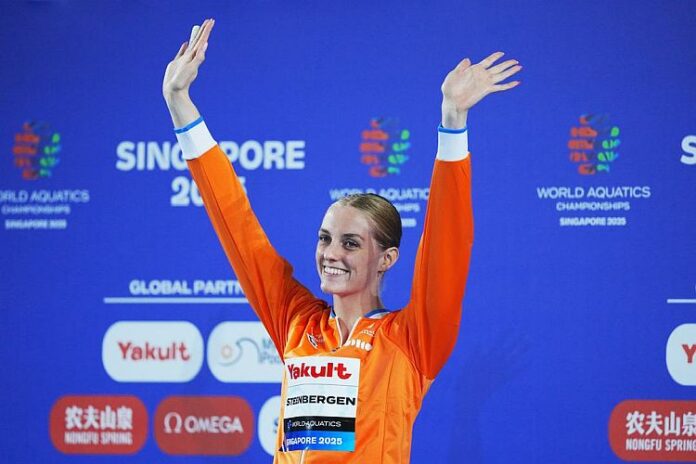
PANORAMA: Comcast to split off NBCUniversal; Ukraine asks to ignore Russia during Youth Olympic Games; Bromell irritates Lyles in Paris 100

The Sports Examiner: Chronicling the key competitive, economic and political forces shaping elite sport and the Olympic Movement.★

To get the daily Sports Examiner Recap by e-mail: sign up here!

≡ THE 5-RING CIRCUS ≡

● Olympic Games ● Comcast announced Monday its plan to split off its NBCUniversal and Sky broadcast units into a separate, publicly-traded company, with the transaction expected to be completed in about a year. It’s a technology play, per the statement:

“Comcast is a leading technology company serving residential and business customers through its broadband, wireless and entertainment platforms. …

“NBCUniversal is a premier global media and entertainment company, anchored by its growing theme parks division, Universal film and television studios, NBC and Telemundo networks, Peacock, and Bravo. In addition, NBCUniversal’s global portfolio will include Sky, our European media business.”

A CNBC report explained: “The company’s share price has plummeted over the past 12 months amid significant challenges facing the media industry, driven by the shift away from the TV bundle and toward streaming.”

Comcast previously cast off its cable television networks and digital assets to create Versant Media earlier in 2026.

Observed: It can be anticipated that the Olympic television rights for 2028 and beyond will go with the new NBCUniversal company, although Comcast is likely to continue its sponsorship relations with LA28 and the U.S. Olympic & Paralympic Committee to further promote its technology products and services to the broad Olympic audience.

● Youth Olympic Games ● The Ukrainian Olympic Committee has asked the International Olympic Committee, the International Federations and the Dakar 2026 organizers for special protections during the November event:

“The appeal pays particular attention to situations that may arise during medal ceremonies should a Ukrainian athlete find themselves on the same podium as representatives from Russia or Belarus. The NOC of Ukraine requests the introduction of a special protocol that would allow Ukrainian athletes to leave the podium early after receiving their own award.

“This mechanism would grant athletes the right not to remain on the podium whilst the flags of the aggressor states are raised and their national anthems are played, and not to take part in joint photo sessions if this conflicts with their moral convictions. The NOC of Ukraine also requests assurances that such actions by Ukrainian athletes will not be regarded as a breach of the regulations and will not result in disciplinary action.

“In addition, the Ukrainian side has requested that the particular circumstances of wartime be taken into account during the competitions and that no sanctions be imposed in cases where handshakes, hugs, bows or other traditional gestures of mutual respect between Ukrainian athletes and representatives of aggressor countries, as provided for in the competition rules.”

● Athletics ● Olympic 100 m champ Noah Lyles finished second to fellow American Trayvon Bromell at the Paris Diamond League 100 m on Sunday – 9.91 to 9.92 – and then posted a still image from the television coverage of the race, showing Bromell looking back at the field (and Lyles) from lane eight as he crossed the finish line:

“Carefully there Treyvon [sic]. The last person who did this to me didn’t even make the podium next time we met.”

A report noted the reference to the 2024 Racers Grand Prix in Jamaica, where Oblique Seville beat Lyles in the 100 m but was eighth at the Paris Olympic 100.

Bromell, a two-time Worlds 100 m medal winner, said afterwards:

“I really liked my start, I pushed the wheel. I didn´t let the race get in my head. I know that I have so much more in my tank, the times and data from my biomechanics make me excited for the season. In Eugene [next week], I will go nuts. After that I will take a small break to wait for my son to come to this world.”

Lyles added later that a rematch is not immediately coming:

“It´s been a very busy year, especially this month of June. It´s been running, running, running, training and running. It´s been a lot of fun, but I think the first half of my European tour is done here. I am going to get back to the U.S. and just do other stuff.”

American Jamal Britt has been the story of the men’s 110 m hurdles this season, getting his third Diamond League win, a lifetime best of 12.89 and becoming the ninth man to sub-12.90:

“I was not expecting to run that today. Just coming out here not feeling 100%, running that time and winning is a great feeling. I was just waiting to be 100% to be able to do this. This race was not perfect, the way I wanted.

“I didn’t have the best start, but I am best at the middle and the end. Indoor season I came out with 7.4 [through hurdle 6], the first time under 7.5, that was a big statement for me. If I can put that out in the 110 m hurdles, times like this will happen all the time.”

Swiss star Audrey Werro, who was just short of the world women’s 800 m record at 1:53.80, said afterwards, “I was not expecting to run this fast this season. These recent performances have really given me hope and built my confidence to what is coming next.”

Rae Edwards, 45, a 10.00 sprinter for the U.S. back in 2010 and now a coach and media personality (RaesTakeTV), was suspended for two years, a reduced doping violation sanction for his help. Per the U.S. Anti-Doping Agency:

“Edwards committed a complicity violation in 2023 by introducing athlete Marvin Bracy-Williams to an individual whom Edwards believed to be a doctor for the purpose of obtaining testosterone. …

“Bracy-Williams’s testosterone use was reported to USADA by a whistleblower in early 2024, prompting USADA to open an investigation that included a targeted out-of-competition test, which returned a positive result and led to Bracy-Williams being sanctioned for his anti-doping rule violation. Federal authorities separately opened a criminal investigation into Paul Askew, the individual who supplied Bracy-Williams with testosterone after Edwards connected them. Edwards provided important assistance to the federal investigation, which culminated in Askew’s guilty plea under the Rodchenkov Anti-Doping Act (RADA) on May 26, 2026.”

This closes the circle of cases and sanctions which started with the Bracy-Williams ban. Edwards’ ban started on 15 November 2024; Bracy-Williams was suspended for 45 months beginning 5 February 2024 and then a 12-year ban for “whereabouts” failures beyond the 45-month ban.

● Badminton ● At the BWF World Tour U.S. Open in Fullerton, California, Li Yang Su (TPE) won the men’s Singles final over India’s Srikanth Kidambi, 21-15, 16-21, 21-9, and Denmark’s Line Christophersen out-lasted Kaloyana Nalbantova (BUL) in the women’s Singles, 21-16, 16-21, 21-11.

Japan won the men’s Doubles and women’s Doubles and Chinese Taipei was victorious in the Mixed Doubles final.

● Tennis ● The International Tennis Federation announced Monday a name change to World Tennis, effective immediately. Further:

“In an open letter co-signed by World Tennis President David Haggerty [USA] and World Tennis Chief Executive Officer Ross Hutchins [GBR], World Tennis pledged to reinvest back into the game at least 85% of all income it generates each year for the next decade – empowering its 214 national tennis associations – and committed to drive collaboration across the sport.”

The federation also announced a goal of expanding worldwide participation in the sport to 140 million players by 2035, from 106 million now. The organization’s income is mostly tied to the Davis Cup national-team competitions and not to shares of Olympic television revenue.

Receive our exclusive, weekday TSX Recap by e-mail by clicking here.
★ Sign up a friend to receive the TSX Recap by clicking here.
★ Please consider a donation here to keep this site going.

For our updated, 681-event International Sports Calendar for 2026 and beyond, by date and by sport, click here!
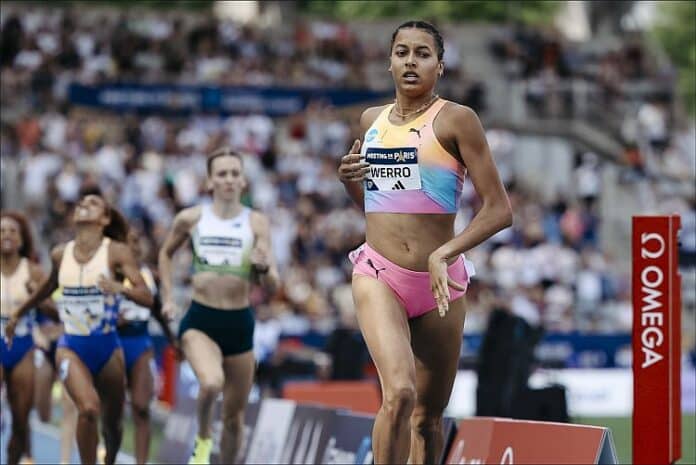
FOOTBALL: Brazil survives on late magic; Paraguay stuns Germany, Morocco ends Dutch on penalties at FIFA World Cup amid all-time attendance record

FIFA World Cup 2026 Web site seizure graphic, courtesy U.S. Department of Justice.

The Sports Examiner: Chronicling the key competitive, economic and political forces shaping elite sport and the Olympic Movement.★

To get the daily Sports Examiner Recap by e-mail: sign up here!

≡ FIFA WORLD CUP ≡

The first of five days of three-a-day matches in the round-of-32 began on Monday and the drama was enormous.

Brazil 2, Japan 1 Japan is usually in possession in its games, but in Houston, Brazil had the ball for 74% of the time up to the first hydration break and a 4-1 shots edge, but no goals.

But Japan midfielder Kaishu Sano intercepted a pass from defender Danilo at midfield in the 29th and dribbled forward to the top of the box, then sent a right-footed laser to the far left side of the goal for the 1-0 lead!

And the Japanese continued to hold possession beyond the score and held the Brazilian attack in check through halftime. Brazilian possession was down to 68% at the half and while Brazil had an 8-4 shots advantage, it was only 4-3 in the “second period.”

Brazil came out determined to find a goal and a Danilo cross to midfielder Bruno Guimaraes in front of the goal in the 52nd resulted in a header that was quickly saved by Japan keeper Zion Sukuzi. More pressure in the 54th saw midfielder Casemiro head another cross off the face of defender Takehiro Tomiyasu, standing on the goal line, rebound and then cleared by defender Hiroki Ito.

Brazil kept coming with crosses instead of trying to attack the center, and in the 56th, they got home with defender Gabriel Magalhaes’ left-footed cross from the left side to a header by Casemiro at the far right side of the goal and he scored over Suzuki’s head for the 1-1 tie.

Vinicius Junior looked for the go-ahead goal on a dribble drive on the left side in the 58th and sent a toe-poke to the far side, but Suzuki got a hand on it and it hit the far post! Japan held better to the hydro break, with Brazil at 67% of the ball but up to 14-5 on shots (6-1 in the half).

The game appeared to be headed to extra time, but at 90+5, Guimaraes had possession at the top of the box and sent a through-ball to forward Gabriel Martinelli in the middle of the box. He moved left and shot with his right foot to the right side of the Japan goal that was barely touched by Suzuki on its way inside the goal. It was 2-1 and Brazil got through. Too much magic.

Brazil was 19-5 on shots – Japan had one second-half shot – and had 69% possession, and were good enough to win when they absolutely had to. On to the last 16.

Paraguay 1 (4), Germany 1 (3) The Germans were in control of the game from the start in 83 F temperatures in Foxborough, with 84% possession at the cooling break, but only 2-2 on shots.

It was difficult for the Germans to find any space on offense, with two rows of four Paraguayan defenders lined up to oppose them most of the time. And then Paraguay struck, in the 42nd, for a 1-0 lead as forward Miguel Almiron sent a pass from the right side forward and to the right of the box to midfielder Matias Galarza. He launched a perfect cross on a line into the middle of the box with unmarked midfielder Julio Enciso sending a header to the left side of the German goal for the score!

A German flurry failed to score, with a save on a left-side drive by midfielder Joshua Kimmich at 45+1. But at the half, Germany had 79% of the ball and was up 5-3 on shots. But down a goal.

More of the same in the second half, with Germany probing, but with a goal in the 54th as a cross from the left side into the box by midfielder Florian Wirtz found striker Kai Havertsz for a header to the far corner of the net for the 1-1 tie.

The Germans had 77% of possession at the hydro break and a 9-7 shots total, but continued to have problems finding space amid the Paraguay zone defense.

Havertsz was denied on another header in the 78th on a punch-away save by Paraguay keeper Orlando Gil. Repeated shots into the box went nowhere, and the first 90 ended 1-1, with the Germans at 76% possession and 14-7 on shots, meaning Paraguay had none in the “fourth quarter.”

On to extra time, and more German pressure and in the 102nd minute, another corner went to the far side of the Paraguay goal, and defender Jonathan Tah headed it in. A video review checked for a foul before the kick on German defender Waldemar Anton, which was upheld, erasing the goal! The first extra period ended 1-1, with shots 4-0 for Germany (18-7 total), and 78% of the ball.

A German header off a corner in the 119th was saved by Gil, and extra time ended with shots at 21-7 and Germany at 75% possession. In the third elimination match, we have penalty kicks.

Havertsz’s first try was saved and Paraguay made three in a row, but the Germans pulled even at 3-3 when German keeper Manuel Neuer saved Fabian Balbuena’s try. But in the sudden-death sixth round was a miss for Tah and Paraguay defender Jose Canale scored to win the game, 4-3.

The Germans are out and a third-place team – Paraguay from Group D – advanced to the round-of-16. Stunner.

Morocco 1 (3), Netherlands 1 (2) This match in Monterrey is perhaps the most anticipated of all in this round and it was a physical effort from both sides.

The Moroccans were on offense quickly and Dutch keeper Bart Verbruggen had to make a hard save on a header from striker Neil El Aynaoui in the 18th off a corner. In the 21st, a right-footed rocket from the right side of the box defender Achraf Hakimi was saved by Verbruggen at the near post.

At the hydration break, Morocco had 54% possession and was 3-1 on shots. As seen multiple times in this tournament, the momentum shifted after the break and the Dutch had more offense.

How physical? The game was stopped in the 38th because Dutch defender Jan Paul van Hecke was bleeding profusely from the forehead off a Moroccan cleat from a loose ball. Not intentional, but still rough.

The Dutch had a chance in the 44th, as defender Micky van de Ven smashed a shot from the left side that was heading in, but Moroccan keeper Yassine Bounou managed to push over the cross bar. Both sides had chances in the final minute of stoppage time at 45+5 on rushes that came up short. Possession was even in the half and Morocco led on shots, 4-3. There were 11 total fouls.

Morocco started hot in the second half and in the 50th, Hakimi charged down the right side of the box and hit the crossbar on a try to get the ball over Verbruggen. Hakimi looked to be on a breakaway in the 55th, but was tackled in the box by van de Ven.

The hydro break came in the 68th, with Morocco at 61% possession for the game and up, 8-5, on shots. The Dutch have been almost completely defensive in the second half.

In the 72nd, however, a loose ball at midfield was picked up by the Dutch forward Wout Weghorst and kicked ahead to midfielder Crysencio Summerville, who rolled down the middle of the field and was tackled at the top of the box. But he pushed the ball to his left and striker Cody Gakpo was there to pick it up and slammed it into the net from the middle of the box for the 1-0 lead! Gakpo said over the weekend that he and his partner lost her pregnancy at 24 weeks of an unborn girl, and he covered his face with emotion after the goal while being mobbed by his teammates.

Morocco went right back on offense, but the Dutch defense was packed in. But at 90+1, another late strike, as a long cross from the left side by forward Chemsdine Talbi found defender Issa Diop right in front of the goal, who headed it into the goal for a 1-1 tie. Regulation ended 1-1, with Morocco at 65% possession and up, 10-6 on shots, with the Dutch committing 12 fouls to Morocco’s 10.

In extra time, Verbruggen saved a point-blank strike by forward Soufiane Rahimi in the 96th, but then the game slowed and the first extra period ended with 68% Morocco possession and the only shot. The second period saw no heroics and it finished 1-1: 70% possession for Morocco and 11-6 on shots.

On to penalties, with the Dutch shooting first. This was crazy, with each team converting only two of their first four. In round five, Summerville’s try was saved and midfielder Ismael Saibari scored, winning the game and eliminating the Dutch. Morocco survives and advances.

≡ PANORAMA ≡

The round-of-32 matches will continue through Friday:

Tuesday, 30 June:
● Ivory Coast vs. Norway ● In Arlington (1 p.m. Eastern)
● France vs. Sweden ● In East Rutherford (5 p.m. Eastern)
● Mexico vs. Ecuador ● In Mexico City (9 p.m. Eastern)

Wednesday, 1 July:
● England vs. Dem. Rep. Congo ● In Atlanta (12 p.m. Eastern)
● Belgium vs. Senegal ● In Seattle (4 p.m. Eastern)
● U.S. vs. Bosnia-Herzegovina ● In Santa Clara (8 p.m. Eastern)

Thursday, 2 July:
● Spain vs. Austria ● In Inglewood (3 p.m. Eastern)
● Portugal vs. Croatia ● In Toronto (7 p.m. Eastern)
● Switzerland vs. Algeria ● In Vancouver (11 p.m. Eastern)

Friday, 3 July:
● Australia vs. Egypt ● In Arlington (2 p.m. Eastern)
● Argentina vs. Cape Verde ● In Miami Gardens (6 p.m. Eastern)
● Colombia vs. Ghana ● In Kansas City (9:30 p.m. Eastern)

FIFA reported that the 72 group-stage matches had a total attendance of 4,644,549, an all-time record for the World Cup, surpassing the 1994 World Cup held in the U.S., a 52-match tournament that had 3,587,538 spectators.

Interestingly, the 1994 average of 68,991 was higher than the 2026 average of 64,508 (with 32 matches to go).

As for the fans, FIFA noted that “2.8 million beers and 300,000 hot dogs” were sold at stadiums and the most popular items were “beer and chips proving most popular in Canada, hot dogs leading in the USA, and pizza and French fries topping the menu in Mexico.”

FIFA said that more than 5.5 million have attended fan festivals, and a total of 40,500 volunteers have serviced the event, from 162 countries. Media accreditations totaled 5,230.

Losing at the World Cup has consequences.

South Korea finished 1-2 and did not advance, and coach Myung-bo Hong was met by angry fans with drums upon arrival at 4 a.m. at the Incheon airport, chanting insults; Hong – who has resigned – was protected by police.

Saudi Arabia football federation head Yasser Al-Misehal resigned Monday after a 0-1-2 (W-L-T) record in Group H. He wrote on X:

“The failure of the national team to qualify for the next round of the World Cup is a result that falls short of all our ambitions, and I bear full responsibility for it. I offer my apologies to everyone who hoped to see our team in a better position.

“A sense of responsibility requires giving the opportunity to open a new chapter, and I have decided not to continue until the end of my current term.”

Uruguay coach Marcelo Bielsa (ARG) told reporters after a 0-1-2 record in Group G, amid reports of complaints from the players:

“What do I leave for Uruguayan football? Nothing, because any contribution that a coach might make to football in a country after three years of work never truly takes hold if results aren’t achieved.

“Fourth place in the qualifiers didn’t count for much and a third-place finish in the Copa America didn’t either. And there is obviously no need to spell it out after what happened now. A tenure that left nothing behind.”

The Uruguay federation was so upset, it canceled the charter flight home from the Mexico training base to Montevideo. Players were left to make their own arrangements to wherever they decided to go, whether to Uruguay, or their club locations … or on vacation.

Miroslav Koubek resigned as head coach of the Czech team after an 0-2-1 record and fourth place in Group A.

Two Argentine nationals were arrested in Hard Rock Stadium in Miami Gardens, Florida for trying to stream the Colombia-Portugal match on Saturday,

Both are YouTube stars with hundreds of thousands of followers: Beni Marmol, 20, and Pato Perrotta, 26, who are facing felony charges for coming to the match using credentials from another event and getting past three layers of security.

They were arrested on a charge of “interference with a sporting or entertainment event” and released on a $2,500 bond. They were among 16 arrests at the game.

More on illegal streaming, as on Friday, the U.S. Justice Department announced “the seizure of nearly 400 sites that were engaged in the unauthorized streaming of matches in the FIFA World Cup Finals in violation of U.S. copyright law.”

It was noted that “Servers and domains linked to illegal streaming of World Cup games were targeted in Peru and Bulgaria, two known centers of online piracy activity. Additional ICHIP-supported disruptions took place in Croatia, Romania, Poland and Colombia.“

The statement added that “The Criminal Division will continue to disrupt and, where appropriate, seek to prosecute these sites and the subjects responsible for this criminal activity.”

U.S. authorities have “detected” 1,139 drones at World Cup sites with more than 500 seized by the U.S. Federal Bureau of Investigations as evidence.

Receive our exclusive, weekday TSX Recap by e-mail by clicking here.
★ Sign up a friend to receive the TSX Recap by clicking here.
★ Please consider a donation here to keep this site going.

For our updated, 681-event International Sports Calendar for 2026 and beyond, by date and by sport, click here!

INT’L OLYMPIC COMMITTEE: Annual report for 2025 showcases lots of activities, but reports first normal-cycle operating loss since 2017

Olympic House in Lausanne, Switzerland, home of the International Olympic Committee

The Sports Examiner: Chronicling the key competitive, economic and political forces shaping elite sport and the Olympic Movement.★

To get the daily Sports Examiner Recap by e-mail: sign up here!

≡ IOC ANNUAL REPORT ≡

The 2025 annual report from the International Olympic Committee was a familiar, colorful recitation of an important year in 2025, as the leadership of the organization transitioned from German Thomas Bach to Zimbabwe’s Kirsty Coventry.

The report details the IOC’s many activities, notably including its direct payments to athletes through its Olympic Solidarity programs, including 1,027 Olympic Scholarships for the LA28 Games, with athletes from 125 National Olympic Committees receiving support. There are also 28 NOCs which are receiving special support, mostly for teams.

In terms of finances, the IOC dropped the headline that it distributes 90% of its revenue back to the Olympic Movement, but stated it had $7.7 billion in revenues and $6.8 billion in distributions for the period of 2021-24, or 88.3%, which is pretty close. A review in June 2025 by The Sports Examiner evaluated the IOC’s financials a little differently and showed about 74% of its revenue between 2021-24 was distributed back to the Movement.

The IOC’s revenue base continues to be heavily weighted to broadcast rights at 55% of the total for the quadrennial and another 36% to its TOP sponsorships: that’s 91% of the total.

The audited financial statements showed an oddity: the IOC lost money in 2025:

● $649.969 million revenue ($0 broadcast rights)

● $218.157 million for Olympic-related costs (including Solidarity)
● $358.296 million distributions to organizers, federations, NOCs
● $191.935 million for Promotion of the Olympic Movement (digital)
● $213.020 million for administration (32.7% of revenues)

● Operating loss of $331.439 million
● Investment gain of $291.879 million
● Net loss of $39.569 million

Throwing out the Covid-19-impacted year of 2020, in which broadcast rights payments were delayed, causing a paper loss, this was the first time that the IOC had an annual loss since 2017, the year following the Rio 2016 Olympic Games (–$117.167 million).

No cause for worry, however, as the IOC stated in mid-2025 that it had already contracted for $7.7 billion in revenue for the 2025-28 quad, with more to come.

Further, the IOC has substantial resources, with $6.969 billion in assets and $4.907 billion in reserves.

The IOC’s distributions in 2025 included some big money to organizing committees:

● $891.974 million in broadcast money to Milan Cortina 2026
● $391.774 million in broadcast money to LA28

● $94.978 million in TOP sponsorship money to Milan Cortina 2026
● $99.344 million in TOP sponsorship money to LA28

The U.S. Olympic & Paralympic Committee, as part of its revenue-sharing agreement with the IOC, received $81.588 million for its share of the TOP sponsorship program in 2025. The USOPC also received $150,000 in licensing rights revenue from the IOC.

The IOC also paid significant support payments to the World Anti-Doping Agency ($23.616 million), $9.380 million to the Court of Arbitration for Sport and $2.000 million to the International Paralympic Committee.

Observed: An item to watch for the future is the IOC’s administrative costs, which reached 32.7% of revenues for 2025 and totaled $213.020 million in a non-Games year. This is up significantly from $173.875 million in the 2022 (Winter Games), $185.464 million in 2023 (no Games) and even $196.318 million in the Olympic year of 2024.

It will be fascinating to see how Coventry, who was a government minister in Zimbabwe before her election to head the IOC, deals with a rapidly expanding bureaucracy built by her predecessor.

Receive our exclusive, weekday TSX Recap by e-mail by clicking here.
★ Sign up a friend to receive the TSX Recap by clicking here.
★ Please consider a donation here to keep this site going.

For our updated, 681-event International Sports Calendar for 2026 and beyond, by date and by sport, click here!
PANORAMA: World swim records for Walsh in women’s 50 m Free, Steenbergen in 100 m Free; Russians leave Rhythmic World Cup over ban of flag!

Dutch sprint World Champion Marrit Steenbergen (Photo: World Aquatics/Aniko Kovacs).

The Sports Examiner: Chronicling the key competitive, economic and political forces shaping elite sport and the Olympic Movement.★

To get the daily Sports Examiner Recap by e-mail: sign up here!

≡ SPOTLIGHT ≡

● Swimming ● Fireworks at the 67th Trofeo Sette Colli meet in Rome (ITA), starting with a world record on Saturday for Dutch two-time World Champion Marrit Steenbergen in the women’s 100 m Freestyle, winning in 51.68 and breaking Swede Sarah Sjostrom’s 2017 mark of 51.71.

Steenbergen had set a lifetime best of 51.86 last month to move to no. 2 all-time and now she is no. 1. She swam all alone, as Hong Kong star – and two-time Olympic 100 m Free medalist – Siobhan Haughey was a distant second in 52.52. Haughey won the 200 m Free in 1:55.00.

Earlier, 2025 World Champion Gretchen Walsh of the U.S. won the 50 m Butterfly in 24.51, the second-fastest time in history, an American Record and just short of Sjostrom’s 24.43 in 2014. Sjostrom was second in the race – 10 months after maternity – in 25.05! Walsh had the U.S. record at 24.66 from the 2025 USA Swimming national championships.

Walsh followed up with a dominant win in the 100 m Fly in 54.82, the no. 5 performance in history … of which she owns all five and is the world-record holder.

On Sunday, Walsh was at it again, this time winning the 50 m Free in another world record, at 23.55, breaking fellow American Kate Douglass’ mark of 23.59 from the Tyr Pro Swim Series in Indianapolis in 19 June. Sjostrom, the former world-record holder, was second at 23.86; it’s Walsh’s first long-course world record.

Gretchen’s sister Alex Walsh – the 2022 World Champion in the 200 m Medley – was also a double winner, taking the women’s 200 m and 400 m Medleys.

Romania’s World Champion David Popovici moved to no. 2 on the world list for 2026 in the men’s 100 m Free in 47.26. He also won the 200 m Free in a speedy 1:44.48,, again moving to no. 2 in the world.

≡ THE 5-RING CIRCUS ≡

● Athletics ● Fleet Feet posted that its Chief Running Officer, Jenny Simpson, 39, the 2011 World women’s 1,500 m gold medalist, was released from Duke University Hospital on Friday (26th), after collapsing during a running event on 16 June:

“During the event, Jenny suffered a sudden cardiac arrest and received immediate lifesaving care, including CPR and the use of an automated external defibrillator (AED), before being transported to UNC Rex Hospital in Raleigh. She was later transferred to Duke University Hospital.

“For the time being, Jenny will remain in North Carolina with her husband, Jason, and their two pups, where her focus will be on rest and healing.”

This is unique: a standard-distance marathon is being planned to be run inside an IKEA store in Croydon, England in December 2027. The route, through the store and warehouse, is expected to be about 1.5 km per loop, requiring about 28 loops.

The field will be limited to 80 entrants. The idea came from Sussex Trail Events, which has held events in parking structures and other unique settings.

● Gymnastics ● Following a decision by former Romanian Prime Minister Emil Boc, now the mayor of the city of Cluj-Napoca not to allow the Russian and Belarusian flags to be displayed during the World Gymnastics Rhythmic World Challenge Cup, the Russian team withdrew on Friday. According to Russian federation press attache  Linar Ginatullin:

“The organizers verbally notified us that the Russian national flag will not be displayed in the arena and the national anthem will not be played if the Russian gymnasts win.

“This is a direct violation of the May decision of the World Gymnastics Executive Committee, according to which the Russian gymnasts were fully reinstated. It also violates the World Gymnastics Charter and the updated provisions of the Olympic Charter, which are aimed at protecting sport and athletes from any external political, governmental, social, and economic pressure. Our national team is always ready to compete in tournaments that comply with World Gymnastics’ requirements.”

World Gymnastics told the Russian news agency TASS: “We have taken note of the information and are evaluating it. If new information emerges, we will report it in due course. At this stage, we are refraining from further comment.”

At the 2025 World Artistic Championships in Jakarta, the Indonesian government did not allow Israeli athletes to enter the country, and they were not able to compete. World Gymnastics did nothing.

● Weightlifting ● The International Weightlifting Federation became the seventh Olympic-program International Federation to reinstate Russian and Belarusian athletes to international competition.

The IWF statement noted, “The decision follows the recent recommendations of the IOC regarding the principles of neutrality in sport and the importance of providing athletes with fair opportunities to compete at the highest international level.”

≡ RESULTS ≡

● Athletics ● A world-leading women’s triple jump for Olympic champion Thea LaFond (DMA) at the 76th Hanzekovic Memorial in Zagreb (CRO) on Friday, winning at 15.25 m (50-1 1/2) and moving to equal-ninth on the all-time list!

Excepting world-record holder Yulimar Rojas (VEN), it’s the furthest jump by anyone  else since 2014! Cuba’s Leyanis Perez was a distant second at 14.76 m (48-5 1/4).

There were plenty of other highlights, including American Jamal Britt lowering his lifetime best in the 110 m hurdles to 12.98 (+1.2), just ahead of Japan’s Rachid Muratake, who got a national record of 13.00.

Americans Alaysha Johnson and Rayniah Jones were 1-2 in the women’s 100 m hurdles, both timed in 12.43 (-0.2) to stand equal-fifth in the world this year.

Nathan Green of the U.S. won the men’s 1,500 m in 3:32.46, a seasonal best, with Sam Prakel fifth in 3:32.90; in the women’s javelin, Madison Wiltrout was second at 60.17 m (197-5).

Olympic bronze winner Rajindra Campbell (JAM) moved to no. 3 on the world list in the men’s shot with a lifetime best of 22.44 m (73-7 1/2), ahead of Italy’s 2023 Worlds silver winner Leonardo Fabbri (22.21 m/72-10 1/2). American Roger Steen was fourth at 21.42 m (70-3 1/2). Poland’s five-time World Champion Pawel Fajdek moved to world no. 4 with a men’s hammer win at 81.89 m (268-8).

Legendary Olympic champion Elaine Thompson-Herah, who turned 34 on 28 June, continued her comeback with a women’s 100 m win in 10.91 (+0.9), now no. 10 in the world this year. Teammate Stacey-Ann Williams moved to no. 5 in the world in the women’s 400 m in 49.48.

The 28th Stadtwerke Ratingen multi-events meet in Germany was a good one for home favorite Leo Neugebauer, the 2025 World Champion, who scored 8,537 to win. The 2024 European bronze medalist, Makenson Gletty (FRA) was second at 8,458; Americans Devon Williams (8,402) and Harrison Williams (8,345) finished 3-4.

World heptathlon leader Annik Kalin (SUI) won the women’s competition with a new leading mark of 6,816, well ahead of American Erin Marsh (6,305 lifetime best) and German Sandrina Sprengel (6,218). American Lexie Keller was 10th (6,017).

The headline from the Pan American Championships in Medellin (COL) was the men’s 100 m, where Colombia’s Ronal Longa steamed to a 9.85 win with +1.5 m/s wind, moving to no. 3 on the world list for 2026. His prior best was 9.96 from 2025.

● Gymnastics ● At the USA Gymnastics National Championships in Tulsa, Oklahoma, Rin Keys won the Rhythmic All-Around title for the third straight year, scoring 117.800 points, over Megan Chu (113.000) and Natalie de la Rosa (111.400). Keys is now one of six who have won three consecutive U.S. championships.

Chu won the Hoop final (29.200); Keys won on Ball (27.950) and Ribbon (29.900), and de la Rosa took the Clubs final (29.150).

In Trampoline, Leah Garofalo took the women’s title at 54.040 over Ava DeHanes (52.260), and Aliaksei Shostak won the men’s gold (his second, also in ’23), scoring 58.940, with Isaac Rowley at 58.160 for second and Ruben Padilla third (57.610).

In the synchronized finals, Isaac Rowley and Elijah Vogel took the men’s title at 52.410; Maia Amano and Kennedi Roberts won the women’s gold (48.790) and Garofalo and Nate Erkert won the mixed competition at 48.860.

Paris Olympic champ Darya Varfolomeev (GER) took the All-Around title at the World Gymnastics Rhythmic World Challenge Cup in Cluj-Napoca (ROU), winning all four events and scoring 116.950 to edge Ukraine’s Taisiia Onofriichuk (112.000).

In the apparatus finals, Varfolomeev won on Clubs (30.250); Onofriichuk took the Hoop gold (28.850) and the Ribbon title (28.000). Liliana Lewinska (POL) won on Ball (28.250).

At the World Gymnastics Trampoline World Cup in Arosa (SUI), China’s 2025 World Champion Zihai Wang won the men’s final at 66.58 and Russian Anzhela Bladtseva was the women’s individual winner, scoring 58.81.

● Hockey ● The Netherlands won their fourth FIH women’s Pro League title in a row as the season ended on Sunday, storming through the season with a 14-1 record and 46 points, earning a berth in the 2028 Olympic tournament as a result.

Argentina (11-4: 31) was second and Belgium (10-6: 30) finished third.

The men’s tournament finished with Belgium as champions, at 14-2 (39), ahead of England (13-3: 35) and Australia (10-6: 30). Belgium won their second title – also in 2021 – and also qualifies for LA28.

● Judo ● Japan was busy again at the IJF World Tour Qingdao Grand Prix in China, taking five titles, in the men’s 60 kg (Hayato Kondo), 66 kg (Olympic champ Hifumi Abe), 73 kg (Worlds bronzer Tatsuki Ishihara), plus in the women’s women’s 52 kg (Kokoro Fujishiro) and 63 kg (Narumi Tanioka).

● Modern Pentathlon ● Germany’s Marvin Dogue emerged as the men’s winner at the UIPM World Cup Final in Budapest (HUN), winning the fencing segment, but starting 26 seconds behind leader Giorgio Malan (ITA) in the Laser Run. But Dogue was almost 16 seconds faster in the final event and compiled a total of 1,597 points to edge Matej Lukes (CZE: 1,589) and Poland’s Lukasz Gutkowski (1,581).

The women’s champion was Swiss Anna Jurt, who was fifth in fencing, second in Obstacle, only 16th in the swimming, but won the Laser Run to move from fifth to first to score 1,493 points. That overtook the prior leader, Viyaleta Hureyeva (BLR: 1,488). Spain’s Laura Heredia (1,481) was third.

● Rowing ● The U.S, had another strong showing at the World Rowing World Cup III in Lucerne (SUI), winning seven medals in Olympic-program events and taking its first World Rowing Cup Trophy with 114 total points.

Germany’s Olympic champ Oliver Zeidler won the men’s Single Sculls in 6:46.49, with American Sam Melvin third in 6:49.44. Belgians Aaron Adries and Tibo Byvey won the Double Sculls in 6:19.50, with Jacob Plihal and Cedar Cunningham of the U.S. in third (6:20.82). In the Pairs final, Angus Dawson and Alexander Hill (AUS: 6:33.35) were the winners, ahead of the U.S.’s Madison Molitor and Pieter Quinton (6:35.97).

Great Britain won the Quadruple Sculls and the Fours, with U.S. boats fourth and sixth in the Fours final. The Netherlands won the men’s Eights.

In the women’s events, Britain’s Lauren Henry, the 2025 Worlds runner-up, took the Single Sculls in 7:33.18 and British entries won the Quadruple Sculls (6:30.98) and the Eights (6:08.54), with the U.S. third in the Eights final at 6:11.26.

The U.S. Pairs team of Regina Salmons and Mia Levy won their final in 7:09.39 and the Americans won the Quadruple Sculls in 6:30.198. In the Double Sculls, Roos De Jong and Benthe Boonstra (NED) won in 7:03.02, with the U.S. 2-3 with Sophia Vitas and Emily Kallfelz (7:03.50) and Isabela Darvin and Evan Park (7:05.74).

In the 12 Olympic-program events, the U.S. won three men’s medals (0-1-2) and four women’s podiums (2-1-1).

● Sailing ● At the annual Kieler Woche in Kiel (GER), regattas in six Olympic Classes were held, with winners from six different countries!

The men’s 49er winners were Joshua Richner and Nilo Scharerat just 17.0 total points, while Canada’s 2025 Worlds bronzers Georgia Lewin-Lafrance and Antonia Lewin-Lafrance won the women’s 49erFX title, winning five races and finishing with 28.0 points.

The women’s ILCA6 gold was won by Helena Wolff (DEN), with three wins and just 20.0 points. The ILCA7 men’s title was for Attilio Borio (ITA), with just 16.0 net points.

The Nacra 17 win went to three-time World Champions John Gimson and Anna Burnet, with five wins and just 23.0 points. The mixed-crew 470 winners were 2025 Worlds silver winners Simon Diesch and Anna Markfort (GER), who won three races and totaled 27.0 points.

● Weightlifting ● There were familiar faces on top of the podium at the U.S. nationals in Colorado Springs, Colorado, as three men and three women who won titles in 2025 won again.

The men’s repeaters included Paris Olympic 61 kg bronze winner Hampton Morris, who defended his 2025 nationals win at the heavier 71 kg class, lifting a combined 316 kg in 2026. Also repeating were Ryan Grimsland in the 79 kg class (322 kg) and Xavier Borde at 110 kg (327 kg total).

New champions included Kaiden Mima at 60 kg (245 kg combined), Bryson Brown at 65 kg (265 kg), Ryan McDonald at 88 kg (325 kg), moving up from second in 2025; Daniel Wiitanen at 94 kg (353 kg) and Keiser Witte at 110+ kg, lifting a combined total of 391 kg.

The women’s champions from 2025 who won in 2026 starts with Diana “D” Irizarry at 53 kg (189 kg total), who won at 48 kg last year; Miranda Ulrey who repeated at 58 kg (210 kg), and Estelle Rohr, who won at 77 kg (220 kg) after a win at 69 kg in 2025.

Virginie Beljour was the new champion at 48 kg (148 kg); Sophia Shaft won at 63 kg with a combined 244 kg; Meredith Alwine took the 69 kg title at 217 kg; Ella Nicholson won in the 86 kg division at 254 kg, and Caitlin Thilges, second in 2025, moved up to gold in 2026 in the 86+ kg class at 256 kg total.

Receive our exclusive, weekday TSX Recap by e-mail by clicking here.
★ Sign up a friend to receive the TSX Recap by clicking here.
★ Please consider a donation here to keep this site going.

For our updated, 681-event International Sports Calendar for 2026 and beyond, by date and by sport, click here!
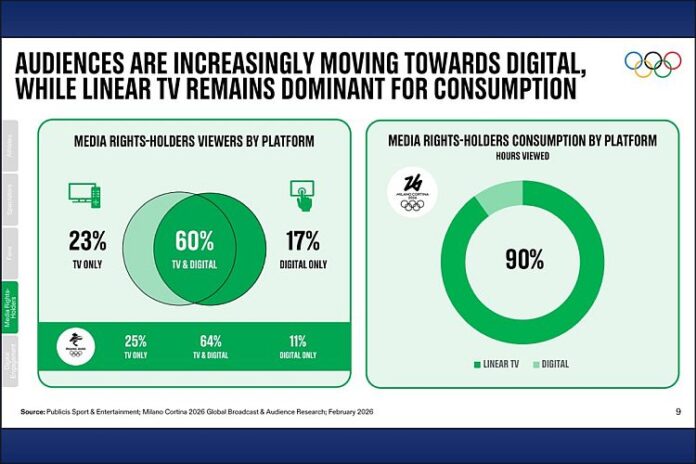
FOOTBALL: FIFA World Cup knock-out round starts with Canadian strike for a 1-0 win over South Africa; median group-stage ticket price was $913

The Sports Examiner: Chronicling the key competitive, economic and political forces shaping elite sport and the Olympic Movement.★

To get the daily Sports Examiner Recap by e-mail: sign up here!

≡ FIFA WORLD CUP ≡

The first elimination game of the FIFA World Cup was at SoFi Stadium in Inglewood, California, with the second-place teams from Groups A and B – Canada and South Africa – facing off.

This was end-to-end action from the start, but strong defending and only two shots (1-1) in the first 15 minutes. South Africa had 65% possession at the hydration break, but Canada – with the crowd on their side – had a 3-2 shot edge.

Canada had a real chance in the 44th, off a corner that was headed by defender Moise Bombito, and the shot had to be cleared by South African defender Aubrey Modiba, and then a rebound shot by forward Tajon Buchanan was kicked away by keeper Ronwen Williams. At 45+1 a possible penalty in the box on defender Richie Laryea on a tackle by South Africa’s Khuliso Mudau was waved off as incidental. The late rush gave Canada an 7-3 shots edge while South Africa finished the half with 55% possession.

The game was end-to-end again in the second half and Canadian forward Tani Oluwaseyi ran onto a lead pass in the 65th and got a clean shot on goal that was saved by Williams, then a rebound was stabbed at by striker Jonathan David, but kicked away by defender Mbekezell Mbozaki, saving a sure goal.

At the second hydro break, it was still scoreless, with South Africa at 59% possession, but the shots piling up for Canada (9-4). Canada was getting more cohesion and  forward Promise David just missed a long-range shot to the left in the 76th.

The Canadian pressure finally paid off at 90+2 as an entry pass into the box was headed back into the midfield and midfielder Stephen Eustaquio ran up to smash a  right-footed one-timer into the South Africa net for the 1-0 lead and a wild celebration of the pro-Canada crowd.

Canada held off the South African rally and won the game, 1-0, with 42% possession but much more aggressive, with a 12-6 edge on shots.

Canada moves on and their “reward” will be to play the winner of Netherlands-Morocco on Monday, on 4 July in Houston.

≡ PANORAMA ≡

The elimination round-of-32 slate for Monday and Tuesday:

Monday, 29 June 2026:
● Brazil vs. Japan ● In Houston (1 p.m. Eastern)
● Germany vs. Paraguay ● In Foxborough (4:30 p.m. Eastern)
● Netherlands vs. Morocco ● In Monterrey (9 p.m. Eastern)

Tuesday, 30 June 2026:
● Ivory Coast vs. Norway ● In Arlington (1 p.m. Eastern)
● France vs. Sweden ● In East Rutherford (5 p.m. Eastern)
● Mexico vs. Ecuador ● In Mexico City (9 p.m. Eastern)

In terms of advancement, the big winner of the expansion to 48 teams and 32 in the knock-out round was Africa, and always-strong Europe also did better than in 2022:

● 13: Europe (of 16 entries; vs. 8/13 in 2022)
● 9: Africa (of 10 entries; vs. 2/5 in 2022)
● 5: South America (of 6 entries; vs. 2/4 in 2022)
● 3: North & Central America & the Caribbean (of 6 entries; vs. 1/4 in 2022)
● 2: Asia (of 9 entries; vs. 3/6 in 2022).

The 16 elimination-round teams in 2018 in Russia included 10 from Europe, four from South America and one each from Asia and CONCACAF.

The tracking site TicketData.com noted that for the 72 matches of the group stage, the median get-in price settled at a final of $913, with 61 matches rising in price since the tournament began.

The median price almost doubled – up 49% – since the 11 June start and 11 matches saw increases of 10-25%, 16 matches were up 25-50% and 34 matches went up by more than 50%.

As for the remaining knock-out round matches, the current median get-in price is $1,852, with half of the matches rising in price since 11 June by 50% or more and just eight that fell in price or were flat.

The lowest-priced round-of-32 ticket as of Sunday morning was Belgium vs. Senegal on 1 July in Seattle, at $449.

The CBC reported that British Columbia Attorney General Niki Sharma has opened an inquiry into the handling of World Cup tickets by StubHub, “in the wake of a CBC News investigation that revealed a mass failure by the ticket reseller platform and StubHub’s cancellation of thousands of fan tickets for World Cup matches in Vancouver, Toronto and host cities across North America.”

Iran was eliminated after the group stage after the wild finishes in Saturday’s game, but left another hand-written note in its locker room following its 1-1 draw with Egypt in Seattle on Friday:

“We come from Iran… from a land that, for thousands of years, has placed honour above victory.

“For us, football is not only a competition for results, it is a test of character.

“Perhaps points can be won in many ways, but respect cannot.

“Perhaps a team can advance from a group, but only through fairness and honour can one stand tall before history.

“Fair play is not just a line in football rules, it is the soul of the game.

“Thank you Seattle for your hospitality, and thank you to all Iranians… who gave their hearts, their voices, and their whole being for Iran. Iran, always standing tall.”

Iranian officials complained vociferously about poor treatment from the U.S. government – in the middle of a major conflict over Iranian nuclear ambitions – during the World Cup, with matches played in Inglewood, California and Seattle.

Receive our exclusive, weekday TSX Recap by e-mail by clicking here.
★ Sign up a friend to receive the TSX Recap by clicking here.
★ Please consider a donation here to keep this site going.

For our updated, 681-event International Sports Calendar for 2026 and beyond, by date and by sport, click here!
ATHLETICS: Swiss Werro scares 800 m world record in 1:53.80 at Paris Diamond League, and U.S. wins for Bromell, Fisher and Britt

Swiss Audrey Werro on the way to a sensational 1:53.80 at the 2026 Paris Diamond League (Photo: Marta Gorczynska for Diamond League AG).

The Sports Examiner: Chronicling the key competitive, economic and political forces shaping elite sport and the Olympic Movement.★

To get the daily Sports Examiner Recap by e-mail: sign up here!

≡ PARIS DIAMOND LEAGUE ≡

The summer heat wave in Europe impacted the eighth stage of the 2026 Diamond League at the Stade Charlety in Paris (FRA), with all of the events other than those for “professional” athletes canceled – essentially the youth and club events – but the meet went on.

The conditions weren’t too bad, with 83 F temperatures when the main part of the meet started, and a nice crowd on hand to see four world-leading performances:

Men/800 m: 1:41.84, Marco Arop (CAN)
Men/1,500 m: 3:28.00, Cam Myers (AUS)
Women/400 m: 48.48, Marileidy Paulino (DOM)
Women/800 m: 1:53.80, Audrey Werro (SUI)

The women’s 800 m was a run at the world record of 1:53.28 by Czech Jarmila Kratochvilova (1983) with Swiss Diamond League Final winner Audrey Werro being challenged by Femke Broeders-Bol (NED) and they were 1-2 after the pacer left. Coming into the final turn, Bol was passed by France’s Anais Bourgoin, but Werro blasted away in the straight and ran to the finish in 1:53.80, the no. 3 performance in history!

Bol came back on Bourgoin and got second at the line, in a stunning 1:55.60, no. 3 in the world for 2026 and Bourgoin got a national record at 1:55.65 (no. 4). Five broke 1:57! American Roisin Willis finished ninth in 1:58.66.

The men’s 800 m was all about Canada’s 2023 World Champion Marco Arop. He followed the pacer through 400 m, was in front by 500 m and ran away. He had a 20 m lead into the turn and more into the straight and won all alone in a world-leading 1:41.84! He’s now no. 11 all-time. Behind him were Niels Laros (NED: 1:43.60) and Tobias Gronstad (NOR: 1:43.63).

The women’s 400 m was a clear win for Olympic champ Paulino, who came into the lead on the final turn and blew away the field down the straight. She finished in a world-leading 48.48, her third-fastest time ever. Czech Lurdes Manuel came on over the straight to get second in a lifetime best of 49.37 with Jamaica’s Stacey Ann Williams third in 49.51.

The 2022 World Champion, Jake Wightman (GBR), was in the men’s 1,500 m, and the field crossed 800 m in 1:52.12. But that was the take-off point for Australia’s Cam Myers and he moved away from France’s Azeddine Habz … and the lead kept growing. He rolled down the straight and won easily in a lifetime best of 3:28.00, a world lead and now no.12 all-time. He’s 20, by the way.

Habz was second in 3:29.80 and Wightman got third (3:29.95). American Vince Ciattei was 14th in 3:36.47.

The men’s 100 m had Olympic champ Noah Lyles and World Indoor champ Jordan Anthony, but two-time Worlds medalist Trayvon Bromell – in lane eight – who had the best start and maintained the lead. Lyles was coming on, as usual, in the second half, but ran out of room and finished second, 9.91 to 9.92 (+0.1 m/s). Tokyo Olympic champ Lamont Marcell Jacobs (ITA) surprised in third in 9.96 and Anthony, who did not get the start he wanted, was fifth in 9.99.

Americans Kendrick Smallwood and Trey Cunningham led the 110 hurdles heats, and Cunningham was out best in the final. He was challenged by emerging U.S. star Jamal Britt, who moved strongly in the middle and took over and was clear to the finish in a lifetime best of 12.89 (+0.8)! Cunningham hit two of the last three hurdles and was passed on the run-in by Japan’s Shunsuke Izumiya for second, 13.01 to 13.07. Smallwood started poorly and was eighth in 13.46.

The men’s 5,000 m was about France’s 10,000 m World Champion Jimmy Gressier, but it was Etienne Daguinos (FRA) who was all alone by 3,000 m. He was caught by 3,600 m and Egide Ntakarutimana (BDI) had the lead at the bell. He continued until 200 m to go, then Sweden’s Andreas Almgren took the lead into the straight. He got passed by Kenya’s Jacob Krop and then Krop was passed by Grant Fisher of the U.S., who won in 12:54.80 to 12:55.22. Almgren was third in 12:55.38 and Ntakarutimana for fourth (12:56.06); Graham Blanks of the U.S. was sixth in 12:57.12. The last lap was in 54.62 for Fisher’s first Diamond League win.

In the men’s 400 m, Britain’s Olympic runner-up Matthew Hudson-Smith led the race around the turn, but 2025 World Champion Collen Kebinatshipi (BOT) pulled up on the straight and won easily in 43.54, with Zakithi Nene (RSA) second in 43.89 and American Chris Bailey with a lifetime best of 44.06 moving on the straight for third, Hudson-Smith had to settle for fourth in 44.09. Kebinatshipi remains no. 2 in the world in 2026, but with a seasonal best. Nene is now no. 3 this year.

There were 22 men in the Steeple, with Gemechu Godana (ETH) leading at 2,000 m and four were in contact at the bell. Godana was still in front with 200 to go and then German Karl Bebendorf came up on Godana and won at the line in a lifetime best of 8:05.55, with Godana at 8:05.86. Kenya’s Edmund Serem was third in 8:08.54; American Matt Wilkinson was sixth in 8:11.35, and Carson Williams was 15th in 8:20.67.

Six cleared 5.83 m (19-1 1/2) in the men’s vault, plus world-record holder Mondo Duplantis (SWE), who cleared 5.63 m (18-5 1/2) and kept passing. Eight jumped at 5.93 m (19-5 1/2) and Duplantis took the lead with a first-time clearance. France’s Baptiste Thiery also cleared on his first try, and they went on to 6.03 m (19-9 1/4), but only Duplantis cleared for the win, with Thiery second. Duplantis cleared 6.13 m (20-1 1/4) to win and moved up to a world record 6.32 m (20-8 3/4), but missed all three tries.

American Chris Nilsen was fourth at 5.83 m; two-time World Champion Sam Kendricks of the U.S. was eighth at 5.73 m (18-9 1/2) and KC Lightfoot cleared 5.63 m and was ninth.

World-record holder Tobi Amusan (NGR) was away well in the women’s 100 m hurdles, as was Dutch star Nadine Visser. But as Amusan stayed in front, American Grace Stark came up to second and chased Amusan to the line, 12.28 to 12.38 (+0.7). Fellow American Alaysha Johnson also passed Visser on the run-in, 12.39 to 12.41. American Rayniah Jones finished sixth in 12.60.

Australian Paris 1,500 m silver winner Jessica Hull had the lead in the women’s 1,500 m at 800 m, but was being tracked by 2024 World Indoor champ Freweyni Hailu (ETH) and 2026 World Indoor winner Georgia Hunter-Bell (GBR) at the bell. Hailu surged into the lead with 240 m to go, followed by Hunter-Bell, who jetted to the lead in the straight. Hailu came back on her and they finished 1-2 at 3:55.63 to 3:55.92. France’s Agathe Guillemot got a national record in third (3:56.24) with Hull at 3:57.22.

Three cleared 4.70 m (15-5) in the women’s vault, and Swiss Angelica Moser was the only one to clear 4.77 m (15-7 3/4) as the winner. New Zealand’s Rio Olympic bronze winner Eliza McCartney and Olympic champ Nina Kennedy were 2-3, both at 4.70. American Emily Grove was fourth at 4.60 m (15-1), Gabriela Leon was sixth (also 4.60 m) and Brynn King was 10th at 4.45 m (14-7 1/4).

Canadian star Sarah Mitton got out to 19.99 m (65-7) in round three and that was good enough to win the women’s shot, just ahead of Olympic champ Yemisi Mabry (GER: 19.93 m/65-4 3/4). The U.S. entries were 7-8-9: Abria Smith (18.46 m/60-6 3/4), Jaida Ross (18.18 m/59-7 3/4) and Adelaide Aquilla (18.09 m/59-4 1/4)

China’s world leader, Ziyi Yan, bombed the women’s javelin field with a monster 67.44 m (221-3) throw in the first round. Serbia’s Adriana Vilagos was second with her second-round throw of 63.83 m (209-5) and Japan’s Olympic champ Haruka Kitaguchi took third at 63.01 m (206-8).

The single Diamond League meet in the U.S. comes next week at the Pre Classic in Eugene.

Receive our exclusive, weekday TSX Recap by e-mail by clicking here.
★ Sign up a friend to receive the TSX Recap by clicking here.
★ Please consider a donation here to keep this site going.

For our updated, 681-event International Sports Calendar for 2026 and beyond, by date and by sport, click here!
FOOTBALL: Bellingham, Kane star for England; Colombia wins group after 0-0 with Portugal; Dem. Rep. Congo advances in FIFA World Cup!

The Sports Examiner: Chronicling the key competitive, economic and political forces shaping elite sport and the Olympic Movement.★

To get the daily Sports Examiner Recap by e-mail: sign up here!

≡ FIFA WORLD CUP ≡

The final day of the group stage had six matches and England got what it needed to win Group L, and the Democratic Republic of the Congo came from behind to beat Uzbekistan and advance to the knock-out round. The scoreless tie between Group K winner Colombia and Portugal was hardly boring, with 37 total shots!

● Group L: England 2, Panama 0 Rainy conditions for this match in East Rutherford, with England (1-0-1 W-L-T) on offense immediately and Panama (0-2) waiting for counterattack possibilities. The hydration break came with England taking five shots to one and with 74% possession. But no goals, after none against Ghana in their second game.

England continued with the ball for the remainder of the half and had nine shots to three at halftime and 72% of the ball, but it was still 0-0 against a strong Panama defense.

England’s scoring ace Harry Kane almost scored in the 52nd, but a pass to the front of the Panama’s goal went off his left, then off the leg of a defender and ended up on the top of the net. Kane smashed a right-foot strike from the right side of the box in the 57th that was saved by Panama keeper Orlando Mosquera.

But off a corner by forward Bukayo Saka in the 62nd, midfielder Jude Bellingham was being held by defender Andres Andrade, and as the ball came into the box, he stuck out his left foot and the ball flew into the goal for the 1-0 lead.

Bellingham made the play again in the 67th, this time on a cross from the left side, near the endline, with a looping pass into the middle of the box for Kane, who headed it in for a 2-0 edge. It’s his 11th career World Cup goal, the most in English history. That led to the hydro break, with England at 71% possession and 14-5 on shots.

Panama got a goal from striker Jose Fajardo with a hard shot just inside the box off a breakaway at 90+1, but was called offsides (barely). It ended 2-0 with 68% possession for England and 17-13 on shots.

● Group L: Croatia 2, Ghana 1 There were lively moments right away in this game in Philadelphia, with Croatia (1-1) off to the races after Ghana (1-0-1) turnovers, but just two shots in the first 25 minutes to the hydro break, with Ghana holding 52% of possession.

The Croatian offense finally arrived in the 31st on a midfielder Petar Sucic strike from well beyond the top of the box off of a feed from midfielder Mateo Kovacic, for the 1-0 lead. That was the score at half, with Croatia enjoying a 5-1 shots advantage and Ghana not seriously threatening at all.

The teams were sharing possession in the second half and Ghana pushed harder on offense, but Croatia maintaining 53% of the ball and 5-3 on shots. On a free kick by forward Ernest Nuamah from the right side, beyond the top of the box, defender Derrick Luckassen ran onto the ball right in front of the net and scored to tie it in the 73rd, following a video review!

Croatia wanted a response and got a perfect play in the 83rd off a corner by midfield star Luka Modric that came down for midfielder Nikola Vlasic at the back of the formation, who sent the header to the far left corner of the net for a 2-1 lead.

That’s how it ended, withy Croatia finishing at 53% possession and 8-6 on shots and second in the group.

● Group L ● England won two games and topped the group at 2-0-1 and seven points. Both Croatia and Ghana advanced, but the Croatia win to get to 2-1 means they are second and Ghana (1-1-1) was third and moving on as well.

● Group K: Colombia 0, Portugal 0 Colombia (2-0) was in excellent position against Portugal (1-0-1) in in hot (85 F) and humid (70%) conditions in Miami Gardens, and the Colombians were on offense with seven shots at the first break, to three for Portugal, even with only 43% of possession.

Portugal found more offense after the break and Colombian keeper Camilo Vargas had to make a great save in the 39th on a point-blank blast by midfielder Bruno Fernandes. Colombia regained the offense right at the end of the half, but it ended scoreless, with Colombia at 55% of the ball and a lively 13-9 on shots.

The second half started with more energy and back-and-forth attacks. Portugal’s scoring star Cristiano Ronaldo was offside and missed a chance wide in the 60th. Colombia’s midfielder Richard Rios had a chance in front of goal in the 62nd, but it went wide. Colombian midfielder Santiago Arias sent a bullet in the 66th, but was saved by Diogo Costa, his sixth save. At the hydro break, Colombia led 18-11 on shots and had 55% of the ball.

Both teams were up and down the field, and Costa made another acrobatic save in the 87th to keep Portugal even. But at 90+1, a header from Davinson Sanchez looked like the game winner, but was called for offsides (barely). It ended scoreless, with 37 total shots in the game – 24 for Colombia – thanks to 54% possession and they win the group.

● Group K: Dem. Rep. Congo 2, Uzbekistan 1 The Africans (0-1-1) needed a win in Atlanta to advance. But it was Uzbekistan (0-2) took an early 1-0 lead in the 10th from striker Eldor Shomurodov, who popped the ball over the head of D.R. Congo keeper Lionel Mpasi off a long feed from midfielder Abbosbek Fayzullaev.

It didn’t take long for the Leopards to respond, in the 17th, with a score from striker Nathaniel Mbuku and an assist to forward Brian Cipenga, but the goal was rescinded for a prior foul by Mbuku after a review. The hydro break came shortly after, with 54% of the ball for D.R. Congo, but only one shot apiece.

The half ended 1-0, with D.R. Congo up to 64% possession and a 4-2 edge on shots.

Still trying to find a equalizer, the Leopards suddenly had a golden opportunity in the 66th, as striker Yoane Wissa was brought down in the box by Abdukodir Khusanov. Wissa took the penalty in the 68th and scored easily on a pass to the right side of the goal. The Leopards had 64% of the ball at the second hydro break and was up 11-3 on shots.

And they kept coming and got the second goal they desperately wanted from forward Fiston Mayele in the 78th, scoring off a deflected ball off a drive by forward Meschack Elia. And the win was confirmed with another goal for Wissa at 90+1 on a drive from 20 yards out from a left-side pass by Elia, for the 3-1 final. The Leopards had 58% possession and, in the end, dominated the game with 19-3 on shots.

● Group K ● Colombia was 2-0-1 and won the group with seven points, and Portugal at 1-0-2 (5) was second. The impressive performance of D.R. Congo earned them their first advancement at 1-1-1 in their second appearance, and will face England in the round-of-32.

● Group J: Argentina 3, Jordan 1 Argentina (2-0) had already clinched the group before this match at AT&T Stadium in Arlington, so nine new players started and superstar Lionel Messi started the game on the bench. Argentina was busy right away and midfielder Giovani Lo Celso scored in the seventh minute, but the goal was wiped off for offsides.

No worries; Lo Celso had a free kick from just outside the box in the 19th and drilled it into the far side of the net with the left foot for the 1-0 lead. Wow. At the hydration break, Argentina had 79% possession and both shots in the game.

In the 29th, Jordan defender Ehsan Haddad was called for a penalty in the box for not playing the ball. Striker Lautauro Martinez took the penalty in the 31st and buried the ball in the far left corner for the 2-0 lead. There were plenty more chances for Argentina, but no more goals in the half; Argentina had 72% possession and 5-3 on shots.

Argentina created more chances in the second half, but then Haddad sent a perfect cross from the right side and forward Mousa Al-Tamari came and met the ball with the left foot and scored in the 55th to cut the score to 2-1! In the meantime, Messi was ready to enter and came on in the 60th, to replace Martinez. The hydration break followed in the 67th, with Argentina still at 73% and 8-5 on shots.

Of course, everyone was waiting for Messi to explode and he did in the 80th on a free kick from on top of the box, where he curled it around the wall and into the goal for a 3-1 lead and increases his World Cup scoring lead to six goals in this tournament. He’s now scored in seven straight World Cup matches, a first for any player.

It ended 3-1, with Argentina up 12-5 on shots and enjoying 73% of possession.

● Group J: Algeria 3, Austria 3 Both teams were 1-0-1 and looking to advance in this match in Kansas City, but neither could get a goal before the hydro break, with Algeria at 53% possession and one shot each.

Just after the re-start, Austrian defender David Alaba sends a long ball ahead and forward Marko Arnautovic did the rest, dribbling in and getting the ball past Algerian keeper Oussama Benbot in the 28th for a 1-0 lead. But the Algerians got even in the 45th, as defender Rafik Belghali picked up the ball after it caromed off the corner flag (and two others were tackling each other), then flashed past two defenders and scored a ripping goal on a liner from the top of the box on the right side, to go 1-1. The half ended that way, with Algeria at 57% of the ball and 7-5 on shots.

Algeria maintained possession to start the second half, but in the 55th, midfielder Konrad Laimer sent a ball in from the right side and midfielder Marcel Sabitzer had space and drilled it for the 2-1 lead.

But the Algerians were unimpressed and five minutes later midfielder Houssem Aouar sent a pass across the Austrian goal and was scored by forward Riyad Mahrez for the 2-2 tie. The hydro break followed with Algeria maintaining 57% of the ball and up by 11-8 on shots.

The pace of the game slowed and it looked like a tie in the making, but at 90+3, Algeria’s Mahrez scored again from Aouar, who sent a ball into the box from right to left to set him up.

But, incredibly, this wasn’t over. With literally seconds to play, a header by forward Michael Gregoritsch from the endline came back to the front of goal, where it was headed in by striker Sasa Kalajdzic at 90+6! The game ended moments later and with the tie, both teams advanced.

Algeria had 65% of possession during the game, but just a 12-10 edge on shots. In the end, both teams won, somehow.

● Group J ● Argentina beat Jordan, but gave up its first goal. They’re on as the group winner at 3-0. The unbelievable tie between Austria and Algeria gave both four points (1-1-1) and sent both on to the round-of-32. The loser was Iran, which had three points, but with a goal differential of zero, lost out on the eighth and final third-place spot to Senegal, which had three points but was +2.

≡ PANORAMA ≡

The elimination round-of-32 will start on Sunday (28th) in Inglewood, California, between South Africa and Canada, at noon local time. For Monday and Tuesday:

Monday, 29 June 2026:
● Brazil vs. Japan ● In Houston (1 p.m. Eastern)
● Germany vs. Paraguay ● In Foxborough (4:30 p.m. Eastern)
● Netherlands vs. Morocco ● In Monterrey (9 p.m. Eastern)

Tuesday, 30 June 2026:
● Ivory Coast vs. Norway ● In Arlington (1 p.m. Eastern)
● France vs. Sweden ● In East Rutherford (5 p.m. Eastern)
● Mexico vs. Ecuador ● In Mexico City (9 p.m. Eastern)

Ticket sales are in for the official Los Angeles Fan Festival from 11-14 June – the first four days of the tournament – at the Los Angeles Memorial Coliseum, with 85,023:

11 June: 27,343 (Monday)
12 June: 20,866 (Tuesday)
13 June: 23,722 (Wednesday)
14 June: 13,092 (Thursday)

Coliseum spokeswoman Andrea Ambriz noted these are ticket holders only and do not include staff or visitors to the greater Exposition Park area, or the watch party at the adjacent BMO Stadium. Also, “that max attendance was closer to 40K on Monday since people stayed for the all-day festivities.”

Receive our exclusive, weekday TSX Recap by e-mail by clicking here.
★ Sign up a friend to receive the TSX Recap by clicking here.
★ Please consider a donation here to keep this site going.

For our updated, 681-event International Sports Calendar for 2026 and beyond, by date and by sport, click here!
LOS ANGELES 2028: City of L.A. added-services contract draft says LA28 to use funds to reimburse L.A. before declaring a surplus

The Sports Examiner: Chronicling the key competitive, economic and political forces shaping elite sport and the Olympic Movement.★

To get the daily Sports Examiner Recap by e-mail: sign up here!

≡ L.A. CITY SERVICES CONTRACT ≡

An agreement between the LA28 Olympic and Paralympic organizing committee and the City of Los Angeles to define how the City will be reimbursed for services it provides for the Games that are above-and-beyond “normal levels” was due in October 2025.

On Friday, nearly nine months later, a draft of the “Enhanced City Resources Master Agreement” was transmitted to the City’s Ad Hoc Committee on the Olympic and Paralympic Games.

The biggest issue identified by City Attorney Hydee Feldstein Soto in a March memorandum was that the LA28 position then was that it could declare a surplus from the Games even if the City had not recovered all of its added expenses.

On this point, the summary of the ECRMA draft noted:

“LA28 agrees to pay the City all outstanding amounts due pursuant to this ECRMA, the Host City Contract, the Games Agreement, and any other relevant agreement between the parties prior to disbursing any potential surplus funds to a legacy entity.”

An amendment to the 2021 Games Agreement will further allow the $270 million contingency fund established by LA28 to be used for unreimbursed security expenses.

Thus, the City obtained better protection, but does not have a commitment from LA28 to use any and all available funds to pay for all of the City’s Games-related expenses, such as security costs not paid by hoped-for Federal funding.

The 15-page Enhanced City Services Master Agreement lays out a framework under which more contracts will be created and signed. Per the summary of the agreement:

● “To support the successful delivery of the 2028 Games, the City will provide Enhanced City Resources (ECR) exceeding normal and customary levels, and LA28 will reimburse the City for resulting costs of these services.”

● “To ensure reimbursement of ECR, a process and timeline is established in the Games Agreement which includes developing the proposed ECRMA to identify, among various issues, City resources, processes, commitments, and payment timelines for the 2028 Games, and subsequently creating Venue Services Agreements (VSA) to identify the specific ECR at each identified LA28 venue.”

Fifteen City of Los Angeles sites – some with more than one venue – have been identified and others will be added, as Griffith Park for road cycling events is not yet on the list.

The City intends to get as much money ahead of time as possible, as the agreement notes:

“The City shall provide the OCOG [organizing committee] with an initial monthly cost estimate for Enhanced City Resources agreed upon in any forthcoming VSA by October 1, 2026, or 60 days following completion of any VSA. Final monthly cost estimates for such Enhanced City Resources shall be mutually agreed upon by the Parties by no later than October 31, 2027 (the ‘Estimated City Services Costs’).”

Monthly payments based on these estimates are to start on 1 February 2028, and a final statement by the City will be due on 1 December 2028. The agreement further explains:

“To the extent the OCOG requests in writing, through either its Chairperson or Chief Executive Officer, that the City further improve accessibility, beautification, streets, or other Games-related infrastructure above and beyond the City’s minimal legal requirements or which the City elects to pursue in its sole discretion, such agreed upon costs will be reimbursed by the OCOG pursuant to the terms and conditions of this ECRMA.”

The next step is for review at the City Council’s Ad Hoc Committee on the Olympic and Paralympic Games.

An area of interest to City Council members is a right to audit LA28’s finances, but no blanket authorization was included in the agreement as provided.

Council member Monica Rodriguez has been pushing for a financial audit of LA28 to be performed by a City contractor to be selected.

Receive our exclusive, weekday TSX Recap by e-mail by clicking here.
★ Sign up a friend to receive the TSX Recap by clicking here.
★ Please consider a donation here to keep this site going.

For our updated, 681-event International Sports Calendar for 2026 and beyond, by date and by sport, click here!

FOOTBALL: Dembele’s hat trick sparks France’s dominant win; Spain wins its group and Cape Verde advances (!) at FIFA World Cup

The Sports Examiner: Chronicling the key competitive, economic and political forces shaping elite sport and the Olympic Movement.★

To get the daily Sports Examiner Recap by e-mail: sign up here!

≡ FIFA WORLD CUP ≡

● Group I: France 3, Norway 1 Both teams were 2-0 and through to the round-of-32 ahead of this match in humid (76%) Foxborough. Norway put in 10 new starters (no Erling Haaland), but France’s Kylian Mbappe was on the field.

And Mbappe sent a terrific lead pass to forward Ousmane Dembele from the left side of midfield to the right in the seventh minute. Dembele did the rest, switching feet and coming up to blast a right-footed shot into the far side of the net for the 1-0 lead.

Dembele did it again in the 20th, taking a pass from Mbappe on the right side, dribbling to the left, taking a moment and then sending a laser with the left foot into the net for 2-0.

The Norwegians were unimpressed and on the following possession, saw midfielder Thelo Aasgaard take the pass from forward Andreas Schjelderup at the left side of the box, take a dribble towards the middle and then rifle a right-footed shot back to the short side of the French net to close to 2-1 in the 21st!

The hydro break came next, with 70% French possession and an 11-4 shots lead, but in a fight for sure. Dembele struck again in the 32nd, as he got the box at the right side of the box, dibbled in and sent a left-footed strike to the far post for a 3-1 lead. Wow.

(Fox’s Ian Darke noted that the last first-half hat trick in the World Cup was in 1994.)

The half ended 3-1, with the French at 62% of the ball and 14-4 on shots, an accurate representation of the half. Norway had a chance for a quick goal as a penalty was called on defender Theo Hernandez was called for a penalty against Norway’s Oscar Bobb in the box in the 48th. But forward Jorgen Larsen took a poor penalty that was easily saved by French keeper Mike Maignan.

The French were at 59% possession and 16-7 on shots at the second hydro break, as the game wound down. But France got to 4-1 at 90+4 as substitute forward Desire Doue scored a header to the right side of goal on a cross from Bradley Barcola. The French left no doubt at 57% possession and 18-10 on shots. Both move on.

● Group I: Senegal 5, Iraq 0 Both teams came in with two losses for the game in Toronto, and it got crazy right away. Senegal defender Abdoulaye Seck appeared to head in a corner in the fourth, but the goal was given to midfielder Habib Diarra as the ball grazed him on the way in.

Iraq suffered a red card in the 13th as defender Rebin Sulaka brought down forward Sadio Mane on what was considered a scoring opportunity, confirmed by video review. At the hydro break, Iraq had 60% possession, but the Senegalese had a 6-2 shots edge, and expecting more goals.

Senegal took control, of course, with the man edge and was at 58% possession at the half and 10-4 on shots, but just the one goal.

The lead stretched out in the second half, with a goal from forward Ismaila Sarr in the 56th following an Iraq turnover and an assist from Lamine Camara, then substitute midfielder Pape Gueye scored in the 59th for a 3-0 lead. At the hydro break, Senegal now had 63% possession and 16-5 on shots.

They got to 4-0 in the 71st as Gueye got his second on a left-footed strike from the top of the box that flew into the top left side of the Iraq net. Senegal was relentless, looking for goals which might give them a spot on the last 32 based on goal differential. It was 5-0 on a Iliman Ndiaye edge-of-the-box strike for a goal in the 82nd, with an assist to Gueye.

It finished with 69% possession for Senegal and 28-6 on shots in a total mismatch.

● Group I ● France dominated the group at 3-0 and went through easily, with Norway at six points at 2-1. Senegal (1-2) earned three points and will have to see if their goal differential (+2 now) is enough to advance.

● Group H: Spain 1, Uruguay 0 The Spanish (1-0-1) were favored in Guadalajara, but Uruguay (0-0-2) needed points to advance. The start was cautious, with Uruguay careful to limit Spanish passing in their zone. Spain had 77% possession at the hydration break, and the only two shots in the game.

The Spanish kept probing and got a break in the 42nd, as midfielder Marcos Llorente got hold of a loose ball on the right side and sent a cross to the middle of the box to midfielder Alex Baena, who launched a right-footed shot, which ready to be stopped by Uruguay keeper Fernando Musiera, but got by him for a 1-0 lead.

Spain finished the half at 74% of the ball and 4-3 on shots in a game they led, but were not totally in control. The second half had Uruguay more aggressive – they needed a goal – but were unable to manufacture chances. But the defense was enough to deny Spain by the hydro break, despite 71% possession so far and 5-4 on shots (yep, two shots in the half so far).

Uruguay kept looking for an opening and found none; Spanish sub forward Ferran Torres had a chance to ice it in the 86th, but an open shot in the middle of the box ricocheted off the crossbar. An Uruguay scramble in the box in the 90th ended with an Uruguayan foul.

Uruguyan frustration boiled over at 90+4 with a studs-up tackle by forward Augustin Canobbio and a red card, with tempers flaring among multiple players. And it ended at 1-0 and in turmoil, with Spain at 67% possession and 6-5 shots. One of the worst games of this tournament.

● Group H: Cape Verde 0 Saudi Arabia 0 The amazing Cape Verde, with two draws, was looking to advance (!) with a win against the Saudis (0-1-1) in Houston, but the match began with defense at the core. No score at the first break, with even possession and the Saudis making the only shot of the first 25 minutes.

Cape Verde was more aggressive after the break, and finished with 53% of the ball and four shots to three in the half. The second half was more aggressive for Cape Verde, but still no score at the second hydro break, with 55% of the ball and 8-4 on shots.

It ended 0-0 and Cape Verde is on to the elimination round. They had 51% possession and 15-7 on shots, Astounding.

● Group H ● Spain won the group at 2-0-1 and five points, but was hardly the juggernaut expected. Cape Verde, the smallest country to ever compete in the World Cup and playing in the tournament for the first time, played to 0-0, 2-2 and 0-0 draws and goes through, to meet defending champion Argentina. Miracle in the making?

Uruguay (0-1-2) and Saudi Arabia (0-1-2) both had high hopes that did not pan out, and there will be repercussions for both at home.

● Group G: Belgium 5, New Zealand 1The Belgians (0-0-2) were on the attack immediately in Vancouver, but did not manage an early goal despite many minutes in front of the New Zealand goal. In the 20th, a possible penalty for a hand ball on New Zealand defender Finn Surman in the box was called off after a video review.

At the hydro break, Belgium held 74% possession and was 7-0 on shots, but no goals. In the 28th, a corner from star Kevin De Bruyne fell right in front of goal, where it bounced and hit New Zealand defender Tim Payne and kicked in by striker Leandro Trossard for the 1-0 lead.

The Kiwis got some time on offense as the half ebbed, but Belgium broke out multiple times, leading to misfires from striker Jeremy Doku and De Bruyne. Fellow forward Charles de Ketelaere was denied on a left-side blast in the 43rd by New Zealand keeper Max Crocombe.

But the half ended 1-0, even with 61% possession by the Belgians and 16 shots to one!

The Red Devils were on the march to start the second half and after a cross into the box by midfielder Hans Vanaken, Trossard shot again and it was blocked, but it bounced back to him and he didn’t miss in the 50th for a 2-0 lead.

De Bruyne got a brilliant goal in the 66th, taking a pass from the middle of the field to the left side, setting himself up and sending a left-footed laser to the far side of the net for the 3-0 lead. The break came soon after, with Belgium at 58% possession and 26-3 on shots.

The Kiwis got a much-deserved goal in the 84th, on a rebound in in the box that was slammed home by forward Elijah Just, to cut the lead to 3-1. Belgium substituted in star striker Romelu Lukaku and he scored almost immediately – 56 seconds later – as a cross from right to left by midfielder Nicolas Raskin found him at the back end of the Kiwi goal for a header to go to 4-1.

The Red Devils finished with a flurry as Lukaku pushed the ball to the right at the top of the box to Alexis Salemaekers at 90+4 and he crushed a shot that rushed into the net for the 5-1 final. Belgium finished with 55% possession, but an overpowering 35-6 shots advantage.

● Group G: Egypt 1, Iran 1 Both offenses were in gear early in Seattle, as group leader Egypt (1-0-1) scored in the fifth minute on midfielder Mahmoud Saber kicked in a rebound off a saved shot from star striker Mo Salah for the 1-0 lead.

But the Iranians (0-0-2) came right back with a penalty in the 11th, with striker Mehdi Taremi fouled on the box. But he took the penalty and it was saved in the right corner by Egypt’s keeper, Mostafa Shoubir. But the pressure continued and a shot by defender Milad Mohammadi was saved, but the rebound was available to defender Ramin Rezaeian, who scored from short range at a difficult angle to tie it in the 14th!

Both sides made forays, with Egypt controlling 62% of possession in the half and eight shots to six. The second half started with chances for both, but Egypt maintained 65% possession to the hydro break and had 12 shots to eight, but with the game still at 1-1.

The game continued on the way to a tie, but got crazy in stoppage time. At 90+4, an Iranian goal on a rebound by defender Shoja Khalilzadeh looked like the winner, but it was waved off for offsides.

Another Iranian rush into the box had a powerful header from midfielder Saeid Ezatolahi that hit the crossbar at 90+7, and it ended 1-1. Egypt had 61% possession and a 15-12 shots edge, but they barely survived.

● Group G ● The whole group was in chaos until the very end, but Belgium’s big win gave them a 1-0-2 record and five points and +4 on goal differential. That was enough to win the group as Egypt also had five points but +2 goal differential and was second.

Iran ends with three draws (3 points) and a zero goal differential and will have to wait to see if they qualify as a third-place team.

≡ PANORAMA ≡

On Saturday, 27 June, group play will finish:

Group L: Panama vs. England, in East Rutherford (5 p.m. Eastern)
Group L: Croatia vs. Ghana, in Philadelphia (5 p.m. Eastern)

Group K: Colombia vs. Portugal, in Miami Gardens (7:30 p.m. Eastern)
Group K: DR Congo vs. Uzbekistan, in Atlanta (7:30 p.m. Eastern)

Group J: Algeria vs. Austria, in Kansas City (10 p.m. Eastern)
Group J: Jordan vs. Argentina, in Arlington (10 p.m. Eastern)

The elimination round-of-32 will start on Sunday (28th) in Inglewood, California, between South Africa and Canada, at noon local time.

Andrew Giuliani, the Executive Director of the White House Task Force for the World Cup, says the U.S. should consider a bid to host the event again in 2038, the first available edition. The BBC reported Giuliani’s comments, that included:

“When you think that this World Cup may at some point expand out to 64 teams, I think the United States can handle it. Let me make sure we get through this World Cup on 19 July before we make our pitch for 2038 or other ones.

“There’s no better country that’s positioned to host a World Cup than the United States, and I think we’re seeing that on social media.

“I think we’re seeing that with all the fans that may be interacting with the U.S. for the first time, or the first time in a long time, that the U.S. truly is extremely welcoming, that we have such an incredible infrastructure.

“We have the stadiums built, so for the U.S., compared to other host nations, where it costs tens and tens of billions of dollars, you know, it cost us a couple of billion.”

The 2030 and 2034 World Cups have already been assigned. Any bid for a future World Cup must come from the U.S. Soccer Federation, which is already preparing for a formal acceptance of its bid to host the 2031 FIFA Women’s World Cup.

Receive our exclusive, weekday TSX Recap by e-mail by clicking here.
★ Sign up a friend to receive the TSX Recap by clicking here.
★ Please consider a donation here to keep this site going.

For our updated, 681-event International Sports Calendar for 2026 and beyond, by date and by sport, click here!

FOOTBALL: Ecuador stuns Germany in Group E, Dutch speed through Group F, U.S. loses to Turkey in FIFA World Cup

The Sports Examiner: Chronicling the key competitive, economic and political forces shaping elite sport and the Olympic Movement.★

To get the daily Sports Examiner Recap by e-mail: sign up here!

≡ FIFA WORLD CUP ≡

The second day of group-stage final games started with an upset of Germany by Ecuador, and a taut match between Japan and Sweden, while the Netherlands was running past Tunisia to win Group F. The U.S. plays later.

● Group E: Ecuador 2, Germany 1 Ecuador (0-1-1 W-L-T) needed a win in this game against 2-0 Germany in East Rutherford, and it went wrong right away, as Germany got a goal in the second minute from striker Leroy Sane, with a left-footed boot off of a loose ball in the middle of the box, despite what looked like a foul by midfielder Aleksandar Pavlovic in the box in kicking the ball over a defender. Midfielder Florian Wirtz forwarded the ball to Sane.

But Ecuador was undaunted and a fabulous strike from midfielder Nilson Angulo at the top of the box in the 9th minute got them even, with their first goal of the tournament. Ecuador continued pressing, but the Germans had 55% of the ball at the hydration break and a 4-1 edge on shots.

The Germans maintained control and were up to 62% possession at half and up 7-2 on shots as Ecuador played a more defense-oriented style through halftime.

In the 46th, Ecuador was called for a penalty on defender Joel Ordonez in the box, but it was wiped off after a video review that showed a foul by Sane on midfielder Pedro Vite in the build-up. Germany had 59% possession at the second hydro break and was 8-4 on shots, but Ecuador kept finding chances.

German keeper Manuel Neuer had to punch away a dangerous strike from forward Enner Valencia in the 62nd and runs into the box kept misfiring. But off a corner in the 77th, forward Kevin Rodriguez headed the ball backwards in the front of goal and forward Gonzalo Plata flicked his left foot at it and popped it over Neuer’s head for a 2-1 lead!

Ecuador then settled into a defensive posture they know so well and ran out the clock for the win and will advance to the elimination round. The Germans ended with 61% and 11 shots to seven, but it was not enough.

● Group E: Ivory Coast 1, Curacao 0 Playing in Philadelphia, Ivory Coast (1-0-1) took charge quickly vs. Curacao (0-1-1) with a goal from striker Nicolas Pepe in the box in the 7th, on forward Yan Diomande’s cross back from the endline after dispossessing the defender.

The Elephants, as Ivory Coast are known, controlled the game up to the hydro break, with 75% possession and a 4-2 shots edge. The Elephants kept control, with 70% of possession by halftime, but Curacao got a couple more shots, with both at four at halftime.

The Ivory Coast pressure continued and resulted in a second goal, with Pepe scoring in the 64th off a seeing-eye pass from midfielder Ibrahim Sangare. At the hydro break, the Elephants had 65% possession, but shots were 6-6.

The rest of the game played out with Ivory Coast in control and ending with 63% of the ball and taking just seven shots all together, vs. 11 for Curacao.

● Group E ● Germany (2-1) had won the group coming in and moves on as expected. Ivory Coast was also 2-1 and finished second after losing, 2-1, to the Germans. Ecuador, with its surprise finish, was 1-1-1 and with four points, should move on as a third-place team.

● Group F: Japan 1, Sweden 1 At AT&T Stadium in Arlington, Japan (1-0-1) and Sweden (1-1) were not sure of advancing, especially with the Netherlands expected to have little trouble with Tunisia.

Japan had the best of possession until the hydro break and 55% possession, but just two shots to one for Sweden. There was a lot of close defending, and the best runs were from Japan, and a noteworthy shot in the box by striker Keito Nakamura to the far corner in the 45th that had to be saved by Swedish keeper Jacob Zetterstrom. The half ended 0-0, with Japan at 55% possession and 4-2 on shots.

Japan had all the pressure in the second half, and finally got a goal in the 56th, on a perfect lead pass from midfielder Ritsu Doan beyond the box and down the middle to a streaking striker Daizen Maeda. Maeda ran onto the ball in stride and finished with authority for the 1-0 lead.

The Swedes, pressing on offense now, saw striker Anthony Elanga with the ball on the right side at the top right corner of the box, and he sent a rocket to the far side of the Japan goal for the 1-1 tie in the 62nd. Wow.

The hydro break came with Japan possession down to 53% and a 7-5 shots advantage. Sweden had the ball for most of the final “period” and Japan keeper Zion Suzuki had to make two saves to maintain the tie. He punched away a right-to-left shot by Elanga at 90+2 and then off of a corner at 90+3, a header by forward Alexander Isak was rejected with lightning reflexes.

It ended 1-1 with Japan at 52% of the ball and Sweden had 10 shots to eight.

● Group F: Netherlands 3, Tunisia 1 In Kansas City, the Dutch came in 1-0-1 and Tunisia had been eliminated at 0-2 already, and the Netherlands was on offense immediately, scoring in the third minute on an own goal by Tunisia’s Ellyes Skhiri! Dutch defender Denzel Dumfries sent a cross from the right side into the box, mis-hit into the goal.

It was 2-0 in the seventh minute as striker Brian Brobbey got his third goal of the tournament off a header from defender Virgil van Dijk from left to right across the goal off of a free kick, with Brobbey making an easy, right-footed finish. The Dutch had 66% possession at the hydro break, but the shots were 3-3.

The game slowed and the score remained the same at half; the Dutch had 70% possession and a 12-4 edge on shots. But Tunisia fired up in the second half and got a header from striker Hazem Mastouri in the 54th to close to 2-1. Midfielder Hannibal Mejbri sent a cross into the box and Mastouri was ready with the header to surprise the Dutch.

However, it was 3-1 quickly, as midfielder Tijjani Reijnders sent a left-side corner kick into the box and defender Jan Paul van Hecke headed it in off of midfielder Anis Slimane and into the goal in the 62nd.

The Dutch continued with 73% of the ball and a commanding 17-6 shots edge, and in control of the game. It finished at 3-1 with 72% possession for Netherlands and a 20-10 shots edge, to clinch the group.

● Group F ● The Dutch finished 2-0-1, and won the group with 10 goals (to four); they are off to play Morocco in the Round of 32. Japan finished second at 1-0-2 and five points with Sweden third (1-1-1: 4) and should go through as a third-place team. All three will be tough to deal with.

● Group D: Turkey 3, United States 2 The U.S. (2-0) changed nine starters and was on offense from the opening, pressuring the Turks (0-2) at SoFi Stadium in Inglewood, with multiple shots in the first two minutes, and then a corner. The service from midfielder Sebastian Berhalter arced to the far side of the goal where defender Auston Trusty brought it down and then slammed it to the far side of the Turkish goal for a 1-0 lead after 2:15!

But the Turks turned it around quickly in the 10th, with a run down the right side and a cross by striker Baris Alper Yilmaz into the middle for midfielder Arda Guler, who sent a hard shot to the far corner and past U.S. keeper Matt Turner, to level at 1-1. Both teams moved the ball well, with the U.S. at 60% possession at the hydro break and with a 5-1 edge on shots.

Off another corner in the 29th, U.S. defender Mark McKenzie scored on a rebound, but was offsides. On the ensuing play, the Turks sped down the field and Guler passed into the box on the left side to defender Eren Elmali. His left-to-right pass found on-time midfielder Orkun Kokcu, who scored to the right side of the net in the 31st for a 2-1 lead.

The teams traded possessions and Trusty got a header on a corner at 45+3 that was dangerous, but over the crossbar. The half ended with no more scores and the U.S. down despite 58% possession and 8-4 on shots.

The second half started with the U.S. looking for offense. Off a long throw into the box in the 49th, the ball was kicked out to the top of the box by Turkish defender Abdulkerem Bardakci, where Berhalter ran up for a low liner that found the net for a 2-2 just 3:06 into the half.

U.S. star midfielder Christian Pulisic came in in the 58th and the American offense came alive, with multiple shots on goal. The U.S. was maintaining possession at 59% and were up to 15-5 on shots, but still tied.

Pulisic barely missed wide a long try from the right side in the 77th and the game went back and forth, with a lot of slipping on the turf. In the 90+8, Turkey got an opportunity and made the most of it, with a shot by midfielder Can Uzun from the left side that was deflected, popped out in front and defender Kaan Ayhan booted it in for the winner, 3-2.

The U.S. was down to 53% possession at the end and was up 18-9 on shots, but still lost.

● Group D: Paraguay 0, Australia 0 Both teams came in 1-1 for this match in Santa Clara, with both looking for at least a draw to advance. This was a defensive match from the start, with Australia at 62% possession and the only two shots in the game to the first break.

There was no score at the half, with 63% possession for the Aussies and 6-1 on shots. Offense was limited. The second half was busier, but still no score by the hydro break, with Australian possession inching down to 61% but still up 9-4 on shots.

The game ended 0-0, which benefits both teams. Australia maintained 56% possession and was up, 12-7, on shots.

● Group D ● The U.S. (2-1) came in already the group winner and will face Bosnia & Herzegovina in the elimination stage on Wednesday. With the tie vs. Paraguay, Australia (1-1-1) finishes second in the group and moves on and Paraguay (1-1-1) also looks promising to be a third-place team that advances. 

≡ PANORAMA ≡

The schedule for Friday, 26 June will complete three more groups:

Group I: Norway vs. France, in Foxborough (3 p.m. Eastern)
Group I: Senegal vs. Iraq, in Toronto (3 p.m. Eastern)

Group H: Cape Verde vs. Saudi Arabia, in Houston (8 p.m. Eastern)
Group H: Uruguay vs. Spain, in Guadalajara (8 p.m. Eastern)

Group G: Egypt vs. Iran, in Seattle (11 p.m. Eastern)
Group G: New Zealand vs. Belgium, Vancouver (11 p.m. Eastern)

On Saturday, 27 June, group play will finish:

Group L: Panama vs. England, in East Rutherford (5 p.m. Eastern)
Group L: Croatia vs. Ghana, in Philadelphia (5 p.m. Eastern)

Group K: Colombia vs. Portugal, in Miami Gardens (7:30 p.m. Eastern)
Group K: DR Congo vs. Uzbekistan, in Atlanta (7:30 p.m. Eastern)

Group J: Algeria vs. Austria, in Kansas City (10 p.m. Eastern)
Group J: Jordan vs. Argentina, in Arlington (10 p.m. Eastern)

The elimination round-of-32 will start on Sunday (28th) in Inglewood, California, between South Africa and Canada, at noon local time.

It was announced during the Germany-Ecuador game that total attendance at the 2026 World Cup has reached a record 3,605,357 in the 56th match, finally surpassing the 1994 World Cup total of 3,587,538, in 52 matches.

Both, of course, were held in the U.S., with some matches in Canada and Mexico this year.

What is the impact of this? FIFA will want to find any way it can to hold its major tournaments in the U.S. Period.

Reiterating a complaint originally lodged months ago, the Iranian Football Federation has asked FIFA to try and cancel pro-LGBTQ activities at Lumen Field as the event had been locally designated a “Pride Match” in Seattle for many months ahead of time. The Iranian federation statement noted:

“Iran and Egypt are two Muslim countries with deep cultural and religious commonalities, and the views expressed by both federations reflect the values and beliefs shared by the peoples of both countries. Our position is that no ceremonies or promotional activities related to this movement should be held in the stadium before or during matches.”

FIFA rejected the request and said in a statement:

“The FIFA World Cup 2026 is an inclusive event that welcomes people from all backgrounds. Fans of all sexual orientations and gender identities are welcome at matches and events.

“General statements of human rights, including rainbow flags and other flags representing sexual orientation and gender identity, are permitted under the FIFA World Cup 2026 Stadium Code of Conduct and may be displayed inside stadiums.”

Canada’s CTV reported that the Canadian government processed almost 17,000 visa applications related to the World Cup from 160 countries and territories, but approved only 41% of them.

Applications for “Temporary Resident Visas” were approved at a 32% rate, while 96% of “Electronic Travel Authorizations” from allowed countries between 14 November 2025 and 31 March 2026 were approved.

Multiple reports have surfaced concerning delivery of tickets – or the lack thereof – by StubHub as a reseller of World Cup tickets that have not been delivered to buyers.

A CBC story noted, “Stubhub has acknowledged it is having issues, which it blames on FIFA’s ticketing technology and an app FIFA introduced a month ago, which restricts the use and transfer of tickets” with StubHub spokesperson Jack Sterne explaining:

“Even with these limitations, we’ve taken steps to improve reliability and support fans. Every order on StubHub is also backed by our FanProtect Guarantee, which provides alternative tickets or a full refund.”

A Yahoo! Sports story about ticketing issues with a StubHub statement explaining that “issues fans are experiencing are tied to performance problems with the event organizer’s ticketing infrastructure, which it said has caused transfer failures across resale platforms.” StubHub added:

“Every StubHub order is backed by our FanProtect Guarantee, so when ticket transfer is interrupted, we work to find a comparable replacement ticket or issue a full refund. Getting fans to their matches is always the priority, and our teams are working through every case with that goal.”

Receive our exclusive, weekday TSX Recap by e-mail by clicking here.
★ Sign up a friend to receive the TSX Recap by clicking here.
★ Please consider a donation here to keep this site going.

For our updated, 681-event International Sports Calendar for 2026 and beyond, by date and by sport, click here!

PANORAMA: Atlanta tug-of-war over ‘96 cauldron; Ski Mountaineering in for 2030 Games; Romanian mayor bans Russian flag at gymnastics World Cup

The Olympic participation medal from Atlanta 1996 (Photo: Crawford Family U.S. Olympic & Paralympic Archives, U.S. Olympic & Paralympic Committee)

The Sports Examiner: Chronicling the key competitive, economic and political forces shaping elite sport and the Olympic Movement.★

To get the daily Sports Examiner Recap by e-mail: sign up here!

≡ THE 5-RING CIRCUS ≡

● Olympic Games 1984: Los Angeles ● Sad news of the passing of another member of the organizing team from 1984, as Bob Liljenwall, who served as the Venue Press Chief for both archery and modern pentathlon, passed away at age 88 on 11 June.

Liljenwall had a long and distinguished career in marketing and communications, including stints at Disneyland, the RMS Queen Mary and Spruce Goose in Long Beach and was a long-time faculty member at UCLA Extension in marketing and brand management.

● Olympic Games 1996: Atlanta ● The Centennial Olympic Games in Atlanta were memorable for great athletic performances and a troubled organizing effort. The trouble is continuing, with the 30-year anniversary of the Games coming up on 19 July.

On 11 June, Georgia State University announced that the top portion – the cauldron – of the 120-foot-tall Olympic Flame tower would be moved to Centennial Olympic Park.

(TSX reader Dan Bell explains that the original tower was moved in 1997 from its Games location about a block north of Centennial Olympic Stadium, which became Turner Field. The venue was reconfigured in 2017 after the MLB Braves left, as Center Parc Stadium for the Georgia State football team as part of a mixed-use district.)

The Olympic Flame tower has been stationary since 1997, but the announcement to remove the cauldron has stirred up animosity in the Summerhill neighborhood in which the stadium was built. While the tower itself and the Olympic Rings bridge will remain, there is now opposition to the move of the cauldron. Georgia State Rep. Phil Olaleye, whose district includes Summerhill, said during a legislative session:

“[A] small group of private interests is seeking to move that torch to Centennial Olympic Park because they believe it will receive greater visibility and investment there. Think about what that says. It says the neighborhood that hosted the world is not prominent enough, is not good enough to carry its own legacy.”

The Atlanta City Council passed a resolution opposing the move of the cauldron; the issue has been framed as a state-level decision, rather than local.

● Olympic Winter Games 2030: French Alps ● The 146th IOC Session approved the inclusion of Ski Mountaineering as a sport for the 2030 Winter Games:

“The intention for Alpes 2030 is to feature five ski mountaineering events across two disciplines, with a quota of 72 athletes. The proposed programme includes women’s and men’s individual race events, alongside the women’s, men’s and mixed relay sprint events that featured at Milano Cortina 2026.”

Ski Mountaineering was introduced at the 2026 Milan Cortina Winter Games, and with France a leading medal-winner of the ISMF World Cup circuit, adding it for 2030 made sense for the organizing committee.

● Sports Safeguarding ● A closely-watched lawsuit in the U.S. District Court for the Northern District of Illinois in which youth volleyball coaches Rick Butler and Cheryl Butler and their GLV volleyball business alleged “Defendants Deborah DiMatteo, Nancy Hogshead-Makar, and Champion Women weaponized decades-old sexual assault allegations against Rick to ruin Plaintiffs’ volleyball business” was thrown out on 17 June by Magistrate Judge Young B. Kim for failure to state a claim.

The suit asked for $250 million in damages for actions taken by DiMatteo and Hogshead-Makar in publicizing inquires into sexual advances and contact by Rick Butler with minor girls with whom he was working with related to his volleyball coaching business. Butler had been sanctioned by USA Volleyball in 1995, and banned in 2018 and was banned by the Amateur Athletic Union in 2018.

The Butlers filed suit against DiMatteo and Hogshead-Makar (a triple gold medalist in swimming at the 1984 Olympic Games) in 2021, complaining about the efforts that both had made in publicizing Butler’s conduct and urging parents, teams, sponsors and others not to work with them.

DiMatteo and Hogshead-Makar moved for summary judgement to essentially kill the complaint for lack of a case. Judge Kim reviewed the allegations and concluded that taking all evidence into account, the case provided by the Butlers shows no “specific facts showing that there is a genuine issue for trial.”

So, “[u]ltimately, summary judgment is warranted only if a reasonable jury could not return a verdict for the nonmovant [Butlers] … Viewing the record under this standard, the court finds that Defendants are entitled to summary judgment.”

A post-opinion statement by Hogshead-Makar’s Champion Women group noted:

“The court found that Nancy Hogshead, Champion Women, and Deb DiMatteo were exercising their constitutionally-protected First Amendment rights to speak about a matter of public concern and controversy: namely, the risk of harm that Rick Butler posed to young athletes. … The court held that Deb DiMatteo was largely sharing her opinions, which constitute protected First Amendment speech. Ultimately, the court determined that Defendants’ speech-based protections trumped any alleged harm felt by Rick and Cheryl Butler.”

● Athletics ● The Athletics Integrity Unit lowered the boom on former half-marathon world-record holder Kibiwott Kandie (KEN: 30), who “has been banned for seven years by the Athletics Integrity Unit (AIU) after admitting to two Anti-Doping Rule Violations, a refusal to submit to sample collection and tampering with the doping control process.”

The ban runs from 14 March 2025 until 13 March 2032; he refused a test on 1 March 2025 and then submitted faked communications that would have excused him. He last race was on 30 August 2025, a cross-country event in which he did not finish.

● Gymnastics ● Emil Boc, the mayor of the Romanian city of Cluj-Napoca, which is hosting a World Gymnastics Rhythmic World Challenge Cup this weekend, has stated he intends “to prevent Russian athletes from participating in the Rhythmic Gymnastics Challenge Cup wearing national symbols.”

A report by the Russian news agency TASS stated that the Russian and Belarusian flags in the BT Arena have been replaced with single-color “neutral” flags. World Gymnastics has reinstated Russian and Belarusian athletes in May.

World Gymnastics told TASS, “We are currently in discussions with the relevant parties to find an appropriate way forward.”

● Wrestling ● Zahid Valencia, the men’s 2025 World Champion at 86 kg, was named the John Smith Award winner by USA Wrestling as the federation’s men’s Freestyle Athlete of the Year.

Valencia went 24-0 in 2025 and won his first UWW Worlds gold. He outscored his opponents by 224-21 and won 16 of his 24 matches without giving up a point!

Receive our exclusive, weekday TSX Recap by e-mail by clicking here.
★ Sign up a friend to receive the TSX Recap by clicking here.
★ Please consider a donation here to keep this site going.

For our updated, 681-event International Sports Calendar for 2026 and beyond, by date and by sport, click here!

MILAN CORTINA 2026: IOC audience research says 2.6 billion “followed” the 2026 Winter Games; people still prefer big screens to phones

Interesting Milan Cortina viewing statistics (Image: IOC audience report).

The Sports Examiner: Chronicling the key competitive, economic and political forces shaping elite sport and the Olympic Movement.★

To get the daily Sports Examiner Recap by e-mail: sign up here!

≡ AUDIENCE REPORT ≡

The International Olympic Committee trumpeted the success and reach of the 2026 Olympic Winter Games during the final day of the 146th IOC Session in Lausanne on Thursday, stating in a research report that “~2.6 billion people followed the Olympic Winter Games Milan Cortina 2026.”

No breakdown of this figure was provided, or how it was arrived at, other than to note that the research was carried out in 15 countries, primarily by Publicis Sport & Entertainment. There were 92 National Olympic Committees attending the Games. (A request for explanation was made to the IOC; this post will be updated with any new information in a reply.)

The IOC’s Beijing 2022 audience report specified that there were 2.01 billion unique viewers on linear television and digital channels of its rights-holders. Was Milan Cortina a 30% increase on this? The IOC’s presentation does not say.

The lack of a breakdown follows others. Repeated requests to NBC about the total number of Americans who saw the Winter Games have never been answered; NBC promotes a 223 million combined audience figure for “Legendary February” which includes 125 million for the NFL Super Bowl.

The data in the IOC report which was provided is interesting in how viewers in the 15 targeted territories for research (also not named) broke down between broadcast and cable and digital channels:

● 60% watched on both broadcast-cable and digital
● 23% watched on broadcast-cable only
● 17% watched on digital only

The digital-only figure is up from 11% from Beijing 2022, but the impact of the Covid-19 pandemic also has to be considered.

In terms of how the Games were watched, big screens still have the advantage as 90% of the hours seen were on broadcast-cable and only 10% on digital. Average hours watched per viewer were up to 6.9, vs. 6.1 for Beijing 2022 and – more importantly – 5.6 for PyeongChang 2018.

Polling in Italy indicated good support for the Games, at least in February when the event was held, with 84% saying the Games were “a success” and 74% saying that they expect the Games to leave “a positive legacy.

The IOC noted a total attendance figure of 5.4 million, with 1.3 million tickets sold, 3.5 million estimated to see the torch relay and another 600,000 attending the “fan villages.”

Polling of athletes on their motivation for the Games was interesting as 92% saying competing in a major multi-sport event was important and 90% saying that representing their country was important. These findings are about the same as those for Beijing 2022.

Receive our exclusive, weekday TSX Recap by e-mail by clicking here.
★ Sign up a friend to receive the TSX Recap by clicking here.
★ Please consider a donation here to keep this site going.

For our updated, 681-event International Sports Calendar for 2026 and beyond, by date and by sport, click here!

PANORAMA: Lawsuits already on NCAA 5-year play plan; open-water quality upset at Portugal World Cup; eight IIHF Presidential candidates!

The Sports Examiner: Chronicling the key competitive, economic and political forces shaping elite sport and the Olympic Movement.★

To get the daily Sports Examiner Recap by e-mail: sign up here!

≡ THE 5-RING CIRCUS ≡

● NCAA ● As expected, on the day after the NCAA Division I Cabinet approved the five-year eligibility plan, lawsuits were filed in Ohio state court by 15 basketball players asking for a fifth year of eligibility, not allowed under the new rule.

More suits are expected in other states. The rule itself is not being challenged in the suit, but the application.

● Athletics ● World Athletics said that Last Rep Coffee, founded by British stars Jake Wightman and Zak Seddon, are the “official coffee suppliers” for the World Athletics Ultimate Championship in Budapest in September. Per the announcement:

“Last Rep will source their coffee beans for the Ultimate through KTRL, a Hungarian coffee roastery, simultaneously supporting a local company while optimising logistics.”

● Ice Hockey ● The International Ice Hockey Federation (IIHF) circulated its confirmed list of candidates for office at the 2 October 2026 IIHF Congress in Spain. There are eight Presidential hopefuls to replace Luc Tardif (FRA), four of whom are current IIHF Council members (*):

Henrik Bach Nielsen* (DEN), Petr Briza* (CZE), Sergey Goncharov (BLR), Frank Gonzalez (ESP), Zakaria Knechuashvili (GEO), Aivaz Omorkanov* (KGZ), Matjaz Rakovec (SLO) and Franz Reindl* (GER).

The only American candidate is Mike Trimboli, a candidate to be a Regional Vice President.

● Swimming ● Complaints about open-water World Cup water quality at last week’s races in Setubal (POR) – a regular World Cup host – with Italian Ginerva Tadeucci, a six-time Worlds medal winner, writing on Instagram: “A whole night vomiting, lying on the floor!”

Teammate Gregorio Paltrinieri, the 10-time Worlds open-water medalist, added on his page: “The quality of the water is a problem, the temperature of the water is a problem, and nothing really ever changes.” He added: “More than 10 athletes sick, some in the hospital.”

World Aquatics officials require specific tests for bacteria at all World Cup stops and have temperature standards for whether races can be held.

● Volleyball ● The International Volleyball Federation (FIVB) is running an Instagram contest in advance of the 7 July “World Volleyball Day” by giving away “a seven-day trip to an FIVB event, with the choice between: the 2026 Women’s Volleyball Nations League Finals in Macau, China, the 2026 Men’s Volleyball Nations League Finals in Ningbo, China, or another 2026 FIVB Volleyball or Beach Volleyball event of their choice.”

There are multiple entry conditions, including sharing a post and using #WorldVolleyballDay, following three FIVB handles and some more requirements. The drawing of the winner will be made at random on 8 July 2026 at noon Central European Time.

● Wrestling ● USA Wrestling named Olympic and World Champion Helen Maroulis as its 2025 women’s Wrestler of the Year. She won the UWW World Championship at 57 kg and became the third American woman to win at least four Worlds golds.

She won previously in 2016 after taking the Olympic title in Rio de Janeiro (BRA).

Receive our exclusive, weekday TSX Recap by e-mail by clicking here.
★ Sign up a friend to receive the TSX Recap by clicking here.
★ Please consider a donation here to keep this site going.

For our updated, 681-event International Sports Calendar for 2026 and beyond, by date and by sport, click here!

FOOTBALL: Swiss win group over Canada; two for Vinicius Junior as Brazil beats Scotland and wins Group C at FIFA World Cup

The 2026 FIFA World Cup “Trionda” ball by adidas (Photo: adidas).

The Sports Examiner: Chronicling the key competitive, economic and political forces shaping elite sport and the Olympic Movement.★

To get the daily Sports Examiner Recap by e-mail: sign up here!

≡ FIFA WORLD CUP ≡

This was decision day on the first of four final days in the group stage, with positions in the knock-out round in play.

● Group B: Switzerland 2, Canada 1 Both teams had four points going in and a draw would advance both. In Vancouver, in humid conditions at B.C. Place, the Swiss had the best of play during the opening minutes, but there was no score at the hydration break. The Swiss had 71% possession and 3-1 on shots.

The game got chippy in the 30th, with a yellow card for Canadian striker Cyle Larin and Swiss midfielder Granit Xhaka for unsportsmanlike play on a free kick. Canada was more on offense towards the end of the half, but it ended scoreless, with the Swiss at 70% of the ball, but Canada with five shots to four.

Fans weren’t back for the second half yet when the Swiss struck after 43 seconds, with a long cross from the right side by midfielder Johan Manzambi found midfielder Ruben Vargas in the middle of the box for a right-footed rocket and the 1-0 lead. Wow.

It got worse for the hosts in the 57th, as a long lead pass out of the back found striker Breel Embolo in the middle of the Canadian zone and he sent a cross to the oncoming Manzambi, who finished easily on the left side of the box for a 2-0 lead that quieted the pro-Canada crowd.

Canada was being aggressive and at the break, the Swiss were down to 57% possession and led on shots, 8-6. Substitute forward Promise David brought life back to Canada with a goal in the 76th. Midfielder Nathan Saliba brought down a long pass out of the back on the right side, then sent a perfect cross to the front of the net, which David hit with his extended right foot to volley the ball into the net.

Canada was all on offense now, with headers that missed, were saved and the last shot at keeper Gregor Kobel was a header from defender Alistair Johnston that was saved at 90+5. The Swiss were down to 55% possession at the end and Canada was 13-6 on shots, meaning 5-0 in the “fourth quarter.” It didn’t help.

● Group B: Bosnia & Herzegovina 3, Qatar 1 Both teams had one point and were playing with one to possibly advance, likely as a third-place team. In Seattle, the Bosnians were the aggressors, with 58% possession and 5-0 on shots to the hydro break.

And they pressed their advantage, scoring in the 29th on striker Kerim Alajbegovic, who eluded multiple defenders and with space, blasted a shot from the right corner of the box for a 1-0 lead!

The attacks continued and it was 2-0 in the 34th on what was called an own-goal by defender Sultan Al-Brake, after a cross to the far post for forward Edin Dzeko was volleyed to the front of the goal and caromed off of the defender and into the Qatar net.

Finally, Qatar got going. After not generating a shot in the first 38 minutes, forward Edmilson Junior received the ball at the back post and sent a cross to the front of goal for fellow striker Hassan Al-Haydos for the score and 2-1 in the 42nd. The half ended with Qatar suddenly in the game – defender Pedro Miguel hit the post at 45+3 – but with Bosnia at 59% possession and 9-4 on shots.

Qatar managed a couple of shots in the “third period,” – 9-6 at the break – but no more goals. The Bosnians moved to 3-1 in the 80th as midfielder Ermin Mahmic scored on a loose ball of a shot in the box by defender Stjepan Radeljic. It ended 3-1 with the Bosnians at 55% possession at 14-9 on shots.

● Group B ● The Swiss end up on top of the group at 7 points (2-0-1 W-L-T) and Canada second (4: 1-1-1). Bosnia & Herzegovina was also 1-1-1 (4), but third on goal differential (-1), but in position to advance as a third-place team.

● Group C: Brazil 3, Scotland 0 It was hot (88 F) and muggy (62%) in Miami Gardens for this match, with Brazil at 4 points and the Scots at 3.

The game changed shape almost immediately. A bad error for Scotland led to a third Vinicius Junior goal at the World Cup in the seventh minute, as defender Scott McKenna made a bad pass out of the back that was blocked by Brazilian forward Rayan. He forwarded it to Vini Junior, who touched it down to get by keeper Angus Gunn and kicked it into the goal for the 1-0 lead.

Another defensive error, this time by defender Jack Hendry, in the 22nd, saw Vinicius Junior steal the ball, then send a low shot behind Gunn for the 2-0 lead. But a video review showed a foul by the Brazilian star and the goal was wiped off. At the hydration break, Brazil had 52% possession, but 5-0 on shots.

Scotland tries to manufacture chances, but then the Brazilians struck again as Vinicius Junior saw midfielder Bruno Guimaraes come up with a loose ball at the top of the box on the right side. He ran for a header at the far post and had no trouble scoring at 45+3 for the 2-0 lead. The halftime break came quickly, and Brazil had 11 shots to four, although possessing only 52% of the time.

Brazil kept probing, and a long-lead pass led to an attack by Guimaraes in the 60th, running down the middle of the field in the box, and then laying it off to his right to the waiting forward Matheus Cunha, who right-footed it into the goal for 3-0.

Scotland got a good look in the 64th on an on-target header by midfielder Scott McTominay, but it was handed by Brail’s keeper Alisson. The break came in the 68th with Scotland at 51% possession, but the shots were 16-7 for Brazil.

The crowd roared for Brazil’s Neymar, returning from injury, in the 76th, replacing Cunha, but there were no more goals. Brazil ended at 54% and 21-14 on shots.

● Group C: Morocco 4, Haiti 2 Morocco entered with 4 points to 0 for Haiti, in this game in Atlanta, but Haiti upset the script by taking a 1-0 lead in the 10th on a goal by striker Lenny Joseph off a cross by defender Jean-Kevin Duverne from the right side. It was eventually called as an own goal for keeper Yassine Bounou.

Morocco had 70% possession into the hydro break, and a 4-2 shots edge, but was down. They got back into the game in the 39th as defender Achraf Hakimi knocked in a rebound on a save by Haitian keeper Johny Placide that came down right next to him on the goal line, to tie it at 1-1.

Undeterred, Haiti came back to lead 2-1 in the 43rd, as forward Wilson Isidor hit a tremendous strike from just outside the box in the middle of the field. But Morocco came back with pressure, and Hakimi sent a cut-back cross from the right side to the middle, to the oncoming midfielder Ismail Saibari for the equalizer at 45+2! The halftime showed Morocco still with 67% possession and 13-4 in shots, but tied.

Both sides were challenged on offense in the second half, with the break showing just one shot apiece in the “third period.” Morocco continued to own the ball at 71%. And they finally got ahead in the 78th, on a score by forward Soufiane Rahimi, off a flick-on from a corner to the box of the top by defender Chadi Riad.

A confused situation in the 89th led to an open-net goal, as the ball appeared to go past the endline and Haiti relaxed, but Rahimi continued and crossed to sub forward Gessime Yassine who left-footed it in for 4-2. It ended that way, with Morocco at 69% possession and 22-10 on shots.

● Group C Brazil won the group at 7 points (2-0-1) over Morocco (7: 2-0-1) on goal differential and Scotland (3: 1-2, -3 goal differential) hopes to be included as a third-place team.

● Group A: Mexico 3, Czech Republic 0 In Mexico City, Mexico (2-0) had a huge crowd roaring for them, but the Czechs (0-1-1) were more effective on offense and generated some early changes. But there were no goal by the hydro break, with the Czechs at 56% possession and 4-0 on shots.

Mexico maintained 54% possession in the half, but the Czechs were 6-5 on shots, with neither size really figuring out the other.

It only took a moment of brilliance to change this, and it happened in the 55th minute, as Mexican midfielder Mateo Chavez got the ball just inside Czech territory, dribbled past defenders and into the box, sending a perfect finish from the left side into the far side of the goal for a 1-0 lead.

Another rush in the 61st sealed it, as midfielder Gilberto Mora’s lead pass set up defender Jorge Sanchez to roll into the box, but his shot was saved by Czech keeper Matej Kovar. The ball came loose and was easily scored by forward Julian Quinones for the 2-0 lead.

The hydro break showed 52% possession for the Czechs and a 9-8 shots edge, but the game had gotten away from them. The Mexican fans went crazy for the replacement of keeper Raul Rangel with the iconic Memo Ochoa, coming in in the 78th to play in his sixth World Cup.

Mexico got a final goal at 90+4 on a rebound that came to Alvaro Fidalgo, who slammed it in after an original shot was blocked, and then forwarded by striker Roberto Alvarado. It ended with the Czechs at 52% possession and holding a 13-11 shots edge, both irrelevant as they were routed.

● Group A: South Africa 1, South Korea 0 In Monterrey, South Korea came in 1-1 and South Africa at 0-1-1, but both with a chance to advance. The opening period saw Korean possession – 61% by the hydration break, and one promising header in the first minute! – and a 4-3 South African shots edge.

There was excitement in the 30th as South Korea goalkeeper Seung-Gyu Kim made a double save to keep it 0-0, and that’s the way the half ended. While the Koreans had 61% of the ball, the South Africans were more aggressive, with 10 shots to four.

Korea kept the ball in the second half, but South Africa finally got a goal in the 63rd from striker Thepelo Maseko, who was set up for a left-footed finish in the middle of the box by fellow forward Tshepang Moremi. It’s about all South Africa has done in the “third quarter,” as South Korea has 65% possession at the break and a 13-5 shots advantage.

And the Koreans could not find the answer. A desperate try at 90+3 saw Jin-Seop Park get a promising header at goal, but it was saved. Korea ended with 68% of the ball but the South Africans maintained a 13-8 shots total and are moving on.

● Group A ● Mexico won the group with three wins (9 points) in style. But the surprise was South Africa, which lost to Mexico, 2-0, in the opener, tying the Czechs and beating the South Koreans to advance (1-1-1: 4) for the first time ever. The Koreans have three points (1-2) and have to wait to see if they can advance as a third-place team.

≡ PANORAMA ≡

The second trio of groups to finish play on Thursday include:

Group E: Ecuador vs. Germany: East Rutherford (4 p.m. Eastern)
Group E: Curacao vs. Ivory Coast: Philadelphia (4 p.m. Eastern)

Group F: Japan vs. Sweden: Arlington (7 p.m. Eastern)
Group F: Tunisia vs. Netherlands: Kansas City (7 p.m. Eastern)

Group D: Turkey vs. United States: Inglewood (10 p.m. Eastern)
Group D: Paraguay vs. Australia: Santa Clara (10 p.m. Eastern)

The U.S. government has allowed the Iranian team to travel to Seattle for its Friday match with Egypt on Wednesday, a day earlier than it has allowed previously for its matches in Inglewood, California.

The Iranians will be expected to leave after Friday’s match and return to its training base in Tijuana (MEX).

Qatar midfielder Assim Madibo was given a five-match ben by the FIFA Disciplinary Committee for his foul against Canadian midfielder Ismael Kone in the 51st minute of the opening match that resulted in a gruesome broken leg.

Madibo apologized later, but Kone, of course, was eliminated from further play.

Receive our exclusive, weekday TSX Recap by e-mail by clicking here.
★ Sign up a friend to receive the TSX Recap by clicking here.
★ Please consider a donation here to keep this site going.

For our updated, 681-event International Sports Calendar for 2026 and beyond, by date and by sport, click here!

INT’L OLYMPIC COMMITTEE: How did the IOC settle on $10,000 for athlete grants? Brisbane 2032 program now based on disciplines review

The Sports Examiner: Chronicling the key competitive, economic and political forces shaping elite sport and the Olympic Movement.★

To get the daily Sports Examiner Recap by e-mail: sign up here!

≡ 146th IOC SESSION ≡

How did the IOC come up with the $10,000 amount for its new grant program?

IOC chief Kirsty Coventry (ZIM) was asked at Wednesday’s news conference about that, and she referenced her experience as an Olympic Scholarship holder, receiving a $5,000 allocation for a qualifying event for entry, travel and preparation expenses. Noting that the qualifying period prior to a Games often includes two world championships, that would be $10,000.

For those who retire – “life after sport” – she noted the IOC’s work with Bangladeshi economist Dr. Muhammad Yunus and the Athlete365 Business Accelerator, and that Yunuis’ experience has been that $10,000 was enough almost everywhere to get someone started on a project, or as seed money to interest others.

The discussion then was how it was to be financed, distributed and so on.

Fraud was a concern and Coventry explained that the existing Olympic Solidarity network program will be used. Athletes apply through the IOC’s Athlete365 portal, and are approved, the money is sent to the National Olympic Committee. The NOC sends confirmation of transmission to the athlete and the athlete confirms receipt via Athlete365.

Coventry was asked about the intense, negative reaction to her 22 May interview with SportNationNZ, where she told reporter Alex Chapman that she was not in favor of paying athletes, later clarified to not paying prize money. Explained Coventry:

“I’ve always said we need to find ways to directly support athletes. … It was a little frustrating, obviously, the backlash from New Zealand, because also, internally, I already knew about this and it was like, ooohhhh, the timing is horrible. …

“Is this the right thing to do? It is the right thing to do. We found a way to directly support all Olympians and that is a priority.”

The IOC Session approved new guidelines for the Olympic program, with the emphasis now on “disciplines” – generally, a group of events which use a common venue – rather than on sports.

Now, the sports and disciplines will be confirmed seven years prior to an Olympic or Winter Games, essentially when the host city-region is selected, with the specific events to be specified after the immediately prior Games is concluded.

The simplified criteria for disciplines, once qualified on governance and integrity, will focus on (1) global appeal; (2) cost and operational complexity; and (3) athlete representation.

Organizing committees will be allowed to ask for up to four added disciplines for an Olympic Games and two for a Winter Games, to be decided five years prior to a Games.

In the news conference following the Session, it was noted this approach will be applied first to the Brisbane 2032 Olympic Games, and will be concluded near the end of 2026, or in early 2027 at the latest.

A question was asked about the status of Russian athletes and the Russian National Olympic Committee, which continues to be suspended by the IOC. Coventry noted that the question of the Russian invasion of Ukraine and its presence in areas which – for sport – were under the jurisdiction of the Ukrainian Olympic Committee, has not been resolved and is being reviewed by the IOC’s Legal Affairs Commission.

The Session added new language for the Olympic Charter, reading “The IOC’s role is: to apply neutrality at all times, free from governmental, cultural, societal or economic pressure.”

How this is to be applied concerning Russian athletes is to be considered by the Legal Affairs Commission. So for now, status quo.

As the IOC’s new $10,000 grant requires adherence to the IOC’s rules on anti-doping, “neutrality” and other rules, Coventry noted that it will be up to the IOC and its Athletes Commission to educate athletes on what “neutrality” means and what is expected of them at the Games and elsewhere, in order to comply.

Receive our exclusive, weekday TSX Recap by e-mail by clicking here.
★ Sign up a friend to receive the TSX Recap by clicking here.
★ Please consider a donation here to keep this site going.

For our updated, 681-event International Sports Calendar for 2026 and beyond, by date and by sport, click here!

OLYMPIC GAMES 2036: IOC confirms new “Strategic Dialogue” step in selecting 2036 host, to be confirmed in 2029

The Sports Examiner: Chronicling the key competitive, economic and political forces shaping elite sport and the Olympic Movement.★

To get the daily Sports Examiner Recap by e-mail: sign up here!

≡ OLYMPIC GAMES 2036 ≡

After a tumultuous period in which Olympic hosts were selected 11 years in advance for 2028 and 2032, the International Olympic Committee announced a new, more disciplined approach for the 2036 Olympic Games, to be chosen in 2029.

The new process inserts a new element – “Strategic Dialogue” – into the selection procedure, an intermediate step between the current discussion-stage “Continuous Dialogue.” The IOC’s statement explains it this way:

● “March 2027: The IOC EB will shortlist Interested Parties from the Continuous Dialogue pool to enter Strategic Dialogue. During this new transitional stage, they will be expected to provide an initial response to the Future Host Questionnaire and core financial guarantees.”

“Late 2028: The IOC EB will open a Targeted Dialogue with Preferred Hosts, based on a Future Host Commission report with a thorough analysis of the bid files and findings from the Commission’s visits. During the Targeted Dialogue, the Preferred Hosts will have an opportunity to update their submissions to address feedback provided by the Future Host Commission during the Strategic Dialogue. They will also have to submit a full set of guarantees, to give maximum legal and financial security.”

● “Mid-2029: The IOC EB will select Preferred Hosts to be put forward for election by the IOC Session to become the host of the 2036 Olympic Games.”

This is a distinct change in the way host decisions are being made. Where the Olympic Agenda 2020 project changed the bidding process from an expensive, circus-like free-for-all with millions spent on a winner-take-all election to a very inexpensive but also murky decision on who hosts Games, the new concept creates a fairly straightforward idea:

(1) Continuous Dialogue: open discussion
(2) Strategic Dialogue: shortlist with preliminary documentation
(3) Targeted Dialogue: second shortlist with heavier inquiries
(4) Preferred Hosts: final candidates for election

The specification of “Preferred Hosts” indicates that the multiple candidates will be put forward for a vote by the IOC members, who have indicated a strong desire for a vote, rather than an affirmation of a selection made by the Future Host Commission and agreed by the IOC Executive Board.

A question yet to be answered is how the IOC will try to contain campaigning costs of the bidders in the final phase, where IOC members will be voting to choose a host city. Even with what appears to be a nine-month phase, there is no doubt that ambitious bidders will find ways to spend money in unique ways to try and obtain votes in any way they can.

And in the recent past, this has created significant problems.

Receive our exclusive, weekday TSX Recap by e-mail by clicking here.
★ Sign up a friend to receive the TSX Recap by clicking here.
★ Please consider a donation here to keep this site going.

For our updated, 681-event International Sports Calendar for 2026 and beyond, by date and by sport, click here!

INT’L OLYMPIC COMMITTEE: IOC approves $10,000 grant for all Olympic athletes, starting with Milan Cortina 2026!

The Sports Examiner: Chronicling the key competitive, economic and political forces shaping elite sport and the Olympic Movement.★

To get the daily Sports Examiner Recap by e-mail: sign up here!

≡ ATHLETE PAY ≡

In a 22 May interview with SportNationNZ’s Alex Chapman, International Olympic Committee President Kirsty Coventry (ZIM) said:

“I don’t believe in paying athletes and I come from a small country. I came from a sport that doesn’t necessarily pay athletes very well and I still don’t believe we should be paying athletes at the Olympic Games.

“Now I do think we should find more ways to directly impact athletes and find ways to directly help them on their journey to become Olympians, while they’re Olympians and as they’re finding ways into their new career transition, because I think as the Olympic Movement, it’s not just about those athletes that are the best in the world, right?”

She added, referring to her own swimming career:

“I was an Olympic Solidarity scholarship holder; without that money, I’m not sure I would have been as successful. And I’m so grateful for that. And it’s because of that that I want to be able to have that solidarity model felt across the Movement.”

Thirty-three days later, the IOC Session approved a first:

“[E]very athlete at the Olympic Games will be eligible for a new USD 10,000 ‘Fit for the Future Olympian Grant.’ The grant has been set up to support the sporting career or the career transition of Olympians. A fund of USD 140 million per Olympiad has been set aside, as announced today by the Chair of the International Olympic Committee (IOC) Athletes’ Commission (AC), Pau Gasol, during the 146th IOC Session in Lausanne, Switzerland. The first athletes to benefit from this initiative will be the Olympians who competed at the Milano Cortina 2026 Olympic Winter Games.”

Coventry said in a follow-up post to her SportNationNZ interview that she was referring to prize money and not to money paid to athletes for development and training. The IOC paid 2,150 “Olympic Scholarship” holders some $17.6 million in 2024 alone.

Now, every Olympian can get $10,000, as part of Coventry’s “Fit for the Future” program:

“The Fit for the Future Olympian Grant complements the existing support programmes. About 14,000 Olympians per Olympiad are expected to be eligible for a grant of USD 10,000 for each edition of the Olympic Games in which they compete. The grant will be delivered through existing National Olympic Committee (NOC) structures.

“If an Olympian chooses not to apply for this grant, their allocation will remain in the fund to benefit future Olympians. The grant will not decrease or detract from already existing support provided by the IOC to the NOCs, International Sports Federations (IFs), Organising Committees for the Olympic Games (OCOGs) or Olympic Solidarity.”

Said Coventry in the IOC statement: “It has been a topic of conversation for many years, and I am extremely proud that we are now able to do this.”

(Yes, The Sports Examiner called for it in July 2025, but for $10,000 for every Olympian for the Olympic year and the three years following.)

IOC Athletes Commission Chair Gasol (ESP), clearly a rising star in the Olympic Movement, noted in the statement:

“This grant will be available to every Olympian. Not just medal winners. Not just athletes from certain countries. Every Olympian. Because, while every athlete’s journey is different, every Olympian has made sacrifices to reach the Olympic stage. Years of dedication. Years of hard work. Years of believing in a dream.

“This is not prize money. This is about recognising the journey and the commitment it takes to become an Olympian. And it is about recognising that every Olympian is part of our Olympic community, and honouring those who have come before us and paved the way, so that current and future generations of Olympians can benefit.

The first payments are expected to be sent in early 2027, for the 2026 Olympic Winter Games.

Observed: This is a monumental shift for the IOC, but completely in keeping with Coventry’s concern that the Olympic Movement has to remain relevant, and today, that means paying athletes.

The activists will moan that this is already insufficient and that unionization and collective bargaining are needed, ignoring the reality that the IOC spends 68% of its revenue just to put on the Olympic and Winter Games.

But this is an important step and there will be more money for athletes in the future. A day after the 132nd anniversary of the founding of the IOC, Coventry has – as she promised – taken the organization is a new direction.

Receive our exclusive, weekday TSX Recap by e-mail by clicking here.
★ Sign up a friend to receive the TSX Recap by clicking here.
★ Please consider a donation here to keep this site going.

For our updated, 681-event International Sports Calendar for 2026 and beyond, by date and by sport, click here!

FOOTBALL: Ronaldo scores two for Portugal; England draws, Croatia wins; Paraguay radioman banned for on-air insults at FIFA World Cup!

The Sports Examiner: Chronicling the key competitive, economic and political forces shaping elite sport and the Olympic Movement.★

To get the daily Sports Examiner Recap by e-mail: sign up here!

≡ FIFA WORLD CUP ≡

Another star-studded World Cup day, as Portugal’s Cristiano Ronaldo scored twice and almost got more in the first game of the day, by far the most stylish of the four. England and Ghana played to a 0-0 draw, Croatia survived a taut test from Panama, 1-0, and Colombia edged D.R. Congo, also 1-0.

● Group K: Portugal 5, Uzbekistan 0 After a disappointing draw with the Democratic Republic of the Congo, Portugal needed a win in Houston and got off to a good start thanks to its star scorer Ronaldo.

In the sixth minute, a cross from defender Joao Cancelo from the right side of the field found Ronaldo camped at the corner of the box, and he fired a right-footed shot that zoomed inside the near post for the 1-0 lead. Ronaldo was mobbed by his teammates and the goal gives him scores in six different World Cups, the first to do it.

In the 17th, Portugal was awarded a free kick just outside the box and the entire stadium expected Ronaldo to take it. He was standing ready, but instead it was defender Nuno Mendes with a left-footed strike that skipped past the left side of the wall and just inside the far post for the 2-0 lead, on a brilliantly simple, deceptive play.

At the hydration break, Portugal had 80% possession and a 6-1 shots edge. But momentum changed after the break, as Uzbek midfielder Abbosbek Fayzullev wrapped his arm around Portugal’s Cancelo at the top of the box and the ball went free to midfielder Azizjon Ganiev, who sent a perfect strike into the goal to close up to 2-1. But a video review called the obvious foul and the goal was disallowed. Wow.

Portugal returned to the attack and Ronaldo was on the right side as midfielder Bruno Fernandes came down the middle of the field in the 39th. Fernandes sent an in-stride pass to Ronaldo running full speed to the corner of the box. He cut the ball back to the far left side of the Uzbek goal and behind keeper Abduvohid Nematov for 3-1 and his second goal of the day (and his 10th World Cup goal).

Ronaldo almost had a third goal at 45+6 on a chip shot over the keeper, but it was saved at the goal line by defender Abdukodir Khusanov. At the half, Portugal enjoyed 65% possession and was 8-3 on shots.

Off a corner in the 60th, Fernandes sent a ball right to the near post, which it was touched by Ronaldo and forward Joao Felix, rebounded off Khusanov and then off of Nematov and into the net for an own goal and a 4-0 Portugal lead. At the hydro break, Portugal was up to 66% of the ball and 12-6 on shots.

Portugal made it 5-0 in the 87th on a deflected pass that landed at the feet of midfielder Rafael Leao, who smashed the ball in from the middle of the box. Portugal finished at 66% possession and 17-7 on shots as they left no doubt.

● Group K: Colombia 1, Dom. Rep. Congo 0Colombia came in with a win and D.R. Congo – the Leopards – with a draw in their first match, for this game in in Guadalajara.

The first half was a question of defense for the Leopards, as Colombia had a 14-2 shots advantage, and D.R. Congo keeper Lionel Mpasi was fabulous. He saved a 4th-minute shot from striker Luis Suarez and then a rebound try from defender Daniel Munoz went wide. Star midfielder James Rodriguez also beat Mpasi in the 11th, but the keeper won. Forward Luis Diaz was barely stopped in the 16th; Mpasi made five saves in the first 20 minutes!

Colombia had 75% possession by the time of the hydro break, but no score. The rest of the half was more of the same and it remained 0-0.

Mpasi stopped another try by Diaz in the 50th and blocked a dangerous cross from defender Johan Mojica in the 63rd. By the second hydro break, Colombia possession was up to 69% and 16-3 on shots.

Finally, a pass from the top of the box to the right side by midfielder Juan Quintero found Munoz in the 76th, and he was on target with a hard, low shot that appeared to deflect off of D.R. Congo defender Steve Kapuadi and into the net for a 1-0 Colombia lead.

Colombia scored twice more – both by Diaz – in the next four minutes, but the first was overturned for a foul and the second for offsides. Mpasi then stopped a rocket from 30 yards out by midfielder Gustavo Puerta in the 86th.

The Leopards went on offense in the 90th, and Colombian keeper Camilo Vargas barely made a save on a drive from the top of the box by forward Nathanel Mbuku, that was the first shot-on-goal for D.R. Congo in the game. A header by striker Simon Banza off a corner almost found the net, but Vargas kept it out at 90+2!

Colombia held on for the 1-0 win, but with 64% possession and 20-8 on shots.

● Group L: England 0, Ghana 0 It was rainy in Foxborough, with England on the ball from the beginning. There was a free kick by Declan Rice that just sailed over the crossbar in the 14th and at the hydro break, it was England with 86% possession and 3-0 on shots.

But for the most part, England was frustrated by a packed-in Black Star defense, much to the distaste of the huge, pro-England crowd. After 35 minutes, the stats showed England completing 242 passes to 32 for Ghana. But it was 0-0.

Beyond that and a nasty, head-to-head collision between Ghana striker Jordan Ayew and defender Reece James in the 21st, the half ended without incident. England had 78% possession and 6-0 on shots, but did not come close to a score.

The second half was more of the same, lots of probing by England and a push now and again by Ghana. There were collisions, hard tackles and a total of 38 fouls committed in the game, 24 by Ghana, and a yellow card for each side.

At the hydration break – in the 70th – England had 76% possession and a 13-1 shots edge. While the game opened up a little at the very end, especially with a couple of England corners in the waning moments of stoppage time, it ended 0-0. England finished at 79% possession and 19-2 on shots, but could not solve the Ghana defense.

Both are now 1-0-1 and have four points.

● Group L: Croatia 1, Panama 0 Both teams were coming off of opening losses in Toronto and a loser would be eliminated. Croatia had control of the early portion of the game, but was unable to score.

Panama nearly took the lead in the 23rd on a brilliant header by midfielder Jose Luis Rodriguez, taking a cross from defender Amir Murillo in the middle of the box that Croatian keeper Dominik Livakovic barely got a hand on and pushed it off the crossbar for an amazing save. At the hydration break, it was Croatia with 58% possession and 1-1 on shots.

Croatia created chances, notably with midfielder Martin Baturina, whose shot had to be saved by Panama keeper Orlando Mosquera at 45+1, and the speedy Rodriguez was a problem again and again on runs down the left side. But the half ended 0-0, with Croatia at 64% possession and just three shots in the half, two from Croatia.

Panama’s speed continued to threaten in the second half, but a classic cross and run-on in the 54th saw defender Josip Stanisic sent a perfect ball from the right side clear through the box and striker Ante Budimir had only to flick it in for a 1-0 lead and a roar from the Croatian fans.

A key follow-up moment came as Panama’s Mosquera saved a breakaway by forward Marco Pasalic in the 57th to keep Panama in it. Then Los Canaleros got organized and Livakovic had to make two quick saves on Murillo and then a brilliant pushaway on a header by midfielder Carlos Harvey in the 68th. The hydration break followed with Croatia at 61% possession and up just 5-4 on shots.

Panama was on the attack – all out – in the final minutes, and a Croatia foul gave Murillo a free kick just above the box at 90+2, but he skied it over the goal. It ended 1-0, with 58% possession for Croatia, an 8-6 edge on shots; Panama was eliminated.

≡ PANORAMA ≡

The Wednesday schedule is the first of four days of six matches to close out play in three groups (points shown for each team):

Group B: Switzerland (4) vs. Canada (4) ● (Vancouver: 3 p.m. Eastern)
Group B: Bosnia & Herzegovina (1) vs. Qatar (1) ● (Seattle: 3 p.m. Eastern)

Group C: Scotland (3) vs. Brazil (4) ● (Miami Gardens: 6 p.m. Eastern)
Group C: Morocco (4) vs. Haiti (0) ● (Atlanta: 6 p.m. Eastern)

Group A: Czechia (1) vs. Mexico (6) ● (Mexico City: 9 p.m. Eastern)
Group A: South Africa (1) vs. South Korea (3) ● (Monterrey: 9 p.m. Eastern)

It was reported that FIFA has revoked the credential of Paraguay ABC Cardinal radio commentator Jorge Vera for the World Cup for “repeated personal attacks and derogatory comments directed at FIFA officials.”

During the Paraguay-Turkey match, midfielder Miguel Almiron was shown a red card for covering his mouth while talking to an opposing player, in violation of new rules in force for the World Cup.

Vera ranted at Salvadoran referee Ivan Barton, then went after FIFA President Gianni Infantino (SUI): “Thief, thief, Barton. They killed football. FIFA, you killed football. Infantino, you’re responsible for this.”

He added, “FIFA, take responsibility for turning football into this. A disgrace. You should be ashamed, Infantino.” He then turned on South American confederation chief Alejandro Domínguez, who is from Paraguay: “Alejandro Domínguez, less photos with Infantino. Grow a pair. You [expletive deleted] thieves!”

ABC Cardinal asked for the cancellation to be reduced, as Vera later apologized: “We believe that the permanent cancellation of a credential for the entire duration of the tournament constitutes an extreme and manifestly disproportionate sanction for a primary infraction that was immediately acknowledged, for which formal apologies and concrete mechanisms for redress were offered.”

Vera said in a follow-up video, in part (translated from the original Spanish): “During the live transmission of the Paraguay-Turkey match, in the heat of the moment and the tension of the broadcast, I made comments that exceeded the limits. …

“I want to apologize publicly to FIFA, to the refereeing team, to my colleagues, and especially to the audience for any offense my words may have caused. It was never my intention to attack anyone personally. I got carried away in the emotion of the moment. I take full responsibility for my mistake.”

There are lots of fan festivals around the world watching the World Cup, but in Amman (JOR), a large crowd assembled at Hashemite Plaza early Tuesday morning and an exit “stampede” caused injuries to nine people, one of whom later died.

Jordan lost to Algeria, 2-1, Monday evening in a group-stage match in Santa Clara, California.

FIFA President Infantino said in a television interview that hydration breaks, experimentally included for the 2026 World Cup in response to heat concerns, will be reviewed for future use. He noted that despite outrage from purists:

“Maybe the coach can reassess certain situations, correct certain mistakes. The players get a little rest and come back in full speed. Well, is that bad necessarily? Maybe it’s good.

“And we see as well the intensity of the games. We’ve never seen 90 minutes in a tournament like this played in such an intensity. Until the last second of the match, players attack and so on.

“And maybe, maybe not, but maybe it’s also a bit thanks to this little break that the players have and after they can go back on the field and show what they can do.”

Receive our exclusive, weekday TSX Recap by e-mail by clicking here.
★ Sign up a friend to receive the TSX Recap by clicking here.
★ Please consider a donation here to keep this site going.

For our updated, 681-event International Sports Calendar for 2026 and beyond, by date and by sport, click here!