










★ The Sports Examiner: Chronicling the key competitive, economic and political forces shaping elite sport and the Olympic Movement.★
★ To get the daily Sports Examiner Recap by e-mail: sign up here! ★
≡ ASSEMBLY HEARING ≡
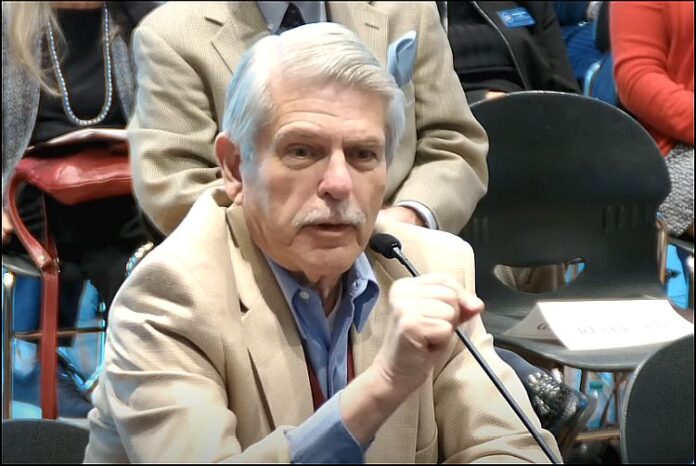
On Friday (6th), I testified at the first hearing of the California State Assembly’s Select Committee on the 2028 Olympic and Paralympic Games, titled “Lessons and Legacy Impacts of the 1984 Los Angeles Olympic Games.”
Here is my prepared statement, giving a (very) short overview of the history and innovations of the Los Angeles Olympic Organizing Committee, which created and staged the Games of the XXIIIrd Olympiad:
I am Rich Perelman and in 1984 I was the Vice President in charge of Press Operations for the 1984 Olympic Games and then Editor-in-Chief of the Official Report of the Games. It’s a pleasure to offer a very, very short summary of the Games that changed the future of the Olympic Movement.
After the murder of 11 Israeli athletes and officials at the 1972 Munich Games and a C$1 billion deficit at the 1976 Montreal Games, there was just one bid for the 1984 Games, in 1977. That was from Los Angeles, trying for the 10th time to bring the Games back after the success of the 1932 Olympic Games.
This unprecedented leverage allowed the volunteer Southern California Committee for the Olympic Games, in close cooperation with Mayor Tom Bradley, to force the International Olympic Committee to agree that the City of Los Angeles would have no financial liability for the Games, which would be organized strictly with private financing.
From the start, the Los Angeles idea for the 1984 Games was different, not only financially, but using existing or temporary sites for 18 of the 21 sports. Olympic Villages would use student housing at UCLA and USC.
With no other option, the IOC agreed in May 1978 to award the 1984 Games to Los Angeles. On March 26, 1979, travel industry entrepreneur Peter Ueberroth, was elected by a single vote as the President of the Los Angeles Olympic Organizing Committee. The LAOOC started out about $300,000 in debt from the bid.
Less than three weeks later, the LAOOC had $2.5 million in the bank thanks to a new television rights sales approach from bid committee member and noted television producer David Wolper. Within six months, Ueberroth signed the largest television deal in Olympic history: $225 million with ABC for U.S. rights and host broadcast services.
These were only the start of many more innovations:
● Ueberroth and marketing chief Joel Rubenstein revamped corporate opportunities around category exclusivity for the first time. Where Moscow 1980 received $5 million from 325 sponsors and suppliers, the LAOOC received $126.7 million from just 99. The “less is more” concept revolutionized the sports and event marketing world and continues to this day.
● Sports venues were almost all existing: the 23 sports at the 1984 Games — including two demonstration sports – took place at 27 sites, 24 of which were extant or temporary. The LAOOC built three venues: a cycling velodrome at Cal State Dominguez Hills, now the site of the Dignity Health Sports Park; a swimming and diving site at USC, still in use today, and a shooting range in Chino, also still in use today.
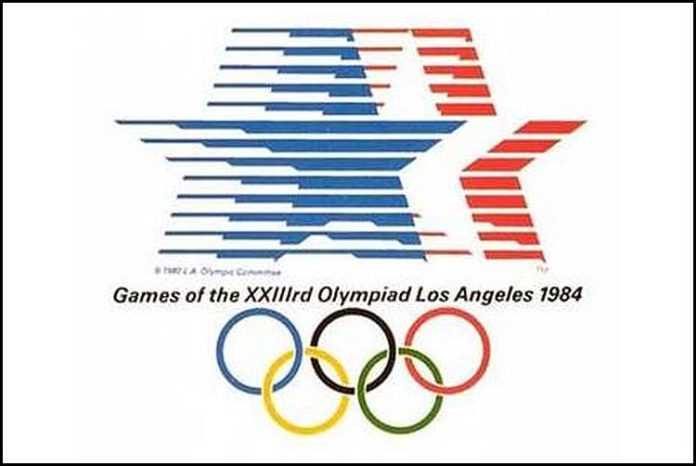
● The visual “Look of the Games” was reimagined in 1982, to incorporate bright, vibrant colors and use inexpensive materials such as construction scaffolding. Developed under the direction of Executive Vice President and General Manager Harry Usher, “Festive Federalism” unforgettably used three million square feet of colored nylon, 21,046 street banners and 35 miles of fence fabric to decorate the Games and the area.
● The organizing committee staff grew from 11 at the end of 1979 to 1,750 by June 1, 1984. But the revolution was using volunteers as the primary workforce, a concept met with disbelief by the IOC.
Some 33,500 volunteers helped the 1984 Games run superbly, and the use of volunteers has now become the norm for sporting events of all sizes and types.
● The LAOOC also ignored old ideas for arts and youth. The usual Games-time art program was expanded into a 10-week “Olympic Arts Festival” of 432 performances and 31 exhibitions attended by 1.26 million people. The usual, two-week “youth camp” for 300 was replaced by a four-year sports and educational program that touched 1.25 million youngsters from 1981-84.
● A never-before-tried national Olympic Torch Relay, beginning on May 8, 1984 and running 9,375 miles across the U.S. for 82 days, raised more than $10.95 million for three youth-sport organizations.
The LAOOC championed the addition of 11 new women’s events, including the marathon, sold a record 5.72 million tickets and staged a safe, secure and wildly-popular Games that revitalized the Olympic Movement.
It also made money. The original budget forecast $368 million in revenue and a $21 million surplus. In the end, there was $768.6 million in revenue and a surplus of $232.5 million, of which 40% went to the U.S. Olympic Committee, 20% to the National Governing Bodies and 40% to found the LA84 Foundation, where we are today.
I will be happy to answer any questions you may have.
The actual delivery was slightly spiced up with some asides, but the facts and statistics are here for the record. It was a pleasure to offer up a summary of what actually happened in an event which changed the trajectory of the Olympic Movement, sports marketing and a lot more.
Rich Perelman
Editor
★ Receive our exclusive, weekday TSX Recap by e-mail by clicking here.
★ Sign up a friend to receive the TSX Recap by clicking here.
★ Please consider a donation here to keep this site going.
For our updated, 45-sport, 910-event International Sports Calendar for 2026 and beyond, by date and by sport, click here!