












★ The Sports Examiner: Chronicling the key competitive, economic and political forces shaping elite sport and the Olympic Movement.★
★ To get the daily Sports Examiner Recap by e-mail: sign up here! ★
≡ ITA WINTER GAMES REPORT ≡
There were no official announcements of doping positives during the 2026 Milan Cortina Olympic Winter Games, and on Wednesday, the International Testing Agency said … there weren’t any:
“At this stage, no anti-doping rule violations have been asserted based on the results of the testing conducted during the Games.”
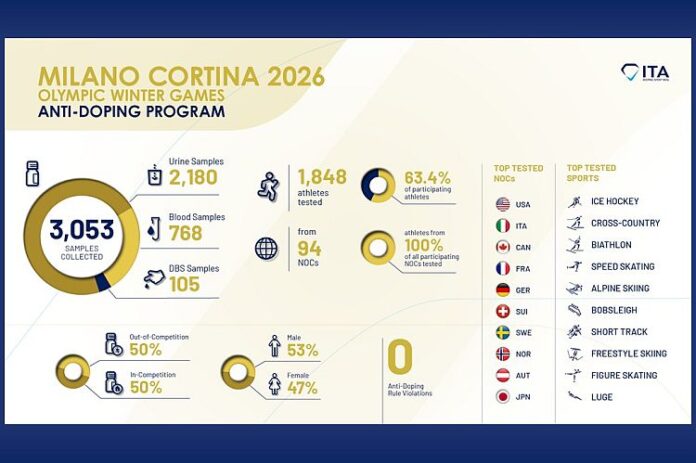
The ITA’s statement summarized the testing program this way:
“Altogether, 3,053 samples were collected both in- and out-of-competition from the opening of the Olympic Villages on 30 January to the Closing Ceremony on 22 February. These samples, comprising 2,180 urine samples, 768 blood samples and 105 Dried Blood Spot (DBS) samples, stemmed from doping controls conducted on 1,848 athletes, representing 63.4% of all participants, a clear increase compared to the 55% of athletes tested during the Olympic Winter Games Beijing 2022.”
This followed an intensive testing regimen prior to the Games, an area which the ITA has stressed to ensure testing of essentially all the medal candidates before the Games:
“During the pre-Games phase, 92% of participating athletes had been tested at least once in the six months leading up to the Games, based on testing conducted by the responsible anti-doping organisations in accordance with the testing recommendations issued by the ITA ahead of Milano Cortina 2026.”
The ITA had a team of 20 at the Milan Cortina Winter Games, helping to oversee the collection and processing of in-competition and out-of-competition samples, which each accounted for 50% of the samples taken. That’s unusual for a Games-time testing environment, where the in-competition collection programs usually dominate.
The top countries tested were those with the top teams, starting with the U.S., Italy, Canada, Germany and Switzerland.
The sports with the most tests started with ice hockey, then cross-country skiing, biathlon, speed skating and alpine skiing.
The ITA keeps all samples for 10 years and will re-analyze at least some of the samples in the future, using improved equipment available at that time.
Observed: This is a showy and happy report from the ITA, and its effort to coordinate an effective anti-doping program prior to the Games is an essential component of its success.
However, it is still astonishing that in a smaller event such as the Olympic Winter Games, with 2,884 athletes entered, that not everyone is tested. Furthermore, it is also remarkable that every athlete is not required to attend a mandatory anti-doping seminar at one of the Olympic Villages, preferably featuring athletes from their own country of region to impress the importance of clean sport.
The only Olympic-sport organization which can support this is the International Olympic Committee and it should insist that athletes taking part in the Games are at least fully aware of what their responsibilities are, as (1) athletes, (2) mentors for other athletes and (3) role models for those they do not meet, but who see them.
Only then can the IOC, the ITA, the World Anti-Doping Agency and others say that they have not just tested, but have tried to teach the importance of anti-doping to those participating at the Games.

★ Receive our exclusive, weekday TSX Recap by e-mail by clicking here.
★ Sign up a friend to receive the TSX Recap by clicking here.
★ Please consider a donation here to keep this site going.
For our updated, 45-sport, 910-event International Sports Calendar for 2026 and beyond, by date and by sport, click here!