
















★ The Sports Examiner: Chronicling the key competitive, economic and political forces shaping elite sport and the Olympic Movement.★
★ To get the daily Sports Examiner Recap by e-mail: sign up here! ★
≡ MILAN CORTINA IN REVIEW II ≡
The memorable XXV Olympic Winter Games provided a lot of thrills, chills and disappointments among the many brilliant moments of sport. Some of the world’s best athletes found out that the Games are a lot different than their own world championships, as explained in the first part of our recap and review yesterday.
On now to the five most prominent lessons from the Games:
● No. 5: Home cooking really does help
One of the best things that can help an organizing committee sell tickets is for the host country to win a lot of medals right from the start of a Games.
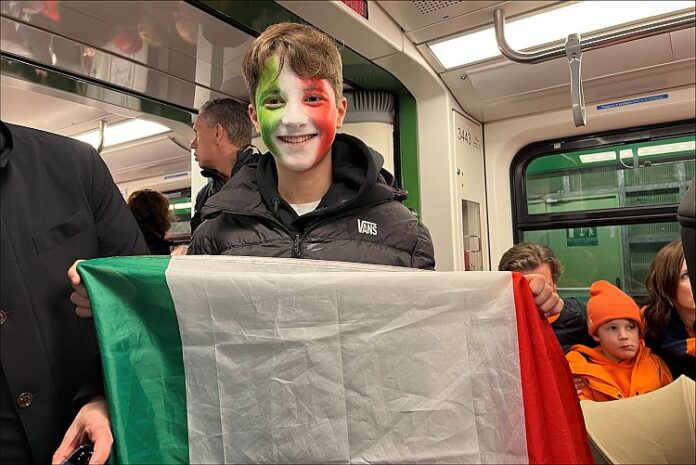
Cue the Italian team for Milan Cortina, which shattered all records for medals at a Winter Games, in front of thrilled crowds in every venue. The Azzurri won nine medals in the first two days of the Games and kept piling it on to a record of 30 total (10-6-14), 50% more than it had ever won at any prior Winter Games!
Updating our 8 February look at the impact of “home cooking” since the 1998 Nagano Games (the 1992-94 cycle change skews the results too much to be used):
● 1998 Nagano: Japan went from 5 medals in 1994 to 10 (+100%)
● 2002 Salt Lake City: U.S. from 13 to 34 (+162%)
● 2006 Turin: Italy from 13 to 11 (–15%)
● 2010 Vancouver: Canada from 24 to 26 (+8%)
● 2014 Sochi: Russia from 13 to 29 (+123%, after 4 doping disqualifications)
● 2018 PyeongChang: Korea from 8 to 17 (+113%)
● 2022 Beijing: China from 9 to 15 (+67%)
● 2026 Milan Cortina: Italy from 17 to 30 (+76%)
(Yes, the increase in events from 61 in 1998 to 116 now must be noted, but do not explain all of these increases. Note that Italian medal production actually went down for Turin in 2006!)
It’s not a record increase, but by far the best Italy has done at a Winter Games and the story of Short Track ace Arianna Fontana moving up to no. 2 all-time among Winter Games medal winners (she has 14 now) and the amazing comeback story of skier Federica Brignone, returning from injury to win two golds, drove attendance and interest. Broadcast reports indicated that two-thirds of the Italian public watched at least some part of the Games.
That helped to sell about 88% of the tickets available for the Games, after loud concerns over sales were voiced just prior to the Games.
● No. 4: The best are still the best
Thanks in part to the continuing expansion in events and to its continuing domination on skis, Norway shattered records again by winning the most-ever medals at a Winter Games with 41 and for gold medals, with 18.
The Norwegians held the prior record with 39 meals at PyeongChang 2018 and the most golds with 16 at Beijing in 2022. Here, they rode dominance in two sports: cross country skiing and biathlon, to 61% of their record totals. Their medals came in seven sports and disciplines:
● 14: Cross Country Skiing
● 11: Biathlon
● 5: Ski Jumping
● 4: Speed Skating
● 3: Nordic Combined
● 2: Alpine Skiing and Freestyle Skiing
Norway brought 80 athletes to the Games and won 41 medals. The U.S. brought 232 and won 33 medals, its best-ever showing outside of North America and no. 3 ever, behind Vancouver 2010 (37) and Salt Lake City 2002 (34).
The U.S. won medals in 11 sports and disciplines with the most – 8 – in Freestyle Skiing. And the Americans won 12 golds, its most ever in a Winter Games, despite disappointments in several events.
When Lindsey Vonn crashed in the women’s Downhill, Breezy Johnson won gold. When Mikaela Shiffrin failed in the Team Combined, she won the Slalom. Where Ilia Malinin fell in the men’s Free Slate, he won the Team Event. And figure skating winner Alysa Liu and Monobob champ Elana Meyers Taylor were not favored going into their events. And there were more like them in other events.
The U.S. Olympic & Paralympic Committee expected to improve on 23 medals in 2018 and 25 at Beijing 2022. A rise to 33 was both satisfying and points to even greater possibilities with Utah 2034 on the horizon.
The International Olympic Committee will be disappointed that the number of nations winning medals remained at 29, down from the high of 30 from 2018.
● No. 3: Politics are part of the Games
Over time, the most consequential athlete of the 2026 Winter Games may be one who never competed: Ukrainian Skeleton racer Vladyslav Heraskevych.
His insistence on wearing his “memory helmet” which pictured 21 Ukrainian athletes – one just nine years old – killed in the Russian invasion that started on 24 February 2022, caused him to be disqualified for violations of the IOC’s Guidelines on Athlete Expression. The guidelines state:
“[E]xpressions are not permitted in the following instances … During competition on the field of play.”
And Heraskevych was making a statement. The artist, Iryna Prots, explained in a story in The Art Newspaper:
“Prots explains she is a family friend of Heraskevych, and has known him since he was a boy. He had come to her, she says, ‘not as an athlete to an artist’ but ‘as a person to a person’, with a wish to commemorate Ukrainian athletes who had fallen in the war. ‘He said, ‘I want them to be with me. Those who did not reach this start’. And I understood: this will not be a drawing; it will be a presence.’”
But what he did was to raise once again – and loudly – the issue of Russian and Belarusian participation. The IOC signaled growing acceptance of Russian and Belarusian re-integration into international sport last December with agreement to allow “youth” athletes to participate openly, with national colors and anthems.
It was left up to the International Federations to decide how to implement this. United World Wrestling is allowing “youth” wrestlers up to 22 years old; have they not checked to see that the age of conscription into the Russian Army is 18? And World Rowing announced that despite the IOC’s continuing ban on teams, Russian and Belarusian SENIOR athletes – as “neutrals” – can compete in Fours and Eights.
Perhaps these formulations will be revisited. But the impetus will have to come from the IOC and President Kirsty Coventry (ZIM), who met with Heraskevych and was unable to dissuade him from wearing his helmet in competition.
● No. 2: In the biggest market, the Games are still big business
NBC announced Monday that its Milan Cortina coverage “averaged 23.5 million viewers on NBC, Peacock, NBCUniversal Digital Platforms and Versant’s CNBC and USA Network across the combined live afternoon Milan Prime window (2-5 p.m. ET) and U.S. primetime (8-11 p.m. ET/PT) time periods.”
While the measurement metrics differ from prior Games – NBC says this was the biggest audience since Sochi 2014 – what the viewership numbers make clear is that the Olympic Games remain highly relevant to the American market, by far the most consequential for the IOC and the Olympic Movement.
About half of all of the International Federations depend on the IOC’s television rights sales dividend every four years – mostly powered by NBC’s billion-dollar fees – to keep afloat. So it is critically important that the Games stay popular in the U.S.
And they are. NBC sold out of its ad spots and is looking for an even bigger bonanza coming in 2028 in Los Angeles … for which the promotion has already started.
● No. 1: Doubted all along, the MiCo organizers won
Despite sometimes hysterical predictions of failure, the Fondazione Milan Cortina 2026 organizing committee made the Games work, and work well. A Winter Games that was spread out from the city of Milan throughout the northern Italian mountains was tied together by television.
The genesis of this concept came from the IOC in 2014 with the adoption of prior President Thomas Bach (GER) and his “Agenda 2020″ and “Agenda 2020+5,” which insisted on using existing venues and temporary facilities wherever possible and keeping new construction to a minimum. The prior insistence on new buildings (and the attendant spending) had crippled interest in the Games.
The new initiative has created boundless enthusiasm to host the Games among cities, regions and countries that had never seriously considered it before. And the Milan Cortina plan stretched the concept to its limits, using famous winter sports venues that were well known to the competitors already, and had in-place organizations to help run the events.
It worked. The issues ended up being with those venues being built with the Games in mind – the sliding track in Cortina, built by the government at the last moment – and the new Milan arena, privately built, but suffering from delays. Both got done late, but they worked, and worked well.
The Olympic Village in Milan was reportedly excellent and will be used for student housing, which is much needed in the city.
There was some backlash on how widely the Games were spread out and this will be an issue for the IOC going forward. But the Milan Cortina team, led by chief executive Andrea Varnier, showed that it can work.
The cooperation between the organizers and the multiple levels of government in Italy appeared to be very strong and beyond some early demonstrations that received a lot of publicity, there were no threats to the Games (even as some other demonstrations took place).
That coordination is a key to success, and will be a focal point for Los Angeles across the fractious American political scene over the next two years.
Perhaps that is the point to be stressed most, and is the biggest lesson from the 2026 Winter Games. Working together is better.
Rich Perelman
Editor
★ Receive our exclusive, weekday TSX Recap by e-mail by clicking here.
★ Sign up a friend to receive the TSX Recap by clicking here.
★ Please consider a donation here to keep this site going.
For our updated, 45-sport, 910-event International Sports Calendar for 2026 and beyond, by date and by sport, click here!