














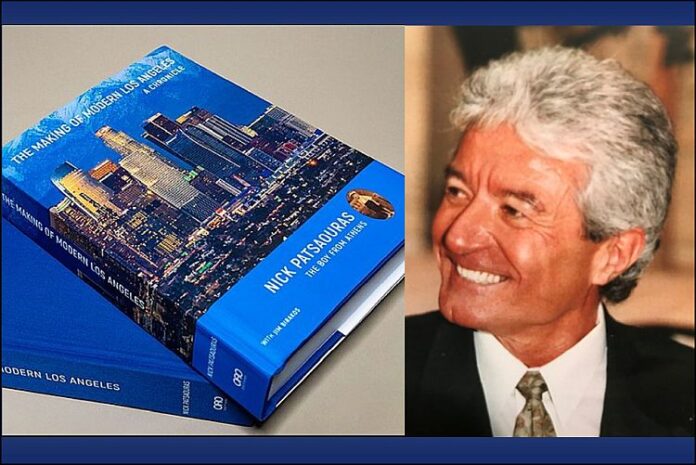
[Nick Patsaouras was president of the Southern California Rapid Transit District during the 1984 Olympic Games, and parts of this comment are drawn from his 2024 book, The Making of Modern Los Angeles (ORO Editions). His opinions, are, of course, solely his own.]
In today’s world, “Armageddon” refers to a worst-case scenario, a total breakdown of normal functioning. That is exactly where the LA28 Olympic mobility plan finds itself. Los Angeles Metro requested nearly $2 billion in Federal funds for its plan, and expected to receive it, but the Trump administration’s budget unveiled last Friday excluded it.
Without those funds a fluid, Mayor Karen Bass‘ proclamation of a “no-car Games” is impossible. To fully understand the shortcoming, consider this: to create a bus fleet suitable for the Games, it must temporarily acquire, operate and store nearly 1,750 additional buses (the number has been scaled down from 3,000 to 2,700 to 1,750, whenever a critical milestone was not met). At the same time thousands of operators, mechanics and support personnel have to be hired, trained and State-certified.
It is a shock beyond Metro’s ability to absorb it. Without these funds, Los Angeles’ transportation system could hit the breaking point. “Without the full level of funding requested, the complete scope of the Games Enhanced Transit System would not be feasible, as the cost of operating this temporary system exceeds Metro`s available operating resources,” the agency has said.
In the 1984 Los Angeles Olympics, terminal gridlock was feared but did not occur. Athletes and fans were not stranded, because years of preparation by the Southern California Rapid Transit District (RTD) delivered a flawless transportation plan that yielded easy and unobtrusive travel.
The 1984 Olympic organizing committee Chair Paul Ziffren appointed me to the Olympic Citizens Advisory Commission and under his direction, as President of the Southern California Rapid Transit District (RTD – Metro`s predecessor) board of directors along with RTD planners, John Dyer, general manager, and Art Leahy, chief of bus operations, a complex transportation plan was devised. A second bus fleet from scratch was created, one that provided direct service to the major Olympic venues. Noteworthy is the fact that there was no rail network in 1984.
Then, the added 550-bus Olympic fleet ranked as the fourth largest public transit district in California. Its operation required more than one thousand workers, including four hundred temporary drivers who had to be hired, trained and certified. To their credit, RTD administrative employees left their desks and worked in the field as passenger assistants, providing fare exchange and information, and supervised bus traffic and security at the various terminals.
Complexity had been added to the transportation obligation with the Games being held in twenty-four venues spread over two hundred miles. In most past Olympic cities, events were scheduled in one central location. The numbers were staggering. Some seven hundred thousand visitors were expected to arrive in Los Angeles each one of the 16-day Olympic period. Most popular events, like track and field, were set for the Coliseum in Exposition Park, USC for swimming and diving, and UCLA for tennis and gymnastics – all known for severe parking shortages and dreadful traffic. RTD carried 40 percent of all spectators to these sites.
The system was tested for efficiency for months. Platoons of buses would arrive or depart from the Coliseum every ten seconds; reserved bus lanes were established; freeway ramps near Exposition Park had to be open only to buses; and bus operators had the opportunity to radio timely status reports to the State Traffic Coordination Center enabling immediate responses to bottlenecks.
Of course, traffic Armageddon was predicted to loom over the region during the 1984 Games but never materialized because of the planning and execution of the RTD’s plan. However, LA28 is another story. The sharp difference is today’s slow planning and lack of funding. So slow, in fact, that I rang the alarm bell in May 2025.
A wasteful chase for $3.2 billion in Federal funds for capital improvements that have a weak nexus to the Olympics has eaten up four years, a time interval that should have been dedicated to developing a coherent mobility plan. The remaining time before the Games is short and unprecedented in Olympic history for locking up funds, the vital blood flow for success.
Seleta Reynolds, Metro’s Chief Innovation Officer and head of Games mobility planning, stated at a January Metro Board meeting that finding and preparing the real estate where the buses will be staged involves a lead time of two years, meaning the agency would need “a chunk of funding available by the summer”; that is a couple of months away!
The known Olympic mobility plan, thus far, is an odd strategic error that will likely cause stagnation, obstruction, and congestion. Rather than directing the spectators away from vulnerable Metro hubs, it directs the flow to those hubs and lines, overwhelming them. Instead, spectators should be directed to large satellite bus-based park-and-ride hubs that can be scaled up to meet surges in a way that Metro Rail cannot. Shockingly, officials who traveled to Paris and viewed how stretched-to-the-limit the city’s rail capacity was, although it is five times the size of Metro Rail, thought that it was a good idea to double down on making Metro Rail stations the biggest mobility hubs for the 2028 Games.
A traffic Armageddon is unavoidable because Southern California’s transportation system is built around nineteen million residents, massive freight corridors, and chronic congestion. The 2028 Games must simultaneously support residents, goods movement, and Olympic demand, an impossible situation. The overlay of a second Olympic transportation system on top of the first is not possible without funds, timely and strategic planning.
On the monetary side, troubled Los Angeles can face exposure, and possible bankruptcy, that may result from LA28 funding shortcomings, precipitated among other challenges by a traffic nightmare. The organizing committee is privately funded for $7.1 billion, but only on paper (LA28 is hiding the books so far). Public guarantees kick in if that budget fails. The monetary exposure is carefully spelled out in the City’s guarantee agreement: if LA28 runs a deficit, Los Angeles is responsible for the first $270 million in losses. The California Legislature agreed to backstop the next $270 million, which means that statewide taxpayers must cover losses from $270 to $540 million. What most people do not know is that if losses exceed $540 million, every additional dollar is the responsibility of Los Angeles’ taxpayers, thus making the city`s financial exposure essentially unlimited.
In sum, we are faced with a dire situation, no clear path of successful operations and avoidance of financial jeopardy. And as unbelievable as it might sound, the Memorandum of Understanding between Metro and LA28, a document with number of ambiguities, was just signed in March. A startling revelation in the MOU is the statement “Metro shall not be obligated for any Metro Enhanced [Olympic] Services, in full or in part, unless and until sufficient New Consideration [funds] is designated, dedicated or committed to Metro.”
So, where do we stand, considering the MOU was signed in March and Trump excluded money in his budget for Metro to provide Olympics service last Friday? The silence is deafening from all quarters, including the Los Angeles Times.
The gap between LA28’s mobility plan and the system L.A. will have is widening to the point where discomfort has now reached a state of a worst-case scenario.

Comments are welcome here.
[≡The Sports Examiner encourages expressions of opinion – we really do – but preferably based on facts. Send comments to [email protected]. We do not guarantee publication of any comment, but all comments submitted will be considered and your submission implies your agreement to publication (and light editing if needed to meet our grammatical and punctuation standards) at our sole discretion. Please include your name and hometown on any comment submitted for publication.≡]

You can receive our exclusive TSX Report by e-mail by clicking here. You can also refer a friend by clicking here, and can donate here to keep this site going.
For our updated, 45-sport, 910-event International Sports Calendar for 2026 and beyond, by date and by sport, click here!