
















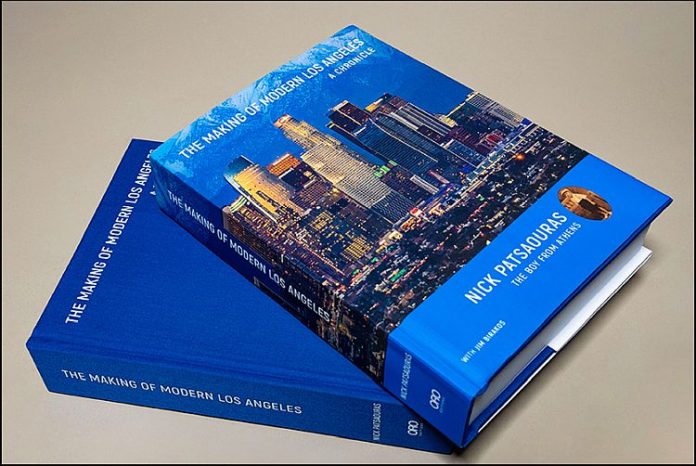
[Nick Patsaouras was president of the Southern California Rapid Transit District during the 1984 Olympic Games, and parts of this comment are drawn from his 2024 book, The Making of Modern Los Angeles (ORO Editions). His opinions, are, of course, solely his own.]
Los Angeles has hosted the Olympics before, so let’s reflect on what those Games mean to everyone. The Olympics are not “just sports.” The Olympic Games are a stress test of civic competence, public trust, and the kind of city we intend to be.
Let’s start by remembering. I wrote about the 1984 Summer Olympics in my book, The Making of Modern Los Angeles. The 1984 Games were a turning point: heavy reuse of existing venues, a disciplined organizing culture, and a business model that treated sponsorship and television revenue as a financial engine rather than an afterthought. LA Metro’s predecessor agency worked with Caltrans and ran extensive park-and-ride and express bus service that successfully moved large crowds to venues. In our civic mythology, these outcomes are inseparable from the leader who drove them: Peter Ueberroth, a businessman-operator who made cost discipline and revenue realism part of the plan. There was an operating surplus and the LA84 Foundation emerged thereafter.
But the modern Olympic era also teaches a second lesson: success on the field and success in governance are not the same thing. Since the late 1970s, the Olympics have grown into a mega-event powered by commercialization and global media, yet repeatedly shadowed by scandals that damage the Olympic brand and, more importantly, the people caught inside it. We’ve seen the Games entangled in geopolitics (the 1980 Moscow boycott and the 1984 Soviet-bloc boycott), shaken by bid-process corruption (the Salt Lake City scandal and subsequent reforms), compromised by systemic doping (the World Anti-Doping Agency findings on Russian state manipulation), scarred by catastrophic athlete-abuse failures (the USA Gymnastics crisis and Larry Nassar), and forced to reckon with security threats (Atlanta’s Centennial Olympic Park bombing). This wider history is the context in which we should judge LA28-not with cynicism, but with sober eyes.
So where do we stand with the 2028 Summer Olympics right now? The organizing committee, LA28, continues to emphasize a privately funded operating model, drawing revenue from sponsorships, ticketing, licensing, hospitality, and a major contribution from the International Olympic Committee. LA28 has also moved into visible public-facing milestones: ticket registration opened in mid-January 2026, with Reuters reporting very high early demand, and the committee has publicly described a structured “ticket draw” process. On the commercial side, Reuters reported that by December 2025 LA28 had surpassed $2 billion in domestic sponsorship revenue, alongside a projected budget of just under $7 billion. Operational leadership has signaled a shift toward delivery mode-logistics, security coordination, and execution discipline. All of that sounds like momentum. And it is.
But momentum does not guarantee legitimacy. The Olympics arrive with a built-in trust problem: residents worry about cost overruns, disruption, and promises that dissolve after the cameras leave. In Los Angeles, that skepticism is not paranoia; it’s lived experience. Which is why leadership credibility matters so much.
That brings us to the uncomfortable January 2026 headline. The Los Angeles Times reported that newly-released “Epstein files” included personal emails from 2003 between LA28 chair Casey Wasserman and sex trafficker Ghislaine Maxwell, a close associate of Jeffrey Epstein. The article reported that Wasserman expressed regret and apologized for any association.
This is exactly the sort of reputational shock that can become a civic distraction … or a civic test. The question is not whether Los Angeles “cancels” someone (a performative ritual that poorly substitutes for governance). The question is whether the institutions around the Games respond in a way that increases public confidence: clear disclosures and clear accountability about how decisions are made and how money flows.
And that is why our city needs to follow a steady moral compass. We need to be less interested in winning the daily outrage cycle and more interested in raising the standard of public judgment. Here is a more practical, civic-oriented approach:
● First, keep the focus on shared problems, not factional talking points. The Olympics will pressure housing, transit, public safety, and basic city services. We should ask simple, demanding questions that any Angeleno can understand: what must be true by summer 2028 for everyday life to feel better, not merely “Olympics-ready”? What will be measured, by whom, and on what schedule?
● Second, insist on virtues in leadership-prudence, justice, courage, and temperance: not just “vibes.” Prudence looks like conservative budgeting and honest risk registers. Justice looks like equitable distribution of burdens and benefits across neighborhoods. Courage looks like confronting special interests when their demands conflict with public purpose. Temperance looks like resisting fear-mongering and over-promising.
● Third, make the public conversation educational. Slogans don’t really help. What residents really need is more like a clear map: which agencies control which levers, what does “privately funded” cover, and which costs land on local government even when the organizing committee is privately financed. Security and transportation planning are always a tangle of jurisdictions and budgets. Buses were central to the 1984 mobility success, a key historical reference point for today’s “transit-first” ambitions for 2028.
● Finally, anchor the discussion in history. The 1984 Olympics are still a part of the city’s larger civic story. That’s the right frame: the Games are less like a two-week festival and more like a mirror. They reveal whether we can govern large systems with competence and fairness, and whether we can tell the truth to ourselves while doing it.
Los Angeles can afford to be a little starry-eyed by definition. But we don’t want to be jaded. If we hold LA28-and ourselves-to reasonably clear and measurable commitments, and a higher standard of civic character, the 2028 Games can be more than a spectacle. We can reflect a disciplined demonstration that this city still knows how to do hard things: together.

Comments are welcome here.
[≡The Sports Examiner encourages expressions of opinion – we really do – but preferably based on facts. Send comments to [email protected]. We do not guarantee publication of any comment, but all comments submitted will be considered and your submission implies your agreement to publication (and light editing if needed to meet our grammatical and punctuation standards) at our sole discretion. Please include your name and hometown on any comment submitted for publication.≡]

You can receive our exclusive TSX Report by e-mail by clicking here. You can also refer a friend by clicking here, and can donate here to keep this site going.
For our updated, 45-sport, 910-event International Sports Calendar for 2026 and beyond, by date and by sport, click here!