


★ The Sports Examiner: Chronicling the key competitive, economic and political forces shaping elite sport and the Olympic Movement.★
★ To get the daily Sports Examiner Recap by e-mail: sign up here! ★
≡ THE 5-RING CIRCUS ≡
● Italy ● For decades beginning in the 1950s, the Italian National Olympic Committee – known as CONI – received money from a share of the state-sanctioned “Totalcalcio” betting pool and was, for a time, one of the best-funded NOCs in the world.
But the receipts declined and CONI’s finances are much shakier now. So, the Italian government has included in its 2025 budget legislation a new game, “Win for Team Italia,” from which 26.5% of the proceeds will go to CONI to establish a more constant financial base.
Time will tell if this actually works. It did before.
● Russia ● The National Olympic Committees of the Baltic States – Latvia, Lithuania and Estonia – sent a joint letter to the International Olympic Committee, “expressing deep concern about the IOC’s recent recommendation to allow young athletes holding Russian and Belarusian passports to participate in international competitions.”
The message explained that “[s]uch participation creates a basis for the dissemination of state propaganda in international sports, especially in the sensitive context of youth sports,” and asked to “maintain and strictly enforce the current restrictions prohibiting Russian and Belarusian athletes from representing their countries under their national flags, anthems and symbols in all international competitions, including youth competitions, until the aggression against Ukraine has ended and accountability for violations of international law has been ensured.”
Further, it was requested that “neutral athlete” designations be maintained only for “those athletes from Russia and Belarus who have passed reliable integrity and anti-doping controls, who have no connection to military, state or propaganda structures, who fully respect the Olympic Charter and whose participation does not involve national symbols, team formats or a delegation associated with a country.”
● Athletics ● Kim Batten knows the 400 m hurdles, winning the 1996 women’s Olympic silver in Atlanta and the 1995 World Championships gold in Goteborg (SWE), setting a then-world record of 52.61.
Now 56, she posted on Facebook that it is time that the hurdle height is raised:
“As the former world record holder in the women’s 400 hurdles, Today I am officially launching the ‘Raise the Hurdles’ campaign to increase the height of the women’s 400 hurdles from 30 inches to 33 inches.
“This has long been a debate in the track and field community, but never has it been more evident of the need than the last few years with the recent performances and progressions in the event across the board, and dominated by the phenomenal current World Record Holder Sydney Mclaughlin-Levrone.
“But THE TIME IS NOW to scale into this challenge and opportunity. Follow Our launch and check back here to sign our upcoming petition at the start of the 2026 year.”
The height for the women’s 100 m hurdles is 33 inches; does this mean that event should raise to 36 inches? The men’s 110 m hurdles height is 42 inches and the 400 m hurdles are 36 inches high.

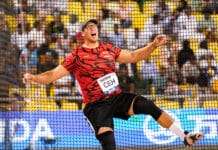
Ukrainian hammer thrower Anatoliy Bondarchuk, who won a gold for the USSR at the 1972 Munich Olympic Games, has died at age 85, at his home in Kamloops (CAN). He also won an Olympic bronze in 1976 and had a best of 77.42 m (254-0).
He later became a renowned coach, including the 1976 and 1980 Olympic winner Yuri Sedykh, still the world-record holder from his 1986 throw of 86.74 m (284-7).

European Athletics announced an agreement with artificial intelligence “localization” firm CAMB.AI, using the service to provide instant language support. Per the announcement, “CAMB.AI for Publishing, which can transform digital content into more than 150 languages through advanced AI-powered translation and dynamic text-to-speech (TTS) technology,” will be used to offer content in multiple languages. European Athletics chief executive Christian Milz (SUI) noted:
“This development marks a major step forward in making our sport more accessible and engaging for fans across the continent. We launched the new languages at the 2025 SPAR European Cross Country Championships in Lagoa last week and our website is now available in 12 additional languages, with more to follow.”
● Fencing ● The Russian news agency TASS reported that the International Fencing Federation has approved the re-integration of Russian and Belarusian junior athletes into international competitions with no restrictions on national symbols, flag and anthem.
The first tournament with Russian entries is expected to be the FIE Junior and Cadet World Cup in the UAE from 2-4 January.
● Figure Skating ● Russian star skater Kamila Valieva’s doping disqualification ended on 25 December and she has been returned to competition and now at 19, intends to resume her career.
The Director General of the Russian Anti-Doping Agency, Veronika Loginova, told TASS:
“There are no complaints. The athlete communicated with us throughout the entire period, asking questions, clarifying her status in events, and complying with all disqualification requirements as correctly as possible. This high-profile case served as a lesson – both for her and for the entire sports community.
“And we see that the figure skating federation has begun working with parents and young athletes – and this is already a significant shift. Her return to sport will be automatic; no additional procedures are required.”
● Football ● ESPN reported that the 2026 World Cup hosting agreement between FIFA and Canada, Mexico and the U.S. allows for the host-country federations “to receive 1% of the tournament’s gross revenues. This amount will be split across the three countries. With tournament revenues forecasted to reach $13 billion, along with the fact that the U.S. is hosting 75% of the matches, the expectation of the USSF [U.S. Soccer Federation] is that it will receive $100 million.”
USSF Secretary General JT Batson sees that money going to make soccer “the most played sport in the country,” meaning:
“Ultimately our goal is to have a very large endowment that is focused specifically on participation, access, growth of the game. And this $100 million will be an awesome jumpstart to that.”
● Gymnastics ● The U.S. Center for SafeSport issued sanctions against four individuals in the sport on 22 December, suspending coaches Al Fong and Armine Barutyan for “Physical & Emotional Misconduct,” with the penalties subject to appeal. Fong and Barutyan operate the well-known GAGE Center in Blue Springs, Missouri, which replied in a statement:
“While we fully support the mission of SafeSport and the importance of creating healthy, safe training environments for athletes, we are deeply disappointed by this outcome and respectfully disagree with the findings.
“These determinations were made without eyewitness testimony and through a committee-based process. We believe the decision does not fairly reflect the full record or context and we intend to exercise our right to arbitration.”
Fong’s suspension is for five years and Barutyan, for one year.
The Center also sanctioned coach Matthew Auerbach of Coeur d’Alene, Idaho for “Criminal Disposition – Sexual Misconduct” and declared him ineligible, with the penalty subject to appeal, and imposed a temporary restriction on coach Kyle Bergsteiner of Chesapeake, Virginia for “Allegations of Misconduct.”
● Swimming ● In an interview with SwimSwam.com, new USA Swimming chief executive Kevin Ring explained that “The USOPC does have a policy that starting in 2028, only American athletes will swim at USOPC facilities.”
That means at the United States Olympic Training Center in Colorado Springs, Colorado, where USA Swimming is headquartered. The story noted, “[o]f the 219 medals awarded in the pool in Paris [at the 2024 Olympic Games], only 14 went to international athletes who train in the United States and they were spread out among just six athletes.”
It was later clarified that the ban will be for 2028 only.
≡ RESULTS ≡
● Alpine Skiing ● Remember this name during the Olympic Winter Games: Julia Scheib.
The 27-year-old Austrian is a rising star on the FIS women’s World Cup circuit in the Giant Slalom, winning her third race this season in Semmering (AUT) on Saturday. She was second to Swede Sara Hector after the first run, but Hector faded to 12th on the second run and Scheib picked up the win in 1:56.46, with Swiss Camille Rast second (1:56.60) and Hector third (1:56.86).
American star Mikaela Shiffrin was eighth on both runs and finished sixth in 1:57.91; A.J. Hurt was 21st.
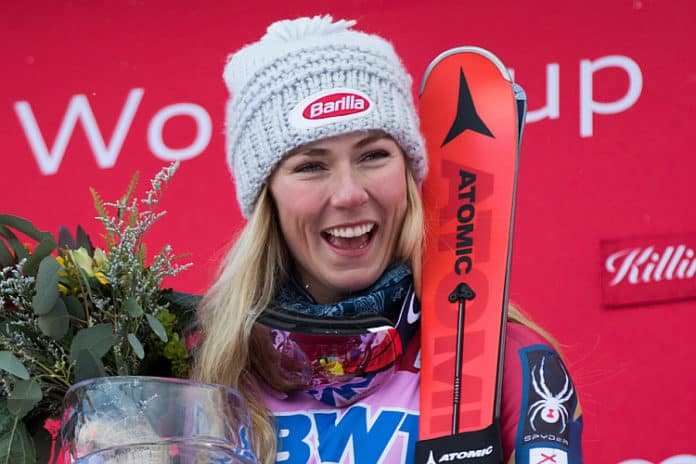
The Sunday Slalom saw Shiffrin keep her streak intact this season: five Slaloms, five wins! She was only fourth after the first run, to 2025 World Champion Rast (SUI), 0.54 second behind. But she blasted the second run in 53.58 and although Rast was second-fastest at 54.21, Shiffrin got the win, 1:48.82 to 1:48.91. Albania’s Lara Colturi was third in 1:49.39.
It’s Shiffrin’s 106th career World Cup win and 69th in the Slalom, both records, of course.

The men’s World Cup was in Livigno (ITA), where seven-time Worlds medalist Marco Schwarz (AUT) picked up his second World Cup gold in a week, taking the Super-G in 1:10.33 over Swiss Alexis Monney (1:10.53) and teammate and Downhill World Champion Franjo van Allmen (1:10.58). Ryan Cochran-Siegle (1:10.89) and River Radamus (1:10.91) finished 13-14 for the U.S.
For Schwarz, it’s his eighth career World Cup win and first in a Super-G!
● Cross Country Skiing ● The 20th Tour de Ski opened in Tolbach (ITA) with the Freestyle Sprint, with Norwegian star Johannes Hoesflot Klaebo winning his fourth World Cup race of the year and third Sprint in 2:28.82, leading a Norse sweep. Lars Heggen (2:29.95) was second and Oskar Vike (2:29.62) was third.
World Sprint runner-up Kristine Skistad (NOR) won the women’s Sprint in 2:49.79, ahead of Coletta Rydzek (GER: 2:50.03) and Sweden’s Olympic silver winner Maja Dahlqvist (2:50.14). American Jessie Diggins, the seasonal World Cup leader and a two-time Tour de Ski winner, was fourth in 2:51.11.
The highly-prized Tour de Ski continues in Tolbach with a Classical Interval Start 10 km, 5 km Freestyle Mass Start and a 20 km Classical Pursuit before moving to Val de Fiemme.

★ Receive our exclusive, weekday TSX Recap by e-mail by clicking here.
★ Sign up a friend to receive the TSX Recap by clicking here.
★ Please consider a donation here to keep this site going.
For our updated, 850-event International Sports Calendar for 2025, 2026 and beyond, by date and by sport, click here!