













★ The Sports Examiner: Chronicling the key competitive, economic and political forces shaping elite sport and the Olympic Movement.★
★ To get the daily Sports Examiner Recap by e-mail: sign up here! ★
★ Friends: YIPPEE! Now 43 donors have covered 110.6% of our winter goal for our tech support costs. Happy to start on the summer bill: you can donate here. YOU are the reason this site continues. ★
= MILAN CORTINA 2026 =
A Rosen Report Extra
A popular event at the Milan Cortina Winter Olympics occurs seven times a night, lasts roughly as long as a figure skating free skate and holds its viewers spellbound.
The best part is it’s free.
Since the Opening Ceremony on Feb. 6, the Olympic flame has been suspended within the Arco della Pace – Arch of Peace – at the Piazza Sempione in Milan (pictured above; TSX photo by Karen Rosen). A smaller cauldron sits off the Corso Italia in Cortina.
While the two flames dance 24 hours a day, as night falls the sound and light shows begin. They start at 5 p.m. and run on the hour until 11 p.m.
Eighteen months ago, the 2024 Paris Olympics set the bar high for a “cauldron experience” with its 30-meter flying balloon at the Tuileries Garden.
Milan Cortina made its flames even more accessible, with the one in the Arco della Pace easy to see from afar.
On a typical night thousands of people stream into the park – sharing paths with the usual runners and cyclists who are indifferent to the spectacle – and then wait expectantly in the open area in front of the triumphal arch. A significant police presence protects both flames.
The cauldrons were Inspired by Leonardo da Vinci’s geometric studies, with the brazier supposed to resemble a sun that opens and closes.
The crowd hushes when lasers begin to flash, producing designs on the cauldron, and the music begins. Soothing and inspirational, the music was composed by Roberto Cacciapagglia, who also wrote the soundtrack for the opening ceremony.
The colors on the cauldron range from red to orange – reminiscent of the Dutch team and fans – to purple, green and deep blue.
Just when you wonder if the cauldron really does expand, it starts to flex its muscles. Now a golden hue, the diameter increases from 3.1 to 4.5 meters (10-15 feet) as the music crescendos.
About four minutes after it began, the show is over.
The flame will be extinguished on 22 February during the closing ceremony and then return for the Paralympic Winter Games – and more shows – from 6-15 March.
~ Karen Rosen
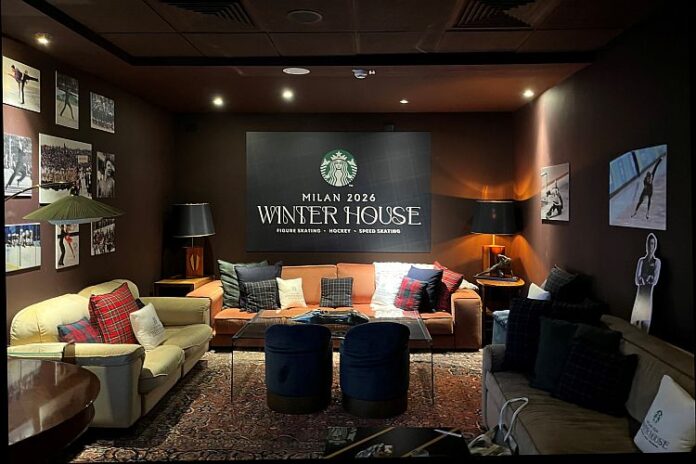
● The Rosen Report ● The U.S. federations for figure skating, ice hockey and speed skating created a Milan hideaway – the “Winter House” – for its athletes and supporters. The U.S. Olympic & Paralympic Museum is there with a unique “medal care kit” for the stars of 2026, and before!
● Il Tempo Olimpici ● More rain is forecast for Milan on Thursday, with highs of 45 F and a low of 40 F. Winds will be up a little to an average of 7 miles per hours.
In Cortina, the last snow of the Games is projected with a high of 27 F and a low of 19 F. Winds, however, are expected to be modest, at 5 miles per hour. Partly-cloudy skies are predicted for Friday and Saturday.
● Scoreboard ● We’re up to 89 of the 116 events decided, and Norway continues to extend its lead on the medal table:
● 33: Norway (15-8-10)
● 26: Italy (9-5-12)
● 24: United States (7-11-6)
● 22: Japan (5-6-11)
● 21: Germany
● 17: France
● 17: Austria
● 15: Netherlands
● 15: Sweden
A better indication of team performance has to go beyond three places, so The Sports Examiner returns our eight-place scoring, using the NCAA track & field format of 10-8-6-5-4-3-2-1 to score each event. After 13 days, the top 12:
● 404.5: Norway 72
● 323.5: United States 70
● 314.5: Italy 62
● 250: Germany 50
● 241.5: France 50
● 235.5: Austria 53
● 215.5: Japan
● 202: Canada
● 181: Netherlands
● 168.5: Switzerland
● 158: Sweden
● 137: China
Norway has 72 placers from 1-8, with the U.S. at 70, then Italy with 62, Austria at 53 and France and Germany with 50 each.
● Television ● From the International Olympic Committee’s news briefing on Wednesday:
“In the United States, Milano Cortina 2026 has been averaging 24.3 million viewers on NBCUniversal platforms up to [Monday] 16 February – up 88 per cent compared to Beijing 2022 at the same point. Coverage has topped 20 million viewers for each of the first 11 days of competition.”
● Cross Country Skiing ● A Czech wolfhound wandered into the finish-line area with some of the later finishers in the women’s Team Sprint qualifications, looking for its owner.
It was shown on the race broadcast; Greek racer Konstantina Charalampidou, who finished 26th, said later, “He followed the camera on the finishing straight, was cute, and thankfully didn’t disrupt the race.
“It was funny. He made me forget about the race, because it wasn’t good. Thanks to him, I’m famous now, so I have to thank him.”
The dog was reunited with its owner.
● Freestyle Skiing ● The athlete quota for the men’s Freestyle Ski Cross event is 32 total athletes, but there are 31 entries indicated, with the event taking place on Saturday (21st). The U.S. has no entries, but American Tyler Wallasch published an open letter through Global Athlete, asking for the final spot:
“I have qualified for that vacant quota place through international competition rankings and have had the backing of the USOPC and FIS to be granted the spot. However, the IOC has denied my request to compete and denied the USA representation in the men’s Skicross event.”
He cites “an administrative rule and administrative procedures that fail to uphold the athlete-centered Olympic ideals of participation and fair competition.”
The letter was signed by 32 other Skicross competitors. According to Global Athlete Director General Rob Koehler (CAN) on X:
“1. @FIS_news and @TeamUSA supported @TJWallasch entry to the @milanocortina26 . Both indicated @Olympics has the power to make the decision.
“2. Tyler requested @iocmedia to attend the Games – the IOC said it was the FIS’s decision. FIS then denied entry.”
● Short Track ● American star Corrine Stoddard, who won three medals at the 2024 World Championships, has had a nightmare in Milan so far, crashing out of her races. But she’s not done; she posted on Instagram:
“I came into the 2026 Olympics with a lot of hopes and dreams of bringing home multiple medals, considering how well I performed throughout the World Cup season. Ultimately, that hasn’t happened. I’m not sure what’s been going on. Part of me thinks I haven’t been able to handle the pressure and expectations I put on myself. The other part of me feels so physically drained every time I try to race.
“This whole experience has been incredibly unfortunate, and I feel embarrassed by how many times I’ve crashed, especially since I’m not an athlete who’s known for falling often. I also feel embarrassed by how much I’ve choked on the Olympic stage over and over again. This isn’t what I planned to show the world I was capable of.
“I’m sorry to my friends and family who’ve had to watch me suffer so many times over the last week. I have one last chance on the 20th (1500m), and then my 2026 Olympics will be over. Thank you to everyone who has continued to be there for me. I’m sorry I haven’t been myself.”
Optimistically, it’s worth noting that she won the 1,500 m bronze at the 2024 Worlds.
● Skeleton ● Ukrainian racer Vladyslav Heraskevych became a household name in Cortina, even though he was not allowed to race in his “memory helmet” that included images of Ukrainian athletes killed during the Russian invasion.
Only 27, he’ll be able to continue racing, as he was given a donation of $200,000 by Ukrainian businessman Rinat Akhmetov, who owns the Azovstal steel company and the Shakhtar Donetsk football club. He said in a statement:
“At the same time, I want him to have enough energy and resources to continue his sporting career, as well as to fight for truth, freedom and the remembrance of those who gave their lives for Ukraine.”
The Associated Press noted the money will be paid to Heraskevych’s foundation, “to ensure the athlete and his coaching staff have the necessary resources to continue their sporting career and their advocacy for Ukraine on the international stage.”
● Winter Paralympic Games ● After the International Paralympic Committee’s General Assembly narrowly voted to return Russia and Belarus to full status last September, and a series of appeals by Russian winter-sport federations against several International Federations, Russia will have six athletes and Belarus will have four at the Winter Paralympics from 6-15 March.
The IPC confirmed on Tuesday that the Russians will have “two in Para alpine skiing (one male, one female), two in Para cross-country skiing (one male, one female), and two in Para snowboard (both male).” All will compete with national colors and anthems, given their restored status.
This has enraged Ukraine, with sports minister Matvii Bidnyi saying Wednesday that Ukrainian officials will not attend the Paralympic Games opening and is asking others to stay away. He explained:
“The flags of Russia and -Belarus have no place at international -sporting events that stand for fairness, integrity, and respect. These are the flags of regimes that have turned sport into a tool of war, lies and contempt.
“In Russia, Paralympic sport has been made a pillar for those whom Putin sent to Ukraine to kill – and who returned from Ukraine with injuries and disabilities.”
Ukrainian foreign minister Andrii Sybiha wrote on X that “I have instructed Ukraine’s ambassadors to engage with officials in their host countries and urge them not to attend the Opening Ceremony if this disgraceful decision is not reversed.”
= RESULTS: WEDNESDAY, 18 FEBRUARY =
(9 finals across 6 sports & disciplines)
● Alpine Skiing: Women’s Slalom
“I came here for the skiing. I wanted to feel these two runs that I felt today. That it was on the limit, that it wasn’t easy but I took the risk even when it felt that there was something to lose. But in the end there was everything to earn.”
That’s American star Mikaela Shiffrin, who dominated the Slalom – as she has so many times before – and ran up a huge, 0.82-second lead on the first run and then was second only to teammate Paula Moltzan on the second to win in 1:39.10, by a sensational 1.50 seconds.
After winning the Slalom in 2014 and the Giant Slalom in 2018, Shiffrin’s difficulties in 2022 were well documented. And a bad crash in a Giant Slalom in November 2024 took a significant toll on her. In Cortina, she missed a clear chance for gold in the Team Combined and did not contend in the Giant Slalom, but destroyed the field in her specialty. The best ever saluted her competition:
“I think there’s many people who can take that [greatest] title and many were skiing today. This is a sport where we get to share the beautiful feelings. Even if one can be on the top of the podium, we share it together.”
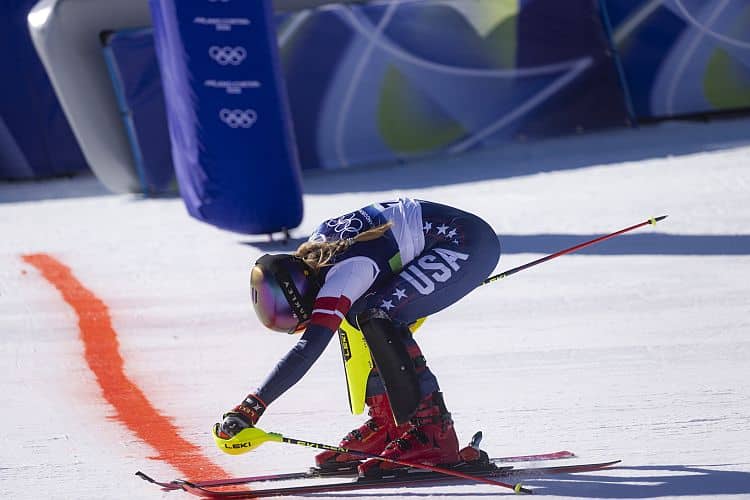
Lena Duerr (GER) stood second after the first run, but skied out on the second, and 2025 World Champion Camille Rast (SUI) moved from fourth to the silver in 1:40.60. Swede Anna Swenn Larsson moved up from fifth to bronze in 1:40.81.
Many of the first-round leaders had trouble on the second run, while Moltzan, 29th in the first run, had the fastest second round and zoomed up to eighth overall at 1:41.29. American A.J. Hurt was 18th at 1:42.43.
Shiffrin is the second to win this event twice, after Vreni Schneider (SUI) in 1988 and 1994. It’s her fourth Olympic medal (3-1-0) and at 30, she’s not close to being done. Could she make it all the way to Utah 2034 … or will she be in the broadcast booth?
Shiffrin is also the leader of the FIS World Cup circuit, looking for a sixth seasonal title. She can rest a little; the next Giant Slalom-Slalom weekend isn’t until 14-15 March in Are (SWE).
● Biathlon: Women’s 4×6 km Relay
France’s lead-off skier, Camille Bened had three penalties and her leg and handed off 55.8 seconds behind defending champion Sweden. No need to worry.
The next three French legs – Olympic medalists Lou Jeanmonnot, Oceane Michelon and Julia Simon – buried the field and brought France a relay sweep – men’s women’s and mixed – in 1:10:22.7 (6 penalties).
Jeanmonnot had the lead by 1.6 seconds over the Swedes after the second leg and then it was over. But the Swedes hung in for silver with Elvira and Hanna Oeberg handling the final two legs to finish in 1:11:14.0 (7). Norway was an expected third, but well back at 1:11:30.3 (7) and then Germany at 1:11:51.8 (9).
The U.S. was 18th at 1:16:49.4 (13) with Deedra Irwin, Luci Anderson, Margie Freed and Joanne Reid.
● Cross Country Skiing: Men’s Team Sprint; Women’s Team Sprint
Coming into the 2026 Winter Games, the U.S. had won a total of four medals in cross country skiing, ever. Bill Koch won the 1976 men’s 30 km silver and Jessie Diggins had won a gold (with Kikkan Randall) and an individual silver and bronze.
As of Wednesday, Americans have won three medals in 2026.
As expected, the heavily-favored Norwegian team, with Einar Hedegart and star Johannes Hoesflot Klaebo, got to the line first in 18:28.98, barely ahead of American Gus Schumacher, charging on the final leg for second in 18:30.35, as he and Sprint silver medalist Ben Ogden both had the fastest final legs.
Said Ogden, the first-ever U.S. men’s double Olympic medalist in cross country:
“It’s insane. Man, we proved today and all week we are here to stay and the USA guys are in good form, so it was awesome.”
Italy figured in the medal hunt and with Elia Barp and veteran Federico Pellegrino, they were third in 18:32.29, just ahead of the Swiss (18:33.20).
Klaebo won his record 10th Olympic gold, and continues alone behind swim icon Michael Phelps of the U.S., who won 23 Olympic golds for the all-time lead. Klaebo won six golds at the 2025 World Championships and had a chance at a sixth in the 50 km Classical to come.

Diggins was looking for another medal in the women’s Team Sprint, with Julia Kern, but the favored Swedes – silver winner Jonna Sundling and bronzer Maja Dahlqvist – had the lead for most of the race and finally won a tight battle with 2025 Worlds bronze winners Switzerland, 20:29.99 to 20:31.39.
The U.S. was second or third for the first half of the race, but Diggins and Kern slowed on the final legs and Germans Laura Gimmler and Coletta Rydzek took the bronze in 20:35.86, followed by Norway (20:36.00) and the U.S. in 20:41.53.
● Freestyle Skiing: Women’s Aerials
Defending champion Mengtao Xu recorded a 107.75 jump in the first final and skipped the second, confident of advancing to the medal final. She did, as the no. 3 qualifier. Australia’s Danielle Scott, the 2025 Worlds bronze winner, uncorked a 117.19 score and was the top qualifier into the medal round.
Once there, it was Xu who scored big as the third starter out of six and took the lead at 112.90 and invited anyone to pass her. No one could, with Scott the last to try and her 102.17 earned her the silver medal, Australia’s first since 2014 in this event.
China’s unheralded Qi Shaq, whose first-up jump scored 101.90, ended up with the bronze, ahead of teammate Fanyu Kong (101.31), the 2023 World Champion.
The U.S. also had two finalists, with Kalia Kuhn scoring 99.16 and Winter Viniecki finished sixth with 90.58 in the medal round.
Xu made history as the first to win this event twice!
● Short Track: Men’s 500 m; Women’s 3,000 m Relay
Dutch star Jens van’T Wout was in lane one and ready for a third gold in the men’s 500 m A final, but he was beaten to the first corner by Canada’s Steven Dubois, the 2025 World Champion. A lap later, his teammate and seasonal leader William Dandjinou passed aggressively on the inside and got into second, but it caused a ripple effect that sent Teun Boer (NED) flying into the pads.
That left Dubois with a serious lead over Melle van’t Wout – the older brother – and they rolled to the line 1-2, with Dubois advancing from bronze in Beijing to gold in Milan. Melle van’T Wout won a completely unexpected silver and Jens recovered enough to finish third, so both were on the podium. Dandjinou was disqualified for his inside pass.
It’s the first win in this event for Canada since 2010 and the first medals ever in the 500 for the Dutch.

The women’s 3,000 m relay had defending champion Netherlands and star sprinter Xandra Velzeboer, but with 15 laps to go, the Dutch crashed out and it was Canada and Italy at the front, with South Korea third.
Canada maintained the lead with the crowd ready to explode for Italy and the Azzurri were in front with four laps to go. Then 1,000 m bronze winner Gil-li Kim flew to the front with two laps to go, with Italian star Arianna Fontana chasing. But it was Kim who got to the line first in 4:04.02, just ahead of Italy in 4:04.15.
Canada ended up with the bronze (4:04.33) with the Dutch finishing in 4:09.10.
The Koreans have won a medal in this event in four straight Games and took the win in the relay for seventh time in the 10 times it has been held.
For Fontana, it was her 14th career Winter Games medal (3-6-5), tying her for the second-most in history with Norse biathlete Ole Einar Bjorndalen and one behind Marit Bjorgen (NOR: cross country).
● Snowboarding: Men’s Slopestyle; Women’s Slopestyle
A loaded field, but the returning silver medalist, China’s Yuming Su, got off an 82.41 jump in the first round and had the lead. Japan’s Taiga Hasegawa, a Worlds medalist in Big Air but not in Slopestyle, scored 82.13 in round one to sit second.
But the big scores never came. France’s Romain Allemand was third heading into the third round at 76.95. American Jake Carter, no. 3 in the order, jumped into bronze-medal position with a 79.36 finale and Su popped an 82.18 back-up score two jumpers later.
But there were no late fireworks and Su moved up from second in 2022 to the top of the podium. Winning on his 22nd birthday, he will have more chances for medals. Hasegawa won his first major international medal in Slopestyle, and Canter – also 22 – won his first major medal as well.
The U.S.’s Red Gerard, the 2018 winner, was fifth (76.60) and Oliver Martin (75.36) was ninth.

The women’s Slopestyle had Big Air medal stars – gold winner Japan’s Kokomo Murase and runner-up Zoi Sadowski Synnott (NZL) – as the final two jumpers in the order, and Murase delivered in the first round, scoring 79.30 for the lead.
That stood until the middle of the second round, when Mari Fukada (JPN), the 2025 Worlds Big Air bronze winner, took over at 85.70, which turned out to be one of just four jumps over 80.00 during the competition.
The action finally got hot in the final round, but Fukada added pressure with an 87.83 closer.
Murase got untracked and improved to 85.80 and the Sadowski Synnott reached 87.48, but it was not enough and Fukada had the gold, and Sadowski Synnott a second silver at the 2026 Games. The 1-3 for Japan were their first medals in this event.
The U.S. finished 6th and 11th with 16-year-olds Jessica Perlmutter (68.18) and Lily Dwawornvej (41.81).
Elsewhere:
● Curling: Swiss Yannick Schwaller’s men’s rink continued undefeated at 8-0, with a 10-4 win over Norway, with 2014 Olympic champ Brad Jacobs and Canada at 7-1 after an 8-3 defeat of Italy.
Daniel Casper’s U.S. squad fell to 4-5 and finished group play, losing to Bruce Mouat and Britain (5-4), 9-2. Casper’s rink is currently sixth and has only a slight chance of getting into fourth place and the playoffs, depending on the results of the remaining matches tomorrow.
In the women’s tournament, Anna Hasselborg’s Swedish rink finished at 7-2, with the four-time World Champion Swiss – skip Silvana Tirinzoni – at 6-2, then the U.S., Canada and South Korea at 5-3, with a day to play.
American Tabitha Peterson’s rink lost to Britain, 8-7, and Hasselborg – the 2018 Olympic champ – lost to South Korea, 8-3. The U.S. will finish tomorrow with the Swiss, and the Canadians and Koreans face off in what could be a play-in game.
● Ice Hockey: In the men’s quarterfinals, Canada got all it could handle from the Czech Republic, but a Mitch Marner goal just 1:22 into overtime got a 4-3 win and advanced the favorites to the semis.
No. 3 Slovakia handled Germany by 5-1 and no. 4 Finland also had to go to overtime to get past Switzerland, 3-2.
The U.S. was matched with no. 7 Sweden, which was 2-1 in Group B, in a tight match that was scoreless after a period. In the second, the Americans broke on top with a Dylan Larkin goal at 11:03 of the period, tipping in a Jack Hughes shot from the top of the zone.
The U.S. stayed in front until 1:31 to go, as Mika Zibanejad took a cross-ice pass from Lucas Raymond and sent a laser past American keeper Conor Hellebuyck, who had turned aside 28 Swedish shots. The U.S. ended regulation with a 34-29 edge on shots.
So the third of four quarterfinals to go to a 3×3 overtime saw the U.S. take the first five shots and dominate the period. Finally, Quinn Hughes reversed from right to left inside the blue line and fired a liner that zipped past the left shoulder of Swedish keeper Jacob Markstrom for the 2-1 win.
So Canada will face Finland and the U.S. will play Slovakia in the semifinals on Friday.
= PREVIEWS: THURSDAY, 19 FEBRUARY =
(7 finals across 6 sports & disciplines)
● Figure Skating: Women’s Singles
Japan dominated the Short Program, with Ami Nakai, 17, and fourth at the national championships, landing a triple Axel and scoring 78.71 points to stand just ahead of three-time World Champion Kaori Sakamoto (77.23).
American Alysa Liu, the 2025 World Champion, is in the mix at 76.59 for third, and Japan’s Mone Chiba, 20, is fourth at 74.00. Russian “neutral” Adeliia Petrosian is fifth at 72.89.
The other Americans are Isabeau Levito in eighth (70.84) and Amber Glenn missed an element and was 13th (67.39).
If the Free Skate scores during the season mean anything, this is going to be close. Sakamoto has the best score so far at 150.13, trailed closely by Nakai at 149.08 and Liu at 146.70. Chiba has scored 144.94.
Sakamoto has scored as high as 155.77 (2022) and figures as the favorite; Liu has scored 150.97and Nakai, 149.08. Close. Very close.
Chiba’s 144.94 Free Skate best and Petrosian has scored 140.91, so they figure to be looking at bronze, not gold, if any of the top three fall back.
● Freestyle Skiing: Men’s Aerials
Defending champion Quangpu Gi (CHN) won a couple of World Cup medals this season. Two-time World Champion Noe Roth (SUI) won one.
But there were lots of others who shined, including China’s Jiaxu Sun, Xindi Wang and Tianma Li, who all won World Cup golds. Ukraine’s Dmytro Kotovskyi and Oleksandr Okipniuk also won.
The U.S. has two contenders, with Chris Lillis, the 2021 Worlds silver winner and Quinn Dehlinger, the 2023 and 2025 Worlds runner-up. A darkhorse pick would be Swiss Pirmin Werner, the 2025 Worlds bronze medalist, who won one World Cup medal this season.
No one has dominated; someone else could completely surprise.
● Ice Hockey: Women’s final
Canada has been in all seven Olympic Winter Games finals and has won five of them. The U.S. has been in six, winning in 1998 and 2018.
So far, this season has been one-sided. The U.S. won the four games in the Rivalry Series by a combined score of 24-7. And the Americans were 5-0 winners in the group-stage game between the two.
On paper, no contest. But it’s one game for the gold.
Canada won, 3-2, at Beijing in 2022, and the Canadians have won three of six IIHF World titles from the U.S. since the 2018 Games. In 2025, the Americans won, 4-3, in overtime.
● Nordic Combined: Team Sprint Large Hill (141 m) + 2 x 7.5 km
This is a new Olympic event, with two athletes per team. The simple math from the Large Hill competition was that Norway’s Jens Oftebro and Andreas Skoglund went 1-4, Finland’s Ilkka Herola and Eero Hirvonen went 3-5 and Austria’s Johannes Lamparter and Stefan Rettenegger went 2-8, so those are the medal favorites.
Germany should challenge, with veterans Vinzenz Geiger and Julian Schmid or Johannes Rydzek, who placed 9-12-11 in the Large Hill competition.
● Ski Mountaineering: Men’s Sprint; Women’s Sprint
This will be the debut for this sport in the Olympic Winter Games, combining uphill climbing and downhill skiing, to be held in Bormio. The 750 m course starts and finished at 1,215 m (3,986 feet), has a climb of 70 m (230 feet) and returns to the original altitude.
Spain’s Oriol Cardona Coll is the unquestioned men’s favorite, having won the ISMF World Championships in 2023 and 2025 and a World Cup Sprint this season. But he has a real challenger in France’s Thibault Anselmet, second and first against Cardona this season and twice runner-up to him in the 2023-25 Worlds. Russian “neutral” Nikita Filippov won two World Cup bronzes this season and could challenge, along with Swiss Jon Kistler – the 2025 Worlds bronzer – and Arno Lietha, who went 1-2 in the World Cup in Utah in early December.
Based on the World Cup season so far, France and Italy are expected to battle for the women’s race, with Emily Harrop (FRA) a two-time World Cup winner this season and the bronze and silver medalist in the last two Worlds. Teammate Margot Ravinel finished 1-2-3 in the three Sprint World Cups this season.
However, Swiss Marianne Fatton, won the 2021 and 2025 Worlds golds, and there is a home favorite. Italy’s Giulia Mirada won two silvers and a bronze in the three World Cup races and took silver at the 2017 World Championships. She will surely be in the mix.
● Speed Skating: Men’s 1,500 m
Two races and two wins for American Jordan Stolz, in the 500 m and 1,000 m and now he goes for the 1,500 m, in which he won the World Championships golds in 2023 and 2024. He was second in the 2025 1,500 m Worlds but then won all five races during the 2025-26 World Cup season.
If he’s healthy, he should win. If not, the three logical challengers are two-time defending Olympic champion Kjeld Nuis (NED), who was second twice and third twice in the World Cup season. China’s Zhongyan Ning was also second twice and third twice in the World Cups and won the 1,000 m bronze.
German Finn Sonnekalb had a second, third and two fourth during the World Cup. Just 18, he won the Youth Olympic Games gold in the 1,500 m in 2024 and the World Junior gold in 2025. A breakthrough?
It must be noted that it was Norway’s Peder Kongshaug who won the 2025 Worlds gold over Stolz and Connor Howe (CAN) was third. Kongshaug was quiet on the World Cup circuit in four races; Howe is injured and is not in Milan.
A U.S. skater hasn’t won this race since Derek Parra in 2002, and no medals since 2010. Stolz is trying to change all that.
= INTEL REPORT =
● Olympic Games 2028: Los Angeles ● The Los Angeles City Council approved on Tuesday, by 10-2, a second reading of an ordinance to be submitted to voters on the 2 June 2026 municipal ballot, an increase in the Transient Occupancy Tax (“hotel tax”) through 2028, raising revenue from visitors through the 2028 Olympic and Paralympic Games.
The current rate would, if approved by voters, to go 16% through 2028 and then revert down to 15% thereafter.
● Athletics ● The U.S. Justice Department announced an indictment in Florida against Paul Askew, 46, of Jacksonville, Florida under the Rodchenkov Anti-Doping Act of 2019, which seeks to punish those who supply doping materials to athletes. Per the announcement:
“[F]rom on or about July 10, 2023, and continuing through on or about January 31, 2024, Askew conspired with others to influence major international sports competitions by providing performance enhancing drugs to an athlete. The major international sports competitions the conspiracy sought to influence included the 2023 Ed Murphey Classic, the 2023 Xiamen Diamond League, the 2023 Prefontaine Classic, the 2024 American Outdoor Track and Field Championship, the 2024 World Athletics Indoor Championships, the 2024 United States Olympics Trials, and the 2024 Olympics in Paris.”
No further details were offered in the indictment; The Associated Press reported that information from 2022 Worlds 100 m silver medalist Marvin Bracy-Williams – banned for 45 months in November 2025, with credit back to February 2024 for time already suspended – was used in charging Askew.
● Cycling ● “Although cycling is now hugely popular across five continents, its media coverage and the revenues generated for its stakeholders do not yet fully reflect its potential. There is considerable room for improvement, provided that a concerted, balanced approach is developed that is adapted to future challenges, while preserving the historical strengths of the discipline.
“Several reforms implemented in recent years have helped to promote the development of road cycling (internationalisation, new events, the growth of women’s cycling, etc.). The aim now is to continue this positive momentum collectively, in a spirit of dialogue and shared responsibility, under the auspices of the UCI.”
That is the driver behind a discussion project of the Union Cycliste Internationale with the road cycling community, to be completed by 30 April 2026. At that point, “in-depth” discussions with the stakeholders in the sport are to develop a better model for the sport.
● Wrestling ● Paris 2024 Olympic 86 kg bronze medalist Aaron Brooks of the U.S., a four-time NCAA champion at Penn State, was suspended for two years by an independent arbitrator.
Brooks tested positive for anabolic agent dehydroepiandrosterone (DHEA) on 21 April 2025, which was ruled as unintentional. Therefore, his sanction was chopped from four years to two; it began on 13 June 2025, the date of his provisional suspension.

★ Receive our exclusive, weekday TSX Recap by e-mail by clicking here.
★ Sign up a friend to receive the TSX Recap by clicking here.
★ Please consider a donation here to keep this site going.
For our updated, 45-sport, 910-event International Sports Calendar for 2026 and beyond, by date and by sport, click here!