












★ The Sports Examiner: Chronicling the key competitive, economic and political forces shaping elite sport and the Olympic Movement.★
★ To get the daily Sports Examiner Recap by e-mail: sign up here! ★
★ Friends: YES! Now 41 donors have covered 108.1% of our winter goal for our tech support costs. Happy to start on the summer bill: you can donate here. YOU are the reason this site continues. ★
= MILAN CORTINA 2026 =
From Lane One
The official announcement came through at 9:55 a.m. in Cortina:
“Skeleton pilot Vladyslav Heraskevych (UKR) has been withdrawn from the startlist of Milano Cortina 2026 Men’s Skeleton event on 12th February 2026 after refusing to adhere to IOC Guidelines on Athlete Expression.”
This culminated a dramatic back-and-forth discussion between the International Olympic Committee and Heraskevych with the IOC sending a letter on 10 February that while he was allowed to wear his “Memory Helmet” picturing images of Ukrainian athletes killed in Russia’s continuing invasion in training session, he would not be able to do so in competition.
A second letter was sent to Heraskevych on Wednesday (11th) and on Thursday, and an in-person discussion took place at the Olympic Village in Cortina. Heraskevych insisted on wearing the helmet in competition and when he came to the Cortina track, he met with IOC President Kirsty Coventry (ZIM) at 7:30 a.m. and refused to change his stance.
So, he was disqualified. In the IOC’s statement:
“The IOC was very keen for Mr Heraskevych to compete. This is why the IOC sat down with him to look for the most respectful way to address his desire to remember his fellow athletes who have lost their lives following Russia’s invasion of Ukraine. The essence of this case is not about the message, it is about where he wanted to express it.”
The statement noted that the IOC withdrew his accreditation for the Games. But that changed.
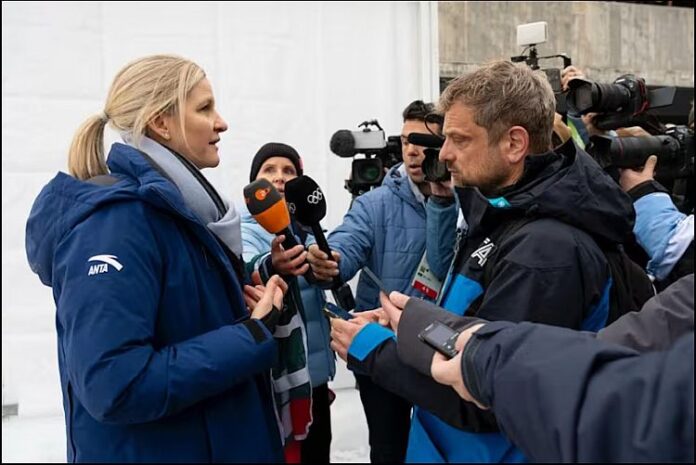
Coventry, who as the then-head of the IOC Athletes’ Commission helped to develop the athlete expression rules, was clearly emotional as she spoke to reporters following the meeting in Cortina (pictured above) and explained:
“I felt that it was really important to come and talk to him face to face.
“Athletes asked us to keep certain areas – the field of play, the podium and the Olympic Village – safe zones. How could we keep them safe in order to not be asked to use the field of play or the podium for something that they didn’t agree with?
“No one – no one, especially me – is disagreeing with the messaging. The messaging is a powerful message. It’s a message of remembrance. It’s a message of memory.
“It’s not about the messaging; it’s literally about the rules and the regulations. In this case – the field of play – we have to be able to keep a safe environment for everyone. And sadly, that just means no messaging is allowed.
“We could find ways where we can pay homage to his message, to his helmet, before he races. And sadly, we’ve not been able to come to that solution.”
Coventry interceded with the IOC Disciplinary Commission and asked for Heraskevych’s accreditation to be restored, and it was, so he can continue to be at the Games.
Before the final meeting with Coventry, Heraskevych posted on X his requests:
“1. Lift the ban on the use of the ‘Memory Helmet.’
“2. Apologize for the pressure that has been put on me over the past few days.
“3. As a sign of solidarity with Ukrainian sport, provide electric generators for Ukrainian sports facilities that are suffering from daily shellings.”
Ukrainian President Volodymyr Zelenskyy posted, in part:
“I thank our athlete for his clear stance. His helmet, bearing the portraits of fallen Ukrainian athletes, is about honour and remembrance. It is a reminder to the whole world of what Russian aggression is and the cost of fighting for independence. And in this, no rule has been broken.
“It is Russia that constantly violates Olympic principles, using the period of the Olympic Games to wage war. In 2008, it was the war against Georgia; in 2014 – the occupation of Crimea; in 2022 – the full-scale invasion of Ukraine. And now, in 2026, despite repeated calls for a ceasefire during the Winter Olympics, Russia shows complete disregard, increasing missile and drone strikes on our energy infrastructure and our people.”
The Ukrainian National Olympic Committee announcement of the disqualification noted:
“The NOC of Ukraine and the national team of Ukraine have consistently supported Vladyslav in his conscious choice. The NOC of Ukraine does not see any violations in the athlete’s actions and will continue to defend the right of Ukrainian athletes to represent Ukraine on the international stage.”
Heraskevych added in the story, “We paid the price for our dignity.”
What is the impact of all this? Let’s point to these:
● Ukraine’s future depends, in large part, on winning the hearts and minds of people around the world. Heraskevych’s actions will be the emotional signature of this Winter Games and made a magnificent statement on behalf of his country.
Heraskevych’s stance recalls the climactic line from the 1983 techno-thriller “War Games,” when the computer “Joshua” considers all possible nuclear-war scenarios and states, “The only winning move is not to play.” And Heraskevych won by not playing.
He knew exactly what he was doing; at 27, this was his third Games, after he finished 12th in 2018 and 18th in 2022. And he was not going to contend for a medal in 2026. But he rose above the competition, even as he sacrificed his own place in it.
● The IOC’s stance, was right. As painful as the decision was, the ban on field-of-play messaging will, in the future, retard future attempts by others – such as Russia – to insert governmental messages into athlete uniforms or something just as clever.
● The loser is Russia, no doubt. Not in Russia, but among those who have, are and will continue to support Ukraine against the Russian invasion that began two days after the close of the 2022 Winter Games.
The 2026 Winter Games go on. Although Heraskevych was not allowed to compete, he won. Ukraine won. Looking into the future, the IOC won, too, although it may not seem like it right now.
~ Rich Perelman
● Milan Cortina 2026 updates ● Heraskevych filed an action at 4:30 p.m. on Thursday with the Court of Arbitration for Sport’s Ad Hoc division, set up for the Winter Games in Milan. He is challenging the International Bobsleigh & Skeleton Federation’s decision to remove him from the men’s Skeleton event. If successful, he is asking to compete in separate runs.
At the morning news briefing, the organizing committee noted that 71,000 tickets were sold on Wednesday.
● Il Tempo Olimpici ● Milan weather on Friday projects as cloudy again, but with a pleasant high of 59 F, then a night-time low of 44 F and likely light rain in the evening.
In Cortina, it will be 44 F for the high with clouds and some sun, down to 29 F with some light snow in the evening. Winds are projected to average about 5 miles per hour.
● Scoreboard ● A total of 44 events out of 116 have been decided, and Italy continues its amazing performance in Milan Cortina, leading all countries with 17 medals. Remember, the most the Italians have ever won in a Winter Games (in total) is 20! After six days of medal events:
● 17: Italy (6-3-8)
● 14: Norway (7-2-5)
● 14: United States (4-7-3)
● 12: Austria (3-6-3)
● 10: Japan (2-2-6)
● 9: Germany
● 8: Sweden
● 8: France
● 7: Switzerland
● 7: Canada
A better indication of team performance has to go beyond three places, so The Sports Examiner returns to our eight-place scoring, using the NCAA track & field format of 10-8-6-5-4-3-2-1 to score each event. After three days, the top 12:
● 200.5: Italy
● 175.5: Norway
● 166.5: United States
● 161.5: Austria
● 112.5: France
● 111: Germany
● 96: Canada
● 94.5: Japan
● 87.5: Switzerland
● 87: Sweden
● 84: Netherlands
● 54: China
In terms of top-8 place winners, Italy is leading with 39, trailed by Austria (36), the U.S. (33) and Norway (32).
● Television ● NBC is not providing daily viewership data, but said the U.S. presentation “is averaging 26.5 million viewers through last night on NBC, Peacock, NBCUniversal Digital Platforms and Versant’s CNBC and USA Network – marking the most-watched Winter Games presentation at this point since 2014 Sochi Olympics, according to official Nielsen Big Data + Panel viewership and preliminary data from Nielsen, and digital data from Adobe Analytics.”
● Transgender ● Swedish Freestyle Moguls skier Elis Lundholm, a female by birth but who identifies as a man, was reported as the first “transgender” athlete ever at the Winter Games.
The Associated Press noted that “The Swedish ski team said Lundholm has not undergone any gender-affirming treatment or surgery,” so that no advantage is present, and even under new proposed rules, would be eligible to compete in the women’s category as a biological female, pending a sex-screening test.
Lundholm finished 29th in the first qualifying round and 15th in the second and did not advance to the first final.
● Also on TSX ● The Los Angeles City Council introduced a resolution on Wednesday asking the LA28 organizing committee to have leaders with “integrity, accountability and respect,” in a swipe at Chair Casey Wasserman. The resolution, which has no legal impact on LA28, heads to two committees for review.
= RESULTS: THURSDAY, 12 FEBRUARY =
(9 finals across 7 sports & disciplines)
● Alpine Skiing: Women’s Super-G
American fans know Lindsey Vonn’s return to skiing as a supreme comeback story, but one which ended in tragedy.
Italian fans will remember Federica Brignone’s return as a dream come true.
Brignone, 35, and in her fifth Games, was the 2025 Worlds Super-G runner-up (and won the Giant Slalom), but suffered a bad crash with multiple fractures of her left leg at the Italian Championships in April 2025 and went through surgery and recovery, only getting back to the slopes in recent weeks.
But after a 10th in the Downhill, she was obviously ready to go and starting sixth in the order, took the lead at 1:23.41, with many more to come. But none were faster.
Austria’s Cornelia Huetter, 10th in the order , who the 2023 Worlds Super-G bronze, challenged for the lead but came up short at 1:23.93. But at least she finished. Favorites like Kira Weidle-Winkelmann (GER: no. 3 starter), Emma Aicher (GER: no. 7), Ester Ledecka (CZE: no. 8) and Sofia Goggia (ITA: no. 9) all failed to finish. Same for Downhill champ Breezy Johnson of the U.S. at no. 19.
(However, Johnson did get a prize: an engagement ring from long-time partner Connor Watkins, near the finish line after her run!)
New Zealand’s Alice Robinson, at no. 14, finished, but was eighth at 1:24.44. Finally a challenge came at no. 15, as France’s Romane Miradoli, with one World Cup medal this season, conquered the course in 1:23.82, passing Huetter and winning the silver.
It’s Brignone’s fourth career Olympic medal and she’s the defending Olympic champ in the Giant Slalom upcoming. She’s also medaled in three straight Winter Games. Huetter kept an Austrian medal streak in this event alive, now in six straight Games.
● Cross Country Skiing: Women’s Interval Start Freestyle 10 km
Sweden’s Ebba Andersson and Frida Karlsson went 1-3 in the 10 km at the 2025 World Championships and Karlsson and Andersson were 1-2 in the 20 km Skiathlon in Val di Fiemme.
Thursday’s Freestyle 10 km was more of the same. Karlsson got out strongly early, finishing in 22:49.2 and taking a resounding victory for her second gold of the Games.
She won by more than 46 seconds over Andersson (23:35.8), who was actually in a duel on the clock with American star Jessie Diggins. The Swede was in second place by the 8 km mark and held off the American by a little more than three seconds, as Diggins finished in 23:38.9, clutching her ribs in pain past the line. She said afterwards:
“I’m the happiest bronze medalist in the world. I’m so grateful for everyone getting me here. It’s taken a serious team effort to get to the start line and a lot of help once I got to the finish line, because I’ve been in a lot of pain.”
Overcoming doubts from her fall in the Skiathlon, Diggins won a medal for the third Games in a row, now with four total and the relays and the 50 km to come.
Novie McCabe was the next U.S. finisher, in 31st at 25:12.8, then Kendall Kramer in 38th at 25:34.9 and Hailey Swirbul in 39th (25:45.3).
● Freestyle Skiing: Men’s Moguls
Canada’s Mikael Kingsbury is the greatest Moguls skier of all time, with the World Cup wins record, the 2018 Olympic title and four Worlds golds. Japan’s Ikuma Horishima has won three Worlds golds. They went 2-3 at the 2022 Beijing Games, but could be expected to be gold and silver this time.
They were 1-3 in the qualifying, with Horishima the leader. And they finished 2-5 in the first final, with Kingsbury at 82.56 for second and Horishima at 80.35. In the medals final, Horishima was third in the order and put up a strong 83.44 score to take the lead, followed by defending champion Walter Wallberg (SWE), who settled for 82.40 and second place at the time.
Australia’s Matt Graham, the 2018 silver winner, was next, but scored only 80.88 and was third. That left Kingsbury and Australia’s Cooper Woods, having the competition of his life. A winner of one career World Cup medal coming in, Woods led the first final at 83.60. Another run like that would win a medal.
Kingsbury skied well and took the lead at 83.71 and looked like a gold medalist in the making. But Woods looked good too and, astonishingly, produced the same score as Kingsbury: 83.71. Even better, he won the tie-breaker on the turns scoring, 48.4 to 47.7 and won the gold medal.
Kingsbury and Horishima, just as in Beijing, were 2-3 again.
Woods, 25, won his only World Cup medal in January 2025, a Moguls silver. Now he has an Olympic gold to go with it. It’s Australia’s first win in this event since 2006. Kingsbury won his fourth straight Olympic medal (2-1-2-2) and a Canadian medal for the fifth straight Games in Moguls. Horishima’s bronze was the third straight for Japan in this event.
American Nick Page ended up seventh (75.00).
● Luge: Team Relay
With Max Langenhan and Julia Taubitz already the Singles winners, Germany was an almost-sure winner and they didn’t miss. In fact, Taubitz, Tobias Wendl and Tobias Arlt, Langenhan and Dajara Eitberger and Magdalena Matschina each had the fastest times of the day and the result was a superb, 3:41.672 gold-medal victory.
In a sport with margins in the 1,000ths of a second, they won by 0.542 over a very good effort from Austria (Lisa Schulte, Thomas Steu-Wolfgang Kindl, Jonas Mueller, Selina Egle-Lara Kipp) in 3:42.214.
Doubles winners Italy, of course, had to be in the medals and took the bronze in 3:42.521, followed by Latvia (3:42.759).
The U.S. finished fifth in 3:42.776, with Ashley Farquharson again third fastest among the women’s segment and Marcus Mueller and Ansel Haugsjaa second-fastest in the men’s Doubles. Both Jonny Gustafson and Chevonne Forgan and Sophia Kirkby were fifth-fastest in their turns.
● Short Track: Men’s 1,000 m; Women’s 500 m
The final was a tactical affair, with favored 2025 Worlds silver medalist (and quarterfinal and semifinal winner) William Dandjinou (CAN) leading, but into the final lap, Jens van’t Wout (NED), the 2026 European champ, attacked and got to the front.
Dandjinou was then passed from behind and into the final turn by China’s Long Sun and Korean Jong-un Rim as van’t Wout and Sun went to the line together. But the photo showed van’T Wout by a toe at 1:24.55 and Sun in silver position at 1:24.58. Rim won the silver at 1:24.72 and Dandjinou was left out of the medals in fourth.
This was a shocker, especially for Dandjinou to be left off the podium. It’s also the first Dutch gold in this event and only its second medal in the men’s 1,000 m in the 10 times it has been held.

A dream day for Italy continued into the final of the women’s 500 m, as 12-time Olympic medalist and two-time defending champion Arianna Fontana – in her sixth Games – made it to the medal round, against two stars each from Canada and the Netherlands.
But there was no doubt about the winner in the final. Dutch star Xandra Velzeboer – the favorite, who had set a world record of 41.399 in her semifinal – started inside, took the lead and extended it right to the finish to win decisively in 41.609. No doubt whatsoever.
Fontana was in second position and could not challenge, but she held off Canada’s Courtney Sauralt, who was trailing her closely throughout the final lap. It was close, but Fontana took silver in 42.294 to 42.427. Selma Poutsma (NED) finished fourth in 42.491. American Kirsten Santos-Griswold crashed in the B final and ended up ninth overall at 1:08.444.
The amazing Fontana won her 13th career Olympic medal – the most ever in Short Track – an tied her with speed skater Ireen Wust (NED: 2006-22) for no. 3 all-time among Winter Games total medal winners. For the Dutch, it’s the first gold ever in this event after silvers in the last two Games.
● Snowboard: Men’s SnowCross; Women’s Halfpipe
This was the sixth running of the men’s Snowboard Cross in the Winter Games, after Seth Westcott (USA) won the first two and then Pierre Vaultier (FRA) won in 2014 and 2018. Could 2022 champ Alessandro Hammerle (AUT) make it two in a row … again?
Hammerle qualified seventh and in the round-of-16, he beat Jake Vedder and Cody Winters of the U.S. to win heat seven. He was second to Beijing ‘22 runner-up Eliot Grondin (CAN) in the quarters and moved into semifinals.
Same result: Grondin over Hammerle in the second semi and both moved on to the medal final with Aidan Chollet (FRA) and Jakob Dusek of Austria.
Dusek had a win over Grondin on the World Cup circuit and Grondin had beaten Hammerle in the 2025 Worlds final, but this time Hammerle closed hard after the final jump and got to the line first by 0.03 over Grondin in a repeat of the 2022 finish, with Dusek third for an Austrian 1-2.
It’s the first time one country has won two medals in this event.

American star Chloe Kim was going for a third Olympic gold in the women’s Halfpipe and led the qualifying at 90.25.
She let the field know she wasn’t going to be easy to beat, jumping no. 12 in the order in the first round and taking the lead at 88.00. That easily surpassed Japan’s two-time Worlds bronze winner Mitsuki Ono (85.00) for the best of the first round. Neither improved in round two, but Japanese teammate Rise Kudo stayed in third but improved to 81.75.
The decisive third round exploded at no. 7, when 17-year-old Korean star Ga-on Choi burst into the lead at 90.25 after two poor jumps. Japan’s Sara Shimizu scored 84.00 to move to fourth, then Kim got to go as the final jumper, standing in silver position. After a good start, she fell in the middle of the pipe and skidded out, leaving the Korean teen with the gold.
It was Korea’s first medal in the event. Kim’s silver continued the U.S. streak of winning a medal in every one of the eight editions of this event at the Olympic level.
The other Americans competing among the snow drifts in Livigno were Bea Kim, eighth at 77.00 and Maddie Mastro, 12th at 5.50.
● Speed skating: Women’s 5,000 m
Coming into Thursday, Italy had never won a medal in the women’s 5,000 m. But continuing the dream-like state of the Azzurri at the 2026 Winter Games, it was another gold, and a second for 3,000 m winner Francesca Lollobrigida.
There were only 12 skaters in the race and the medal possibilities were in the final three. The fourth pair saw Dutch star Merel Conijn take the lead at 6:46.27, beating Sandrine Tas (BEL: 6:46.47) to stand 1-2.
The fifth pair had Lollobrigida and Norway’s 3,000 m silver winner Ragne Wiklund and the Italian won the battle by 6:46.17 to 6:46.34 and they stood 1-3 going into the final race.
That had Canadian star Isabelle Weidemann, the 2022 silver medalist, against legendary Czech star Martina Sabilkova, now 38, and while a four-time medal and two-time champion in the event, was not a contender this time. Weidemann won easily in 6:50.08, with Sabilkova well back at 7:07.08 in 11th.
So, Lollobrigida gets a second gold at the Games, while Conijn earned silver, moving up from bronze at the 2025 World Championships. For Wiklund, this was also Norway’s first-ever medal in this event.
Elsewhere:
● Curling: On the second day of the men’s tournament round-robin, Yannick Schwaller’s Swiss rink clubbed the Danny Casper’s U.S. rink, 8-3. Defending champ Sweden and Niklas Edin lost their second straight match, this time to Bruce Mouat and Britain, 6-3.
In the loss to the Swiss, U.S. alternate Rich Ruohonen – a lawyer from Minnesota – was substituted in and at age 54, he became oldest-ever U.S. Winter Olympian. He’s a couple of years up on figure skater Joseph Savage, who was 52 at the 1932 Lake Placid Games.
The women’s tournament started and American Tabitha Peterson’s squad defeated 2024 Worlds bronzer Eun-ji Gun (KOR) by 8-4. Four-time World Champion Silvana Tirinzoni’s Swiss team won by 7-4 over Italy and Silvana Constantini.
● Ice Hockey: The men’s tournament continued with the U.S. on the ice for the first time, in Group C, facing Latvia. After a 1-1 first period, the Americans got in gear with three goals, from Brock Nelson at the 10:38 mark, then Tage Thompson on a power play at 17:35 and Nelson again 2:13 later for a 4-1 edge going into the final 20 minutes.
The Americans got a final goal on a power-play score by Auston Matthews at 2:35 of the third and finished with a 5-1 win. Connor Hellebuyck handled 17 of 18 Latvian shots while the U.S. took 38.
Women’s pool play finished as Canada shut down Finland, 5-0, so the U.S. won Group A at 4-0 and 20-1 in goals-against. The quarterfinals start Friday and will pit the U.S. and Italy (2-2), Canada (3-1) and Germany (3-1), Sweden (4-0) vs. the Czech Republic (1-3) and Finland (1-3) against the Swiss (1-3). The semis will be re-seeded.
= PREVIEWS: FRIDAY, 13 FEBRUARY =
(7 finals across 6 sports & disciplines)
● Biathlon: Men’s Sprint
Either a Norwegian or a German has won this race in 11 of 12 prior Olympic editions, but in 2026, don’t count out the Italians!
Tommaso Giacommel already has a Mixed Relay silver and was sixth in the 20 km. Moreover, he won this event twice on the IBU World Cup circuit and had another silver besides. But he will have to deal with 20 km winner Johan-Olav Botn (NOR), the new star of the men’s side of the sport in just his second year on the tour. He also won a Sprint, back in December.
Norway’s Sturla Holm Lagreid was the 2024 World Champion in this event and just won the 20 km bronze. He got himself into trouble by publicly announced how sorry he was after cheating on his girlfriend of the past six months … three months ago, telling NRK television:
“Six months ago, I met the love of my life and the most beautiful and kindest person in the world. Three months ago, I made my biggest mistake and cheated on her.”
The now-ex-girlfriend, who wishes not to be identified, told Norwegian paper Verdens Gang:
“It’s hard to forgive. Even after a declaration of love in front of the whole world. I did not choose to be put in this position, and it hurts to have to be in it. We have had contact, and he is aware of my opinions on this.”
Lagreid said later he knew he was “dropping a bomb,” and “then we’ll see what happens. I have nothing to lose. I am already hated by her, and I hope that maybe it can make her realize how much I love her.”
He added later:
“I had the gold medal in life. I am sure there are many people who will see things differently, but I only have eyes for her. Sport has come second these last few days. Yes, I wish I could share this with her.
“I hope that committing social suicide might show how much I love her. I’m taking the consequences for what I’ve done. I regret it with all my heart.”
If his emotions are in check, he’s a contender; beyond Botn, teammates Vetle Christiansen, Martin Uldal and Johannes Dale-Skjevdal all won World Cup Sprint medals this season. French stars Quentin Fillon Maillet (2022 Olympic silver) and Eric Perrot, the 20 km runner-up, are in the mix for sure.
American hopes for a first-ever Olympic biathlon medal are on Campbell Wright, who stunned with a Worlds silver in the Sprint in 2025. Swede Sebastian Samuelsson gets close among all the others, but he will not be a surprise on the podium
● Cross Country Skiing: Men’s 10 km Freestyle
Can anyone stop Norway’s amazing Johannes Hoesflot Klaebo? Anyone?
Klaebo won the Skiathlon and the Sprint and now looks for a third gold in an event which has not been held since the 1998 Games. It was won twice by Norway’s Bjorn Daehlie, who just happens to be the all-time leader in Olympic cross-country golds with eight and 12 medals overall. Klaebo now has seven and is trying for a gold-medal tie.
Klaebo, by the way, won this event at the 2025 World Championships, on the way to six golds there.
He will get pushed by teammates Martin Nyenget, bronze winner in the Skiathlon, Einar Hedegart, a two-time World Cup winner at 10 km, and Mattis Stenshagen, who won two 10 km World Cup races as well. In fact, Norwegian entries won all six 10 km World Cup races so far this season.
The best contenders from elsewhere appear to be Finland veteran Iivo Niskanen and France’s Jules Lapierre. The best American will likely be Gus Schmacher, who won a 5 km World Cup on 31 December.
● Figure Skating: Men’s Singles
The men’s Free Skate starts with three men who scored more than 100 points during the Short program: World Champion Ilia Malinin of the U.S. (108.16), Beijing 2022 runner-up Yuma Kagiyama (JPN: 103.07) and France’s 2024 Worlds bronzer Adam Siao Him Fa (102.55). There was a wide drop-off to fourth place Daniel Grassl (ITA: 93.46).
Malinin won the World titles in 2024 and 2025 and is a prohibitive favorite, expected to throw as many as seven quadruple jumps into his routine, including the quad Axel, which only he has completed in competition.
Kagiyama, who stands 5-3, is solid: Worlds silver winner in 2021-22-24 and bronze in 2025 and if Malinin were to fail badly, he would be in a position to launch a major upset. But that is not expected; Malinin was off his game in the Team Event, but said he overcame his Olympic jitters in the Short Program:
“I did not think it would be that heavy. I thought that I could come into this like any other competition, but honestly I definitely underestimated it.
“Now that I’ve gotten three performances under Olympic ice, I think that I’ve really tamed the Olympic ice.”
By the way, the highest score ever at an Olympic Games was American Nathan Chen’s 332.60 and Chen has the highest score on record at 335.30 in 2019. Malinin’s best is 333.81 from February 2025 and he owns five of the top-10 scores ever.
Malinin scored an unbelievable 238.24 in June of 2025 for the highest Free Skate ever. Just so you’re ready for it.
● Skeleton: Men
Despite having a special, aerodynamic helmet disqualified by the International Bobsleigh & Skeleton Federation, British riders Matt Weston (5) and Marcus Wyatt (2) won all seven World Cup races this season. In the two races Wyatt won, Weston was second. He’s the favorite.
Beyond the British pair, Beijing 2022 winner and three-time World Champion Christopher Grotheer (GER) is back, as is Axel Jungk, the silver medalist. Italy has a contender as well in 2023 Worlds runner-up Amadeo Bagnis, who won two late-season silvers behind Weston in January. Mostly overlooked, but one of the most consistent riders this season has been China’s Zheng Yin, with three World Cup bronzes and ranked no. 2 on the seasonal points table.
In the first two races on Thursday, Weston won both and leads at 1:52.09, 0.30 up on Jungk (1:52.39) and 0.46 on Grotheer (1:52.55). Fourth now is China’s Wenhao Chen (1:52.68); Wyatt was seventh in 1:53.21. American Austin Florian was 13th at 1:53.54.
● Snowboard: Men’s Halfpipe; Women’s SnowCross
Australia’s Scotty James won Olympic bronze in 2018 and silver in 2022. He’s a four-time World Champion, including in 2025 and on Wednesday, put down a 94.00 first qualifying run and went home.
He’s the favorite. Two others scored 90-plus: Japan’s 2021 World Champion Yuto Totsuka (91.25) and Ryusei Yamada (90.25), a World Cup winner last December. In fact, Japan qualified all four riders for the final, including 2025 Worlds silver winner Ruka Hirano (87.50) and defending Olympic champ Ayumu Hirano (85.50), who also won silvers in 2014-18.
They all are in the medal mix, along with Australia’s Val Guseli (86.75), the 2023 Worlds silver medalist, and American Alessandro Barbieri, fourth in the qualifying at 88.50.
Two more Americans, three-time Olympian Chase Josey (76.50) and second-time Olympian Jake Pates (75.50) also qualified in 11th and 12th.

The women’s SnowCross will look familiar to Olympic watchers, with 2018 Olympic champ Michela Moioli (ITA) and silver winner Julia Pereira de Sousa Mabileau (FRA) back, as well as 2022 runner-up Chloe Trespeuch (FRA).
Pereira won one of the three FIS World Cups this season, along with serious medal contenders Charlotte Bankes (GBR), the 2025 Worlds runner-up and France’s Lea Casta. Australia’s Josie Baff, the 2023 Worlds runner-up, should be a medal contender as well.
But can Moioli, 30, ride the home crowd to another Olympic gold? She is the most decorated in the field, with not only her 2018 Olympic gold, but is the reigning World Champion from 2025 and has been a Worlds medalist in five of the last six editions. She will be hard to beat.
● Speed Skating: Men’s 10,000 m
This is a rarely-contested event any more, and held only once on the World Cup tour, in the skating hotbed of Heerenveen (NED), in December.
There, Czech star Metrodej Jilek got a lifetime best of 12:29.63 to handle the field, including 2022 Olympic bronzer Davide Ghiotto (12:33.37), France’s former 5,000 m world-record holder Tim Loubineaud (12:36.61), Norway’s 5,000 m winner Sander Eitrem (12:41.34) and the 2014 Olympic winner, 40-year-old Jorrit Bergsma (NED: 12:45.46).
That race also had 2018 Olympic champ Ted-Jan Bloemen (CAN: 12:51.21) in seventh, behind American Casey Dawson (12:48.42).
Ghiotto is the reigning World Champion from 2023-24-25, the world-record holder (12:25.69) and in front of a roaring home crowd, figures as the favorite.
= INTEL REPORT =
● Olympic Games 2028: Los Angeles ● Major League Baseball Commissioner Rob Manfred told reporters on the sidelines of an owners meeting that he is optimistic about MLB players participating in the 2028 Games:
“I sense a lot of momentum towards playing in L.A. in 2028. I think we are going to get over those issues. I think people have come to appreciate that the Olympics on U.S. soil is a unique marketing opportunity for the game. I think we had a lot of players interested in doing it and, you know, I feel pretty good about the idea [that] we’ll get there.”
Participation in the 2028 Games will have to come in agreement with the MLB Players Association. It was reported that the 2028 All-Star Break would be extended to 9-21 July, with the Olympic tournament scheduled for 13-19 July, at Dodger Stadium.

★ Receive our exclusive, weekday TSX Recap by e-mail by clicking here.
★ Sign up a friend to receive the TSX Recap by clicking here.
★ Please consider a donation here to keep this site going.
For our updated, 45-sport, 910-event International Sports Calendar for 2026 and beyond, by date and by sport, click here!