
















★ The Sports Examiner: Chronicling the key competitive, economic and political forces shaping elite sport and the Olympic Movement.★
★ To get the daily Sports Examiner Recap by e-mail: sign up here! ★
≡ ASSEMBLY HEARING ≡
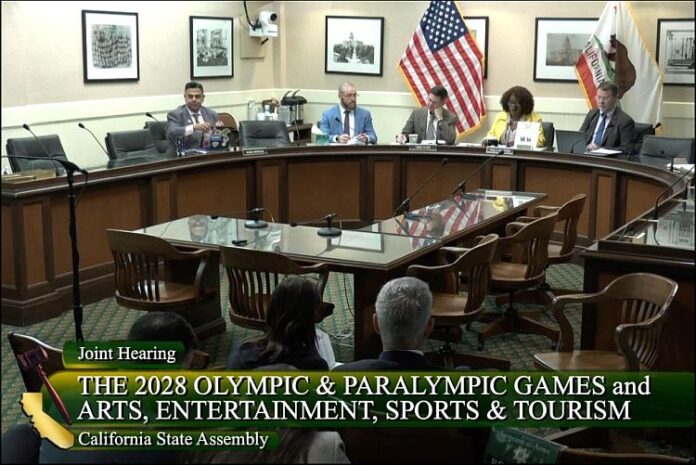
A second meeting of the California Assembly Select Committee on the 2028 Olympic And Paralympic Games, joined with the Assembly Committee on Arts, Entertainment, Sports and Tourism provided mostly an overview of the planning for the Games.
However, LA28 chief executive Reynold Hoover did offer some positive news on the beginning of ticket sales, so far only for Southern California and Oklahoma City residents:
“We just went on sale this past week; I will say in this room that we have exceeded all expectations in our revenue projections and our ticket sale projections. We have exceeded what Paris [2024] sold in their first days – in terms of Olympics – and we’ve actually outpaced all recent Olympics.
“And I think what that tells you is, it’s the power of the Games. … People want to come to L.A. and be a part of history.”
Hoover also detailed some of the progress on other organizing committee programs:
● He said that some 250,000 individuals have registered to volunteer for the Games, from many countries; “about 50,000 of them are Angelenos.” The plan is to register as many as 500,000, and to eventually select about 60,000 for the Games (Olympic and Paralympic).
● The LA28 staff total is now more than 650, eventually to rise to 1,000 by the end of the year. About 5,000 staff in total are expected to actually work at Games time.
● The Olympic Torch Relay is planned to be the largest ever held in the U.S., visiting all 50 states over the course of 100 days.
On transportation during the Games, a favored tactic implemented for the 1984 Games will return. Said Hoover:
“I think the Mayor is going to require deliveries after hours. So, during ‘84, commercial deliveries from 11 o’clock at night to, like, four or five o’clock in the morning, so that will take big trucks and delivery trucks off the roads.”
He also noted the now-available possibilities for remote work; “Mayor [Karen] Bass has already said she will ask people to remote work, those that are able to do that.” And he added that, compared to 1984, the availability of artificial intelligence to maximize the effectiveness of traffic routes related to the Games, will also be a help. Hoover said, “I feel very confident that both our athletes and the spectators, all of the officials, the Olympic Family, will be able to move around L.A.”
Assembly member Tom Lackey (R-34th District) thought more remote-work encouragement will be needed:
“I know that the Mayor has asked for people to do the stay-at-home, and if she could use a little stronger language – like direct them to stay home – or give them some kind of incentive to stay home, that’s the only thing that’s going to work, in large scale, in my opinion. … That’s the only way this is going to work, is if people will cooperate with us.”

There were many questions to Hoover, accompanied by Chief Athlete Officer Janet Evans, about small business opportunities for the Games, and these questions were also asked to Paul Krtekorian, the Executive Director of the City of Los Angeles Office of Major Events.
Krekorian explained the current program to use the Regional Alliance Marketplace for Procurement (RAMP) for businesses to see LA28 postings for contracts, as well as many others. But Krekorian was also looking for some State help for the 2028 Games, for cultural programming.
While LA28 will stage its mandated cultural program related to the Games, the City of Los Angeles has developed a community-based program, and “I’m confident that we’ll have significant support for those [cultural] programs, but it won’t be enough, and I can tell you that right now. It will not be enough, so one of the things we’ve asked you to consider is supporting some of those programs with state funding.”
He noted that the City is reaching out for philanthropic support as well within the Southern California community.

The final panelist, by video, was Los Angeles County Metropolitan Transportation Authoritychief executive Stephanie Wiggins, who is also looking for more money.
First, she said that Metro expects a attendee split of 40% from California, another 40% from around the U.S. and about 20% of international visitors. Further, of the 1,700-plus buses expected to be needed for the Games period, “we have, through pledges from across the country, already secured over half of the required buses.”
But Wiggins was also clear:
“We will need to secure additional funding to deliver [service] for the Olympic Games. We simply do not have the ability to fund operations ourselves. …
“Metro and our Games Mobility partners will need to make key investments to our system to be ready for the surge in users of our system and we are asking for the State’s help in funding some key legacy improvements.”
The ask is for $379 million for construction of station and line improvements and transit management, with Metro already having done – at its own cost – the engineering and environmental preparation work.

★ Receive our exclusive, weekday TSX Recap by e-mail by clicking here.
★ Sign up a friend to receive the TSX Recap by clicking here.
★ Please consider a donation here to keep this site going.
For our updated, 45-sport, 910-event International Sports Calendar for 2026 and beyond, by date and by sport, click here!