







★ The Sports Examiner: Chronicling the key competitive, economic and political forces shaping elite sport and the Olympic Movement.★
★ To get the daily Sports Examiner Recap by e-mail: sign up here! ★
≡ L.A.’s 2028 CULTURAL PROGRAM ≡
While the City of Los Angeles will be providing support services for the 2028 Olympic and Paralympic Games, it will itself be executing a wide-ranging program of cultural activities before and during the 2028 Games.
The planning was discussed on Tuesday morning at a meeting of the Los Angeles City Council’s Arts, Parks, Libraries and Community Enrichment Committee, led by City Department of Cultural Affairs (DCA) General Manager Daniel Tarica and Assistant General Manager Chris Concepcion.
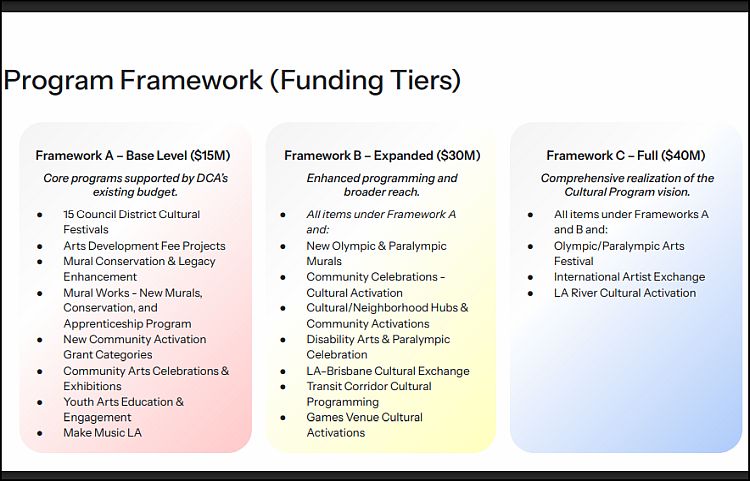
The key concept is a three-tier program, dependent on funding, outlined in detail in an October report, and summarized in a slide presentation for the committee:
Tarica explained:
● “It serves as a blueprint for our arts and cultural planning efforts for the 2028 Games, with the intent to create an inclusive framework that others can see themselves working within, and that includes L.A. artists, arts and cultural organizations, and funders.”
● “The framework document is the blueprint for our cultural program . Given the limited capacity and budget of the department, the framework was strategically crafted to leverage existing resources and prioritizes unprecedented collaborations across government and the arts sector.”
● “We are primarily focused on serving Los Angeles’s communities, as [well as] opportunities with tourists and visitors come to the city, but with the ideal that we have a strong program that is focused on youth and families.
“So the strategies that we are building are focused on engagement, place-keeping, public events, collaboration and legacy programs. And we can’t do this alone. As part of these strategies, we’re going to be working with our partners and community three different ways: we’ll have DCA-produced events, we’ll have organizations that are contracted, that serve as contracted partners and then we’ll have arts and cultural efforts with programming that is aligned with the cultural program, and that will be run by outside entities.”
Concepcion detailed the commitment now made to the first-level framework, possibly expanding with more funding:
● “We see this occurring really in three phases that we’ve been mentioning. We would have an official launch in the summer of 2027, however, in the interest of doing some test events and making sure we’re prepared to scale up, we would be doing lead-up programming beginning as soon as summer of 2026, and those plans are underway. And, we want to make sure that we are, in addition to the programming that we do before and during the Games, we really want to focused on designing legacy programs that will be occurring through 2032 and beyond.”
● “Given DCA’s limited budget [$19.8 million for fiscal year 2025-26], we have really strategically prepared this package of three frameworks, based on funding scenarios. Framework A aligns existing resources and refocuses some current programs within the department to deliver the core program, using existing, budgeted funds. So we just want to be very clear that if we can’t do anything else, and if we can’t bring in any additional funds, what we will be delivering is Framework A, using our existing resources and funds.”
● “For Framework B and C, that really is designed to grow as additional resources materialize, and we see this occurring through potential additional City monies that may come through, either through the budget, or through other funding sources, as well as fund-raising, which could be both DCA-led fund-raising using our development team, as well as collaborative work with the Mayor’s Office of Strategic Partnerships and any partnerships that the Council office wishes to engage with us on.”
In terms of the promised festivals in each of the 15 Council districts, Concepcion said that the programming uses “a model based on the Lunar New Year celebration that we do city-wide and using the funding that exists for that model to fund it.” That program started in 2023 and has expanded to 10 events in February and March 2025.
Tarica was asked about the interface so far with the LA28 organizers:
“We’ve been meeting with LA28 over the last several years, first with their marketing and government affairs team and then ultimately with their Cultural Olympiad team as they develop their appointed Cultural Olympiad staff.
“We’ve been meeting with them about monthly, to be able to understand and learn what the focus is that they’re building, and learning the similar values and discussing our program, and then ultimately, working with the hope that what they will be releasing will be complimentary to ours. …
“Our plan is going to be very much focused on our city and all corners of our city and to being able to reach and lift up all of the communities. From what we understand and the conversations that we’ve had with the Cultural Olympiad team, they also would like to be able to do that, but also have a larger, global gaze, so they’re looking at the Cultural Olympiad from the national perspective, knowing that the Games are also taking place outside of Los Angeles.”
Questions from the committee members focused on programming, but also on the City’s continuing budget issues and possible further cuts for the fiscal year 2026-27 budget. The Cultural Affairs programming plan for 2028 will eventually require approvals by the City Council and the Mayor.
The LA28 organizers have been quiet about their plans for cultural programming, but have said more details would be released by the end of the year.
Observed: The L.A. City Council members have said over and over again that residents should have the opportunity to feel the Games in their neighborhoods. The Framework A plan shown by the City’s Cultural Affairs team applies a fairly basic approach to placing arts and related programs in each district and the Lunar New Year project will provide basic funding.
This is a start, but it is now clear that such festival events are NOT designed to be giant, multi-screen viewing programs as will be launched for the FIFA World Cup host cities in 2026, or as planned – for example – by the New Zealand Olympic Committee in conjunction with Culver City in 2028.
Based on what was heard Tuesday, that will be up to the LA28 organizers.

★ Receive our exclusive, weekday TSX Recap by e-mail by clicking here.
★ Sign up a friend to receive the TSX Recap by clicking here.
★ Please consider a donation here to keep this site going.
For our updated, 850-event International Sports Calendar for 2025, 2026 and beyond, by date and by sport, click here!