















★ The Sports Examiner: Chronicling the key competitive, economic and political forces shaping elite sport and the Olympic Movement.★
★ To get the daily Sports Examiner Recap by e-mail: sign up here! ★
≡ TOP STORIES OF 2026: 5 to 1 ≡
The new year brings new issues, but the schedule says that the biggest stories in 2026 will take place in February and (mostly) June. But are developing stories to watch in our countdown from no. 5 to no. 1.
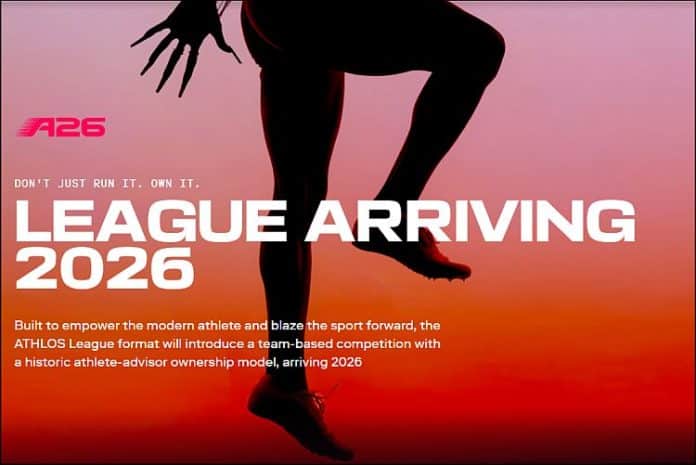
5. Another new track concept: the Ultimate Championship
After a sensational Paris Olympic Games on the track in 2024 and a brilliant World Athletics Championships in Tokyo in September 2025, the track and field world would normally be taking a breather in 2026.
Not now. World Athletics President Sebastian Coe (GBR) told reporters in his year-end briefing,
“It is really imperative that every year, at the right broadcastable moment, we have a billion people watching our sport. We can’t go a year without that, it just can’t happen.
“So that was, in large part, why we did that and when we looked at what that product would look like, we challenged ourselves to be different.”
The result is the World Athletics Ultimate Championship, over three nights in Budapest (HUN) from 11-13 September, essentially an all-star event with the Olympic and World Champions from 2024 and 2025 and the top athletes of 2026, with a $10 million prize purse. The program has 28 events, fewer than in the Olympics or Worlds and in a finals or semis-and-finals format.
A winner? Time will tell, but in the aftermath of the implosion of Grand Slam Track, this will be another test of whether another new concept can find success.
4. The year LA28 goes public
On 23 February, the eyes of the Olympic world will turn from Milan and Cortina to Los Angeles and its third Olympic Games in 2028. And 2026 will be the coming-out year for the LA28 organizing committee.
Volunteer registration began in late 2025 and will pick up steam in 2026. Ticket lottery sign-ups will begin on 14 January and ticket sales will begin much earlier than usual, slated for April.
With no new venues to be built and an unprecedented 11-year run-up to the Games when awarded in 2017, LA28 has been mostly quiet. That has to change as there will be questions galore – some serious, some silly – about the plan, about Los Angeles and how the Games will work, spread from the San Fernando Valley in the north all the way to the San Diego County line in the south.
A year ago, the International Olympic Committee Coordination Commission for 2028 was concerned about a lack of progress within the organizing committee, but there has been new energy from chief executive Reynold Hoover and significant sponsorship sales activity from U.S. Olympic & Paralympic Properties chief John Slusher. Those efforts will accelerate in 2026.
Open to more questions is the readiness of the City of Los Angeles, facing continuing budget deficits and a shortage of police officers, and the L.A. Metropolitan Transportation Agency, which has asked the U.S. government for $3.2 billion for Olympic program support and received nothing. Look for the Trump Administration to turn its attention to L.A. and 2028 after the FIFA World Cup concludes in July.
3. Coventry, the IOC and “protection of the female category”
There has been a noisy, but steady march by the major international federations, in athletics, aquatics, cycling, rowing and others, to removing transgender athletes and those with “differences in sex development” from competition in the women’s division in their sports. In February 2025, even the United Nations Special Rapporteur for violence against women and girls has called for sex screening to be reinstated for the Olympic Games.
Into the middle has stepped new International Olympic Committee President Kirsty Coventry (ZIM), who formed a working group to deal with the “protection of the female category.”
The work has been kept very quiet, so much so that even the members of the working group have not been named, in order to keep them shielded from lobbying and attacks. And their report and recommendations are due in the first quarter of 2026. Per Coventry in a December briefing:
“It’s maybe not going to be the easiest thing to do, but we are going to try our best to be sure than when are talking about the female category, we are protecting the female category and doing that in the most fair way and in finding a consensus for everybody to be able to at least believe in and get behind in. …
“We want to make sure that we can try and ensure that we’ve spoken to all stakeholders and that we’ve really taken adequate time to cross the ‘t’s and dot the ‘i’s. … I don’t want to try and constrain – maybe is the right word? – the working group that they need to have a specific deadline, but I am hopeful in the next couple of months, definitely within the first quarter of next year, we will have a very clear decision and way forward, which I think we’re all looking forward to.”
World Athletics has been at the forefront, including commissioning more scientific research and, based on its findings, issuing a requirement last July for eligibility in last September’s World Athletics Championships:
“All athletes wishing to compete in the female category at the World Championships are required to undergo a once-in-a-lifetime test for the SRY gene – a reliable proxy for determining biological sex. This is to be conducted via a cheek swab or blood test, whichever is more convenient.”
Many believe that is where the IOC is likely to come out.
2. Coming in February: the Olympic Winter Games
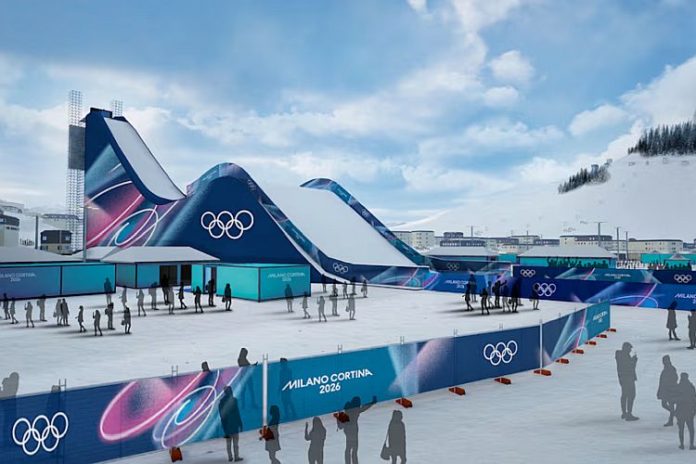
The IOC’s concept of using existing venues to cut down on costs for staging the Olympic Games has been pushed to its logical extreme by the Milan Cortina organizers, who have events taking place all over northern Italy, but primarily in Milan and 1956 Winter Games host Cortina d’Ampezzo. Familiar World Cup venues will be featured for skiing and snowboarding, with the ice events mostly in Milan.
There have been venue construction issues, with a miraculous new sliding track created in just months and still questions about the main ice hockey arena, still not open. But the Games will go on, with considerably more joy than Beijing 2022, held during a continuing Covid-19 lockdown and damaged by the Kamila Valieva Russian doping scandal in figure skating.
But the competition should be fierce, with Norway expected to win the most medals again, and Germany and the U.S. both expected to have strong teams. The American outlook, at the turn of the year, is especially bright, with star skaters such as World Champions Ilia Malinin, Alysia Liu and Madison Chock and Evan Bates in figure skating and six-time World Champion speed skater Jordan Stolz.
Alpine star Mikaela Shiffrin – undefeated in five Slaloms this season – and comebacking Downhill gold medalist Lindsey Vonn headline the skiing team and on Wednesday, history was made as three-time Olympic gold medalist Jessie Diggins and emerging star Gus Schmacher both won FIS World Cup 5 km Freestyle races in Toblach (ITA), reportedly the first time two Americans had won World Cup races on the same day!
And then there are the star-studded men’s and women’s ice hockey teams, both with gold-medal ambitions. It should be quite a show.
1. The biggest FIFA World Cup ever
There will be a lot of firsts at the 2026 FIFA World Cup, with 48 teams and 104 matches for the first time, three countries – Canada, Mexico and the U.S. – hosting the event and FIFA running the event itself from new offices in Coral Gables, Florida.
Questions about logistics have faded recently as FIFA created a ticketing system using “dynamic pricing” that reacts to demand and increases or decreases prices. But with 6-7 million tickets to sell, FIFA has received more than 150 million requests and prices have skyrocketed. For group stage matches, current pricing is from $140 to $2,735!
So, FIFA is accused of making the World Cup only for the rich. Quite right.
As the 11 June starting date gets closer, however, the questions of entry visas to a much more careful U.S. State Department, accommodations, ground transportation, culture, security and more will be scrutinized incredibly closely, in the largest sporting spectacular in the U.S. since 2002.
Against a backdrop of human rights concerns and Arab culture, the Qatar 2022 World Cup was a smashing success on the field, overshadowing all other issues. Will the 2026 World Cup be the same, or will issues off the field color the tournament? It will take the full month of the event to know for sure.

Beyond these on-field events, look for a rising visibility for the International Committee for Fair Play (CIFP), under the direction of American Sunil Sabharwal. Founded in 1963 in Paris (FRA), it has been fairly quiet for most of its history, but Sabharwal wants to raise not so much the CIFP itself, but the fair-play concept. More and more federations – including the IOC, FIFA and World Athletics – are incorporating Fair Play Awards into their events and in annual awards; look for this to be expanded.
Sabharwal wrote in a New Year’s message, “I find myself reflecting on a simple but profound truth: Fairness is not a distant ideal; it is the atmosphere we breathe. …
“You do not need a stadium to practice fair play; you only need to look at your surroundings-your office, your school, your local club-and ask, ‘How can I tilt this environment toward fairness today?’
“Fairness does not prevail by accident; it prevails because people like you decide that it must.”
Good advice to start the year.
Rich Perelman
Editor
★ Receive our exclusive, weekday TSX Recap by e-mail by clicking here.
★ Sign up a friend to receive the TSX Recap by clicking here.
★ Please consider a donation here to keep this site going.
For our updated, 850-event International Sports Calendar for 2025, 2026 and beyond, by date and by sport, click here!