


















★ The Sports Examiner: Chronicling the key competitive, economic and political forces shaping elite sport and the Olympic Movement.★
★ To get the daily Sports Examiner Recap by e-mail: sign up here! ★
≡ TOP STORIES of 2026: 10 to 6 ≡
The post-Olympic year of 2025 is done and a Winter Olympic year is getting started in 2026. What will the top stories be in the new year? Time for predictions, or – let’s say – projections of the issues that will garner attention and interest. Some good and some not good at all.
10. Russia, Israel and access to sport
Russia invaded Ukraine on 24 February 2022 and is still fighting its war of aggression. Hamas, the ruling body in Gaza, massacred more than 1,200 Israelis in a coordinated attack on 7 October 2023 and took 250 hostages and Israel responded with a comprehensive attack, leading to a fragile “cease fire,” in effect since 10 October 2025.
In 2022, the International Olympic Committee declared quickly that Russian and Belarusian athletes should not participate in international competitions, including teams. An IOC plan to allow “neutral” individuals who have shown no public support for the war was developed at the end of 2023 and implemented for the Paris 2024 Olympic Games. In December, the IOC decided that Russian and Belarusian “youth” competitors and teams can compete internationally without restrictions, subject to federation rules and procedures.
In October 2025, Indonesia – after giving assurances earlier – refused to allow Israeli athletes to enter the country to compete in the World Artistic Gymnastics Championships. The IOC ended all discussions about future events in Indonesia and the government has still not said it will allow Israeli participation in the future.
At the Olympic Summit on 11 December 2025, the Olympic stakeholders “reaffirmed that athletes have a fundamental right to access sport across the world, and to compete free from political interference or pressure from governmental organisations.”
So what happens in 2026? Russia and Belarus appear to be in a re-entry phase, but what about Israel and other IOC-recognized countries that have been refused visas, such as Kosovo? And what of the increasing scrutiny on entry into the United States, with the 2026 FIFA World Cup in June and July?
9. The IOC and esports?
A 12-year deal between the IOC and the Saudi Arabian National Olympic Committee to create and stage a new, “Olympic Esports Games” was announced with great fanfare in July 2024.
In October 2025, the deal was dead, with the announcement noting in part:
“The IOC, for its part, will develop a new approach to the Olympic Esports Games, taking the feedback from the ‘Pause and Reflect’ process into account, and pursue a new partnership model.
“This approach will be a chance to better fit the Olympic Esports Games to the long-term ambitions of the Olympic Movement and to spread the opportunities presented by the Olympic Esports Games more widely, with the objective of having the inaugural Games as soon as possible.”
What does the IOC do now? Under prior President Thomas Bach (GER), a link to the e-sports community was created, but has stalled. As he noted at the time, the structure of competitive gaming is much different from Olympic sports, with commercial publishers instead of International Federations.
There are perhaps more than three billion active gamers worldwide, but many fewer registered professionals. Will new President Kirsty Coventry’s IOC seek out engagement, as Bach did? Find a blend with active sport contested online, a la the World Rowing Indoor Championships? Do nothing?
Remember this line in “The Godfather” from 1972? Looking to the future, consigliere Tom Hagen told his boss, Vito Corleone, “if we don’t get a piece of that action, we risk everything we have; I mean not now, but ten years from now.”
8. Collegiate sport still in chaos
The U.S. Olympic & Paralympic Committee stated that “75% of U.S. Olympians will have competed collegiately as part of their journey to Team USA” for the Paris 2024 Games and that the American collegiate system is a bedrock of the U.S. athlete development program.
In 2025, collegiate athletics surged into chaos as pay-for-play was fully implemented, firstly and mostly for college football and also significantly impacting college basketball for men and women. The now-legal payments to players, and barely-regulated booster pay on top of that, plus the costs for coaches, support and facilities, threatens to crowd out all other sports, including Olympic mainstays such as track & field, swimming, wrestling, volleyball, gymnastics and many others.
The NCAA is looking to Congress for legislative support and some collegiate conferences and the USOPC are beyond the SCORE Act, which requires that the large football-playing schools maintain a 16-sport program which will ensure continued funding of non-revenue sports, which are essentially everything other than football and basketball at most schools.
But the SCORE Act (H.R. 4312) and competing bills have not made it across the finish line yet and do not appear to be close. The Trump Administration is in favor of a Congressional fix to the college sport mess, but has many other priorities.
There is a wide agreement that collegiate sport’s structure is broken, but how to fix it is not clear. We’re here to help: The Sports Examiner proposed a comprehensive fix in 2024, detailed here.
7. What about the Enhanced Games?
Under the leadership of then-IOC President Juan Antonio Samaranch (ESP), the World Anti-Doping Agency was formed in 1999 to take the global lead against doping in sport, on competitive, ethical and medical safety grounds.
In 2025, a new competition was announced, doing away with doping tests and encouraging “enhanced” athletes to compete in a showcase of “superhumans,” titled the Enhanced Games, planned to be held at Resorts World in Las Vegas, Nevada in late May of 2026.
Widely condemned, the event is to feature a small number of sprint events in track & field and swimming, plus weightlifting, all trying to break world records set by athletes who have competed in competitions which follow the World Anti-Doping Code.
Each event is to have a $500,000 prize purse, with $250,000 for the winner; world-record bonuses will pay $250,000 except for the 50 m Free swim and 100 m dash, which will have $1 million payouts for records.
WADA and many other organizations have labeled the event dangerous and unethical. The promoters have had trouble signing up athletes, who will be instantly banned from Olympic and International Federation competitions. So far, nine swimmers, three track athletes and two weightlifters have agreed to participate, and the Enhanced Games had a lawsuit alleging restraint of trade against WADA, World Aquatics and USA Swimming was dismissed.
But the Enhanced Games got a $40 million lifeline in a complex transaction in November, with the promise of more, with a product line to follow which would be the basis of the business going forward.
Will the Enhanced Games be held? If so, will anyone care? Many in the Olympic world have disowned it, but there will be attention paid to see what happens – if anything – in May.
6. Will ATHLOS succeed where Grand Slam Track failed?
One of the big questions of 2025 was whether Michael Johnson’s Grand Slam Track would succeed. It did not, staging only three of its planned four meets, selling less than 65,000 tickets across eight meet days and staring at $31.4 million in debt at the end of 2025.
Now in Chapter 11 bankruptcy proceedings in Delaware, Grand Slam Track is trying to settle its debts – it owes its athletes about $7 million – and get re-energized with new funding. It will have an uphill climb to regain any trust within the track & field community. But it is trying.
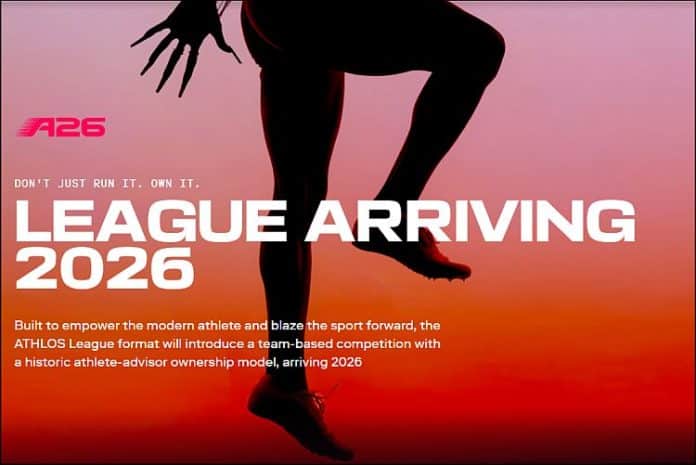
Getting ready to enter the fray, apparently, is ATHLOS, a project of Reddit co-founder Alexis Ohanian, who staged two showy, end-of-season meets in New York in 2024 and 2025, with a limited event program, strong athlete pay and integrated concerts which had more fan attention than the meets.
Ohanian has promised an ATHLOS “league” beginning in 2026:
“The ATHLOS League introduces a team-based competition model designed for and by the modern athlete. Taking place after the conclusion of the World Athletics season, ATHLOS will feature multiple meets hosted in major cities, culminating in a final championship event.”
The ownership is to include athletes such as Sha’Carri Richardson, Gabby Thomas and Tara Davis-Woodhall. That’s all there is to say at present. The details, with Grand Slam Track’s experience as a cautionary tale, will be fascinating.
Coming New Year’s Day: our projected top-five stories of 2026, including a fight over science and two of the world mega-events.
Rich Perelman
Editor
★ Receive our exclusive, weekday TSX Recap by e-mail by clicking here.
★ Sign up a friend to receive the TSX Recap by clicking here.
★ Please consider a donation here to keep this site going.
For our updated, 850-event International Sports Calendar for 2025, 2026 and beyond, by date and by sport, click here!