



















★ The Sports Examiner: Chronicling the key competitive, economic and political forces shaping elite sport and the Olympic Movement.★
★ To get the daily Sports Examiner Recap by e-mail: sign up here! ★
≡ MILAN CORTINA IN REVIEW I ≡
The Olympic Winter Games in Milan, Cortina and elsewhere have closed, with a considerable level of success, despite many challenges. There will be a lot of post-Games discussions about what was good and what was not, but as for a quick look back, here are 10 impressions, starting with today’s no. 10 to no. 6:
● No. 10: The weight of the Olympic Games is real
No one was a heavier favorite going into the Games than American figure skating star Ilia Malinin, who had won two World Championships golds in a row and looked utterly unbeatable.
But he had a rough time in the Short Program of the Team Event, then rebounded somewhat to win the Free Skate and earn a gold for the U.S. He then led the men’s Singles Short Program by almost five points and said afterwards that the Games is a different experience:
“I did not think it would be that heavy. I thought that I could come into this like any other competition, but honestly I definitely underestimated it.
“Now that I’ve gotten three performances under Olympic ice, I think that I’ve really tamed the Olympic ice.”
He hadn’t and he fell apart in the Free Skate, finishing 15th with a modest – for him – four quadruple jumps, but with two falls. He ended up eighth. He said prior to the Free Skate:
“It felt different than any other competition. Sometimes it still overwhelms you, and I definitely felt that in the Team Short Program.”
He was not the only one who felt the weight of expectations. U.S. audiences didn’t see some of these, but consider China’s Eileen Gu, who came in as the reigning Olympic champion in two events, but won only the Freestyle Skiing Halfpipe and settled for silvers in Big Air and Slopestyle. She was looking for three golds.
She’s still just 22 and Malinin is just 21. They have long careers ahead of them. Swiss ski star Marco Odermatt came in leading the FIS World Cup standings in the Downhill, Super-G and Giant Slalom; he won a Super-G bronze and Giant Slalom silver and was fourth in the Downhill.
The Games is different.
● No. 9: King Klaebo supreme, thanks to Putin?
For all the difficulties many stars had, Norway’s Johannes Hoesflot Klaebo had none. He won six gold medals at the 2025 FIS World Nordic Championships, sweeping the cross country skiing events. He did the same in the Games, setting a new record for the most golds by a single athlete in a single Games, breaking the mark of five by American speed skater Eric Heiden from way back in 1980.
But he had help, specifically from Russia. The Russian invasion of Ukraine, which started two days following the close of the 2022 Beijing Winter Games, removed his chief foreign rival, Alexander Bolshunov, who won the 2022 Olympic golds n the 30 km Skiathlon and 50 km Classical and also on the Russian team in the 4×10 km relay.
Bolshunov, like Klaebo, is 29, and was not going to be allowed in as a “neutral” for sure, and he can thank Russian President Vladimir Putin for keeping him from trying to stand in Klaebo’s way.
Sometimes even winning medals isn’t enough. Norwegian biathlete Sturla Holm Laegreid won five medals (0-3-2), but said he was sad because he lost his girlfriend … because he cheated on her.
● No. 8: Don’t give up, don’t ever give up
The ups and down of champion athletes was no better demonstrated than on the U.S. Ski Team.
Downhill favorite Lindsey Vonn, 41, suffered a bad crash 13 seconds into her race, had to be lifted off the mountain and is now recovering from multiple surgeries on her left leg. Instead, teammate Breezy Johnson – the shock 2025 World Champion – won again!
A few days later, Johnson won the Downhill portion of the women’s Team Combined and turned the lead over to the best Slalom skier in history, teammate Mikaela Shiffrin. Shiffrin had trouble, ranked 15th in the Slalom and she and Johnson finished fourth overall and out of the medals.
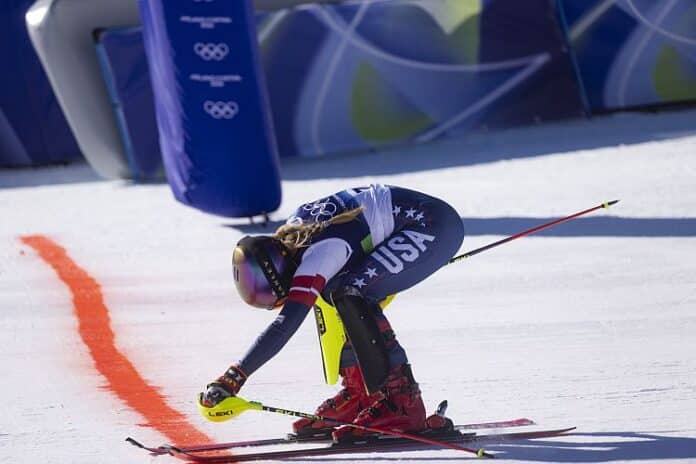
Eight days later, Shiffrin was back on the Slalom course in Cortina … and crushed the competition, winning by a huge – in skiing – 1.50 seconds and earned her first Olympic gold since 2018. She wrote in a cathartic post on Instagram, in part:
“I questioned all that I’ve learned in life, multiple times this week. I questioned what kind of grit I have in my heart and I wondered if I should be doing this at all. I questioned my toughness and tenacity. I questioned it all. And then I left those questions behind, and stepped into the arena anyway.
“I won.”
The late basketball coach Jim Valvano’s lesson of “Don’t give up, don’t ever give up” was on display again and again. American Short Track skater Corinne Stoddard apologized in an Instagram post, also noting the weight of the Games:
“I’m not sure what’s been going on. Part of me thinks I haven’t been able to handle the pressure and expectations I put on myself. The other part of me feels so physically drained every time I try to race.
“This whole experience has been incredibly unfortunate, and I feel embarrassed by how many times I’ve crashed, especially since I’m not an athlete who’s known for falling often. I also feel embarrassed by how much I’ve choked on the Olympic stage over and over again. This isn’t what I planned to show the world I was capable of.”
She came back and won a bronze medal in the 1,500 m after two earlier crashes.
● No.7: The Olympics and AI can’t come fast enough
The ugly head of favoritism and questionable judging popped up again in 2026, and not just in figure skating.
There were multiple questions raised about scoring in the Ice Dance final, where France’s Laurence Fournier Beaudry and Guillaume Cizeron won by 1.43 points over Americans Madison Chock and Evan Bates. A French judge scored the U.S. pair far less than everyone else on the panel, and an Italian judge scored that country’s pair, Marco Fabbri and Charlene Guignard, in the top three; they finished fourth.
In the women’s Singles Free Skate, it was noted that Kazakh judge Nadezhda Paretskaia gave her highest score to Russian “neutral” Adeliia Petrosian, even though she fell and had issues with two other jumping sequences.
This was a substantial problem for the International Skating Union in 2002 in Salt Lake City and forced a change in the scoring program to try and eliminate outlier scores. But they are obviously still around.
Then there was the “double touching” scandal in curling, where a high-decibel argument between teams was heard worldwide and Canadian and British teams had stones removed from competitions. World Curling added judges, then removed them.
This is where the warp-speed advances in artificial intelligence can help. World Gymnastics, another federation in deep need of judging and meet management help, is already working on an automated-scoring project. The ISU made a big announcement of a “strategic partnership” with IOC professional services sponsor Deloitte during the Games.
Deloitte did an impressive job overseeing the results reporting and integration systems during the Milan Cortina Games. Now it needs to talk with the gymnastics folks and help the ISU and World Curling to take the prejudice out of judges in all three sports.
The sooner, the better.
● No. 6: Opportunity dawns for USA Hockey
USA Hockey is considered one of the best-run of the National Governing Bodies, servicing 577,864 player-members and 67,253 coaches during its 2024-25 fiscal year. It also now has the Olympic champion men’s and women’s hockey teams.
The thrilling overtime wins for both of the U.S. creates a sensational, rare opportunity for further growth in this sport, especially on the women’s side.
It is not lost on longtime observers that the rise of the WNBA has been the support of the NBA, which has also extended to the National Governing Body level at USA Basketball, for both men and women.
The National Hockey League has had its eyes toward European expansion, to the concern of the International Ice Hockey Federation, whose finances largely depend on its World Championships, mostly played in Europe.
Is there an opportunity for USA Hockey and well-respected chief executive Pat Kelleher to bring the NHL owners’ attention to the possibilities for a women’s league on the same model as the WNBA was founded?
The existing Professional Women’s Hockey League is a Mark Walter Group project, which has interests in the Los Angeles Dodgers, controlling ownership of the Los Angeles Lakers and a partial ownership of the WNBA Los Angeles Sparks. The structure is there to do much more in hockey.
Next up: the key lessons of Milan Cortina 2026, from no. 5 to no. 1.
Rich Perelman
Editor
★ Receive our exclusive, weekday TSX Recap by e-mail by clicking here.
★ Sign up a friend to receive the TSX Recap by clicking here.
★ Please consider a donation here to keep this site going.
For our updated, 45-sport, 910-event International Sports Calendar for 2026 and beyond, by date and by sport, click here!