
















★ The Sports Examiner: Chronicling the key competitive, economic and political forces shaping elite sport and the Olympic Movement.★
★ To get the daily Sports Examiner Recap by e-mail: sign up here! ★
≡ ‘THE BIG BOUNCE” ≡
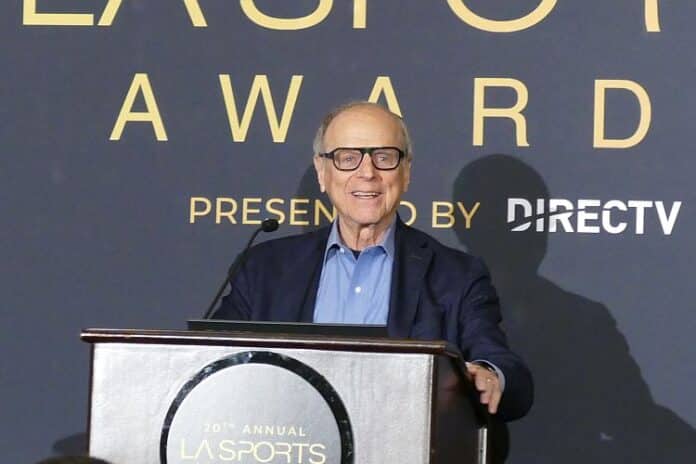
In “The Big Bounce: The Surge That Shaped the Future of U.S. Soccer,” lawyer turned soccer impresario Alan Rothenberg traces, step by step, the rise of a game which had been forecasted for so long as the future in American sport … and finally got there.
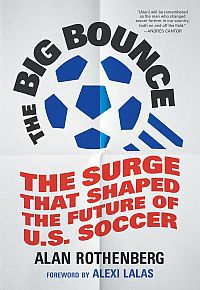 Today’s Major League Soccer, National Women’s Soccer League and the 2026 FIFA World Cup and upcoming 2031 FIFA Women’s World Cup in the U.S. were only distant – and not very realistic – dreams in the early 1980s.
Michigan-born, Rothenberg was a highly-respected and successful attorney in Los Angeles, with a small experience as an investor in the North American Soccer League’s ill-fated Los Angeles Aztecs for three years in the late 1970s, Rothenberg was approached by Los Angeles Olympic Organizing Committee President Peter Ueberroth in 1980. Rothenberg opened the book this way:
“Peter Ueberroth changed my life – and set in motion the events that truly launched soccer in the United States as a major sport. … If you were in the sports business world in Southern California, you heard plenty of informed speculation about how these Olympics would be a bust, financially at least.
“There was fear and panic from some quarters. But not from Peter.”
Rothenberg accepted the role of “Commissioner of Soccer” for the 1984 Games, a position that made him one of 23 staff senior executives of the sports in the Games, but with only part-time duties until 1984 came along. There were staff to handle the day-to-day chores.
His book places you essentially on his shoulder as he walked through about 15 years that changed the status of soccer (football) in the U.S. Staging the 1984 Olympic football tournament was about overcoming doubts from FIFA about using large venues like Pasadena’s Rose Bowl and Stanford Stadium as well as putting the event together. Then this happened:
“Going into the first game at the Rose Bowl, Italy against Egypt on July 29, we obviously weren’t going to print up 103,300 tickets and assume a sellout. … We printed up about 30,000 tickets and hoped they’d all move.
“The afternoon of the match, which started at 7:30 p.m., we could see a lot of fans streaming into the stadium. We were flooded. People were coming. I was wondering what was going to happen if we ran out of tickets. We wanted to avoid a riot. …
“So, we hurried down into the bowels of the Rose Bowl and found old rolls of tickets, like you would see at old movie theaters. It was time to improvise. They would do. … Official attendance for the game was 37,430, though I’m sure the actual number on hand was easily 50,000 or more.”
The Games went beautifully and Rothenberg wanted to do something special, especially with a sell-out coming for the France vs. Brazil final, which drew 101,799 fans in Pasadena. Despite a lid of $10,000 for any purchase by a commissioner (or any department head), Rothenberg signed 10 purchase orders for $9,999 each to get a huge fireworks show at the end of the final match.
And the crowds, the venue, the fireworks and more moved FIFA’s President, Joao Havelange (BRA) and Secretary General Sepp Blatter (SUI):
“The FIFA hierarchy saw the mighty Rose Bowl filled with cheering fans, 100,000 strong, and for the first time felt confident thinking ahead to bringing world soccer’s crown jewel, the World Cup, to the United States.”
Rothenberg remembered:
“Those Olympics also turned out to be the launching pad for the explosion of soccer in the United States – with me unexpectedly thrust front and center.”
FIFA awarded the 1994 World Cup to the U.S. in 1988 and Rothenberg was not involved. But FIFA came calling and asked Rothenberg to take over the organizing committee in 1990. He also needed to become the President of U.S. Soccer and that came to pass, also in 1990, when he defeated unpopular incumbent Werner Fricker.
Now, Rothenberg was still practicing law full-time, was the head of the U.S. federation and charged with making sure the 1994 World Cup was a blazing success.
First, he ensured that the American women’s team was supported for the first FIFA women’s World Championship – later recognized as the first World Cup – in China in 1991. And the U.S. won with an entertaining brand of attacking soccer led by midfielder Michelle Akers. Based on that, Rothenberg asked Havelange in 1992 to add women’s football to the program of the 1996 Olympic Games in Atlanta. It was added.
Now back to the 1994 World Cup. Rothenberg notes, “FIFA expected us to be in small stadiums and we had to persuade them, as well as some of the bidding cities, that we could fill large stadiums.”
He recruited a combination of executives who were soccer experts with limited business experience, some ‘84 Olympic staffers and experts in areas like advertising, music and television. It worked.
But a test was needed and so the “U.S. Cup” was created in summer 1993, with Brazil, England and Germany invited, along with the U.S. And the test was aced:
“The crowds were large and enthusiastic, the matches came off without a significant hitch, and the U.S. team was highly credible, beating England and staying competitive with Germany and Brazil in losses.”
He and his organizing committee could see the success ahead of them in 1994, but finances were always a concern. So a “Family Ticket Sale” was opened early on, to pick up ticket revenue from anyone the organizers had an address for. The allocations sold out quickly, but:
“[R]ather than holding one big press conference and declaring a sellout, we got creative. This was where some shamelessness came in. We went city by city. … We basically stretched a one-say story out over two weeks.”
The result: “Every time we released another batch of tickets, they sold out instantly.”
Rothenberg asked FIFA to be able to sell very high-priced tickets, but FIFA – worried about credibility with fans – said no. Marketed very quietly, the organizers “created effectively the first premier ticket package, which consisted of a good seat (all that buyers really cared about), a match program, a parking pass, and a hot dog. That as it.”
He also had the idea of pricing all 100,000 tickets for the final at the Rose Bowl at $1,000, meaning a $100 million gate. FIFA said no.
There were a lot more bells and whistles to make the ‘94 World Cup stand out. The Final Draw was in Las Vegas, with comic star Robin Williams as the emcee (Rothenberg used the occasion to pitch investors on what became MLS). No Olympic Torch Relay, but a World Cup Trophy Legacy Tour. “SoccerFest” was created as a fan festival in L.A. during the World Cup, based on the NFL Experience, but outdrew it. The Three Tenors concert staged first in Rome for the 1990 World Cup, was replicated, but in Dodger Stadium.
Rothenberg also never forgot U.S. Soccer’s needs. When Chicago Mayor Richard Daley asked about how the city could land the opening game, an arrangement was made for U.S. Soccer to lease and eventually buy an aging mansion to use as its headquarters. The federation only just moved to a new headquarters and training center in Atlanta.
The World Cup was not just great, but monumental. Wrote Rothenberg, “[W]e completely changed the way the World Cup was presented to the public.” The organizing committee also realized a sensational $50 million-plus surplus, which was turned into the U.S. Soccer Foundation – which helped with the seed money for MLS – and that still supports the sport today.
That’s the first half of the book and the second half details how the 1996 Olympic Games in Atlanta did for women’s football what the 1984 Games in Los Angeles had done for the men, leading to the 1999 FIFA Women’s World Cup – whose organizing committee he chaired, after he finished his U.S. Soccer presidency – and the start of the rise of women’s football in the U.S.
He also reviews the difficulties in getting Major League Soccer going and the long road between the start in 1996 and today’s league, dominated by Argentine icon Lionel Messi.
Rothenberg summed up the whole process this way:
“For the men, a successful 1984 Olympics led to a record-breaking 1994 World Cup, which led to a professional league, MLS; which after some incredibly difficult early years has taken hold and continues to grow dramatically.
“Similarly for the women, a successful 1996 Olympics. Followed by a record-setting 1999 World Cup, has led to a professional league, NWSL, taking hold and beginning to experience ‘hockey stick’ growth, following years of difficulties for it and its failed predecessors.”
And, whether as the head of those revolution-starting World Cup organizing committees, or during two dramatic terms as President of the U.S. Soccer Federation from 1990 to 1998, Rothenberg was there. His easy-to-read book lets you tag along.

★ Receive our exclusive, weekday TSX Recap by e-mail by clicking here.
★ Sign up a friend to receive the TSX Recap by clicking here.
★ Please consider a donation here to keep this site going.
For our updated, 45-sport, 910-event International Sports Calendar for 2026 and beyond, by date and by sport, click here!