















★ The Sports Examiner: Chronicling the key competitive, economic and political forces shaping elite sport and the Olympic Movement.★
★ To get the daily Sports Examiner Recap by e-mail: sign up here! ★
★ Friends: YES! Now 41 donors have covered 108.1% of our winter goal for our tech support costs. Happy to start on the summer bill: you can donate here. YOU are the reason this site continues. ★
= MILAN CORTINA 2026 =
From Lane One
Politics and sports have clashed again, this time in Cortina d’Ampezzo, with Ukrainian Skeleton racer Vladyslav Heraskevych determined to wear his “memory helmet” with images of slain Ukrainian athletes on it.
Heraskevych has worn the helmet in training and has written continuously on his X account, including:
● “I want to thank everyone for all the support we’re receiving. There really is an incredible amount of it.
“For me, the sacrifice of the people depicted on the helmet means more than any medal ever could – because they gave the most precious thing they had. And simple respect toward them is exactly what I want to give.”
● “Tomorrow [12th] the skeleton competitions at the 2026 Olympic Games begin. But instead of preparing for the starts, we are forced to fight for the right to compete in the ‘Memory Helmet.’
“Let’s return to the topic of the IOC’s double standards. A similar situation occurred with the Israeli skeleton athlete: at the opening ceremony, he appeared wearing a kippah (which he had announced in advance on his social media), on which were written the names of the 11 Israeli athletes and coaches killed by terrorists at the 1972 Munich Olympics. In other words, the athlete literally placed the memory of the fallen on his head to honor them.
“I honestly don’t understand how these two cases are fundamentally different. The IOC rules are the same for opening ceremonies, medal presentations, and competition venues. Why such treatment towards Ukrainians?
“The ‘Memory Helmet’ must be allowed in competitions.”
International Olympic Committee spokesman Mark Adams (GBR) spoke at length about the issue at the morning news briefing:
“We will contact the athlete today, and we will reiterate the many, many opportunities he has to express his grief. As we discussed before, he can do so on social media, in press conferences, in the mixed zone. So we will try to talk to him about that and try to convince him.
“We want him to compete. We really, really want him to have his moment. That’s very, very important. We want all athletes to have their moment, and that’s the pint: we want all athletes to have a fair and level playing field.”
Adams noted that the Guidelines on Athlete Expression were approved by 4,500 athletes and emphasized that the “clean” field of play is “what the athletes want:
“They want that specific moment, on the field of play, to be free of any distraction.
“He can, and we would encourage him, to express his grief. We feel his grief. We expressly want him to do that. But, you know, in the end, let me be clear: it’s not the message, it’s the place that counts.
“And that, for us, and not actually for us; we are, in this, in sense, in a back seat. It’s the message of the athletes, the athletes that reiterated to us, time and time again. There are 130 conflicts going on in the world; we cannot have 130 different conflicts featured, however terrible they are. We cannot have them featured during the field of play, during the actual competition.
“So, we would beg him: we want you to compete.”
The IOC has offered Heraskevych the opportunity to wear a black armband during his races and Adams added that he wants him to “express your understandable grief before and after the competition.” He said it’s best for “people to talk to people” to find a resolution.
The IOC formulated the rules through a lengthy consultation with athletes, but when it comes down to it, as Adams said, it’s about people. Any decision on a possible disqualification would ultimately, he said, would eventually be up to the IOC.
~ Rich Perelman
● Milano Cortina 2026 Update ● The organizing committee said it sold 77,000 tickets across 12 sports on Tuesday.
● Il Tempo Olimpici ● Thursday weather in Milan is expected to have some rare sunshine, with pleasant temps of 52 F (high) and 41 F for the low. There’s a 25% chance of at least some rain.
In Cortina, some snow is expected again, with a high of 33 F and a low of 24 F. Winds are not expected to get much about 5 miles per hour.
● Scoreboard ● Norway continues at the top of the medal table, but suddenly, there is home Italy as well. After five days of medals and 35 of 116 events:
● 13: Norway (7-2-4)
● 13: Italy (4-2-7)
● 12: United States (4-6-2)
● 8: Germany (3-3-2)
● 8: Austria (2-5-1)
● 8: Japan (2-2-4)
● 7: Switzerland
● 7: France
● 6: Sweden
● 4: Canada
A better indication of team performance has to go beyond three places, so The Sports Examiner returns to our eight-place scoring, using the NCAA track & field format of 10-8-6-5-4-3-2-1 for each event. After five days, the top 12:
● 160: Italy
● 154: Norway
● 143.5: United States
● 124.5: Austria
● 100: Germany
● 92: France
● 87.5: Switzerland
● 73.5: Japan
● 64: Sweden
● 54: Canada
● 46: Netherlands
● 36: China
Italy is having not a great Games, but is in dreamland, at least so far.
● Television ● NBC reported a big audience following the NFL Super Bowl LX broadcast on Sunday:
“Sunday’s Primetime in Milan and Milan Prime presentation averaged 42 million viewers, marking NBCUniversal’s largest Winter Games audience since Day 2 of the 2014 Sochi Olympics (a span of 53 event days) and an increase of 73% over the corresponding 2022 Beijing Olympics show (24.3 million) which followed Super Bowl LVI.”

Olympic Broadcasting Services chief Yiannis Exarchos (GRE) spoke about the host coverage of the Games, noting that 25 drones, including 15 first-person-view (FPV) drones, are being used.
Working with the International Federations, the drones are always staged behind the athletes, never in front. Multiple tests were done, with athletes, prior to the Games, to ensure safety:
“All the pilots that we use, for each FPV drone we have a pilot and a spotter – a person sitting next to them – who really guides them about any situations in the environment, because the pilot himself is wearing goggles, like you wear in VR, and this is the way they pilot this piece of equipment. It’s not possible to pilot if you’re just looking at them.”
He added:
“It may seem like a simple flight, but there has been a lot of preparation – years.”
He also note the noise generated by the drones, explaining that while there are 860 cameras covering the Games, there are more than 1,800 microphones! It impacts viewers more than athletes, who are wearing helmets in outdoor events.
● Doping ● It was reported that two Korean cross-country skiers – Da-som Han and Eui-jin Lee – were disqualified for the use of fluorinated wax, prohibited for three years, for environmental reasons.
● Russia ● The International Olympic Committee is pushing hard to separate sport and politics, at least to give athletes an opportunity to compete irrespective of what the governments of their countries do.
That is allowing Russian and Belarusian youth and junior athletes to be welcomed back into international competitions by some federations. But that does not mean that Russian Sports Minister – and President of the Russian Olympic Committee – Mikhail Degyarev believes anything the IOC is saying.
He told VK Video’s Central Channel on Tuesday:
“What is sport? It’s, generally speaking, a permanent war and battle, meaning it’s a competition between people, between capabilities, between countries, between countries’ strengths. Therefore, of course, it’s considered politics. This nonsense that sport isn’t politics is untrue.”
Interesting, especially as he tries to end the suspension of the Russian Olympic Committee.
● Alpine Skiing ● American star Lindsey Vonn underwent a third surgery after her Downhill crash last Sunday and posted on Instagram:
“I had my 3rd surgery today and it was successful. Success today has a completely different meaning than it did a few days ago. I’m making progress and while it is slow, I know I’ll be ok.
“Thankful for all of the incredible medical staff, friends, family, who have been by my side and the beautiful outpouring of love and support from people around the world. Also, huge congrats to my teammates and all of the Team USA athletes who are out there inspiring me and giving me something to cheer for.”
● Figure Skating ● To be young and talented! American star Ilia Malinin after his brilliant Short Program scored 108.16 to take a five-point lead after some struggles in the Team Event and spoke about his Olympic experience so far:
“I did not think it would be that heavy. I thought that I could come into this like any other competition, but honestly I definitely underestimated it.
“Now that I’ve gotten three performances under Olympic ice, I think that I’ve really tamed the Olympic ice.”
He added more later on being at the Games:
“It felt different than any other competition. Sometimes it still overwhelms you, and I definitely felt that in the Team Short Program.
“Going into this individual event, I decided to try different strategies. Really just try to calm things down and not get too excited, enjoy my time on the ice, and try as hard as I can. …
“I felt really comfortable today. I definitely wanted to take a different approach as opposed to the Team Event. I think I just went out there and that Olympic atmosphere really blew me away… I got maybe a little too excited.”
● Snowboard ● A crash by Australian rider Cam Bolton, 35, in SnowCross training on Monday got worse when his neck pain rose and he was eventually hospitalized.
Competing in his fourth Games, it turned out that he has two fractures in his neck and was transported to a hospital for treatment. He was joined by his wife; Australian chef de mission Alisa Camplin said:
“Cam wanted to make his teammates understood what was happening and that he was fine and doing well and being looked after well.”
= RESULTS: WEDNESDAY, 11 FEBRUARY =
(8 finals across 7 sports & disciplines)
● Alpine Skiing: Men’s Super-G
Swiss Marco Odermatt may be the best skier in the world, having won the FIS World Cup seasonal title four times in a row. But right now, no one is beating his teammate, Franjo von Allmen.
Von Allmen completed a sweep of the speed medals, winning the men’s Super-G on Wednesday from the no. 7 starting position, sweeping down the Stelvio course in 1:25.32, to take the lead from American Ryan Cochran-Siegle, the Beijing 2022 silver medalist.
Odermatt came at no. 10 and raced well, but his time of 1:25.60 was third and he stayed there are those three were not challenged during the rest of the day. France’s Nils Allegre was fourth – from the no. 1 position – at 1:25.63 and the top six finishers all came from among the first 10 starters.
Sam Morse of the U.S. was 23rd (1:27.12) and Kyle Negomir was 26th (1:28.62); River Radamus did not finish his run.
Von Allmen joins a select group of two others who have won three Alpine golds in a single Games: Toni Sailer (AUT) in 1956 in Cortina (!) and France’s Jean-Claude Killy, in 1968. They each won three individual events; von Allmen has the Downhill and Super-G and the Team Combined. Odermatt is not done, however, as he is the defending Olympic champ in the Giant Slalom.
Cochran-Siegle is the first to win back-to-back silvers in this event; American men have won five Super-G silvers out of the 12 times it has been run, plus two bronzes. Amazingly, Cochran-Siegle has just one Super-G World Cup medal in his career, from December 2020.
● Biathlon: Women’s Individual (15 km)
A year ago, France’s Julia Simon dominated the field on the way to a nearly-40-second win in the IBU World Championships women’s Individual Race. Last October, she was found guilty of using the credit card of teammate Justine Braisaz-Bouchet in 2022 to run up a bill of between €1,000-2,000, received a three-month suspended sentence and a fine of €15,000 (€1 = $1.19 U.S.).
She was suspended for six months by the French ski federation, with three months suspended, allowing her to compete in the Milan Cortina Games.
On Wednesday, she won the Olympic 15 km Individual Race in 41:15.6 with one penalty, more than 53 seconds up on teammate Lou Jeanmonnot (42:08.7/2) and Bulgaria’s surprise bronze winner, Lora Hristova (42:20.1/0).
Margie Freed was the top American, in 21st (44:19.9/1) with Deedra Irwin in 34th (44:57.6/3) and Joanne Reed finishing 68th (48:08.7/4). Luci Anderson was 84th in 50:40.8 (8).
Simon, 29, won France’s first gold in this event and Jeanmonnot won the third silver for France in this event (and second in a row). Hristova won Bulgaria’s first biathlon medal since 2002 and hadn’t finished higher than 23rd in a World Cup race.
● Figure Skating: Ice Dance
In the fourth and final group on Wednesday, Italy’s two-time Worlds medal winners Charlene Guignard and Macro Fabbri gave a crowd-pleasing performance, but with some small errors, that scored 125.30 points for a 209.58 total and the lead.
Canada’s 2023 Worlds bronze winners Piper Gilles and Paul Poirier were emotional and sensual in their routine, performing brilliantly and scoring a lifetime best by more than six points at 131.56 and taking the lead at 217.74, assuring them of at least an Olympic bronze.
American World Champions Madison Chock and Evan Bates were next, trailing 90.18 to 89.72 and skating to an instrumental version of the Rolling Stones’ “Paint it, Black,” were technically elegant and flowed across the ice with expressive choreography that wowed the crowd.
The judges loved it and scored it a seasonal best of 134.67 and Chock and Bates took the lead with 224.39 in total.
Then came the Rhythm Dance leaders, Laurence Fournier Beaudry and Guillaume Cizeron, with Cizeron half of the 2022 Beijing gold-medal team. Together on the ice less than a year, they became instant challengers. They skated to selections from “The Whale,” also a slower tempo and moved gracefully together with impressive artistry and choreography. They were rewarded with a seasonal best of 135.84 and the gold medal, with a 225.82 total.
Cizeron repeats as Olympic champ and is the first to win with two different partners. He’s won medals now in the last three Games.
Americans Emilea Zingas and Vadym Kolesnik scored a lifetime best 206.72 and placed a very creditable fifth, and Christina Carreira and Anthony Ponomarenko realized 197.62 points for 11th.
● Freestyle Skiing: Women’s Moguls
This was the 10th running of this event in Olympic competition and American skiers had medaled in six of the first nine. Make it seven of 10.
Coming in with a decorated squad that included 2022 silver winner Jaelin Kauf, and seven World Cup medals this season, the American qualified two to the medal final: Kauf and Elizabeth Lemley. Olivia Giaccio and Tess Johnson barely missed in placed 9-10.
The qualifying leader and clear favorite was Australia’s Jakara Anthony, the defending champion and winner of three of four World Cup events this season. She was the final competitor, but ahead of her, PyeongChang 2018 champ Perrine Laffont (FRA) put up a 78.00 score that was promising, but hardly unbeatable.
Fifth in the order was Lemley – 20 – who had the no. 2 score in qualifying and she put up a strong total of 82.30, to take the lead. Only Anthony had scored higher, in the qualifying. Japan’s Hinako Tomitaka also scored 78.00, but was behind Laffont on the tie-breaker.
Then came Kauf in the seventh position and she got her highest score in the Games, at 80.77 for second behind Lemley, with only Anthony to go. But there was no storybook ending, as Anthony slipped and ended up eighth at 60.81.
That left Lemley as Olympic champ for the U.S., its third after Donna Weinbrecht in 1992 and Hannah Kearney in 2010. Kauf won silver for the second time in a row – never done before – and gave the Americans their first 1-2 in this event in Olympic history.
● Luge: Men’s and Women’s Doubles
This was a more than little crazy.
The men’s Doubles had Americans Marcus Mueller and Ansel Haugsjaa in the lead after the first of two runs, with a track record of 52.482. What? Three-time defending Olympic champs Tobias Wendl and Tobias Arlt (GER) were in fifth and out of the medals. What?
The second run was epic, with Wendl and Arlt rolling through in 52.593 and taking the lead. Teammates Toni Eggert and Florian Mueller, clear medal contenders in fourth, were slower in 52.690 and were second and likely out of the medals.
Third-place Italians Emanuel Rieder and Simon Kainzwaldner, completely unheralded before the Games, were standing third and raced well, finishing in 52.587 and took the lead, passing the Germans, with two sleds left.
Austria’s Thomas Steu – Olympic bronzer in 2022 – and Wolfgang Kindl were next, sitting in second and managed a 52.669, slower than the Italians and now second, waiting for the Americans.
Mueller and Haugsjaa did not have the same magic as the first run and their 52.811 left them in sixth place overall. Creditable, but not what they wanted.
Instead, it was Italy in gold (1:45.086), then Steu and Kindl for silver (1:45.154) and Wendl and Arlt for bronze (1:45.176), with the top 11 sleds separated by less than one second. Mueller and Haugsjaa finished in 1:45.293 and Zach Di Gregorio and Sean Hollander were eighth in 1:45.467.
No Italian sled had won since 1994 and it was Italy’s third Luge gold overall, for a pair which did not win a World Cup medal this season. How did they do it? Home cooking on a new track; said Rieder, “After our many training runs, we were able to use our home advantage.”

The women’s Doubles debuted in Cortina, and it was quite a show, with the home team completing an unlikely sweep.
Unlike the men, Italians Andrea Votter and Marion Oberhofer were dominant. They had won a World Cup medal this season – a bronze – and set a track record in the first run at 53.102, taking an 0.22 lead on Germans Dajana Eitberger and Magdalena Matschina (53.124), with Austrians Selina Egle and Lara Kipp in third (53.193).
Those three were separated from the field and rolled to the medals. The Italians had the fastest second run as well and won gold in 1:46.284, more than a second ahead of Eitberger and Marschina (1:46.404) and Egle and Kipp (1:46.543). Impressive, very impressive.
The U.S. had Chevonne Forgan and Sophia Kirkby in fifth at 1:47.565, placing fifth and seventh in their two runs.
When the new sliding track was built on an incredibly tight timeline, many did not see it finishing in time for the Games. Absolutely no one saw an Italian sweep of the luge Doubles coming.
● Nordic Combined: Individual Normal Hill (107 m)
For a discipline under pressure to stay in the Games, the best possible outcome of the Gunderson 107 m jumping/10 km race was a close finish with three different countries winning medals.
Bingo!
The jumping leader was Estonia’s Kristjian Ilves and Austria’s Thomas Rettenegger, but they weren’t the favorites. In the skiing, three men came up to separate and go for the medals: seasonal leader Johannes Lamparter (AUT), Norway’s second-ranked Jens Oftebro and surprise Finnish challenger Eero Hirvonen.
Hirvonen finally dropped back, posting the fastest ski time and had to settle for third (30:01.9), while Oftebro, who started 28 seconds behind, won a tight finish with Lamparter, 29:59.4 to 30:00.4 (including their handicaps). It was the first Olympic medal for all three and the first Norwegian win since 1998!
There were five countries with finishers in the top 10. The U.S. finished 17th and 18th with Ben Loomis (33:38.4) and Niklas Malacinski (33:39.1).
● Speed Skating: Men’s 1,000 m
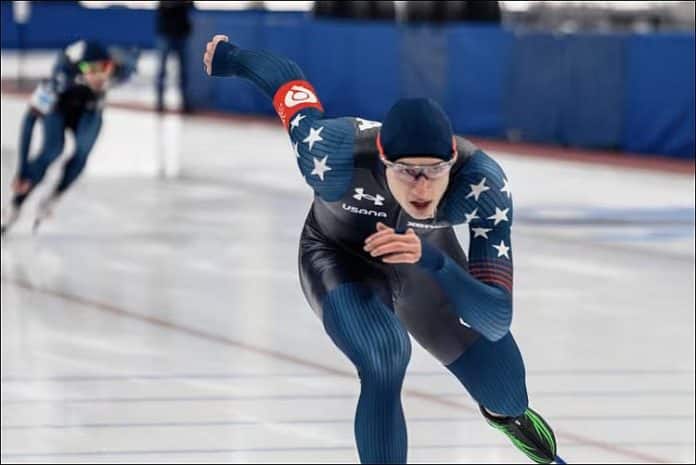
There was no doubt about the favorite: world-record holder and two-time World Champion Jordan Stolz of the U.S.
And all eyes were on the 14th pair, pitting Stolz and 2025 World Champion Jenning De Boo (NED). And Stolz won a tight battle, coming from 0.37 down at the 600 m mark but getting an Olympic Record 1:06.28 to win by a half-second (1:06.78) and earn his first Olympic gold medal.
De Boo was a very clear second, with China’s 2024 Worlds runner-up Zhongyan Ning, winning the 12th pair, third in 1:07.34. Poland’s Damian Zurek, in the 15th and final pair, managed 1:07.41, but was fourth.
American Conor Mcdermott-Mostowy finished ninth in 1:08.48, skating with Ning, and Cooper Mcleod was 19th (1:09.31). Stolz’s win ended a U.S. drought in this event; Shani Davis and Chad Hedrick went 1-3 in Vancouver in 2010 for the last American medals.
Stolz will be busy; this is only the beginning, with the 500 m, the 1,500 m and the Mass Start ahead. But this is a very good start.
Elsewhere:
● Curling: The men’s tournament started with Bruce Mouat’s British rink beating China, 9-4. Danny Casper’s U.S. squad beat the Czech Republic, 8-7, Canadian star Brad Jacobs, the 2014 Olympic winner, defeated Germany, 7-6 and in a mild upset, Italy and Joel Retornaz edged defending champs Sweden and Niklas Edin, 7-6.
● Ice Hockey: The men’s tournament started, with Slovakia upsetting Finland, 4-1 before 11,025 at the Santa Giulia arena. Canada and the U.S. will play their first games on Thursday. Sweden dominated Italy, 5-2, in the second match.
= PREVIEWS: THURSDAY, 12 FEBRUARY =
(9 finals across 7 sports & disciplines)
● Alpine Skiing: Women’s Super-G
This could be another good day for Italy, with Downhill bronzer Sofia Goggia having won a gold and silver on the World Cup circuit this season. She will be inspired by teammate and 2025 Worlds runner-up Federica Brignone, who had a terrible crash in April 2025 and has been recovering, but competed in the Downhill, famously finishing 10th. A medal from Brignone is hard to imagine, but in an Olympic Games, dreams sometimes come true.
There are others with plans for the podium, including New Zealand star Alice Robinson, who also has a World Cup gold and silver. Emma Aicher (GER) is coming off her Downhill silver and won a World Cup Super-G in January. And what about Downhill champ Breezy Johnson of the U.S., who won a World Cup bronze in the last Super-G before the Games?
There are contenders lurking elsewhere, like Swiss Malorie Blanc, who won that last pre-Games Super-G on 31 January and Czech Ester Ledecka, who won this race in a huge upset in 2018, and failed to reach the medal round of her Snowboard Parallel Giant Slalom event. Defending silver medalist Mirjam Puchner (AUT) was 11th in the Downhill.
● Cross Country Skiing: Women’s Freestyle 10 km
Ordinarily, this should be a strong event for three-time Olympic medalist Jessie Diggins of the U.S., who is an excellent Freestyle skier and the 2023 World Champion at 10 km, but who suffered bruised ribs from her early fall during the Skiathlon. Her efficiency is in question.
Sweden went 1-3 in the 10 km Classical at the 2025 Worlds, with Ebba Andersson and Frida Karlsson, who were silver and gold, respectively, in the Skiathlon. The fastest in the second 10 km – Freestyle – were Karlsson, Norway’s Heidi Weng (the bronze winner), Diggins, Andersson and Austria’s 2022 bronze winner Teresa Stadlober. Consider those the medal favorites.
Norway has added contenders including Karoline Simpson-Larsen and Astrid Slind and Swede Moa Ilar, with medals in four of six World Cup 10 km races (1-2-1) is not to be ignored.
Everyone will be looking at Diggins and asking, “is she healthy?”
● Freestyle Skiing: Men’s Moguls
Another crown for the king? Canada’s Mikael Kingsbury owns the records for the most World Cup wins, has four Worlds golds and Worlds medals and was the 2018 Olympic winner. But he was second to Swede Walter Wallberg in 2022.
Neither has dominated on the World Cup circuit. Kingsbury won his only medal of the season – a gold – in January at home at Val St. Come. Wallberg earned a silver in December in Finland.
Instead, Japanese veteran Ikuma Horishima, a three-time Worlds gold medalist and the 2022 bronzer, won two of the four World Cups this season and was second in another to Australia’s Matt Graham, the 2018 Olympic runner-up and the 2019 and 2023 Worlds runner-up.
There are only three medals to be shared among those four and American Nick Page (two World Cup bronzes this season), Sweden’s Filip Gravenfors and Canada’s Julien Viel are all capable of upsetting the script.
● Luge: Team Relay
This will be the fourth edition of the Team Relay and German teams have won the first three. Austria and Latvia have medaled twice and Canada once. Yes, they are all contenders again, with the Germans the prohibitive favorite.
At the 2025 Worlds, it was Germany, Austria and Latvia for the medals again.
It was a bit more mixed during the World Cup season, with five races and “only” three German wins. Italy and Austria won once each and the U.S. earned two bronzes and could contend, if everything goes well.
But with Max Langenhan and Julia Taubitz already the Singles winners, it is going to be a tall order to beat the Germans.
● Short Track: Men’s 1,000 m; Women’s 500 m
These races pick up with the quarterfinals after the heats on the 10th. The men’s 1,000 m has really been about Canada and 2025 World Champion Steven Dubois and silver winner William Dandjinou.
But they did not dominate the ISU World Tour races in this distance, Italy’s Pietro Sighel, the 2025 Worlds bronze winner, won one World Tour and was second and third in others. Korea’s Jong-on Rim won two medals and veteran Dae-heon Hwang won a bronze. Shaoang Liu won an Olympic bronze for Hungary in 2022 but now skates for China and took two medals this season.
And Dutch veteran Jens van’t Wout is simply dangerous, having won the European title in 2026. But the Canadians figure to be the ones to beat and the strategies are being built around handling them.
The women’s 500 m is mostly whether Dutch World Champion Xandra Velzeboer can stay upright. She won three of four World Tour events this season, but crashed in the Mixed Relay and cost a medal. She is a clear favorite, but Canada again will challenge with Courtney Sauralt, who won a World Tour 500 m this season.
American Corinne Stoddard was a strong medal contender, but crashed out in the heats. Teammate Kirsten Santos-Griswold was the star of the 2024-25 season, but has been hampered by injuries. If she is right, she can skate with anyone.
All of this ignores – at one’s peril – the two-time defending Olympic champ, Italy’s Arianna Fontana, who just won a 12th career Olympic medal in the Mixed Relay. She and Velzeboer are both in quarterfinal no. 1. Two-time Olympic bronzer Kim Boutin of Canada is also back to try for a third medal in this event.
● Snowboard: Men’s SnowCross; Women’s Halfpipe
The men’s Snowboard Cross favorites have to start with defending champion Alessandro Hammerle (AUT) and Canada’s silver winner Eliot Grondin from 2022, with Grondin winning the 2025 Worlds gold and Hammerle third.
But neither of them won any of the three World Cup races this season, as Jonas and Adrian Chollet (FRA) were 1-2 in Italy in December, Austria’s Jacob Dusek won over Grondin in China in January and Australian Adam Lambert won the second race in China, beating Hammerle in the final.
Lambert won medals in all three races and has to be a medal contender; American Nathan Pare, a first-time Olympian, won a bronze in the final pre-Games race in China. A surprise?
The women’s Halfpipe was considered a foregone conclusion for U.S. star Chloe Kim, a two-time Olympic champ, but she has been nursing a shoulder injury in late January. She has been cleared to compete, but no one will know how fit she is until she starts.
The U.S. has won this event five of the seven times it has been held, with Kim the only repeat winner. The star of the World Cup season, however, has been Korean Ga-on Choi, 17, who won three of the five events so far. As always, Japanese stars Mitsuki Ono – a two-time Worlds bronze winner – and Beijing 2022 bronzer Sena Tomita, and Rise Kudo.
Americans won two World Cup medals this season, with Madeline Schaffrick taking a silver in January and Bea Kim (no relation) taking a bronze in December. They’re both at the Games.
Chloe Kim had no trouble in the qualifying, ripping off a 90.25 on her first run and going home. Sara Shimizu (JPN: 87.50) was second and American Maddie Mastro impressed with a 86.00 on her second run.
● Speed skating: Women’s 5,000 m
Italy’s Francesca Lollobrigida won an emotional Olympic 3,000 m gold on her birthday on 7 February, over Ragne Wiklund (NOR) and Valerie Maltais (CAN). Can she double her pleasure?
A year ago, it was Lollobrigida winning the Worlds 5,000 m over Wiklund, but with Merel Conijn (NED) third. Those four are in the mix again, along with Canada’s Isabelle Weidemann, the 2022 Beijing silver winner.
Recovering from a viral infection which kept her out of the 5,000 m, homage must be paid to Czech star Martina Sabilkova, now 38, who won Olympic golds in this event in 2010 and 2014, was second in 2018 and bronze in 2022. She owns 10 World Championships golds in this event. She still ranked eighth in the ISU World Cup Distance standings this season, but said Wednesday that while she will race, she won’t be competitive.
A dark horse? Try Nadezhda Morozova (KAZ), in the top five in three of five World Cup distance races this season.
= INTEL REPORT =
● Olympic Games 2028: Los Angeles ● The Executive Committee of the LA28 Board of Directors issued a statement Wednesday morning, that after a detailed inquiry, Casey Wasserman should continue as the Chair of the organizing committee. More here.
● Athletics ● An audacious Grand Slam Track bankruptcy reorganization plan was filed that proposes to pay 85% of debts owed to athletes, but just 1.5% owed to vendors and aims to create a new, Michael Johnson-led entity for a future circuit. More here.

At the World Athletics Indoor Tour Gold meet in Belgrade (SRB), Bulgaria’s 2025 European Indoor champ Bozhidar Saraboyukov took the world lead in the men’s long jump at 8.45 m (27-8 3/4), beating Olympic champ Miltiadis Tentoglou (GRE: 8.27 m/27-1 3/4).
American Roger Steen, the 2025 Worlds runner-up, won the men’s shot with a world-leading mark of 22.07 m (72-5), his best ever indoors.
Swiss 800 m star Audrey Werro, the Diamond League final winner, took the women’s 800 m in a world-leading 1:57.27, moving her to no. 8 on the all-time indoor list, with a national record.
Poland’s Jakub Szymanski won the men’s 60 m hurdles in 7.43, moving to no. 2 in the world for 2026, winning easily over Paris 2024 silver winner Daniel Roberts of the U.S. (7.57). Italian sprinter Zaynab Dosso, the 2025 Worlds silver winner, went to no. 2 in the world for 60 m at 7.02.

★ Receive our exclusive, weekday TSX Recap by e-mail by clicking here.
★ Sign up a friend to receive the TSX Recap by clicking here.
★ Please consider a donation here to keep this site going.
For our updated, 45-sport, 910-event International Sports Calendar for 2026 and beyond, by date and by sport, click here!