

















★ The Sports Examiner: Chronicling the key competitive, economic and political forces shaping elite sport and the Olympic Movement.★
★ To get the daily Sports Examiner Recap by e-mail: sign up here! ★
≡ THE TECHNOLOGY GAMES ≡
Technology plays a huge part in the staging of any Olympic Games, and the 2026 Winter Games opening ceremony will be a prime demonstration of what is possible, thanks to the work of the Olympic Broadcasting Services team.
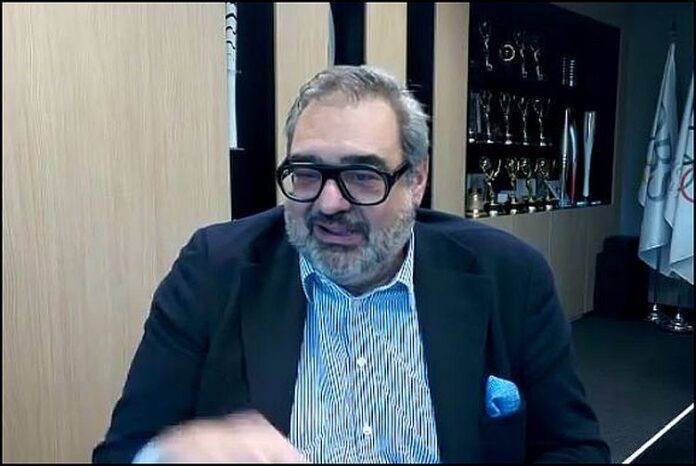
OBS chief Yiannis Exarchos (GRE) spoke to reporters on Wednesday and explained the challenge:
“This opening ceremony, as you probably know, will be distributed geographically. These are Games that have a very wide distribution across northern Italy; it’s difficult to go from one place to the other.
“So it was fundamental that we provide, for the organizers, for the IOC, an opportunity for all Olympic athletes to have a feeling of participation in the opening ceremony. We know important it is for all of them.
“With the help of our underlying technology and especially the core connectivity that OBS is establishing between different places of the Games, this opening ceremony will actually take place at the same time across four different locations, actually across five locations because there will be two in Milano, and this, we feel, is an example where technology comes and helps really create excitement and create a sense of participation.”
Exarchos explained that the parade of athletes in four different locations will be “integrated” – between all four sites where athletes will march – thanks to a coordinated and rehearsed program developed by organizing committee Creative Lead Marco Balich (ITA) and OBS.
And the multi-site ceremonies program is just one of the innovations that will be seen in the OBS production. Even more, the connectivity engineering that has been created for the Games, spread across northern Italy, will remain as a legacy after the Games to improve the communications infrastructure for the mountain region.
Exarchos showcased a series of efforts which will be either new at the Milan Cortina Winter Games, or significant improvements on what was done in recent Games:
● “First Person Drones” flying with athletes as sports such as bobsled, luge and skeleton for the first time, in addition to the well-known flyover shots of skiing events.
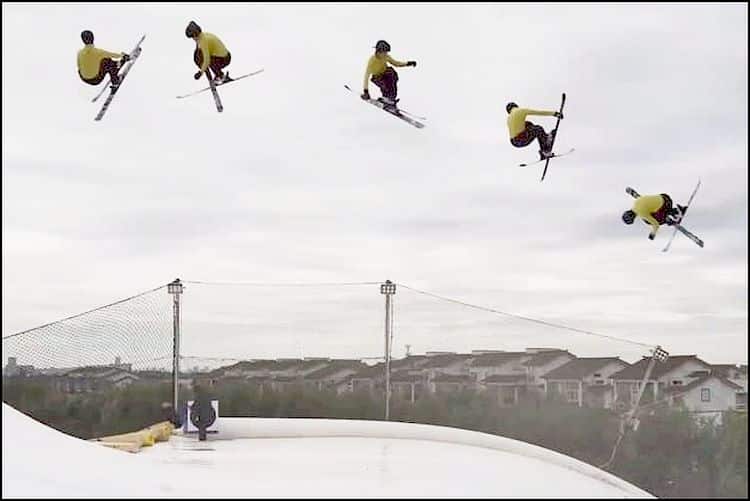
● “Real Time 360º Replay” offering multi-camera replay systems and stroboscopic analysis, which can be overlaid with added information; Exarchos showed a skiing example, which would in practice be a video overlaid with tracking data:
● “Olympic GPT.” a new project for the Olympics.com site which will provide not only rules and results, but “will have the capacity to answer questions about the current state of events.”
● “Olympic AI,” which will offer AI-generated answers to user inquiries, but not based on whatever is available online, but drawn from the International Olympic Committee’s own, deeply detailed and continuously revised database.
● For rights-holding broadcasters and the IOC’s own channels, AI is being used for “Automatic Media Description” identification of highlights within a broadcast session, “Automatic Highlights Generation” for the first time at a Winter Games and using real-time reactions on Olympics.com to identify the most compelling moments of the Games.
All of this will take place in a continuously-shrinking International Broadcast Center, which Exarchos explained will be 25% smaller than the IBC at the Beijing 2022 Winter Games. But that does not mean there won’t be thousands of broadcasters on the ground:
“Even in Milano, we will have something like 6,000 broadcasters being present. Why? Because they want to the close to their athletes. And this is very legitimate; most of them need to do that.
‘What we don’t want is that they are forced to be bringing people doing something that they could be doing at the other side of the world. … For Milano, 65% of the signals are being transmitted over the cloud.
“When we started the cloud with [IOC sponsor] Alibaba, we thought by Milano, we would have an adoption of 25% and we are at 65%, first because everybody is seeing the benefit, and second, because we had the pandemic that forced people to accelerate how to work differently.”
Exarchos surmised that the International Broadcast Center for Los Angeles 2028 will have half the size of the IBC at Rio 2016 and by the time of the Brisbane 2032 Olympic Games, the IBC will likely be the size of the Milan Cortina Winter Games facility! But it won’t go away entirely.
However, this efficiency has not slowed the expansion of content produced by OBS. That keeps expanding, as Exarchos noted:
“We will be producing more than 6,000 hours of content. Now, the competition in the Winter Games is about 1,000 hours. So all this additional amount is really because we want to produce this extreme type of diversity of content, because consumption of content as you very well know, in today’s world is not done on traditional television.
“It’s still a very, very important factor, but you have so many different platforms that have their own ways of consumption, we have to be enable broadcasters to be able to use all these types of content: short form, behind-the-scenes, virtual reality content and so on, be able to use them across all these different platforms
“And this is how we end up producing so much, which of course would not have been possible unless technology provided us the means to do it.”
Consider this: the communications traffic out of the IBC alone during the Games will be equal to 70% of the entire among of bandwidth used in the city of Milan during a normal, non-Games day.
He said that some coverage will be shot in a vertical format, instead of the traditional horizontal television format, for content to be used on mobile phones.
It’s a big undertaking, but Exarchos emphasized that the advantage of having a permanent organization to handle broadcasting for the Games – the OBS concept essentially started in 2000 – allows for continuos expansion of capabilities and eliminates the learning curve that a new host broadcaster had to deal with.
Exarchos is looking forward to the opening of the Milan Cortina Games, not only for the show, but also “these Games can really help us all recalibrate a little bit how we feel about the world and how we feel about the relations between people, and get immersed in this unique power that the Olympics have to bring people together.”

★ Receive our exclusive, weekday TSX Recap by e-mail by clicking here.
★ Sign up a friend to receive the TSX Recap by clicking here.
★ Please consider a donation here to keep this site going.
For our updated, 45-sport, 910-event International Sports Calendar for 2026 and beyond, by date and by sport, click here!