



















★ The Sports Examiner: Chronicling the key competitive, economic and political forces shaping elite sport and the Olympic Movement.★
★ To get the daily Sports Examiner Recap by e-mail: sign up here! ★
≡ TOP STORIES of 2025: 5 to 1 ≡
The year 2025 produced some incredible performances by star athletes and memorable upsets on the field, but the top stories of the year – for the most part – took place off the field and in board rooms, Congresses and government offices.
The Sports Examiner selections of the top stories of 2025 from no. 10 to no. 6 are here; let’s count down the top five:
5. FIFA World Cup ticket prices soar, as does demand
With an expansion to 48 teams and 104 matches, the 2026 FIFA World Cup is expected to shatter all kinds of records.
One of those will be for ticket prices, as FIFA – which is organizing the tournament itself – made a shift to try to capture as much ticket revenue as possible, using dynamic pricing and sending prices skyward. An Associated Press review of prices as of 11 December showed:
● Group stage: from $140 to $2,735
● Round of 32 and 16: $190 to $980
● Quarterfinals: $535 to $1,775
● Semifinals: $905 to $3,295
● Final: $4,185, $5,575 and $8,680
Facing blistering criticism from fan groups, FIFA created a $60 ticket tier for a few hundred tickets per game for fan support groups working with member national federations. But nearly all tickets appear ready to be sold as FIFA said more than 150 million tickets have been requested vs. the 6-7 million to be actually available.
4. Indonesia denies Israel access for gymnastics World Championships
Following a consistent policy over decades and despite earlier promises, the government of Indonesia barred Israeli athletes – including defending men’s Floor Exercise World Champion Artem Dolgopyat – from competing at the World Gymnastics Championships in Jakarta in October by denying entry visas.
The door slammed on 10 October, nine days before the event began and in time for World Gymnastics – as now known – to follow its own rules, cancel the event and find a new host on postponed dates. But it did not, as Secretary General Nicolas Buompane (SUI) confirmed that the federation did not see this coming:
“When it comes to it, it was previsible not that much in our sense.
“Okay, we know that there is no relationship if I may say so between both countries. But at the same time when the bid has been allocated to Indonesia, we receive a confirmation from the government and this is part of the bidding process mentioning that all participants will be granted with a visa and it was the case until the 9th of October.
“Everybody got their visa and suddenly because of these threats [for riots] and all this they had to change their mind for security reason.”
The International Olympic Committee tried to intervene, but failed and then ended any dialogue about a future Olympic Games or other events in the country and asked the International Federations to also stay away. Indonesia, which shut down the 2023 ANOC World Beach Games and had the 2023 FIFA men’s U-20 World Cup removed over not allowing Israeli participation, does not care and has not responded to IOC requests for future guarantees to allow athletes of all nations to compete there.
Black eye for Indonesia, black eye for the naive World Gymnastics and no word from the IOC on any sanction or even a rebuke to its two members who failed in this episode: Indonesian member Erick Thohir, the country’s youth and sports minister, and World Gymnastics President Morinari Watanabe of Japan.
3. LA28 organizers reach $2 billion in sponsorship sales
Although publicly mostly silent, the LA28 Olympic and Paralympic organizing committee was busy in 2025, moving its headquarters to a historic downtown L.A. skyscraper, finishing some venue moves and focusing on flagging domestic sponsorship sales.
That turned into a success for the year, with major “Founding Partner” sponsorships announced for Honda in June, and then Starbucks in September, Google in October and Intuit in November. In all, there are 29 corporate partners across three levels announced by the end of the year, with $2 billion now committed out of a $2.517 billion budget line item.
LA28 also began taking names for volunteer roles and will open ticket lottery registrations in January 2026. Staffing expanded noticeably, from less than 200 at the start of the year to about 600 at year’s end. The organizers also filed a lengthy “Impact and Sustainability Report,” with goals for environmental protection and local hiring.
It was not as rosy a year for the City of Los Angeles, which started with devastating fires, notably in the Palisades area, then having to close a $1 billion budget gap by eliminating open positions and getting help from its labor unions and, in September, approving a $2.63 billion expansion of the Los Angeles Convention Center. This project will not be finished in time for the 2028 Games, requiring it to be paused, and if behind schedule, the multiple sports to be held there might have to be moved.
Parallel to all of this is a continuing, angry tug-of-war between business interests and labor unions in Los Angeles, especially over minimum wage legislation, possibly to be settled at the ballot box in 2026 elections referenda. LA28 is not directly involved, but could be impacted significantly as a bystander in 2028.
2. Grand Slam Track starts, does not finish and may be finished
When announced in 2024, there were high hopes for the Grand Slam Track concept of four major meets with star athletes and strong prize money. The reality proved to be much less.
Created by Atlanta 1996 Olympic icon Michael Johnson, the circuit opened in Kingston, Jamaica on 4 April and drew modest attendance at the National Stadium, with an estimated 4-5,000 on Friday, then about 10,000 on Saturday and perhaps 8,000 on Sunday, in a 35,000-seat venue. It turned out that meet killed the circuit’s financing, as a probable investor decided not to participate after seeing the turnout.
The results on the track were great and the follow-up meet in Miramar, Florida was nearly full, – in a 5,000-seat facility – in early May and then a terrific house at Franklin Field in Philadelphia at the end of May with an estimated 18,000 on hand for each of the two days there.
But by that point, investor money was long gone and the fourth meet, to be at UCLA’s Drake Stadium in Los Angeles, was canceled. Millions were owed to athletes and vendors and Chapter 11 bankruptcy was declared in December.
Grand Slam Track has $143,126 in cash and debts of $31.4 million, owed to investor Winners Alliance ($11.4 million), athletes ($7.0 million) and vendors and suppliers ($13.0 million). Winners Alliance is advancing additional loans of more than $3 million for restructuring through March 2026 to help get the program back up and running, but the key will be to pay athletes in full.
And any future meets will need to be cash-and-carry as far as vendors and suppliers are concerned.
The Philadelphia meet showed the possible viability of the concept, much more so than the first two meets, but it appears that finding the right venues was a challenge and the television audiences were in the 250,000 range on The CW plus some more on NBC’s Peacock streaming network. There are many more question marks than answers, starting with whether Grand Slam Track will return, in 2026, 2027 or beyond.
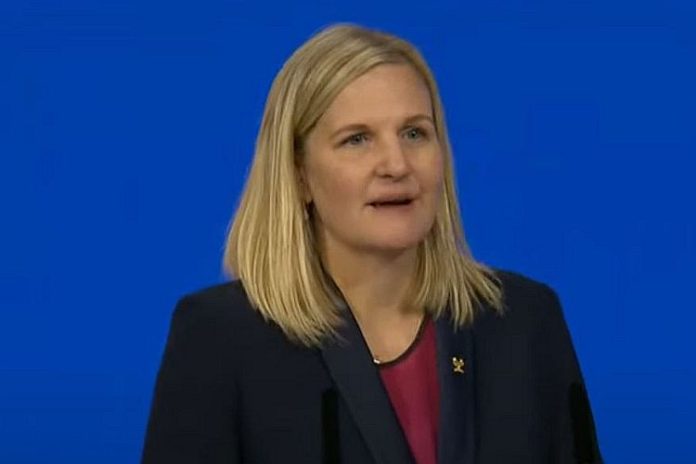
1. Olympic swim star Kirsty Coventry elected as IOC President
“This is an extraordinary moment. As a nine-year-old girl, I never thought that I would be standing up here one day, getting to give back to this incredible Movement of ours.”
That was Zimbabwe’s Kirsty Coventry, speaking to the IOC Session immediately after her election as President on 20 March in Costa Navarino, Greece.
Coventry won the vote over six other candidates, with 49 votes, the exact minimum number required to win in the first round, out of 97 votes cast, ahead of Juan Antonio Samaranch (ESP: 28); Sebastian Coe (GBR: 8); David Lappartient (FRA: 4) and Morinari Watanabe (JPN: 4); Prince Feisal Al Hussein (JOR: 2) and Johan Eliasch (GBR: 2).
At 41, she became the second-youngest IOC President ever, and brought multiple firsts, including being the first woman President of the IOC and the first from Africa. She has extensive U.S. ties, having swum collegiately at Auburn University before winning seven Olympic medals – including two golds – in 2004 and 2008.
In her early months as President, she has maintained the policies of predecessor Thomas Bach (GER), but with a more informal and relaxed style. As she promised, she has invested significant time in listening to the IOC membership, which has felt cut-off from the organization’s decision making, and created four working groups to consider new approaches for the future for commercial partnerships and marketing; the Olympic sports program, the Youth Olympic Games and “protection of the female category.”
Coventry clearly does not want to be rushed in new directions, and is very desirous of consensus, so far as is possible with difficult topics such as differences in sex development and transgender participation. She has maintained Bach’s approach to “neutral” athletes for the Milan Cortina 2026 Winter Games for Russia and Belarus.
But she is finding her own style, and has received a warm welcome from the International Federations and the National Olympic Committees thus far. The harder decisions are yet to come, starting with the “female category” question in early 2026.

These top-10 moments are not, of course, all that deserve mention for 2025. No recap of the year can be complete without noting the continuing chaos in collegiate sports in the U.S., with millions now going to football and basketball players and smaller sports such as track, swimming, volleyball, wrestling, gymnastics, tennis and so on all threatened as resources shrink.
Important also has been the work of the U.S. Olympic & Paralympic Committee, which is benefitting from a share of the LA28 sponsorship revenue streams and which received a sensational $100 million gift in March from Stone Ridge Holding Group founder Ross Stevens, to create a fund that will provide $100,000 in cash and a $100,000 death benefit to each Olympian and Paralympian, available 20 years after their qualifying Games or at age 45, whichever is later, beginning with the 2026 Winter Games.
Up next: the projected top stories of 2026!
Rich Perelman
Editor
★ Receive our exclusive, weekday TSX Recap by e-mail by clicking here.
★ Sign up a friend to receive the TSX Recap by clicking here.
★ Please consider a donation here to keep this site going.
For our updated, 850-event International Sports Calendar for 2025, 2026 and beyond, by date and by sport, click here!