













★ The Sports Examiner: Chronicling the key competitive, economic and political forces shaping elite sport and the Olympic Movement.★
★ To get the daily Sports Examiner Recap by e-mail: sign up here! ★
≡ WORLD CONFERENCE ≡
“By 2029, we will establish a global Intelligence & Investigation network spanning all continents. But we must also confront a difficult truth. WADA’s investigators do not have the tools that are available to law enforcement. They cannot seize or access digital devices. They cannot demand the production of evidence.
“They cannot use investigative powers that police rely on every day. This limitation becomes even more critical in countries where doping is not a criminal offense. In those jurisdictions, law enforcement cannot act either.
“This leaves WADA with limited means to investigate even when the need for intervention is clear.
“Despite this, our I&I team delivers results that defy these limitations. Imagine what they could achieve if they had all the tools they need.”
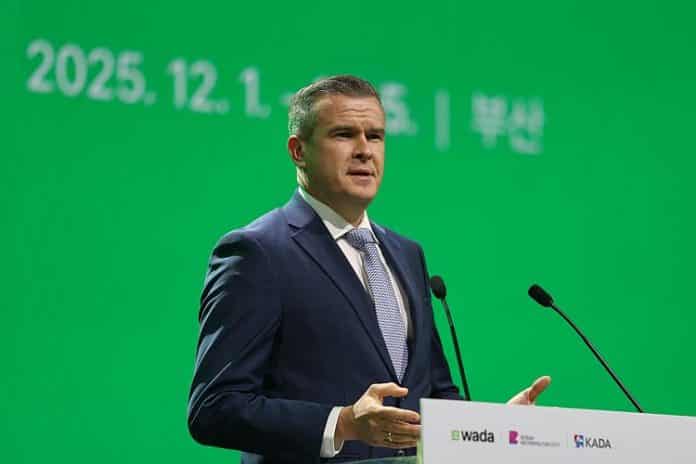
That’s World Anti-Doping Agency President Witold Banka (POL) addressing the sixth World Conference on Doping in Sport in Busan (KOR), with 1,500 delegates and observers at the largest meeting of the anti-doping community and the first since 2019.
Banka then went further:
“This is why I respectfully but firmly call on our stakeholders, including governments, to consider expanding – with appropriate safeguards – the investigative capabilities available to WADA’s I&I Department. Not to punish more athletes. Not to overreach. But to close a gap that criminals exploit, and to enable effective investigations where no other authority has the mandate to act.”
That will be a matter for governments to consider, and the angst created by the Rodchenkov Anti-Doping Act of 2019 (now 21 USC §2401; signed into law in 2020) that allows the U.S. Department of Justice to exercise extra-territorial jurisdiction over doping cases will not make such an agreement easy.
But Banka is being aggressive. He opened with an appreciation for how far the anti-doping movement has come:
“Last month, WADA turned 26. And in those 26 years, global anti-doping has undergone a transformation that few could have predicted in 1999. What was once a fragmented landscape – with different rules, different laws, different expectations – has become a harmonized system built on shared responsibility between governments and the sport movement. Some people doubted the 50–50 model would last. But it has proven to be durable, effective, and indeed essential for the success of the entire global system.
“We acknowledge the leaders who guided WADA through defining moments – Richard Pound [CAN], the late John Fahey [AUS], and Sir Craig Reedie [GBR]. Their stewardship established the institution and strengthened its credibility.
“When I assumed the presidency in 2020, the consequences of Russia’s institutionalized doping scheme were still unfolding. Operation LIMS – WADA’s investigation into the Moscow Laboratory – exposed the truth, and nearly 300 individuals were ultimately sanctioned. That process reaffirmed a fundamental principle: justice in sport may take time, but it will prevail.”
He also warned that the pressure on the anti-doping world is increasing:
“[T]he reality is that doping is evolving at an unprecedented speed. Designer substances, microdosing strategies, new gene technologies, a rise in contamination cases, and increasingly sophisticated trafficking networks are reshaping the threat landscape. The financial stakes in sport have never been higher. Nor has the sophistication of those who want to cheat.
“If we want to stay ahead, science must move at least as fast as those who seek to undermine fairness. This requires investment. Significant investment. And so today I urge governments, the Olympic Movement, and all partners in clean sport to increase support for anti-doping science.
“Empower our laboratories. Accelerate research. Develop the next generation of detection tools. Without decisive action, we risk falling behind forces that do not share our values.”
And he did not miss an opportunity to bash the doping-friendly Enhanced Games, scheduled for May 2026:
“We also stand united against reckless concepts such as the Enhanced Games, which allows for the unregulated use of performance-enhancing substances — abandoning the very principles that give sport meaning. They are not the future of sport – they are a distortion of it.”
Banka also asked for an added emphasis on education: “Education is not an optional extra. It is a must-have. It is the easiest and most effective way to protect athletes and prevent doping.”
Observed: The WADA President did not mention the continuing fight with the U.S. Anti-Doping Agency and the U.S. government – among others – on the WADA response to the 2021 Chinese swimming mass-positives incident, or the subsequent and continuing refusal of the U.S. Office of National Drug Control Policy to pay dues.
But he is asking for more tools to fight doping – more legal backing from governments – following up on the remarks of Athletics Integrity Unit head David Howman (NZL) at the U.S. Anti-Doping Agency’s annual Symposium on Anti-Doping Science in September:
“I suggest we have not reached the ‘ridding’ nirvana, in fact, we are still only catching the dopey dopers and they are getting dopier. Most sophisticated dopers still evade detection.”
So how are Banka and WADA going to get law-enforcement-style permissions? That will a key topic to watch in the future, even if it ends up being a closer cooperation with national or local police powers.
But how would that have helped in the 2021 Chinese swimming mass-positives incident?
¶
★ Receive our exclusive, weekday TSX Recap by e-mail by clicking here.
★ Sign up a friend to receive the TSX Recap by clicking here.
★ Please consider a donation here to keep this site going.
For our updated, 850-event International Sports Calendar for 2025, 2026 and beyond, by date and by sport, click here!