Home Blog

MILAN CORTINA 2026 Review & Preview: IOC notes criteria for keeping a sport Olympic; U.S. wins five medals among the chaos; 12th career medal for Italy’s Fontana

All smiles for Italy in the Short Track Mixed Relay, with Arianna Fontana (fourth from left) winning a 12th career Olympic medal! (TSX photo by Karen Rosen).

The Sports Examiner: Chronicling the key competitive, economic and political forces shaping elite sport and the Olympic Movement.★

To get the daily Sports Examiner Recap by e-mail: sign up here!

Friends: YES! Now 41 donors have covered 108.1% of our winter goal for our tech support costs! But, you can still donate here if you wish! You are the reason this site continues. ★

= MILAN CORTINA 2026 =
From Lane One

International Olympic Committee President Kirsty Coventry (ZIM) said last week that her working group on the Olympic program is creating a set of metrics to help evaluate the place of sports in the Olympic and Winter Games.

At Sunday’s media briefing in Milan, IOC Sports Director Pierre Ducrey (SUI) explained further, in the context of the future of the Nordic Combined, for which women were controversially not added for the 2026 Winter Games. Ducrey explained:

“When it comes to Nordic Combined, I think we look at it in a way that these [2026] Games will provide us a lot of information.

“When we assess a sport, not necessarily Nordic Combined – any sport – what do we look for?

“We look for universality, we look for spread of excellence at the top, we look for is this sport being watched – in the Games, outside the Games – there are a lot of elements being used, which again, are not specific to Nordic Combined. We apply the exact same criteria to all sports.

“It just turns out that this particular discipline has had challenges in the past. I think it’s been communicated , both on the men’s and women’s side, so we just want to make sure that we take a very good look – in detail – at how much the sport has moved forward since we made the decision for 2026.

“When we decided on the women for 2026, you know in ‘21 there had only been one World Championship, with a lower number of athletes. Now the sport has evolved further, so we want to make sure we take all the criteria I just mentioned and inform those that have to make the decision.”

Coventry’s prior comments and Ducrey’s raise the issue of sports that have been in the lower tiers of popularity according to the IOC’s measurements in recent Games. For the 2016-2020 Games, these included canoeing, equestrian, fencing, handball, hockey, sailing, taekwondo, triathlon and wrestling, along with modern pentathlon and the new (as of 2016) sports of golf and rugby sevens.

IOC member Karl Stoss (AUT), who is leading the Olympic Program working group, was clear during his IOC Session presentation, “we will not be able to make everyone happy,” and added, “our responsibility is clear: to ensure the Olympic sports program is balanced, relevant and forward-looking and sustainable.”

Ducrey gave a little more perspective on what Stoss meant.
~ Rich Perelman

● Rosen Report ● A full review of a wild day in Short Track, and a bad day for American star Corinne Stoddard, among others, on soft ice on Tuesday.

● Rosen Report II ● An emotional Short Program for American skater Maxim Naumov, remembering his parents while qualifying for the Olympic final.

● Also on TSX ● In its massive spending bill signed into law last week, the U.S. government authorized funds for transportation assistance for the 2026 FIFA World Cup and 2028 Los Angeles Games. It even had funding for the World Anti-Doping Agency, but with strings attached!

● Milan Cortina 2026 ● The organizing committee said in the morning news briefing that it sold 56,000 tickets across nine venues on Monday.

Spokesman Luca Casassa explained that the problem of some medals and ribbons becoming detached at the top has been taken up with the Italian Mint – which made them – and anyone with an issue can turn them in for a quick repair and return.

The International Olympic Committee decided that Ukrainian skeleton racer Vladyslav Heraskevych will not be allowed under the political neutrality rules to wear a special helmet which commemorates those lost during the Russian invasion of the country with pictures of about 20 individuals, but will be allowed – as an exception – to wear a black armband instead.

Heraskevych has worn the helmet during training and promoted it on his social channels, but will not be able to wear in competition. Said IOC spokesman Mark Adams (GBR): “We feel this is a good compromise in the situation,” maintaining a “safe space” in the competitions.

Milan Cortina 2026 food and beverage director Elisabetta Salvadori explained that the dining halls of the Olympic Villages include 600 seats in Milan, 400 in Cortina and 400 in Predazzo, preparing about 4,500 meals a day in Milan and about 4,000 in Cortina and 3,000 in Predazzo. The ice hockey players eat the most and the lines are longest – surprise? – at the pasta and pizza stations!

● Il Tempo Olimpici ● Some sunshine is expected for Milan on Wednesday (11th), with temperatures up to 55 F for the high and a 41 F low, with the warming trend continuing through Friday.

In Cortina, winds are expected to be light, with overcast conditions and a high of 43 F. Temps will dive to 25 F overnight, with some light snow moving in late.

● Scoreboard ● A big day for Norway moved them into the lead in the overall medal table, through 27 of 116 events:

● 12: Norway (6-2-4)
● 11: Italy (2-2-7)
● 8: Japan (2-2-4)
● 7: United States (2-3-2)
● 6: Germany (3-2-1)

● 6: Sweden (3-2-1)
● 5: Switzerland
● 5: Austria
● 3: France
● 3: Canada

The U.S. had a five-medal day, but no golds (0-3-2).

A better indication of team performance has to go beyond three places, so The Sports Examiner returns our eight-place scoring, using the NCAA track & field format of 10-8-6-5-4-3-2-1 to score each event. After three days, the top 12:

● 141: Norway
● 124: Italy
● 89.5: Austria
● 87.5: United States
● 74: Germany

● 69.5: Switzerland
● 68.5: Japan
● 64: Sweden
● 49: France
● 43: Canada

● 31: Netherlands
● 29: China
● 29: Czech Republic

The Italians have put up an impressive 25 place winners (1-8) in just the first three days of medal competitions.

● Television ● Criticism of television announcers is nothing new; commentary on what is said on television inspired a site called “Awful Announcing” – focusing on U.S. television – way back in 2006!

But the performance of RaiSport director Paolo Petrecca at the Milan Cortina opening ceremony on Friday might be a new low. Among the gaffes, he identified Italian actress Matilda De Angelis as American star Mariah Carey, said IOC chief Coventry was the daughter of Italian President Sergio Mattarella and failed to recognize most of the hugely-popular men’s and women’s world champion volleyball teams who carried the Olympic Torch in the stadium and marched it outside for its eventual lighting at the Arco della Pace.

He had opened the telecast as being from the Stadio Olimpico – which is in Rome – instead of the San Siro, the iconic Milan stadium.

It was so bad that RaiSport pulled Petrecca from the closing ceremony announce team and the RaiSport staff issued a statement on Monday that included:

“From today at 5 p.m. and until the end of the Games – we read in a note – we are withdrawing our signature from services, connections and commentaries while we wait for the company to finally become aware of the damage that the director has caused: to the viewers who pay the license fee, to Rai as a company and to the entire editorial staff who are working as always with passion on this great event.”

The RaiSport union’s statement included:

“Dear colleagues, for three days we have all been embarrassed, no one excluded, and through no fault of our own. It’s time to make our voices heard because we are facing the worst performance ever by RaiSport during one of the most anticipated events of all time, the Milan-Cortina Winter Olympics. …

“This is not a political issue , as some would have us believe, but a question of respect and dignity for public service. Starting today at 5 p.m., we have requested that a union statement be read on all Olympic news programs and on the Mattina Olimpica and Notti Olimpiche programs.”

And it ended explaining that after the end of the Games, “we will implement the three-day strike mandate that the editorial staff voted for after the director’s editorial plan was twice rejected.”

Awful announcing, indeed. De Angelis made fun of the “mix-up” with Carey, writing on her Instagram page, “Please, call me Mariah.”

● Figure Skating ● U.S. skater Amber Glenn came to a resolution concerning using “The Return” by Canadian singer Seb McKinnon (CLANN), explaining in a statement:

“The issue of music rights can be complex and confusing. Seems like there was a hiccup in that whole process. I’m glad we cleared things up with Seb and I look forward to collaborating with him.”

Glenn had been using the song in routines for about two years, but McKinnon found out about it only in the context of the Winter Games and publicly questioned the use of his music without his direct consent.

A handful of usage incidents have come up for Olympic skaters, including Spain’s Tomas-Llorenc Guarino Sabate and Russian “neutral” Petr Gumennik.

Another hiccup was during the Team Event medal ceremony, where the podium was covered by a non-skid material rather than a soft cover, and the teams came out in their skates, without covers.

So, there were incidents of minor damage to some skates, with the organizing committee stating:

“During the Figure Skating Team Event medal ceremony, the anti-slip surface of the podium caused some damage to the athletes’ skates.

“To minimise the impact of the damage to athletes’ preparations and in agreement with [International Skating Union], Milano Cortina 2026 has made a skate-sharpening service available and offered an additional training session to the impacted National Olympic Committees. We also understand that some [National Olympic Committees] have offered their services to the impacted athletes from other countries in a true example of the Olympic spirit.”

● French Alps 2030 ● It was reported that chief executive Cyril Linette will be dismissed by organizing committee chief Edgar Grospiron, with a meeting of the Executive Board on Tuesday evening. A national governmental committee hearing from the organizers is scheduled for 25 February.

= RESULTS: TUESDAY, 10 FEBRUARY =
(9 finals across 8 sports & disciplines)

Charles Dickens immortally wrote, “It was the best of times, it was the worst of times” as the opening line of his 1859 novel A Tale of Two Cities. That’s what happened to Team USA on Tuesday, in a wild swing of emotions throughout a chaotic of triumph and despair. Check it out.

● Alpine Skiing: Women’s Team Combined
A shocker. An absolute shocker. Olympic Downhill champion Breezy Johnson of the U.S. led off with a leading mark of 1:36.49 and handed off to the greatest Slalom skier of all time, Mikaela Shiffrin. Same as at the 2025 World Championships, where the pair won gold.

This time, she had trouble and finished 15th in the Slalom segment and left the American pair in fourth place and out of the medals. Said Shiffrin:

“I’m careful not to make excuses but it comes from a lot of different variables.

“It is a sport of fine margins and a lot of variables. This kind of thing happens more often than not in training where it’s like I don’t quite feel comfortable enough and there’s a certain amount of luck when it goes right.

“But there’s also a feeling that I’m going to work to achieve for the Slalom race coming up.”

Meanwhile, Austria’s Ariane Raedler was a surprise second in the Downhill and even with a 10th-place Slalom finish for Katharina Huber, they won the event with a combined time of 2:21.66. Likewise, German Kira Weidle-Winkelmann was sixth in the Downhill, but new star Emma Aicher won the Slalom and they grabbed the silver in 2:21.71.

The second American team of Jackie Wiles (fourth in the Downhill) and Paula Moltzan figured to be in the medal mix and Moltzan’s fourth in the Slalom brought them the bronze in 2:21.97. The Austrian pair of Cornelia Huetter and Katharina Truppe were expected to compete for gold, but finished fifth and 13th and ended up fifth. It didn’t happen only to Shiffrin.

The other American teams included Keely Cashman and A.J. Hurt in 15th overall (2:24.90) and Isabella Wright did not finish the Downhill.

● Biathlon: Men’s Individual
Norway’s new star, Johan-Olav Botn, a three-time winner on the World Cup circuit in only his second season, shot clean and won his first Olympic medal in his first Olympic race in 51:31.5.

That was 14.8 seconds up on France’s Eric Perrot, the 2025 World Champion, who crucially missed a shot on the second segment and took silver in 51:46.3.

They were both well ahead of the rest of the field, with Norway’s Sturla Holm Lagreid – the 2021 World Champion – taking bronze in 52:19.8 (1), with the next-closest competitor more than 48 seconds behind. Defending champ Quentin Fillon Maillet (FRA) was eighth.

Botn signaled to the sky at the line, remembering teammate Sivert Guttorm Bakken, who passed in December in a hotel in Lavaze (ITA). The U.S. had Campbell Wright in 27th (56:53.9/2), Paul Schommer in 44th (58:00.4/1), Maxime Germain in 67th (1:00:44.9/3) and Sean Doherty in 80th (1:02:16.8/6).

● Cross Country Skiing: Men’s and Women’s Sprint
Another shocker. But not for Norway’s all-conquering Johannes Hoesflot Klaebo, who won his second gold of the Games in 3:39.74, his third straight win in the Winter Games! No one has ever done that before and Norwegians have now won five of the seven men’s Sprints ever held.

What came after was hard to believe: American Ben Ogden, who had been second in the qualifying, won his quarterfinal and was a close third in his semi. In the final, he was the only real competitor for Klaebo and finished second in 3:40.61 for his first Olympic medal!

Ogden, 25, had won a total of two FIS World Cup medals in his career – both bronzes – and none this season. Now, he’s the second American man to ever win an Olympic cross country medal, after Bill Koch’s 30 km silver way back in 1976! What?

Norway picked up the bronze with Oskar Vike at 3:46.55.

The women’s Classical Sprint climaxed a Swedish progression on the podium. Stina Nilsson won in 2018, then Jonna Sundling and Maja Dahlqvist went 1-2 in 2022. This time it was a sweep, with Linn Svahn – a World Cup winner this year – winning in 4:03.05, ahead of Sundling (4:04.64) and Dahlqvist (4:07.88). It’s the first-ever medals sweep in this event, men or women.

American Julia Kern made the final and finished sixth in 4:43.41. Jessie Diggins, more of a distance racer now, and still suffering from bruised ribs from her fall earlier, was eliminated in her quarterfinal.

● Curling: Mixed Doubles
Sweden’s brother-sister team of Isabella and Rasmus Wrana were the last ones to make it into the playoffs in Cortina, but they stood highest on the podium with a final-end win over Cory Thiesse and Korey Dropkin of the U.S., 6-5.

The U.S. had a 1-0 lead after the first end and the Swedes came back with two in the second. It was 4-3 for Sweden at the end of six and then the Americans struck – as they did in the semis – with two points to take a 5-4 lead into the final end.

But the Wranas were keen to respond and Isabella’s final shot scored two in the eighth and got the gold, 6-5. It was Sweden’s first gold in the event and the first medal for the U.S., the 2023 World Champions.

Defending champions Italy won the bronze over Britain, 5-3, as Stefania Constantini and Amos Mosauer scored single points in the first, third, sixth and eighth ends. They are the second two-time medalists in the event.

● Freestyle Skiing: Men’s Slopestyle
Norway’s Birk Ruud came in as the favorite, after winning the Worlds golds in Slopestyle in 2023 and 2025, after winning the Big Air gold at the Beijing 2022 Games.

He wasted no time putting the pressure on the rest of the field, sailing out to an 86.28 score on his first run and daring anyone else to beat him. No one could.

In fact, only three skiers managed scores in the 80s. Switzerland’s 2021 World Champion, Andri Ragettli, was second after the first round at 78.65, but American Alex Hall – the defending champion – fired up to second place at 85.75 in the second round, with Ragettli still in third.

Rudd wasn’t close on his second run, scoring 45.08, but in the third round, New Zealand star Luca Harrington, the 2025 World Champion in Big Air, moved up to third at 85.15. Hall went for broke but could not execute and scored only 8.03. Ruud had to sweat out six more riders, but then flew down his final run in celebration.

It’s Norway’s second win in this event in four times it has been held at the Games; the U.S. has won the other two and Americans have won medal all four times (and seven of the 12 awarded all-time).

Americans Konnor Ralph (66.76) and Mac Forehand (55.93) finished ninth and 11th.

● Luge: Women’s Singles
Germany had won this event seven straight times in Olympic competition, and that didn’t change in Cortina.

Julia Taubitz, the 2021 and 2025 World Champion, set the track record at 52.550 on her second run and entered day two as the leader by 0.61 over teammate Merle Fraebel. Taubitz left absolutely no doubt and won the third and fourth runs and was a dominant winner in 3:30.625.

Behind her was more chaos. Fraebel had a horrible third run, ranking 20th and even with a second-place final run, finished at 3:32.172 and opened the door for others. Latvia’s Elina Bots – who won no World Cup medals this season, but already a surprise third on the first day – didn’t miss her chance and ranked fourth and sixth on her two runs and won silver in 3:31.543, 0.918 seconds behind Taubitz.

Italy had a shot at bronze with Verena Hofer starting the day in fourth place, and she ran well, placing fifth and seventh on her two runs for a 3:31.645 total. But American Ashley Farquharson – in her second Games – was on fire on Tuesday, running third overall on her third run to move into bronze medal position. And a fourth-place finish on her last run meant she won the bronze in 3:31.582. She said later:

“I feel amazing. This feels unbelievable. I still feel a little bit like I’m dreaming,”

“It was the first time that I felt competitive at the Olympics, so it was a lot of managing my emotions and making sure that I was ready to perform at exactly the right time. I feel like I did a very good job. And I really, really put my game face on and threw down. When I came into the outrun and I saw the [number] one, I knew that I [was] guaranteed a medal. It seriously felt like I was dreaming. It did not feel real.”

This was only the second U.S. medal ever in this event, after Erin Hamlin’s bronze in Sochi in 2014. It was the first ever for Latvia! And, eight in a row for Germany.

The U.S. also finished 12th with Emily Fischnaller (3:33.035) and 14th with Summer Britcher (3:33.553).

● Short Track: Mixed Relay
Chaos was the right word to describe this event in Milan as the Short Track program got going.

American star Corinne Stoddard fell in the quarterfinals, but managed to tag teammate Kristen Santos-Griswold and the U.S. qualified into the semis. In the first semi, home favorite Italy, powered by six-time Olympian Arianna Fontana, won in 2:37.482, but Dutch star Xandra Velzeboer crashed and they ended up third in 2:53.319 and into the non-medal B final.

Semi two had Canada, another favorite, who won in 2:39.607. But Stoddard crashed again, possibly due to what the skaters said was soft ice, and the Americans were fourth in 2:53.341, and into the B final.

Italy, with Fontana, Elisa Confortola, Pietro Sighel and Thomas Nadalini, won the expected tight final from Canada, 2:39.019 to 2:39.258, giving Fontana a third career Olympic gold and her 12th career medal (3-4-5), the most ever in Short Track. Olympic super-statistician Dr. Bill Mallon noted that the 12 medals moves to equal-4th all-time on the Winter Olympic medal standings and third among women, with only Marit Bjorgen (NOR: 15) and Ireen Wust (NED: 13) ahead of her. And Short Track is only getting started.

The Dutch felt the worst of all, winning the B final in an Olympic Record of 2:35.537, which would have won the gold. The U.S. finished fourth (2:57.160) with Andrew Heo, Brandon Kim, Santos-Griswold and Julie Letai replacing the despondent Stoddard.

● Ski Jumping: Mixed Team (107 m hill)
This was the second time this event has been in the Games, first in 2022 in Beijing, with Slovenia – with Peter Prevc on the team – winning over Russia and Canada.

This time, the Slovenian team had younger members of the Prevc family on the hill in Predazzo in Domen and Nika and they did not disappoint. Teamed with veteran Anze Lanisek and Nika Vodan, the Slovenians were balanced, made no mistakes and piled up 1,069.2 points to win easily over 2025 World Champions Norway (1,038.3) and Japan (1,034.0). Lanisek was especially impressive, the only one to score more than 140 points on both of his jumps: 140.7 and 142.0, top score of the day.

The U.S. team of Annika Belshaw, Jason Colby, Paige Jones and Tate Frantz made the final – a nice achievement – and finished seventh with 932.9 points.

Elsewhere:

● Figure Skating: The men’s Short Program brought two-time World Champion Ilia Malinin of the U.S. back to the ice, and after ranking second in the Short during the Team Event, he left no doubt, scoring a sensational 108.16 points – his second best of the season – to lead Beijing 2022 runner-up Yuma Kagiyama (JPN: 103.07) and France’s 2024 Worlds bronzer, Adam Siao Him Fa (FRA: 102.55).

Italy’s Daniel Grassl was a distant fourth at 93.46, and the U.S. also qualified Andrew Torgashev (8th: 88.94) and Maxim Naumov (14th: 85.65) to the final.

Malinin’s program included a quad Flip and quad Lutz-Triple Toe Loop combo and all of his elements received strong execution scores. Yes, he also threw in an outrageous backflip. He remains the favorite for the gold in a couple of days.

● Ice Hockey: The U.S. and Canada met in group play, and the Americans – who won all four games in the Rivalry Series in 2025 by a combined score of 24-7 – started fast with a goal from Caroline Harvey at 3:45 of the first period, followed by a Harvey assist in a goal at 17:18 for Hannah Bilka. A strong effort held Canada to just four shots, while the U.S. had 11.

More of the same in the second, as a quick Canadian penalty led to a power-play goal for Kirsten Simms just 1:18 into the period for a 3-0 edge. It was 4-0 at the 13:00 mark with another goal for Bilka and the U.S. ended the period with an 11-6 shots edge.

The final period saw a fifth U.S. goal, from Laila Edwards at 11:53 of the period for the 5-0 final, with the Americans out-shooting Canada, 33-20. The U.S. will win the group at 3-0; Canada has a game to play against Finland on the 12th.

It’s the biggest win for the U.S. against Canada since its 10-4 victory on 10 December 2025 in Edmonton and its first shutout against them since a 1-0 overtime win in the group stage of the 2024 IIHF World Championship.

= PREVIEWS: WEDNESDAY, 11 FEBRUARY =
(8 events in 7 sports & disciplines)

● Alpine Skiing: Men’s Super-G
He may have finished “only” fourth in the Downhill, but have no doubt that Swiss star Marco Odermatt is the Super-G favorite. He’s the 2025 World Champion. He’s won the seasonal World Cup title three seasons in a row. He has two Super-G wins on the FIS World Cup circuit this season.

But he is not invincible. Teammate Franjo von Allmen, the Downhill winner, has three World Cup medals this season. Downhill runner-up Giovanni Franzoni (ITA) also has a World Cup win, as does Austria’s Vincent Kreichmayr, who just shared a Team Combined silver with Odermatt’s Swiss pair. Austrian teammates Raphael Haaser (2025 Worlds silver), Stefan Babinsky and Marco Schwarz all have World Cup medals this season.

If you’re looking for a surprise, your candidates could be Norway’s Fredrik Moeller or Czech Jan Zabystran or Swiss Alexis Monney, each one-time medalists during the World Cup season.

American hopes are on Ryan Cochran-Siegle, who surprised with an Olympic silver in Beijing in 2022.

● Biathlon: Women’s Individual (15 km)
France ruled women’s biathlon in 2025, winning three of the five World Championships races, including Julia Simon’s impressive win by almost 40 seconds in the Individual Race, plus a third-place finish for Lou Jeanmonnot, who broke open the Olympic Mixed Relay for France on Sunday, with Simon on anchor.

They have to start as medal favorites, but in the sole edition during the IBU World Cup season, it was veteran Italian star Dorothea Wierer, 35, who won it; she’s also the 2020 World Champion in this event. Same for teammate Lisa Vittozzi, the 2023 Worlds bronze winner and 2024 World Champion in this race.

Sweden has Hanna Oeberg, who won this event at the 2018 PyeongChang Games but has been better at the shorter distances more recently. And what about Finland’s emerging stars Suvi Minkkinen and Sonja Leinamo?

Lots of contenders, but all eyes will be on what is expected to come down to a France vs. Italy showdown. In the Olympic history of the event, France has one total medal and Italy has none.

● Figure Skating: Ice Dance
This event is expected to be a fight between World Champions Madison Chock and Evan Bates of the U.S. and the French paid of ex-Canadian Laurence Fournier Beaudry and Guillaume Cizeron, the Beijing 2022 Olympic champion with former partner Gabriella Papadakis, and a five-time World Champion.

A flawless routine gave the French a small 90.18 to 89.72 lead after the Rhythm Dance, so the Free Dance will be the decider. Chock and Bates and Cizeron have dominated the event for more than a decade:

Papadakis/Cizeron:
● Worlds gold in 2015-16-18-19-22
● Worlds silver in 2017

Chock/Bates:
● Worlds gold in 2023-24-25
● Worlds silver in 2015
● Worlds bronze in 2016-22

Beyond the top two are familiar Worlds medal winners, starting with Canada’s sassy Piper Gilles and Paul Poirier, Worlds bronzers in 2023 and silver winners in 2024 and 2025, and Italy’s elegant Charlene Guignard and Marco Fabbri, silver medalists in 2023 and bronze in 2024. They are third (86.18 for the Canadians) and fifth (84.28 for the Italians) heading into the Free Dance.

In between and with a clear shot at a medal are Britain’s Lilah Fear and Lewis Gibson (84.28), who won the 2025 Worlds bronze. In sixth are Americans Emilea Zingas and Vadym Kolesnik, who could envision a medal with a brilliant performance … and some mistakes by those ahad of them. This should be great.

● Freestyle Skiing: Women’s Moguls
There will be a familiar look to this event, with 2018 Olympic champion Perrine Laffont (FRA) also the 2025 World Champion. Australia’s 2022 Olympic winner, Jakara Anthony, however, has to be the favorite after dominating the FIS World Cup this season, winning three of four events.

The U.S. will have a big say, with Jaelin Kauf back after an Olympic silver in 2022, and Tess Johnson (2), Olivia Giaccio (4) and Elizabeth Lemley (1) all winning World Cup medals this season.

Not to be overlooked as the silver and bronze winners from the 2025 Worlds, Japan’s Hinako Tomitaka and Canadian Ashley Schwinghammer. But they will have their hands full with Anthony, Laffont and the Americans.

● Luge: Men’s and Women’s Doubles
The women’s Doubles will debut in Cortina, but as with the men, the winners will likely speak German.

During the FIL World Cup season, 2022 and 2023 World Champions Jessica Degenhardt and Cheyenne Rosenthal (GER) dueled with Austria’s 2024 and 2025 Worlds winners Selina Egle and Lara Kipp, with each winning three times.

Just behind them has been Germany’s Dajana Eitberger and Magdalena Matschina, bronze winners at the 2025 Worlds, who medaled in six of seven races this season. Not to be counted out, however, is the American pair of Chevonne Forgan and Sophia Kirkby, the 2024 Worlds bronze winners, and home favorites Andrea Votter and Marion Oberhofer, World Cup medal winners this season.

The men’s Doubles is about who can prevent Germans Tobias Wendl and Tobias Arlt from a fourth straight Olympic gold! They won three World Cup races this season and … they were the last three prior to the Games!

They have no room for mistakes, however, and will be challenged by Latvia’s Martins Bots and Roberts Plume, the 2025 Worlds silver winners, and German Toni Eggert,  five times the World Champion with Sascha Benecken, but now with Florian Muller and twice World Cup medalists this season.

Austria has two medal-contender sleds, with Juri Gatt and Riccardo Schopf (four World Cup medals) and Thomas Steu and Wolfgang Kindl; Steu won Olympic bronze with Lorenz Koller in 2022.

The U.S. has two competitive sleds, starting with World Cup winners in Lake Placid, Marcus Mueller and Ansel Haugsjaa and veterans Zach Di Gregorio and Sean Hollander, who won a silver in Park City.

● Nordic Combined: Individual Normal Hill (107 m)
Under pressure to put on a good show that preferably would have three different countries win the three medals, this starts with jumping off the 107 m hill and follows with a 10.0 km cross-country skiing race, using a staggered start based on the jumping standings.

Defending champion Vinzenz Geiger (GER) is back, but is perhaps one of four favorites. During the World Cup season, seasonal leader Johannes Lamparter (AUT), Geiger, Norway’s Einar Oftebro and younger brother Jens Oftebro all won races in this format, with Lamparter winning twice.

They could take up all the medals, but Austrian brothers Steffen and Thomas Rettenegger and Germany’s Julian Schmid cannot be counted out. A German has won this race thrice in a row and four of the last five; Norway’s last win came in 1998 (!) and an Austrian has never won.

● Speed Skating: Men’s 1,000 m
The Dutch have won this race three times in a row in Olympic competition – including the still-dangerous Kjeld Nuis in 2018 – but the question is about American ace Jordan Stolz. In his second Games at age 21, he was the 500-1,000-1,500 m World Champion in 2023 and 2024, but was under the weather in 2025 and went 2-3-2 in those three races,

So, three years and 9-for-9 in Worlds medals, but Stolz is looking for gold now and is the favorite. He won all five races at this distance during the World Cup season and at times looked not just unbeatable, but unapproachable. Stolz has the world record of 1:05.37 set in the thin air of Kearns, Utah’s Olympic Oval in 2024 and that’s not likely to fall, but Stolz seems to have no limits when he is at his best.

Challengers? Yes, starting with the Dutch and 2025 World Champion Joep Wennemars and silver medalist Jenning De Boo, whose best event is the 500 m. Same for Poland’s Damian Zurek, second in three World Cups in the fall.

Fellow American Cooper Mcleod is an outside medal threat on his best day and German Finn Sonnekalb should not be a surprise if he shows up as a medal threat.

= INTEL REPORT =

● REMEMBERING ● Sad to report that long-time Olympic-sport executive Keith Ferguson, 67, passed away on 3 February 2026, from complications related to heart surgery

Ferguson’s introduction to the Olympic Movement was with the organizing committee for the 1989 U.S. Olympic Festival in Oklahoma City. He was with the U.S. Olympic Committee as its Director of Bid Administration and International Events from 1989-2005 and later the chief executive of USA Climbing from 2008-12 and USA Taekwondo from 2016-17.

He spent 10 years with RFD TV in Tennessee and Texas as Executive Vice President, developing their sports programming.

● ATHLETICS ● USA Track & Field announced that the 2026 national championships will be held in New York, at Icahn Stadium at Randall’s Island Park from 23-26 July.

It’s the first time since 1991 for the USATF meet in New York, at this site, which seats 5,000. It will be the first time since 2019 that the meet will not be held at Hayward Field in Eugene, Oregon, which had hosted five in a row.

● SWIMMING ● SwimSwam.com reported that “USA Swimming will not send a team to the 2026 Summer Youth Olympic Games in Dakar, Senegal. A spokesperson said that the decision came down to Junior Team resource allocation and prioritization.”

The pool competitions in Dakar (SEN) are slated for 1-6 November, for athletes aged 14-17, also conflicting with the U.S. school schedules for the fall.

Receive our exclusive, weekday TSX Recap by e-mail by clicking here.
★ Sign up a friend to receive the TSX Recap by clicking here.
★ Please consider a donation here to keep this site going.

For our updated, 45-sport, 910-event International Sports Calendar for 2026 and beyond, by date and by sport, click here!

MILAN CORTINA 2026/ROSEN REPORT II: U.S.’s Naumov qualifies for Olympic final while remembering his parents, lost in the AA5342 crash

American Olympian Maxim Naumov looking skyward at the close of his Short Program routine at the Milan Cortina 2026 Games (TSX photo by Karen Rosen).

The Sports Examiner: Chronicling the key competitive, economic and political forces shaping elite sport and the Olympic Movement.★

To get the daily Sports Examiner Recap by e-mail: sign up here!

≡ ROSEN REPORT II ≡

MILAN, Italy – It’s called men’s Singles, but Maxim Naumov was sure he had company on the ice as he moved through his Olympic Short Program routine.

“I felt almost like a hand on my back pushing me forward,” he said, “and just feeling my parents guiding me from one element to another, and just kind of keeping me grounded.”

His parents, Vadim Naumov and Evgenia Shishkova, who were also his coaches, were killed on 25 January 2025, when their flight home aboard AA5342 collided with a U.S. Army helicopter following the national championships. Among the 67 casualties were 28 skaters, coaches and family members.

Naumov went home before his parents, the 1994 World Pairs Champions who had stayed in Wichita, Kansas, for a developmental clinic.

He continued skating to honor his parents and achieve the family’s dream of competing in the Olympic Games. Each skater was introduced on the Milano Ice Skating Arena video screen with a quote or motto, and Naumov’s said, “Mom and Dad, this is for you.”

As he skated to Chopin’s “Nocturne No. 20,” Naumov said he felt “almost like a chess piece on a chess board… unlike any other feeling I’ve ever felt.”

And this was unlike any other performance. Naumov posted a season-best score of 85.65 points, markedly better than his previous season high of 76.71.

The 24-year-old qualified for the final in 14th place, while teammate Ilia Malinin leads following the short program with 108.16 points.

Starting with a quad Salchow, Naumov then landed a triple Axel and a triple Lutz-triple Toe Loop combination with no deductions.

“It’s almost like I closed my eyes,” Naumov said, “and I opened them again, and I was on my knees at the end and just looking up and saying, ‘Man, look what we just did.'”

In the “kiss and cry,” Naumov kissed a photo showing his parents holding his hands on the ice when he was a little boy.

“This competition was so different,” said Naumov. “Usually I’m a little jittery and kind of rush a little bit, and I felt none of that here. The calm, the stillness, the confidence. I tried to lean as much into that as I possibly could. And man, it worked to be able to just have 2 minutes and 50 seconds to show what you’ve been working on for 19 years.”

Naumov is grateful for the support from the figure skating community. “I just hope that I made everyone proud,” he said. “And the job’s not finished. One program is down. We have one more to go.”

And he hopes his journey will resonate with others. “You know tragedy and very difficult times will unfortunately happen to all of us at a certain moment in your life,” Naumov said. “I just hope that my story can empower or inspire somebody to continue to push themselves onward, because that’s what we can do. That’s what we have to do.”

In the year since the tragedy, Naumov said the hardship and difficulty have taught him about himself and contributed to his growth as a human being.

Besides feeling his parents’ presence, Naumov was asked to imagine what they would have said to him in this moment.

“Well, I know for a fact that my mom wouldn’t have been here watching that’s for sure,” he said. “She never liked to watch me in person. She would always be refreshing the scores thing and making sure that she’s on top of it, but nervous out of her mind, but supporting me in her own way always.

“My dad would be right next to me and giving me the biggest hug and just saying, ‘I’m proud of you.'”

Receive our exclusive, weekday TSX Recap by e-mail by clicking here.
★ Sign up a friend to receive the TSX Recap by clicking here.
★ Please consider a donation here to keep this site going.

For our updated, 45-sport, 910-event International Sports Calendar for 2026 and beyond, by date and by sport, click here!

MILAN CORTINA 2026/ROSEN REPORT: Soft ice leads to bad day for U.S. Short Track star Corinne Stoddard

U.S. Short Track star Corinne Stoddard falls onto the ice during the Mixed Team Relay (TSX photo by Karen Rosen).

The Sports Examiner: Chronicling the key competitive, economic and political forces shaping elite sport and the Olympic Movement.★

To get the daily Sports Examiner Recap by e-mail: sign up here!

≡ THE ROSEN REPORT ≡

MILAN, Italy – Soft ice led to some hard falls by short track speed skaters, with three by American medal contender Corinne Stoddard.

She was eliminated from the 500 meters and the second of her two falls in the rounds of the Mixed Team Relay knocked the U.S. out of a chance for the A final.

Stoddard wasn’t alone, however, in her misery. Xandra Velzeboer also fell in the Mixed Team Relay semifinals, costing the Netherlands a medal. The Dutch, who already held the Olympic record, lowered it in the B final. However, a rule change prevents B final teams from earning a medal.

Julie Letai replaced Stoddard in the B final and she fell, too. The fifth-ranked U.S. team wound up in eighth place overall.

Andrew Heo of the U.S. said the ice at the Milano Ice Skating Arena is “definitely kind of softer than what we’re used to. I think it’s just the amount of people that are in the arena right now and it’s pretty hot.”

The 9,700-seat arena was nearly full.

Heo said softer ice doesn’t allow skaters to push into it. “It just kind of breaks out from under you,” he said.

American skater Brandon Kim wondered if sharing the arena with figure skating made a difference in the make-up of the ice.

“It was a little bit hard to stay on your feet,” he said, “but I guess we did the best we could given the circumstances.”

Stoddard’s very bad day began barely six minutes into the Short Track competition at the Milan Cortina Games. In heat three of the women’s 500 meters, she went out aggressively and was leading the 4 1/2-lap race when China’s Xinran Wang overtook her.

Stoddard, ranked No. 3 in the world, responded by moving inside, briefly edged into the lead and promptly wiped out with two laps to go.

The American’s crash into the boards also took out Rika Kanai of Japan and Arianna Sighel of Italy while Wang cruised alone to the finish line. In Short Track parlance, this is known as “chaos.”

Kanai recovered for second, but Stoddard slipped again as she tried to restart her race and eventually finished fourth.

“You could see that she had an insane amount of speed,” Letai said. “She potentially has the highest speed out of anyone out here right now, so if her main problem is having too much speed, that’s a good problem to have and hopefully that’s something we’ll be able to fix.”

A glum Stoddard walked through the mixed zone without speaking to reporters after stopping for NBC Sports. A spokesperson for US Speedskating said her ankle is a “little bit swollen.”

“Ice is different at every venue,” Letai said. “It’s also different we have a lot of people in the crowds now, the temperature is up. It was already kind of a soft-ice situation, so now it’s even softer and I think that’s why multiple races… a lot of ruts in the ice. And then we’re going at these top speeds and you need something to hold you, so if it’s too soft, it’s not there.”

Everyone’s on the same ice,” she added. “We’ll figure it out.”

Stoddard’s chance for redemption in the Mixed Team Relay took another unfortunate turn when she fell in the quarterfinals, but still managed to tag teammate Kristen Santos-Griswold.

Team USA advanced to the semifinals when disaster struck again. This time, Stoddard started on the outside and skated cleanly in her first leg. The U.S. was in second place when Stoddard began her second leg. As soon as she surged into first place, she fell again, tripping the South Korean skater behind her.

Stoddard would not return to the ice. The U.S. team substituted Letai, who crashed into the padding on the second of her two outings.

“Out of nowhere I just didn’t adjust to the ice conditions properly and I think you’e seen, the more speed that you have on the ice right now, the harder it is to keep it together,” Letai said.

Italy did keep it together for the gold in the A final as star Arianna Fontana won her 12th medal, third gold, in her sixth Olympics.

But the Netherlands had the faster time. “It’s tough to take,” said Jens Van’t Wout. “The record doesn’t mean anything; we had it already. We showed we were the fastest, but you don’t buy anything with that.”

He said he has been having blade troubles and called the ice “really tricky right now.”

“There have been some weird falls and people slipping around,” he said. “I don’t know if the ice is a little dirty.”

Stoddard will return for the 1,000, 1,500 and 3,000-meter relay.

We’re all proud of Corie,” Letai said. “I think she’s handling everything the best that she can. Everyone knows she’s super strong; this isn’t going to change anything like that. She’s still a super intimidating competitor. She still knows what she can do. She knows that she’s one of the best out there, so I’m excited she has another chance to show that early this week.”

Four years ago at the 2022 Beijing Winter Games, Stoddard also fell in her first race. She crashed so hard into the boards during the 500 that her knee hit her face, breaking her nose. She was medically cleared to continue skating.

This time, “At least she didn’t break her nose,” Heo said, “so we’re all happy about that.”

Receive our exclusive, weekday TSX Recap by e-mail by clicking here.
★ Sign up a friend to receive the TSX Recap by clicking here.
★ Please consider a donation here to keep this site going.

For our updated, 45-sport, 910-event International Sports Calendar for 2026 and beyond, by date and by sport, click here!

U.S. CONGRESS: Massive spending bill has money for 2028 Olympics transport, 2026 World Cup transport and the World Anti-Doping Agency (maybe)

North wing of the U.S. Capitol, containing the Senate Chamber (Photo: Wikipedia via Scrumshus).

The Sports Examiner: Chronicling the key competitive, economic and political forces shaping elite sport and the Olympic Movement.★

To get the daily Sports Examiner Recap by e-mail: sign up here!

≡ ANALYSIS & OBSERVATIONS ≡

The 567-page “Consolidated Appropriations Act of 2026” – also known as H.R. 7148 – became Public Law 119-75 on 3 February with the signature of U.S. President Donald Trump.

It allocated billions of dollars for military and civilian programs, and touched on the 2026 FIFA World Cup, the 2028 Los Angeles Olympic & Paralympic Games and even the long-running fight between the U.S. Congress and the World Anti-Doping Agency.

So, here’s what happened:

FIFA World Cup 2026:
The bill, of course, only allocated funding for the 11 U.S. sites for the tournament starting in June. A push from Representatives and Senators from the 10 involved states – California, Florida, Georgia, New Jersey and New York, Massachusetts, Missouri, Pennsylvania, Texas and Washington – resulted in a little more than $100 million for transportation only.

And the grants will not simply be doled out equally to each World Cup city:

“[T]he Secretary shall make $100,250,212 available for grants to transit agencies for costs related to eligible planning, capital, and operating expenses for equipment and facilities in support of matches or other public events held in domestic host cities for the FIFA World Cup 2026.”

“Provided, That the Secretary shall apportion such amounts not later than 30 days after enactment of this Act so that the transit agencies in each of the domestic host cities for the FIFA World Cup 2026 are each entitled to receive an amount equal to:

“(1) 70 percent of the total amount apportioned multiplied by a ratio equal to the FIFA estimated stadium capacity of the host stadium at the time of apportionment divided by the total FIFA estimated stadium capacity of all host stadiums at the time of apportionment; and

“(2) 30 percent of the total amount apportioned multiplied by a ratio equal to the number of matches to be held in the host stadium divided by the total number of matches to be held in all host cities in the United States.”

This means that Dallas, with AT&T Stadium at about 94,000 capacity, will get the most money and transit authorities around Gillette Stadium in Foxborough, Massachusetts and Hard Rock Stadium in Miami Gardens, Florida, at about 65,000 each, will likely get the least.

Because the money is coming from the Department of Transportation, “amounts made available in this section are available for the planning, capital, and operating expenses of transit agencies for hosting matches or other public events held in domestic host cities for the FIFA World Cup 2026″ and nothing else.

Olympic & Paralympic Games 2028:
The Los Angeles Metropolitan Transportation Agency has been asking the Federal government for up to $3.2 billion in support for the Olympic period in 2028 and had gotten nothing from either the Biden or Trump Administrations, until now. Finally, in the Department of Transportation allocation:

● “[T]he Secretary shall make $94,316,766 available for transportation assistance, including assistance with transit planning, capital projects, and operating assistance, for surface, commuter, and public transportation systems necessary to support the mobility needs of the international quadrennial Olympic and Paralympic events.”

● “Provided, That such assistance shall be for any eligible entity … that serves or supports service to a venue that is part of the 2028 international quadrennial Olympic or Paralympic events.”

● “Provided further, That such assistance may be provided through direct grants or cooperative agreements for which the Federal share shall not exceed 80 percent, with the exception of assistance for a supplemental public transportation bus system which shall be no less than 90 percent.”

So, Metro has to come up with some other funding to add to the Federal support, and can share this amount with regional operators who provide 2028 transport support services. That should present no difficulties.

World Anti-Doping Agency:
The U.S. Office of National Drug Control Policy is the government entity which has paid the U.S. dues to the World Anti-Doping Agency, but has not paid for 2024 or 2025. The bill does pay for what appear to be the 2025 dues, but only on conditions which the Congress has insisted on in the wake of the Chinese mass-positives incident from January 2021:

“[U]p to $3,700,000 for the United States membership dues to the World Anti-Doping Agency …”

● “That the Director of the Office of National Drug Control Policy shall, not fewer than 30 days prior to obligating funds under this heading for United States membership dues to the World Anti-Doping Agency, submit to the Committees on Appropriations of the House of Representatives and the Senate a spending plan and explanation of the proposed uses of these funds.”

“Provided further, That such plan shall include the results of an audit of the World Anti-Doping Agency to be conducted by external anti-doping experts and experienced independent auditors that demonstrate the World Anti-Doping Agency’s Executive Committee and Foundation are operating consistent with their duties.”

WADA has already said it does not need to be audited any more than it already is.

Observed: The transport grants for the 2026 World Cup and 2028 Olympic and Paralympic Games will be welcomed, but are short of what was hoped for, especially for the L.A. Metro Transportation Agency.

However, Metro badly needs this money to secure parking and maintenance lots for the 2028 Games period and has been told that funding was needed by mid-year 2026. Now it will get some Federal support, as it has said it needed. But it will need more.

As far as the WADA allocation, any cooperation from it on the audit required by the bill is unlikely. And WADA President Witold Banka (POL) said in remarks in Milan last week, “I wish we could have this money, [U.S.] contributions, but WADA is financially very stable, so this is not the biggest problem.”

Sounds like nothing will happen fast there.

Receive our exclusive, weekday TSX Recap by e-mail by clicking here.
★ Sign up a friend to receive the TSX Recap by clicking here.
★ Please consider a donation here to keep this site going.

For our updated, 45-sport, 910-event International Sports Calendar for 2026 and beyond, by date and by sport, click here!

MILAN CORTINA 2026 Review & Preview: IOC happy with Milan Cortina organizers; Vonn stable after surgeries; U.S. in curling Mixed Doubles gold game!

This is what “NOC Houses” are for: Dutch star Jutta Leerdam cheered at the TeamNL Huis in Milan! (TSX Photo by Karen Rosen).

The Sports Examiner: Chronicling the key competitive, economic and political forces shaping elite sport and the Olympic Movement.★

To get the daily Sports Examiner Recap by e-mail: sign up here!

Friends: You did it! Now 41 donors have covered 108.1% of our winter goal for tech support! Yes! Thank you; happy to start on the next bill, and you can donate here. YOU are the reason this site continues. ★

= MILAN CORTINA 2026 =
From Lane One

The seal of approval from the International Olympic Committee to the Milan Cortina organizers came Monday at 11 a.m. local time, as IOC Olympic Games Executive Director Christophe Dubi (SUI) said at the morning news briefing:

“From an operational standpoint, the system is stable

“And it really matters, when on day three, and this was today, the IOC President [Kirsty Coventry] is able to say, ‘no more coordination meetings. It’s pretty rare that it happens day three, and that allows everyone to attend to what we’re here for, and that’s sport. So, congratulations for this [organizing] team.”

He noted that there are no “systemic” issues, but there are problems – here and there – and “problems, yes, but we have an team which is amazingly responsive, and when I say the team, it is not only Milano Cortina, but it is also all the authorities that have to contribute to smooth operations.”

He also repeated praise from IOC Athletes’ Commission members on the strong attendance so far and the enthusiasm of the spectators at the venues. The organizers noted that 62,000 more tickets were sold Sunday at the nine sites in operation and 127,000 through the first three days (two competition days) and more than 1.2 million in total so far.

Once again, German and American media had questions on the exchange between Freestyle Halfpipe skier Hunter Hess and U.S. President Donald Trump. Hess said in a Friday briefing, “It brings up mixed emotions to represent the U.S. right now. It’s a little hard, there’s obviously a lot going on that I’m not the biggest fan of and I think a lot of people aren’t.

“Just because I’m wearing the flag doesn’t mean I represent everything that’s going on in the U.S.”

Hess added on his Instagram page on 7 February, writing: “I love my country.
“There is so much that is great about America, but there are always things that could be better. One of the many things that makes this country so amazing is that we have the right and the freedom to point that out. The best part of the Olympics is that it brings people together, and when so many of us are divided we need that more than ever. I cannot wait to represent Team USA next week when I compete.”

Trump bashed him on his own platform on Sunday, in part: “U.S. Olympic Skier, Hunter Hess, a real Loser, says he doesn’t represent his Country in the current Winter Olympics.”

The U.S. Olympic & Paralympic Committee told The Associated Press, “The USOPC stands firmly behind Team USA athletes and remains committed to their well-being and safety, both on and off the field of play,” and is monitoring social media platforms for abusive and potentially harmful messages.

The quadrennial Winter Games are going well, but politics is a 24/7/365 sport.
~ Rich Perelman

● Il Tempo Olimpici ● Cloudy skies are projected, with cooler temperatures of 49 F for the high and 43 F for the low. There is no rain in the forecast until next week.

In Cortina, cloudy and cold is projected with a high of 29 F and low of 21 F. Also, no snow until Thursday (maybe).

● Scoreboard ● Italy continues at the top of the medal table, even without a podium on Monday:

● 9: Italy (1-2-6)
● 7: Japan (2-2-3)
● 6: Norway (3-1-2)
● 5: Switzerland (3-1-1)
● 4: Germany (2-1-1)

● 4: Austria: (1-3-0)
● 2: eight tied

The U.S. is one of those with two medals (2-0-0); this is through 18 of 116 events.

A better indication of team performance has to go beyond three places, so The Sports Examiner returns our eight-place scoring, using the NCAA track & field format of 10-8-6-5-4-3-2-1 to score each event. After three days, the top 12:

● 94: Italy
● 73: Norway
● 65.5: Austria
● 62.5: Japan
● 59.5: Switzerland

● 40: Germany
● 39.5: United States
● 37: France
● 31: Canada
● 24: Czech Republic

● 24: Sweden
● 23: China

The Italians already have an impressive 19 point-scorers in this Games. Austria is second with 17, then Norway with 13.

● Television ● NBC said its Saturday coverage of the Games averaged 28.5 million viewers across NBC, USA Network, CNBC and the streaming platform Peacock, the “most-watched Winter Games presentation since 2014 (Day 10 of 2014 Sochi Olympics), according to preliminary data.”

Streaming accounted for 4.1 million viewers. The audience was almost double the 14.8 million for the same day of the Beijing 2022 Winter Games.

● Alpine Skiing ● Following her crash 13 seconds into her women’s Downhill race, American star Lindsey Vonn was airlifted to a Cortina hospital for immediate treatment, then to Ca’Foncello Hospital in Treviso and had surgery. Per the hospital: “In the afternoon, she underwent orthopedic surgery to stabilize the fracture sustained in her left leg.”

Reuters reported that a second procedure was undertaken to “prevent complications linked to swelling and blood flow.”

Vonn, 41, competed with a torn anterior cruciate ligament, sustained in a January crash in Switzerland, but she successfully completed two training runs prior to the Olympic Downhill. She wrote on Instagram:

“Yesterday my Olympic dream did not finish the way I dreamt it would. It wasn’t a story book ending or a fairy tail, it was just life. I dared to dream and had worked so hard to achieve it. Because in Downhill ski racing the difference between a strategic line and a catastrophic injury can be as small as 5 inches.

“I was simply 5 inches too tight on my line when my right arm hooked inside of the gate, twisting me and resulted in my crash. My ACL and past injuries had nothing to do with my crash whatsoever.

“Unfortunately, I sustained a complex tibia fracture that is currently stable but will require multiple surgeries to fix properly.”

● Bobsled & Skeleton American driver Kris Horn had his appeal to race in the Two-Man competition turned down by the Appeals Tribunal of the International Bobsleigh & Skeleton Federation because he did not meet the races requirement.

IBSF rules require placements in eight total IBSF races during the 15 1/2-month qualifying period and placed in at least five of the eight on two different tracks. Horn ranked in four races and crashed out of the others he entered, and had his appeal dismissed.

So, although Horn helped the U.S. achieve two quota slots for the Games, he won’t be able to race himself. The Associated Press noted that the U.S. has always had at least two sleds in all 21 prior Olympic Two-Man events.

● Figure Skating ● Three-time U.S. champion Amber Glenn won a Team Event gold with the U.S. squad on Sunday, then was the subject of criticism by Canadian artist Seb McKinnon (CLANN), who posted on X:

“So just found out an Olympic figure skater used one of my songs without permission for their routine. It aired all over the world … what? Is that usual practice for the Olympics?”

Glenn had been using McKinnon’s “The Return” in routines for two years – without incident – but the Olympics is, of course, different. Glenn left Milan to go to a training site to prep for the women’s competition later in the Games.

Music rights and figure skating have been a recent issue since 2014 when rules were changed to allow music with vocals and the International Skating Union has neem trying to develop a rights-clearance solution, as have third parties. But it’s a clouded issue, and continues so.

= RESULTS: MONDAY, 9 FEBRUARY =
(5 finals across 5 sports & disciplines)

● Alpine Skiing: Men’s Team Combined
In its first Olympic appearance, matching a Downhiller and Slalom racer from the same country, no appeared able to stop the Swiss combo of Downhill champion Franjo von Allmen and Tanguy Nef. Or for that matter, the second Swiss team of superstar Marco Odermatt and Loic Meillard.

No one did. Von Allmen was surprisingly only fourth after the Downhill portion, but the fresh Nef won the Slalom and the two timed 2:44.04 and won the event comfortably as the no. 1 Swiss team.

In a sport where 1,000ths of a second make the difference, Switzerland 2 – Odermatt and Meillard – were 0.99 back at 2:45.03, with Meillard unable to catch their countrymen on the Slalom leg after Odermatt had been third in the Downhill.

Their time, however, only tied them with the Austria 1 pair of Vincent Kriechmayr and Manuel Feller (2:45.03) and they shared the silver.

The second Austrian team of Raphael Haaser and Michael Matt were a very close fourth in 2:45.06.

The U.S. pair of Kyle Negomir and River Radamus timed 2:47.34 and finished 19th.

● Freestyle Skiing: Women’s Slopestyle
China’s superstar Eileen Gu won two golds at the Beijing 2022 Games, but had to settle for silver in the Slopestyle, thanks to Swiss Mathilde Gremaud, a two-time World Champion since.

So, Gu was happy to lead the first round at 86.58, with Gremaud second at 83.60 as the only flyers to exceed 80 points. But in round two, Gu couldn’t land her new “disaster” trick and scored just 23.00. But Gremaud performed perfectly – one of her best ever, she said later, and scored 86.96 to take the lead.

No one else was close and Canada’s Megan Oldham, a three-time Worlds medalist, improved in the final round at 76.46 to move from fourth to third and secured the bronze by the time Gu and Gremaud came up in the final round.

Gu missed on “disaster” again and abandoned the run, so Gremaud celebrating, adding the Swiss flag to her bib and sailed down the run on the way to her second straight gold medal. She’s now won silver-gold-gold in the last three Games in this event and made it three straight Swiss wins, after Sarah Hoefflin’s 2018 victory.

Teen Avery Krumme, the lone U.S. finalist, finished 11th at 52.40.

● Ski Jumping: Men’s Normal Hill (109 m)
German Philipp Raimund, on fire during the World Cup season with five medals, led the first round at 135.6 points, ahead of surprising Valentin Foubert (FRA: 134.6) and Kristoffer Sundal (NOR: 132.9). Favorite Domen Prevc was eighth at 130.6.

The second round was chaotic as well, but not for Raimund. A six-time World Cup medalist, but never a winner, Raimund, 25, upped his game and scored 138.5 points on the final jump of the event to win easily at 274.1. He’s previously won just two silvers and four World Cup bronzes.

Behind him, Poland’s Kacper Tomasiak, 19, and a winner of two World Cup medals – both this season – got off a strong jump at 107.0 m and scored 137.9 points and moved him into second for his first international medal. Wow.

Japan’s Ren Nikaido, expected to contend, moved from sixth to third with an excellent second jump of 106.5 m and 134.9 points for a 266.0 total. But he only tied for the bronze with another surprise, Austria’s Gregor Deschwanden, 34. He hadn’t won a World Cup medal since 1 January 2025, but was fourth after the first round and moved up to third, scoring 133.2 for a 266.0 total and a share of third.

Foubert slid to fifth, Prevc finished sixth, and defending champ Ryoyu Kobayashi of Japan was eighth. PyeongChang 2018 champion Andreas Wellinger (GER) was 17th. The American finalists included Jason Colby (20th: 252.3) and Tate Frantz (251.9, tied for 21st). Kevin Bickner did not make the final.

● Snowboard: Women’s Big Air
Japan’s Kokomo Murase, the 2025 World Champion, took the first-round lead at 89.75, barely ahead of Seungeun Yu (KOR: 87.75), with 2025 Worlds runner-up Reira Iwabuchi (JPN) well back in third at 82.75.

Mari Fukada (JPN), the 2025 Worlds bronze winner, fired up in round two at 85.00 to get back into contention and then 2022 Olympic silver winner Zoi Sadowski-Synnott (NZL) won the second round at 88.75.

That left seven real contenders for medals in the third round, with the two best scores of the day counting. Fukada fell out of contention as the no. 3 starter, scoring only 30.00 for a 115.00 total. Sadowski-Zynnott, fifth in the order, sailed to a good 83.50 mark and totaled 172.75 for the lead.

Iwabuchi fell out of contention at no. 6, scoring only 20.50 and finishing 11th. Sadowski-Synnott was still in the lead when Murase came up at no. 11, but she responded brilliantly, scoring 89.25 and taking the lead at 179.00 with only Yu remaining. But she did not improve and stayed at 171.0 and settled for the bronze.

Sadowski-Synnott now has medals in all three Games in which Big Air has been held, going 3-2-2; she’s also the defending Olympic champ on Slopestyle. Murase moved up from bronze to gold and now has both Olympic and Worlds golds.

Two-time gold medalist Anna Gasser (AUT), who has said she is retiring, had a rough day, finishing eighth (121.25).

● Speed Skating: Women’s 1,000 m
It came down to the 15th and final pair with defending Olympic champ Miho Takagi (JPN) and Dutch star Jutta Leerdam, the 2022 Olympic runner-up and two-time World Champion, trying to overhaul Femke Kok (NED), the seasonal World Cup winner.

Kok set an Olympic Record of 1:12.59 in the 13th pair against American Brittany Bowe, the 2022 Olympic bronzer and a three-time World Champion (1:14.55).

Leerdam – with fiance Jake Paul cheering in the stands – pushed hard in the middle of her race and got away from Takagi and sailed across the line in 1:12.31, winning the gold and taking Kok’s Olympic Record. Takagi closed well and finished in 1:13.95, taking the bronze from Bowe, who skated superbly, but ended up fourth in her best shot at an individual medal.

Fellow American Erin Jackson, the 2022 500 m champ, also skated well and finished sixth overall in 1:15.00.

The crowd, heavily clad in orange – Dutch fans – cheered wildly, as a Dutch skater won a medal in this event for the sixth straight Games, and won for the fourth time in the last eight. It’s Leerdam’s first Olympic gold, to go with five Worlds golds.

Elsewhere:

● Figure Skating: The Ice Dance competition got going with the Rhythm Dance, and French contenders-for-gold Laurence Fournier Beaudry and 2022 Olympic champ Guillaume Cizeron was on early and were brilliant, scoring 90.18, by far the leader.

Canada’s Piper Gilles and Paul Poirier, the two-time Worlds silver medalists, were more than enthusiastic, mugging for the judges right in front of their scoring positions and bringing the crowd with them, scoring 86.18 to stand second before World Champions Madison Chock and Evan Bates of the U.S. took the ice as the final pair.

Dancing to Lenny Kravitz’s “Fly Away,” the precision and technical merit was outstanding and had the crowd roaring at the finish, with a huge smile for the married couple. They were second in the technical scoring by 0.40 and ended up at 89.72, in second place.

Britain’s 2025 Worlds bronze winners Lilah Fear and Lewis Gibson scored 85.47 for fourth overall, ahead of two-time Worlds medalists Charlene Guignard and Marco Fabbri (ITA: 84.28). Americans Emilea Zingas and Vadym Kolesnik were sixth in 83.53.

Christina Carreira and Anthony Ponomarenko of the U.S. placed 11th at 78.15.

● Ice Hockey: The U.S. got some sharp goaltending early against an aggressive Swiss team from Gwyneth Philips, who was replaced at the end of the second period by Ava McNaughton, and the two combined for a 5-0 shutout that moved the American record to 3-0, at the top of Group A.

The U.S. went up at the 6:04 mark in the game on a Haley Winn goal, then Joy Dunne scored at 14:08 of the second for a 2-0 lead.

The U.S. offense was in gear, but the Swiss managed 15 shots in the first two periods, to 37 for the Americans. In the third, the U.S. poured it on with goals from Hannah Bilka (11:17), Alex Carpenter (16:34) and Caroline Harvey (17:42) for the 5-0 final.

Canada was in action against the Czech Republic in its second match, and dominated with a 5-1 win to move to 2-0, with a 4-0 blitz in the first period.

The Americans and Canadians will renew their rivalry on Tuesday to decide the winner of Group A.

= PREVIEWS: TUESDAY, 10 FEBRUARY =
(9 finals across 8 sports & disciplines)

● Alpine Skiing: Women’s Team Combined
This may be a re-run of the 2025 World Championships, when American Downhill winner Breezy Johnson teamed up with superstar Mikaela Shiffrin to win the Worlds women’s Team Combined .

Then, Swiss Lara Gut-Behrami (now injured) and Wendy Holdener took second and Austrians Stephanie Venier and Katharina Truppe won bronze. In Cortina, the Swiss have 2022 Olympic Downhill champ Corinne Suter – she was 14th on Sunday – to pair with 2025 World Slalom champ Camille Rast. Holdener is back for the Slalom, this time with Jasmine Flury on Downhill.

Truppe is back for Austria and will combine with Downhill co-fourth-placer Cornelia Huetter, so the podium could look much the same as the 2025 Worlds.

Another contender: Germany’s Downhill runner-up, Emma Aicher is good at the Slalom too and she will take the Slalom duties with Olympic ninth-placer Kira Weidle-Winkelmann handling the Downhill.

Countries can enter more than one team and the U.S. could have another medal possibility with Downhill co-fourth-placer Jackie Wiles and Paula Moltzan in the Slalom. The Downhill is held first, in the morning, followed by the Slalom in the late afternoon.

● Biathlon: Men’s Individual
France has the defending Olympic champ in Quentin Fillon Maillet returning, but a better bet might be teammate Eric Perrot, the 2025 World Champion and winner of the last two World Cup races (both 15 km) just before the Games.

He will have to deal with Norway’s new star, Johan-Olav Botn, who won three World Cup races, and teammates Vetle Christiansen and Johannes Dale-Skjevdal, who also won golds. Given the success of the home team, however, the most dangerous man on the course might be three-time World Cup winner Tommaso Giacomel, who has the most World Cup wins this season, with four, plus two silvers … and the World Championships silver in 2025.

The U.S. has never won an Olympic medal in this sport and has high hopes for 2-year-old Campbell Wright. Born in New Zealand, he was a 2022 Olympic for the Kiwis, but then switched to the U.S. and stunned everyone with Worlds silvers in 2025 in the 10 km Sprint and 12.5 km Pursuit. Is this history waiting to happen?

● Cross Country Skiing: Men’s and Women’s Sprint
The second step in Norwegian star Johannes Hoesflot Klaebo’s run at a possible six gold medals – he won six at the 2025 World Championships – is the Classical Sprint. He’s already the Sprint winner from 2018 and 2022 and the only man to win the event more than once.

During the 2025-26 World Cup season, the Classical Sprint was held four times and he won all four. Moreover, Norwegians won seven of the 12 medals available, so there are other possibilities.

It’s hard to see Klaebo losing, but medals will be sought by World Cup medalists like Jules Chappez (FRA: 2023 Worlds bronze), Swede Edvin Anger and American Gus Schumacher. Italy’s Federico Pellegrino has won the last two Olympic silvers, but is a better Freestyle than Classical skier (and won two World Cup medals in the Free Sprint). Finland’s Lauri Vuorinen won the Worlds bronze in 2025.

The women’s Sprint is not a foregone conclusion at all. The Beijing 2022 medal winners, Swedes Jonna Sundling and Maja Dahlqvist and American Jessie Diggins all figure to be in the fight and Sundling won the 2025 Worlds in this event, over Norway’s Kristine Skistad and Nadine Faehndrich (SUI).

During the World Cup season, the four Classical Sprints were won by Skistad, Johanna Hagstroem (SWE), Finn Jasmi Joensuu and Swede Linn Svahn. Swedes Sundling, Emma Ribom and Swiss star Faehndrich all won medals. If you’re looking for an emerging star, how about German Laura Gimmler, runner-up to Svahn in the last Sprint before the Games?

Diggins didn’t win a Sprint medal in the World Cup this season, but irritated after falling in the Skiathlon, she is dangerous.

● Curling: Mixed Doubles
Monday saw the end of the round-robin play with 2021 Worlds winners Jennifer Dodds and Bruce Mouat leading at 8-1, followed by defending champs Stefania Constantini and Amos Mosauer (ITA: 6-3) and the U.S. pair of Cory Thiesse and Korey Dropkin, the 2023 World Champions (6-3). Sweden’s brother-sister combo of Isabella and Rasmus Wrana were fourth at 5-4.

In the semis, Britain and Sweden were 3-3 through five ends, but Wrana and Wrana stunned with a five-point sixth end to take an 8-3 lead and added one in the seventh for an upset, 9-3 win and a spot in the gold-medal final.

Italy and the U.S. were tighter, with big ends through the first four with two for Italy in the first and third and two and three for the Americans in ends two and four. The U.S. got two more in the sixth for a 7-5 lead, but the defending champs stormed back with three in the seventh for an 8-7 lead and huge cheers from the home crowd. In the eighth, Dropkin’s final shot pushed the Italian stones away, then Constantini’s stone moved Dropkin’s away. But the U.S. had the hammer and Thiesse’s shot rolled the red stone away for two points and a 9-8 win.

Italy had beaten the U.S. in the morning, 7-6, in the final series of round-robin matches, but the Americans got even, helped by their own cheering section in Cortina.

It will be the first medal for the U.S. in Olympic Mixed Doubles; Sweden (Almida de Val and Oskar Eriksson) won bronze in 2022. The U.S. won the round-robin match, 8-7.

● Freestyle Skiing: Men’s Slopestyle
Beijing 2022 Big Air champion Birk Ruud (NOR: 81.75) led the men’s qualifying, and the U.S. qualified three to the final: 2023 Worlds runner-up Mac Forehand (6th), defending Olympic champ Alex Hall in 8th and Konnor Ralph in 10th.

At the 2025 Freestyle Worlds, Ruud won gold in Slopestyle for the second time, but was chased by Forehand and Hall for the medals. Hall, although just 27, has vast experience and owns Worlds Slopestyle bronzes from 2021 and 2025.

There are other contenders, such as Swiss Andri Ragettli (the 2021 World Champion), Austria’s 2019 World Junior champ Matej Svancer and New Zealand’s Luca Harrington, the 2025 World Big Air gold medalist.

● Luge: Women’s Singles
Germany has won this event seven straight times in Olympic competition and has gone 1-2 in six of those seven Games. After the first day … same.

Julia Taubitz and Merle Fraebel went 1-2 at the 2025 Worlds and Taubitz has won gold or silver in six straight Worlds. Fraebel won twice, and won the first run on Monday in 52.590, with Taubitz second at 52.638. Then Taubitz got going with a track record of 52.550 in the second run and Fraebel had to settle for second at 52.659.

So after two of four runs, Taubitz leads at 1:45.188 to 1:45.249, a healthy 0.61-second edge.

It was further back for third and a surprise for Latvia’s Elina Bota, fifth and third in her two runs for a 1:45.683 total, ahead of home favorite Verena Hofer (ITA: 1:45.743).

American Ashley Farquharson – 12th in 2022 a World Cup bronze winner this season – is in a medal-contending position in fifth at 1:45.796, racing to fourth and seventh-place finishes in her two runs.

Fellow U.S. slider Emily Fischnaller (nee Sweeney) stood eighth at 1:45.872, but Summer Britcher, a two-time World Cup winner this season, had a bad start on her first run and was 15th, then 13th on her second. She’s 12th overall at 1:46.614.

● Short Track: Mixed Relay
This will be only the second appearance for the 2,000 m relay, with China winning the 2022 edition, ahead of Italy and Hungary.

The event was held four times during the World Cup season, with four different winners: China, Canada, South Korea and The Netherlands. The Dutch (1-2-0), Canadians (1-0-2) and Koreans (1-1-1) were the all consistent, with three medals each in the four races.

That makes those three the medal favorites, but China and the U.S., especially with stars Andrew Heo, Corinne Stoddard and Kristen Santos-Griswold expected to race.

But this has been Canada’s year in Short Track, led by William Dandjinou and Courtney Sauralt and they will be hard to beat.

● Ski Jumping: Mixed Team (109 m hill)
This is the second time this event has been in the Games, first in 2022 in Beijing, with Slovenia – with Peter Prevc on the team – winning over Russia and Canada.

In 2026, there are double the number of Prevcs ready to jump, with men’s star Domen and younger sister Nika, already the Normal Hill silver medalist. They placed second and first in the two World Cup events this season, adding Timi Zajc and Nika Vodan.

In both events, Japan won gold and bronze, with men’s stars Ryoyu Kobayashi and Ren Nikaido, women’s revelation Nozomi Maruyama and either veteran Yuki Ito or Sara Takanashi. But Norway won the Worlds gold, with Anna Stroem, the Olympic Normal Hill winner, plus stars Eirin Kvandal and Johann Andre Forfang and Marius Lindvik.

Those three teams figure as medal favorites, but Austria, with women’s star Lisa Eder, Jan Hoerl and three-time World Champion Stefan Kraft are certainly contenders, as is Germany, with Normal Hill gold winner Philipp Raimund and Selina Freitag leading the squad.

Will Domen and Nika join older brother Peter Prevc as Olympic champ?

= INTEL REPORT =

● Olympic Games 2028: Los Angeles ● Olympic fans probably also knew that the NFL Super Bowl took place on Sunday and the 2027 title game will be at SoFi Stadium in Inglewood. Taking advantage of the high profile, LA28 and the National Football League issued a new emblem with an NFL football crossing the “A” in LA28, promoting the first-time inclusion of flag football in the Olympic program.

The design brings together NFL, LA28 and International Federation of American Football (IFAF) marks in a single design.

● Athletics ● No more USATF New York Grand Prix.

Listed on the World Athletics Continental Tour Gold calendar for several months, USATF instead announced Monday that Texas A&M’s Cushing Stadium will host the “USATF Lone Star Grand Prix” on 6 June instead.

The other USATF Grand Prix meet will be held the following week at USC’s 3,000-seat Loker Stadium on 13-14 June.

A world-leading 8.39 m (27-6 1/2) for Italian 2025 World Champion Mattia Furlani and Bozhidar Saraboyukov (BUL) at the Meta Moselle Athelor meet on Sunday. It’s a national indoor record for Saraboyukov.

Receive our exclusive, weekday TSX Recap by e-mail by clicking here.
★ Sign up a friend to receive the TSX Recap by clicking here.
★ Please consider a donation here to keep this site going.

For our updated, 45-sport, 910-event International Sports Calendar for 2026 and beyond, by date and by sport, click here!

MILAN CORTINA 2026/ROSEN REPORT: U.S. challenged, but Malinin’s clutch Free Skate clinched gold in nail-biting figure skating Team Event

U.S. Pairs skaters Danny O’Shea and Ellie Kam embrace on the victory stand for the Olympic figure skating Team Event medal ceremony (TSX photo by Karen Rosen).

The Sports Examiner: Chronicling the key competitive, economic and political forces shaping elite sport and the Olympic Movement.★

To get the daily Sports Examiner Recap by e-mail: sign up here!

≡ THE ROSEN REPORT ≡

MILAN, Italy – Evan Bates had some advice for his U.S. teammates before the medal ceremony Sunday in the Olympic team figure skating event.

“He’s like, ‘Guys, be careful,’” said pairs skater Danny O’Shea. “‘There’s real gold in there and they’re malleable. Don’t be jumping around and hit it on things. I dented mine right away.’”

This is the second gold medal for Bates and Madison Chock, his wife and Ice Dance partner, but the first they received immediately after their competition. Japan was in a similar situation with the country’s second straight silver medal, while Italy won the bronze for its first Olympic team figure skating medal.

At the 2022 Beijing Olympic Winter Games, a doping controversy engulfed Kamila Valieva and the Russian Olympic Committee team, with the U.S. and Japanese teams as collateral damage.

The medal ceremony was delayed. Months went by.

By the time the case concluded, the U.S., which originally won the silver medal, was bumped to first place, with Japan second and the ROC team third.

Because the International Olympic Committee wanted the American and Japanese skaters to have a real Olympic victory ceremony, they finally received their medals about 18 months later at the summer Games in Paris.

The three-day competition that concluded Sunday at the Milano Ice Skating Arena was more of a nail-biter than the Beijing event. Thanks to a masterful performance by Chock and Bates in their Free Dance Saturday, the U.S. entered the final three segments leading Japan by 44-39.

Then the Japanese whittled away at the margin.

Two-time world champions Riku Miura and Ryuichi Kihara won the Pairs free skate for 10 points with O’Shea and Ellie Kam placing fourth to garner seven points.

That meant Japan trailed by just two going into the women’s event, which figured to be a duel between three-time world champion Kaori Sakamoto and Amber Glenn, the 2024-25 Grand Prix Final champ.

While Sakamoto turned in a lovely performance to win, Glenn made some mistakes – including a turn out of her signature triple Axel – and finished behind Anastasia Gubanova of Georgia.

The score was tied at 59.

Glenn hung her head in despair; even Madeline Schizas of Canada, who wound up fifth, was buoyed by someone calling out, “I love you like maple syrup.”

“I felt guilty,” said Glenn, who made her first appearance on Olympic ice.

Everything now depended on Ilia Malinin.

“I felt like I left so much pressure on him and he’s already under so much pressure being hailed as ‘Quad God’ and all that,” Glenn said. “I couldn’t imagine what that’s like. And he stepped up like we all knew he would. I’m just really grateful.”

Malinin, who said he only gave “50 percent” while placing second in the short program a night earlier, was pumping his fist as he came out of the tunnel.

The Quad God landed five quadruple jumps, although he again did not attempt his patented quad Axel. As always, his backflip was a crowd-pleaser en route to his score of 200.03 points.

“I was more nervous watching Ilia than I was skating myself,” said O’Shea.

Malinin had no illusions about how much pressure rested on his shoulders. “The deciding factor was going to be my skate,” he said.

Yet the 21-year-old also viewed the assignment as an opportunity to “recalibrate” following his short program and prepare for the individual event.

“It really came down to the energy, the support, the passion for my whole team supporting me, cheering me on,” he said.

Japan had a strong skater, too. Shun Sato replaced Yuma Kagiyama for the Free Skate. Although he performed a season-best, he fell short with 194.86 points.

“It really took every single point for us to do it today,” O’Shea said. “I love that it was the closest-fought team event ever. That’s a really cool thing to be part of that shows you how great figure skating’s going.”

Receive our exclusive, weekday TSX Recap by e-mail by clicking here.
★ Sign up a friend to receive the TSX Recap by clicking here.
★ Please consider a donation here to keep this site going.

For our updated, 45-sport, 910-event International Sports Calendar for 2026 and beyond, by date and by sport, click here!

MILAN CORTINA 2026 Review & Preview: U.S. scores amazing Downhill gold by Johnson, then Malinin clinches skating Team Event win

American star Ilia Malinin during his gold-medal-winning Team Event skate at the 2026 Olympic Winter Games (TSX photo by Karen Rosen).

The Sports Examiner: Chronicling the key competitive, economic and political forces shaping elite sport and the Olympic Movement.★

To get the daily Sports Examiner Recap by e-mail: sign up here!

Friends: You did it! Now 41 donors have covered 108.1% of our winter goal for tech support! Yes! Thank you; happy to start on the next bill, and you can donate here. YOU are the reason this site continues. ★

(For a round-up of weekend competitions in other sports; see the “Intel Report” section at the bottom of this post.)

= MILAN CORTINA 2026 =
From Lane One

Italian athletes are already enjoying a great Olympic Winter Games, winning nine medals (1-2-6) through the first two days. The most Italy has ever won at a Winter Games is 20 in 1994 and it looks like they may sail past that quickly.

So, how much is “home cooking” worth at a Winter Games? Often, quite a bit, but not always (!). In terms of the history, let’s look at the home-team performance starting with the 1998 Nagano Games, since the 1992-1994 change-over in cycle skews the results for those Games:

1998 Nagano: Japan went from 5 medals in 1994 to 10 (+100%)
2002 Salt Lake City: U.S. from 13 to 34 (+162%)
2006 Turin: Italy from 13 to 11 (–15%)
2010 Vancouver: Canada from 24 to 26 (+8%)
2014 Sochi: Russia from 13 to 29 (+123%, after 4 doping disqualifications)
2018 PyeongChang: Korea from 8 to 17 (+113%)
2022 Beijing: China from 9 to 15 (+67%)
2026 Milan Cortina: Italy from 17 to ?

It must be noted that the number of events in the Winter Games has been enlarged from 61 in 1994 to 116 in 2026, which also has an impact in terms of medals won. But home cooking has a real impact.
~ Rich Perelman

● Milan Cortina 2026: Security ● A march by as many as 10,000 protesters in Milan on Saturday against the environmental impact of the Winter Games and the U.S. turned violent as a much smaller group tried to reach the Santa Giulia hockey arena and threw firecrackers, smoke bombs and bottles. Italian police responded with tear gas and a water cannon to keep them way from the site. Six arrests were made by the police.

Milan Cortina 2026 spokesman Luca Casassa said at Sunday’s media briefing that (per the simultaneous interpreter):

“We believe that sport is also based on dialogue, but everything has to be carried out within certain limits and it has to be respectful at all times. Anything that turns into violent demonstrations is not part of this, and I would like to thank the police forces, law enforcement agencies for handling beautifully these demonstrations.”

● Rosen Report ● The Rosen Report takes you inside the U.S. figure skating team as they battled and finally won the Team Event on Ilia Malinin’s clutch Free Skate. You’ll find it here.

● Il Tempo Olimpici ● Cloudy skies are forecast for Milan, with a Monday high of 53 F, turning to sunshine in the afternoon and then a low of 42 F.

In Cortina, it will be mostly cloudy with a high of 39 F and a low of 24; winds are expected to average about 5 miles per hour. Snow is predicted for Thursday.

● Scoreboard ● Just two days in and the medal count after 13 of 116 events:

● 9, Italy (1-2-6)
● 6, Norway (3-1-2)
● 4, Japan (1-2-1)
● 3, Austria (1-2-0)
● 3, Germany (1-1-1)

● 2, United States (2-0-0)
● 2, Czech Rep. (1-1-0)
● 2, France (1-1-0)
● 2, Sweden (1-1-0)
● 1, six tied

A better indication of team performance has to go beyond three places, so The Sports Examiner returns our eight-place scoring, using the NCAA track & field format of 10-8-6-5-4-3-2-1 to score each event. After two days:

● 1. 88.0, Italy
● 2. 73.0, Norway
● 3. 49.5, Austria
● 4. 35.0, Japan
● 5. 31.5, United States

● 6. 30.0, France
● 6. 30.0, Germany
● 8. 24.0, Czech Republic
● 8. 24.0, Switzerland
● 8. 24.0, Sweden

Just two days in, the home Italians have already enjoyed 17 places in the top eight!

● Television ● NBC announced preliminary data on the Milan Cortina opening ceremony on NBC and Peacock, averaging 21.4 million U.S. viewers, 34% more than for the 2022 Beijing opening.

This was a combined total of the live broadcast and the primetime version, vs. the 15.9 million from 2022. The streaming component was 3.0 million; more comprehensive data will be available on Tuesday.

= RESULTS: SUNDAY, 8 FEBRUARY =
(8 finals across 7 sports and disciplines)

● Alpine Skiing: Women’s Downhill
There were a lot of stories in this race, beginning with no. 3 starter Federica Brignone, the Italian star who crashed last April and fought her way back to the slopes for this race against considerable odds.

She finished in 1:37.29, settling into second place. The next stage in the drama came with the no. 6 starter, American Breezy Johnson, the reigning World Champion, who had no Downhill World Cup medals this season and one in the Super-G.

But Johnson was superb and rushed down the slope in 1:36.10 and that was going to be a medal-contending time.

German Emma Aicher, a two-time World Cup winner this season, followed at no. 10 and moved into second at 1:36.14, just 0.04 behind Johnson. No. 11, Austrian Cornelia Huetter, also a World Cup medalist this season, moved into third at 1:36.96. American star Lindsey Vonn, at 41 one of the most talked-about comebacks for this Games, started at no. 13, but her Olympic dream was shattered with a crash just 13.4 seconds after her start, requiring her to be airlifted off the course and taken to a hospital.

Two racers later, it was Italian star Sofia Goggia on the course, the 2018 gold winner and 2022 runner-up and she skied beautifully, with a slight mistake in the second half and finishing in 1:36.69 and into third place.

Goggia’s run ended the top group, but there were contenders left, notably American Jackie Wiles at no. 17. Also a World Cup medal winner this season, she raced through the course and scared the podium, but had to settle for fourth – in a tie with Huetter – at 1:36.96. The final American, Isabella Wright, was 21st at 1:38.85.

The U.S. Ski Team posted that “Lindsey Vonn sustained an injury, but is in stable condition and in good hands with a team of American and Italian physicians.”

Johnson, meanwhile, won the first American medal of these Games and repeated her gold-medal performance from the 2025 Worlds, also on 8 February! She said:

“I still can’t believe it yet, I don’t know when it will sink in. I knew I had to push, go harder than I did in training. I had to be super clean and felt like I did that. But I knew the speeds were good so I hoped it would be enough.”

She is now a World Champion and Olympic Champion and has yet to win a FIS World Cup race. Johnson is the first American to win the women’s Downhill since Vonn in 2010 in Vancouver.

Goggia now has a full set of Downhill medals: gold in 2018, silver in 2022 and bronze in 2026.

● Biathlon: Mixed 4 x 6 km Relay
The second Olympic appearance of this event figured as a showdown between France and Italy, and it was, with the French winning in 1:04:15.5 with seven combined penalties. It was close until the third leg, when Lou Jeanmonnot, a four-time Worlds relay gold medalist, took an 18.9-second edge on Italy’s Dorothea Wierer and broke the race open.

Julia Simon was also faster by 6.6 seconds than Italian anchor Lisa Vittozzi and crossed with a 25.8-second win, with the Italians second in 1:04:41.3 (5). Germany was an easy third over Norway, 1:05:20.8 (4) to 1:05:52.7 (8). The French moved up from silver to gold from 2022.

The U.S. was 14th in 1:07:43.2 (14), with a team of Maxime Germain, Campbell Wright, Deedra Irwin and Margie Freed.

● Cross Country Skiing: Men’s 20 km Skiathlon
Norway’s Johannes Hoesflot Klaebo has the possibility of six gold medals in the 2026 Games and he got off – with some difficulty – to a golden start.

He trailed teammate Martin Nyenget by a half-second at the 10 km mark and they were joined by Hugo Lapalus and Mathis Desloges of France, and Lapalus was in the lead at the 16.6 km mark. But Klaebo got to the front with 1.2 km left and managed to get across first in 46:11.0.

He was two seconds up in Desloges (46.13.0), with Nyenget taking the bronze in 46:13.1 in a lean at the finish. Lapalus fell back to fifth (46:15.3). Gus Schumacher of the U.S. was 24th (48:27.5), Hunter Wonders was 31st (49:02.1 and Zak Ketterson was 43rd in 50:23.5.

Klaebo, 29, now has eight Olympic medals (6-1-1) and now has a day before the Classical Sprint on the 10th. Norway has won this event now six times out of the 10 times it has been held.

● Figure Skating: Team Event
The U.S. started the day with a 44-39 lead on Japan, but that was narrowed in the Pairs as two-time World Champions Riku Miura and Ryuichi Kihara won the Free Skate at 155.55 points with the U.S. duo of Ellie Kam and Danny O’Shea fourth, scoring 135.36. That closed the score to 51-49 for the Americans.

Next was the women’s Free Skate, with three-time World Champion Kaori Sakamoto (JPN) winning at 148.62, ahead of Georgia’s Anastasia Gubanova (140.17) and a disappointed Amber Glenn of the U.S., in third at 138.62; she lost execution points on her first three jumps. So, the score was knotted at 59-59 going into the men’s Free Skate.

The men’s Free Skate was the decider, with World Champion Ilia Malinin of the U.S. going fourth and 2025 Worlds sixth-placer Shun Sato (JPN) last. An emotional performance from Italy’s Matteo Rizzo scored a seasonal best 179.82 and he was rapturously mobbed by his teammates in what turned out to be the bronze-medal-clinching skate. It was Italy’s first medal in the event and the first time anyone other than Canada, the U.S. and Russia have won a medal in the Team Event.

Malinin was smiling during his warm-up, but was all business on the ice, performing with a restrained fury, including five quadruple jumps – with a slip that had two hands on the ice on one of them – that still scored 200.03 to take the lead.

That left Sato, whose best-ever score was 194.02 from earlier this season, skated brilliantly, with excellent technical execution. Sato scored 194.86, scary close to Malinin, but just short.

So the Americans, who moved up from second to first in 2022 after the disqualification of Russian Kamila Valieva to a doping charge, won gold on the ice in 2026. The U.S. has medaled in all four editions of this event: 3-3-1-1.

The U.S. finished at 69 points to 68 for Japan, then 60 for Italy, 56 for Georgia and 54 for Canada.

● Luge: Men’s Singles
Germany’s Max Langenhan came in as the 2024 and 2025 World Champion, but had a mixed record on the FIL World Cup circuit this season. He was unstoppable in Cortina.

He led the first day with track records of 52.924 and 52.902 in the two races and he improved two more times in the final two heats, getting track records of 52.705 in race three and then 52.660 in race four to win convincingly in 3:31.191! It’s Langenhan’s first Olympic medal and the third win by a German racer in the last four Games.

Just as steady in second was 2023 World Champion Jonas Mueller, second after the first day and faster in both of Sunday’s races to total 3:31.787 for the silver. Third and fourth also did not change from Saturday, as Roland Fischnaller (ITA) maintained his bronze-medal position in 3:32.125 and Latvian Kristers Aparjods was fourth (3:32.612). The spread, across four races, from first to third was just 0.934 seconds!

American Jonny Gustafson finished 11th (3:34.32) and Matthew Greiner was 20th (3:35.872).

A German – west or East or combined – has won this race 12 times in 17 runnings in Olympic history.

● Snowboard: Men’s and women’s Parallel Giant Slalom
After two golds in a row in the women’s Parallel Giant Slalom in 2018 and 2022, it was anticipated that the Czech anthem would be played for star Ester Ledecka, easily the top qualifier, with teammate Zuzana Maderova second.

The Czech anthem was indeed played, but not for Ledecka.

She was stunningly eliminated in the quarterfinals, by Austrian star Sabine Payer, twice a World Cup gold winner this season. And Payer then dispensed with Italy’s two-time World Cup winner, Lucia Dalmasso, to reach the final.

On the other side of the bracket, Maderova breezed into the semis and won by 0.45 over Italy’s Elisa Caffont, then crushed Payer in the final by 0.83 for the third straight gold for the Czechs. Delmasso won the bronze in the all-Italian third-place race, 0.11 up on Caffont. It was the first Italian medal in this event since 2002.

The men’s race had another defending champion, Austria’s Benjamin Karl, who qualified third-fastest and was a smart medal choice. He squeezed by in his round-of-16 race against home favorite Maurizio Bormolini by 0.03 seconds, then slid past countryman Andreas Prommegger (+0.12) in the quarters.

Karl then beat 2022 silver winner Tim Mastnak (SLO) in his semi by 0.24 and faced 37–year-old Sang-kyum Kim (KOR) in the final. Karl managed a win by 0.19 and won his second straight gold, only done once previously by Swiss Philipp Schoch in 2002 and 2006! He also now has medals in four Winter Games: PSG silver in Vancouver, a Parallel Slalom bronze in 2014 and now golds in 2018 and 2022. He celebrated by ripping off his shirt and flexing to the crowd!

Bulgaria’s Tervel Zamfirov won the bronze over Mastnak in a photo finish at the line, the first-ever Snowboard medal for Bulgaria!

● Speed Skating: Men’s 5,000 m
There was little doubt that Norway’s Sander Eitrem, the world-record holder, was the favorite and so all eyes were on pair no. 9, where he was skating with Czech Metodej Jilek (19), a two-time World Cup winner this season.

Eitrem was ready and skated evenly to a dominant 6:03.95 win and the Olympic Record, shattering Swede Nils van der Poel’s 6:08.84 from Beijing in 2022. Jilek, for his part, stayed strong throughout and his time of 6:06.48 moved him into second place with only one pair to go.

But that pair included former world-record man Tom Loubineaud (FRA), but this wasn’t his best day and while he won his race, his time of 6:11.15 placed him only fifth. Instead, the bronze went to emerging Italian star Riccardo Lorello, the 2025 European silver medalist, who won the third pair in 6:09.22, which held up for a medal.

His teammate, Davide Ghiotto, the 2025 Worlds 10,000 m winner, was the nearest challenger, in the eighth pair, timing 6:09.57, good for fourth. American record holder Casey Dawson, skating in the eighth pair, finished in 6:11.88 and was eighth.

Eitrem is the first Norwegian winner of this race since the iconic Johan Olav Koss won it in 1994. Absent from the podium were the Dutch, who had won a medal in this event in 10 straight Games.

Elsewhere:

● Curling: In the Mixed Doubles, the round-robin won’t finish until Monday, but the four playoff teams are set.

Britain’s 2021 World Champions, Jennifer Dodds and Bruce Mouat, finished at 8-1 and led the qualifying. The U.S. team of Cory Thiesse and Korey Dropkin, the 2023 Worlds winners, are 6-2 with a match to play, ahead of defending champion Italy (5-3) and Sweden (5-4). The U.S. and Italy will play tomorrow to sort out the seedings, with the semis starting Monday evening.

● Ice Hockey: The women’s tournament grinds on with the U.S. at 2-0 in Group A and Canada playing its first game on Saturday and blanking the Swiss, 4-0. The U.S. and the Swiss play on Monday, while Canada faces the Czech Republic.

American star and captain Hilary Knight tied the U.S. record for most career goals at an Olympic Games with 14 in the 5-0 win over Finland. Natalie Darwitz (2002-06-10) and Katie King (1998-2002-06) also had 14.

The Americans and Canadians will play on Tuesday (10th) and then Canada will finish group play with the delayed match against Finland on the 12th. Playoffs start on the 13th.

= PREVIEWS: MONDAY, 9 FEBRUARY =
(5 finals across 5 sports & disciplines)

● Alpine Skiing: Men’s Team Combined
This is a new event, matching a Downhiller and Slalom racer from the same country.

Can anyone stop the Swiss? Franjo von Allmen already won the Downhill and Loic Meillard has been a consistent World Cup Slalom medalist this season.

France has defending Olympic Slalom king Clement Noel and Norway has Atle Lie McGrath in the Slalom, but no Downhill stars to ensure a medal. Perhaps home favorites Italy might be in position for another medal after a 2-3 in the Downhill from Giovanni Franzoni and Dominik Paris and hope for the best in the Slalom.

The U.S. can pick from Ryan Cochran-Siegle or Kyle Negomir or Bryce Bennett in the Downhill and River Radamus in the Slalom for a possible upset.

● Freestyle Skiing: Women’s Slopestyle
Defending champion Mathilde Gremaud (SUI) led the qualifying, but will have to fight off China’s Eileen Gu once again, the 2022 Olympic runner-up and second in qualifying.

Those two look solid for medals, but there are more challengers, such as Britain’s Kirsty Muir, who won a World Cup gold this season, three-time Worlds medalist Megan Oldham and 2025 Worlds runner-up Lara Wolf (AUT).

Unheralded American Avery Krumme, 17, qualified fourth with a solid second run. She’s never won a World Cup medal; perhaps her first podium comes at the Olympic Games?

● Ski Jumping: Men’s Normal Hill (109 m)
Defending Olympic champ Ryoyu Kobayashi (JPN) is back and has two wins on this year’s FIS World Cup circuit, but all eyes will be on another Prevc: Domen. His older brother Peter won an Olympic silver in this event in 2014 in Sochi (RUS), and younger sister Nika just won the women’s Normal Hill silver.

Domen, 26, has dominated the World Cup this season with 11 wins, including the last four in a row! But he could be upset by a countryman, Anze Lanisek, a Worlds bronze winner and a three-time World Cup himself this season.

Kobayashi’s teammate, Ren Nikaido has made great strides this season, with seven medals and one win and is a definite medal threat. Then there are the Austrians: Daniel Tschofenig (two wins), Stefan Kraft (three-time World Champion) and Jan Hoerl, who won two medals at the 2025 Worlds, and Germans Philipp Raimund (five World Cup medals this season) and Felix Hoffmann (four medals). All could land on the podium.

● Snowboard: Women’s Big Air
This will be the third time for this event in the Winter Games and two-time winner Anna Gasser (AUT) is back to keep it all to herself.

The rest of the podium is back from 2022, with silver winner Zoi Sadowski-Synnott (NZL) and Japan’s third-placer Murase Kokomo, also the 2025 World Champion. Kokomo’s teammates, 2025 Worlds runner-up Reira Iwabuchi and bronzer Mari Fukada are clear contenders as well.

Youth will be served by Britain’s Mia Brookes – 19 – a World Cup winner this season, and the 2023 World Champion in Slopestyle.

Sadowski-Synnott (172.25), Murase (171.25) and Brookes (167.00) were the top qualifiers.

● Speed Skating: Women’s 1,000 m
Dutch skaters have won this event four times, tied for the most ever in Olympic competition and are in position to make it five. Stars Femke Kok and Jutta Leerdam ranked 1-2 on the ISU World Cup circuit in the event this season, with Leerdam winning three of the four races she contested and Kok finishing 2-1-3-2-3 to take the seasonal title.

Leerdam won the Olympic silver in Beijing in 2022 and has two Worlds golds in the event from 2020 and 2023. Kok is stronger in the 500 m, but won the 2025 Worlds silver in the 1,000.

But standing in their way is defending champ and two-time World Champion Miho Takagi (JPN), who won once and was second twice in her four World Cup races.

American Brittany Bowe – the 2022 Olympic bronzer and a three-time Worlds winner in 2015-19-21 – ranked third in the World Cup standings and figures as a contender for bronze, and teammate Erin Jackson, the 2022 Olympic 500 m winner, is also in this race, but is only an outside contender for a medal (but with the speed to surprise for sure).

= INTEL REPORT =

● Olympic Games 2028: Los Angeles ● Finland-based OURA, maker of the OURA Ring was named the Team USA and LA28 exclusive provider of continuous health and fitness tracking devices.

This is in the Official Supporter category, the third tier of the LA28 domestic sponsorship program, and is the 13th company in that level.

● Athletics ● At the World Athletics World Indoor Gold meet in Karlsruhe (GER), Britain’s Georgia Hunter Bell, the 2025 Worlds 800 m runner-up and 2024 Paris 1,500 m bronzer, grabbed the world 1,500 m lead in 4:00.04, out-dueling Ethoipia’s Birke Haylom (4:00.88).

American Grace Stark, the 2025 Worlds 100 m bronze winner, moved to no. 2 in the world in the women’s 60 m hurdles, winning in 7.86. World women’s high jump leader, Olympic champ Yaroslava Mahuchikh (UKR) won the women’s high jump at 2.01 m (6-7). Italy’s Larissa Iapichino, the 2025 Euro Indoor winner, took the women’s long jump at 6.84 m (22-5 1/4).

Dutch 400 m hurdles star Femke Bol made a very successful debut in the 800 m in Metz Moselle Athletor meet in France, winning in 1:59.07, now no. 5 in the world for 2026. It’s her recorded mark at the distance.

At the Woo Pig Classic in Fayetteville, Arkansas, Olympic 100 m women’s champ Julien Alfred (LCA) won in 7.00 to take the women’s world lead in the 60 m.

A U.S. (Atlanta Track Club) team of Clay Pender, Luke Houser, Luciano Fiore and Sean Dolan set a world record for the men’s indoor 4×800 m at the Penn Classic in Philadelphia on Friday (6th), running 7:10.29 and winning by more than 12 seconds.

The old mark was 7:11.30 from 2018 from another U.S. squad, set in Boston.

Norwegian distance star Jakob Ingebrigtsen confirmed he had surgery in the U.S. on his left Achilles after a flare-up in January of an April 2025 injury that dogged him during the season. He wrote on Instagram:

“My Achilles tendon is absolutely fine and has been for many months – it is the sheath around it that has been causing the issue and unfortunately it has not been able to recover properly.

“The sheath has been ruined and covered in scar tissue, which is what we have gone in and removed. So the surgery by itself is not that big, which is why the recovery time is somewhat short. Hopefully I am not going to be out for very long but it is necessary for me to be healthy again. So don’t be concerned – it’s not as bad as it seems.”

● Cycling ● Italian star Elisa Longo Borghini won her third title at the UCI Women’s World Tour UAE Tour – and second straight – winning the final stage on Sunday after Dutch star Lorena Wiebes had won the first three flat stages.

Wiebes had an 18-second lead on the field coming into Sunday and Longo Borghini was 30 seconds back in 35th place. But Sunday’s race on 156 km had a significant uphill finish and the Italian broke away and won by 12 seconds over fellow Italian, Monica Trinca Colonel, in 4:13.04.

Wiebes was 54th, finishing 8:46 behind and ended up 40th. Longo Borghini and Trinca Colonel were 1-2 at the end in 13:06:32 and 13:06:48.

● Fencing ● Italy swept the medals at the FIE women’s Epee World Cup in Wuxi (CHN), with Giulia Rizzi taking the final from 2023 Worlds silver winner Alberta Santuccio, 15-9, for her fourth career World Cup gold. Two-time World Champion Rossella Fiamingo won the bronze.

The Team title went to host China, with a 45-35 win over Korea.

● Judo ● A huge field of 488 judoka from 78 countries gathered for the IJF World Tour Paris Grand Slam in France, with the home team getting first-day wins from Paris 2024 bronze winner Shirine Boukli in the women’s 48 kg class and two-time Olympic medalist Sarah Cysique at 57 kg. Two-time Olympic bronzer Romaine Dicko won the women’s +78 class on Sunday.

Japan saw World Champion Takeshi Takeoka win at 66 kg on Saturday, then ran the table on Sunday, winning the men’s classes at 81 kg (Yuhei Oino), 90 kg (Goki Tajima), 100 kg (Dota Arai) and +100 kg (Kanta Nakano).

Olympic champions taking golds were Tokyo 2020 Olympic champ Distria Krasniqi (KOS) in the women’s 52 kg division and Rio 2016 Olympic winner Rafaela Silva (BRA) in the women’s 63 kg.

● Rugby Sevens ● The fourth stage of the HSBC Sevens Series was in Perth (AUS), with Fiji and Australia taking the men’s pools at 3-0 each, and New Zealand and Australia sweeping through their women’s pools.

The playoffs saw Fiji continuing through to the men’s final, but lost to South Africa, 21-19. Australia won the bronze over New Zealand, 12-10.

The women’s final was another AUS-NZL showdown, this time convincingly won by the Kiwis, 29-7. France took the bronze over the U.S. women, 21-14.

● Wrestling ● Cohlton Schultz won the only medal for the U.S. in Greco-Roman at the United World Wrestling Ranking Series in Zagreb (CRO), taking a silver in the final against seven-time World Champion Riza Kayaalp (TUR), losing by 7-1.

Receive our exclusive, weekday TSX Recap by e-mail by clicking here.
★ Sign up a friend to receive the TSX Recap by clicking here.
★ Please consider a donation here to keep this site going.

For our updated, 45-sport, 910-event International Sports Calendar for 2026 and beyond, by date and by sport, click here!
MILAN CORTINA 2026/ROSEN REPORT: U.S. figure skating star Malinin upside down in Olympic debut in Team Short Program in Milan

World Champion Ilia Malinin of the U.S., in his opening pose for the Team Event Short Program at the 2026 Olympic Winter Games (TSX photo by Karen Rosen).

The Sports Examiner: Chronicling the key competitive, economic and political forces shaping elite sport and the Olympic Movement.★

To get the daily Sports Examiner Recap by e-mail: sign up here!

≡ THE ROSEN REPORT ≡

MILAN, Italy – Ilia Malinin was upside down in his first appearance on Olympic ice Saturday.

The American became the first figure skater to legally perform a backflip at the Winter Games since 1976, but the “Quad God” left out his even more famous signature move.

Malinin decided it was in his best interests to skip the quadruple Axel, a jump no one else in the world can do. Uncharacteristically, he also landed in second place in the men’s short program portion of the Olympic team event.

I’m pretty happy with what I did because that’s only 50 percent of my full potential,” said Malinin.

If that’s 50 percent, imagine what he can do when he goes full bore in the individual event.

Although Malinin, 21, has a place in his short program for the quad Axel – in combination with a triple toe-loop – he opted for a quad Flip by itself and a quad Lutz-triple Toe Loop combo. He was marked down for under-rotating his quad Lutz and his flying sit-spin did not receive maximum value.

“I wasn’t even expecting to go out there and win the competition,” Malinin said. “That was not my goal with the team event. My team event was to focus on myself and how I feel just overall.”

He’ll get another chance to assess that Sunday night. Malinin will be the U.S. representative in the men’s Free Skate, the last event to determine the team medals. Team USA had the option to put in another male skater and Malinin said he needed to “talk about it with a lot of people” and decide if it is “going to be worth it for me.”

Apparently, it is.

The U.S. has medaled in every team event since it was added to the Olympic program in 2014.

The Americans won the gold in Beijing following the controversial disqualification off Russia’s Kamila Valieva, but had to wait more than two years to get their medal ceremony.

Team USA enters the final three rounds with 44 points, followed by Japan with 39 and host team Italy with 37.

Malinin received a huge ovation when he stepped onto the ice as the final male skater, after Japan’s Yuma Kagiyama, a two-time Olympic silver medalist, had just scored 108.67.

Malinin’s 98.00 was well off the 115.10 he garnered with this program at the U.S. Championships last month. “Of course, it wasn’t the perfect, ideal 100-percent skate like I wanted to have,” he said, “but for the standard I set myself today, I think I did that.”

Will he break out the quad Axel or save it for the individual event, which starts Tuesday? Malinin is the gold-medal favorite.

“It’s a lot of pressure and it’s honestly something that I’ve expected to do coming to these Olympics,” said the two-time reigning world champion. “But overall I just need to pace myself correctly, put myself in the right mindset not to think about that pressure and really just come out here and do what I need to do.”

Four years ago, Malinin was just 17 when he placed second at the 2022 U.S. Figure Skating Championships. However, U.S. Figure Skating has the discretion to choose the Olympic team and left Malinin home while Vincent Zhou, who had placed third, and veteran Jason Brown, who was fourth, went to Beijing

Malinin said that snub motivated him. The son of two Olympic skaters from Uzbekistan has not lost in more than two years and did seven different quad jumps in the 2025 Grand Prix final.

Malinin is also determined to make figure skating a crowd-pleasing sport again, hence the back flip. After American Terry Kubicka did a backflip in the 1976 Olympics, the move was seen as too dangerous and banned. Surya Bonaly of France did unauthorized backflips in the 1990s and the trick was legalized again in 2024.

“Once I do that backflip, everyone’s like screaming for joy and they’re just out of control,” Malinin said. “I think it’s something that’s really bringing back the popularity of the sport.”

Because the backflip is so well-known, Malinin said it can bring in the non-figure skating crowd as well.

The Milano Ice Skating Arena was nearly full Saturday, with “Wicked” composer Stephen Schwartz in a front-row seat.

The crowd clapped along to some of the more energetic routines, and so did the skaters in their team boxes.

Before he finally achieved his lifelong dream of skating in the Olympics, Malinin watched his chief rival Kagiyama perform his program.

“I was so inspired,” the American said. “He looked like he was enjoying every single moment. I’m so happy for him. It’s so unreal that all of us come out here on this Olympic stage and really feel so much energy, so much excitement just from this Olympic feeling.”

Receive our exclusive, weekday TSX Recap by e-mail by clicking here.
★ Sign up a friend to receive the TSX Recap by clicking here.
★ Please consider a donation here to keep this site going.

For our updated, 45-sport, 910-event International Sports Calendar for 2026 and beyond, by date and by sport, click here!

MILAN CORTINA 2026 Review & Preview: Record ticket sales for a Winter opening; Chock & Bates brilliant in Team Free Ice Dance as U.S. leads

U.S. Ice Dance stars Evan Bates and Madison Chock at the start of their Team Event Free Dance in Milan (TSX photo by Karen Rosen).

The Sports Examiner: Chronicling the key competitive, economic and political forces shaping elite sport and the Olympic Movement.★

To get the daily Sports Examiner Recap by e-mail: sign up here!

Friends: So close! Now 39 donors have covered 98.8% of our winter goal for our tech support costs. You can donate here. You are the reason this site continues. ★

= MILAN CORTINA 2026 =
From Lane One

“We believe we have achieved the biggest number of tickets sold for a Winter Olympics ceremony, with 61,221 tickets [in Milan] but we actually involved many more people because another 10,000 people were attending the remote ceremonies, so this is extraordinary for a Winter Olympics ceremony.

“A big challenge that we have taken on and the result of which makes us very, very proud.”

That’s Milan Cortina 2026 organizing committee chief executive Andrea Varnier at a Saturday morning news conference in Milan, reflecting on the Friday opening at the San Siro in Milan, but also ceremonies in Cortina, Livigno and Predazzo so that all of the athletes could participate if they desired.

Ceremonies Director Maria Laura Iascone congratulated her team on the ceremony, adding, “We have been working for years on this ceremony, with the purpose of telling about the Italian spirit, of narrating to the world why Italy is so proud, so I would like to thank the ingenuity of my [team] because the ceremony communicated what we wanted to communicate: the Italian spirit, the Italian passion, the Italian harmony.”

Asked about the performance of American star Mariah Carey, Iascone noted that she was not paid to participate and that she had some technical help with singing in Italian:

“Of course we had a teleprompter, it’s part of the show; it is a way to support the talents on the stage.”

No television ratings data was available yet, but is promised on a few days. Overnight digital engagement was reported as quite strong.

International Olympic Committee spokesman Mark Adams (GBR) noted that U.S. Vice President J.D. Vance met with IOC chief Kirsty Coventry on Friday and expressed the Trump Administration’s support for the upcoming 2028 Los Angeles Games.

In reply to a question about the norovirus that impacted the Finnish women’s hockey team and one Swiss athlete, it was insisted upon that there was no outbreak and that all of the cases were being treated. The Finns fielded a full team against the U.S. on Saturday.
~ Rich Perelman

● ROSEN REPORT ● Special coverage of the Olympic debut of U.S. skating star Ilia Malinin, who was a rare second in the Team Event men’s Short Program on Saturday, here.

● Milan Cortina 2026: Torch Relay ● A poignant moment on Friday before the opening, when IOC member and women’s champion Anita DeFrantz of the U.S. ran with the Olympic Torch and passed it to IOC chief Coventry, the first woman to be elected as the IOC President (photo: Quinton Meyer/IOC):

Said Coventry:

“To take the flame from Anita was super special; she was so happy and I was so happy. And it was super memorable because she’s really led the way for female leaders in sport globally, and for her to be here and for her and me to share that moment was really very cool.”

Added DeFrantz: “Now, having a woman President of the IOC is exactly how the world should be. I’m so grateful to her and her work.”

● Il Tempo Olimpici ● Pleasant winter weather for Milan on Sunday, with cloudy skies and highs of 51 F and a low of 41. Rain is forecast for Tuesday morning.

In Cortina, the Sunday high is projected at 42 F and then 23 F at night, with partly cloudy skies. No snow is forecast until Thursday.

● Scoreboard ● After the first day of medal events, with five of 116 events completed:

● 3: Italy (1-1-1)
● 3: Japan (1-1-1)
● 3: Norway (1-1-1)
● 2: Sweden (1-1-0)
● 1: Four tied

A better indication of team performance has to go beyond three places, so The Sports Examiner returns our eight-place scoring, using the NCAA track & field format of 10-8-6-5-4-3-2-1 to score each event. After a day:

● 34: Norway
● 28: Italy
● 24: Japan
● 24: Switzerland
● 18: Sweden

The U.S. has six points from Ollie Martin in the Snowboard Big Air and Jessie Diggins in the women’s Cross Country Skiathlon.

= RESULTS: SATURDAY, 7 FEBRUARY =
(5 finals across 5 sports & disciplines)

● Alpine Skiing: Men’s Downhill
Swiss star Franjo von Allmen won the 2025 World Championships gold and now he is the 2026 Olympic Champion.

He was in familiar territory when he came to the start as the no. 8 skier on Saturday, looking at the time of teammate and World Cup leader Marco Odermatt, who took the lead at 1:52.31. But von Allmen was equal to the challenge and rolled through the iconic Stelvio course to a 1:51.61 mark and let the rest of the field chase him.

No one got close until Italy’s emerging star Giovanni Franzoni at no. 11, who moved into second at 1:51.81 and then teammate Dominik Paris, 36, who won a Worlds Downhill silver way back in 2013, challenged for the lead at no. 12. He finished at 1:52.11 and squeezed Odermatt out of the medals by 0.20 and no one else got close to the podium.

It’s the first time in the last six Games with a men’s Downhill medal for the Swiss and two wins in a row after Beat Feuz in 2022. The U.S. had Kyle Negomir in 10th (1:53.20), then Bryce Bennett in 13th (1:53.45), Ryan Cochran-Siegle in 18th and Sam Morse in 19th.

● Cross Country Skiing: Women’s 20 km Skiathlon
American Jessie Diggins’ hope for a medal ended early as she collided with Karoline Simpson-Larsen (NOR) just beyond the 1.5 km mark and both fell back and out of contention. As expected, Sweden’s two-time Worlds winner in this event, Ebba Andersson, was out in the lead in the Classical first section, chased by teammate Frida Karlsson, a two-time Worlds runner-up.

Karlsson took over by the 11.8 km mark, now in Freestyle and led the rest of the way to the line, winning her first individual Olympic medal and first gold in 53:45.2, with Andersson at 54:36.2 for silver and Norway’s Heidi Weng (55:11.9 third. It’s Weng’s second Skiathlon Olympic bronze, also in 2014.

Diggins was 21st after her fall, but worked her way up to 17th by the 10 km mark and then to eighth overall at 56:06.3, with the third-fastest Freestyle 10 km in the race. She said afterwards:

“I’m in the best shape of my life and my body felt really good, but there’s a lot of things that need to come together for a good ski race to happen.

“I was really encouraged by the skate [Freestyle] half, but the Classic half, the things out of my control did not go very well. I had a crash on the first lap, where my tip just disappeared in the slush, and unfortunately it was a tough spot where you lose all your momentum.”

● Ski Jumping: Women’s Normal Hill (109 m)
Could anyone beat 20–year-old Slovenian star and 2025 World Champion Nika Prevc?

There was one who could: Norway’s Anna Odine Stroem, 27, who got out in front in the first round with a 100.0 m jump and 136.9 points to take the lead, with Prevc second but close at 98.0 m and 135.9 points.

Prevc put the pressure on in round two, at 99.5 m and scoring 130.3 points, but Stroem, who won once on the FIS World Cup circuit his season vs. 13 for Prevc, was equal. She jumped 101.0 m and even with a 130.0 score, won the gold, 267.3 to 266.2. An upset for sure.

Japan’s Nozomi Maruyama, also figured for a medal, took the bronze finishing 3-4 on her two jumps for 261.8, over Austrian Lisa Eder (257.3) in fourth.

The U.S. had Annika Belshaw in 21st (225.4), Paige Jones at 23 (222.6) and Josie Johnson in 27th (216.4).

● Snowboard: Men’s Big Air
Japan’s Kira Kimura, a two-time World Cup silver medalist this season, took the lead with his spirited 89.00 performance in the first of three rounds, trailed by defending Olympic champ Yuming Su (CHN: 88.25).

Japanese teammate Ryoma Kimata put together an 85.25 score in the second round to take the lead at 171.50 and pressure the field. Kimura fell and Su’s only scored 73.75. American Ollie Martin – competing after recovering from a broken arm that he kept quiet – recovered from a first-round fail to score 79.50 and move into contention.

The final round saw the 17-year-old Martin second-up and get a solid 83.50 score and take the early lead at 163.00. He stayed on top through six more riders until Kimura came up for his third try, needing a big score. He got it at 90.50, best of the day and took a solid lead at 179.50 with only three others left.

Su was 11th out of 12 and got a good 80.25 score for 168.50 that passed Martin for the bronze and when Kimata did not improve on his final run, Japan had a 1-2 finish and Su settled for bronze.

These are the first two medals in this event for Japan, in only the third time that Big Air has been held at the Games. It was the first time in three tries that Canada did not win a medal.

● Speed Skating: Women’s 3,000 m
No one broke 4:00 until the eighth of 10 pairs when Italian birthday girl – and 2025 5,000 m World Champion – Francesca Lollobrigida, now 35, tore the race apart and scored an Olympic Record of 3:54.28 to take the lead. Her performance helped Canada’s Valerie Maltais to a 3:56.93 clocking that looked a potential medal winner.

Norway’s Ragne Wiklund was in the ninth pair and was the 2023 World Champion in this event, but she could not match Lollobrigida and had to settle to move into second at 3:56.54; Mass Start star Marijke Groenewoud (NED) disappointed with a 4:01.35 time that was out of the medals.

That brought the final pair and 2025 World Champion Joy Beune (NED), who simply could not generate the needed speed and fell back lap by lap and ended with 3:58.12 in fourth, leaving Maltais with the bronze.

An overjoyed Lollobrigida moved up from silver in 2022 and ended a three-Games win streak for the Dutch, who missed the podium altogether for the first time since 2010.

Elsewhere:

● Curling: Britain’s Jennifer Dodds and Bruce Mouat, the 2021 World Champions, remained the only undefeated team in the Mixed Doubles, defeating the U.S.’s 2023 World Champions Cory Thiesse and Korey Dropkin on Saturday, 7-4. So the Brits are 7-0.

The U.S. dropped to 4-2, losing to South Korea, 6-5, Saturday evening, the first win for the Koreans in six matches. Heading into Sunday, the U.S. and defending champ Italy are 4-2 and Sweden is 4-3, in the top four places.

The round-robin continues through the 9th with the top four moving to the playoffs.

● Freestyle Skiing: Qualifying was on in men’s and women’s Slopestyle, with Beijing 2022 Big Air champion Birk Ruud (NOR: 81.75) leading the men’s qualifying. The U.S. qualified three to the final: 2023 Worlds runner-up Mac Forehand (6th), defending Olympic champ Alex Hall in 8th and Konnor Ralph in 10th. Troy Podmilsak, the 2023 World Big Air winner, did not qualify in 28th place.

The women’s qualifying had some drama from Chinese star Eileen Gu, the 2022 Olympic silver winner, who fell on her first run, but scored 75.30 for second overall on her final run. Defending Olympic champ Mathilde Gremaud (SUI: 79.15) was the leader.

The U.S.’s Avery Krumme qualified fourth at 64.93; Grace Henderson (15th: 49.78) and Marin Hamill (16th: 47.91) did not advance.

● Ice Hockey: The U.S. women had no trouble with Finland – which was suffering from norovirus issues but fielded a full team on Saturday – with a 5-0 win. The American powerhouse generated 49 shots-on-goal to 11 for the Finns and after a 1-0 lead at the end of the first period, exploded in the second.

Taylor Heise made it 2-0 at 2:21 of the second, then just 1:06 later, it was defender Megan Keller for a 3-0 edge. Captain Hilary Knight scored at 9:17 on a power play to make it 4-0 at the end of the second.

Abbey Murphy scored the final goal at 15:56 of the third. Aerin Frankel got the shutout in goal. Next up for the 2-0 Americans are the Swiss, on the 9th.

= PREVIEWS: SUNDAY, 8 FEBRUARY =
(8 finals across 7 sports and disciplines)

● Alpine Skiing: Women’s Downhill
The last chapter in the amazing story of Lindsey Vonn? Now 41 and an 84-time FIS World Cup winner, the 2010 Vancouver Olympic Downhill gold medalist and a lot more, she returned to competition after a successful knee replacement surgery in 2024. After placing 1-2-3-1-3 in the first five World Cup Downhills this season, she crashed on 30 January in Crans-Montana and tore an anterior cruciate ligament, but completed a training run in Cortina and will compete.

If she’s right, she’s a medal favorite for sure, in what she says is her last season and maybe her last race. She will have to deal with two strong teammates, 2025 World Champion Breezy Johnson and Jackie Wiles, both World Cup medalists this season.

Then there is Italy’s torch-lighter, Sofia Goggia, the 2018 gold medalist and 2022 silver winner, Austria’s Cornelia Huetter and Germans Emma Aicher and Kira Weidle-Winkelmann, all of whom are World Cup medalists this season. Austrian Mirjam Puchner won the 2025 Worlds silver behind Johnson and should be a contender as well.

Saturday’s final training session was cut off after 23 skiers due to deteriorating conditions, but Johnson and Vonn were 1-3 among those who completed a run, including most of the contenders.

● Biathlon: Mixed 4 x 6 km Relay
This event was held twice during the FIS World Cup season, with France winning over Italy and Norway at the end of November and the Italians over France and the Czech Republic at the end of January.

Given their depth, France and Italy are medal favorites. This is the fourth time this event has been held at the Winter Games, with Norway a medalist each time (1-2-1), France twice (1-2 in 2018-22) and Italy twice (3-3 in 2014-18). Sweden also has to be considered; those four squads should take the three medals.

● Cross Country Skiing: Men’s 20 km Skiathlon
This event was held only once during the FIS World Cup season, with Norwegian star Johannes Hoesflot Klaebo winning in Trondheim (NOR) at the head of a sweep, with Harald Amundsen second and Emil Iversen third.

Another Norwegian sweep is a possibility; it happened in 2018. Moreover, Norway has won this event five of the nine times it has been held at the Winter Games. And at the 2025 World Championships, Klaebo won ahead of teammates Martin Nyenget and Amundsen!

Who could break them up? Italy’s Federico Pellegrino, better known as a sprinter, was fifth in this event at the 2025 Worlds, with Mathis Deloges of France sixth. American hopes are pinned on Gus Schumacher, who was ninth at the 2025 Worlds and won a 5 km Mass Start gold and a Sprint silver in this season’s World Cup.

● Figure Skating: Team Event
The U.S. had a 25-23 lead over Japan going into the men’s Short Program, and it got tighter as Beijing 2022 silver medalist Yuma Kagiyama put on a spectacular performance and earned his second-highest score ever at 108.67.

American star Ilia Malinin was next and he was excellent, but not perfect, despite a quad flip and quad Lutz, plus his patented backflip, scoring 98.00 points for second. That cut the U.S. lead to 34-33 going into the final round. Italy (28), Canada (27) and Georgia (25) also advanced to the final.

First up was the Free Dance, Japan’s weakest event and Utana Yoshida and Masaya Morita scored 98.55 and finished fifth, scoring six points. Canada’s Marjorie Lajoie and Zachary Lagha performed elegantly and scored 120.90 for third, behind Italy’s two-time Worlds medal winners Charlene Guignard and Marco Fabbri, who completed a sensuous routine at 124.22 and won nine points for second.

But World Champions Madison Chock and Evan Bates of the U.S. were in another league. Their perfect routine wowed the audience and scored a seasonal high of 133.23, sending a clear signal they will be tough to beat in Milan.

But for the Team Event, the U.S. moved out to an expected 44-39 lead on Japan going into Sunday’s Pairs, women’s and men’s Singles. Japan has a clear edge on the U.S. in Pairs, but the competition in the women’s and men’s Free Skates will be the difference maker.

● Luge: Men’s Singles
The first FIL World Cup back in December had 2010 and 2014 Olympic champ Felix Loch (GER: 36) beating 2023 World Champion Jonas Mueller (AUT) and 2024 and 2025 World Champion Max Langenhan (GER).

Those figured to be the medalists in Cortina, as Loch won four times on the World Cup circuit, and Mueller three times, with Langenhan winning six medals in seven races.

After the first two runs on Saturday, however, Langenhan was in front at 1:55.826, having won both races and setting track records in both, at 52.924 and 52.902. Mueller was close at 1:45.988, running second twice. Loch was ninth at 1:46.745 and the contenders for medals now are Italy’s 2022 Olympic bronzer Dominik Fischnaller at 1:46.124 and Latvian star Kristers Aparjods (1:45.334), a 2022 Olympic team relay bronze winner.

The U.S. had Jonny Gustafson in 11th (1:47.301) and Matthew Greiner in 17th (1:47.760).

Since re-unification, German lugers have won this event six times out of nine.

● Snowboard: Men’s and women’s Parallel Giant Slalom
Perhaps the intrigue is highest in the women’s competition, where two-time Olympic champion Ester Ledecka (CZE) will go for three straight golds, but was saddened by a schedule clash with the women’s Downhill, which she also wanted to contest. Remember, she stunned everyone in 2018 with a win in the women’s super-G, which she will also ski in Cortina.

She asked for an accommodation, but none was granted, so she opted for a possible PGS triple; no one else has even won two in a row besides Ledecka. She won one World Cup gold this season, on 23 January in Austria, just to show everyone she’s ready.

She won’t have a cakewalk, with challenges from 2023 World Champion Tsubaki Miki (JPN), Austria’s Sabine Payer, who has two World Cup wins this season, and Italian favorites Lucia Dalmasso (two World Cup wins) and Elisa Caffont (five World Cup medals). Germany’s 2018 Olympic bronzer, Ramona Hofmeister, has to be accounted for, as she won four World Cup medals in January races. Also, Poland’s Aleksandra Krol-Walas took two World Cup silvers this season.

The men’s race has Beijing 2022 gold medalist Benjamin Karl (AUT) and PyeongChang 2018 runner-up Sang-ho Lee (KOR) on the line once again; both have World Cup wins this season. But this could be a good day for Italy.

Roland Fischnaller – now 45 – was the 2025 World Champion in PGS and three World Cup wins and a silver. Maurizio Bormolini has two wins and Mirko Felicetti and Aaron March have one each. Italian riders have 16 medals out of 33 possible in the first 11 races of the season.

Karl’s teammates will challenge, including red-hot Fabian Obmann, who has two silvers and a bronze in the last three World Cups. American hopes are primarily on Cody Winters, who won a World Cup bronze in mid-January.

● Speed Skating: Men’s 5,000 m
Norway’s Sander Eitrem is the reigning World Champion from 2025 and on 24 January in Inzell (GER), became the first man to break six minutes, with a world record 5:58.52. He’s the favorite, for sure.

But Czech Metodej Jilek, 19, the 2025 Worlds 10,000 m bronzer, must be watched; he had two wins and two seconds on the World Cup circuit this season, and France’s Tim Loubineaud had the world record at 6:00.23 in November in Kearns, Utah, until Eitrem crushed it.

Casey Dawson is the top American and on the right day, can be a medal contender and is the American record holder at 6:01.84. Italian fans will be looking to 10,000 m star Davide Ghiotto, the 2025 World 10,000 gold medalist, who won Worlds silver in the 5 in 2023 and 2024.

The Mixed Doubles in curling and women’s ice hockey are continuing as well.

= INTEL REPORT =

● Milan Cortina 2026: Bobsled & Skeleton ● An appeal by the British Bobsleigh & Skeleton Association to allow a new-styled helmet to be used by the medal-contending Skeleton racers was turned down by the Court of Arbitration for Sport in Milan:

“After hearing the expert opinions and considering the evidence, the Panel noted that the helmet departs from the standard shape and reflects a novel design specifically developed to enhance aerodynamic performance where the rear considerably protrudes. The Panel determined that the BBSA did not sufficiently establish that the helmet complies with the current IBSF rules. As a consequence, the application was dismissed.”

● Athletics ● World Athletics announced some minor changes in the schedule for the 2028 Olympic Games in Los Angeles, with a switch of the women’s 400 m and 400 m hurdles.

Now, the women’s 400 hurdles will start on 15 July, the women’s 400 will start on the morning of 18 July with the 400 hurdles semis in the afternoon. But on 20 July, the 400 m semis and 400 m hurdles final are still in the same session. The 400 final is on the 22nd.

So, no relief for hurdles and flat 400 star Sydney McLaughlin-Levrone of the U.S., who would still have to run a 400 semi and hurdles final within an hour. Her coach, Bobby Kersee, has bemoaned the schedule; a simple move of the 400 semi into the morning session of the same day could salvage the situation, but has not been made … yet.

● Fencing ● At the FIE Foil Grand Prix in Turin (ITA), American Nick Itkin made it to the men’s final, but fell to home favorite Guillaume Bianchi, the 2025 European Champion, 15-11. It was Itkin’s fifth career Grand Prix medal.

Italy finished 1-2 in the women’s event, with 2014 Worlds silver winner Martina Batini out-dueling two-time World Champion Arianna Errigo, 15-13.

Ruslan Kirbanov (KAZ), the 2023 Worlds bronzer, won the FIE men’s Epee World Cup in Heidenheim (GER), in a 15-14 tussle with 2023 Worlds runner-up Davide di Veroli (ITA).

● Wrestling ● In the women’s Freestyle division at the United World Wrestling Ranking Series in Zagreb (CRO), the U.S. claimed three golds, with Everest Leydecker of the U.S. in the 53 kg class, Skylar Grote at 72 kg and Yelena Makoyed at 76 kg.

Two more Americans won silvers, with Alexis Janiak (59 kg), and Tristan Kelly at 76 kg.

Receive our exclusive, weekday TSX Recap by e-mail by clicking here.
★ Sign up a friend to receive the TSX Recap by clicking here.
★ Please consider a donation here to keep this site going.

For our updated, 45-sport, 910-event International Sports Calendar for 2026 and beyond, by date and by sport, click here!

MILAN CORTINA 2026 Review & Preview: Winter Games opens with Italian style in Milan and the mountains, with four parades and two cauldrons!

The Olympic Rings on fire in the San Siro for the opening of the Olympic Winter Games in Milan (TSX photo by Karen Rosen).

The Sports Examiner: Chronicling the key competitive, economic and political forces shaping elite sport and the Olympic Movement.★

To get the daily Sports Examiner Recap by e-mail: sign up here!

Friends: Almost! Now 38 donors have covered 96.6% of our winter goal for our tech support costs. Please help us across the finish line: you can donate here. You are the reason this site continues. ★

= MILAN CORTINA 2026 =
From Lane One

The theme of the Milano Cortina Games is “Armonia” or “Harmony” and the opening ceremony had very comfortable conditions at 47 F at the start at 8 p.m. in Milan’s famed 79,179-seat – and mostly full – San Siro stadium.

The program, directed by veteran Olympic ceremonies producer Marco Balich (ITA) – who also did the Turin 2006 Winter Games opening – opened with a gloriously-choreographed opening dance to salute the neoclassical history of Italy and transitioned into a colorful salute to iconic Italian composers Giuseppe Verdi, Giacomo Puccini and Gioachino Rossini and to the history of Italy through costumed characters representing ancient Rome, fashion, food, literature, architecture and more.

American singing star Mariah Carey got a huge roar from the crowd as she sang “Nel Blu, dipinto di Blu” in Italian, followed by her “Nothing Is Impossible.”

Italian President Sergio Mattarellla and International Olympic Committee President Kirsty Coventry (ZIM) entered next, followed by the Italian flag and the national anthem, sung by Italian star Laura Pausini, with scenes intercut from a simultaneous ceremony in Cortina d’Ampezzo.

A “City and Mountain” segment gave way to two flying rings that came together on the stage to symbolize the unity of the Games in multiple locations and after two people descended from the rings to the stage, three more rings appeared to magically form … the Olympic Rings high above the stage. This isn’t the first time this has been done, but it was well executed, leading to a mane of fireworks.

The parade of athletes followed, with Greece first of course, at the 40-minute mark of the show. The great innovation of this ceremony was the parade not just in Milan, but at the mountain sites in Cortina, Livigno and Predazzo as well, allowing everyone to march if they desired. A total of 92 teams came in, equaling the largest number of nations in a Winter Games from 2018 in PyeongChang (KOR); there were 91 at Beijing 2022.

There was a huge cheer for Ukraine in the San Siro, which was invaded by Russia two days after the end of the 2022 Winter Games in China. Russia has 13 athletes at the Milan Cortina Games as “neutrals.”

And the U.S. got a hearty cheer when its massive squad entered with speed skating gold medalist Erin Jackson in the stadium, and bobsledder Frank Del Duca in Cortina. There were some jeers when the screen showed U.S. Vice President J.D. Vance.

France followed as the next Winter Games host and then the Italian team, raucously welcomed in the San Siro. The march took 93 minutes, a half-hour more than the allotted 63:23; it always runs long.

A “time travel” segment across the history of the Winter Games led to the protocol aspects:

● Milan Cortina 2026 organizing committee chief – and International Olympic Committee member – Giovanni Malago (ITA) offered an emotional welcome, including:

“Tonight, this unique celebration means so much to me because I know how hard we have all struggled to make this happen. To be honest, the road has not been without challenges…

“However, like the entire team of Milano Cortina 2026, I was determined never to give up because, simply, I love my country, I love sport and I love the Olympic Movement.”

And he added:

“The co-ordination of so many different bodies in the pursuit of one dream has been a powerful expression of this country’s ability to deliver such a complex project.

“So, I would like to say grazie to the Italian people. Grazie to the thousands of volunteers who will make these Games so special. And grazie to all who will compete and take part in this historic spectacle.

“I have never been as proud to be Italian as I am tonight. To the athletes: this is your time.”

● Coventry’s remarks reflected her time as a five-time Olympic athlete, including:

“So first, be proud. Be proud of how far you have come. And now, take it all in. Enjoy it. Enjoy every second. Over the next two weeks, you’re going to give us something truly special.

“You’ll show us what it means to be human. To dream. To overcome. To respect one another. To care for each other. You’ll show us that strength isn’t just about winning – it’s about courage, empathy and heart. …

“So let these Games be a celebration of what unites us – of everything that makes us human.

“This is the magic of the Olympic Games: inspiring us all to be the best that we can be – together. Tonight, we are grateful to our gracious hosts, the Italian people, who set this spectacular Olympic stage with such passion and care.”

Mattarella then opened the Games in Italian to a roar from an adoring crowd.

The torch lighting protocol, opened by legendary Italian tenor Andrea Bocelli, with the torch walked into the stadium as he sang. During his brilliant, choir-backed performance, the torch was handed to a group of three Italian athletes, then to a second group of three, who walked it out of the stadium!

A promotion-of-peace segment followed, leading to the entry of the Olympic Flag, in both Milan and Cortina, carried by eight individuals honored as promoters of peace in the San Siro, including Brazilian gymnast Rebeca Andrade and marathon superstar, Kenyan Eliud Kipchoge.

The Olympic Anthem was rendered by Italian mezzo-soprano Cecilia Bartoli, accompanied by Chinese pianist Lang Lang, then the Olympic Oath was taken in Cortina by two athletes – Italian curler Stefania Constantini and luger Dominik Fischnaller – plus two coaches and two judges.

A segment on the “Armonia” for the future, led to the return of the Olympic Flame, outside the stadium, and in Cortina. The procession finally led to the Arco della Pace in Milan and Italian alpine heroes Deborah Compagnoni and Alberto Tomba lit the expanding cauldron, patterned after Leonardo da Vinci’s knots.

In Cortina, Italian alpine star Sofia Goggia – competing in these Games – lit the cauldron at the Angelo Dibona Square, with both sites to host the flame during the Games.

It was a 3 1/2-hour program, of which the march took 1 1/2 of those hours.

But the ceremony had lots of drama, the messages of peace which are so dear to the Olympic Movement and enough drama, effects and theatrics to be entertaining and thoughtful. A great, fun and enjoyable start.
~ Rich Perelman

● Opening Ceremony notes ● The organizing committee said 1,200 volunteer performers were part of the ceremony, from ages 10 to 70, aided by 70 hairdressers and 110 make-up artists. Some 1,400 costumes were created

NBC’s coverage was anchored by Terry Gannon, but without “Today Show” anchor Savannah Guthrie due to her mother’s kidnapping. Mary Carillo replaced her, and Halfpipe superstar Shaun White – the triple Olympic gold medalist – brought a fun element to the program.

● Il Tempo Olimpici ● Weather in Milan is expected to clear on Saturday, with a high moving up to 53 F, then a low of 40 F in the evening.

In Cortina, overcast conditions are forecast Saturday, but no snow and a high of 41 F, going down to 23 F in the evening. Light winds are expected, but this should not interfere with the skiing.

● Ice Hockey ● Finland’s women’s norovirus situation is improving, with team General Manager Kimmo Oikarinen telling The Associated Press, “We still have nine players isolated, but we strongly believe we will play tomorrow [against the U.S.]. It is getting better. Forfeit is the last thing we want to do. I don’t believe we will go there. I do not see that happening.”

● Ski Jumping ● “This wild rumor started off a few weeks ago from pure hearsay. There has never been any indication, let alone evidence, that any competitor has ever made use of a hyaluronic acid injection to attempt to gain a competitive advantage.”

That’s International Ski & Snowboard Federation (FIS) spokesman Bruno Sassi (BRA) to The Associated Press, shutting down a German report that genital injections had been tried to create an advantage. OK, over.

● Olympic Winter Games: Future ● The organizing committees of the next two Olympic Winter Games – French Alps 2030 and Utah 2034 – signed a memorandum of understanding on Friday morning in Milan, to share best practices and expertise.

Utah 2034 also signed a similar agreement with the Auvergne-Rhône-Alpes and Provence-Alpes-Côte d’Azur regions, that will focus on sustainability, access to sport, and the legacy of Olympic venues.

= RESULTS: FRIDAY, 6 FEBRUARY =

No medal events yet, but competitions were held in curling, figure skating and ice hockey:

Curling: Great Britain and the U.S. moved into the lead in the Mixed Doubles round-robin, with Jennifer Dodds and Bruce Mouat, the 2025 Worlds silver winners, now at 5-0 and the American pair of Cory Thiesse and Korey Dropkin – the 2023 World Champions – at 4-0.

The U.S. dropped Canada’s Jocelyn Peterman and Brett Gallant to 3-1 with a 7-5 win on Friday, thanks to three points in the seventh end. Britain and the U.S. face off on Sunday.

Figure Skating: The U.S. got off to a solid start in the Team Event on Friday, led by World Champions Madison Chock and Evan Bates, who won the Rhythm Dance at 91.06, ahead of France’s Laurence Fournier Beaudry and Guillaume Cizeron (89.98).

Two-time Pairs World Champions Riku Miura and Ryuichi Kihara (JPN) were easy winners in the Short Program, scoring 82.84 to 77.54 for European champions Anastasiia Metelkina and Luka Berulava (GEO). Ellie Kam and Danny O’Shea of the U.S. placed fifth at 66.59, with a fall, but lost only a point in the overall standings.

Japan’s three-time World Champion Kaori Sakamoto was the winner of the women’s Short Program, scoring 78.88 to 74.90 for 2025 World Champion Alysa Liu of the U.S., with Lara Naki Gutmann (ITA: 71.62) third.

All together, the U.S. scored 25 points to 23 for Japan and 22 for Italy, with the top five teams to advance to the final. In the qualifying, only the men’s Singles remains for tomorrow, with the U.S. fielding World Champion Ilia Malinin.

Ice Hockey: In the women’s pool play, Switzerland defeated the Czech Republic, 4-3, in Group A in a shoot-out after a 3-3 tie in regulation and overtime. The Swiss are now 1-0 and the Czechs are 0-2. Canada, whose game with Finland was delayed due to the Finnish team suffering from the norovirus, opens Saturday with the Swiss. The U.S. will play Finland, assuming they are healthy.

In Group B, Japan scored twice in the third to edge France, 3-2.

In case you were wondering, yes, they are playing at the new Santa Giulia arena! Italy played before 9,356 on Thursday, and beat the French by 4-1.

Elsewhere:

Alpine Skiing: Yes, Lindsey Vonn completed a training run today for the women’s Downhill and is now eligible to ski on Sunday. Coming back from a crash at Crans-Montana (SUI), Vonn timed 1:40.33 for the 11th-fastest run on Friday. Fellow American Jackie Wiles was fastest of all at 1:38.94 and 2025 World Champion Breezy Johnson was sixth at 1:40.05.

= PREVIEWS: SATURDAY, 7 FEBRUARY =
(5 finals across 5 sports & disciplines)

● Alpine Skiing: Men’s Downhill
If you believe the results of the 2025-26 FIS World Cup, then the favorites are Swiss stars Marco Odermatt and Franjo von Allmen. Odermatt, the current men’s super-skier, has won the last four World Cup seasonal titles and is on his way to a fifth. He’s won three of the six Downhills this season and von Allmen, the 2025 World Champion, has won the other two.

But there are others and the fearsome Streif course in Bormio can produce a catastrophe for anyone. Austria’s Vincent Kriechmayr was the 2021 Worlds Downhill winner and has a silver in this year’s World Cup. Italian upstart Giovanni Franzoni has a World Cup Downhill win this season and two other medals. American Ryan Cochran-Siegle has a Downhill silver and bronze; the last American medalist in this event was Bode Miller in 2010 (bronze).

● Cross Country Skiing: Women’s 20 km Skiathlon
The Skiathlon has only been held once in the 2025-26 FIS World Cup season and American star Jessie Diggins won it in Trondheim (NOR), over Heidi Weng (NOR) and Swede Ebba Andersson. They’re all contenders this time, and Andersson is the two-time Worlds winner in the event in 2023 and 2025.

Swedish teammates Frida Karlsson (two Worlds silvers in this event) and Jonna Sundling (2025 Worlds bronze) are sure contenders and Austria;s 2022 Olympic bronzer Teresa Stadlober is not to be counted out. A latecomer to the World Cup medal list is Finn Johanna Matintalo, who won the final World Cup race, a 20 km Mass Start, on 25 January.

● Ski Jumping: Women’s Normal Hill
No doubt about the favorites in Predazzo off the 109 m hill: 20–year-old Slovenian star Nika Prevc and Japan’s Nozomi Maruyama.

Prevc, the younger sister in the ski jumping Prevc family, has won 13 times on the FIS World Cup circuit, including six in a row in January. Maruyama, the find of the 2025-26 season, won the first three events of the year and three more since. But there are other contenders, such as Norway’s Eirin Kvandal, a 2025 Worlds bronze winner and two-time World Cup winner this season, and Austria’s Lisa Eder, who has one win, but five silvers and two bronzes!

A longer shot would be Canada’s Abigail Strate, who won three medals in the last five World Cup before the Games.

● Snowboard: Men’s Big Air
The three World Cup events this season were won by China’s defending Olympic champ Yuming Su (2) and Japan’s qualifying leader, Hiroto Ogiwara (1). Japanese teammate Kira Kimura won two silvers and American Oliver Martin won a bronze.

Japan has four finalists and all are contenders, with Ryoma Kimata the 2025 World Champion and Taiga Hasegawa the silver winner and 2023 World Champion. A sweep is possible!

● Speed Skating: Women’s 3,000 m
The sentimental favorite is Italian birthday girl Francesca Lollobrigida, who turns 35 and comes in as the 2025 World 5,000 m champion, but her best was only fourth on the ISU World Cup circuit this season.

Norway’s Ragne Wiklund won the Long Distances World Cup title, winning medals each time and finishing 3-2-1-2-1 and won the 2023 Worlds 3,000 m gold. She’s a slight favorite, but will have to deal with Dutch star Joy Beune, the 2025 World Champion, ahead of ageless (she’s 38) Martina Sabilkova (CZE), the 2010 Olympic champion and a six-time Worlds winner at this distance. She was fifth three times in this season’s World Cup races.

Beijing 2022 bronze winner Isabelle Weidemann (CAN) figures as a contender as she had two World Cup silvers during the season. And do not count out Dutch star Marijke Groenewoud, a Mass Start superstar with three World titles, who won the 2024 European gold in this event.

Competitions continue in curling Mixed Doubles, the figure skating Team Event, Freestyle Slopestyle qualifying, ice hockey and the men’s Singles in luge.

= INTEL REPORT =

The Winter Games may be on, but that hardly interests the summer-sport federations, with world-level events this weekend in cycling, fencing, judo, rugby, wrestling and, of course, track & field.

● Athletics ● The fourth World Athletics Indoor Tour Gold tour was in Madrid (ESP), with American shot star Jordan Geist equaling his own world lead at 22.04 m (72-3 3/4). That beat Olympic bronzer Rajindra Campbell (JAM: 21.94 m/71-11 3/4) and Roger Steen of the U.S. (21.88 m/71-9 1/2).

Spain’s home favorite 800 m star Mohamed Attaoui took the world lead in the men’s 1,000 m in 2:14.52, a European record , and no. 3 all-time! He finished well ahead of countryman Mariano Garcia (2:16.40). Portugal’s Paris Olympian Agate de Souza took the world lead in the women’s long jump at 6.97 m (22-10 1/2)

Spain’s Enrique Llopis moved to no. 2 in the world in the men’s 60 m hurdles, winning in 7.45, with American Jamal Britt third in 7.51. Alaysha Johnson of the U.S. was second in the women 60 hurdles in 7.90, losing a photo finish to Laeticia Bapte (FRA) in the same time.

Charity Hufnagel of the U.S. took the women’s high jump at 1.96 m (6-5).

The Karlsruhe (GER) indoor is the next Gold-level meet, on Sunday.

● Football ● Now this is getting spicy. The town of Foxborough, Massachusetts, in which Gillette Stadium is located, said it will not issue the required license for this summer’s FIFA World Cup matches unless a $7.8 million bill for security for the event is picked up by someone else. The deadline to issue the license is 17 March; seven matches – including a quarterfinal – are scheduled for the site.

Said Bill Yukna, Foxborough Select Board Chair, “It’s not up to the Town of Foxborough to support or pay for any of this. As our chiefs are the ones responsible for the security and safety of the facilities, their needs need to be met or this cannot be an event that moves forward.”

Paige Duncan, the Foxborough Town Manager added:

“Foxborough supports the World Cup and wants to be a successful host community. However, the taxpayers of Foxborough cannot and will not be responsible for funding an international sporting event. We believe it is reasonable and appropriate that FIFA and/or event partners provide the funding necessary to support the public safety and operational requirements that come with hosting these matches.”

The reply from the Boston Host Committee: “We are working closely with FIFA, the stadium, and the town of Foxboro to reach an agreement.” The U.S. government appropriated $625 million for security related to the FIFA World Cup event in 2025; there are 11 U.S. sites for the event.

Receive our exclusive, weekday TSX Recap by e-mail by clicking here.
★ Sign up a friend to receive the TSX Recap by clicking here.
★ Please consider a donation here to keep this site going.

For our updated, 45-sport, 910-event International Sports Calendar for 2026 and beyond, by date and by sport, click here!

PANORAMA: WADA chief wants U.S. dues, but is fiscally stable without; Richardson, Coleman plead not guilty; Paris champ Khelif will box again?!

World Anti-Doping Agency President Witold Banka (POL) (Photo: WADA).

The Sports Examiner: Chronicling the key competitive, economic and political forces shaping elite sport and the Olympic Movement.★

To get the daily Sports Examiner Recap by e-mail: sign up here!

≡ THE 5-RING CIRCUS ≡

● Olympic Winter Games 2026: Milan Cortina ● Although the opening ceremony comes Friday, competition continued at the Winter Games in three sports, and there were a lot of other things going on.

Curling: Round-robin play in Mixed Doubles was on in Cortina, with Jennifer Dodds and Bruce Mouat (GBR) and Canada’s Jocelyn Peterman and Brett Gallant off to 3-0 starts and the American pair of Cory Thiesse and Korey Dropkin at 2-0.

The Americans edged Norway, 8-6, and got past Switzerland, 7-4. Round-robin play continues through the 9th.

Figure Skating: The Team Event will start on Friday with the women’s Short Program, the Pairs Short Program and the Rhythm Dance.

The U.S., defending champions after the long process to disqualify Russia after the 2022 Beijing Winter Games, will field two World Champions in Alysia Liu in the women’s competition and Madison Chock and Evan Bates in Ice Dance. The 2024 U.S. Pairs champs, Ellie Kam and Danny O’Shea will contest in Pairs.

The men’s Short Program and the Free Dance come on Saturday and the event will finish on Sunday. The U.S. is the unquestioned favorite, with Japan also in the mix and Canada perhaps in best position for the third medal.

Ice Hockey: U.S. players were not aware that Vice President J.D. Vance was on hand for their 5-1 opening win over the Czech Republic, with star forward Hilary Knight saying afterwards, “Oh, I didn’t know. We’re dialed in on the game.”

Kendall Coyne Schofield echoed, “I had no idea they were here. I’m sorry. We’re in the game when we’re there, so I think our focus was on the ice.” Forward Joy Dunne was more excited: “Very cool. It was an unreal fan base today. Really cool on both sides. You just love to play in that environment.”

Asked about the postponement of the Canada-Finland game due to a norovirus breakout with the Finnish squad – the U.S.’s next opponent – Coyne Schofield said, “I think there’s always something that goes around … when people get together. I think it’s just staying vigilant and washing our hands, doing what we can. But I’m not fully aware.”

In Thursday’s other games, Sweden sailed past Germany, 4-1, and Italy swamped France, 4-1. The Canada-Finland game was rescheduled to 12 February because of a norovirus outbreak affected 13 Finnish team members.

Snowboard: Canadian star Mark McMorris was released from the hospital after his Wednesday Big Air training crash and will skip that event in order to prepare for the Slopestyle event in which he is a three-time Olympic bronze medalist. He wrote on Instagram:

“Fortunately, things are looking good for slopestyle, so I’m staying positive and shifting my focus there. Huge thanks to the incredible medical staff who took great care of me, and to everyone who reached out with so much love and support.”

In the Big Air men’s qualifying, Japan’s Hiroto Ogiwara (20) led the men’s field at 178.50 with defending champ Yuming Su (CHN) fourth (172.75). American Oliver Martin is in the final in ninth place (167.50). Jake Canter did not qualify, in 15th (160.25) and Sean FitzSimons was 25th (136.00).

Fair Play: The International Olympic Committee and the International Fair Play Committee announced that “nominations for the Milano Cortina 2026 Fair Play Award are officially open.

“The search for the ultimate act of sportsmanship is a global effort, and entries are invited from National Olympic Committees, International Federations, athletes and coaches, plus the public watching the Games, on site and globally.”

Nominations can be made here. The process of selection:

“After the end of the Games, a jury composed of representatives from the CIFP, the IOC and members of the international media will shortlist the most impactful moments. The global public will then be invited to vote for the winners, with the final results announced shortly after.”

The Milan Cortina award has a special significance as Italian bobsled legend Eugenio Monti was the first recipient of the award for his sportsmanship at the 1964 Winter Games in Innsbruck (AUT).

● World Anti-Doping Agency ● At a Milan news conference, WADA chief Witold Banka (POL) said there is no need for more audits of his agency, as demanded in a bill now moving through the U.S. Congress:

“I don’t know any other international organization with such strong auditing mechanisms, so I think there are no obstacles for our friends from U.S. to fulfill their duties and pay the contributions.”

But Sara Carter, the head of the U.S. Office of National Drug Control Policy, which pays the American dues, told The Associated Press, “The United States will not be bullied or manipulated into paying dues to WADA until such [an audit] is achieved.”

The U.S. has withheld dues of more than $3.6 million per year for both 2024 and 2025, but Banka said, “I wish we could have this money, [U.S.] contributions, but WADA is financially very stable, so this is not the biggest problem.”

WADA Director General Olivier Niggli (SUI) explained the status of Russia, still considered non-compliant:

“The current ban is not related to anti-doping. The Russian Anti-Doping Agency still does not have compliance status, but for a different reason. In particular, we are continuing the judicial process and discussion of Russian legislation, which needs to be amended to comply with the Court of Arbitration for Sport’s ruling. So there are other elements that are still in the process of being resolved.

“RUSADA works in Russia, we maintain contacts with them, and we have a working relationship.”

In terms of timing, Niggli said “The timeframe may be similar [to the end of the war in Ukraine], or it may be different, we are following our process.”

● Athletics ● U.S. sprint star Sha’Carri Richardson pleaded not guilty on Monday to charges of speeding at more than 104 miles per hour on a road in Winter Park, Florida. She said that a back tire was under-inflated and that she did not means to be going so fast.

Her partner, Olympic sprinter and 2019 World men’s 100 m champ Christian Coleman was also arrested at the scene for trying to help her and had a “glass smoking device: in his car. He also pled not guilty.

World Athletics has declined to ratify the sensational 56:42 half marathon by Jacob Kiplimo (UGA) from Barcelona (ESP) in 2025 as a world record. 

Specifically, the presence of the lead car in the race was seen as a pacing aid for Kiplimo, although there are no specific rules on separation between vehicles and runners. Thus, the record reverts to 57:30 for Yomif Kjelcha (ETH) in 2024.

Another Kenyan sanction from the Athletics Integrity Unit, this time four years for 13:00.38-26:43.98-58:45 man Benard Kibet Koech, “from 10 June 2025 for Use of a Prohibited Substance/Method (ABP case).” In this case, blood manipulation was identified as the reason for the abnormalities in his medical data.

● Biathlon ● International Biathlon Union President Olle Dahlin (SWE) told the Russian news agency TASS that Russian federation reinstatement has a long path:

“[W]e previously had an action plan to return the Russian Biathlon Union to the IBU as a full member. We’re talking about 12 criteria. So there’s a lot to do here, too, in various areas, and, at least in the area of anti-doping, it’s extremely important for us to stay up to date with the latest developments.

“This program is still relevant, but the war in Ukraine is at the forefront.”

● Boxing ● Algerian Olympic women’s 66 kg boxing gold medalist Imane Khelif told CNN that she wants to continue her career in the ring. That includes taking a sex-screening test as required now by World Boxing:

“Of course, I would accept doing anything I’m required to do to participate in competitions.

“They should protect women, but they need to pay attention that while protecting women, they shouldn’t hurt other women.

“I’m not transgender. I’m a woman. I want to live my life. Please do not exploit me in your political agendas.”

Khelif and Yu-ting Lin (TPE: 57 kg) won Paris golds, but were accused of being ineligible by the International Boxing Association, the former governing body for Olympic boxing. The new World Boxing organization was approved by the IOC to run the sport in 2025 and has adopted an eligibility for the women’s category that requires a screening test for the Y chromosome, found in men.

● Cycling ● Two-time World Track Championships silver medalist Martha Bayona Pineda (COL) has been suspended for 18 months for “whereabouts” failures of three missed tests in a 12-month period.

The Keirin runner-up at the 2017 and 2023 Worlds will be ineligible through 22 October 2026 due to time served; the sanction can be appealed to the Court of Arbitration for Sport.

● Sport Climbing ● Poland’s Aleksandra Miroslaw, the 2024 women’s Olympic Speed gold medalist, said she will retire at the end of the 2026 climbing season.

She owns the women’s world record at 6.03 seconds , but at 32, she wrote on Instagram:

“For a long time, I knew how I wanted to say goodbye to the world of sport in this role. On top. On my own terms. My own way. And now, as I turn 32, that day has come.

“I’d like to tell you that the 2026 season will be my last competitive season in the World Cup and European Championships. Just a few final starts and then this chapter comes to a close.. Sport will always remain an important part of who I am, even though my role will gradually change. There will be time to tell that story.”

● Wrestling ● American men’s Freestylers made a big impression at the first United World Wrestling ranking series event of 2026, the Zagreb Open in Croatia, with tournament golds for Paris Olympic silver man Spencer Lee at 57 kg, Austin DeSanto at 61 kg, David Carr at 74 kg, Parker Keckeisen at 86 kg, and Stephen Buchanan at 97 kg, beating Iranian star and 2016 Olympic champ Hassan Yazdani at 97 kg!

The U.S. also won silvers by Dean Hamiti at 79 kg, Trent Hidlay at 92 kg and Wyatt Hendrickson at 125 kg. The women’s and Greco-Roman tournaments are continuing.

Receive our exclusive, weekday TSX Recap by e-mail by clicking here.
★ Sign up a friend to receive the TSX Recap by clicking here.
★ Please consider a donation here to keep this site going.

For our updated, 45-sport, 910-event International Sports Calendar for 2026 and beyond, by date and by sport, click here!
MILAN CORTINA 2026/ROSEN REPORT: American women’s hockey opens with 5-1 win over Czech Republic before pro-U.S. crowd

The scene at the Milano Rho arena as the U.S. women defeated the Czech Republic, 5-1 (TSX photo by Karen Rosen).

The Sports Examiner: Chronicling the key competitive, economic and political forces shaping elite sport and the Olympic Movement.★

To get the daily Sports Examiner Recap by e-mail: sign up here!

≡ USA WOMEN 5, CZECH REP. 1 ≡

MILAN, Italy – It’s been eight years since a U.S. women’s hockey team heard this much cheering or saw as many American flags at a Winter Olympic Games.

And the players hope this tournament will bring other echoes of 2018, specifically a gold medal.

On the day before the Opening Ceremony, Team USA kicked off its 2026 campaign by dominating the Czech Republic 5-1 at the Milano Rho Arena.

It was amazing to hear the fans cheer and the momentum swings, the chants (of U-S-A, U-S-A),” said captain Hilary Knight, playing in her fifth Olympic Games. “It’s just so much fun. It really goes to show that you miss that. To be back in a best-on-best tournament with fans in the crowd, it’s special.”

After the Americans defeated perennial rival Canada 3-2 in PyeongChang, their neighbors to the north regained the upper hand in Beijing four years later. Due to the pandemic, no spectators from outside China were allowed, not even friends and family.

But on Thursday night, 3,766 spectators flowed into the Fiera Milano complex, walking down an incredibly long concourse with one moving sidewalk after another. Once inside the arena, they seemed to be releasing energy that has been pent-up for four years.

“That game just had so much buzz,” said Britta Curl-Salemme, making her Olympic debut, after being an alternate for Beijing in 2022. 

Knight, 36, said the first game is always the hardest for the team, and with her experience she should know.

U.S. women’s captain Hilary Knight speaking to reporters on 5 February 2026 (TSX photo by Karen Rosen).

“Everyone did extremely well and I think for us it’s just simplifying the Games,” Knight said. “Everyone’s played hockey for decades, right? So at this point everyone’s battle-tested and knows what our role is and is out there executing.”

This team also has 12 Olympic rookies, some still in college, who are being tested in Milan. Joy Dunne scored a goal in her first Olympic game. 

“Our first-timers really stepped up and it was just awesome to see them get on the board and just have a great game to kick off their Olympic experience,” said Kendall Coyne Schofield, who is playing in her third Games.

Hayley Scamurra, playing in her second Games, had two goals, while Knight and Alex Carpenter, also in her third Games, scored the others.

Carpenter opened the scoring in the first period. “When we let teams hang around, things can get dicey,” she said, “so I think a big thing for us is putting our foot to the pedal pretty early.”

The fifth goal, by Scamurra, was not cheered quite as loudly as Carpenter’s because the American scoring had become almost expected vs. the Czechs, who had only 14 shots on goal to Team USA’s 42.

“It was a testament to her craft and her workload today that she was able to convert on pretty much everything that touched her stick,” Knight said. “I was hoping she’d get a third, to be honest. She’s so diligent, she’s strong, she’s fast, she’s physical and she’s pretty explosive. She kind of checks every box for a hockey player.”

The Americans will have to carry this momentum throughout the tournament, which concludes Feb. 19.

Team USA took the gold in the inaugural women’s Olympic hockey appearance in 1998, then Canada won four straight crowns. Following that U.S. victory in 2018, Canada was back on top with a 3-2 win in Beijing. The Canadians have never missed a gold-medal game, while the U.S. won the bronze in 2006, also in Italy, and Canada beat Sweden 4-1 in the most lopsided Olympic final.

“We’re a confident group,” said Coyne Schofield, who said all of the American hockey teams have adopted Lynyrd Skynyrd’s “Free Bird” as their anthem.

“I think this team is just special top to bottom,” added Cayla Barnes, who is also an Olympic three-timer. “Everyone is selfless, puts the team first and is willing to do a job, whatever the job that is, and be great at it.”

Knight said she did not know that the official U.S. government delegation, led by Vice President J.D. Vance, was in attendance.

We’re America’s team in the best way,” she said. “And through positivity and trying to inspire through sport, we just hold onto that. And whatever political climate’s going on, we’re just trying to have a positive impact through our play and show up and represent our country to the best of our ability. Because we are proud Americans and there’s great unity that we can find through sport together.”

Receive our exclusive, weekday TSX Recap by e-mail by clicking here.
★ Sign up a friend to receive the TSX Recap by clicking here.
★ Please consider a donation here to keep this site going.

For our updated, 45-sport, 910-event International Sports Calendar for 2026 and beyond, by date and by sport, click here!
OLYMPIC GAMES: IOC to review sports program again; “we will not be able to make everyone happy”; Swiss 2038 bid gets boost from On

The Sports Examiner: Chronicling the key competitive, economic and political forces shaping elite sport and the Olympic Movement.★

To get the daily Sports Examiner Recap by e-mail: sign up here!

≡ INTEL REPORT ≡

Wednesday’s second day of the 145th IOC Session offered some key glimpses into the future of the Olympic Games, especially the selection of sports on the program.

In an important presentation on the progress of the IOC’s working group on the Olympic program, IOC member Karl Stoss (AUT) reported to the Session:

“We are reviewing the size of the Games, the mix of sports and disciplines, options for new additions and a clearer process for changes. We also look at potential crossover between summer and winter sports, and in second stage, we will look at how the Games fit within the global sports calendar.”

He noted that the working group has met six times and has concentrated on a better understanding of the “costs and revenue associated with changes to sports and disciplines of the Games” and the creation of a process to review the program after each Games, along with actual evaluation criteria. A framework to evaluate requests for added sports must also be developed.

The immediate issue is the program for French Alps 2030, which will be the next Games for which the program must be concluded.

Looking to the future, Stoss gave his warning:

“We know we will not be able to make everyone happy. But our responsibility is clear: to ensure the Olympic sports program is balanced, relevant and forward-looking and sustainable, and we thank you for your input, your trust and your understanding.”

So, the smaller sports are once again on the hot seat, with the key words “relevant and forward-looking and sustainable.”

But the terms of engagement are yet to be fixed.

The summer Games selection process review was reported on by summer Games Future Host Commission head Kolinda Grabar-Kitarovic (CRO), who said that the discussions so far point to a process which has “clear criteria, documented procedures and more regular updates for both IOC members and for interested parties would build legitimacy and guard against perceptions of favoritism.”

She underlined that the discussions with IOC members and others reflect a desire for clear timelines to be created, and she proposed a new level of interaction with the Future Host Commissions between the current two levels of “continuous dialogue” and “targeted dialogue.”

A third level – in between the two – would create a “short-listing of a limited number of interested parties with advanced projects for deeper evaluation.”

Consultations with the IOC members showed that the main things are still important: venue and village plan, the sports program, financial guarantees and the “added value of prior experience in hosting multi-sport events,” as well as sustainability. And IOC members must be more involved.

More transparency in the process should also include the public reporting of those bids in “continuous dialogue” with the IOC for future Games.

She also noted that those bidders which are unsuccessful must be recognized as well to maintain interest and reinforce their interest in the Movement.

The International Olympic Committee created a new form of “Privileged Dialogue” with the Swiss bid for the 2038 Winter Games and IOC Future (Winter) Hosts Commission chief Stoss told the IOC Session on Wednesday that the Swiss has completed a master plan for the Games.

The Swiss government is now considering it and will confirm whatever its financial and regulatory support by June 2026 with a target of approval from the Swiss Parliament in December 2026. If all in line, the IOC could start a “Targeted Dialogue” process at the end of 2026 and a formal election could be made as early as April 2027.

Stoss said the Program Commission considers the Swiss concept as “much improved,” as the concept of using existing sites is maintained, but now with three clusters and three villages, that would host 80% of the athletes. This is far less dispersed than the original plan.

On Thursday, the Swiss bid got a significant boost from its first private partner, the Swiss-based sportswear brand On, which has pledged CHF 20 million ($25.704 million U.S.) to assist the Swiss 2038 bid.

Receive our exclusive, weekday TSX Recap by e-mail by clicking here.
★ Sign up a friend to receive the TSX Recap by clicking here.
★ Please consider a donation here to keep this site going.

For our updated, 45-sport, 910-event International Sports Calendar for 2026 and beyond, by date and by sport, click here!
INT’L OLYMPIC COMMITTEE: IOC releases 2025 financial statements, showing near $650 million in revenue, assets up to $6.97 billion

Olympic House in Lausanne, Switzerland, home of the International Olympic Committee

The Sports Examiner: Chronicling the key competitive, economic and political forces shaping elite sport and the Olympic Movement.★

To get the daily Sports Examiner Recap by e-mail: sign up here!

≡ IOC FINANCIALS ≡

The International Olympic Committee’s 2025 financial statements were released on Wednesday and showed the lowest revenue total since 2020. It had a loss for the year.

But the IOC’s total assets rose to $6.969 billion from $6.120 billion at the end of 2024 and its reserves are now at $4.907 billion, up from $4.880 billion at the end of 2024.

In truth, not that much happened.

The financial report showed a quiet, post-Olympic Games year for the first time since 2017 and it’s against that backdrop that the IOC’s finances have to be evaluated. Revenues for the past 10 years, including the confusing COVID period show:

2016: $3.518 billion (Rio Games)
2017: $523.4 million
2018: $2.206 billion (PyeongChang Winter Games)
2019: $695.5 million

2020: $623.8 million (Tokyo Games postponed)
2021: $4.162 billion (Tokyo Games)
2022: $2.363 billion (Beijing Winter Games)
2023: $902.1 million

2024: $4.415 billion (Paris Games)
2025: $650.0 million

The IOC states that it does not include television rights revenue until the year in which a Games is held and that revenue is matched against the delivery of the event paid for. Respecting this protocol, the IOC’s “off-year” revenue of $650.0 million for 2025 is better than the non-Games year of 2020 ($623.8 million) and much better than the post-Games year of 2017 ($523.4). It’s also not far away from the 2019 total of $695.5 million.

But the IOC also lost money, with total operating expenses of $981.4 million, an operating deficit of $331.4 million and a total loss of $39.6 million thanks to investment income of $291.9 million. Where did the money go?

● $358.3 million (36.5%): Federations, national committees, organizers
● $218.2 million (22.2%): Olympic Solidarity, grants
● $191.9 million (19.6%): Promotion of the Olympic Movement
● $213.0 million (21.7%): Administration

So, that’s 78.3% distributed to various groups around the world and the rest for administration and internal operations.

The IOC often touts that it re-distributes 90% of its income to the Olympic Movement, but a TSX analysis in 2025 showed that for the 2021-24 quadrennial – not including the Tokyo 2020 TV rights shown in the 2024 financials – the IOC passed out 64.9% of its revenue, with the remainder to reserves and administration.

Among those expenditures were payments to support the World Anti-Doping Agency ($23.62 million), International Council of Arbitration for Sport ($9.38 million) and the International Paralympic Committee ($2.00 million). In terms of the Olympic Channel and the IOC’s digital reach, $126.75 million was spent in 2025.

Against a promised total of $1.335 billion, the IOC advanced the LA28 organizing committee a significant amount of $381.7 million in 2025.

As for direct payments to athletes, the 2025 financials showed $10.261 million for Olympic Scholarships and another $3.568 million for team grants. Of course, some funds sent to National Olympic Committees and International Federations also ends up going to athletes, but under the direction of those entities.

The IOC also has significant revenue already booked for the future, having previously announced commitments for:

● $7.5 billion for 2025-28
● $6.9 billion for 2029-32
● $4.0 billion for 2033-36

For a non-Olympic year, the IOC’s finances were solid but not spectacular. That performance is already under discussion in one of the working groups now considering the future of revenue for the IOC and the Olympic Movement in a changing media and business environment.

Receive our exclusive, weekday TSX Recap by e-mail by clicking here.
★ Sign up a friend to receive the TSX Recap by clicking here.
★ Please consider a donation here to keep this site going.

For our updated, 45-sport, 910-event International Sports Calendar for 2026 and beyond, by date and by sport, click here!

MILAN CORTINA 2026: U.S. V.P. Vance and family and Secretary Rubio attend U.S. women’s 5-1 opening win over Czech Republic

U.S. Vice President J.D. Vance and family taking in the USA-CZE women's hockey match on 5 February 2026 (TSX photo by Karen Rosen).

The Sports Examiner: Chronicling the key competitive, economic and political forces shaping elite sport and the Olympic Movement.★

To get the daily Sports Examiner Recap by e-mail: sign up here!

≡ USA ICE HOCKEY OPENER ≡

/With reporting from Karen Rosen in Milan/The American women, at least the co-favorite for the gold medal at the Milan Cortina 2026 Winter Games, opened with a clear, 5-1 win over the Czech Republic at the Milano Rho Arena before a noisy house and some special guests.

Those would be U.S. Vice President J.D. Vance and his family and U.S. Secretary of State Marco Rubio – wearing a USA flag sweater – and other American officials, along with a significant security detail.

The Americans took control right away, out-shooting the Czechs by 14-3 in the first period, with Alex Carpenter getting the only goal at 15:55, with assists to Megan Keller and Laila Edwards.

The U.S. attack really got into gear in the second, with scores from Joy Dunne at 3:13 of the period, then Hayley Scarmurra at 4:36 for a 3-0 edge. The Czechs got one back at 8:37 as Barbora Jurickova scored after a flurry of action in the U.S. end, but at 17:50 of the period, the U.S. went up 4-1 in a Hilary Knight goal and the issue was essentially decided.

Second-period shots favored the U.S. by 17-6.

The third was quieter, with a second goal for Scarmurra at 4:22 of the period for the 5-1 final. The Czechs got a late penalty, the only one of the period and the U.S. had an 11-5 edge on shots for a 42-14 total for the game.

Aerin Frankel stopped 13 of 14 Czech shots for the U.S. in goal.

Attendance was listed at 3,766 for the 5,700-seat venue, with plenty of NHL-style music, with a pro-U.S. crowd that sang along with “Sweet Caroline” during the second intermission. (Vance and Rubio shown below at the game; TSX photos by Karen Rosen.)

Rubio left with about nine minutes left and the Vance family with about six minutes to go in the third period.

The Americans will face Finland in its next game on the 7th, depending on the situation with the Finnish team (see below).

In the other opening matches, Sweden eased past Germany, 4-1, and home Italy rolled over France by 4-1.

The scheduled Canada vs. Finland match was posted due to a norovirus outbreak on the Finnish team that affected as many as 13 players. An IOC-Int’l Ice Hockey Federation-Milan Cortina 2026 statement noted:

“The decision was taken following consultations with medical professionals after cases of norovirus were identified within Team Finland.

“It was made collectively and in accordance with established health and safety principles, with the health and well-being of players, team staff, officials and all tournament participants as the highest priority.”

That game has been rescheduled for 12 February.

Receive our exclusive, weekday TSX Recap by e-mail by clicking here.
★ Sign up a friend to receive the TSX Recap by clicking here.
★ Please consider a donation here to keep this site going.

For our updated, 45-sport, 910-event International Sports Calendar for 2026 and beyond, by date and by sport, click here!

PANORAMA: Milan Cortina starts with curling! Coach says Vonn should be OK for Sunday’s Downhill; Grand Slam Track gets $2.35 million loan

The Sports Examiner: Chronicling the key competitive, economic and political forces shaping elite sport and the Olympic Movement.★

To get the daily Sports Examiner Recap by e-mail: sign up here!

≡ THE 5-RING CIRCUS ≡

● Olympic Winter Games 2026: Milan Cortina ● The Games have started!

As is normal, some of the team sports get going prior to the formal opening and curling opened in Cortina d’Ampezzo, despite an electrical issue that lasted for about three minutes, but was resolved, no doubt impacted by as much as eight inches of snow outside.

But the Mixed Doubles got going with four matches, as Sweden stomped South Korea (10-3), Britain edged Norway (8-6), Canada doubled up the Czech Republic (10-5) and the Swiss needed an extra end to defeat Estonia, 9-7, in nine.

Curling, ice hockey and qualifying in snowboard Big Air will be held on Thursday; the opening is on Friday.

NBC announced that “Today Show” anchor Savannah Guthrie will not be part of the network’s announce team for the Friday Olympic Winter Games opening, as the search continues for her 84-year-old mother, Nancy, who has been reported missing from her Tucson, Arizona home.

Veteran correspondent Mary Carillo, who is working on her 17th Olympic assignment, will join Terry Gannon on the opening call.

Milan Cortina 2026 organizing committee head Giovanni Malago told his fellow International Olympic Committee members on Tuesday, “The journey has lasted almost seven years and it has not been without hardships and obstacles.

“But what still lies before us is certainly the most challenging part of the journey. We are facing days and nights of pure passion, excitement and tension which we will never forget. Starting from the Opening Ceremony and the lighting of the two cauldrons, a first in Olympic history, we are preparing to embrace the world in the name of sport and its values.”

Chief executive Andrea Varnier explained further:

“From a complex initial framework, I believe we have built a resilient and credible Olympic project. Many people say that Italians are exceptionally good at arriving at the last minute, at delivering important goals right on the finish line. This may sometimes be true, and it can even tickle someone’s pride, but it is a stereotype that I have never accepted. A stereotype that provokes a deep sense of frustration in me and in my closest collaborators.

“Major projects require planning, discipline and accountability. And where we could, whenever we were in control, we applied this clear business principle. That said, there are moments when an organization must operate under emergency conditions, and the Games of Milano Cortina 2026 are certainly one of those cases. With extremely tight timelines and limited resources that must be identified, secured and mobilized rapidly, we worked under constant pressure coming from all sides. Yet, on the most critical and problematic issues, the organizing committee has always responded with determination and energy. The entire Milano Cortina 2026 team has consistently risen to the challenge.”

He noted that the sponsorship program was a considerable achievement, explaining “Going from 3 to 56 in less than 3 years, despite very difficult market conditions.”

On the venues:

“[A]mong the most demanding challenges I would highlight two in particular. The Sliding Center in Cortina d’Ampezzo and the Ice Hockey Arena in Santa Giulia in Milan both delivered to the organizing committee quite literally at the final breath, at the very edge of every available deadline, and with very difficult working conditions, as you are all well aware of.

“Nevertheless, both venues will be outstanding for the Games, and we really hope they will remain as a tangible legacy for the communities. Among these challenges, however, it is equally important to recall another major achievement. The completion, without any disruption and within the perfect planned timeline, of another significant daring venue, the Milano Ice Park at Rho Fiera, where we will stage speed skating and hockey with a very different solution compared to the Candidature project, highly sustainable and with a potential long-lasting legacy. A clear demonstration that even under pressure, complex projects can be delivered with stability and vision.

NBC, in a facts-and-figures post, noted that it will have about 1,000 staff in Italy to work on the Winter Games, but 1,600 at its broadcast center in Stamford, Connecticut, producing its 700+ hours of content on broadcast and cable and 2,500 hours of streaming coverage.

As is usual in arenas these days, the Milan Cortina venues have restrictions on multiple items that cannot be brought in for Games events, including “megaphones, vuvuzelas, air horns, loudspeakers, or musical instruments” as well as “folding chairs, mats, tents, frisbees.”

The Russian news agency TASS also noted “Flags (current and historical), and other items that may be associated with, countries whose athletes are allowed to participate exclusively as individual neutral athletes” are also banned.

Alpine Skiing: American star Lindsey Vonn has been doing training exercises and her coach, Chris Knight, told The Associated Press on Wednesday:

“I’m pretty confident that she can still pull off this dream. I’ve got no doubts in my mind that this is going to be OK.”

“She’s been doing box jumps, she’s trying everything out, loads and stresses and things like that to just see where she’s at and see how she feels and she’s pulled up great from everything. No swelling, no pain.”

Vonn crashed at Crans-Montana (SUI) last week, tearing her anterior cruciate ligament in her left knee. The scheduled Thursday Downhill training session was canceled due to heavy snow in Cortina d’Ampezzo.

At the men’s Downhill training in Bormio, Norway’s Fredrik Moeller crashed and injured his left shoulder. He was airlifted off of the mountain and taken to a nearby hospital.

Fellow Norwegian star and two-time Olympic medalist Aleksander Aamodt Kilde announced he will not compete in Cortina, saying in a statement, “I have done everything I possibly could to be ready for the Olympics, but my mind and body are not performing the way I need them to.”

He suffered a bad crash in January 2024 and only returned to the FIS World Cup in December of 2025.

Bobsled & Skeleton: The latest fight in Skeleton is over helmets, specifically a helmet design used by British racers, with the International Bobsleigh & Skeleton Federation (IBSF) holding that the design does not comply with its rules.

A hearing will be held at the Court of Arbitration for Sport’s temporary Milan venue on Thursday with the British Bobsleigh & Skeleton Association asking for rulings that the helmet is not only compliant, but “that the Team GB helmet is proven to be safer and more beneficial to athletes’ health and safety than any other helmets being used.”

Snowboard: A crash during Wednesday night Big Air training in Livigno required Canada’s 2021 World Champion Mark McMorris, 32, to be taken away on a stretcher. He is a three-time Olympic bronze medalist in Snowboard Slopestyle.

● Olympic Games 2028: Los Angeles ● Last week, the State of California-owned Exposition Park in Los Angeles – home to the Los Angeles Memorial Coliseum and other facilities – noted that a $96.5 million funding proposal was included in the State’s initial Fiscal 2026-27 budget.

Another $1.04 million will come from the Federal government, with the money used for upgrades for accessibility, improved public safety and modernizing infrastructure. The budget is, of course, yet to be approved.

● Asian Games ● After Saudi Arabia returned the 2029 Asian Winter Games over delays in its massive NOEM project, the Olympic Council of Asia named Almaty (KAZ) as the replacement host.

● International Olympic Committee ● At the IOC Session, popular veteran member Juan Antonio Samaranch (ESP) – the runner-up in last March’s Presidential election – was re-elected for a second term as an IOC Vice President.

Also elected to the IOC Executive Board were Ingmar De Vos (BEL, head of the International Equestrian Federation), Jae Youl Kim (KOR, head of the International Skating Union) and Neven Ilic (CHI, head of Panam Sports).

Also elected as an IOC member was former badminton Olympian – and now coach – Soraya Aghaei Haji Agha from Iran, the first-ever woman to serve as an IOC member from that country. There are now 107 IOC members, of which 43 are Olympians and 48 are women.

● Anti-Doping ● In his remarks to the IOC Session, World Anti-Doping Agency President Witold Banka (POL) noted that a total of 298 prosecutions of Russian athletes for doping have resulted from the agency’s efforts against the Russian state-sponsored doping program from 2011-15.

● Athletics ● The U.S. Bankruptcy Court in Delaware approved a loan of $2.35 million to Grand Slam Track by existing lead investor Winners Alliance, to be used through the bankruptcy process and not to repay any of its $40.8 million of debt.

This loan now has priority before all other debt in the case and will be used to pay for the reorganization costs through 17 April 2026.

The Athletics Integrity Unit announced that Canadian vaulter – and Paris 2024 Olympic bronze winner – Alysha Newman has been provisionally suspended for “whereabouts” failures as of 3 February. No further details were provided.

In an interview with Track & Field News, Olympic and World Championship shot put king Ryan Crouser said he plans to retire after the 2028 season and is looking into performance coaches and expanding his World Shot Put Series.

● Football ● FIFA chief Gianni Infantino (SUI) has drawn a furious response to his comments that the ban on Russian teams – at least at the youth level – has achieved nothing, with Ukrainian sports minister Matvii Bidnyi telling Sky News:

“Gianni Infantino’s words sound irresponsible – not to say infantile. They detach football from the reality in which children are being killed.

“War is a crime, not politics. It is Russia that politicises sport and uses it to justify aggression. I share the position of the Ukrainian Association of Football, which also warns against Russia’s return to international competitions.

“As long as Russians continue killing Ukrainians and politicising sport, their flag and national symbols have no place among people who respect values such as justice, integrity, and fair play.”

Receive our exclusive, weekday TSX Recap by e-mail by clicking here.
★ Sign up a friend to receive the TSX Recap by clicking here.
★ Please consider a donation here to keep this site going.

For our updated, 45-sport, 910-event International Sports Calendar for 2026 and beyond, by date and by sport, click here!

UTAH 2034: International Olympic Committee thrilled with organizing progress, asks for “no planning” but “innovation”! Wow!

Utah 2034 President Fraser Bullock at the 145th IOC Session (IOC video screen shot).

The Sports Examiner: Chronicling the key competitive, economic and political forces shaping elite sport and the Olympic Movement.★

To get the daily Sports Examiner Recap by e-mail: sign up here!

≡ IOC SESSION REPORT ≡

This never happens. Never. Ever.

The International Olympic Committee’s Olympic Games Executive Director, Christophe Dubi (SUI) told the Utah 2034 Winter Games organizers during his comments to the 145th IOC Session about the organizing committee’s progress:

“Think about innovations, think about the legacy, think about elevate, but let’s not plan.”

Wow.

But there are good reasons for him to say that.

Utah 2034 President Fraser Bullock, during his report to the Session, explained that the staff includes just 12 people, but that the “Podium34″ fund-raising effort from the Utah business and philanthropic community, had reached $250 million.

In previous U.S. organizing committee start-ups, the first issue is raising enough funds to stand up a small team to begin the process of planning the Games. Further, no corporate sponsorship sales are available for the 2034 organizers until 2029, following the 2028 Los Angeles Games. But the Utah 2034 team vaporized that issue, creating a program to assemble support from private-sector sources within the state.

The response, announced last September, was stunning, with all-private-sector commitments of $200 million through 2034. The initial goal of $200 million was raised to $300 million, and Bullock explained that the total commitments have now reached $250 million!

It’s also noted that the Utah 2034 venue plan calls for no new venues to be built, and will be the beneficiary of renovations to existing sites used for the 2002 Salt Lake City Winter Games and possible new facilities that may show up before 2034. Utah 2034 has already talked about a revolutionary concept of an “Athlete Family Village” to provide better, direct support for relatives of the competitors at the Games, usually a responsibility of an athlete’s National Olympic Committee.

So, when Dubi was asked for comments about the IOC staff view of the status of the 2034 effort, he enthusiastically offered comments perhaps never before heard at an IOC Session by an IOC staff member:

“You go to Salt Lake City, up in the mountains, Utah Olympic Park. You visit Delta Center. You go to Solider Hollow. The venues are better than they were 20 years ago. It’s outstanding, what you have done over time.

“I think it’s a testament of the love that this community has for the Olympic Games and for Olympism.

“And if one ever doubts about the power of transformation of the Olympic Games, let’s go back to Utah. And this is what we do. And when we go there, we are really hosted by a community …

“It is truly extraordinary.”

He closed with this:

“We have all the conditions for these Games to be outstanding. The only thing I urge Utah 2034 to do is not to start planning for these Games. Think about innovations, think about the legacy, think about elevate, but let’s not plan. We don’t need to do it at this stage.”

Stunning.

And there was a hint of more Winter Games in Utah, as International Skating Union President Jae Youl Kim (KOR), added in the question-and-answer session:

“We’ve started talking about the rotational model and this is something that Salt Lake City could be a great model, where we would actually make the rotation model a reality.”

The 2002 Winter Games was a huge success. So, Utah 2034 is coming and perhaps, Utah again in 2046 or 2050? It’s under discussion.

Receive our exclusive, weekday TSX Recap by e-mail by clicking here.
★ Sign up a friend to receive the TSX Recap by clicking here.
★ Please consider a donation here to keep this site going.

For our updated, 45-sport, 910-event International Sports Calendar for 2026 and beyond, by date and by sport, click here!

MILAN CORTINA 2026: Imagine running into Jordan Stolz’s mom and dad on an airplane bound for Milan!

Jane and Dirk Stolz, in New York’s JFK Airport, on the way to the Milan Cortina Winter Games (TSX photo by Karen Rosen).

The Sports Examiner: Chronicling the key competitive, economic and political forces shaping elite sport and the Olympic Movement.★

To get the daily Sports Examiner Recap by e-mail: sign up here!

≡ MEET MR. & MRS. STOLZ ≡

The road to the Olympics isn’t just for athletes. Their parents often come along for the ride, and just like their globe-trotting kids they must adapt to adversity.

While Jane and Dirk Stolz were caught in a nearly 24-hour delay at New York’s John F. Kennedy Airport due to mechanical issues Tuesday night, they had one pleasant surprise.

Walking down the concourse, they noticed a car advertisement playing at every gate. “I was like, ‘Oh my gosh. I’ve got to get a selfie with this,’” Jane said. “Here’s my son on every single billboard.”

Their son is Jordan Stolz, who could become the first speedskater to win five gold medals since Eric Heiden in 1980. Jordan, 21, is a medal favorite in the 500 m, 1,000 m, 1,500 m and Mass Start and is a candidate to skate in one of the early rounds in team pursuit (skaters in the prelims earn any subsequent medal).

Dirk said the Olympics were in the back of his mind when he shoveled the snow off the frozen pond in their Kewaskum, Wisconsin backyard so Jordan, 5, and his sister Hannah, 7, could skate.

“It was a little bit of a goal to make an Olympic team,” Dirk said.

Jane was initially hesitant.

“I didn’t let them do that at first because I was afraid they would fall in,” Jane said. “It was spring-fed, so I had them wear life vests when they were on there.”

They wore old hockey skates on a straightaway, but then Dirk used his all-terrain vehicle to make an oval.

Jane said Jordan told the kids at school, “I’m going to the Olympics.'”

For better ice, they made the drive to the Pettit Ice Center in a West Allis. That could take anywhere from 50 to 75 minutes.

One day an announcer at the center asked Jordan if he wanted to be a national champion.

Jordan replied, “What’s that?” The announcer said it was the fastest skater in the country.

“He’s like, ‘Yeah,’ and they high-fived,” Jane said. “Dirk and I were skating behind him and we looked at him kind of chuckling and he turned around and said, ‘I’m not kidding. Your kids are really good and they’re really determined. They never get tired and they don’t complain. It’s going to take time and it’s going to take money.’ We’re like, “OK, that’s what we would like if they want to do it.'”

Jordan won his first national title at age 9 and quickly progressed through the ranks.

“He’s got an uncanny feel for the ice,” Jane said. “He can feel what it’s doing and what his feet need to do to get what he needs to go out of it.”

He grew up hunting and fishing, but never ventured into the traditional ball sports like baseball, basketball or soccer. At age 14, he took up cycling and hopes to be a professional cyclist, with that sport and speedskating sharing similar qualities.

Hannah, who will arrive in Milan before Jordan competes, left the sport at age 16 to pursue her passion in avian taxidermy.

Because Jordan enjoyed pack skating, he originally competed in both Short Track and long-track speedskating. At the Short Track trials for the 2020 Youth Olympic Games, Jordan crashed, going up in the air and landing on his knees. He couldn’t race the rest of the weekend and from that point concentrated solely on long track. At the Youth Olympics in Lausanne, he finishing fifth in the 500 m at age 15.

Two years later, Jordan was making a name for himself as the next U.S. speedskating phenom, skating an impressive 34.99 in the 500 at age 16.

“That was a big eye-opener,” Jane said.

He made the Olympic team in 2022 and was considered a medal contender.

But with the Beijing Winter Games taking place during Covid restrictions, Dirk and Jane could not go to China to support him.

“That was just a disaster,” Dirk said. “Very, very disappointing. Everybody’s working to try to make an Olympic team and we can’t even go.”

Jordan wound up 13th in the 500 m and 14th in the 1,000 m.

“I just figure without mom and dad there,” Dirk said, “by himself, 17 years old, nutrition was an issue over there, I kind of figured it was not going to go real well.”

Jordan, who is fueled by moose burritos, Alaskan salmon, halibut and steak, did not thrive on the meals in the Beijing Olympic Village, even sending a photo of a duck head to his parents.

So far he hasn’t had much to report about the food in Milan, but his parents are bringing him a humidifier. Jane keeps tabs on his skating blades with a tracking app. It is usually used for pets so the blades look like cat heads on her phone.

Jane and Dirk, who now spend half the year in Alaska, are as unflappable as their son when approaching the competition.

“People are like, ‘Aren’t you so excited?'” Jane said. “I said, ‘I suppose when we get there and we see all the Olympic stuff we’ll be excited. Right now I feel like we’re just going to the World Cup. We just got back from Germany. Two weeks before that we were in the Netherlands. I feel like we’re going to one in Italy now.”

While Jordan is garnering more and more attention in the U.S. due to NBC’s promotions, he is already a superstar in the Netherlands, where speedskating is one of the top sports.

“Everybody sees Jordan’s face on their news every night, and then us sometimes,” Jane said.

She was sitting in a Dutch coffee shop “all tired and scruffy looking” after a flight and a woman approached her. Jane thought she needed help with her luggage, but the woman said, “Are you Jordan’s mom?”

He’s also popular in Japan and spent a month training there. A Japanese film crew came to Wisconsin and asked to see the pond.

“The ice started making noises,” Jane said. “Guys were running in every direction and I was running away from them. They didn’t go back on the ice after that.”

Jordan hasn’t skated on the pond in four years because it would ruin his blades, but he fishes from a boat or the bank.

Now he’s on the world’s biggest ice.

Because Jordan has raced in front of more than 10,000 fans in the Netherlands, he is used to a large crowd.

“To him, it’s just another race,” Dirk said. “He’s been doing it forever. The only thing that really changes is the scenery and the big drama about it.

Jordan also handles media with aplomb. Before Beijing, NBC spent nine hours at their house and Jordan explained how he wanted to influence the next generation of skaters.

“I’m thinking, ‘the next generation? You’re 17. You act like you’re 30,” Jane said. “His answers were so mature and so thoughtful, I was so proud.”

After the setback in Beijing, Jordan took the skating world by storm with world titles in the 500, 1,000 and 1,500 m. He was recovering from pneumonia when he took home three medals at the 2025 Worlds and this year has dominated the World Cup with 16 wins. He is the world-record holder in the 1,000 and also holds American records in the 500 and 1,500.

Dirk, who retired as a deputy sheriff, has attended every World Cup this season, while Jane, who retired from her job as a dental hygienist, just missed one in November. Jane films all of Jordan’s races, which allows her to zoom in and see what she can’t with the naked eye. Jordan then asks for her phone so he can watch his performance.

After the Olympics, they will go back to the Netherlands where Jordan will attempt to win the world All-Round title, which means he will skate all distances including the 10,000 m.

Back in 1980, Heiden won every Olympic event from the 500 to the 10,000 m and Jordan often texts with him.

If Jordan matches his medal haul, Jane said might show some uncharacteristic emotion, “I’d probably cry on that one,” she said. “People say, ‘Oh you guys never scream and yell.’ I’m like, ‘Well, inside we’re happy.'”

Receive our exclusive, weekday TSX Recap by e-mail by clicking here.
★ Sign up a friend to receive the TSX Recap by clicking here.
★ Please consider a donation here to keep this site going.

For our updated, 45-sport, 910-event International Sports Calendar for 2026 and beyond, by date and by sport, click here!
INT’L OLYMPIC COMMITTEE: Coventry says Olympic program, venue spread are being examined; media questions LA28 leadership at news conference

International Olympic Committee Kirsty Coventry at her 4 February 2026 news conference (IOC video screen shot).

The Sports Examiner: Chronicling the key competitive, economic and political forces shaping elite sport and the Olympic Movement.★

To get the daily Sports Examiner Recap by e-mail: sign up here!

≡ COVENTRY NEWS CONFERENCE ≡

Following the close of the 145th Session of the International Olympic Committee in Milan (ITA) earlier in the day, IOC President Kirsty Coventry took questions at the Main Media Centre for the Milan Cortina Winter Games for about 45 minutes, many of which were about what the future of the Olympic Games might look like:

● About moving sports from the Olympic to the Olympic Winter Games: “What I have asked the Olympic Program Commission is to really look at things with a complete, fresh, new piece of paper: if we were setting up this organization, what would it look like today?”

The Commission has received a lot of feedback from the IOC members and other stakeholders and now it has to be sorted out: “We don’t have any fixed, specific idea on sports.”

● On moving up the dates of the Winter Games due to climate issues: Coventry noted this was discussed with the membership today and “nothing has been decided. … This is a recommendation that was given by a member,” notably concerning the Winter Paralympic Games, which follow in March and could be impacted.

● On a possible Winter Games rotation of host sites with dependable winter conditions, Coventry said it was not discussed, but is now ripe for consultations with the International Federations, National Olympic Committees, athletes, broadcasters and others.

● On the size of the Olympic Games: “I do think we’re at a point where we realize we’ve gone from 10,500 athletes to having over 11,500 athletes in L.A. [in 2028]. And I think even the Brisbane team shared with us that would not be a possibility for them in 2032, right.

“So I think we’re at a really good crossroads right now to be able to analyze that, and again, this was a big topic of discussion in the consultations and the workshop today in and around the Olympic program. But also the complexity that that has, because it has ripple effects, right? …

“One thing that is standing out is that as soon as we start adding venues … that’s when you start adding complexities and costs. So, again, how do we look at it collectively, was really the question. … We know that for Brisbane, we’re not going to have 36 sports.”

● On the wide dispersal of venues in the future: “I think we’re really experiencing a little more spread-out Games here, for the first time. And we have put number of things into place in order to capture all the data and I think we’re going to learn a lot.

“We heard today and actually spoke about this exact thing in the member’s workshop this afternoon. That we took the decision to have a more spread-out Games to try and be more sustainable for many different reasons, climate being one of them. And venues, not having new venues, right, but we are seeing that there is a little bit of impact on [National Olympic Committees] because of the spread-ness, right? I guess it’s maybe shifted a little bit different responsibilities to some of the different stakeholders, which has made it a little bit harder for them. …

“So, how now to we weigh this up? What’s the priority? How are we going to find the balance between a spread Games, in order for sustainable reasons, and does that shift complexities to other stakeholders? How can we balance that out?”

● On the status of the Swiss bid for 2028, Olympic Games Executive Director Christophe Dubi (SUI) said no one else is being spoken to at present, but if the appropriate plan and guarantees do not come through, bidding will be re-opened. Dubi said there were interested sites in Europe and Asia.

Coventry was also asked about the doping-friendly Enhanced Games, and replied that “I think as the IOC we’ve been pretty clear with our Movement that safeguarding of athletes and athlete’s health and well-being has been a priority and that is the stance that we will continue to take.

“There are many different sports competitions around the world that abide by different rules and regulations and they are free to continue to do that. But for us in the Olympic Movement, we will continue to ensure the safety of our athletes.”

Although the Winter Games are in Italy – the first curling matches took place on Wednesday – there were lots of questions about the U.S. Asked about Italian protests against the U.S. Immigration and Customs Enforcement agency, Coventry said:

“I hope that the opening ceremony is seen by everyone of an opportunity to be respectful towards each other,” and pointed to the experience of the Olympic Village, “the best reminder of how we all should be,” with athletes mixing with each other freely and respectfully.

“For me, I hope that the opening ceremony will do that and be a reminder to everyone of how we could be, and that’s what I think these Games will also bring.”

She was asked about what she hoped to achieve when she meets U.S. Vice President J.D. Vance at the opening on Friday; she didn’t mention the American delegation in her response:

“I hope that the opening ceremony for everyone watching is a really good showcase of possibilities, of inspiration, of a nice reminder of how we could act towards each other and how we can do that respectfully.”

She also spoke about the impact of the Olympic torch relay, now coming into the Milan area, and the pictures and videos of “the faces of the inter-generational fans that are coming out and watching the flame and being excited, and that I think is what the Games represent. And so I hope anyone that’s watching can feel that energy and excitement and that passion and can be invigorated by it.”

One reporter posited “there’s an aura of scandal around the leader” of the LA28 organizing committee, Chair Casey Wasserman and noted that the LA28 organizers did not speak with media in the mixed zone after their Session presentation on Tuesday. Coventry replied:

“Casey has put out his statement; I have nothing further to add on that, and I didn’t know they didn’t come through the mixed zone and speak to you, so when I see them, I’ll tell them to find you guys and have a little chit-chat.”

Asked directly if Wasserman should be removed:

“I think as we said before, Casey has put out his statement; there’s really nothing else for me to add. From the IOC point of view, the [organizing committee] and how they are structured is not something that we are going to get involved into.”

And for people who are still protesting the Games or other issues in Milan:

“The Games are a place where people are reminded of the best of humanity and what that looks like, they can be inspired and so I hope that more and more people can feel that sort of magic, of what I think of as the Olympic Games and what the Games bring. Hopefully everyone starts feeling that as we get closer to the opening ceremony.”

Receive our exclusive, weekday TSX Recap by e-mail by clicking here.
★ Sign up a friend to receive the TSX Recap by clicking here.
★ Please consider a donation here to keep this site going.

For our updated, 45-sport, 910-event International Sports Calendar for 2026 and beyond, by date and by sport, click here!
PANORAMA: Vonn says she will race in Sunday’s Downhill; L.A. City Council approves LA28 temp works ordinance; L.A. Metro finally get Fed 2028 funds!

U.S. skiing star Lindsey Vonn (Photo: US Ski & Snowboard).

The Sports Examiner: Chronicling the key competitive, economic and political forces shaping elite sport and the Olympic Movement.★

To get the daily Sports Examiner Recap by e-mail: sign up here!

≡ THE 5-RING CIRCUS ≡

● Olympic Winter Games 2026: Milan Cortina ● American skiing star Lindsey Vonn posted a clear answer on Instagram on Tuesday to the question of whether she will race in the Olympic Downhill in Cortina:

“Well… I completely tore my ACL last Friday. I also sustained a bone bruise (which is a common injury when you tear your ACL), plus meniscal tears but it’s unclear how much of that was there previously and what was new from the crash.

“This was obviously incredibly hard news to receive one week before the Olympics. I really appreciate everyone giving me time and space to process what happened and find a way forward.

“After extensive consultations with doctors, intense therapy, physical tests as well as skiing today, I have determined I am capable of competing in the Olympic Downhill on Sunday. Of course I will still need to do one training run, as is required to race on Sunday, but… I am confident in my body’s ability to perform. Despite my injuries my knee is stable, I do not have swelling and my muscles are firing and reacting as they should. I will obviously be continuing to evaluate with my medical team on a daily basis to make sure we are making smart decisions but I have every intention of competing on Sunday.

“I know what my chances in these Olympics were before this crash, and even though my chances aren’t the same now, there is still a chance. And as long as I have a chance, I will not lose hope. I will not give up! It’s not over yet!”

Vonn won the Olympic women’s Downhill at the Vancouver 2010 Games, and also owns bronze medals from the 2010 Super-G and the 2018 Olympic Downhill. The Cortina Downhill is on 8 February; she did not say whether she will race the Super-G, which is on 12 February.

For Sunday, however, if she is feeling good, she will be dangerous.

Five-time U.S. Skeleton Olympian Katie Uhlaender lost her appeal to the Court of Arbitration for Sport to intervene due to Canadian manipulation of the final North American Cup race in Lake Placid, New York on 11 January that cost her ranking points and a place in the Winter Games.

She followed up on X, postingI’m disappointed that nothing is being done again. I am currently exploring my options. But I’m fighting for the right thing, as this action hurt a whole field of athletes. Not just me” andSo no one has jurisdiction? Who does?”

The answer to the last question is the International Olympic Committee, which owns and the Games and can do what it wants. But the IOC has already said the issue is up to the International Bobsleigh and Skeleton Federation (IBSF), which has already turned Uhlaender down.

Time is running out.

The U.S. Olympic flagbearers for Friday’s opening will be speed skating gold medalist Erin Jackson and bobsled driver Frank Del Duca, selected by a vote of U.S. athletes conducted by the Team USA Athletes’ Commission.

Jackson won the Beijing 2022 Olympic women’s 500 m gold and is back to defend that title and contest the 1,000 m. Del Duca is part of the U.S. Army’s World Class Athlete Program (WCAP) and a sergeant in the U.S. Army, stationed in Lake Placid, New York.

The Milan Cortina 2026 organizers said Tuesday that 1.2 million tickets out of a total of 1.4 million available, have been sold so far.

The International Testing Agency reported that 92% of the athletes at the Milan Cortina Winter Games have been tested at least once, with 7,100 tests made on 2,916 athletes with 90% of the tests in the six months prior to the Games.

Of the total athlete population, 63% were tested according to recommendations identifying the athlete as an individual who should be tested in advance of the Games, emphasizing the intelligence aspect of ITA’s pre-Games program.

● Olympic Games 2024: Paris ● World Gymnastics issued a statement following the Swiss Federal Tribunal’s instruction to the Court of Arbitration for Sport to consider all available evidence in the appeal of American gymnast Jordan Chiles regarding the Olympic women’s Floor Exercise bronze medal. It included:

“World Gymnastics was not aware of the existence of this specific additional evidence during the original proceedings. It had nevertheless already recommended that the proceedings should not be rushed, in order to ensure that the decision could be taken on the basis of a complete evidentiary record. World Gymnastics welcomes the fact that the Court of Arbitration for Sport (CAS) will now be able to reassess the case on a more complete evidentiary basis, in the interest of reaching a materially correct decision for all athletes concerned.

“With regard to the identified lack of a reliable in-competition mechanism to verify compliance with the inquiry time limit (one minute at the time), World Gymnastics notes that the Paris 2024 competition was the first time such an issue had arisen in respect to this specific aspect of the inquiry procedure.

“Drawing the lessons from this unfortunate experience, World Gymnastics has since implemented an improved inquiry process. The new system provides clear, real-time traceability for officials and stakeholders. It is designed to prevent a recurrence of the difficulties encountered at the Paris 2024 Olympic Games.”

● Olympic Games 2028: Los Angeles ● The Los Angeles City Council approved, by 13-1 vote, an ordinance to exempt temporary 2028 Olympic and Paralympic Games-related projects from planning and zoning requirements of the City’s Zoning Code in preparation for the Games.

This is in parallel to what was done to assist the Los Angeles Olympic Organizing Committee for the 1984 Games, giving the LA28 organizing committee a faster path to approval of temporary works related to the execution of the Olympic and Paralympic Games. The new ordinance does not eliminate building and safety approvals, but the lengthy planning and zoning reviews.

Council member amendments centered on the installation of digital signage in residential areas, with a proposal to have the City share in “net new revenue” from digital ad boards installed under the ordinance.

The Los Angeles Metropolitan Transportation Agency finally got some 2028 Games funding from the Federal government.

A $94.3 million grant, plus $9.1 million out of a $100 million fund for the 2026 FIFA World Cup, were included in the H.R. 7148 Consolidated Appropriations Act of 2026, which was signed into law by U.S. President Donald Trump on Tuesday.

The $94.3 million is far short of the originally-requested $3.2 billion, but are the first Federal funds delivered specifically for the 2028 Games. The money will be used for Games Enhanced Transit System, including advance service planning, initial leasing costs for land, design for temporary bus facilities and station experience enhancements, plus engineering on other elements of the 2028 transit system.

Los Angeles County Supervisor Janice Hahn said Tuesday, “I think Casey Wasserman needs to step down.” as the Chair of the LA28 organizing committee.

“Having him represent us on the world stage distracts focus from our athletes and the enormous effort needed to prepare for 2028.”

The comment followed last week’s release of million of pages of documents from the U.S. Justice Department related to the Jeffrey Epstein case. Personal e-mail messages from 2003 between Wasserman and convicted child sex trafficker Ghislaine Maxwell (GBR) were included in the release; Wasserman apologized in a statement for having had any contact with them.

In a State of the City address on Monday, Los Angeles Mayor Karen Bass mentioned the 2028 Olympic Games only in passing, but took a swipe at FIFA’s World Cup ticket pricing once again:

“As we prepare for the U.S. Women’s Open, the FIFA World Cup, and soon after, the greatest Olympic and Paralympic Games in history – we will continue to focus on the fundamentals. The things that shape how a city feels to the people who live here and the millions who will visit. …

“[I]n 2028, we welcome the world on an even grander scale — as we host the Olympics for the third time and the Paralympics for the first time in history. That is an extraordinary opportunity. And it is a serious responsibility.

“When the world looks at LA, they won’t just see venues. They will see our values, the diversity of our people, and all that our neighborhoods offer, including our restaurants and food trucks, our stores, and our cultural richness.”

As for this summer’s World Cup:

“Now let me be clear though: these moments will not belong only to those who can afford the seats. Have you seen how much they cost? Well they’re going to belong to all of us because that’s why I’m so excited to announce today that we will host more than 100 watch parties and events throughout every city council district, every city council district during the World Cup, and they will all be free, and they will all be open to the public.

“Because I want Los Angeles to know, when we say games for all, we mean for all of you, because everyone here should participate, and every neighborhood should benefit when these games come to our city.”

● Olympic Games 2032: Brisbane ● Reporting to the IOC Session, the Brisbane 2032 organizers reported that their first sponsor will be announced in the second quarter.

For 2028, an “Australia House” will be created , for the first time since the Sydney 2000 Games, but with no details announced as yet.

● Olympic Winter Games 2034: Utah ● A major boost to the Utah 2034 organizing committee of the 2034 Winter Games came Tuesday with the confirmation of whole-hearted support from the Utah-headquartered Church of Jesus Christ of Latter-day Saints.

Introduced in an event at the Milan Foreign Press Association, the announcement included:

“During the event, Bishop Sean Douglas, Second Counselor in the Church’s Presiding Bishopric, read a statement outlining a broad commitment to support the success of the 2034 Games. These include a significant financial donation, access to Church-owned real estate known in Salt Lake City as Block 85 for use as an official Olympic venue, and the use of additional land for parking adjacent to proposed Olympic sites.

“Bishop Douglas also noted that members of the Church will be encouraged to serve as volunteers, consistent with the Church’s long-standing emphasis on service, hospitality and strengthening families.

Block 85 in downtown Salt Lake City has been identified as the site for Freestyle and Snowboard Big Air events and a Medals Plaza.

● Athletics ● Another fast indoor 800 m at the Czech Indoor Gala in Ostrava, with Belgian star Eliott Crestan – the 2025 Worlds indoor silver medalist – winning in 1:43.83 over Poland’s Maciej Wyderka (1:44.07) and Mark English (IRL: 1:44.23) to move to no. 4 on the all-time indoor list.

Hungary’s Attila Molnar got a European indoor record of 45.01 in the men’s 400 m and no. 3 on the 2026 indoor world list, and Pole Jakub Szymanski won the 60 m hurdles in 7.48, equaling his season best and no. 2 world list spot. World Champion Mattia Furlani (ITA) won a duel with Olympic champ Miltiadis Tentoglou (GRE), 8.30 m (27-2 3/4) to 8.23 m (27-0). American Jordan Geist won the men’s shot at a world-leading 22.04 m (72-3 3/4).

Italy’s women’s sprint hope Zaynab Dosso moved up the equal-third on the 2026 World indoor list with her 7.09 win in the women’s 60 m and Dutch 400 m star Lieke Klaver took the world lead with a 51.00 victory.

Ethiopia’s Birke Haylom grabbed the world 1,500 m by winning in 4:00.62 over teammate Saron Berhe (4:01.23). Pole Pia Skrzyszowska got the world lead in the 60 m hurdles at 7.78 in her heat and then won the final in 7.80 for the no. 2 time this season, trailed by American Alaysha Johnson (7.88).

● Figure Skating ● The International Skating Union announced a partnership with Swiss-based Aiving for its digital “Jump Tracker,” a small device which wraps around a skate and offers real-time data online about a jump.

The goal is to advance training success and prevent injury. It is already in use by more than 200 skaters in 10+ countries; it will be offered for public sale later this year. What was not mentioned is that the use of such a device in judging is … inevitable.

● Skating ● The International Skating Union circulated a notice that national federations are required to report sanctions of all kinds – except doping, handed through a separate channel – to the ISU to ensure the sanctions are properly administered everywhere, to ensure safety:

“Any provisional suspensions, suspensions or other sanctions imposed at the national level are of critical interest to the ISU if the nature of the allegations have an international impact or could extend to areas outside of the jurisdiction of an ISU Member and into the wider jurisdiction of the ISU. In such cases, the ISU needs to be informed of such sanctions and to know the nature of the allegations in order to determine whether a reciprocal suspension (ISU Code of Ethics Article 7.6) or any other action is warranted.”

And this is a requirement, not a request:

“ISU Members are obliged to inform the ISU about non-[doping] suspensions or other sanctions of international level Skaters, Coaches, Athlete Support Personnel, Officials, and other relevant individuals, by their ISU Member, their national Safe Sport organization, their NOC [National Olympic Committee] or the criminal or civil courts in their country. Related publicly available decisions or reference documents should be provided.”

Receive our exclusive, weekday TSX Recap by e-mail by clicking here.
★ Sign up a friend to receive the TSX Recap by clicking here.
★ Please consider a donation here to keep this site going.

For our updated, 45-sport, 910-event International Sports Calendar for 2026 and beyond, by date and by sport, click here!
LOS ANGELES 2028: IOC confident in LA28’s progress, as organizing committee expands; Wasserman promises, “we will deliver”

LA28 Chair Casey Wasserman addressing the 145th IOC Session in Milan, Italy on 3 February 2026 (IOC video screen shot).

The Sports Examiner: Chronicling the key competitive, economic and political forces shaping elite sport and the Olympic Movement.★

To get the daily Sports Examiner Recap by e-mail: sign up here!

≡ LA28 IOC SESSION REPORT ≡

“I want to emphasize my confidence and the confidence of the Coordination Commission in what we have seen with LA28 with their planning, revenue generation, their growth and their ambition.”

That’s the bottom line view of the International Olympic Committee’s Los Angeles 2028 Coordination Commission Chair Nicole Hoevertsz (ARU) at the IOC Session in Milan (ITA) on Tuesday.

A 47-minute LA28 presentation was opened by U.S. Olympic & Paralympic Committee President Gene Sykes, who addressed in direct way any concerns about the U.S. government’s support of the Games, as well as the preparedness of the organizing committee:

“L.A. is not just preparing to host the Games. It is preparing to host the world. LA28 has a very clear plan, very strong governance and an unprecedented amount of private investment.

“We’re advancing forward with optimism and discipline. Just as importantly, LA28 is doing so in close alignment with the IOC, grounded in the shared priorities around the athlete experience, sustainability, innovation and global engagement.

“At a time when reassurance matters, let me be clear: the United States remains fully committed to the independence, the integrity and the global mission of the Olympic and Paralympic Movement. We understand the responsibility that comes with hosting the world. We embrace it, with humility, with respect, and preparation. …

“Their leadership is steady, collaborative and deeply intentional. …

“They are not only on track, they are trying to set a new standard for how future Games can engage their communities, elevate athletes and inspire the world. They want to be trusted partners for the IOC, as well as steadfast champions for athletes and architects of something that should endure well beyond 2028.”

LA28 Chair Casey Wasserman offered an energetic message of commitment to the task of putting on the 2028 Games:

“Through times of challenge and change, the Olympics have endured as a beacon of hope and human achievement. And I promise you all today, LA28 will be no different, just 892 days from now.

“Together, we will welcome the world to a safe and secure environment, one that celebrates the very best of sport and humanity. An environment built on innovation, sustainability and inclusion and one that leaves a lasting impact on communities long after the Games come to an end.

“Of course, the L.A. Games will not happen in a vacuum. The world is complicated and unpredictable. Conflicts within and among nations ignite, and are resolved. We are not naive to this reality. We take it seriously and will face it head-on.

“But I argue, it’s exactly because of these challenges, the world needs a strong Olympic Games more than ever. Rather than focus on what is frightening, let’s focus on the opportunity this moment presents. The opportunity to undeniably establish the Olympics as the singular, unifying force for the world.

“Because here’s the truth: the world does not need another reason to fight with each other. It needs a reason to come together.”

He closed with:

“When the moment arrives, LA28 will be eager to meet it. We will proudly host the largest peacetime gathering in human history, defined by confidence, readiness and accountability, and anchored in an Olympic Games that meet the moment we’re living in: an athletes-first Games, rooted in community, designed to elevate performance and celebrate the very best of human achievement.

“We will meet this moment with our values front and center: unity, respect and excellence. Not as lofty ideals or principles to pay lip service, but as commitments we live up to every single day, between now and 2028. And we will deliver.”

LA28 chief executive Reynold Hoover received a warm reception to a detailed review of what has been achieved so far, notably to the 1.5 million-plus registrations by potential ticket buyers from 175 countries, with Hoover noting that it “made one thing clear: that the world is ready for the LA28 Olympic Games.”

As for the organizing effort:

“Today I can say with confidence, we are building momentum, we are adding talent, sport experience and voices from across the Olympic Movement to a team that is rising to the moment. Over the last year, the momentum has translated into real progress.

“Our team has grown to more than 600 people and will approach 1,000 by the end of the year.”

He added that beyond the UCLA main village, there will also be three satellite villages and 30 training sites. He also introduced an important new initiative: the launch of the LA28 VisaLink program, working in concert with the U.S. State Department to help navigate travel to the U.S., with a dedicated visa assistance team already in place within LA28.

As for 2026, Hoover noted LA28 would introduce its mascot, unveil its Cultural Olympiad program, the “Look of the Games” and more. And a lot more testing:

“In terms of operational readiness, we are moving from planning to proving through comprehensive testing and readiness programs across every venue zone. We’ve conducted joint operational planning sessions with our local, state and Federal partners, and we are launching a comprehensive, organization-wide training program this year.

“Table-top and functional simulations will begin this quarter and continue through 2028, stress-testing everything from Games and sport operations to medical response and emergency planning, logistics to transportation.

“As you can see, we are validating our plans and training today, so when the world arrives in L.A., we will be ready.”

Hoevertsz’s view from the Coordination Commission standpoint, praised LA28 for listening to the group’s recommendations and “we have full trust in you and your entire team.”

She expressed confidence in the budget and the budgeting process and commented on the ticket pricing, which she said “goes from the very affordable to very premium, which your unique market can bear. Our ambition is full stadia, as we are in Paris.” Wasserman reiterated that one million tickets will be available for $28 and two-thirds of all tickets will be priced under $200.

Test events are slated for the summer of 2027 through June of 2028.

There were the typical International Federation questions of why isn’t everything completely ready now and worries about visas for spectators, but in general a positive reception to the LA28 report by the IOC membership.

Receive our exclusive, weekday TSX Recap by e-mail by clicking here.
★ Sign up a friend to receive the TSX Recap by clicking here.
★ Please consider a donation here to keep this site going.

For our updated, 45-sport, 910-event International Sports Calendar for 2026 and beyond, by date and by sport, click here!

INT’L OLYMPIC COMMITTEE: Coventry rings the bell for change and a thorough review of Olympic sports and events, to open the 145th IOC Session

International Olympic Committee President Kirsty Coventry (ZIM) in her opening address at the 145th IOC Session (IOC video screen shot image).

The Sports Examiner: Chronicling the key competitive, economic and political forces shaping elite sport and the Olympic Movement.★

To get the daily Sports Examiner Recap by e-mail: sign up here!

≡ 145th IOC SESSION ≡

“The world is changing faster than ever. Expectations of us are changing too. The needs of athletes, partners and fans are evolving – and so must we. That’s what our Fit for the Future process is all about.”

Change was an important theme as International Olympic Committee President Kirsty Coventry (ITA) opened the first business day of the 145th IOC Session in Milan (ITA). She signaled that changes are not only coming, but must be coming. From her remarks:

● “As we set the course for our future, we will face difficult decisions and conversations. That’s part of change. Not everyone will agree on every issue — and that’s okay. What matters is that we all work toward what is best for the Olympic Movement as a whole, not for individual or short-term interests.”

● “If we want to stay strong, we have to push our own boundaries. We have to be honest about what works and sometimes, more importantly, what doesn’t. And when we make mistakes, we need the courage to say: we’ll do better next time.”

● “We have to make sure the Games remain inspiring for young people everywhere – that they reflect their values, their sense of authenticity, and their search for something genuine.

“This means finding the right balance between tradition and innovation, between stability and flexibility. It means we have to look at our sports, disciplines and events, with fresh eyes – to make sure that we are evolving with our times. And we must recognise that any evolution will affect all of us: athletes, federations, NOCs, organisers, fans and others.

“Through Fit for the Future, we are creating the space to have these conversations openly and respectfully, to listen to every voice, and to make decisions that serve the long-term interests of the Games as a whole. I know these discussions can be, and potentially will be, uncomfortable, but they are essential if we want to keep the Games strong for generations to come.”

“I know change isn’t always easy. As every athlete knows, evolving, growing and pushing the limits can feel uncomfortable at first. But I also know how deeply everyone here cares about the future of our Movement. I’ve seen the team spirit, the passion, and the sense of purpose that drive you – that drive us all. That’s what will carry us forward as we evolve together and strengthen the organisation we love so much.”

Coventry, who was previously a government minister in her native Zimbabwe, also emphasized what the IOC is not:

“We are a sports organisation. We understand politics, and we know we don’t operate in a vacuum.

“But our game is sport.

“That means keeping sport a neutral ground — a place where every athlete can compete freely, without being held back by the politics or divisions of their governments. In a world that is increasingly divided, this principle matters more than ever. It is what allows the Olympic Games to remain a place of inspiration, where the athletes of the world can come together and showcase the best of our humanity.

“But this also means focusing on what we do best. We cannot be all things to all people. The Olympic Games, and the values they represent, are our greatest asset. Of course, sport plays a wider role in health, inclusion, and education — and we will continue to support this. But our first responsibility is to keep the Games strong and meaningful, so that they remain a source of hope and inspiration for generations to come. That’s where our strength lies. That’s what makes us different. And that’s what the world needs from us.”

Coventry promised in her election campaign to help energize all of the IOC members and noted:

“As we move forward, I want us to build on that strength — to make sure every Member has the opportunity to contribute fully, and to help shape our future together. Being an IOC Member today is about more than a title. It’s about bringing your experience, your passion, and your voice to the table — staying close to the athletes, to sport, and to society. It’s about being an advocate for the power of sport as a force for good in our lives, and helping our Movement evolve while staying true to its values.”

Observed: Taken on its face, her comments rang the bell to re-examine the Olympic “sports, disciplines and events, with fresh eyes.”

That should send a shiver down the spine of every International Federation chief – many of whom were in the room – whose sports survive essentially on the quadrennial Olympic television rights share from the IOC. Should the Olympic Games include sports which really cannot support themselves without IOC funding?

She also signaled the coming re-integration of Russia and Belarus, to make sport “a place where every athlete can compete freely, without being held back by the politics or divisions of their governments.” This will come only in stages, as Russia continues its war against Ukraine without pause, and also means that any sanctions effort against Israel for its retaliation against the 7 October 2023 invasion by Gaza’s Hamas government, are unlikely to receive any support.

Further, Coventry’s comment also indicate that the inexhaustible efforts of now-Honorary President Thomas Bach (GER) to forge ties with other international organizations, especially those related to the United Nations, will be relaxed a bit, at least for now.

Receive our exclusive, weekday TSX Recap by e-mail by clicking here.
★ Sign up a friend to receive the TSX Recap by clicking here.
★ Please consider a donation here to keep this site going.

For our updated, 45-sport, 910-event International Sports Calendar for 2026 and beyond, by date and by sport, click here!

SPOTLIGHT: A Veteran U.S. Sled Hockey Team is Ready to Extend Historic Paralympic Gold-Medal Streak in Italy

The World Champion United States team following the 2025 Para Ice Hockey World Championship (Photo: USA Hockey via Micheline Veluvolu)

★ The Sports Examiner is delighted to present this important contribution from our patron, the United States Olympic & Paralympic Committee, with a focus on American Paralympic stars. Opinions expressed are those of the USOPC. ★

The U.S. is the only team in Paralympic sled hockey history to repeat as champions. In Italy, the Americans will play for their fifth gold in a row.

By Bob Reinert
Red Line Editorial

The U.S. National Sled Hockey Team will head into the Paralympic Winter Games Milano Cortina 2026 in March looking to extend a historic run.

At the 2014 Sochi Games, the U.S. became the first sled team to ever repeat as champions at the Paralympics. Four years ago in Beijing, the Americans won their fourth straight gold medal.

Declan Farmer has played on three of those gold-winning teams and he led the U.S. in scoring at the 2018 and 2022 Games. Ever since he joined the national team in 2012, the Tampa, Florida, native has tallied 420 points, by far the most in team history. Teammate and fellow three-time Paralympic gold medalist Brody Roybal is second on the list with 279 points.

With the chance to extend Team USA’s dominant Paralympic run, Farmer reflected on what playing for the national team means to him.

“I think there’s not too many Olympic or Paralympic teams that have ever gone five straight across five different Games in team events, so that’s pretty cool,” Farmer said. “The guys who played on previous teams, they set the tone for us. They did a lot to grow sled hockey and Paralympic sport in the U.S. We’re working hard and trying to keep that going.”

Farmer’s not wrong. No team in Winter Olympic or Paralympic history has ever won five straight golds. Canada and the Soviet Union have each won four golds in a row in men’s hockey, while the Canadians have also won four straight golds in women’s hockey.

Now heading into his fourth Paralympics, Farmer, 28, said the experience never gets old.

“Every time is different,” he said. “Each time, there’s a different team. It feels different. And the culture’s constantly evolving and changing for the better.”

Farmer pointed out that this year’s team features the lowest turnover from a previous Paralympics since his 2014 debut. Only four players will skate in their first Games this time around.

“And they’re four great young players, so it’s definitely exciting to get them in,” Farmer said. “They’re all extremely deserving. And I think they’ll be contributors, as well. For any team to have success, you need the young guys to come in and be difference-makers and ‘X’ factors. They all have the talent to do that.”

Among them is 19-year-old Kayden Beasley of Coats, North Carolina, who only found the sport in 2019 at 12 years old. According to Farmer, that’s late for an elite player.

“He’s like the most talented player I’ve ever seen, probably,” Farmer said. “He just learns quickly. He just has really good fundamentals for someone who hasn’t spent a lot of total time on the ice and played with other good players.

“He works hard, too. He has a great hockey IQ [and] incredible skills. He’s just going to be an awesome player.”

Beasley said he’s looking forward to making his Paralympic debut.

“It will be really cool to be over there,” he said. “It’s a tough sport because there’s a limited number of [roster] spots. You’ve got to grind for it. I think we’re looking pretty good now that we’ve got the final roster down.”

Playing on a roster full of veterans, Beasley has tried to absorb pointers from teammates with Paralympic experience, such as Farmer. Beasley said he’s received a lot of feedback from his teammates, and every player on the roster, no matter the level of experience, has pushed one another to get better as they prepare for the Games.

Brett Bolton of Rockledge, Florida, Liam Cunningham of River Falls, Wisconsin, and Landon Uthke of Albert Lea, Minnesota, join Beasley as first-time Paralympians on the sled team. Cunningham is the youngest player on the team, as he’ll turn 18 on 5 March, one day before the Opening Ceremony.

So far this season, Team USA is undefeated and won the championship at the International Para Hockey Cup in October and the Para Hockey Cup in December. Even so, Farmer thinks there’s a lot the Americans can improve on heading into the Games.

“We won all our games this season, but I don’t think we were great in our most recent tournament in Canada,” Farmer said. “Sometimes, that’s a good thing. I kind of like coming off of a bad tournament because it gets us focused up on the things that were not great, and it kind of exposes our weaknesses as a team so we’re able to kind of stay motivated.

“I think it was good for us to build off of that. You want room for improvement, for sure.”

Farmer is eager to see fans in Italy since they were absent from Beijing in 2022 due to the pandemic.

“It’s so exciting,” he said. “It’s going to be great to have friends and family back there watching us. It’s going to be cool to share that experience with them.”

What the fans likely will see is a Paralympic hockey tournament that’s more competitive than in the past. The U.S. and Canada remain the undisputed powerhouses, but other nations are closing the gap.

Farmer pointed out that the U.S. has had to grind out one-goal wins against Czechia and China in recent years, and Italy has beaten Czechia and will have home-ice advantage.

Members of the U.S. team have encouraged parity in the sport and have held camps and clinics in different countries to help grow the game globally. However, when the puck drops in Italy, the Americans will be ready to extend their golden streak.

“Everyone’s in pretty good shape,” Farmer said. “We do a pretty good job of managing rest and recovery and balancing that with hard training days. I think everyone’s feeling really good and trying to peak at the right time.”

Bob Reinert spent 17 years writing sports for The Boston Globe. He also served as a sports information director at Saint Anselm College and Phillips Exeter Academy. He is a contributor to TeamUSA.com on behalf of Red Line Editorial, Inc.

For more, please visit the USOPC Paralympic Educational Hub.

The Sports Examiner: Chronicling the key competitive, economic and political forces shaping elite sport and the Olympic Movement.★

You can receive our exclusive TSX Report by e-mail by clicking here. You can also refer a friend by clicking here, and can donate here to keep this site going.

For our updated, 45-sport, 910-event International Sports Calendar for 2026 and beyond, by date and by sport, click here!

LOS ANGELES 2028: LA28 organizers announce six football preliminaries sites in California, Missouri, New York, Ohio and Tennessee

The Sports Examiner: Chronicling the key competitive, economic and political forces shaping elite sport and the Olympic Movement.★

To get the daily Sports Examiner Recap by e-mail: sign up here!

≡ 2028 FOOTBALL CITIES ≡

The long-awaited announcement of the 2028 Olympic football cities, for preliminary matches came on Tuesday, with six recently-built sites spread around the U.S.:

Columbus, Ohio: ScottsMiracle-Gro Field (20,371) ~ opened 2021

Nashville, Tennessee: Geodis Park (30,000) ~ opened 2022

New York, New York: being built in Etihad Park (Queens: 25,000) ~ opening 2027

San Diego, California: Snapdragon Stadium (35,000) ~ opened 2022

San Jose, California: PayPal Park (18,000) ~ opened 2015

St. Louis, Missouri: Energizer Park (22,243) ~ opened 2022

All six of these sites are or will be home fields for Major League Soccer teams and are sized accordingly.

All of the 2028 Olympic football matches for men and women will be played at these sites through 22 July, with the men’s and women’s semifinals at the Rose Bowl in Pasadena on 24-25 July and the medal matches on 27-28-29 July.

The assignments of matches to pools and brackets – the teams are not known yet – will be made before LA28’s tickets sale opens in April. The actual team match-ups will not be known until the Olympic Draws in 2028. The football program includes 16 women’s teams for the first time and 12 men’s teams.

The spread of football matches across the U.S. for Olympic competitions follows a long-standing Olympic format, including for the Los Angeles 1984 Olympic Games, which had games at the Rose Bowl, at the old Stanford Stadium, Navy-Marine Corps Memorial Stadium in Annapolis, Maryland and Harvard Stadium in Cambridge, Massachusetts.

For the Atlanta 1996 Games, football was played “locally” at Sanford Stadium at the University of Georgia in Athens, but also in Birmingham, Alabama (Legion Field), Miami, Florida (Orange Bowl), Orlando, Florida (Citrus Bowl) and RFK Memorial Stadium in Washington, D.C.

With these announcements, the only venue questions still left open are the routes for the cycling road races and time trials, the track & field marathons and walks and the triathlon. The cycling road races, marathons and triathlon will start at Venice Beach; the walks locations have not been disclosed yet.

Receive our exclusive, weekday TSX Recap by e-mail by clicking here.
★ Sign up a friend to receive the TSX Recap by clicking here.
★ Please consider a donation here to keep this site going.

For our updated, 45-sport, 910-event International Sports Calendar for 2026 and beyond, by date and by sport, click here!
PANORAMA: World Athletics wants Grand Slam Track to pay debts; Infantino says national bans don’t work; cycling airbags?

FIFA President Gianni Infantino (SUI) at the 72nd FIFA Congress (Photo: FIFA video screenshot)

The Sports Examiner: Chronicling the key competitive, economic and political forces shaping elite sport and the Olympic Movement.★

To get the daily Sports Examiner Recap by e-mail: sign up here!

≡ THE 5-RING CIRCUS ≡

● Olympic Winter Games 2026: Milan Cortina ● The International Olympic Committee named the flagbearers for Friday’s opening ceremonies in Milan and Cortina, with eight in Milan and two in Cortina:

Milan:
● Tadatoshi Akiba (JPN): Mayor of Hiroshima from 1999-2011
● Rebeca Andrade (BRA), two-time Olympic gymnastics champion
● Maryam Bukar Hassan (NGR), 2025 U.N. Global Advocate for Peace
● Nicolò Govoni (ITA), Nobel Peace Prize nominee in 2020, 2023
● Filippo Grandi (ITA), U.N. High Commissioner for Refugees from 2016-2025
● Eliud Kipchoge (KEN), two-time Olympic marathon champion
● Cindy Ngamba (Refugee Team), first Refugee Olympic gold winner
● Pita Taufatofua (TON), first Tongan Olympian at Olympic & Winter Games

Cortina:
● Franco Nones (ITA), 1968 Olympic cross country skiing champion
● Martina Valcepina (ITA), three-time Olympic Short Track medalist

The opening will actually take place in four locations, with athletes marching in Milan, Cortina, Bormio and Livigno.

Ukrainian Skeleton racer Vladislav Geraskevich told a Ukrainian media outlet that “The IOC contacted us regarding the Olympic Games, asking us not to stage any protests at the Games.

“Let’s just say they contacted the Ukrainian side about possible protests.”

Canadian Pairs star Deanna Stellato-Dudek, 42, one half of the 2024 World Champion team with Maxime Deschamps, suffered a injury during training and will be held out of the figure skating Team Event in Milan.

Her status remains questionable for the Pairs competition during the Games, where she and Deschamps are strong medal contenders.

Local furor over the U.S. Immigration and Customs Enforcement agency in Italy, including protests drummed up by left-wing parties over the weekend, led to a change in name for the hospitality facility set up in Milan by the U.S. Figure Skating Association, US Speedskating and USA Hockey.

What had been called the “Ice House” has been changed to the “Winter House” to avoid any confusion or unwanted attention. These U.S. federations set up their own venue for the 2026 Games since the U.S. Olympic & Paralympic Committee is not staging its own site.

● Olympic Games 2028: Los Angeles ● A change in the management of the LA28 cultural program, with veteran organizer Dwayne Jones named – but not publicly announced – last November as the Senior Vice President, Cultural Olympiad and Stakeholder Events.

Jones has been with LA28 for its entire life, joining the LA2024 bid in 2016 as a Strategic Event Consultant after a very successful stint with the Special Olympic World Games Los Angeles 2015, where he was the Vice President, Special Events, Celebrity Engagement and Entertainment.

Enthusiastic, endlessly engaged and high energy, Jones eventually became the head of the LA 2024/2028 Director, Special Events and moved over to the organizing committee. He was Senior Director for Experiential Engagement and Protocol, then Vice President, Events and Engagement and now the senior staff person for the Cultural Olympiad, while still wearing his special-events hat.

Nora Halpern continues as the LA28 Executive Director of the Cultural Olympiad, now reporting to Jones.

● International Olympic Committee ● One of IOC President Kirsty Coventry’s fans from her actions during her first year in office is Union Internationale de Pentathlon Moderne (UIPM) President Rob Stull of the U.S., also a first-term leader of his federation.

Speaking to reporters during an online session last week, Stull explained:

“One of the wonderful things about Kirsty Coventry and her Presidency is she’s very open. From my experience – very limited experience – but my experience is that she takes the podium and she doesn’t have a predisposition, she doesn’t have an answer in her head before she asks the question.

“She really wants your opinion, whoever you are, whatever stakeholder you are. She’s really trying hard to get the answers from the opinions of all these various Olympic stakeholders, because the Olympic Movement – the Games – are the biggest social movement on the planet, and I think she’s doing a wonderful job, in terms of gathering information and being very, very careful with the direction she going, based on gathering information from all possible sources.

“My hat’s off to her, I think she’s doing a great job.”

Stull’s relationship with the IOC is crucial as his federation continually fights to maintain its spot on the Olympic program, now incorporating obstacle racing and even the International Federation for obstacle into the UIPM, with an approval vote coming in March.

● Athletics ● The Associated Press reported a statement from World Athletics, repeating its stance that Grand Slam Track must pay off debts of more than $40 million for its 2025 season before thinking about more meets in the future:

“It is unconscionable that efforts would be made for Grand Slam Track to restart in 2026 without the settlement of outstanding financial obligations to athletes, vendors and service providers.

“It is paramount that athletes who competed in good faith and vendors and service providers are treated fairly and paid.”

World Athletics itself is owed $25,000 for a “data feed license agreement.”

Ethiopian runners dominated the annual Dubai Marathon, with 2024 African Games men’s 10,000 m champion Nifret Melak making his marathon debut with a 2:04:00 win, now no. 42 in the all-time list and fastest in 2026.

He finished way in front of runner-ups Yasin Haji (ETH: 2:05:52) and Rwanda’s John Hakizimana (2:06:04 national record).

Ethiopian women finished 1-13, with Anchinalu Dessie Genaneh winning in a lifetime best and world-leading 2:18:31 in her third career marathon, all of which are wins. Muliye Dekebo (2:18:43 lifetime best) and Fantu Worku (2:19:08) were 2-3.

Two breakthrough performances on Friday and Saturday at the John Thomas Terrier Classic at Boston University on Friday and Saturday, starting with Britain’s Isabelle Boffey, 25, storming to the lead on the final lap over U.S. outdoor 800 m champ Roisin Willis to take almost two seconds off her lifetime best and win in a world-leading 1:57.43 to 1:57.97. Boffey’s best had been 1:59.30 outdoors coming in; she’s now no. 8 all-time indoors!

Willis got an American Record, crushing Ajee’ Wilson’s 1:58.29 from the 2020 Millrose Games.

On Saturday, New Zealand’s Sam Ruthe – born on 12 April 2009, so he’s 16! – won the men’s mile in a world-leading 3:48.88! Figuring in Sunday’s Millrose results, he’s now no. 12 all-time indoors with a world U-18 best and took almost five seconds off his best of 3:53.83 outdoors on 24 January at home in Wanganui! Belgian Pieter Sisk was second in 3:50.31.

● Boxing ● World Boxing hired former long-time World Archery Secretary General Tom Dielen (BEL) as its new Secretary General, beginning this month.

He served World Archery from 2005-25 and ran for the federation presidency, but was unsuccessful and then left the organization. He brings a wealth of knowledge of the Olympic Movement, especially in major event operations and extensive contacts that can aid the new boxing organization.

● Cycling ● The Management Committee of the Union Cycliste Internationale announced a series of important changes from its 29-30 January meeting in Belgium, starting with the development of a review of the “economic model” of road cycling, the economic engine of the sport:

“To this end, the UCI will consult the concerned parties in the coming days, inviting them to put forward their vision for the future. This consultation will be addressed to all cycling families (the CPA, AIGCP and AIOCC), as well as to all individual stakeholders, asking them to share their expectations and proposals regarding the evolution of the current organisational model (calendar, race formats, internationalisation, broadcasting, economic model, sustainability, solidarity within the sporting pyramid, etc.).

“Following feedback from stakeholders, the UCI will hold discussions with these actors and with all partners necessary for the success of this project. Only together and united, under the authority of the UCI, can a more appealing model for all stakeholders be developed.”

Significant safety changes may also be coming:

“[T]he UCI has decided to launch a call for expressions of interest concerning the development of airbags for cyclists, with the aim of protecting them in the event of a crash. This initiative primarily targets manufacturers or laboratories working on such airbags, in order to define with them a framework and standards to be adopted to enable the development and use of airbags in cycling, as well as cycling textile equipment manufacturers, in order to explore the integration of airbag solutions into clothing, and to discuss and propose solutions for enhanced protection of cycling clothing.”

Airbags? Wow.

● Football ● FIFA President Gianni Infantino (SUI) told Britain’s Sky News that national bans don’t work:

“Should we consider lifting sanctions on Russian teams? We definitely must do so. At least at the youth level. Because this ban has achieved nothing; it has only generated more frustration and hatred.”

It was also reported that Infantino believes that FIFA needs to create a statutory provision that it should never again ban any country from playing football because of the actions of its political leaders.

FIFA World Cup fan sites in the Los Angeles area were announced last week, with the “FIFA Fan Festival” at the historic Los Angeles Memorial Coliseum from 11-15 June, but without further details.

The Los Angeles World Cup 26 Fan Zones were also announced with nine sites running from one to four days between 18-21 June for the Original Farmers Market in Los Angeles with the final ones at the Pomona Fairplex and West Harbor in San Pedro on 18-19 July. No details on the programming were provided.

● Taekwondo ● The World Taekwondo Council, meeting in the UAE, ignored the recommendation of the International Olympic Committee and the Olympic Summit and granted full re-integration to all Russian and Belarusian athletes:

“Following the IOC’s decision to allow Russian and Belarusian youth athletes to participate in the Dakar 2026 Youth Olympic Games under their national flags, the Council decided on January 31 to permit Russian and Belarusian junior and senior athletes to compete under their respective national flags. Existing restrictions remain unchanged, however, meaning international sports events may not be organized in Russia, and accreditation will not be issued to government officials from Russia and Belarus.”

Receive our exclusive, weekday TSX Recap by e-mail by clicking here.
★ Sign up a friend to receive the TSX Recap by clicking here.
★ Please consider a donation here to keep this site going.

For our updated, 45-sport, 910-event International Sports Calendar for 2026 and beyond, by date and by sport, click here!
MILAN CORTINA 2026: Court of Arbitration for Sport slams door on Uhlaender appeal, rules it has no jurisdiction to consider arguments

The Court of Arbitration for Sport, in Lausanne (SUI).

The Sports Examiner: Chronicling the key competitive, economic and political forces shaping elite sport and the Olympic Movement.★

To get the daily Sports Examiner Recap by e-mail: sign up here!

≡ KATIE UHLAENDER APPEAL ≡

“The CAS Ad hoc Division has ruled that it has no jurisdiction to consider an application by Skeleton athlete Katie Uhlaender (USA) against Bobsleigh Canada Skeleton (BCS), coach Joe Cecchini and the International Bobsled and Skeleton Federation (IBSF). The results of the 11 January 2026 IBSF North American Cup Race (the “Race”) and Skeleton qualification places for the Olympic Winter Games Milano Cortina 2026 (2026 OWG) remain unchanged.”

Uhlaender appealed to the Court of Arbitration for Sport on Saturday, trying to obtain an added place in the women’s Skeleton event at the Milan Cortina Winter Games, following a maneuver by the Canadian team at the final North American Cup race in Lake Placid, New York on 11 January to reduce the number of Olympic ranking points available in order to help one of their athletes qualify for the Winter Games.

Uhlaender lost an appeal to the International Bobsleigh & Skeleton Federation’s Interim Integrity Unit, but another appeal to the IBSF Appeals Tribunal was more successful in terms of a condemnation of the actions by the Canadians, but the Tribunal said it had no ability to change the outcome as concerned ranking points.

Per the CAS statement:

“In her application, Ms Uhlaender requested CAS to determine whether the decision to withdraw four athletes from the Race was in violation of the Olympic Movement Code on the Prevention of the Manipulation of Competitions. Ms Uhlaender also requested that full ranking points be awarded for the Race, which may affect the selections for the 2026 OWG.”

But, on technical grounds, Uhaelder’s appeal was rejected:

“A hearing was held on 1 February 2026 where the CAS Ad hoc Division Panel carefully considered the evidence and the submissions. In its Award, the CAS Panel noted that the CAS Ad hoc Division for the 2026 OWG has been established to resolve disputes only insofar as they arise during the 2026 OWG or during a period of 10 days preceding the Opening Ceremony (on 6 February 2026).

“As a result, the dispute must have arisen by 27 January 2026 at the earliest in order to fall within its jurisdiction. Considering the chronology of the events between Ms Uhlaender and the Respondents, the CAS Panel concluded that the latest date on which the dispute arose was 23 January 2026, on which date the IBSF Appeals Tribunal issued its decision. Consequently, the application fell outside the jurisdiction of the CAS Ad hoc Division Milano Cortina 2026.

Uhlaender, a five-time Olympian, appears to have exhausted all appeals and will not race in Cortina. The IBSF for its part, has indicated it will look into future rules changes to keep such a situation from happening in the future.

Receive our exclusive, weekday TSX Recap by e-mail by clicking here.
★ Sign up a friend to receive the TSX Recap by clicking here.
★ Please consider a donation here to keep this site going.

For our updated, 45-sport, 910-event International Sports Calendar for 2026 and beyond, by date and by sport, click here!

MILAN CORTINA 2026: International Olympic Committee Session opens at La Scala; Coventry says “The athletes cannot wait.”

International Olympic Committee President Kirsty Coventry (ZIM) at the opening of rhe 145th IOC Session (Photo: IOC via Quinton Meyer).

The Sports Examiner: Chronicling the key competitive, economic and political forces shaping elite sport and the Olympic Movement.★

To get the daily Sports Examiner Recap by e-mail: sign up here!

≡ IOC SESSION OPENS ≡

The 145th Session of the International Olympic Commission opened at the famed Teatro La Scala in Milan, with remarks by IOC President Kirsty Coventry (ZIM), Italian President Sergio Mattarella, Italian National Olympic Committee President Luciano Buonfiglio and organizing committee President Giovanni Malago.

Malago offered what he sees as the essence of the Games:

“Milano Cortina 2026 is a global event, that promotes sport, its values and its unique ability to bring people together. It is also an extraordinary showcase of Italian excellence and culture, art, landscape, quality of life, the craftsmanship that defines us and our longstanding tradition of hospitality.”

Coventry struck the happy tone of an athlete ready to compete, as she was in five Olympic Games as a swimmer:

“La Scala represents the Italian spirit: a deep love of the arts and life, of human creativity, of blending tradition and innovation. It is the same spirit that will now embrace the world’s best winter sports athletes as they prepare to make their Olympic dream come true.

“It has been a long journey – sometimes a bit bumpy, like every Olympic journey – but it is truly wonderful to be here, among our Italian partners and friends. And they have become family.

“Over the past few days, we have seen the excitement building everywhere. Today we got to spend some time in the Olympic Village. The athletes cannot wait. They are so excited. The first athletes are moving into the Villages across Italy. And they have a special sparkle in their eye. You can feel the anticipation, but you can feel the excitement even more.

“Everyone you meet cannot wait for the Games to begin. There is definitely an Olympic vibe building in the streets of Milano, in Cortina, and in all host regions and more specifically in the hearts of the people across the country.”

And after she met some of the Italian athletes getting ready to compete in a home Games, she added, “Remember to leave a few medals for the other teams – this is a little remark I passed on to them today.”

The ceremony, of course, included musical performances that honored La Scala’s cultural landmark status, performed under the baton of Musical Director Riccardo Chailly and featuring Gioachino Rossini‘s “Sinfonia,” from La gazza ladra and the aria “Resta immobile” from Guglielmo Tell, and Giuseppe Verdi’s “Prelude” from Macbeth and the aria “Pietà, rispetto, onore” from Act IV, performed by star baritone Luca Salsi.

Receive our exclusive, weekday TSX Recap by e-mail by clicking here.
★ Sign up a friend to receive the TSX Recap by clicking here.
★ Please consider a donation here to keep this site going.

For our updated, 45-sport, 910-event International Sports Calendar for 2026 and beyond, by date and by sport, click here!
MEMORABILIA: Amazing RR Auction has a Milan Cortina 2026 torch (!) and 2004 LeBron James and Michael Phelps accreditations among 340 items!

The cannot-fail Moscow 1980 stadium torch, one of just 20 made and on offer from RR Auction (Photo: RR Auction).

The Sports Examiner: Chronicling the key competitive, economic and political forces shaping elite sport and the Olympic Movement. ★

A sponsored post by RR Auction.

The Milan Cortina 2026 Olympic Winter Games hasn’t started yet, but you can bid on one of the Games torches now, at RR Auction’s winter sale which ends on 19 February.

The 340 lots cover the sublime to the slightly ridiculous and include 34 high-end items with estimated sales prices of $10,000 or more:

● $150,000: Moscow 1980 “Stadium Torch”
● $100,000: Athens 1896 champion’s silver medal
● $40,000: Athens 1896 second place bronze medal
● $40,000: Oslo 1952 Winter gold medal (ice hockey) on plaque
● $30,000: Lake Placid 1932 Winter bronze medal and diplomas

● $30,000: Tokyo 1964 gold medal (fencing)
● $30,000: Lillehammer 1994 Olympic Winter torch
● $30,000: Tokyo 2020 silver medal (judo)
● $30,000: Paris 2024 bronze medal (canoeing)
● $25,000: Los Angeles 1932 gold medal (with box)

● $25,000: Innsbruck 1964 Winter gold medal (speed skating)
● $20,000: Sapporo 1964 Olympic Winter torch
● $20,000: Sapporo 1964 Winter gold medal (speed skating)
● $20,000: Calgary 1988 Olympic Winter torch and safety lamp
● $20,000: Nagano 1998 Winter bronze medal (ski jumping)

● $20,000: Turin 2006 Winter silver medal
● $20,000: Rio 2016 silver medal (judo)
● $15,000: Athens 1896 original invitation letters (3)
● $15,000: 1904 St. Louis participation medal
● $15,000: Melbourne 1956 Olympic torch

● $15,000: Cortina 1956 Olympic Winter torch
● $15,000: Mexico City 1968 gold medal (volleyball)
● $15,000: Mexico City 1968 gold-silver-bronze medals set
● $15,000: Innsbruck 1964 Winter gold medal (ice hockey)
● $15,000: Albertville 1992 Winter bronze medal

● $15,000: Paris 2024 Olympic torch
● $12,500: Milan Cortina 2026 Olympic winter torch
● $10,000: 40-plus Olympic participation medals from 1896-2010
● $10,000: Antwerp 1920 gold medal (shooting)
● $10,000: Chamonix 1924 Winter bronze medal

● $10,000: St. Moritz 1948 Winter IOC President badge
● $10,000: Munich 1972 gold medal
● $10,000: Sydney 2000 silver medal (baseball)
● $10,000: Turin 2006 Winter silver medal (unawarded)

What’s so special about that Moscow torch? The description explains:

“During the 1980 Moscow Olympics, a little-known special solid-fuel stadium torch—produced in only 20 examples—was introduced for cauldron-lighting ceremonies in Moscow, Leningrad, Minsk, and Kiev. Unlike the standard liquid-gas relay torch used by the thousands, this stadium variant was engineered for absolute reliability: its pyrotechnic fuel burned in any weather, even underwater, and its construction avoided the fragile upper aluminum section of the standard model. …

“The consistent use of the special torch in these stadium ceremonies reveals the Organizing Committee’s concern with eliminating any risk of flame failure at the decisive moment. Whereas the regular relay torch could be extinguished by heavy weather, the solid-fuel stadium torch guaranteed a robust, wind- and rain-proof flame for the public lighting of the cauldron.”

Having a Milan Cortina 2026 Olympic Winter Games torch on auction prior to the opening ceremony of the Games is a unique achievement and the first to be offered at auction! It has received 21 bids so far and that total will go higher.

Perhaps the most unusual items are three unissued file copies of Athens 2004 Games accreditation badges for ex-U.S. President George Bush, basketball star LeBron James (in his first Games) and swim icon Michael Phelps, in his second Games. Each is estimated to go for $2,000 and all have had multiple bids so far!

Also up for sale is a Paris 2024 Olympic Torch Greek lighting ceremony Priestess Dress and Sandals, estimated to go for $2,000 and how about a Sports Emmy Award, originally honoring NBC feature producer Nicolas Worth for his work on the 2002 Salt Lake City Winter Games broadcast (also projected at $2,000). Wow.

And this auction also offers a completely unique collection of 39 Olympic-related men’s ties that once belonged to the late Canadian member of the International Olympic Committee, James Worrall. If you need some ties – there are also a pair of Olympic Team Canada suspenders – it’s a bargain at an estimated price of just $200.

The first bidding deadline is 7 p.m. Eastern time on 19 February, after which only registered bidders can compete for items.

A sponsored post by RR Auction.

For information about advertising and sponsored posts, please contact us here.

You can receive our exclusive TSX Report by e-mail by clicking here. You can also refer a friend by clicking here.

VOX POPULI: A Moral Compass for LA28: Competence, Trust, and the City We Choose

[Nick Patsaouras was president of the Southern California Rapid Transit District during the 1984 Olympic Games, and parts of this comment are drawn from his 2024 book, The Making of Modern Los Angeles (ORO Editions). His opinions, are, of course, solely his own.]

Los Angeles has hosted the Olympics before, so let’s reflect on what those Games mean to everyone. The Olympics are not “just sports.” The Olympic Games are a stress test of civic competence, public trust, and the kind of city we intend to be.

Let’s start by remembering. I wrote about the 1984 Summer Olympics in my book, The Making of Modern Los Angeles. The 1984 Games were a turning point: heavy reuse of existing venues, a disciplined organizing culture, and a business model that treated sponsorship and television revenue as a financial engine rather than an afterthought. LA Metro’s predecessor agency worked with Caltrans and ran extensive park-and-ride and express bus service that successfully moved large crowds to venues. In our civic mythology, these outcomes are inseparable from the leader who drove them: Peter Ueberroth, a businessman-operator who made cost discipline and revenue realism part of the plan. There was an operating surplus and the LA84 Foundation emerged thereafter.

But the modern Olympic era also teaches a second lesson: success on the field and success in governance are not the same thing. Since the late 1970s, the Olympics have grown into a mega-event powered by commercialization and global media, yet repeatedly shadowed by scandals that damage the Olympic brand and, more importantly, the people caught inside it. We’ve seen the Games entangled in geopolitics (the 1980 Moscow boycott and the 1984 Soviet-bloc boycott), shaken by bid-process corruption (the Salt Lake City scandal and subsequent reforms), compromised by systemic doping (the World Anti-Doping Agency findings on Russian state manipulation), scarred by catastrophic athlete-abuse failures (the USA Gymnastics crisis and Larry Nassar), and forced to reckon with security threats (Atlanta’s Centennial Olympic Park bombing). This wider history is the context in which we should judge LA28-not with cynicism, but with sober eyes.

So where do we stand with the 2028 Summer Olympics right now? The organizing committee, LA28, continues to emphasize a privately funded operating model, drawing revenue from sponsorships, ticketing, licensing, hospitality, and a major contribution from the International Olympic Committee. LA28 has also moved into visible public-facing milestones: ticket registration opened in mid-January 2026, with Reuters reporting very high early demand, and the committee has publicly described a structured “ticket draw” process. On the commercial side, Reuters reported that by December 2025 LA28 had surpassed $2 billion in domestic sponsorship revenue, alongside a projected budget of just under $7 billion. Operational leadership has signaled a shift toward delivery mode-logistics, security coordination, and execution discipline. All of that sounds like momentum. And it is.

But momentum does not guarantee legitimacy. The Olympics arrive with a built-in trust problem: residents worry about cost overruns, disruption, and promises that dissolve after the cameras leave. In Los Angeles, that skepticism is not paranoia; it’s lived experience. Which is why leadership credibility matters so much.

That brings us to the uncomfortable January 2026 headline. The Los Angeles Times reported that newly-released “Epstein files” included personal emails from 2003 between LA28 chair Casey Wasserman and sex trafficker Ghislaine Maxwell, a close associate of Jeffrey Epstein. The article reported that Wasserman expressed regret and apologized for any association.

This is exactly the sort of reputational shock that can become a civic distraction … or a civic test. The question is not whether Los Angeles “cancels” someone (a performative ritual that poorly substitutes for governance). The question is whether the institutions around the Games respond in a way that increases public confidence: clear disclosures and clear accountability about how decisions are made and how money flows.

And that is why our city needs to follow a steady moral compass. We need to be less interested in winning the daily outrage cycle and more interested in raising the standard of public judgment. Here is a more practical, civic-oriented approach:

● First, keep the focus on shared problems, not factional talking points. The Olympics will pressure housing, transit, public safety, and basic city services. We should ask simple, demanding questions that any Angeleno can understand: what must be true by summer 2028 for everyday life to feel better, not merely “Olympics-ready”? What will be measured, by whom, and on what schedule?

● Second, insist on virtues in leadership-prudence, justice, courage, and temperance: not just “vibes.” Prudence looks like conservative budgeting and honest risk registers. Justice looks like equitable distribution of burdens and benefits across neighborhoods. Courage looks like confronting special interests when their demands conflict with public purpose. Temperance looks like resisting fear-mongering and over-promising.

● Third, make the public conversation educational. Slogans don’t really help. What residents really need is more like a clear map: which agencies control which levers, what does “privately funded” cover, and which costs land on local government even when the organizing committee is privately financed. Security and transportation planning are always a tangle of jurisdictions and budgets. Buses were central to the 1984 mobility success, a key historical reference point for today’s “transit-first” ambitions for 2028.

● Finally, anchor the discussion in history. The 1984 Olympics are still a part of the city’s larger civic story. That’s the right frame: the Games are less like a two-week festival and more like a mirror. They reveal whether we can govern large systems with competence and fairness, and whether we can tell the truth to ourselves while doing it.

Los Angeles can afford to be a little starry-eyed by definition. But we don’t want to be jaded. If we hold LA28-and ourselves-to reasonably clear and measurable commitments, and a higher standard of civic character, the 2028 Games can be more than a spectacle. We can reflect a disciplined demonstration that this city still knows how to do hard things: together.

Comments are welcome here.

[≡The Sports Examiner encourages expressions of opinion – we really do – but preferably based on facts. Send comments to [email protected]. We do not guarantee publication of any comment, but all comments submitted will be considered and your submission implies your agreement to publication (and light editing if needed to meet our grammatical and punctuation standards) at our sole discretion. Please include your name and hometown on any comment submitted for publication.≡]

You can receive our exclusive TSX Report by e-mail by clicking here. You can also refer a friend by clicking here, and can donate here to keep this site going.

For our updated, 45-sport, 910-event International Sports Calendar for 2026 and beyond, by date and by sport, click here!
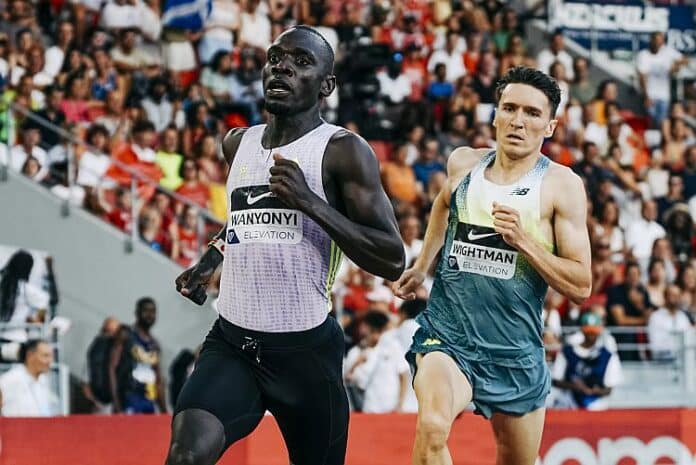
PANORAMA: Sprint stars Coleman and Richardson arrested; women protest Nordic Combined Olympic exclusion, then U.S.’s Brabec wins first gold!

2019 World 100 m Champion Christian Coleman (USA)

The Sports Examiner: Chronicling the key competitive, economic and political forces shaping elite sport and the Olympic Movement.★

To get the daily Sports Examiner Recap by e-mail: sign up here!

≡ THE 5-RING CIRCUS ≡

● Olympic Games 2028: Los Angeles ● In the dump of three million pages of materials by the U.S. Justice Department related to the Jeffrey Epstein sex-trafficking case, personal electronic mail messages between convicted child sex trafficker Ghislaine Maxwell (GBR) and LA28 Chair Casey Wasserman surfaced, from 2003.

In a statement to The Hollywood Reporter, Wasserman said:

“I deeply regret my correspondence with Ghislaine Maxwell which took place over two decades ago, long before her horrific crimes came to light. I never had a personal or business relationship with Jeffrey Epstein. As is well documented, I went on a humanitarian trip as part of a delegation with the Clinton Foundation in 2002 on the Epstein plane. I am terribly sorry for having any association with either of them.”

Asked about the news at Sunday’s news conference, International Olympic Committee chief Kirsty Coventry (ZIM) said the matter was not discussed at the IOC Executive Board meeting and said “I believe Mr. Wasserman put out his statement and we have nothing further to add.”

The IOC Executive Board approved 22 more qualification procedures for the LA28 Games, to add to the 26 previously released, leaving six more to go.

These vary from covering entire sports to specific disciplines and in some cases, even individual events. The LA28 Games will be the largest ever with 36 sports and 353 medal events.

● Olympic Winter Games 2034: Utah ● A delegation from the Utah 2034 organizing committee is in Milan Cortina for the Winter Games and will provide a report to the International Olympic Committee Session on Tuesday (3rd).

On Friday, the Utah organizers will sign a Memorandum of Understanding, aimed at sharing best practices, with the heads of France’s Auvergne-Rhône-Alpes and Provence-Alpes-Côte d’Azur regions, University Côte d’Azur, and Italy’s Lombardia region. A separate information-sharing agreement is also expected to be signed with the French Alps 2030 organizers, also on Friday.

● Pan American Games 2027 ● Panam Sports announced that the dates for the 2027 Pan Am Games in Lima (PER) have been moved by a week, now to take place from 23 July to 8 August.

The dates had originally been 16 July to 1 August.

● World University Games ● International University Sports Federation (FISU)  President Leonz Eder (SUI) said that he will retire in 2027 at the end of his term. He served as Interim President from 2021-23 and then was elected to a full term of his own.

In an important signal for winter sport, the FISU Executive Committee approved the addition of cross-country running at the 2027 Changchun FISU Winter Universiade. Cross country is being considered as a possible addition to the Olympic Winter Games, since it is a winter-time sport.

● Athletics ● Worlds gold medalists Sha’Carri Richardson and Christian Coleman were arrested in Winter Garden, Florida on Thursday. Richardson was driving at a reported 104 miles per hour in a gray Aston Martin and was pulled over. She was arrested and charged with excessive speeding and traffic offenses.

Coleman followed a little later in a black Jeep, parked at the side of the road, walked toward the stopped cars and was told to return to his vehicle. He continued to speak with the officers, then refused to provide identification and was arrested for resisting instructions.

A search then found a “glass smoking device” in the console. Later, fellow sprint star (and relay gold medalist) TeeTee Terry came by and joined the discussions; she was ticketed for stopping on a limited-access highway.

Both Coleman and Richardson were released on bond. 

● Curling ● American Beau Welling confirmed he will run for a second term as President of the federation, with elections coming in September.

He told Francs Jeux.com, “I don’t think I’ve reached the end; there are still things to accomplish. I think I still have something to contribute to this organization. We’ll see with my colleagues and our members, but I intend to run again to continue what we’ve started.”

● Figure Skating ● Now 19 and returned from her four-year doping suspension, Russian star Kamila Valieva returned to the ice for the Russian Jumping Championships, reaching the semifinals.

Alisa Dvoeglazova was the winner, scoring 127.27 points with Dina Khusnutdinova second (119.26). Nikita Sarnovsky won the men’s event (193.42) and Anastasia Mishina and Alexander Galliamov won Pairs (52.06).

● Nordic Combined ● As the International Olympic Committee placed the Nordic Combined essentially on probation for the 2026 Winter Games in Italy, it did not add the women’s competition to the 2026 Olympic program.

The women’s FIS World Cup starters in Seefeld (AUT) launched their own protest on Friday prior to the 5 km Individual Mass Start – won by American Alexa Brabec for her first World Cup gold – by crossing their ski poles right at the start line.

At the Sunday IOC news conference in Milan, sports director Pierre Ducrey (SUI) said that Nordic Combined is still under examination:

“I think we acknowledged the challenges that exist for the discipline, both on the men’s and the women’s side. … In September, we communicated then that we would use all of the information coming out of the Milano Cortina 2026 Games to really inform a decision for 2030.

“And this is what we intend to do. It will really give us a sense of how has the discipline come forward, on the women’s side, but also on the men’s side, between 2022 and 2026.”

≡ RESULTS ≡

● Alpine Skiing ● At the FIS World Cup in Crans-Montana (SUI), the only men’s race was the Downhill, with 2025 World Champion Franjo von Allmen (SUI) taking his second win of the season in 1:55.00, ahead of Italy’s 2019 World Super-G champ Dominik Paris (1:55.65) and American Ryan Cochran-Siegle, who got his second medal of the season in 1:55.70.

After thee cancellation of the women’s Downhill, the women’s Super-G was held, with Swiss Malorie Blanc taking her second career World Cup medal and final gold, in 1:17.34, ahead of Italian star Sofia Goggia, the 2018 Olympic Downhill winner (1:17.1:17.52) and 2025 World Downhill champ Breezy Johnson of the U.S. (1:17.70), her first medal of the season!

● Badminton ● At the BWF World Tour Thailand Masters in Patumwan, Indonesia’s Mohamed Zaki Ubaidillah won the men’s Singles by 21-19, 20-22, 21-19 over Panitchaphon Teeraratsakul (THA), and India’s Devika Sihan eased to the women’s title, 21-8, 21-16 against Jin Wei Goh (MAS).

Indonesia won the men’s, women’s and Mixed Doubles titles!

● Cycling ● The UCI Women’s World Tour Cadel Evans Great Ocean Race, in and around Geelong (AUS) covered 141.2 km, finally turning into an all-out sprint of 12 riders. New Zealand star Ally Wollaston got to the line first in 3:54.55, just ahead of Josie Nelson (GBR) and Mireia Benito of Spain.

The 182.3 km men’s edition, the 10th, was held on Sunday with a mass sprint finish of 19 riders, won by Tobias Lund Andresen (DEN) in 4:15:25, ahead of Matthew Brennan (GBR) and Brady Gilmore (AUS). Luke Lamperti was the top American, in 12th.

● Freestyle Skiing ● The FIS World Cup Ski Cross circuit was in Val di Fassa (ITA), with 2023 Worlds silver medalist Florian Williamson (GER) winning the first men’s race over countryman Cornel Renn. Williamson made the final in Sunday’s second race, but took second to Italy’s 2023 World Champion Simone Deromedis, who won his second race of this season.

Italian Joie Galli, a 2022 Olympian, won the first women’s race over France’s Marielle Berger Sabbatel, and then 2022 Olympic bronzer Daniela Maier (GER) got her second World Cup win in the last three races, this time over Swiss Saskja Lack. Galli took the bronze.

● Nordic Combined ● The FIS World Cup stopped in Seefeld (AUT) for the famed “Seefeld Triple” for the men, with three different winners this year! Seasonal leader Johannes Lamparter (AUT) won the 10 km race and 109 m jumping with 129.5 points, just ahead of countryman Stefan Rettenegger (129.0). The second event was the Compact 109 m jumping and 7.5 km race with 2022 Olympic champ Vinzenz Geiger (GER) winning a tight one with Lamparter, 18:00.9 to 18:01.1 and Norway’s Jens Oftebro close at 18:03.2 for third. Finally, Oftebro won the 109 m jumping and 12.5 km race in 30:27.8 over Rettenegger (30:31.5) and Geiger (30:46.4).

Following their opening protest move (see above), the women’s 5 km race and 109 m jumping was a first-ever win for American Alexa Brabec, scoring 122.9 over Ema Volavsek (SLO: 121.6) and seasonal winner (already) Ida Marie Hagen (NOR: 115.3).

Hagen took over from there, winning the Compact 109 m jumping and 5 km race in 14:03.5, followed by Brabec (14:29.5) and then Nathalie Armbruster (GER: 14:51.3). American Tara Geraghty-Moats, now 32 was fifth in 14:57.5 and Annika Malacinski was ninth in 15:39.3.

Hagen won the Gundersen 109 m jumping and 7.5 km race in 21:03.2, followed by Brabec (21:58.2) and Geraghty-Moats (22:50.6), with Malacinski in 10th (25:04.7).

● Rugby Sevens ● At the third-leg (of six) HSBC Sevens Series in Singapore, Fiji and France led pool play with 3-0 records and they rolled right into the championship final, with Fiji taking a 21-12 win. New Zealand edged South Africa, 14-12, for the bronze.

The women’s tournament, as usual, had Australia and New Zealand as 3-0 winners of their pools, and they zipped to the final as well, with the Kiwis winning in a 36-7 rout. Canada beat the U.S. women, 24-19, to take the bronze.

● Ski Jumping ● Slovenian star Domen Prevc continued to treat the FIS World Cup, this time in Willingen (GER), as if he owns it, sweeping the two men’s events off the 147 m hill. He now has a streak of four straight World Cup wins working.

He won Saturday’s event at 264.2, ahead of Japan’s seasonal find, Ren Nikaido (242.2) and German Karl Geiger. He followed up on Sunday, winning at 293.0 points, over Nikaido (261.3) and German Philipp Raimund (253.1).

The women’s jumping was a double win for Norway’s four-time Worlds medal winner Eirin Kvandal, winning Saturday at 235.7, ahead of 13-time seasonal winner Nika Prevc (SLO: 224.4) and Japan’s Nozomi Maruyama (217.8). Kvandal won on Sunday with 251.8, coming from fourth after the first jump, to beat Maruyama (243.9) and Prevc (235.1). Josie Johnson of the U.S. was ninth at 186.1.

Not surprisingly, the Mixed Team event was won by Slovenia (295.4: with both Prevcs), over Germany (294.8) and Japan (277.8).

● Ski Mountaineering ● The ISMF World Cup in Bol Taull (ESP) showcased the men’s and women’s Sprint, with France’s Worlds runner-up Thibault Anselmet winning a tight men’s dual with World Champion Oriol Cardona Coll (ESP), 2:35.9 to 2:39.9.

French World’s runner-up Emily Harrop won the women’s Sprint in 3:01.8, well ahead of Italian Giulia Murada (3:09.0) and Margot Ravenel (3:11.9).

The Mixed Relay, of course, went to World Champions Harrop and Anselmet together, in 27:47.5, ahead of Worlds silver winners Cardona Coll and Ana Alonso (ESP: 28:04.4). The U.S. pair of Anna Gibson and Cameron Smith finished seventh in 29:25.3.

● Snowboard ● Korea’s 2018 Olympic Parallel Giant Slalom silver winner Sang-ho Lee got his first win the FIS World Cup Parallel Giant Slalom season in Rogla (SLO), winning the men’s final over Italy’s 45-year-old, two-time World Champion Roland Fischnaller. It’s also Lee’s first medal of the season!

The women’s PGS gold went to Japan’s Tsubaki Miki, the 2023 World Champion, over 2018 Olympic bronzer Ramona Hofmeister (GER). It was Miki’s second win of the season, and Hofmeister’s third medal in the last four races!

Receive our exclusive, weekday TSX Recap by e-mail by clicking here.
★ Sign up a friend to receive the TSX Recap by clicking here.
★ Please consider a donation here to keep this site going.

For our updated, 45-sport, 910-event International Sports Calendar for 2026 and beyond, by date and by sport, click here!

ATHLETICS: Hocker wins featured Millrose Games two-mile, as Myers and Hiltz take fast Wanamaker Mile titles among four world leads

U.S. distance star Cole Hocker winning the 2024 USATF National Indoor 1,500 m (Photo: Lorenzo Montgomery via Wikipedia).

The Sports Examiner: Chronicling the key competitive, economic and political forces shaping elite sport and the Olympic Movement.★

To get the daily Sports Examiner Recap by e-mail: sign up here!

≡ MILLROSE GAMES ≡

/Updated/The 118th edition of New York’s Millrose Games was looking for a successor to the fabulous 2024 world men’s two-mile record run of 8:00.67 by British star Josh Kerr. Perhaps the first sub-8 indoors?

The field was great, with Kerr challenged by Worlds 5,000 m champ Cole Hocker, Worlds Steeple winner Geordie Beamish (NZL), 2022 Worlds 1,500 m victor Jake Wightman (GBR), two-time NCAA cross country winner Graham Blanks and more.

Pacer Ben Allen led at the mile in 4:07.29, ahead of Habtom Samuel (ERI-New Mexico: 4:07.79) and two-time NCAA winner Ky Robinson (AUS: 4:08.09). Samuel took over from the pacer with seven laps left. Blanks moved to the lead over Robinson and Hocker and started to tow the field with 4 1/2 laps left.

Kerr moved into second with 2 1/2 left as the front of the race got crowded. Blanks was in front, but Kerr almost tripped with 1 1/2 laps to go, but Kerr, Parker Wolfe and Hocker were in front at the bell. Wolfe sprinted hard to get the lead, with Hocker following and then burst off the last turn to the front to win easily in 8:07.31. Kerr passed Wolfe for second in 8:07.68, to 8:07.93 for Wolfe and 8:08.40 for Robinson.

Hocker’s time was the no. 3 performance in U.S. indoor history and Wolfe is now no. 4 on the all-time U.S. indoor list. No record, but another impressive demonstration of Hocker’s closing speed.

The men’s Wanamaker Mile was about U.S. star Yared Nuguse, the former world-record holder in the event – at Millrose in 2025 – and winner of the last three Millrose miles. This was his season opener for 2026,

Pacer Abe Alvarado crossed 800 m in 1:52.21, with Nuguse in third. Ireland’s two-time Olympian Andrew Coscoran took over with three laps left, with Nuguse right behind and Australia’s 19-year-old phenom Cam Myers moving up.

Myers, third in Nuguse’s world-record race at Millrose last year, took the lead from Nuguse with 1 1/2 laps to go with new world indoor 2,000 m record holder Hobbs Kessler right behind. Kessler moved wide with 100 to go and tracked Myers into the turn, but no one was catching the teen and he won easily with a world-leading 3:47.57, moving to no. 7 all-time, with the no. 9 performance in history.

Nuguse passed Kessler for second on the final straight, 3:48.31 to 3:48.68, with Nico Young getting a lifetime best of 3:48.72 in fourth. Coscoran was fifth in 3:49.54.

The women’s Wanamaker Mile had 2024 World Indoor 1,500 m silver winner Nikki Hiltz, Paris 1,500 m silver medalist Jess Hull (AUS), 2022 U.S. 1,500 m champ Sinclaire Johnson and more, with Johnson taking over with 3 1/2 laps left. Johnson, Hull and Hiltz were 1-2-3 with three laps left and stayed that way with two laps left.

Hiltz burst into the lead with Hull close with 1 1/2 laps to go and Hiltz took the bell and it was a two-woman race to the finish. Hiltz held on and won by daylight in 4:19.64, fastest in the world in 2026. Hull was second in 4:20.11, then Poland’s Klaudia Kazimierska in 4:21.36 and Australian Linden Hall at 4:21.45. Hiltz is now no. 13 all-time indoors and no. 3 all-time U.S.

In all, the meet produced a quartet of world-leading performances:

Men/Mile: 3:47.97, Cam Myers (AUS)
Men/Two Mile: 8:07.31, Cole Hocker (USA)
Men/Shot: 21.77 m (71-5 1/4), Rajindra Campbell (JAM)
Women/Mile: 4:19.64, Nikki Hiltz (USA)

The rest of the meet was hot too:

Men/60 m: Puerto Rico’s Eloy Benitez was out well in lane eight, but Jamaica’s 2024 Worlds 60 m bronzer Ackeem Blake came on hot to win in the final 3 m in 6.55. Benitez was second in 6.60, then NCAA indoor and outdoor sprint champ Jordan Anthony in 6.64.

Men/600 m: U.S. 400 m star Jenoah McKiver ran to the lead right away and had 3 m at the bell, but he was being chased by ex-prep star Cooper Lutkenhaus – now 17 and a high school junior, but running professionally – who ran 1:45.23 last week. Lutkenhaus had a strong finish off the turn and won easily in 1:14.15, now no. 5 all-time!

McKiver was a clear second in 1:14.77, now no. 7 all-time and Isaiah Jewett was third in 1:15.48.

Men/800 m: The 2025 U.S. champion, Donavan Brazier, had the lead with 1 1/2 laps to go, but was passed by Spain’s Paris Olympic finalist Mohamed Attaoui who looked like a possible winner heading into the final turn. Suddenly, Northern Arizona’s Colin Sahlman came up and was moving faster than everyone and steamed to the line with a lifetime best – indoors or out – of 1:44.70, a collegiate indoor record! Attaoui was second in 1:44.98 and then Ben Pattison (GBR: 1:45.43) and Brazier in 1:45.63.

Sahlman crushed an ancient collegiate mark of 1:44.84 by Paul Ereng (KEN-Virginia) from 1989, and is now is no. 5 all-time U.S. indoors.

Men/60 m hurdles: Olympic medalist Daniel Roberts had the lead early, but 110 m Worlds winner Cordell Tinch stormed the last half and won by daylight in 7.52, in what he said was his last indoor race this season. Connor Schulman was also fast on the close and was second in 7.57, with Roberts third in 7.61.

Men/Mile Walk: This was the national championship at this distance, and Nick Christie added to his trophy room with a solid win in 5:52.94 to 6:11.86 for Jordan Crawford and 6:15.98 for Jason Cherng. It’s Christie’s fifth Millrose win in as many races.

Men/Shot: Superstar Joe Kovacs, the two-time World Champion, got to the lead at 20.99 m (68-10 1/2) in the third round. But Jamaica’s Paris 2024 bronzer Rajindra Campbell grabbed the world lead at 21.77 m (71-5 1/4) in round five. Kovacs improved to 21.21 m (69-7), but fouled in round six and had to settle for second.

Chuk Enekwechi (NGR) finished third at 20.63 m (67-8 1/4).

Women/60 m: U.S. star Jacious Sears got to the lead early, and it was all that Britain’s 2019 World 200 m chamo Dina Asher-Smith could do to catch her at the tape in 7.10 to 7.12. Prep Mariah Maxwell got third in 7.26. It was Asher-Smith’s third indoor win in three weeks in 2026.

Women/600 m: All eyes on new American Indoor 800 m record holder Roisin Willis, who ran 1:57.97 in Boston on Friday (30th). But former LSU star Michaela Rose broke out in front and had the lead at the bell. Willis made a big move with 100 to go and rolled to the tape to win in 1:24.87. That makes her 14th all-time and no. 7 all-time U.S.

Stanford’s Juliette Whittaker was close for second in 1:25.64, then Olivia Baker in 1:25.01, as Rose faded to fifth in 1:29.19.

Women/1,000 m: American Addy Wiley took over after the pacer left, with 2024 World Indoor silver winner Jemma Reekie (GBR) close. Tsige Duguma (ETH), the 2024 World Indoor 800 m champ, ran to the lead at the bell and was chased by Wiley into the final turn, but had too much left and won in 2:35.50 with Wiley at 2:35.77 and Maggi Congdon of the U.S. third at 2:35.91. That’s 2-3-4 on the 2026 world indoor list.

Women/3,000 m: The NCAA cross country stars, winner Doris Lemngole (KEN-Alabama) and BYU runner-up frosh Jane Hedengren, who set the collegiate women’s 5,000 m mark of 14:44.79 in Boston on 6 December in her first-ever collegiate track race.

Hedengren, 19, took over from the pacer, with Japan’s Nozomi Tanaka and Lemngole close and then Tanaka took the lead with five laps to go, at 2,000 m. Hedengren pushed to the lead with two laps left and Lemngole followed immediately. Lemngole took the lead at the bell and ran away to win in 8:31.39, taking the collegiate record from Katelyn Tuohy, who ran 8:35.20 in 2023.

Hedengren fell back and Britain’s Hannah Nuttall took second in 8:32.94, then Hedengren finished as the no. 2 collegian ever in 8:34.98.

Women/60 m hurdles: Jamaica’s Megan Simmonds got out best, but it was two-time 100 m World Champion Danielle Williams (JAM) came on late to win at the line in 7.90. World-record holder Devynne Charlton was also a fast closer in 7.96 for second and Christina Clemons of the U.S. leaned for third in 7.97.

Women/Mile Walk: /Updated/New star Lauren Harris won easily in a meet record 6:10.31, but was disqualified afterwards. So, the USATF national title went to Maria Michta-Coffey, now a seven-time Millrose winner in 7:16.69, with Angelina Colon (7:16.77) second and Ruby Ray third (7:21.48).

Women/Vault: Chloe Timberg, the 2024 NCAA outdoor champ, was the only one to clear 4.60 (15-1) and was a clear winner over Nastassja Campbell at 4.40 m (14-5 1/4) and Emily Grove (also 4.40 m).

In the Saturday weight throws, American Michael Pinckney won at 21.10 m (69-2 3/4) and Elisia Lancaster took the women’s title at 21.56 m (70-9).

Receive our exclusive, weekday TSX Recap by e-mail by clicking here.
★ Sign up a friend to receive the TSX Recap by clicking here.
★ Please consider a donation here to keep this site going.

For our updated, 45-sport, 910-event International Sports Calendar for 2026 and beyond, by date and by sport, click here!

MILAN CORTINA 2026: Cortina cable car system not ready; 11-year-old kicked off bus, now in opening; Vonn crashes but sees comeback

U.S. Skeleton Olympian Katie Uhlaender in 2021 (Photo: Wikipedia via Steffen Prossdorf)

The Sports Examiner: Chronicling the key competitive, economic and political forces shaping elite sport and the Olympic Movement.★

To get the daily Sports Examiner Recap by e-mail: sign up here!

≡ INTEL REPORT ≡

● Olympic Operations ● Reuters reported that the Apollonio-Socrepes gondola system designed to ferry spectators 1,100 m in 10-passenger cars to the Olympic women’s alpine competition in Cortina d’Ampezzo will apparently not be finished in time for the Games, leading to alternate solutions.

Reuters reported on a communication from the governmental Milano Cortina Infrastructure Company (SIMICO SpA) to the organizing committee on 28 January that the tram system will not be available as planned. So, alternative measures using buses led to a request from the organizers for school closures on 10 and 12 February and 11 February also if possible, for use of those facilities for transportation uses.

The organizing committee has limited ticket sales to capacities for which transportation can be guaranteed, starting last November and continuing now.

The opening ceremony for the Milan Cortina Winter Games has added a performer: Riccardo Zuccolotto, an 11-year-old who was kicked off a bus in the Cortina d’Ampezzo area.

The boy boarded a Dolomiti Bus to go home from school last Tuesday (27th), but didn’t have the right fare to handle the Games-period increase to €10, which also required a special type of payment. Zuccolotto had regular tickets, but the driver told him he had to make a travel pass or pay with a debit card, as instructed by the bus company. So, the boy left the bus and had to walk about 6 km home in freezing conditions.

Informed of the situation, the organizing committee reached off and offered him a part in the 6 February opening, which was immediately accepted! The driver was suspended and the original ticket pricing and normal payment options were reinstated for local residents (who need to show identification, of course).

Zuccolotto is fine and excited; his grandmother – a lawyer – has filed a complaint, and the story was front-page news in Italy.

● Alpine Skiing ● The women’s Downhill in Crans-Montana (SUI) on Friday was cancelled after three of the first six racers failed to finish the course, including U.S. star Lindsey Vonn, who was the last to start.

FIS Race Director Peter Gerdol (SLO) explained, “The main reason is the safety of the athletes. The visibility was getting worse and worse, they couldn’t see the race line properly and it caused mistakes. We saw six athletes starting and all six had some mistakes. This was a sign that it was a high-risk situation. We know that our sport is a risky sport, but the feeling was too much risk.”

Vonn, in the midst of an amazing resurgence at age 41, had to be airlifted off the course, and wrote on Instagram later in the day:

“I crashed today in the Downhill race in Switzerland and injured my left knee. I am discussing the situation with my doctors and team and will continue to undergo further exams.

“This is a very difficult outcome one week before the Olympics… but if there’s one thing I know how to do, it’s a comeback.

“My Olympic dream is not over. Thank you for all of the love and support. I will give more information when I have it.

“Thank you to all the medical staff who helped me today. I am grateful for all the incredible help I received.

“Sending my best to @marte.monsen who also had a major crash and injury today.”

Vonn wrote on Saturday, after deciding not to race in the Super-G:

“Unfortunately, I won’t be able to race today… wishing all my teammates a great race.

“Thank you for all of the love and support I have received. Means the world to me.

“Doing my best right now….”

Her coach, Chris Knight, wrote Saturday that Vonn is “preparing for Cortina as usual,” in a text message to The Associated Press.

The women’s Downhill is scheduled for 8 February; training will be on 5-6-7 February.

● Bobsled & Skeleton ● American skeleton star Katie Uhlaender filed an appeal to the Court of Arbitration for Sport, claiming that the decision of Canadian coaches to remove four of their athletes from the final North American Cup race in Lake Placid, New York last month to reduce the number of points available – and protect the ranking of other Canadian racers – amounts to manipulation.

Reuters reported a statement from the Court of Arbitration:

“Ms Uhlaender requests that CAS determine whether a decision by BCS to withdraw four of its athletes from the 11 January 2026 IBSF North American Cup Race was in violation of the Olympic Movement Code on the Prevention of the Manipulation of Competitions, and that BCS coaches violated the IBSF Code of Conduct.”

The hearing was slated for today (1st). Uhlaender is seeking an added place in the women’s skeleton field for the Games, which would be her sixth. More than a dozen countries have joined a petition to have her included in the Games.

Receive our exclusive, weekday TSX Recap by e-mail by clicking here.
★ Sign up a friend to receive the TSX Recap by clicking here.
★ Please consider a donation here to keep this site going.

For our updated, 45-sport, 910-event International Sports Calendar for 2026 and beyond, by date and by sport, click here!
INT’L OLYMPIC COMMITTEE: Coventry says Milan Cortina Games getting ready in style, Dubi reports more than 1.1 million tix sold

International Olympic Committee President Kirsty Coventry (ZIM) listens at a 1 February 2026 news conference (IOC video screen shot).

The Sports Examiner: Chronicling the key competitive, economic and political forces shaping elite sport and the Olympic Movement.★

To get the daily Sports Examiner Recap by e-mail: sign up here!

≡ IOC EXECUTIVE BOARD ≡

“Things are running really well. Lots of excitement, athletes are starting to arrive … things are looking really positive and we’re seeing lots of good things happening around the city and throughout the regions.”

That’s the first report from International Olympic Committee President Kirsty Coventry (ZIM) in Milan, at a Sunday news conference from the Olympic media center, following the IOC Executive Board meetings.

Unusually, there were no announcements of decisions, and Coventry said the focus has been on the Winter Games that start on Friday:

“The preparation is going extremely well. The team is working really hard. What’s really nice is the Milano Cortina organizing committee and ourselves as the IOC and the International Federations and all stakeholders are working very well. …

“We’re exactly where we need to be.”

She was asked about the wide spread of the venues into the mountains and Coventry thanked the organizing committee for being well prepared, and added that the events “are going to be in world-class venues in the most iconic, in the most beautiful places in Italy and I think the athletes are going to have an absolutely fantastic time.”

Olympic Games Executive Director Christophe Dubi (SUI) was even more enthusiastic:

“With a week go, the venues look fantastic. We’ve been up there in the mountains, we’ve visited all venues in Milano. You’ll see, it’s really spectacular.”

As for the Santa Giulia arena for ice hockey, racing to be ready, Dubi explained, “No one’s experience will be tainted by anything that needs to be painted or carpeted after the Games. Let’s be very clear. Anything that is public-facing, media or starting with the athletes, absolute top.

“Do we still have works? Yes. Cleaning, absolutely … still works ongoing, frantic as you say, but to make it really a great venue.”

As for the geographic spread, he noted, “If you’re an alpine skier – men or women, respectively – do you choose any other venue other than Bormio or Cortina? Yes, it’s far away, but are these the most iconic locations? Without doubt.”

He also pointed to the opening ceremonies concept, with elements in all four athlete locations:

“Is it easy to do? Certainly not. Main, actually, in San Siro [Milan], but in Cortina, in Predazzo, in Livigno, all of them can walk. All of them can participate in the ceremony.”

The IOC’s head of National Olympic Committee relations, James Macleod (GBR) added:

“The feedback from the National Olympic Committees and the athletes [who] have started to move into the Villages has been nothing short of extraordinary, really the services that Milan Cortina organizing committee have provided is really outstanding. And the athletes have started their training and everything is going very well. We’re on track to have probably 92 NOCs participating.”

Dubi also updated the ticketing situation, with more than 1.1 million tickets sold so far with a week to go, a bit more than three-quarters of those available. “This is pretty impressive for Winter Games … for anyone out there looking for tickets, there are still a few, but not so much, so rush. That’s the same for the opening ceremonies, it will be a full house, that’s for sure.”

He felt that the organizers will hit their ticketing budget target.

There were other questions, starting with LA28 Chair Casey Wasserman and 23-year-old e-mails with convicted child sex trafficker Ghislaine Maxwell (GBR) and the presence of U.S. Immigration and Customs Enforcement staff on the U.S. security detail; Coventry brushed both of these away and said she has not talked with Wasserman about this, but that the IOC is also monitoring the situation as regards any other information from the U.S. Justice Department files that might concern the IOC.

On any movement toward Russian re-integration or reinstatement of the Russian Olympic Committee, Coventry said there is no timetable for this.

On why women’s Nordic Combined was not added, IOC Sports Director Pierre Ducrey (SUI) noted that the future of the whole discipline is under study and the experience in 2026 will inform what the IOC will do with Nordic Combined for 2030.

Coventry was asked about the work of the “Fit for the Future” working groups and when reports would be received; she indicated she expected most of the work to be done by June.

Receive our exclusive, weekday TSX Recap by e-mail by clicking here.
★ Sign up a friend to receive the TSX Recap by clicking here.
★ Please consider a donation here to keep this site going.

For our updated, 45-sport, 910-event International Sports Calendar for 2026 and beyond, by date and by sport, click here!
PANORAMA: Italy says ICE not “operational personnel” at Games; Fitzgerald Mosley starting in-depth SafeSport review; AIU suspends three for betting!

The Sports Examiner: Chronicling the key competitive, economic and political forces shaping elite sport and the Olympic Movement.★

To get the daily Sports Examiner Recap by e-mail: sign up here!

≡ THE 5-RING CIRCUS ≡

● Olympic Games 2028: Los Angeles ● A motion from Los Angeles City Council President Marqueece Harris-Dawson filed Wednesday proposes an “Olympic Friendship City relationship” designation for Los Angeles and Brisbane (AUS), host for the 2032 Games. In specific:

“The LA-Brisbane Olympic Friendship City relationship will focus on key areas including, but not limited to: Sustainability, Housing, Transportation, Indigenous Recognition, Emergency Preparedness, Security, and Infrastructure.

“Formalizing Brisbane as an Olympic Friendship City presents a valuable opportunity to develop extensive exchange programs, particularly those linked to the upcoming Olympic and Paralympic Games and future initiatives.”

The motion was referred to the Rules, Elections and Intergovernmental Relations Committee.

● Olympic Winter Games 2026: Milan Cortina ● After a flurry of criticism from politicians such as Milan mayor Giuseppe Sala about the presence of U.S. Immigration and Customs Enforcement staff coming as part of the U.S. security detail, an Italian Interior Ministry statement explained:

“It should be reiterated that the investigators of the Homeland Security Investigation [a unit of ICE] will not be represented by operational personnel such as those engaged in migration controls in U.S. territory, but by referents exclusively specialized in investigations, without any attribution on the Italian territory and mainly responsible for consulting their databases and supporting the other actors involved.”

The U.S. Italian Embassy’s statement noted, “HSI’s role at the Olympics will be strictly advisory and intelligence-based, with no patrolling or enforcement involvement,” the embassy added. “All security operations will remain the responsibility of Italian authorities.”

Brazilian statistician Marcio Melo posted a list of announced team sizes for Milan Cortina; the leaders:

● 232: United States
● 206: Canada
● 193: Italy
● 184: Germany
● 176: Switzerland

● 156: France
● 125: China
● 120: Austria
● 118: Japan
● 114: Czech Republic

There are 12 teams with 100 or more. Norway, expected to lead the medal table, has a team of 83 (and did not qualify either of its ice hockey teams).

Revisiting the story on American and Mexican Olympic skier Sarah Schleper getting ready to compete in her seventh Games, Olympic super-statistician Dr. Bill Mallon reports that “there have been 126 women who competed for two different National Olympic Committees at the Winter Olympics. However, only 24 of them competed for distinctly different nations.”

What does that mean? That 102 of these dual-nation competitors were part of “split-off” team formed by political changes, such as the many countries that used to be part of the USSR, or Yugoslavia, but also situations such as the integration of East Germany into Germany

The International Testing Agency announced that a team of 150 Doping Control Officers will staff the Milan Cortina Games, at 23 doping control centers in the venues and Olympic Villages.

The doping control effort will include about 2,200 test sessions and collection of about 3,000 samples: urine, blood and dried-blood-spot samples. Testing of samples will be done at the accredited laboratory in Rome.

The Official Pin Trading Center at the Milan Cortina Winter Games will be “redesigned with a Looney Tunes look and feel through a licensing collaboration between Warner Bros. Discovery, Honav USA, and the IOC. The center will be open February 6–22 at Via Carlo de Cristoforis 1.”

The location is perhaps a half-hour walk from the iconic Duomo Milano; the pin-trading hall will include 12 tables, rotated among traders in three-hour shifts. Trading is allowed; no selling, but Honav USA, the licensee for organizing committee pins, will have a sales site as well.

A limited-edition pin will be offered for each of the 17 days of the Games, available until exhausted with a limit of two per buyer per day.

● U.S. Center for SafeSport ● The Associated Press interviewed newly-named SafeSport chief executive Benita Fitzgerald Mosley and she explained that the first order of business will be to identify what actually works and what doesn’t:

“We may need to alter the structure of how we go about the work. I think, though, it’s important [to acknowledge] many of the complaints come from the grassroots. If we’re really, truly trying to change the culture of American sports to focus on athlete well-being and safety, you have to start from the bottom and go to the top.

“Then we’re going to go back to them and say ‘Thank you for participating. This is what we found, and this is what we’re going to do about it.’”

She was part of the U.S. Commission on the State of the Olympics and Paralympics, which suggested that issues at the youth level may be better served through regional entities rather than a national office also tasked with elite sport.

She knows the clock is ticking: “I’ll be able to tell you in six or nine months, how quickly are we able to turn this barge around? Is it three months, is it six months, is it 18 months? I don’t know. But it can’t be 18 years. We’ve got to do this quickly.”

● Transgender ● The U.S. Department of Education’s Office of Civil Rights “found that San José State University (SJSU) violated Title IX of the Education Amendments of 1972 (Title IX). OCR concluded that SJSU’s policies allowing males to compete in women’s sports and access female-only facilities deny women equal educational opportunities and benefits.

“In February 2025, OCR initiated a directed investigation into SJSU amid allegations that the university allowed a male to compete on the female indoor volleyball team and allegedly retaliated against female students and an assistant coach who condemned its ‘gender identity’ policies.”

The Wednesday announcement included a summary of the factual background:

“OCR found that beginning in 2022, SJSU actively recruited and allowed a male to compete on the women’s indoor and beach volleyball teams and reportedly instructed members of the coaching staff not to tell the female players that the athlete was a male. As a result, female athletes on the team shared women’s locker rooms and hotel rooms with the male student while being unaware that he is a member of the opposite sex.

“In addition to privacy concerns, the presence of this male athlete presented a safety concern for female athletes and provided SJSU’s volleyball team with an unfair physical advantage over opposing teams. On multiple occasions, the male athlete spiked the ball so forcefully that it knocked females on the opposing team to the ground. During one season, seven all-women’s teams from other universities forfeited their competitions, accepting a loss rather than competing against a male.”

Among five steps demanded of San Jose State by the Department of Education are to “[i]ssue a public statement to the SJSU community that SJSU will adopt biology-based definitions of the words ‘male’ and ‘female’ and acknowledge that the sex of a human – male or female – is unchangeable” and “[s]end a personalized apology to every woman who played in SJSU’s women’s indoor volleyball (2022–2024), 2023 beach volleyball, and to any woman on a team that forfeited rather than compete against SJSU while a male student was on the roster – expressing sincere regret for placing female athletes in that position.”

● Alpine Skiing ● Norway scored a 1-2 on the second-day night Slalom of the Schladming stop on the FIS World Cup tour, with star Henrik Kristoffersen placing second on both runs to win in 1:53.80, ahead of first-run leader Atle Lie McGrath (1:54.14). France’s 2022 Olympic champ Clement Noel was third (1:54.34).

Benjamin Ritchie was the top American, in 13th (1:56.60).

● Athletics ● The Athletics Integrity Unit lowered the boom on betting. In a Thursday announcement:

“The Athletics Integrity Unit (AIU) has sanctioned German discus throwers, Henrik Janssen and Steven Richter, along with French middle-distance runner, Aurore Fleury, for breaching the World Athletics Integrity Code and Manipulation of Competition (MSC) rules regarding betting.

“In a move that highlights the AIU’s zero-tolerance to betting on the sport by participants, 27- year-old Janssen and 22-year-old Richter were handed three-month suspended bans while 32- year-old Fleury received a six-month ban (from 1 September 2025) and was fined 3 000 Euros to be donated to charity. All three athletes were charged with violating Integrity Standard 3.3.4 relating to ‘Maintaining Integrity of Competition’ – and they all admitted the violations. The rules concerning betting prohibit all ‘applicable persons’ from betting on any athletics event.”

Janssen and Richter both placed small bets on the 2025 World Athletics Championships in Tokyo and unsuccessfully tried to rescind them after being told it was not allowed.

Fleury was a lot more serious, wagering €2,000 on another French athlete, and ended up winning €5,000 at the 2024 European Athletics Championships in Rome. The size of the bet was considered grounds for more serious punishment.

● Boxing ● World Boxing continues to add national federation members, with Benin, Mali, Moldova and St. Lucia endorsed to join, awaiting final approval by the World Boxing Congress later this year.

The additions bring the federation to 159 members.

● Football ● The German Football Association (DFB) downplayed boycott chatter about the 2026 FIFA World Cup with federation chief Bernd Neuendorf explaining: “I don’t think this is a big debate at all, because I believe we at the DFB are very unanimous in our view that this debate is completely misguided at this point in time.”

German Football League (DFL) President Hans-Joachim Watzke, added, “When the time is right, we will discuss it, but from my point of view, it is completely out of place right now.”

Oke Gottlich, a DFB Vice President, had raised the issue. Neuendorf noted that Gottlich “hasn’t been with us that long. But as a rule, we first discuss these issues in committees, so to speak, and then form an opinion. Unfortunately, he has now jumped the gun on this issue.”

Los Angeles Mayor Karen Bass joined the chorus of critics of the ticket prices for the FIFA World Cup 2026. During a public forum with Oklahoma City Mayor David Holt at the U.S. Conference of Mayors winter meeting in Washington, D.C., she noted:

“Another thing about the Olympics is that the tickets are going to be a range [of prices], and they will be affordable.

“That’s the thing that is unfortunate about FIFA. Because even the nosebleed tickets are hundreds of dollars.”

It was reported that Cindy Parlow Cone will run unopposed for re-election as the President of the U.S. Soccer Federation.

She became President in 2020, filling the unexpired term of Carlos Cordeiro, then won election on her own for the one-year remainder of that term in 2021 and then for a full term in 2022. She will be elected again at the USSF Annual General Meeting in February.

Receive our exclusive, weekday TSX Recap by e-mail by clicking here.
★ Sign up a friend to receive the TSX Recap by clicking here.
★ Please consider a donation here to keep this site going.

For our updated, 45-sport, 910-event International Sports Calendar for 2026 and beyond, by date and by sport, click here!
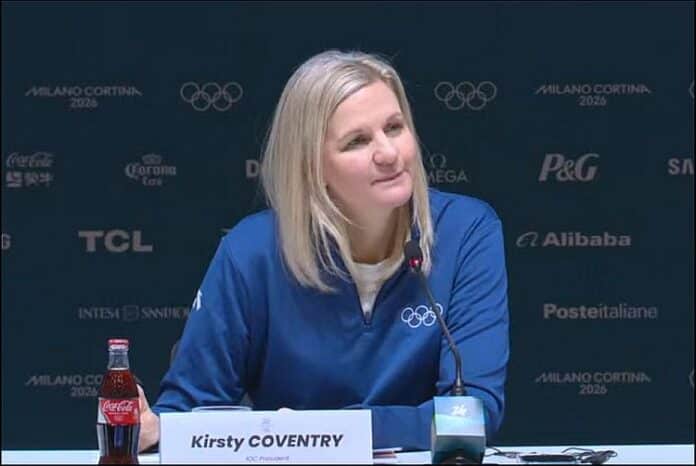
LOS ANGELES: Olympic legends Miller and Naber, football “stars” Cantor and Rothenberg honored at 20th L.A. Sports Awards

Olympic swim star John Naber accepting his L.A. Sports Council Lifetime Achievement Award on 28 January 2026 (TSX photo).

The Sports Examiner: Chronicling the key competitive, economic and political forces shaping elite sport and the Olympic Movement.★

To get the daily Sports Examiner Recap by e-mail: sign up here!

≡ L.A. SPORTS AWARDS XX ≡

A full house of almost 400 gathered Wednesday at the Town & Gown ballroom at the University of Southern California to honor three of the university’s famed former students for the 20th Los Angeles Sports Awards.

Two were Olympic gold medalists, basketball icon Cheryl Miller from the 1984 women’s team and swim superstar John Naber, who stormed to four golds and a silver at the 1976 Olympic Games in Montreal.

Miller reflected on the advice of her father, who told her “that I can be anything I wanted to be, and all it would take was everything I had.”

She thanked her USC coach, Linda Sharp, “for allowing me to be me,” which was the most dominant player in collegiate basketball history during a three-year run as national player of the year from 1984-86. Miller also singled out her long-time friend and mentor Ann Meyers Drysdale, the four-time UCLA All-American from 1975-78 and 1976 Olympic silver medalist (and also in the house on Wednesday), of whom Miller said she learned, “what a leader looks like.”

The ebullient Naber, who always raises the energy in any room he’s in, remembers when he first encountered the Olympic Movement:

“At age 10, my family took us on a vacation – a Mediterranean cruise – that stopped neat the city of Olympia, Greece, the site of the ancient Olympic Games, and the tour guide explained to us that all the athletes in the ancient Games had to march through a tunnel before they got to the stadium where the competition would take place, and on either side of them were statutes that were carved in the likeness of any athlete who ever got caught cheating in the ancient Olympic Games.

“To show how important it was not to cheat, because they made the home town pay for the statue, and it was really a Hall of Shame. And I said to my mom, ‘this program, it’s not about honoring the athletes, it’s about honoring the gods, it’s about sportsmanship and fair play and teamwork.’ And I said, ‘Mom, I’m going to be an Olympian some day!’”

He didn’t start swimming for another three years. But he was ingrained from that early age, with the culture of Olympism, and offered the acknowledged definition of “a philosophy seeking to create a way of life based on the joy found in effort, the educational value of good examples and respect for universal, fundamental, ethical principles. Now if that’s not a reason to get involved in sport, I don’t know what is.”

He also got a huge laugh from the crowd, that after winning four Olympic golds in 1976, he was on top of the world. But, “that moment can’t last forever. You have to come down from that planet and find something else to do. And let’s be fair, and tell the truth, the ability of swim quickly on your back has limited value at society at large.”

But Naber adjusted, becoming a sought-after broadcast of more than two dozen sports and continuing to promote Olympian through his three books, through board positions on the Los Angeles Olympic Organizing Committee and the U.S. Olympic & Paralympic Committee, the L.A. Sport Council’s “Ready, Set, Gold!” program that integrates athletes into schools, and a lot more.

Another former Trojan whose voice has become synonymous with football (soccer) in the U.S. was honored: long-time broadcaster Andres Cantor.

He brought the house down with an in-person rendition of his iconic “Goooooaaal” call and explained that he was happy to be back on campus. Cantor attended USC from 1981 to 1984, but didn’t graduate … because he finished his journalism curriculum and decided to go to work. He joked that because there was no top-tier professional league in the U.S. – the North American Soccer League was dying – for him to play in, he had to “do the next best thing, which is being a broadcaster and being around the game.”

He said he was initially a little worried about receiving a “lifetime” achievement award, “I thought, hmmm, that sounds like the two-minute warning,” which drew a big laugh. But he was told by a colleague, “yeah, but it’s the two-minute warning of the first half.”

Cantor’s comments also effectively introduced the night’s final Lifetime Achievement Award winner, Alan Rothenberg – who went to Michigan – whose role in the development of professional soccer has not been fully appreciated. He told the house that Rothenberg “is responsible for what soccer is today. … Mr. Alan Rothenberg is responsible for having brought the 1994 World Cup to the U.S.

“There is a before-and-after Alan Rothenberg in U.S. soccer history. I am deeply honored to be sharing this night with him, because if it were not for him, we wouldn’t have MLS – Major League Soccer – which is now a very healthy, 30-team league across the nation, so the soccer community owes you everything.”

Rothenberg accepted his award, noting he can’t shoot a basketball, he’s not a fast swimmer and he can’t even say, “gooooaal,” but he thanked the many people whom he has worked with in so many events, the volunteers who made the events work and the millions of fans who made the successes possible.

Los Angeles Sports Council President Matt Cacciato (r) presenting a Lifetime Achievement Award to Alan Rothenberg on 29 January 2026 (TSX photo).

He noted that he has been especially “blessed to be in this great city. It’s truly one of the greatest cities in America, we have our problems, but we always come back from them. And it’s truly the sports capital of the world,” pointing to 12 professional teams, plus outstanding college teams, and a plethora of world-class venues.”

Rothenberg wrote about his unique role in creating the modern American soccer landscape in his forthcoming book, The Big Bounce: The Surge That Shaped the Future of U.S. Soccer, coming out on 12 February, but offered as a gift to attendees, along with Naber’s Olympic Trivia Challenge! from 2021.

The evening also included awards specific to Los Angeles sport in 2025, with Los Angeles Dodgers star Shohei Ohtani (JPN) recognized as the men’s sports person of the year and Angel City FC scoring sensation Riley Tiernan as the women’s athlete of the year. Naturally, the Dodgers’ second consecutive World Series victory was the top moment of the year.

Receive our exclusive, weekday TSX Recap by e-mail by clicking here.
★ Sign up a friend to receive the TSX Recap by clicking here.
★ Please consider a donation here to keep this site going.

For our updated, 45-sport, 910-event International Sports Calendar for 2026 and beyond, by date and by sport, click here!
MILAN CORTINA 2026: IBSF Appeals Tribunal upholds Uhlaender’s charge that Canada undercut entries intentionally; a CAS case would be next

U.S. Skeleton Olympian Katie Uhlaender in 2021 (Photo: Wikipedia via Steffen Prossdorf)

The Sports Examiner: Chronicling the key competitive, economic and political forces shaping elite sport and the Olympic Movement.★

To get the daily Sports Examiner Recap by e-mail: sign up here!

≡ UHLAENDER WAS RIGHT ≡

The Appeals Tribunal is satisfied that the action of the Canadians was intentional
and directed to reducing the points available to athletes who slid at the final Lake Placid NAC [North American Cup].”

That, in a sentence from the decision of the Appeals Tribunal of the International Bobsleigh & Skeleton Federation (IBSF), vindicates American skeleton star Katie Uhlaender’s claim of deliberate manipulation of the IBSF Rankings used for Olympic selection by the Canadian team.

It important to note that the IBSF Appeal Tribunal is a separate body from the IBSF Interim Integrity Unit, which dismissed Uhlaender’s appeal. The Appeals Tribunal, in a seven-page order issued Wednesday, was clear on its findings:

● “16. Canada entered six sliders in the final Lake Placid NAC Women’s Skeleton race by the registration deadline. Prior to the Official Training period, Canada’s coach Mr. [Joe] Cecchini [ITA] became concerned that Canada might lose an overall Olympic quota spot if non-Canadian athletes in Lake Placid performed well.”

● “17. In order to protect against that occurrence – Canada instructed four of its athletes not to participate in the Official Training period. By not participating, the four Canadian athletes became ineligible to be drawn during the final pre-race team captains meeting. (The other two Canadians participated in Official Training, the draw, and the race itself.)”

● “18. Only 19 names were drawn at the final pre-race meeting, thereby fixing the number of points available at 75% of the allotment for NAC races with twenty or more names drawn.”

● “19. Although Canada subsequently attributed its decision to order four athletes not to slide in Official Training to concerns about the athletes involved, substantial evidence supports Ms. Uhlaender’s contention that the move was a deliberate effort by Canada to reduce the points available at the final Lake Placid NAC so as to protect its own Olympic quotas.”

Even so, however, the Appeals Tribunal dismissed Uhlaender’s appeal, which was asking for full points to be awarded for the final Lake Placid race, which would have given her more ranking points than Mystique Ro and presumably would place her on the U.S. Olympic Team for the Milan Cortina 2025 Winter Games.

The Appeals Tribunal points to its authority under the Olympic Movement Code, which allows “invalidation or modification of results” and in terms of sanctions:

“When determining the appropriate sanctions applicable, the Sports Organisation shall take into consideration all aggravating and mitigating circumstances and shall detail the effect of such circumstances on the final sanction in the written decision.”

The Appeals Tribunal decided not to use the reference to “mitigating circumstances” on sanctions to modify the Lake Placid race results, which appears to have been an option under a reasonable reading of the Olympic Movement Code sections.

If this had been done, Uhlaender would then have had to file an appeal with the U.S. Olympic & Paralympic Committee to give her the spot assigned to Ro. But the Appeals Tribunal held, specifically:

“To the extent that the Appeals Code authorizes the ‘voiding of any action’ or ‘invalidation or modification of results,’ the relief sought by Ms. Uhlaender is outside the scope of such authority.”

Uhlaender’s only viable next step is to the Court of Arbitration for Sport, asking for an intervention on an equity basis, since the Milan Cortina qualification rules for Skeleton are clear that “Exceeding the total amount of quota places for women is not allowed under any circumstances.”

The International Olympic Committee could, if it wishes – as the owner of the Games – could make an exception and add Uhlaender if it wants to, but has previously said this is an IBSF matter.

But Uhlaender, per the Appeals Tribunal, was right: Canada manipulated the final Lake Placid race and it cost her a spot at the Winter Games. If she wishes to drag the Canadians through the mud, she has the makings of a civil suit, one that would be concluded long after the closing of February’s Winter Games is over.

Receive our exclusive, weekday TSX Recap by e-mail by clicking here.
★ Sign up a friend to receive the TSX Recap by clicking here.
★ Please consider a donation here to keep this site going.

For our updated, 45-sport, 910-event International Sports Calendar for 2026 and beyond, by date and by sport, click here!

PARIS 2024: Jordan Chiles’ Olympic bronze appeal to the Swiss Federal Tribunal upheld and the case goes back to the Court of Arbitration for Sport

Olympic champion gymnast Jordan Chiles, competing for UCLA (Photo: UCLA Athletics)

The Sports Examiner: Chronicling the key competitive, economic and political forces shaping elite sport and the Olympic Movement.★

To get the daily Sports Examiner Recap by e-mail: sign up here!

≡ NEW HEARING COMING ≡

The long-shot appeal by American gymnast Jordan Chiles to retain the bronze medal she initially won in the Paris 2024 Olympic Games women’s Floor Exercise got a major boost on Thursday.

A long and tangled set of circumstances started on 5 August 2024, as Chiles initially scored 13.666 to place fifth. However, American coaches filed a inquiry with the Federation Internationale de Gymnastique (FIG), and Chiles’ difficulty score for her routine was increased from 5.800 to 5.900, increasing her score to 13.766, and she was awarded the bronze medal.

But Romania filed protests the next day, claiming that the appeal of Chiles’ score came after the 60-second time limit. On 10 August, the Court of Arbitration for Sport bought the Romanian argument, despite the U.S. side being informed only hours ahead of the hearing due to a communications error.

On 11 August, USA Gymnastics found and turned over video evidence which showed the inquiry on Chiles’ score to be made 47 seconds after posting. But the Court of Arbitration stood by its ruling and the International Olympic Committee awarded the bronze to Romania’s Ana Barbosu.

Chiles, USA Gymnastics and the U.S. Olympic & Paralympic Committee pursued the matter on Chiles’ behalf, with a filing to the Swiss Federal Tribunal, which can review Court of Arbitration for Sport decisions on limited grounds. One of those is procedural unfairness and on Thursday, the Swiss court statement explained:

“The Federal Supreme Court rejected Jordan Chiles’ appeal concerning the alleged lack of independence and impartiality of the arbitrator in question.

“However, it accepted both requests for revision. In the highly exceptional circumstances of the case in question, it considers that there is a likelihood for the audio-visual recording of the final on 5 August 2024 to lead to a modification of the contested award in favour of the applicants, since the CAS could consider, in the light of this audio-visual sequence, that the verbal inquiry made on behalf of Jordan Chiles had been made before the expiry of the regulatory one-minute time limit.

“The Federal Supreme Court therefore partially overturns the contested award and refers the case back to the CAS for a new ruling, taking into account the probative value of the audio-visual recording in question.”

So, Chiles – already a gold medalist from the team event – hasn’t won her case yet, but the Swiss Tribunal has sent a clear message that she should be (re-)awarded the Floor Exercise bronze.

There was more to the court statement, notably that the two appeals by the Romanian Gymnastics Federation were dismissed. The first was that Chiles’ appeal was made after the one-minute deadline, which was eliminated by the video evidence presented by the U.S. side.

There was also the matter of an out-of-bounds penalty assessed against Romanian gymnast Sabrina Maneca-Voinea, also using video evidence and if not assessed, would have placed her in third place. But:

“Sabrina Maneca-Voinea challenged the CAS award by filing an appeal and a request for evision with the Swiss Federal Supreme Court. In its decision of 23 January 2026, the Federal Court deemed both legal arguments inadmissible. It considered that it could not examine whether the gymnast had stepped outside the boundaries of the floor, as this question fell within the category of non-justiciable rules of the game and not within that of reviewable legal rules.”

USA Gymnastics was thrilled, of course, and issued its own statement:

“We are pleased the Swiss Federal Supreme Court recognized the flaws in the initial process and that Jordan’s case can now be heard inclusive of all relevant evidence.

“USA Gymnastics will continue to support the efforts of Jordan and her team to retain her bronze medal in the 2024 Olympic women’s floor exercise.

“We look forward to a fair arbitration that includes the clear evidence proving the inquiry into Jordan’s score was filed well within 1 minute as required by FIG rules.”

It’s another high point for Chiles, a senior at UCLA this season, who is leading the nation in All-Around scoring with a 39.712 average and leading on Vault at 9.944.

It will take some more time for Chiles’ case to go through the review process at the Court of Arbitration for Sport, but it appears that is another victory for her in the future.

Receive our exclusive, weekday TSX Recap by e-mail by clicking here.
★ Sign up a friend to receive the TSX Recap by clicking here.
★ Please consider a donation here to keep this site going.

For our updated, 45-sport, 910-event International Sports Calendar for 2026 and beyond, by date and by sport, click here!

MODERN PENTATHLON: UIPM chief Stull announces Pent and Obstacle Worlds in China, plus less swimming, more shooting, more “excitement”

The Sports Examiner: Chronicling the key competitive, economic and political forces shaping elite sport and the Olympic Movement.★

To get the daily Sports Examiner Recap by e-mail: sign up here!

≡ UIPM HEADS TO CHINA ≡

“While this sport certainly was Euro-centric for quite a while, you can’t ignore the rest of the world.”

With that backdrop, Rob Stull, the American president of the Union Internationale de Pentathlon Moderne (UIPM) introduced the federation’s “Race Across China” in 2026, coupling two of its major championship events together:

24-30 Aug.: UIPM World Championships in Guiyang
02-06 Sep.: UIPM Obstacle World Championships in Beijing

Guiyang, the capital of the Guizhou province in southern central China, is home to 4.5 million people and is the hometown of UIPM Secretary General Shiny Fang. Stull explained that what made an impression on the federation was Guiyang’s enthusiasm in “their presentation, what they’re willing to do for us in terms of showcasing the sport is not the sort of standard recipe … what they offered to us was a different approach in how to present the sport, in their style.”

He did not give any details, but these will surface later. The attraction for more events in China, of course, is the enormous market there:

“We’re trying to grow on all fronts. China is definitely a big market; we have some very strong commercial partners there,” and teased future announcements about television programming “and some really cool things.”

Again, nothing to announce in detail yet.

Stull also spoke at length about how modern pentathlon is changing, again. Having dumped equestrian for obstacle at the behest of the International Olympic Committee after the Tokyo 2020 Games, the sport’s format is continuing to change.

The UIPM Executive Board agreed with innovations to the format, with Stull explaining it’s about “how to keep the sport compact, the excitement level up, how to keep it dynamic, how to make it this 90-minute format” more exciting.

● Swimming will be reduced from 200 m to 100 m, which Stull said still kept the swimming component, but the 100 m is just a more exciting race,” and noted that the shorter distance will attract a different type of athlete.

● Shooting was expanded from four segments to five in the Laser Run finale. Stull: “Shooting is drama.”

● Fencing was previously compacted with a change of format, but a change to bout times from 60 seconds to 45 seconds was rejected, pending further study and trials.

“It’s all about maintaining the energy in the room,” said Stull. “As you transition from one sport to another, you have these transition periods that are very short – think of triathlon in a transition, right – as you’re going from one event to another, ours are just a few minutes, but we’re trying to make sure that even those transition periods are very exciting.”

He said that during the 2025 season, he would watch the eyes of spectators to see when they were fixed on the field of play and when they went somewhere else: “During that 90 minutes, you’re focused on the event. … This 90-minute format is not just a sporting event, it’s entertainment.”

Stull also hinted at further technical changes leading up to the 2028 Olympic Games in Los Angeles, especially in the obstacle course, with the goal of not only challenging the competitors, but wowing the crowd and creating new fans, both in person and on television.

The UIPM became the third International Federation this week to announce the re-integration of Russian and Belarusian youth athletes – age 19 and under – to compete freely and without restrictions. This does not apply to the UIPM Junior and Senior-level events.

He also noted the positive promotional opportunities that this creates for the UIPM, as obstacle is popular in both countries:

“Everybody knows that the demographic of obstacle sports tends to be to the youth … frankly, that’s the audience we wanted to catch. … How to be relevant to the youth of the world. That’s a challenge that I think every Olympic sport has, how do you stay relevant? Obstacle is our answer and it’s been very successful.”

Receive our exclusive, weekday TSX Recap by e-mail by clicking here.
★ Sign up a friend to receive the TSX Recap by clicking here.
★ Please consider a donation here to keep this site going.

For our updated, 45-sport, 910-event International Sports Calendar for 2026 and beyond, by date and by sport, click here!

LANE ONE: The L.A. City Council wonders about a 2028 Olympic boycott; it won’t happen. They should concentrate on the one key element for its success

The Olympic and Paralympic flags on display at Los Angeles City Hall (TSX photo)

The Sports Examiner: Chronicling the key competitive, economic and political forces shaping elite sport and the Olympic Movement.★

To get the daily Sports Examiner Recap by e-mail: sign up here!

≡ AN LA28 BOYCOTT? NO! ≡

At the Monday meeting of the Los Angeles City Council’s Ad Hoc Committee on the 2028 Olympic and Paralympic Games, City Council President Marqueece Harris-Dawson worried out loud about a possible boycott of the Games by countries – especially in Europe – that would refuse to compete in opposition to the Trump Administration.

Following the shooting of an armed protestor in Minneapolis on Saturday (24th) by U.S. Immigration and Customs Enforcement, protests have spread nationally and notice has been taken internationally. Said Harris-Dawson:

“It’s hard to miss it. The situation with the national government in this country makes human rights an even more important question than it would ordinarily be. …

“I noticed at least three reports of countries discussing in a formal way – I mean, big countries like Germany, France – discussing boycotting FIFA [2026 World Cup], because of the actions of the U.S. around Greenland or whatever, so we have a national government who’s setting the stage for an environment where we can have a serious boycott.

“We had a boycott in ‘84 in L.A., we know it’s possible to overcome that. But I’m just wondering, is that part of what the [International Olympic Committee] has preparations for, how do you prepare for that, given people are making real threats and holding governmental hearings about it in other parts of the world?”

LA28 Chief Operating Officer John Harper explained, “We’ve had no discussions with the IOC, no indications that that is going to be a concern here, but obviously, we’ll continue to work with the IOC and the [International Paralympic Committee] as they drive towards 2028. But all indications are that we’re looking forward to welcoming the world, all 206 nations of all the NOCs represented in 2028.”

But Harris-Dawson went further:

“This Council has, as its charge, the well-being of the City of Los Angeles, so we’ll do that piece, but another piece of it that I just offer to you, is damage to the Olympic Movement overall, which is all of our inheritance, everybody’s in the world . And I certainly don’t want to be the city and the country that is at the center of doing serious damage to that. …

“It’s not like we haven’t seen this before. We never talk about the boycott of ‘84, but there was a significant boycott in 1984, so it doesn’t mean that you can’t figure it out, but it also means you have to face it and face it directly.”

Harris-Dawson is right to be concerned, but here’s what he should know:

● 1. It’s 2028, not 1984.
● 2. There will be no 1980- or 1984-style boycott in 2028.
● 3. City worries should be elsewhere.

Starting with the history, the one truth about the Olympic Games is that only a raging world war can stop the celebrations. The 1916 Games was wiped out by World War I and the 1940 and 1944 Games were lost to World War II. Otherwise, they’re on.

And as for civic strife, boycotts and the Games, consider:

1968: The 2 October confrontation by the Mexican army against protesters in Mexico City – 10 days before the opening ceremony – resulted in the “Tlatelolco massacre” in which an estimated 300 or more died. The Games went on.

1972: The Olympic Movement was shattered by the capture at the Olympic Village and later killing of 11 members of the Israeli delegation by Palestinian terrorists on 5 September. There were widespread calls from the Games to be scrapped; the Games went on.

1976: The Montreal Games were hamstrung by construction delays and overruns to the tune of C$1 billion and there was a boycott of 29 mostly African countries over New Zealand’s hosting of the South African rugby team earlier in the year. The Games went on.

1980: In response to the Soviet invasion of Afghanistan, U.S. President Jimmy Carter organized a boycott by 66 countries of the Moscow Games. Only 80 National Olympic Committees attended, but the Games went on.

1984: In response to the U.S. boycott in 1980, the Soviet bloc – 14 nations – boycotted the L.A. Games and four other countries declined to come for unrelated reasons. The Games went on with a then-record 140 nations attending and changed the Olympic Movement for the better.

During the IOC Presidency of Spain’s Juan Antonio Samaranch, substantial changes were made to avoid such boycotts in the future and these have been carried on to today. But that does not mean there have not been calls for boycotts of various Games since 1984.

Boycotts were demanded by various groups of the 2008 Games in Beijing, China in view of Chinese human rights policies, but the Games went on and were a successful showcase for China. There were outcries against Rio de Janeiro (BRA) in 2016 over human-rights abuses, but the success of that Games was marred by a lack of money, people and planning. Yet, they went on.

Tokyo managed the postponed Games in 2021 – somehow – during the Covid pandemic despite local demands for cancellation and hosted successfully, and the Paris 2024 Games were, in a word, spectacular.

The Games went on.

And they will go on in 2028.

A major difference between the 1976-80-84 period and today is a major change to the Olympic Charter, which governs the Olympic Movement. Language was added which now REQUIRES that National Olympic Committees attend the Games, or will be suspended by the IOC and ineligible for any future IOC funding during such a suspension. This is a serious issue for many National Olympic Committees and a stern incentive to get them to the Games, regardless of what they may think of the host country or city.

Further, the IOC’s immediate past President and now Honorary President Thomas Bach (GER) hammered the importance of the Olympic Movement’s political neutrality during his 12-year term, and remains at the disposal of current President Kirsty Coventry (ZIM) in case any of the NOCs – or their governments – need to be reminded.

As Bach and others have said over and over: the only people hurt by boycotts are the athletes.

As for the anger of L.A. City Council members over the Trump Administration, it is also true that Trump’s Executive Orders on entry visas specifically carve out exemptions for – now – not just Olympic and Paralympic athletes and officials, but those attached to many large sporting events. So, the athletes and teams are going to be able to get into the U.S. and to L.A. to compete.

Their fans – especially if from certain countries restricted from U.S. entry – are a different issue.

Harris-Dawson mentioned the chatter around boycotting the FIFA World Cup coming to the U.S. (and Canada and Mexico) in June, but the chances of a government removing its national team from the event are tiny. The politicians responsible will incur the wrath of their populations for keeping their team from playing on the world’s biggest single-sport stage.

Former FIFA head Sepp Blatter (SUI) sided with a much more subtle and important concept, of essentially an economic boycott of the World Cup matches in the U.S. by fans.

Swiss anti-corruption attorney Mark Pieth, who helped with FIFA’s reform efforts after Blatter left in 2015, told the Swiss paper Der Bund:

“If we consider everything we’ve discussed, there’s only one piece of advice for fans: Stay away from the USA! You’ll see it better on TV anyway. And upon arrival, fans should expect that if they don’t please the officials, they’ll be put straight on the next flight home. If they’re lucky.”

Blatter posted on X: “I think Mark Pieth is right to question this World Cup.”

The City of Los Angeles’ financial reward for the 2028 Olympic Games will come from visitor spending and especially out-of-town spending for accommodations, food, transportation, shopping and entertainment beyond the competitions. If people don’t come, they won’t spend.

LA28 will sell its tickets; the 1.5 million first-day registrations for its ticket lottery demonstrates clear interest and perhaps four million tickets at $100 or less will ensure most people have options to see Olympic competitions.

But Los Angeles, which has offered no public plan for its activities related to the Games, needs Olympic and Paralympic visitors. That is what should be concerning Harris-Dawson and his fellow Council members.

The Paris tourism bureau’s follow-up report on the 2024 showed their Games brought about 420,000 extra overnight stayers across the 17 days of the Olympic Games. Not millions, but hundreds of thousands, up about (only?) 16% from the year prior.

That’s the metric that L.A. needs to focus on if it wants to “profit” from the 2028 Games, in terms of jobs and tax revenues. And where’s the plan for that?

Because the Games will go on.

Rich Perelman
Editor

Receive our exclusive, weekday TSX Recap by e-mail by clicking here.
★ Sign up a friend to receive the TSX Recap by clicking here.
★ Please consider a donation here to keep this site going.

For our updated, 45-sport, 910-event International Sports Calendar for 2026 and beyond, by date and by sport, click here!
PANORAMA: LA28 signs Korn Ferry as 7th top-tier partner; Milan mayor doesn’t want ICE at Games; Kenyan marathoner Kosgei to Turkey?

Samsung’s 2026 Galaxy Z Flip7 Olympic Edition will be distributed to athletes at the Olympic and Paralympic Games in Milan and Cortina (Photo: Samsung).

The Sports Examiner: Chronicling the key competitive, economic and political forces shaping elite sport and the Olympic Movement.★

To get the daily Sports Examiner Recap by e-mail: sign up here!

≡ THE 5-RING CIRCUS ≡

● Olympic Games 2028: Los Angeles ● The LA28 organizers announced recruitment giant Korn Ferry as a Founding Partner, its highest sponsorship level, joining Comcast, Delta, Google, Honda, Intuit and Starbucks.

Korn Ferry’s designation is as “Official Talent & Organizational Consulting Partner,” and the announcement explained:

“Korn Ferry is working closely with LA28 to hire, onboard, and develop the nearly 5,000-people workforce needed to deliver the Games, while cultivating leaders and high-performing teams that reflect the spirit of Los Angeles and the Olympics and Paralympics.”

Continuing a hot streak in sales, LA28 has now signed seven highest-tier sponsors with 2 1/2 years to go, equaling the number signed for Paris 2024 in total.

● Olympic Winter Games 2028: Milan Cortina ● Now the Mayor of Milan, Giuseppe Sala, has stepped in with an opinion on U.S. Immigration and Customs Enforcement (ICE) staff coming to the Winter Games as part of the security detail for the American delegation, led by Vice President J.D. Vance. He told Italian media:

“This is a militia that kills. It’s a militia that enters people’s homes by signing permits for themselves. … It’s clear that they’re not welcome in Milan, there’s no doubt about that. …

“I believe they shouldn’t come to Italy, because they don’t guarantee they’re aligned with our democratic security management methods. We can take care of their security ourselves. We don’t need ICE.”

The U.S. State Department told CBS News:

“The State Department’s Diplomatic Security Service is leading the U.S. security effort at the Milano-Cortina 2026 Winter Olympics. As in previous Olympic events, multiple federal agencies are supporting the Diplomatic Security Service, including Homeland Security Investigations, ICE’s investigative component.

“At the Olympics, the role of Homeland Security Investigations is strictly supportive – working with the Diplomatic Security Service and Italian authorities to vet and mitigate risks from transnational criminal organizations. ICE is not involved in policing or managing security during the Olympics. All security operations at the Olympics are directed and managed exclusively by Italian authorities.”

France announced a record team of 159 athletes and two alternates (161 total) for the Milan Cortina Winter Games, way ahead of the 86 sent to the Beijing 2022 Winter Games and 106 or PyeongChang in 2018.

Switzerland will also have a record number of athletes, with a 175-member team announced, more than the 173 in PyeongChang and 168 in Beijing.

The International Olympic Committee updated its list of invited “neutral” athletes from Russia and Belarus on Tuesday, totaling 20 in all:

There are 13 confirmed Russian athletes, in alpine skiing, cross-country skiing, figure skating, luge, Short Track and speed skating,

Belarus has seven invitees, in alpine skiing, cross-country skiing, figure skating, freestyle skiing and speed skating.

Samsung has been distributing complimentary mobile phones to Olympic and Paralympic athletes since 2014 and unveiled its 2026 Galaxy Z Flip7 Olympic Edition, to be handed out starting on 30 January to the more than 3,800 athletes expected to compete in the two Games.

This custom edition is not for public sale and has AI features incorporated along with special Games applications, including the Galaxy Athlete Card for exchanging profiles, the Samsung Wallet with the Coca-Cola Free Beverage Key for Olympic-Paralympic Village vending machine (!), Athlete365 performance and schedule support, the IOC Hotline and many more.

There is also a neat “Dual Recording” feature allowing users “to capture both what they see and their own reactions in a single shot using the rear and front cameras at the same time.”

Samsung, an IOC TOP sponsor, also created a special, curving Olympic “wallpaper” for this phone and each unit has a custom gold metal frame.

● Alpine Skiing ● Swiss star Loic Meillard, the 2023 Worlds Giant Slalom silver winner, took Tuesday’s night-time FIS World Cup Giant Slalom in Schladming (AUT), placing second in both runs and totaling 2:14.38 for his ninth career World Cup gold.

Brazil’s Lucas Pinheiro Braathen was the first-round leader but ended up second in 2:15.11, then second-run winner Alban Elezi Cannaferina (FRA: 2:15.28). The Schladming stop will finish Wednesday with a Slalom.

● Athletics ● It was reported last week in Canadian Running that five Kenyan distance runners, including former women’s marathon world-record holder Brigid Kosgei and “2024 Olympic [5,000 m] silver medallist Ronald Kwemoi, Catherine Amanang’ole, Brian Kibor and Nelvin Jepkemboi were listed “in a now-deleted social media post from the Turkish Athletics Federation announcing five new national team members.”

World Athletics has a three-year waiting period for transfers to be effective, so change requests had to be filed in 2025 in order to athletes to run for their “new” country at the 2028 Olympic Games in Los Angeles.

It was reported last year that four Jamaican stars were transferring to Turkey, as well as Nigerian sprinter Favour Ofili. The Canadian Running article noted, “Each athlete reportedly received a US$500,000 signing bonus, monthly stipends and performance incentives that include a $380,000 bonus for Olympic gold and an additional $190,000 for setting an Olympic record.”

● Bobsled & Skeleton ● American Skeleton star Katie Uhlaender has been turned down by the IOC in her quest for an added spot in the Winter Games, and she may still file a complaint with the Court of Arbitration for Sport.

She told CNN of what she has called a flawed review process by the International Bobsleigh and Skeleton Federation’s Interim Integrity Unit:

“It saddens me that they didn’t respond to my email with the evidence. They didn’t reach out to any of the affected parties, not even afterwards, to make sure anyone was okay, and it makes the community feel isolated from the governance. I think this is an opportunity for us to all come together.”

She added that she worries about the message that it being sent by the manipulation of the qualifying process by withdrawing athletes from competitions:

“It was never about getting into the Olympics, it was about standing up for the integrity of the sport. I have to emphasize that when I see the younger generation witnessing competition manipulation like some are trying to justify it, ‘through the rules,’ it concerns me because, if we didn’t speak out and show that people care about the integrity of the sport and ethics, they might just fall in line and behave that way.

“I don’t want Canada to have a bad reputation; I’m hoping that we don’t treat any (athlete) in this situation like an enemy. We treat them like a part of our community and try to show them that the better way forward is sticking together and being transparent and honest.”

● Figure Skating ● U.S. Figure Skating reported that 1964 Olympic Pairs bronze medalist Dr. Ronald Joseph passed away on 20 January at age 81 from the effects of ALS.

He and sister Vivian won the Worlds silver in 1965 and the U.S. title that year. Joseph sent on to a long career as an orthopedic surgeon; he and his sister were inducted into the U.S. Figure Skating Hall of Fame in January 2024.

● Football ● The U.S. women face off against Chile in a friendly in Santa Barbara, California on Tuesday evening and once again routed an overmatched opponent, winning by 5-0 (following a 6-0 win vs. Paraguay), even with a youthful line-up.

The Americans had immediate control, with 80-20% possession after 10 minutes and the first goal came at 18 minutes from midfielder Croix Bethune, followed by forward Jameese Joseph (26th) and defender Emily Sams in the 33rd for a 3-0 halftime lead.

Forward Emma Sears scored right after halftime (46th) and star striker Trinity Rodman got a score on a left-footed, right-side rocket in the 68th, followed by a dance-off with U.S. coach Emma Hayes (GBR). The U.S. finished with 71% possession and a 21-0 shots advantage!

Next up will be the SheBelieves Cup in March.

● Wrestling ● Following the IOC’s recommendations from December, United World Wrestling announced that Russian and Belarusian athletes in the U-15, U-17, U-20 and U-23 competitions will be fully readmitted into international competitions, and no longer will compete under the UWW flag.

This does not apply to senior-level competitions. Moreover, the announcement noted that “the IOC maintains that no government officials from Russia or Belarus should be accredited or invited to international sports events or meetings for either senior or youth competitions.”

Receive our exclusive, weekday TSX Recap by e-mail by clicking here.
★ Sign up a friend to receive the TSX Recap by clicking here.
★ Please consider a donation here to keep this site going.

For our updated, 45-sport, 910-event International Sports Calendar for 2026 and beyond, by date and by sport, click here!
TEAM USA WINTER MEDAL TRACKER: Seventeen more medals and six golds as U.S. stars like Shiffrin and Stolz show readiness for Winter Games

The Sports Examiner: Chronicling the key competitive, economic and political forces shaping elite sport and the Olympic Movement.★

To get the daily Sports Examiner Recap by e-mail: sign up here!

≡ ON THE PODIUM ≡

U.S. athletes had another strong weekend on the snow and ice, with the Milan Cortina Olympic Winter Games just a couple of weeks away, with World Cup and championship medals in five different disciplines:

Alpine Skiing: FIS World Cup in Spindleruv Myln (CZE):
Women/Giant Slalom ~ Silver: Paula Moltzan
Women/Giant Slalom ~ Bronze: Mikaela Shiffrin
Women/Slalom ~ Gold: Shiffrin

Shiffrin won her seventh Slalom of the season and wrapped up her ninth seasonal Slalom title as well, after eight of the 10 races. She told reporters on Monday that she’s looking forward to the Games:

“I’m particularly excited about the alpine team we’re bringing into Cortina this year. On the women’s side, we are currently first in the Nations Cup standings for overall, Slalom, GS and Downhill.

“This success that we’ve had so far in this World Cup season is really unprecedented for the U.S. … It’s been a big season already. We’ve been in Europe for months competing every single weekend and often on the weekdays as well.

“I just skied my 14th, I think, 14th World Cup race yesterday in the Czech Republic … and our team is bringing really big energy into Milan Cortina.”

The American women’s squad is impressive, including Moltzan with three World Cup G-S medals and one in Slalom so far, Lindsey Vonn with two Downhill wins, silver and two bronzes, and two Super-G medals, plus a Downhill bronze from Jackie Wiles.

Biathlon: IBU World Cup in Nove Mesto (CZE):
Men/15 km Mass Start ~ Silver: Campbell Wright

Wright was a sensation at the 2025 World Championships, taking silvers out of nowhere in the Sprint and Pursuit and now scored his first medal of the 2025-26 World Cup season.

He is trying to become the first American ever to win an Olympic medal in biathlon.

Cross Country Skiing: FIS World Cup in Goms (SUI):
Men/Classical Sprint ~ Silver: Gus Schumacher
Men/Team Free Sprint ~ Bronze: Ben Ogden and Schmacher
Women/20 km Classical Mass Start ~ Silver: Jessie Diggins

Schumacher won his second medal of the season and now figures as a contender for medals in Milan Cortina, although not a favorite. He hadn’t planned on doing the Sprint at the Games, but with his silver and a bronze with Ogden in the Team Sprint:

“I’m definitely going to have to think about it. This course definitely suits me more than I think Val di Fiemme does, but I don’t know – we’ll see.”

Diggins, on the other hands, continues as the overall World Cup leader and won her eighth medal of the season. She already owns three Olympic medals (1-1-1) from 2018 and 2022 and will be looking for more.

Figure Skating: ISU Four Continents Championships in Beijing (CHN):
Pairs ~ Gold: Alisa Efimova and Misha Mitrofanov
Ice Dance ~ Gold: Emilea Zingas and Vadym Kolesnik
Ice Dance ~ Silver: Caroline Green and Michael Parsons
Ice Dance ~ Bronze: Oona Brown and Gage Brown

Efimova and Mitrofanov won the U.S. Nationals, but can’t go to the Games since Efimova is not a U.S. citizen. The only Olympic team members to skate at Four Continents were Zingas and Kolesnik and they won impressively, taking both segments and scoring 202.86 points.

Speed Skating: ISU World Cup in Inzell (GER):
Men/500 m I ~ Silver: Jordan Stolz
Men/500 m II ~ Silver: Stolz
Men/1,000 m ~ Gold: Stolz
Men/1,500 m ~ Gold: Stolz
Men/Team Sprint ~ Gold: Conor McDermott-Mostowy, Cooper Mcleod, Zach Stoppelmoor
Women/Mass Start ~ Bronze: Mia Manganello

Stolz wasn’t too concerned about the second-place finishes in the 500s to Pole Damian Zurek and was pleased with the 1,000 and 1,500 m wins, saying, “It was all right. I was a bit tired from 1,500 m, and I think this is about where I think I would be right now.

“There isn’t any way I can get slower right now, so that’s good. I’ve done a lot of training.”

Stolz did clinch the seasonal titles in all three distances, repeating his triple from 2025.

Manganello won the seasonal trophy for the Mass Start for the first time, and at 36, has expected this would be her last season, but:

“Maybe we’ll play it by ear. But as of now, the plan is to be done, but we’ll see.

“I’m 36 and I’d really like to move on with my life. It’s difficult as a woman. I know there’s a couple of amazing talents in our women’s field that have been able to leave, have a family and come back. I don’t know if I have that in me to do. So yeah, I feel like I’m about ready to move on.”

But Milan comes first.

This was the last major weekend of winter-sport action with the Olympic Winter Games starting on 6 February; the skiers still have a few more events this weekend.

But 17 more medals across five more sports and disciplines shows continuing American strength and maintains high hopes for a strong performance at the Winter Games, and the star power represented by Shiffrin and Stolz, especially!

Receive our exclusive, weekday TSX Recap by e-mail by clicking here.
★ Sign up a friend to receive the TSX Recap by clicking here.
★ Please consider a donation here to keep this site going.

For our updated, 45-sport, 910-event International Sports Calendar for 2026 and beyond, by date and by sport, click here!
PANORAMA: No Russians or Belarusians in Winter Games opening marches; House passes $100.25 million World Cup aid for U.S. host cities

The Sports Examiner: Chronicling the key competitive, economic and political forces shaping elite sport and the Olympic Movement.★

To get the daily Sports Examiner Recap by e-mail: sign up here!

≡ THE 5-RING CIRCUS ≡

● Olympic Winter Games 2026: Milan Cortina ● Italy announced a 196-member team for a home Winter Games, including skiing star Federica Brignone, set to return for a fifth Games despite a brutal crash last April.

It’s the largest Italian team ever, ahead of the 184 for the Turin 2006 Games, the last held in Italy.

The International Olympic Committee told the Russian news agency TASS that as for Russian and Belarusian “neutrals” at the Milan Cortina opening ceremonies:

“Individual Neutral Athletes will not take part in the Athletes’ Parade, but the opportunity to experience the event will be offered in Milan as well as in the mountain clusters.”

Mexico’s Sarah Schleper will compete for Mexico in alpine skiing at Milan Cortina, in her seventh Olympic Winter Games, four for the U.S. (1998-2010) and now three for Mexico (2018-26). Olympic super-statistician Dr. Bill Mallon notes:

“She will become the 1st woman and 2nd Winter Olympian to compete at 3 or more Olympics for 2 different nations. It has previously been done 7 times by men, 6 of them at the Summer Olympics, although 4 of them were for related nations.”

Even more special, she will be competing at the Games alongside her teenage son, Lasse Federico Gaxiola!

The Rome newspaper Il Fatto Quotidiano reported that U.S. Immigration and Customs Enforcement (ICE) agents will be part of the security detail for the U.S. government delegation for the Milan Cortina Games, starting 6 February and led by Vice President J.D. Vance.

According to the story, the paper “had reported the presence of agents in Italy, as confirmed by the US agency itself, in this very vein: ‘ICE Homeland Security Investigations will support the diplomatic security service of the United States Department of State for the duration of the 2026 Olympic and Paralympic Games in Milan.’”

The Italian interior ministry said it had no concrete knowledge of the U.S. security team make-up.

It was confirmed to The Sports Examiner that The Washington Post, in a partial reversal, will send four staff members to cover the Milan Cortina Games, after declaring it would not send anyone last week. The Post was approved for 14 total credentials for the Games and had made, at significant cost, extensive accommodations and travel arrangements.

● Olympic Council of Asia ● Qatar’s Sheikh Joaan Bin Hamad Al Thani was elected unopposed as the 22nd President of the Olympic Council of Asia at the OCA Congress in Tashkent (UZB). He takes over from Interim President Timothy Fok (HKG).

Sheikh Joaan is also the head of the Qatar Olympic Committee and Senior Vice President of the Association of National Olympic Committees.

● Television ● Famed producer Geoff Mason, who worked primarily with ABC and ESPN but also had stints with Fox and NBC and others, passed away at 85 of natural causes in Naples, Florida on Sunday (25th).

Mason was best known for being the one in the producer’s chair when the Israeli hostage crisis and later massacre, took place during the 1972 Olympic Games in Munich, West Germany. He coordinated the 22 straight hours of ABC coverage that ended with the confirmation that all of the hostages had died during a failed airport rescue attempt.

● Athletics ● Dutch 400 m hurdles star and World Champion Femke Bol is slated to make her 800 m debut at the Meeting Metz in France on 8 February.

She will be facing some of the best in the world, including Britain’s Olympic champ Keely Hodgkinson, Worlds silver winner Georgia Hunter Bell (GBR) and Diamond League winner Audrey Werro (SUI).

● Biathlon ● Olympic and World Championships gold medalist Sebastian Samuelsson (SWE) told SVT television that he is sure that he is still competing against dopers:

“I think two or three percent of the competitors are or have been under the influence of doping. Doping happens, and it would be strange to expect everyone to suddenly stop doing it. I’m absolutely convinced that I’m competing against people who are doping.”

He also referred to survey of Scandinavian athletes, of which half said they had never had an out-of-competition test from 1 September 2025 and 1 September 2025, stating

“This is bad, more testing should be done. At the same time, this trend has been going on for several years, and I wondered why this was happening.”

● Football ● As part of the 1,059-page Consolidated Appropriations Act for 2026 (H.R. 7148), passed by the U.S. House last Thursday, an allocation of $100,250,212 was included for “eligible planning, capital, and operating expenses for equipment and facilities in support of matches or other public events held in domestic host cities for the FIFA World Cup 2026.”

The impact on each of the 11 U.S. host cities was noted by Rep. Buddy Carter (R-Georgia), who noted where the local impact of the funding will be felt:

“As Georgia prepares to host the 2026 FIFA World Cup, the more than $9 million in transit funding will help ensure that visitors and fans from around the world experience the warm hospitality the South is known for.”

The appropriation process continues in the U.S. Senate.

The logo for the 2027 FIFA Women’s World Cup in Brazil was unveiled at the Copacabana in Rio, plus the “GO EPIC” slogan and “a distinctive sonic identity inspired by vibrant Brazilian sounds to unite fans across every platform and touchpoint.”

The tournament symbol is described as “a powerful emblem inspired by the Brazilian flag and the geometry of the football pitch, crafted from the union of ‘W’ (‘women,’ ‘world’) and ‘M’ (from the equivalent Portuguese words mulheres and mundo). The design symbolises movement and mastery, while subtly paying homage to the national flag.”

● Rowing ● World Rowing announced its annual medal winners for 2025, which included World Champions Giacomo Gentili, Luca Chiumento, Luca Rambaldi and Andrea Panizza of the Italian men’s Quadruple Sculls team, and the Dutch World Champion women’s Eight.

Diederik Simon (NED) was recognized as coach of the year and Czech five-time World Single Sculls champ Ondrej Synek was awarded the Thomas Keller Medal for his outstanding career in the sport.

● Snowboard ● Former Canadian Olympic snowboarder Ryan Wedding pled not guilty to charges of running a drug smuggling ring and colluding on multiple murders in a court appearance in Santa Ana, California on Monday.

Mexican authorities said Wedding turned himself in to the U.S. Embassy in Mexico City last week, but this was disputed by Wedding’s attorney. He will appear in court again on 11 February, with trial set for 24 March. He is being held in custody and also has Canadian charges pending against him that go back as far as 2015.

● Swimming ● Canadian star Ilya Kharun, born in Montreal and currently swimming at Arizona State, announced on Instagram that he will change allegiance to the U.S.:

“Hey everyone, I’ve got big news. I’m changing my international representation from Canada to USA.

“First off, I’d like to thank everyone in Canada. It’s been incredible to travel the world representing Canada and while competing with the top Canadian athletes. John Atkinson and everyone representing Swim Canada, thank you. I would not be the swimmer or person I am today without your support. To my Canadian teammates, thank you. You helped me progress into the person I am today. You guys really made me feel like I was part of a family. It’s been an honor wearing the Maple Leaf flag and everyone in Canada will always have my support.

“Despite the incredible support I’ve received from Canada, I’ve always felt like an American. I grew up in Las Vegas. I’ve lived in America my whole life. I’ve never represented a club team outside of USA Swimming. I’ve got a long career left as a swimmer and I’d like to be based at home. And that home is in the USA.”

Kharun won Olympic bronzes in Paris in the 100 and 200 m Butterfly events, and he said that his U.S. affiliation will become effective on 26 October 2026. He has dual citizenship since April 2024 and will therefore be eligible – after the changeover per World Aquatics rules – to compete for the U.S. at the 2028 Games (if he makes the team!).

● Weightlifting ● The International Weightlifting Federation, following the recommendation of the International Olympic Committee, approved Russian and Belarusian youth lifters to return to international competition.

The approved classes include youth (ages 13-17) and juniors (15-20).

Receive our exclusive, weekday TSX Recap by e-mail by clicking here.
★ Sign up a friend to receive the TSX Recap by clicking here.
★ Please consider a donation here to keep this site going.

For our updated, 45-sport, 910-event International Sports Calendar for 2026 and beyond, by date and by sport, click here!

ATHLETICS: Bankruptcy filings show Grand Slam Track debt now $40.68 million in all; Johnson loaned $2.7 million to the league last May

Grand Slam Track founder Michael Johnson (Photo: Grand Slam Track).

The Sports Examiner: Chronicling the key competitive, economic and political forces shaping elite sport and the Olympic Movement.★

To get the daily Sports Examiner Recap by e-mail: sign up here!

≡ GRAND SLAM TRACK ≡

New filings in the bankruptcy proceedings for Grand Slam Track, Inc. show that the organization’s finances are even worse than imagined.

A 221-page Schedules of Assets and Liabilities filed last Thursday (22nd) included:

● $831,385 in property assets, including $143,286 in cash

● $5,020,000 owed to secured creditors
● $68,295 owed to priority unsecured creditors
● $35,591,214 owed to all other unsecured creditors

That’s total debt of $40,679,509 vs. $831,385 in assets. Beyond the cash, the remaining $688260 is tied up with the bankruptcy filing process, including attorneys and the process company.

All of the $5.02 million in secured creditor debt is to investor Winners Alliance, the commercial arm of the Professional Tennis Players Association. However, total debt owed to Winners Alliance also includes another $6.113 million for additional unsecured debt and another $6.0 million it forwarded for a SAFE (Simple Agreement for Future Equity) investment.

A list of 340 creditors are owed a combined total of more than $35.660 million, as many are listed with balances “Undetermined.” These include:

● $3,035,584 to Momentum-CHP Partnership for TV production
● $2,245,565 to founder Michael Johnson for a personal, unsecured loan
● $232,539 to Johnson for unpaid wages and un-repaid travel expenses
● $172,433 to President Stephen Gera for unpaid wages

So, according to the filings, Johnson put in about $2.7 million of his own money on 23 May 2025, trying to save his league, just in advance of the most successful meet, in Philadelphia. He was repaid $500,000 on 4 June 2025.

A long list of athletes are owed money. The top 75 are owed $20,000 or more and include (this is not just prize money, but also appearance fees):

$268,750: Sydney McLaughlin-Levrone
$195,000: Kenny Bednarek
$185,625: Gabby Thomas
$174,375: Melissa Jefferson-Wooden
$173,125: Marileidy Paulino

$168,750: Josh Kerr
$164,375: Alison dos Santos
$147,500: Matthew Hudson-Smith
$141,250: Marco Arop
$137,500: Ackera Nugent
/10/
$122,500: Agnes Ngetich
$119,250: Grant Fisher
$107,500: Cole Hocker
$98,750: Jereem Richards
$96,875: Zharnel Hughes

$91,500: Sasha Zoya
$80,625: Nikki Hiltz
$77,000: Trey Cunningham
$75,000: Salwa Eid Naser
$71,875: Jessica Hull
/20/
$67,000: Jamal Britt
$64,250: Ejgayehu Taye
$63,375: Oblique Seville
$62,000: Trevor Bassitt
$61,250: Caleb Dean

$60,000: Masai Russell
$58,250: Danielle Williams
$57,500: Jasmine Jones
$56,250: Daniel Roberts
$55,500: Andrenette Knight
/30/
$55,500: Chris Robinson
$55,500: Tia Jones
$53,750: Alexis Holmes
$53,570: Yared Nuguse
$51,875: Mary Moraa

$51,000: Emmanuel Wanyonyi
$51,000: Freweyni Hailu
$49,375: Muzala Samukonga
$48,750: Nickisha Pryce
$47,500: Freddie Crittenden
/40/
$46,250: Tsige Gebreselama
$42,000: Alexander Ogando
$42,000: Bella Whittaker
$42,000: Tamari Davis
$39,375: Ronald Kwemoi

$38,750: Roshawn Clarke
$37,000: Dalilah Muhammad
$36,250: Elise Cranny
$34,500: Dylan Beard
$33,750: Steven Gardiner
/50/
$33,125: Nozomi Tanaka
$32,500: Hagos Gebrhiwet
$32,000: Cooper Teare
$32,000: Cordell Tinch
$32,000: Jenna Prandini

$31,500: Rushell Clayton
$30,000: Jasmine Camacho-Quinn
$29,500: Megan Tapper
$28,750: Daryll Neita
$27,000: Shiann Salmon
/60/
$26,000: Anna Cockrell
$26,000: Christopher Bailey
$26,000: Hirut Meshesha
$26,000: Jacory Patterson
$26,000: Nico Young

$25,000: Fred Kerley
$24,500: Dina Asher-Smith
$24,500: Jacious Sears
$24,500: Malik James-King
$24,000: Brittany Brown
/70/
$23,750: Shamier Little
$22,000: Ackeem Blake
$22,000: Andre De Grasse
$21,250: Clement Ducos
$20,750: Medina Eisa
/75/

Dozens more are owed less than $20,000. It should be noted that in another filing, it showed that athletes were paid $4.702 million in the 90 days prior to the filing of the bankruptcy, in line with Grand Slam Track statements that some of the money owed from the Kingston, Jamaica meet was paid.

A parade of other creditors are listed, for production, public relations, music, tents and a lot more. On the promotional side, U.S.-based Citius Magazine is owed $272,916 and Britain’s Athletics Weekly is owed $33,629.

There are debts in all of the Grand Slam Track meet cities, including $77,896 to the City of Miramar, Florida, $135,401 to Penn Athletics in Philadelphia and for the meet in Los Angeles that was canceled, the listing shows $70,399 owed to the UCLA Luskin Conference Center and $350,465 to the W Los Angeles hotel, near the UCLA campus.

The U.S. Anti-Doping Agency is owed $34,119 and track supplier Rekortan is shown as owed $350,000, possibly for the resurfacing of the track in Jamaica’s National Stadium. Prime Time Timing, which worked on the meets, is owed $177,934.

On a separate form, Grand Slam Track showed income in 2025 of $1,829,317, far less than the debts. Grim.

Receive our exclusive, weekday TSX Recap by e-mail by clicking here.
★ Sign up a friend to receive the TSX Recap by clicking here.
★ Please consider a donation here to keep this site going.

For our updated, 45-sport, 910-event International Sports Calendar for 2026 and beyond, by date and by sport, click here!
LOS ANGELES 2028: L.A. City Council 2028 Games oversight committee voices worries on human rights boycotts, LA28 procurement flow

The Los Angeles City Council chamber at City Hall (Photo: City of Los Angeles)

The Sports Examiner: Chronicling the key competitive, economic and political forces shaping elite sport and the Olympic Movement.★

To get the daily Sports Examiner Recap by e-mail: sign up here!

≡ L.A. CITY COUNCIL ≡

The main action item on the Monday agenda of the Los Angeles City Council’s Ad Hoc Committee on the 2028 Olympic and Paralympic Games was the approval of a draft ordinance to allow temporary construction related to the Games to forego the usual, lengthy planning and zoning requirement reviews and approvals.

In response to public comments and Council member questions, it was noted that signage to be approved under this exemption would be temporary and only related to the Games. With a minor amendment to add a sign-off by the Los Angeles City Attorney, the draft ordinance was moved forward by a 5-0 vote.

It was suggested that a refinement be examined to allow the City to remove illegal signs related to the Games more quickly and not go through the usual legal process, in which a court hearing would not take place until the Games are already over!

But that was not the focus of the two-hour session. The protests against the Trump Administration’s immigration enforcement and recent shootings in Minnesota, and questions about who gets contracts for services during the Games were in the forefront.

Council member Monica Rodriguez bored in on the security arrangements for 2028, which as a National Special Security Event, are led by the U.S. Secret Service:

“Clearly, given the most recent activity, there’s even more heightened concern … about the lead agency in law enforcement. We’ve clearly seen the egregious abuse of power at the Federal level, and the composition of the LA28 Board, given some of the newer members [friendly to the Trump Administration] has only elevated my concerns about what it’s going to look like here in Los Angeles. …

“We really need to have really serious conversations about who’s the lead and what the security looks like here in Los Angeles. And make no mistake, colleagues, we really need to be prepared about having some really hard conversations what we do going forward, especially when the people of Los Angeles are going to be on the hook for expenditures that perhaps exceed what has been raised and secured as it relates to the production of these Games.

“Look, we’ve just got to acknowledge it, we’ve got to talk about it, but we’ve got to be serious about this and stop pretending that they’re not going to overreach their authority.”

Rodriguez urged LA28 to increase its sponsorship goals and to raise even more money from any and all sources, again fearing a deficit from the organizing committee.

Council President Marqueece Harris-Dawson weighed in about implications of the Minnesota protests that are going far beyond local and national politics:

“It’s hard to miss it. The situation with the national government in this country makes human rights an even more important question than it would ordinarily be. …

“I noticed at least three reports of countries discussing in a formal way – I mean, big countries like Germany, France – discussing boycotting FIFA [2026 World Cup], because of the actions of the U.S. around Greenland or whatever, so we have a national government who’s setting the stage for an environment where we can have a serious boycott. We had a boycott in ‘84 in L.A., we know it’s possible to overcome that. But I’m just wondering, is that part of what the [International Olympic Committee] has preparations for, how do you prepare for that, given people are making real threats and holding governmental hearings about it in other parts of the world?”

LA28 Chief Operating Officer John Harper replied, “We’ve had no discussions with the IOC, no indications that that is going to be a concern here, but obviously, we’ll continue to work with the IOC and the [International Paralympic Committee] as they drive towards 2028. But all indications are that we’re looking forward to welcoming the world, all 206 nations of all the NOCs represented in 2028.”

Fully 43 minutes of discussion was had on the single topic of LA28’s procurement of goods and services for the Games and how City of Los Angeles-resident businesses will get first priority.

The City is part of the RAMP program (Regional Alliance Marketplace for Procurement) and wants all of LA28’s purchasing to go through this portal to ensure that City and Southern California-area businesses have a clear shot at all available contracts.

A briefing by City Bureau of Contract Administration head John Reamer noted that LA28 is also using a software tool Supplier.io for vetting small businesses which was then badly explained, but drew a furious (through civil) response from the Council members about why anything other than the City’s own review process should be used.

Reamer was instructed to work with LA28 to ensure that for those contracts which are not required to be offered to the organizing committee’s commercial partners are offered through RAMP and that the City is the one doing the verification of resident or small-business status.

Harper made a brief report at the start of the hearing, noting “with 2028 less than three years to go, we continue to feel confident in our progress.” He pointed to the continuing success of the sponsorship sales program, which has passed $2 billion in contracted commitments through the end of 2025, about 80% of the budgeted goal.

He was challenged by Council member Bob Blumenfield on the size of the contingency in the LA28 budget, which went down slightly from $615.9 million to $613.5 million in 2025, even as the budget increased from $6.884 billion to $7.149 billion. Blumenfield asked that the contingency be fixed as a percentage of the budget, so that it goes up as the budget goes up, reflecting the Council’s continuous worry about an organizing committee deficit that would have to be paid by the City. This is to be reviewed in advance of the next LA28 annual report, due in March.

Harper also noted the continuing success of the volunteer registration program, which opened last year with 70,000 sign-ups on the first day and now past 150,000. And the ticketing registration, with 1.5 million signs-up in the first 24 hours, but no further updates since.

Receive our exclusive, weekday TSX Recap by e-mail by clicking here.
★ Sign up a friend to receive the TSX Recap by clicking here.
★ Please consider a donation here to keep this site going.

For our updated, 45-sport, 910-event International Sports Calendar for 2026 and beyond, by date and by sport, click here!

TEAM USA: U.S. Olympic & Paralympic Committee names 232-member American team for Milan Cortina; Uhlaender’s appeal rejected by IOC

The Sports Examiner: Chronicling the key competitive, economic and political forces shaping elite sport and the Olympic Movement.★

To get the daily Sports Examiner Recap by e-mail: sign up here!

≡ TEAM USA NAMED ≡

The U.S. Olympic & Paralympic Committee named its team for the Milan Cortina Olympic Winter Games, with 232 athletes that could be the largest American team ever.

The USOPC announcement included some amazing details about a powerful squad that will compete for medals in almost every discipline at the Games:

● “The 2026 U.S. Olympic Team features 98 returning Olympians – including seven four-time Olympians, 10 three-time Olympians and 22 two-time Olympians.

“The slate of veterans features 33 Olympic medalists, including 18 Olympic champions who have won a combined 22 gold medals. Sixteen athletes have won multiple Olympic medals, while three have won multiple Olympic gold medals.

● “The multiple medalists are led by Elana Meyers Taylor (bobsled) who leads the team with five Olympic medals, including three silvers and two bronzes.

“The multiple gold medalists are Kaillie Humphries (bobsled) with three, and Mikaela Shiffrin (alpine skiing) and Chloe Kim (snowboarding), both with two golds each. Humphries and Hilary Knight (ice hockey) enter Milano Cortina 2026 with four medals each, while Shiffrin, Lindsey Vonn (alpine skiing), Jessie Diggins (cross-country skiing), Kendall Coyne Schofield (ice hockey), Lee Stecklein (ice hockey) and Nick Goepper (freeski) each have three medals.”

“Set to make their fifth Olympic appearance in Milano Cortina, the seven four-time Olympians are Evan Bates (figure skating), Nick Baumgartner (snowboarding), Faye Thelen (formerly Faye Gulini, snowboarding), Humphries, Knight, Meyers Taylor and Vonn. Humphries has raced in four Olympic Winter Games, and additionally served as an alternate athlete at Torino 2006.”

This means that 134 of the 232 athlete total – 58% – are first-time Olympians; the 232 total does not include alternates.

The highest-ever actual competitor totals for the U.S. at a Winter Games are 228 at PyeongChang (KOR) in 2018 and 222 in Sochi (RUS) in 2014, so the 2026 team could surpass those numbers. More on the team:

● The roster includes athletes from 32 states and Washington, D.C., with Colorado (30), Minnesota (24) and California (19) the leading states.

● There are 117 men and 115 women on the team, with 15-year-old Abby Winterberger (Freestyle skiing) the youngest and curler Rich Ruohonen the oldest at 54. There are 26 athletes who are also parents, with 17 dads and nine moms.

● There are four sets of siblings on the team: Tara Peterson and Tabitha Peterson-Lovick (curling), Matthew Tkachuk and Brady Tkachuk and Quinn Hughes and Jack Hughes (both ice hockey), and Freestyle skiers Birk Irving and Svea Irving.

USOPC Chief of Sport and Athlete Services Rocky Harris told reporters on Monday that the appeal for skeleton racer Katie Uhlaender to be added to the Games was turned down by the International Olympic Committee:

“We did send a letter to the IOC, and we got a response this morning, that they are supporting the International Federation decision on the matter, since it was an International Federation’s decision.

“And so for us, I’m going to talk to Katie later today and see how she wants to move forward. But we did get a response from them.”

The International Bobsleigh & Skeleton Federation’s Interim Integrity Unit expressed some distaste for the actions of the Canadian federation in withdrawing some of its athletes from the final North American Cup race in Lake Placid – which reduced the ranking points available in that race, won by Uhlaender – but noted that there are no rules which prohibit such a move.

Uhlaender has indicated a willingness to take the matter to the Court of Arbitration for Sport, specifically citing a conversation she had with Canadian coach Joe Cecchini (ITA), indicating that the withdrawal of the four young Canadian racers was specifically to protect Canada’s second skeleton racer for Olympic qualification purposes. Uhlaender said the IBSF tribunal never asked her for any information or evidence she had.

Receive our exclusive, weekday TSX Recap by e-mail by clicking here.
★ Sign up a friend to receive the TSX Recap by clicking here.
★ Please consider a donation here to keep this site going.

For our updated, 45-sport, 910-event International Sports Calendar for 2026 and beyond, by date and by sport, click here!
PANORAMA: Washington Post staff won’t go to Winter Games; drug trafficker Wedding arrested by FBI; ISL wins $1 at trial vs. World Aquatics!

American ski star Paula Moltzan at the 2025 World Alpine Championships (Photo: Stifel U.S. Ski Team).

The Sports Examiner: Chronicling the key competitive, economic and political forces shaping elite sport and the Olympic Movement.★

To get the daily Sports Examiner Recap by e-mail: sign up here!

≡ THE 5-RING CIRCUS ≡

● Olympic Winter Games 2026: Milan Cortina ● In what can only be called a shock, Kimi Yoshino, the Managing Editor of The Washington Post, sent a Friday message to the sports staff announcing:

“As we assess our priorities for 2026, we have decided not to send a contingent to the Winter Olympics. We realize this decision and its timing will be disappointing to many of you, so please reach out to me if you want to talk further.”

The New York Times reported that The Post had 14 credentials (writers and photographers) to cover the Winter Games with spending of more than $100,000 for travel and accommodations already committed.

Other reports noted possible context for this at The Post as the “decision comes as major layoffs are expected in the coming weeks.”

● Asian Winter Games 2029 ● On Saturday, the Olympic Council of Asia posted a notice which began with:

“The Saudi Olympic and Paralympic Committee and the Olympic Council of Asia have agreed on an updated framework for future hosting of the Asian Winter Games, confirming the postponement of the 2029 edition to a later date to be announced in due course.”

The 2029 Asian Winter Games were slated for the Saudi mega-development of Noem, which has been hampered by multiple delays. Now, a Games three years away has been pushed off, and the OCA announcement never mentions Noem. Saudi Arabia was awarded the 2034 FIFA World Cup and promised to build 10 new stadiums and renovate five more for the event.

The OCA has been aware of the challenges and was reported to speak with possible alternative hosts in 2025.

● Football ● I really wonder when the time will be to think and talk about this concretely. For me, that time has definitely come.”

That’s German football federation (DFB) Vice President Oke Gottlich, speaking to the Hamburger Morgenpost newspaper concerning a possible boycott of the 2026 FIFA World Cup in response to U.S. political activities. Gottlich, who is also the St. Pauli football club president, added:

“What were the justifications for the boycotts of the Olympic Games in the 1980s? By my reckoning the potential threat is greater now than it was then. We need to have this discussion.

“Qatar [2022] was too political for everyone and now we’re completely apolitical? That’s something that really, really, really bothers me.

“As organisations and society, we’re forgetting how to set taboos and boundaries, and how to defend values.”

The French government has already said it is not interested in a boycott.

● Snowboard ● Former Canadian Olympic snowboarder Ryan Wedding, wanted for drug trafficking and the coordination of multiple murders, was arrested Thursday night in Mexico City and brought to the United States for trial, landing in Ontario, California in FBI custody.

Wedding competed for Canada at the 2002 Salt Lake City Winter Games, placing 24th in the men’s Parallel Giant Slalom. He had been wanted for criminal activities as early as 2006. He was indicted by a grand jury last November and will be in court for the first time on Monday.

Wedding had previously been convicted of distribution of cocaine in November 2009 and was sentenced to four years in prison; he was released in December 2011.

● Swimming ● The International Swimming League won a jury trial against World Aquatics – formerly known as FINA – in an anti-trust case over then-FINA’s actions against a December 2018 invitational meet in Italy. After more than seven years, the case, held in San Francisco, California, finally opened on 12 January and finished on Friday (23rd).

The outcome was unusual, but hardly unprecedented. SwimSwam.com reported that the jury found for ISL on nine of 11 questions pertaining to an agreement to boycott ISL, collusion, substantial harm, and a violation of anti-trust laws.

But the damages award was $1. Yes, $1. 

Despite the “harm” caused by FINA as regards the December 2018 meet, the federation changed its rules shortly thereafter and ISL, in fact, went ahead with its league concept in 2019, 2020 and 2021, ending only because of the Russian invasion of Ukraine in February 2022. ISL founder and funder, Ukrainian billionaire Konstantin Grigorishin, lost access to many of his assets and the league had lost about $20 million a year for each of the three seasons.

Essentially, the jury held that FINA’s actions were against the law, but ISL suffered no real injury as it went ahead as it wanted to with its money-losing league in 2019. ISL has stated it wants to start up once again, in late 2026 or 2027.

World Aquatics President Husain Al-Musallam (KUW) said in a statement:

“This case has taken up resources that would have been much better utilized if they had been devoted to the sport and athletes.

“It was disappointing to learn during the trial that many athletes and service providers in the aquatics community remain unpaid by ISL, and we welcome ISL’s commitment to pay the $7 million it owes to swimmers before attempting to restart its league.”

≡ RESULTS ≡

● Alpine Skiing ● A great weekend for the U.S. at the FIS women’s World Cup in Spindleruv Myln (CZE), with three medals in the two races! In Saturday’s Giant Slalom, Beijing Olympic champ Sara Hector (SWE) led after the first run and won in 2:23.66, but with American Paula Moltzan right behind her at 2:24.04 by moving up from fifth by winning the second run. It was Moltzan’s second Giant Slalom silver of the season.

U.S. superstar Mikaela Shiffrin won her first Giant Slalom medal of the season in third, moving up from fourth after the first run and finishing in 2:24.09. Fellow American Nina O’Brien was fifth in 2:25.66 and A.J. Hurt was eighth (2:26.93)!

On Sunday, Shiffrin dominated the Slalom, winning both runs and finishing in 1:37.59, winning by an enormous margin – for ski racing – of 1.67 seconds over World Champion Camille Rast (SUI: 1:39.26). German Emma Aicher was third in 1:39.77. Liv Moritz was the next U.S. finisher (1:41.73), in 13th. Shiffrin wrapped up the seasonal Slalom title with the win, the ninth of her career. She remains the overall World Cup leader, by 1,133 to 963, over Rast after 24 of 37 events.

At the FIS men’s World Cup in Kitzbuehel (AUT), Swiss star Marco Odermatt won his eighth race of the year in Friday’s Super-G, in 1:08.41, just ahead of teammate Franjo von Allmen (1:08.44) and Stefan Babinsky (AUT: 1:08.66). Sam Morse was the top U.S. finisher in 18th (1:09.28).

Odermatt got close to a ninth win in Saturday’s Downhill, but Italy’s Giovanni Franzoni came out with the gold, 1:52.31 to 1:52.38. Americans Erik Arvidsson (1:53.91) and Wiley Maple (1:53.91) tied for 19th.

Sunday’s Slalom was a win for 2017 Worlds runner-up Manuel Feller (AUT) in 1:40.60, well ahead of Swiss World Champion Loic Meillard (1:40.95) and Germany’s Linus Strasser (1:41.13). The top U.S. finisher was Benjamin Ritchie in 15th (1:42.24).

● Badminton ● At the BWF World Tour Indonesia Masters in Jakarta, home favorite Alwi Farhan won the men’s Singles title over Panitchaphon Teeraratsakul (THA), 21-5, 21-6. The women’s final saw top-seed Yu Fei Chen (CHN) win over Thailand’s Pitchamon Opatniputh, 23-21, 21-13.

Malaysian teams swept the Doubles over Indonesia (men), Japan (women) and Denmark (mixed).

● Biathlon ● American hopes for a breakthrough Olympic medal in biathlon rose again at the IBU World Cup in Nove Mesto (CZE), as Campbell Wright won a silver in the men’s 15 km Mass Start, finishing behind three-time Worlds gold medalist Eric Perrot (FRA) by 35:49.6 (0 penalties) to 36:08.6 (1). It was Wright’s first medal of the season; he won two Worlds silvers in 2024.

Perrot swept the weekend with a win in the men’s 15 km Short Individual race, in 36:30.6 (0) with teammate Emilien Jacquelin second in 37:12.4 (0).

France swept the women’s events, too, with Beijing 2022 Mass Start gold medalist Justine Braisaz-Bouchet edging teammate Lou Jeanmonnot in the 12.5 km Short Individual race, 35:50.3 (1) to 35:51.7 (1). The 12.5 km Mass Start was won by three-time Worlds gold winner Julia Simon in 33:39.4 (1) to 33:39.9 (1) for fellow French Oceane Michelon. American Deedra Irwin finished 10th in 34:56.8 (1).

In the mixed relays, Finland won the Single Mixed Relay over France and Italy won over France in the 4×6 km team relay. The U.S. was fourth in the 4×6 km with Irwin, Margie Freed, Wright and Maxime Germain.

● Cross Country Skiing ● A dominant display for Norwegian star Johannes Hoesflot Klaebo in the final pre-Olympic FIS World Cup in Goms (SUI), sweeping both men’s events. He took the Classical Sprint first in 3:19.23, with American Gus Schumacher getting a surprise silver, 2.64 seconds back.

In the Classical 20 km Mass Start, Klaebo led a Norwegian sweep, finishing in 48:29.0, followed by Emil Iversen (48:34.6) and Harald Amundsen (48:36.0). Zak Ketterson was the top American, in 18th (50:01.0); Schumacher was 22nd.

Sweden won its third straight women’s World Cup race with Linn Svahn taking the Classical Sprint in 3:46.07, ahead of Laura Gimmler (GER) by 10.54 seconds. In the 20 km Mass Start, it was Finn Johanna Matintalo out-legging American star Jessie Diggins to the finish, 55:53.9 to 55:54.8, with Astrid Slind (NOR: 55:55.6) in third.

American Julia Kern was 16th (57:37.3) and Diggins continued in the seasonal lead, now by 223 points after 19 of 28 events.

● Curling ● At the USA Curling Mixed Doubles National Championship in Bemidji, Minnesota, the final saw Rachel Kawleski and Connor Kauffman take the title by 8-4 over Ella Fleming and Jackson Bestland.

Both were 5-2 in the round-robin stage and Kawleski and Kauffman reeled off 1-1-2-1 points in ends 5-6-7-8 to earn the win.

● Cycling ● The UCI World Tour kicked off with the Santos Tour Down Under in Australia, with a prologue and five stages and home favorite Jay Vine took charge after the second stage and never lost control.

Vine had won this race in 2023 and earned a mere six-second lead when taking the lead following stage two, but this expanded to 1:03 after stage four, when fire danger and hot weather required a change in the course from 176.0 km to 130.8 km and primary challenger Jhonatan Narvaez (ECU) dropped out.

Vine finished with a 1:03 margin over Swiss Mauro Schmid, despite finishing in the top 10 only once in the five main stages.

● Fencing ● The men’s FIE Sabre World Cup in Salt Lake City went to Korea’s Paris Olympic champ Sang-uk Oh, who won the final from Mao Kukubo (JPN) by 15-12. France’s Sarah Noutcha won her first career World Cup gold with a 15-14 win against Japan’s two-time World Champion Misaki Emura.

At the Epee Grand Prix in Doha (QAT), Dutch fencer Tristan Tulen grabbed the gold over Simone Mencarelli (ITA), 15-7 in the final, for his first career Grand Prix win. Hungary’s Olympic bronzer Eszter Muhari earned the women’s gold, 15-5, against France’s Alexandra Louis Marie.

● Figure Skating ● The U.S. and Japan split the titles at the ISU Four Continents Championships in Beijing (CHN), with Japan taking the Singles titles and American entries winning the Pairs and Ice Dance.

Twenty-year-old Kao Miura won the men’s Singles event for the second time – previously in 2023 – taking the Short Program and then fourth in the Free Skate and scoring 273.73 points. Korean star Junhwan Cha, the 2023 Worlds runner-up, was second for the second straight year (273.62), rising from sixth by winning the Free Skate. U.S. entries Tomoki Hiwatashi (240.54), Jacob Sanchez (240.25) and Liam Kapeikis (226.75) finished 7-8-10.

Japan swept the women’s Singles with Yuna Aoki winning her first major title (217.39), followed by Ami Nakai (215.78) and Worlds bronzer Mone Chiba (202.23). American Bradie Tennell was fourth (199.37), Sarah Everhardt was eighth (182.72) and Starr Andrews was 15th (160.74).

The U.S. Pairs champs, Alisa Efimova and Misha Mitrofanov, who cannot go to Milan Cortina because Efimova is not yet a U.S. citizen, won the Free Skate to move from third to first, scoring 205.34 points to 200.99 for home favorites and Beijing 2022 gold medalists Weijing Sui and Cong Han. Americans Katie McBeath and Daniil Parkman (181.12) and Audrey Shin and Balazs Nagy (176.40) went 6-7.

In Ice Dance, the U.S. swept the medals with Emilea Zingas and Vadym Kolesnik winning both segments and scoring 202.86 points to 194.72 for Caroline Green and Michael Parsons and 190.78 for siblings Oona and Gage Brown! It’s the second medal in this event for Green and Parsons, who won in 2022.

● Football ● The no. 2-ranked U.S. women had no trouble with Paraguay in a Saturday friendly in Carson, California, scoring five times in the second half for a 6-0 victory.

The U.S. enjoyed 70% possession and a 19-2 shots edge, but was ahead only 1-0 at the break thanks to a stoppage-time goal at 45+3 by striker Reilyn Turner. But forward Ally Sentnor scored only two minutes in the second half, then an own goal by defender Fiorella Martinez made it 3-0.

Returning star forward Trinity Rodman made it 4-0 in the 56th and Sentnor got a second in the 57th for a 5-0 lead. Emma Sears added a score in the 72nd for the 6-0 final. It was the U.S.’s fifth straight win and 11th in the last 12 matches. The U.S. will face Chile on the 27th in Santa Barbara, California.

● Freestyle Skiing ● The fourth stop for the FIS World Cup in Ski Cross was in Veysonnaz (SUI), with Canada’s reigning seasonal champion Reece Howden showing he’s in top form, winning a silver and gold in the men’s races.

France’s Youri Duplessis-Kergomard won Friday’s first final over Howden, but Howden came back to get fourth win of the season – in seven races – on Saturday, cross the line ahead of Germany’s Tim Hronek.

The women’s star, as usual, was Olympic champ Sandra Naeslund (SWE), who won Friday’s final over 2022 Olympic bronze winner Daniela Maier (GER), for her fifth win of this season. Maier came back on Saturday to take her first win of the season, this time over Sanja Gigler (AUT).

● Luge ● The final FIL World Cup prior to the Olympic Winter Games was in Oberhof (GER), with more German gold. Two-time Olympic champ Felix Loch won the men’s Singles at 1:24.673 over 2023 World Champion Jonas Mueller (AUT: 1:24.762) and two-time World Champion Max Langenhan (1:24.994). Americans Jonny Gustafson (1:25.911) and Matthew Greiner (1:25.940) were 15-16.

The Doubles went to three-time Olympic winners Tobias Wendl and Tobias Arlt (GER: 1:22.575), just ahead of 2022 Olympic bronzers Thomas Steu and Wolfgang Kindl (1:22.727). For the U.S., Zachary DiGregorio and Sean Hollander (1:23.082) were eighth and Marcus Mueller and Ansel Haugsjaa (1:23.345) were 11th.

The women’s Singles title was the second straight win for Merle Fraebel (1:23.330), beating Austria’s 2024 World champ Lisa Schulte (1:23.435) and two-time World Champion Julia Taubitz (1:23.467). Summer Britcher of the U.S. was ninth in 1:23.705 and fifth in the seasonal standings.

The Austrians got a gold from women’s Doubles stars – and two-time World Champions – Selina Egle and Lara Kipp (1:24.086), beating Elisa-Marie Storch and Pauline Patz (1:24.241). Americans Chevonne Forgan and Sophia Kirkby (1:24.677) were fifth and Maya Chan and Sophia Gordon (1:24.805) were seventh.

● Ski Jumping ● Slovenian star Domen Prevc was the favorite at the World Ski Flying Championships in Obertsdorf (GER), off the giant, 235 m hill and he came through, winning the final three rounds and finishing at 905.4 points.

Second was 2022 winner Marius Lindvik (NOR: 845.9) and then Japan’s Ren Nikaido (842.4). It’s Prevc’s first Ski Flying Worlds gold, but not the first in the family as older brother Peter Prevc won this title in 2016!

Japan won the team title in a tight battle with Austria, 1,569.6 to 1,560.0.

The FIS women’s World Cup was in Sapporo (JPN), jumping off the 137 m hill, with the 12th and 13th victories of the season for Slovenia’s Nika Prevc, the youngest of the ski-jumping Prevcs at age 20.

The results of both competitions were eerily similar. Prevc won on Saturday over Canada’s Abigail Strate, 279.4 to 273.9, and then on Saturday in a weather-shortened one-round event, 134.5 to 129.2 with Strate again second.

Norway got third both times, with Anna Stroem on Saturday (260.3) and Heidi Traaserud (124.6) on Sunday.

● Ski Mountaineering ● The ISMF World Cup in Andorra featured familiar winners in the Vertical Race, with Swiss reigning World Champion Remi Bonnet winning in 27:21.6, ahead of Austria’s Paul Verbnjak (27:31.0). American Cameron Smith was sixth in 28:26.2.

France’s Axelle Gachet Mollaret, also the Vertical Race World Champion in 2025, won the women’s race in 31:44.4, well ahead of teammate Emily Harrop (32:39.9).

The Sprint Race comes on Monday.

● Snowboard ● Italy’s 45-year-old reigning World Champion Roland Fischnaller showed that he is again a contender for all honors at the FIS World Cup in Parallel Giant Slalom in Simonhohe (AUT), winning his second race of the season, over Austria’s Fabian Obmann, who won silver for the second race in a row.

Czech star Ester Ledecka, the two-time Olympic PGS champ, won the women’s final over Worlds Parallel Slalom bronzer Michelle Dekker (NED), for Ledecka’s first World Cup gold of this season.

● Speed Skating ● The fifth and final ISU World Cup of the season was in Inzell (GER), with Norway’s 2025 World 5,000 m champion Sander Eitrem making a statement ahead of the Winter Games: a world record of 5:58.62, winning by almost 3 1/2 seconds.

He’s the first one to dip under 6:00 and he smashed the mark of 6:00.23 set last November by France’s Tim Loubineaud, who finished third in Inzell in 6:03.65. American Casey Dawson was fourth in 6:05.13.

American star Jordan Stolz was busy, winning the men’s 1,000 m in 1:06.83 ahead of Poland’s Damian Zurek (1:07.20) with Americans Cooper Mcleod (1:07.68) in fifth and Conor McDermott-Mowtowy in seventh (1:07.92). Stolz also won the 1,500 m in 1:41.95, in front of China’s 2024 Worlds 1,000 m runner-up Zhongyan Ning (1:43.18) and Olympic champ Kjeld Nuis (NED: 1:43.81) in third.

In the 500s, Stolz was beaten twice by Zurek, 34.09 to 34.26 in the first race and then 34.06 to 34.10 in the second. In the Mass Start, Czech Metrodej Jilek was a decisive winner in 7:41.19.

The U.S. trio of McDermott-Mostowy, Mcleod and Zach Stoppelmoor won in 1:17.61, clear from Norway (1:18.27).

Dutch women won five events, starting with World Champion Femke Kok in the first 500 m in 36.87 over teammate Jutta Leerdam (37.22) with 2022 Olympic champ Erin Jackson of the U.S. in fourth at 37.44.

Leerdam, a two-time World Champion at 1,000 m, won that event in 1;12.74 ahead of reigning World Champion Miho Takagi (JPN: 1:13.43) and Kok (1:13.67). American Brittany Bowe (1:14.02) and Jackson (1:14.32) were 4-5.

World Champion Joy Beune won the 1,500 in a tight finish with Takagi, 1:53.34 to 1:53.59, with Bowe fifth at 1:54.57. Norway’s 2023 World Champion Ragne Wiklund claimed the 3,000 m in 3:54.74 with Beune second in 3:56.96. The Mass Start went to World Champion Marijke Groenewoud in 8:38.32, ahead of Valerie Maltais (CAN: 8:38.77) and American Mia Manganello (8:39.29).

With most of the Dutch stars out, Poland’s Kaja Ziomek-Nogal won the second 500 m in 37.25; Jackson was seventh (37.85). The Dutch won the Team Sprint as well in 1:25.52; the U.S. was fourth in 1:30.05. On to Milan.

Receive our exclusive, weekday TSX Recap by e-mail by clicking here.
★ Sign up a friend to receive the TSX Recap by clicking here.
★ Please consider a donation here to keep this site going.

For our updated, 45-sport, 910-event International Sports Calendar for 2026 and beyond, by date and by sport, click here!
MILAN CORTINA 2026: USOPC (and others) lobbying for Olympic inclusion for skeleton racer Uhlaender directly with IOC

U.S. Skeleton Olympian Katie Uhlaender in 2021 (Photo: Wikipedia via Steffen Prossdorf)

The Sports Examiner: Chronicling the key competitive, economic and political forces shaping elite sport and the Olympic Movement.★

To get the daily Sports Examiner Recap by e-mail: sign up here!

≡ “EXCEPTIONAL CIRCUMSTANCES” ≡

Had this race not been manipulated, I would be preparing to represent the United States of America and make history as the first woman to compete in six Olympic Winter Games for our country… Instead, I am now focused on legally challenging what I believe to be a fundamentally flawed investigation and decision by the IBSF in a final attempt to earn my place at what would be my sixth and last Olympic Games.”

That’s American women’s skeleton racer Katie Uhlaender, 41, on X, continuing her fight to be allowed to compete at the 2026 Olympic Winter Games in Cortina d’Ampezzo (ITA). She has been joined by the U.S. Olympic & Paralympic Committee, whose Chief of Sport and Athlete services, Rocky Harris, sent a formal request to the International Olympic Committee for Uhlaender to be added to the Olympic skeleton field.

Harris’ letter stated that adding Uhlaender is “warranted in this moment given the exceptional circumstances … that resulted in significant reputational harm to the sport across the world.

“Specifically, allegations that another national federation delayed withdrawing four of its women’s skeleton athletes from the competition until they could not be replaced with other competitors.”

Further, Uhlaender added on X that she is receiving support from athletes of other countries, stating, “We have the support of 9 nations and it is growing….” and she said she is ready to take her case to the Court of Arbitration for Sport to compel her entry.

She has an interesting case:

● Uhlaender was not selected for the USA Bobsled & Skeleton team for the International Bobsleigh & Skeleton Federation’s World Cup circuit, which offers the highest point totals for Olympic qualification. Undaunted, she went to the lower-point races in the IBSF Asian Cup and North American Cup.

● In four Asian Cup races in South Korea in December, she finished 3-1-5-2 and piled up 414 points. She came back to the North American Cup circuit in Lake Placid, New York in January and won all three races, earning 120 points in each of the first two, but only 90 points in the third for a total of 330.

● The discounted, 90-point total was because only 19 racers contested the final race, on 11 January. The IBSF rules show that for 21 or more racers, points for North American Cup races earn 120-110-100 points for the top three, down to one point for 40th. For races with 15-20 competitors, points are reduced to 75%, or 90-83-75, down to 16 points for 20th. There is a further reduction for races with 11-15 sliders and for those with 6-10.

● Uhlaender ended up with 414 + 330 = 744 points, ranking 19th among all IBSF women’s racers for the Olympic qualifying period. That placed her third among U.S. racers, with Kelly Curtis at 16th at 798, then Mystique Ro at 17th with 762 points. They made the U.S. team.

So, if Uhlaender had the added 30 points if a full field had raced in the final Lake Placid event – which she won – she would have totaled 774 and been 17th overall and ahead of Ro and would have been named to the U.S. team.

Further, Uhlaender immediately called out the cause of her problem – Canadian team coach Joe Cecchini (ITA) – who withdrew four young athletes from the field prior to the draw for the final race. Said Uhlaender to DW.com:

“He did not have to do that. He did it because he could. And it wasn’t to protect his athletes; it was to manipulate the system. He waited until after everyone was registered and gave the illusion that the Canadians were going to be competing. He wanted to make sure that we could not get full points.”

The DW.com story also quoted an e-mail message sent by Cecchini to members of the Canadian team in Lake Placid, which “explains that the decision to withdraw athletes was made to ‘ensure that we have a complete and accurate understanding of the points landscape, qualification implications and confirmed start numbers,’ adding that participation would be determined in the ‘best interests of the national team.’”

Canada was trying to protect its no. 2 racer, Jane Channell, who ultimately ended up no. 25 in the rankings (624 points) and two Canadian quota places were granted. The final IBSF quotas show 25 racers for both the men’s and women’s fields.

The case was referred to the IBSF Interim Integrity Unit, which issued a rapid decision on 15 January (after the 11 January races) that the Canadians broke no rules, but also noted – with clear distaste – that the

“IBSF will task its Sport Committee to review this incident that occurred at the NAC in Lake Placid during the Sport Committee meeting in spring and possibly suggest adjustments to the Rules.”

Uhlaender ripped the IBSF Interim Integrity Unit decision, saying that the group did not even ask her about the communications she had with Cecchini on the issue.

The IOC issued no Saturday comment, but the Uhlaender is not about to stop lobbying, and a Court of Arbitration for Sport challenge seems likely.

Receive our exclusive, weekday TSX Recap by e-mail by clicking here.
★ Sign up a friend to receive the TSX Recap by clicking here.
★ Please consider a donation here to keep this site going.

For our updated, 45-sport, 910-event International Sports Calendar for 2026 and beyond, by date and by sport, click here!
ATHLETICS: U.S.’s Hoey runs world indoor record 1:42.50 800 m, Kessler crushes world 2,000 m record in New Balance Grand Prix

Josh Hoey of the U.S. wins the 2025 World Indoor 800 m gold over Belgium’s Eliott Crestan (Photo: Dan Vernon for World Athletics).

The Sports Examiner: Chronicling the key competitive, economic and political forces shaping elite sport and the Olympic Movement.★

To get the daily Sports Examiner Recap by e-mail: sign up here!

≡ NEW BALANCE GRAND PRIX ≡

American 800 m star Josh Hoey dominated the indoor 800 m last season, winning the World Indoor title in China and setting an American Record to win the USATF Nationals in Staten Island, New York.

His outdoor season was a disappointment as he failed to make the U.S. World Championships team, although his seasonal best of 1:42.01 made him no. 4 on the world list.

But now he’s back indoors and all is well. In December, he set the world best for 600 m at 1:12.84 in Boston and on Saturday, he mauled the World Indoor Record of 1:42.67 by Denmark’s Wilson Kipketer in 1997, running 1:42.50 to take the headline from the New Balance Grand Prix meet in Boston.

He was paced through the first 400 m by older brother Jaxson Hoey and passed the halfway mark in 50.21, then took over and finished in 52.30 for the 1:42.50 record win. He was way ahead of Poland’s Filip Ostrowski (1:44.68) and Dutchman Ryan Clarke (1:44.72).

The men’s 2,000 m was also set up for a record try, with indoor 3,000 m record holder Grant Fisher ready to go, but he wasn’t alone. The distance had already seen a shake-up with World 5,000 m Champion Cole Hocker of the U.S. running an American Indoor Record of 4:52.92 in Blacksburg, Virginia on Friday.

Fisher and 2023 World Road Mile Champion Hobbs Kessler were away after the pacemaking ended at 1,600 m, with Fisher leading until the fial half-lap as Kessler took over and held on to the line, getting a world record 4:48.79 win with Fisher at 4:49.48. Both of those times were faster than Ethiopian legend Kenenisa Bekele’s 4:49.99 from back in 2007!

Belgium’s Peter Sisk was third at 4:52.41, now no. 5 all-time and British star Jake Wightman was fourth (4:53.69), now no. 9 all-time. Wow!

Those were the most spectacular results of a solid meet:

Men/60 m hurdles: Trey Cunningham of the U.S., the 2022 Worlds 110 m silver winner, equaled the early-season world lead at 7.48, beating Connor Schulman (7.51).

Women/800 m: U.S. outdoor champion Roisin Willis ran her fourth-fastest 800 m ever and won in an early-season world lead of 1:59.59, easily ahead of Isabelle Boffey (GBR: 2:00.14) and American Victoria Bossong (2:00.36).

Women/1,500 m: Kenyan Dorcus Ewoi grabbed the early-season world lead with a 4:01.22 win over American Sinclaire Johnson, whose 4:01.30 moved her to no. 4 all-time U.S. indoors with the no. 5 performance. Fellow American Gracie Morris ran 4:02.12 for fifth, now no. five all-time U.S. indoor.

Women/3,000 m: U.S. star Elle St. Pierre, the 2024 World Indoor 3,000 m champ, was back in full strength from maternity and dueled with Australia’s Linden Hall, the Paris Olympic 1,500 m sixth-placer in 2024. St. Pierre finally took the lead on the last lap and sailed to a world-leading time of 8:26.54, the no. 5 performance in American history (she has three of the five).

Hall was second in 8:27.03 ahead of countrywoman and Paris 1,500 m silver winner Jess Hull (8:36.03).

Women/60 m Hurdles: A world lead for two-time World 100 m hurdles champ Danielle Williams (JAM) at 7.87, beating world indoor record holder Devynne Charlton (BAH: 7.92) and Christina Clemons of the U.S. (7.94).

Beyond the world leads, the men’s 300 m drew a lot of attention with sprint icon Noah Lyles, 2022 World Indoor 400 m champ Jereem Richards (TTO) and American 400 m star Vernon Norwood. Richards had the lead from the gun and Lyles finished with his usual rush, but fell just short by 32.14 to 32.15, the no. 7 performance in U.S. history for Lyles. Norwood was third in 32.38.

Elsewhere, Jamaica’s Ackeem Blake won the men’s 60 m in 6.53, American Worlds relay silver medalist Khaleb McRae won the 400 m over prep sensation Quincy Wilson, 45.38 to 45.96, and Ireland’s Cian McPhillips won the men’s 600 m, 1:16.37 to 1:17.20 and 1:17.24 over American stars Donovan Brazier and Bryce Hoppel. Australia’s Cam Myers moved to no. 10 all-time in the 3,000 m at 7:27.57, winning by more than three seconds.

James Carter of the U.S. won the triple jump at 16.32 m (53-6 1/2).

Britain’s Dina Asher-Smith won the women’s 60 m in 7.08, Britain’s Nicole Yeargin won the 400 m over heptathlon Worlds winner Anna Hall of the U.S., 52.63 to 52.77 and American Monae Nichols took the women’s long jump at 6.64 m (21-9 1/2).

Receive our exclusive, weekday TSX Recap by e-mail by clicking here.
★ Sign up a friend to receive the TSX Recap by clicking here.
★ Please consider a donation here to keep this site going.

For our updated, 45-sport, 910-event International Sports Calendar for 2026 and beyond, by date and by sport, click here!
PANORAMA: U.S. Ski & Snowboard names powerful, 97-member Olympic team; McLaughlin-Levrone pregnant; USA Swimming ups athlete pay!

U.S. cross-country skiing superstar Jessie Diggins (Photo: U.S. Ski Team).

The Sports Examiner: Chronicling the key competitive, economic and political forces shaping elite sport and the Olympic Movement.★

To get the daily Sports Examiner Recap by e-mail: sign up here!

≡ THE 5-RING CIRCUS ≡

● Olympic Games 2028: Los Angeles ● The Los Angeles City Council approved, by 13-0, the “framework plan” of the Department of Cultural Affairs for the 2028 Olympic and Paralympic Games.

The Cultural Affairs plan offered programming at three levels, depending on funding: $15 million from available department funding, an enhanced level of $30 million and a top level of $40 million, if funding is available. That fund-raising effort can start now.

This is not the cultural program to be offered by the LA28 organizing committee, which is yet to be unveiled.

In a not-unrelated announcement, LA Plaza de Cultura y Artes on Main Street in downtown Los Angeles was named on Tuesday (20th) as the “Casa Mexico Los Angeles 2026″ for the upcoming FIFA World Cup, although Mexico is unlikely to play any of its matches (maybe one in playoff rounds) in the L.A. area. The venue will offer live broadcasts of Mexican  and other games, music, visual arts and cultural performances during the tournament from 11 June to 19 July.

● Olympic Games 2032: Brisbane ● Australian Minister for the Environment and Water Murray Watt has received five applications – with one withdrawn – asking him to stop development of the Olympic Stadium in Victoria Park on Aboriginal heritage grounds.

He rejected one last week, but appointed an independent mediator to work through concerns about heritage issues on the site:

“The purpose of the dedicated facilitator will be to avoid harm to cultural heritage and inform any future decisions relating to the specified areas.

“This decision follows consultation with interested parties and acknowledges the area is of particular significance to the Turrbal and Yagara people in accordance with their traditions.”

Work on the site is expected to begin in the middle of the year.

● Olympic Winter Games 2026: Milan Cortina ● U.S. Ski & Snowboard named an enormous, 97-member team for Milan Cortina, including 73 skiers and 24 from Snowboard, expected to contend for medals across multiple disciplines.

The team includes 48 first-time Olympians and 49 veterans, and a bevy of Olympic champions, including alpine skiers Mikaela Shiffrin (fourth Olympic team) and Lindsey Vonn (fifth), cross-country skier Jessie Diggins (fourth), Freestyle Team Aerials champion Chris Lillis (second), Freestyle Slopestyle winner Alex Hall (third), Snowboard Halfpipe star Chloe Kim (third), Slopestyle champ Red Gerard (third) and Mixed SnowCross winner Nick Baumgartner (fifth).

Baumgartner, at 44, is the oldest of the group; the youngest is Freestyle Halfpiper Abby Winterberger at 15! There are 47 men and 50 women on the squad.

USSS noted in its announcement: “At the 2022 Beijing Olympic Winter Games, U.S. Ski & Snowboard accounted for more than 40% of Team USA’s delegation and brought home 15 of the 25 total Olympic medals won.”

The full American team is expected to be announced on 26 January.

The Associated Press reported that the International Skating Union’s rules for “neutral” athletes from Russia and Belarus no longer include a ban on these athletes speaking with news media at the Games.

The ISU’s rules for qualifying events – which it controls – prohibited any media contact. The Olympic Winter Games are under the control of the International Olympic Committee.

Jamaica became a sensation in 1988 by qualifying for the Olympic Winter Games bobsleigh competitions and now another country not known for snow will be sliding in Cortina:

Israel.

A reallocation spot was available as Great Britain will field only one men’s sled in the Two Man and Four Man events and Israeli Adam Edelman’s sled ranked 32nd in the Two Man and 31st in Four Man World Cup standings.

The Israelis also earned – without reallocation – one spot in men’s Skeleton, with Jared Firestone ranking 38th in the all-inclusive IBSF rankings.

Who knew?

● Athletics ● Don’t look for 400/400 hurdles star Sydney McLaughlin-Levrone on a track anytime soon.

She announced her pregnancy on Instagram on Thursday with a photo of her and husband Andre Levrone Jr. and a short text on the side:

“Made a human with my favorite human.

“Oh, how we have prayed for you… and the Lord has answered!! You are our greatest blessing and are already so loved. We are eagerly waiting to meet you!”

McLaughlin-Levrone has been busy, winning the Paris Olympic 400 m hurdles in 2024 and then moving to the 400 meter flat and winning the World Championships gold in 2025.

Interestingly, she posted this three weeks ago as the new year dawned:

“From age 16 to 26 my love for the grind has not diminished by any measure…Thank you to 2025— another season doing what I love with the people I love”

Time for other priorities.

● Swimming ● USA Swimming announced an increase in its direct-athlete-support spending, with four levels for pool and open-water swimmers:

● $3,750 per month for “Qualified professional athletes who sign Athlete Partnership Agreement”

●$2,250 per month for “Qualified professional athletes who do not sign Athlete Partnership Agreement”

● $1,750 per month for “Qualified NCAA Athletes”

● $1,750 per month for “Qualified pre-enrollment NCAA eligible athletes”

The top 30 men and 30 women swimmers (60 total) and top two men and women (four total) open-water swimmers will receive funding.

The Athlete Partnership Agreement (see the 2025 handbook) lists requirements for competition appearances, agreeing to remain competitive fitness, observe doping regulations, and two personal appearances over a six-month period, plus attendance at the annual Golden Goggles Awards.

The new amounts for the top-level swimmers were reported as a 15% raise from prior levels – from $39,000 annually to $45,000 – which had not been changed since 2010.

The City of Long Beach, California, approved by an 8-0 vote on Tuesday (20th) a plan to build a new Belmont Beach and Aquatics Center, replacing the historic Belmont Plaza Pool site – where the 1968 and 1976 U.S. Olympic Trials were held – that had become unsafe and was demolished in 2014.

A series of designs were proposed and final approvals have been delayed, but the project is now settled, with a 50 m pool with a movable bulkhead, a separate recreational and instructional pool and beach-adjacent activity items such as a climbing wall and zip line. Seating for 544 is included, where the old pool had room for 2,500.

The project is estimated at $105.1 million, to be completed and opened in the spring of 2028.

Receive our exclusive, weekday TSX Recap by e-mail by clicking here.
★ Sign up a friend to receive the TSX Recap by clicking here.
★ Please consider a donation here to keep this site going.

For our updated, 45-sport, 910-event International Sports Calendar for 2026 and beyond, by date and by sport, click here!

MILAN CORTINA 2026: Organizing committee offers 2-for-1 lowest-category tickets for 6 February Opening Ceremony for those 26 and under!

The Sports Examiner: Chronicling the key competitive, economic and political forces shaping elite sport and the Olympic Movement.★

To get the daily Sports Examiner Recap by e-mail: sign up here!

≡ OPENING CEREMONY PROMO ≡

“Milano Cortina 2026 announces the launch of an exclusive promotion dedicated to fans aged 26 and under, offering young spectators a unique opportunity to experience live the greatest event and show in the world: the Olympic Opening Ceremony of the Olympic Winter Games.

“Starting today, 22 January, eligible fans will be able to purchase two tickets for the price of one to attend one of the most anticipated moments of the Games. The exclusive offer is valid exclusively for Category D tickets, while availability lasts.”

The opening ceremony of an Olympic or Olympic Winter Games is often one of the earliest events to sell out. But not for Milan Cortina 2026.

The 6 February show, to be held in the famed San Siro Stadium in Milan – which will then be demolished and replaced afterwards – will have the iconic parade of nations, the lighting of the Olympic Flame and performances by American star Mariah Carey, Chinese pianist Lang Lang, famed tenor Andrea Bocelli and more.

But it’s not sold out.

So, now a 2×1 promotion just 15 days before the Games, but only for Category D seats, at the lowest price level – and highest seats – in the 60,000-seat venue. There are four ticket levels posted with none apparently sold out:

€2,026: Category A (~$2,382 U.S.)
€1,400: Category B (~$1,646 U.S.)
€700: Category C (~$823 U.S.)
€260: Category D (~$306 U.S.)

In case you were wondering about hospitality packages, they cost more:

€3,250 for a Category B ticket and lounge access, including a buffet meal.
€8,950 for a Category A ticket and lounge access, including a buffet meal.

The Milan Cortina ceremony will be historically unique in that the San Siro show will integrate live feeds from three mountain locations in which aspects of the ceremony – including an athlete march – will take place. No indication was given about how many San Siro tickets have been sold so far (and how many are left).

The organizing committee statement emphasizes:

“Being there means experiencing the greatest live show in the world, sharing an unforgettable emotion and becoming part of a moment that will remain in collective memory forever.”

Apparently, not enough people are convinced. At least not yet.

Receive our exclusive, weekday TSX Recap by e-mail by clicking here.
★ Sign up a friend to receive the TSX Recap by clicking here.
★ Please consider a donation here to keep this site going.

For our updated, 45-sport, 910-event International Sports Calendar for 2026 and beyond, by date and by sport, click here!